116 | P a g e
Short-Term Effect of Teaching English as a Foreign Language without a Textbook
Salome Gureshidze*
Abstract
Communicative language teaching, demanding a certain degree of freedom, has to a certain degree undermined the role of the textbook in it. However, insufficient research exists of the issue. The current article aims at understanding what effect English as a Foreign Language (EFL) classrooms without a textbook may have on
learners’ achievements in mastering the target language. Textbook reliance is taken for granted in the field of
TEFL (Teaching English as a Foreign Language). However, many researchers and practitioners realize that such practice has its pitfalls and drawbacks which sometimes outweigh the positive features that course books represent for learning and teaching any foreign language. The article summarizes literature review concerning the issue, presents an experiment conducted with 30 undergraduate freshman students of General English during one month for verifying the effectiveness of no-textbook EFL teaching/learning and corresponding conclusions and recommendation for EFL educators and researchers. The students in the control and experimental group took pre- and post-tests, while the students in the experimental group were asked to fill in a questionnaire on their satisfaction with no-textbook teaching. The research proved the effectiveness of no-textbook EFL lessons for
developing learners’ language skills and competences.
Keywords: Textbook, no-textbook lessons, EFL, TEFL, motivation, authentic
Introduction
Textbook dependence is an evident feature of foreign language teaching practice. It is a long-established trend explicable by its nature- being ready-made, relevant for learners’ age and interest, for the language level to be
covered, containing almost all material for all language skills and aspects essential for learning and teaching a foreign/second language. However, communicative language learning and teaching posed a question and somehow undermined the practice of strictly following the menu that textbooks have on offer, without diverging from the course set by them. Communicative language learning/teaching often requiring textbook-free activities
* International Black Sea University, Tbilisi, Georgia
117 | P a g e and procedures made TEFL world less textbook-dominant. However, how much such practice is justified, whether it brings sizable benefits to learners- the research in this respect requires more insight and depth.
Teaching English as a foreign language involves five essential components: teachers, students, teaching methods, language material and evaluation. Material is considered as the main characteristic, which controls teaching and learning. Nowadays textbooks are the major characteristics in English language teaching and learning. There has been intensive discussion about the usefulness of existing course books (Tomlinson, 2014). Whether English textbooks are effective enough for developing all the skills and aspects of English language is a debatable issue. Any classroom that teachers enter consists of various types of learners. There is no universal textbook which can meet the needs of all learners. Although informational technologies are gradually becoming part of classroom and there are a wide range of electronic resources, still textbooks remain the leading material of EFL teaching-learning process.
In most cases, teachers as well as students are greatly dependent on a single textbook. Most of the English course books contain activities which are characterized by similar nature and constant reliance on them is boring and uninteresting for students (Harmer, 2007). Materials which are based on the textbooks as the sole source of
information, might not satisfy the language students’ needs. Lack of challenging materials and activities make
lessons monotonous for students and hence, they stop being active participants of lessons. To make classroom atmosphere motivating for students, teachers have to search for various methods of teaching English without textbooks.
When the question is about teaching English as a foreign language, the main feature of classrooms is being learner-centered. Based on Swain (1985), students need real-world input for effective learning. For keeping classroom atmosphere alive and interesting, teachers should prepare supplementary materials of authentic nature and then students will be more attracted and involved in what they are learning. Students find challenging the application and connection to the real world. According to Cloud, Genesee and Hamayan (2000), by reading authentic texts, students gain a greater depth of understanding of the target language and culture.
Teaching English as a foreign language without a textbook involves using authentic materials as the main resources which can be engaging and interesting for both students and teachers. Experienced teachers should know how to choose appropriate and effective materials and how to adapt them in class. Information and communication technology (ICT) plays a prominent role while teaching without a textbook. All kinds of audio-visual resources are presented by means of computers and they represent a crucial part in teaching specific language skills. Internet and computers offer a lot of possibilities for students to practice the target language and for teachers to compose materials.
118 | P a g e learners for real-life communication. Taking into account all the aspects, which were mentioned above, the aim of this paper is to measure the immediate effect of teaching English without a textbook. This article will figure out the progress and development of the students’ language competences while putting the textbook aside and
teaching them with various supplementary resources.
Literature Review
Since the 1970s, there has been a powerful incorporation of communicative approaches into the process of foreign/second language teaching which normally yields better results in developing learners’ language skills
(Richards, 2006). One of the main aspects of such communicative “movement” is the emphasis on communication rather than on forms and structures in L2 learning. The mighty urge towards using genuine interaction mirrors the language used in the real world. Such a demand towards teachers and curriculum designers for including more everyday language materials in their process and product consequently introduces
authentic language to EFL classes. A significant aim of incorporating such materials is enhancing students’ L2
communicative competence. At the current time there is more urgent need to prepare EFL learners for real life communication than it was four decades ago (Belaid & Murray, 2015). Paradoxically enough, despite the decades’
efforts in this respect language educators lack competence and awareness in CLT.
In the classroom teachers use a variety of materials to teach EFL, but, to make teaching organized and systematic, one of the most important materials that is the basic one and is predominantly used for instruction is a textbook. Textbooks as one of the main teaching resources play a crucial role in most EFL/ESL classrooms. On the other hand, to overcome the difficulties in communication, we have to expose our students to the real language or situations which are provided by the use of authentic materials (Harizaj, 2014).
Classroom without a textbook has positive as well as negative sides. Every learner has different learning needs which cannot be adequately provided by one course book. No particular book can meet all the requirements of a specific learning situation. Some textbooks are partly irrelevant, since the topics presented in the textbook may not be interesting for a group of learners depending on their culture, gender, age (Ur, 1996).
To compensate this drawback, lessons without a textbook are characterized by the emphases on multiple intelligences. Such lessons are aimed to meet the needs of various types of learners. The nature of materials for teaching and learning English without textbooks is authentic. Berardo (2006) claims that presenting material in an
119 | P a g e biases. In many cases textbooks are regarded as tainted end-product of an author’s or publisher’s desire for quick
profit (Ur, 1996).
The advantages of teaching without a textbook deal first of all with emphasizing communicative competence, learner motivation and interest towards language learning. Scholars argue that the use of authentic materials helps students to bridge the gap between classroom knowledge and their capacity to participate in real-world events. In other words, incorporating authentic materials helps students acquire effective communicative competence in the target language (Abkari & Ravazi, 2016).
On the other hand, the advantages of having lessons with textbooks during English classes are the following:
• A textbook gives both teachers and learners a framework to follow (Tok, 2010).
• It can be said that it gives learners a sense of security since they are aware of what is coming next and it may reduce their anxiety as a debilitative factor in learning (Chou, 2010, Richards, 2005).
• Textbooks can be used as a useful guide for new and inexperienced teachers (Richards, 2005).
• Textbooks give learners some sense of autonomy; they may provide them with an opportunity to learn more independently (Ur, 1996).
• Textbooks provide structure and syllabus for a program and without course books the program may have no central core and learners may not receive a syllabus which is systematically planned and developed (Chou, 2010).
• Textbooks have standardized instructions and the use of course books ensures that students in different classes receive similar content and therefore can be tested in a similar way (Richards, 2005).
• Finally, ESL/EFL course books are the cheapest and most convenient ways of providing learning materials for each student (Kayapinar, 2009).
Thus, lessons without textbook can be chaotic and disorganized. The teachers need a great amount of time for planning lessons and it is time and energy-consuming work. Without textbooks, the teachers do not have strictly defined syllabi and objectives, and consequently what the students are expected to be able to do is unpredictable.
120 | P a g e Figure 1. Advantages and disadvantages of textbook-relying EFL classrooms
Figure 2. Advantages and disadvantages of no-textbook EFL classrooms textbook-relying
classrooms
advantages
having a framework to follow
being a useful guide
providing standardized
instruction
having cheap and convenient material
disadvantages
being predicable
having similar nature
having uninteresting and irrelevant topics
for leaners
causing reliance on textbooks
classrooms without a textbook
advantages
focusing on CLL
using authentic material
enhancing learner motivation and
interest
focusing on multiple intelligences
bridging classroom and real life
disadvantages
being chaotic and disorganized
requiring much planning, time, energy
121 | P a g e Whatever the disadvantages of teaching English without textbooks are, it is important in the 21st century, because such an approach evidently entails teaching communicative competence in any language. Communicative language teaching focuses both on what to teach and how to teach and on the significance of language functions rather than depending solely on grammar and vocabulary teaching. Language instruction in
CLT is focused on fluency and the integration of language skills, rewarding learners’ efforts to speak or write even
if errors result. Learners are encouraged to do communicative activities which will refine their speaking, listening, writing, reading or even thinking in a natural way (Richards, 2006).
Methods of Research
As a hypothesis, the following proposition was taken - EFL lessons without textbooks combined with textbook-relying ones are effective for language skill acquisition, learner motivation and interest enhancement.
The research presented below serves the purpose of verifying the statement. The study is based on a mixture of quantitative and qualitative methods of research. A quantitative research design was applied in the experimental research. In order to find out the immediate effect of teaching English without a textbook on EFL
learners’ proficiency, control and experimental groups were chosen. The participants of the groups were intermediate level students of General English at International Black Sea University, Tbilisi, Georgia. The experiment duration was one month and it was held within the frames of a larger ongoing (one term-long) experiment aiming to prove general effectiveness of such practice. In terms of the experiment, the experimental group students were having 50 percent of their lessons without a textbook, while the students of the control group had usual classes. At the beginning of the semester, both groups were pre-tested. The pre-test was
important to investigate the level of the students’ English skills. After four weeks from the beginning of the course
the students of both groups were given a post-test with the aim of determining the level of improvement in both groups. The tests were PET Cambridge exam papers, they were of the same format and skill level and they measured proficiency in all four language skills.
Participants
122 | P a g e control group and 8.13 in the experimental group, which shows that the groups were rather homogeneous by
skill level and, moreover, the distribution of ‘weaker’ and ‘stronger’ students was more or less the same.
Procedure
In this research, the participants were selected based on their placement test. An approval from University administration and students about participating in the research was obtained. The students of both groups had four hours of English classes a week. The students of the experimental group were having 50 percent of their classes with textbooks and the rest 50 percent with various activities without using textbooks. The teacher in the experimental group thoroughly planned and implemented lessons without a textbook using various task-based and communicative activities, authentic resources for covering the syllabus of the course. Such lessons aimed at covering various skills (mostly two of them) at a time. The main focus of teaching without a course book in the experimental group was developing communicative competence. The content of the lessons held without textbooks was authentic and most of the material which was presented for the students had a real-life context.
The main sources of authentic texts were the Internet, English newspapers and magazines, even menus and billboards. The teacher implemented authentic context in the classroom with the aim of preparing the students for the real-life communication. For instance, for developing writing skill, the students had real-purpose writing tasks and almost genuine target audiences, like job applications, letters of complaint, formal and informal letters were used, e.g., students were asked to write informal letters to each other (based on real facts and events in their lives) or to apply with their CVs and cover letters for job vacancies announced on various employment sites. For developing the language competences, the teachers actively used informational technologies in the classroom and offered students Power Point Presentations which met the needs of different kinds of learners. The videos, which the teachers used to demonstrate during the classes were authentic as they presented material from British and American TV shows, from BBC and CNN news and this was the main reason the students completed listening
tasks with great motivation and interest. Activities during such lessons incorporated students’ professional
interests, e.g., for TBL activities students of the same faculty were grouped and they had to provide their peers with professional advice in their field, for instance, students of Business School had to give pieces of advice to their fellow students on how to open bank accounts and how to use various bank services. Their peers- amateurs in the field - had to think of questions to ask in pairs or in groups.
The teacher used formative assessment in both groups and the students’ performance was regularly
123 | P a g e as intensive as in the experimental group and represented a general trend in e EFL. In the control group the students were performing activities dealing with learning grammar, vocabulary, speaking, listening, writing tasks as well as reading comprehension-based on the textbook materials. Like the students of the experimental groups, they had a pre-test for measuring their level of language competence and a post-test for comparing the final results with them. The concept of the post-test targeted at clarifying the difference and improvement after the four-week research between the experimental and control groups.
Results and discussions
Performance test results were calculated with the use of SPSS 20. Standard deviation and mean were calculated.
Results of the control group
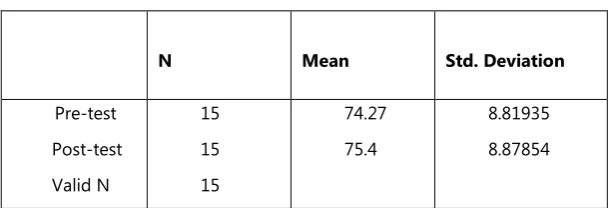
As it is demonstrated in Table 1, pre- and post-results of the control group are almost the same. Although there
is a slight increase in certain students’ post-test results, still the results of majority of the group are the same or in some cases little lower. This mean change is just one point (initial mean is 74.27 and final - 75.4). The standard
deviation has insignificantly increased, which indicates that the students’ level of language skills has become relatively more heterogeneous.
Table 1. Test Results of the Control Group (Descriptive Statistics)
N Mean Std. Deviation
Pre-test Post-test Valid N
15 15 15
74.27 75.4
8.81935 8.87854
Results of the experimental group
As is it obvious from Table 2, pre-test mean result in the experimental group was 75.4, while post-test mean result is 82.25. There is a greater difference between pre and post-test results than in the control group (by 6.85 points). The standard deviation has decreased, which means that the students’ level of language skills has become not
124 | P a g e Table 2. Test Results of Experimental Group (Descriptive Statistics)
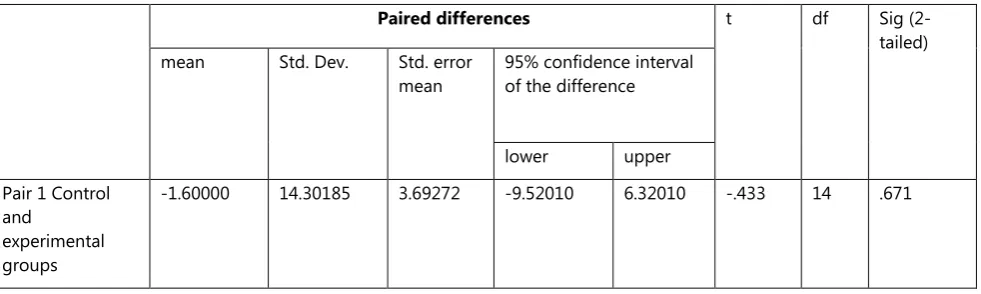
Table 3. Paired samples Test for the results of the control and experimental groups
Paired differences t df Sig
(2-tailed) mean Std. Dev. Std. error
mean
95% confidence interval of the difference
lower upper
Pair 1 Control and
experimental groups
-1.60000 14.30185 3.69272 -9.52010 6.32010 -.433 14 .671
Judging the fact that significance is 0.671, which is smaller than P<0.05, it can be concluded that there is a significant difference between the two groups’ test results. It is evident that the students of the experimental
group have shown more progress in total performance. The results indicate that the compared pre/post-result difference between the two groups is statistically significant. Thus, the results supported the hypothesis of the research - teaching English as a foreign language without a textbook with supplementary authentic material better stimulated the development of language acquisition via motivation than mastering language skills only based on English textbooks.
N Mean Std. Deviation
Pre-test
Post-test
Valid N
15
15
15
75.4
82.25
8.87854
125 | P a g e
Observations
During the four-week experiment, the students of the experimental group showed an improvement in their language competence. Based on the observations of the teacher, the students developed both aspects of their speaking skill- fluency and accuracy, because all authentic communication activities helped them to develop their speaking skills. The lessons, which were held in the experimental group, made students active participants of English lessons. The students expressed their high interest towards the lessons which were conducted with the use of Informational Technologies. They were highly motivated with the resources which the teacher presented in the classroom as the students perceived the real-life nature of the material. Most of their tasks were authentic which gave assumptions that they were learning English for using it in their real-life context. The students were given real purpose tasks which were directed towards their future needs. Based on this, the students were willing to fulfill the tasks given by the teacher. They were completing their tasks enthusiastically and always volunteered to present their work in front of the classroom, not anxious about making some grammatical mistakes. In the experimental group the students were actively involved in the learning process which was being conducted without any EFL textbook.
In the control group the students revealed less interest and enthusiasm towards the course, especially knowing that their peers were trained in an innovative way, they expressed their criticism towards the textbook, and were not eager to do textbook tasks and exercises.
Surveying and interviewing the experimental group students
In order to identify the students’ opinions about the lessons without textbooks and understand whether the implementation of no-course book lessons was beneficial for them a survey questionnaire was prepared. The survey consisted of one close-ended, one open-ended and four Likert scale questions. The students of the experimental group were surveyed in order to clarify whether no-textbook lessons which were held with supplementary authentic resources were beneficial for them. All the students agreed to take part in the survey. Besides the survey, an interview was conducted with them at the end of the four-week experiment which aimed to summarize how the students felt about the lessons without textbooks and what they liked most about such practice. The interview was audio-recorded and then it was transcribed. The interview consisted of six questions and it contained one close-ended and five open-ended questions. According to the interview, most of the students regard no-textbook English classes as an extremely interesting and motivating process for them. In their answers, they admitted that they had a positive attitude toward these classes since they found them really useful and, simultaneously, entertaining. All the learners expressed their complaint that they had never before learned English without textbooks since they had been mostly “chained” to the English course books during their
126 | P a g e with audio-visual materials. Eighty percent of the students claimed that in terms of learning without a textbook they improved their speaking skills and after the experiment most of them felt freer when communicating in English after this treatment. Below are presented some extracts from the interview.
1. What do you think about lessons without a textbook?
“I like them and I have had a lot of fun during English classes. My English lessons are not boring any more as the teacher offers various activities.” (Participant 1)
“I like lessons without textbooks, because I can learn from my classmates. In most cases I work with my
friends and during our tasks we can share answers and can help each other.” (Participant 2)
2. Which skills develop better when you have English without a textbook?
“There is a great improvement in my speaking skill. I always found speaking English a hard work, but the teacher offered us a lot of speaking tasks, which made us significantly more confident in oral
communication.” (Participant 1)
“I developed my speaking skills, because we had a lot of communicative activities. We had plenty of role-plays which made our class fun and entertaining. We watched videos and played out the same
sketches. It was so motivating for me to talk in English.” (Participant 2).
“After the lessons without textbooks I am more trained in speaking and listening. We watched various videos by native speakers. We listened to perfect accents which at first was hard to catch up with. Now I
find listening easier because of the material that the teacher offered us.” (Participant 3).
3. Do you think no-textbook lessons are good for students?
“I think no-textbook lessons are obligatory from time to time. We are so bored with having the textbooks all the time. We have the lessons based on the textbooks in every subject and this idea was really innovative and good for us.” (Participant 1)
“Such lessons are very motivating for me because I learn with fun. The activities are so interesting for me
that I never feel bored. The texts are so interesting because the teacher gives us some real stories from newspapers, from TV programs. And she knows our interests and needs. That is what I like most in the
portfolio.” (Participant 1)
4. Define the degree of difficulty for you of participating in no-textbook communicative activities?
“I find it fairly easy to participate in communicative activities. They are so much fun and I talk only
English and I really feel progress.” (Participant 1)
“I find quite easy to be involved in communicative activities. Before that, I used to feel nervous, because
127 | P a g e
5. What is your idea about using computers during English classes?
“This is the best part of our lessons. We watch everything what the teacher presents to us, even new vocabulary. I remember the material easier when they are presented by Power Point.” (Participant 1) “I have never liked grammar, but now I like doing grammar exercises, because we do everything on the
Internet. Grammar competitions are so entertaining and fun and I really practice better than I did
before.” (Participant 2)
6. How often did you learn English without a textbook before?
“I have never had classes like this. We had a course book and the teacher rarely used to bring some extra resources. The lessons were so boring before.” (Participant 1)
Survey results
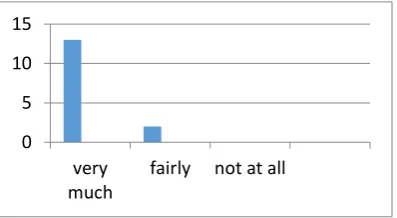
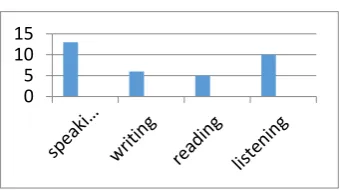
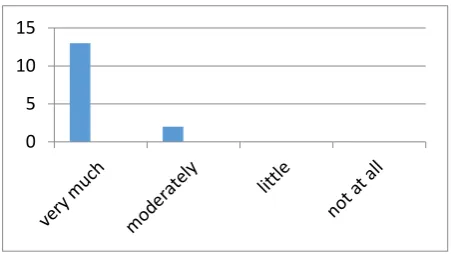
The students of the experimental group were clear about their answers. They came to the conclusion that teaching English without a textbook was beneficial for them. The majority of the participants -13 students (86.66%) claimed that they found English lessons without textbooks practical and entertaining. Again 86.66 percent of the participants expressed their idea that they had better practiced speaking during the experimental lectures. Every student from the experimental group stated that no-textbook classrooms were beneficial for them. Moreover, most of the students surveyed -14 (93.33 %) stated that they found fairly easy to participate in communicative activities. The students were unanimous that such lessons made their English course complete during the term and lastly, 13 of them (86.66%) claimed that no-textbook lessons made them more independent and autonomous EFL learners.
Figure 3. How much practical and entertaining are English lessons without a textbook?
0 5 10 15
very much
128 | P a g e Figure 4. Which skills are mastered better when you have English lessons without a textbook? (You can
underline more than one answer)
Figure 5. Do you think no-textbook classrooms are good for the students?
Figure 6. How much easy was it for you to participate in communicative activities during no-textbook lessons?
Figure 7. How much compete did no-textbook lessons make the English course during the term?
0 5 10 15
0 5 10 15 20
yes no
0 5 10 15
very much fairly not at all
0 5 10 15 20
129 | P a g e Figure 8. How much independent and autonomous did no-textbook lessons make you as learners?
Limitations of the study
One of the limitations of the research is its small sample size with 2 groups (30 participants), which might not be representative of all the EFL students in Georgia. Future research is needed which will involve a larger group of students and will aim at proving compatibility of the study. The performance tests and the survey were applied in a private university, which is placed in the capital of Georgia, Tbilisi (International Black Sea University). For the further research, it is desirable to engage other universities from various parts of Georgia, as well as from other countries.
Conclusions
Implementing English classes without textbooks is vital in learning and teaching it as a foreign language. For
overcoming some students’ low motivation, for making English language teaching more effective, for diversifying lessons with supplementary authentic materials, teachers should time to time put their course books aside and venture to teach without it at least during some lessons. In Georgia EFL students mostly have classes which are solely based on textbooks. Because of the repetitive and monotonous nature of textbooks, many students are not motivated to learn English. The findings of the research displayed that teaching English with authentic resources and with intensive use of audio and visual materials have a significant positive impact on the development of
students’ language abilities. The research emphasized ICT-based lessons where the Internet is the main source of any kind of material. Computers and the Internet make the students more motivated and interested in the learning process as they find it entertaining. The main focus during the lessons without a textbook is communicative language learning and, correspondingly, more often applied.
The study revealed that teaching EFL partly without textbooks has improved students’ language proficiency
even over a brief period of time, i.e., such practice yields its benefits fast which has its practical implications for modern busy people who wish to significantly improve their English during a short period of time. A great
130 | P a g e advantage of the fact that the students saw their quick progress is that it enhances their self-confidence and motivation to learn English further, makes them autonomous learners.
The research presented in the article focused on the short-term effects of teaching English without
textbooks. The article clarified the students’ academic achievement in the experimental group after teaching with
supplementary resources. The results confirmed the research hypothesis.
Recommendations
After collecting the data and summarizing results, the lessons without textbooks can be recommended to EFL educators. The teachers should be ready for generating supplementary material for such lessons. For organizing lessons with authentic resources the teachers have to be experienced and qualified, as they are responsible for choosing effective and relevant resources for students which will be in accordance with their needs and language competence. Although it is a time-consuming job for teachers, the lessons without textbooks are effective and motivating for students. Based on the study above, teaching without textbooks can be recommended to increase the efficiency of foreign language teaching/learning at the universities of Georgia and worldwide.
References
Abkari, O. & Ravazi, A. (2016). Using authentic materials in the foreign language classrooms: Teachers’
perspectives in EFL classes. International Journal of Research Studies in Education, 5(2), p. 105-116.
Belaid, A. & Murray, L. (2015). Using authentic materials in the foreign language classrooms: Teacher attitudes and perceptions in Libyan Universities. International Journal of Learning and Development, 5(3), p. 25-37 Berardo, S. A. (2006). The use of authentic materials in the teaching of reading. The Reading Matrix, 6 (2), p. 60-69. Chou, P. T. (2010). Advantages and Disadvantages of ESL Course Books. The Internet TESL Journal, Xvi:11. Cloud, N., Genesee, F., & Hamayan E. (2000). Dual Language Instruction: A Handbook for Enriched
Education. Boston, MA: Heinle & Heinle.
Harizaj, M. (2014). Authentic textbooks in enhancing communication in EFL classes. Anglisticum Journal (IJLLIS), 3(1), p. 10-16.
Harmer, J. (2007). How to Teach English. London: Longman.
Kayapinar, U. (2009). Course book evaluations by English teachers. Inonu University Journal of the Faculty of Education, 10 (1), p. 69 – 78.
131 | P a g e Richards, J.C.(2005).The role of textbooks in a language program. Regional Language Centre (RELC) Journal, 36(1), p.
85-92.
Swain, M. (1985). Communicative competence: Some roles of comprehensible input and comprehensible output in its development. In S. Gass, & C. Madden (Eds.), Input in Second Language Acquisition (p. 235-253). Rowley, MA: Newbury House.
Tok, H. (2010). TEFL textbook evaluation: from teachers’ perspectives. EducationalResearchandReview. 5, 9, p. 508-517.
Tomlinson, B. (2014). Developing Materials for Language Teaching. London: Bloomsburg.