RESEARCH
Effects of seed age, inoculum
density, and culture conditions on growth
and hydrocarbon accumulation of
Botryococcus
braunii
SAG807-1 with attached culture
Pengfei Cheng
1,2†, Yan Wang
3†, David Osei‑Wusu
4, Tianzhong Liu
5*and Defu Liu
6Abstract
Background: Botryococcus braunii is difficult to cultivate and has a limited amount of substantive scale‑up and productivity assessments with conventionally suspended cultivation systems, such as open pond or closed photobio‑ reactors. The biomass concentrations of cultivated microalgal biofilms are much higher than those of suspension cul‑ tures, and the attached microalgal cells are easily separated from cultivation media. However, studies on the attached cultivation conditions for B. braunii have been rarely performed.
Results: Herein, an attached cultivation method for B. braunii SAG 807‑1 incubation was introduced. The effects of primary culture conditions on growth and hydrocarbon accumulation were investigated. Seed age influenced the biomass and hydrocarbon accumulation in B. braunii, and the highest values were 5.97 and 2.99 g m−2 day−1, respec‑ tively, when seed age was 14 days. The appropriate range of initial inoculation density was 7.9–10.1 g m−2. Light intensity was a dominating factor influencing B. braunii’s growth in the attached culture, and the light saturation point was 100–150 μmol m−2 s−1. Periodic illumination in 8:16 light: dark cycle had the highest utilisation of photons at approximately 1.0 g of biomass per mole of photons. The increasing CO2 concentration in aerated gas improved the growth rate, but its concentration should be 1%.
Conclusions: Attached algal cultivation systems have been widely explored. However, the optimised values for aqueous suspension methods may be unnecessary for the attached system. Optimised seed age, inoculum density, CO2 concentration, light intensity and photoperiod can improve the growth and hydrocarbon accumulation of B. braunii SAG807‑1 with the attached culture.
Keywords: Botryococcus braunii, Attached culture, Culture conditions, Biomass, Hydrocarbon
© The Author(s) 2018. This article is distributed under the terms of the Creative Commons Attribution 4.0 International License (http://creativecommons.org/licenses/by/4.0/), which permits unrestricted use, distribution, and reproduction in any medium, provided you give appropriate credit to the original author(s) and the source, provide a link to the Creative Commons license, and indicate if changes were made.
Open Access
*Correspondence: [email protected]
†Pengfei Cheng and Yan Wang contributed equally to this work 5 Qingdao Institute of Bioenergy and Bioprocess Technology, Chinese
Academy of Sciences, Qingdao 266101, China
Full list of author information is available at the end of the article Background
Microalgae are important resources for the conversion of CO2 and sunlight into usable energies because they show the potential for higher lipid production than other biomass sources (Service 2011; Fan et al. 2014; Su et al. 2016). Bioregenerative methods involving photosynthe-sis by microalgal cells have been applied to reduce the
amount of atmospheric CO2 to ensure a safe and relia-ble living environment. Among microalgal species, Bot-ryococcus braunii has a high lipid content, which mostly consists of hydrocarbons (Banerjee et al. 2012). Hydro-carbons are easily transformed into fuels; thus, the effec-tive utilisation of B. braunii will lead to the development of a method for biofuel production, thereby reducing CO2 emissions and building a sustainable society (Tasić et al. 2016; Yoo et al. 2010).
microalgal growth, lipid production and biochemical composition. However, a cost-effective algal cultiva-tion technology for large-scale applicacultiva-tions has yet to be established to considerably reduce dependency on foreign oil (Chisti 2007). The major challenges in large-scale B. braunii’s cultivation, especially traditional open ponds and closed photobioreactors, are the slow growth rate and negative effects of this species (Ruangsom-boon 2012; Baba et al. 2012). These photobioreactors are used by cultivating algae in liquid nutrient media, and algae need excessive amounts of water to produce lipid; energy-intensive dewatering and biomass concentration processes are also required for the downstream process-ing of algae in biorefinery (Berner et al. 2015).
Attached algal cultivation systems have been widely explored. We previously introduced a novel biofilm cul-tivation system called attached culcul-tivation. The biofilm-attached cultivation of algae involves algal cells that are generally immobilised in high density and fed with nutri-ent solutions and differs from convnutri-entional aqueous suspended cultures. In this system, a high-density micro-algal paste was attached to a supporting structure, which consisted of a glass plate, a filter paper and a cellulose acetate/cellulose nitrate membrane, to form an artificial ‘leaf’; several pieces of these leaves are vertically inserted into a glass chamber (Liu et al. 2013; Cheng et al. 2013, 2014).
Studies have been conducted to identify the potential of biofilm growth and the overall lipid productivity of B. braunii; however, current knowledge on B. braunii bio-film growth and lipid productivity is limited (Wijihastuti et al. 2017; Ozkana et al. 2012). The growth rates of B. braunii in a culture system are also affected by a com-bination of environmental parameters, such as CO2, light intensity and photoperiod (Yoshimura et al. 2013). Light intensity and photoperiod play an important role in algal growth and distribution, but requirements vary significantly in different species, culture conditions and algal culture density. Light cycle, including fluctuations in intensity and photoperiod, is among the main factors influencing the growth and biochemical composition of microalgae (Wahidin et al. 2013).
The optimised values for aqueous suspension meth-ods may be unnecessary for the attached system because inherent differences exist between these systems in the following aspects: (1) In illumination, for the suspended methods, algal cells continuously switch between light and dark cycles. However, the attached algal cells were immobilised to ensure that light condition was relatively stable when the natural fluctuation of light sources was not considered. (2) In CO2 transfer, in suspended culti-vation, the carbon source supplied by CO2 should be dissolved firstly in the aqueous medium to form diluted
HCO3−, CO32− and CO2 solutions, and these gases were then absorbed by algal cells (Van Den Hende et al. 2012). However, a ‘water wall’ segregating the carbon source and algal cells is eliminated in the attached system, and the concentrated CO2 gas easily reaches algal cells (Wang et al. 2015; Cheng et al. 2017). These differences in the supply patterns of light and CO2 between suspended and attached methods likely alter the key metabolism path-ways in algal cells (e.g. photosynthesis and lipid synthe-sis) and mass cultivation biotechnology.
Given the specificity for attached photobioreactors, algal cells must adhere onto a filter paper or other mate-rials. Therefore, inoculum density of microalgal cells was crucial in biomass production to achieve high pho-tosynthetic efficiency. Microalgal cells undergo changes in morphological characteristics, cell wall structure and composition in different growth phases. Thus, the seed age of algal cells may affect the growth or lipid produc-tion of microalgae in this attached culture.
This study investigated the effects of seed age, inocu-lum density, CO2, light intensity and photoperiod on
growth and hydrocarbon accumulation in B. braunii
SAG807-1 grown in the attached culture. The results revealed the optimal conditions for B. braunii SAG807-1 cultivation in the attached culture.
Methods
Algal strain and broth seed culture for inoculum preparation
Botryococcus braunii SAG 807-1 (SAG Culture Collec-tion, University of Gottingen, Germany) was grown in a modified Chu 13 medium (Largeau et al. 1980). For the preparation of the inocula, which were used in the attached bioreactors, algae were firstly cultivated in glass bubbling columns (diameter = 0.05 m) for approxi-mately 2 weeks (in the middle of exponential phase) and then harvested through centrifugation at 5000×g. The column containing 0.7 L of algal broth was con-tinuously illuminated with cold white fluorescent lamps (NFL28-T5, NVC, China) under a light intensity of 100 ± 10 μmol m−2 s−1. The algal broth temperature dur-ing cultivation was 25 °C ± 2 °C. Air bubble containing 1% CO2 (v/v) was continuously injected into the bottom of the columns at a speed of 1 vvm to agitate the algal broth and to supply carbon.
Attached cultivation system
against the horizontal plane. The medium was propelled (~ 10 mL min−1) using a peristaltic pump (TP12DC 12V, Guangzhou JU PlasFitting Technology Co., Ltd., China) to facilitate the circulation of the medium inside the sys-tem. The light intensity inside the chamber at the posi-tion of the attached algal cells was 100 ± 10 μmol m−2 s−1. Continuous airflow containing 1% CO
2 (v/v) was injected into the glass chamber at a speed of 0.1 vvm to supply carbon, and the temperature inside the glass chamber was 25 °C ± 2 °C during the experiments. For accurate measurement, each culture period was main-tained for 8 days in all of the attached cultivations (Cheng et al. 2013).
Experimental design
Effects of seed age on algal cell growth and hydrocarbon accumulation
Different growth phases are defined in the growth curve. Algal cells at different growth phases were cultivated in glass bubbling columns for 7, 14, 21 and 28 days, har-vested and placed in the attached photobioreactors. The initial inoculum density was approximately 8–10 g m−2, and the glass chamber was bubbled with 1% CO2 (air/ CO2) for the growth of the attached algal cells. The temperature and light intensity were 25 °C ± 2 °C and 100 μmol photons m−2 s−1, respectively.
Effect of inoculum density on algal growth and hydrocarbon accumulation
A stock culture of B. braunii SAG807-1 was cultured in a 1 L Erlenmeyer flask containing 0.7 L of medium. After 14 days, the microalgal cells in the exponential growth phase were obtained and washed thrice with sterilised water. The algal cells were subsequently inoculated in different volumes to prepare seven levels of cell density (1.9, 4.1, 5.7, 7.9, 10.1, 15.2 and 24.9 g m−2) and bubbled with 1% CO2 (air/CO2). The temperature and light inten-sity were 25 °C ± 2 °C and 100 μmol photons m−2 s−1, respectively.
Effects of CO2 concentrations on algal growth and hydrocarbon accumulation
The growth of B. braunii SAG807-1 under different
CO2 concentrations was measured. The initial inoculum density was approximately 8–10 g m−2. The growth and hydrocarbon accumulation under bubbling with ambi-ent air (0.038% CO2) and air containing 0.5, 1, 5 and 10% CO2 were investigated. Air-CO2 mixtures, purchased from a commercial gas supply company, were bubbled directly into the attached photobioreactors at a speed of 0.1 vvm to supply carbon throughout the culture period. The temperature and light intensity were 25 °C ± 2 °C and 100 μmol photons m−2 s−1, respectively.
Effects of light intensity and photoperiod on algal growth and hydrocarbon accumulation
A wide range of light intensities (10, 20, 40, 60, 80, 100, 150, 200 and 250 μmol m−2 s−1) produced by cold white fluorescent lamps was set to study the effects of different light intensities. Six different photoperiods, namely, 24:0, 20:4, 16:8, 12:12, 8:16 and 4:20 h light:dark (L:D) cycles, with 100 μmol m−2 s−1 light intensity were used to deter-mine the effect of photoperiod on growth and hydrocar-bon accumulation in B. braunii SAG807-1. The initial inoculum density was approximately 8–10 g m−2. The temperature and CO2 concentrations were 25 °C ± 2 °C and 1%, respectively.
Growth analysis
The biomass concentration of an algal disc (DW, g m−2), which was a wet paste of algal cells attached onto a sup-porting material to form a thin layer of algal population, was determined using gravimetric method (Liu et al. 2013). The cells of the algal disc were rinsed, resuspended in deionised water and filtered through a preweighted
0.45-µm GF/C filter membrane (DW0; Whatman,
Eng-land). The membrane was oven dried at 105 °C for 12 h and then cooled to room temperature for dry weight (DW1) measurement. DW was calculated as follows:
where 0.001 represents the footprint area of algal disc (m2).
Hydrocarbon analysis
Hydrocarbon analysis was conducted in accordance with previously described methods (Cheng et al. 2013; Sawayama et al. 1992). In brief, attached algal cells were harvested by washing with deionised water and centri-fuging at 3800×g for 10 min. The algal pellets were rinsed
thrice with deionised water to remove the attached salt. After the algal pellets were freeze dried, 50 mg of dried algal biomass was homogenised and then extracted with
n-hexane thrice. The supernatants were combined in a preweighted glass vial, and the solvent was blown away with nitrogen gas (> 99%). The residue remaining in the glass vial was considered ‘crude hydrocarbon’ (Largeau et al. 1980; Singh and Kumar 1992; Dayananda et al. 2005).
Statistical analysis
Experiments were performed in triplicates. Data were presented as mean of three independent replicates and further analysed through one-way analysis of variance (ANOVA) using Microsoft Office Excel 2010 (Microsoft, USA). P < 0.05 indicated significant difference.
Results and discussion
Effects of seed age on biomass productivity and hydrocarbon accumulation
In this study, B. braunii SAG 807-1 seed liquid was cultured for 7, 14, 21 and 28 days in a traditional liq-uid column reactor. Subsequently, the attached cul-ture was prepared in Chu 13 culcul-ture medium at 25 °C ± 2 °C under a continuous illumination intensity
of 100 ± 10 μmol m−2 s−1 and 1% CO2. After 8 days, the biomass productivity, hydrocarbon content and hydro-carbon yield of the culture were determined (Fig. 1). Fig-ure 1a shows that the seed liquid in the attached culture for 14 days displayed the highest biomass productivity of approximately 5.97 g m−2 day−1, followed by the cul-ture with a seed age of 7 days (5.62 g m−2 days−1). The seed liquid in the attached culture for 21 and 28 days supported the lowest biomass productivity at 3.24 and 2.35 g m−2 days−1, respectively. Figure 1b illustrates that the highest hydrocarbon content of approximately 58.9% was observed in the attached culture system with a seed
age of 28 days. The highest hydrocarbon productivity (approximately 2.99 g m−2 days−1) was observed in an attached culture with a seed age of 14 days. The lowest hydrocarbon yield of approximately 1.38 g m−2 days−1 was obtained in the seed age of 28 days. The hydro-carbon yields of seed ages 7 and 21 days were 2.71 and 1.83 g m−2 days−1, respectively.
The prolonged culture time of B. braunii SAG 807-1 seed liquid increased the hydrocarbon content with the attached culture. However, the higher the seed age was, the lower the biomass productivity would be. Thus, the corresponding hydrocarbon yield decreased. These results (Fig. 1) indicated that 14 days was the optimal seed age of B. braunii SAG 807-1 for seed liquid cultiva-tion through the attached culture. Hydrocarbons were the secondary metabolites in the microalgal culture, and seed age significantly influenced the growth of algae and the synthesis of their metabolites. Seed age consider-ably influenced the efficiency and economic viability of attached culture method for algal cultivation. In general, the logarithmic phase of seed age in liquid cultivation is exuberant. In the logarithmic phase, cells grow rapidly, and their number increases exponentially. Given the specificity of the attached photobioreactor, a well-cul-tured seed solution should be initially inoculated onto an adherence membrane, and a culture may be subsequently prepared.
Effects of inoculum density on growth and hydrocarbon accumulation
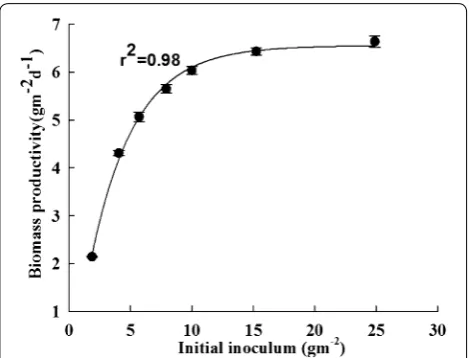
In this study, B. braunii SAG 807-1 was cultured in a liquid column reactor for 14 days, and the algal cells were then cultured in the attached reactors at differ-ent initial inoculum densities, namely, 1.9, 4.1, 5.7, 7.9, 10.1, 15.2 and 24.9 g m−2 for 8 days. In Fig. 2, the bio-mass productivity of B. braunii SAG 807-1 gradually increased as the initial inoculum density increased. Con-versely, the biomass productivity gradually decreased when the initial inoculum density increased to a certain degree. The lowest biomass productivity (approximately 2.14 g m−2 days−1) was obtained at an initial inoculum density of 1.9 g m−2. The biomass productivity of B.
brau-nii SAG 807-1 slightly changed at an initial inoculum density of 7.9–24.9 g m−2.
The effects of different initial inoculum densities on the hydrocarbon content of B. braunii SAG807-1 did not vary significantly (Table 1). At a high initial inocu-lum density, the hydrocarbon content slightly decreased. When the initial inoculum density was 1.9 g m−2, the hydrocarbon content was 51.6% higher than those under the initial inoculum densities of 15.2 and 24.9 g m−2 (47.6 and 44.2%, respectively) possibly because microalgae
exposed to illumination, CO2 and other factors were not uniform at a high inoculum density.
Our experimental results showed that the optimal initial inoculum density for the attached culture of B. braunii SAG807-1 was approximately 7.9–10.1 g m−2 (Fig. 2 and Table 1). Too high or too low inoculum den-sity possibly causes photoinhibition or optical limitation (Wang et al. 2013). Khatri et al. (2013) reported that algal cell concentration decreases as initial inoculum densi-ties increase because of light-limited growth conditions. Moreover, seed cost should be considered in a culture with a high inoculum density. In traditional microbial/ fungal fermentation, high inoculum density can shorten the time of cell proliferation and increase the production of metabolites. However, excessive inoculum may pro-mote the rapid growth of cells, increase the viscosity of culture media and lead to a lack of matrix or dissolved oxygen, consequently affecting metabolite synthesis. A considerably small amount of inoculum will prolong the fermentation cycle, increase the chance of bacterial con-tamination and cause mycelial agglomeration and other fermentation abnormalities. Algal cultures similarly face these problems. Attached culture requires the inocula-tion of microalgal seed liquid onto membrane materials
for a certain period. Therefore, the control of initial inoc-ulum density was a key to ensuring normal algal culture and metabolite generation.
Effects of CO2 concentrations on growth and hydrocarbon accumulation
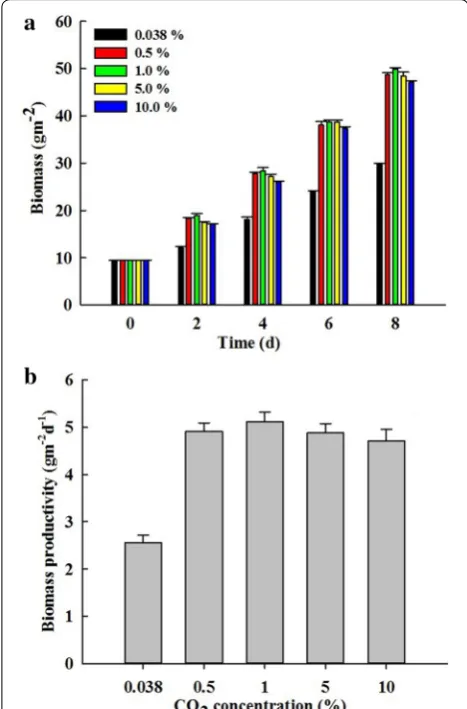
This study investigated the effect of 0.038% air and 0.5, 1, 5 and 10% CO2 on growth and hydrocarbon accumula-tion in B. braunii SAG 807-1 with the attached culture. In Fig. 3, B. braunii SAG 807-1 could grow under different CO2 concentrations with the attached culture. However, different CO2 concentrations elicited various effects on
B. braunii’s growth. In the attached culture, the increas-ing CO2 concentration resulted in a rapid growth and a corresponding increase in biomass productivity. When air was introduced to the attached culture (0.038%), the biomass productivity of B. braunii SAG 807-1 was approximately 2.56 g m−2 day−1. As the CO
2 concentra-tion increased, biomass productivity also increased. The highest biomass productivity was observed at approxi-mately 5.11 g m−2 day−1 at 1% CO
2. At 5 and 10% CO2, the corresponding biomass productivities were 4.88 and 4.71 g m−2 day−1, respectively. The biomass productivity likely stabilised and did not further increase.
In terms of the effects of different CO2 concentrations on hydrocarbon accumulation in B. braunii SAG 807-1 grown in the attached culture, high CO2 concentration could promote hydrocarbon synthesis (Fig. 4). In Fig. 4, when air (0.038%) was introduced to the culture medium, the hydrocarbon content of B. braunii was approximately 36.7%, which was relatively low. When the CO2 con-centration in the culture medium increased to 0.5 and 1%, the hydrocarbon content also increased to 45.4 and 46.8%. The highest hydrocarbon content of B. braunii
grown in the attached culture was approximately 60.4% at 5% CO2. Conversely, the corresponding hydrocarbon content slightly decreased to approximately 55.3% when the CO2 concentration continuously increased (up to 10%). The influence of different CO2 concentrations on the hydrocarbon yield of B. braunii SAG807-1 was simi-lar. Furthermore, 5, 10 and 1% CO2 highly affected its hydrocarbon yield.
Our comprehensive analysis showed that the opti-mal CO2 concentration for the attached culture of B.
Fig. 2 Effect of inoculum density on growth of B. braunii SAG807‑1 under attached cultivation. Data are means ± standard deviations of three replicates
Table 1 Effect of inoculum density on growth and hydrocarbon accumulation of B. braunii SAG 807-1 under attached cul-tivation
The data were means ± standard deviations of three replicates
Initial inoculum densities (g−2) 1.9 4.1 5.7 7.9 10.1 15.2 24.9
Biomass productivity (g−2 day−1) 2.14 ± 0.14 4.32 ± 0.11 5.07 ± 01.9 5.65 ± 0.23 6.03 ± 0.26 6.43 ± 0.32 6.64 ± 0.31
braunii SAG 807-1 was 1%. High CO2 concentration could increase the biomass productivity of B. braunii and promote hydrocarbon synthesis. CO2, the main carbon source of autotrophic microalgae, plays an important role in microalgal growth and lipid synthesis. However, high CO2 concentration considerably increases the cost of algal production and restricts the development of this industry for the commercial production of algal fuel. Current studies on the application of CO2 in microalgae mainly focus on their CO2 tolerance, algal growth rate and biomass. An et al. (2003) used high CO2 to provide carbon for the growth of B. braunii. Yoshimura et al. (2013) studied the effect of 0.2–5% CO2 on B. braunii growth and metabolism. However, these studies have focused on culturing B. braunii via traditional liquid sus-pension cultures. In our study, the attached culture was a photoreaction system separating the culture medium from algal cells, and the transfer mode of CO2 and nutri-tive salt in the attached culture was different from those in traditional liquid culture (Ji et al. 2014). Therefore, attached culture was significantly essential for research on CO2 and other factors influencing algal growth.
Effects of light intensity and photoperiod on growth and hydrocarbon accumulation
This study also investigated the effects of differ-ent light intensities (10, 20, 40, 60, 80, 100, 150, 200 and 250 μmol m−2 s−1) on the growth and hydrocar-bon accumulation in B. braunii SAG 807-1. Figure 5 shows that the growth of B. braunii SAG 807-1 in the attached culture gradually increased as light inten-sity increased (< 100 μmol m−2 s−1). When light inten-sity was 10 μmol m−2 s−1, the biomass productivity was only 1.16 g m−2 day−1. Conversely, when light intensity
Fig. 3 Effect of CO2 concentration on growth of B. braunii SAG807‑1 under attached cultivation. The biomass densities after different days cultivations (a) and the average biomass productivity of 8 days cultivations (b) at the CO2 concentrations of 0.038, 0.5, 1.0, 5.0 and 10.0%. Data are means ± standard deviations of three replicates
Fig. 4 Effect of CO2 concentration on hydrocarbon accumula‑
tion of B. braunii SAG807‑1 under attached cultivation. Data are means ± standard deviations of three replicates
increased to 80 μmol m−2 s−1, biomass productivity also increased to 6.14 g m−2 day−1. As light intensity increased from 100 to 150 μmol m−2 s−1, the biomass productiv-ity of B. braunii SAG807-1 slightly increased (from 6.61 to 7.74 g m−2 day−1). When light intensity continuously increased (> 150 μmol m−2 s−1), algal growth was inhib-ited, and biomass productivity slightly decreased from 7.55 to 7.35 g m−2 day−1.
Low light intensity prevented hydrocarbon accumu-lation in B. braunii SAG 807-1 (Table 2). For example, hydrocarbon content at 10 μmol m−2 s−1 light intensity was 26.69%. As light intensity increased, hydrocarbon content also increased possibly because strong light induced hydrocarbon synthesis and accumulation. How-ever, biomass productivity in B. braunii SAG807-1 was low at a low light intensity (Table 2). Hydrocarbon yield was also lower than 2.0 g m−2 day−1 at a light intensity of lower than 60 μmol m−2 s−1. Based on the experimental results, our conclusion was that the optimal light inten-sity for B. braunii SAG 807-1 grown in the attached cul-ture was approximately 100–150 μmol m−2 s−1.
Light substantially affects the growth, reproduction, cell morphology and metabolism of microalgae. Appro-priate light with a suitable intensity could accelerate the growth and reproduction of microalgae and effec-tively improve the productivity and quality of algal cul-ture (Fig. 5). High light intensities limit algal growth but favour high lipid content and yield (Ruangsomboon 2012). Light is a complex component with several influ-encing factors, including light intensity, photoperiod and spectrum. Related studies are currently in the stage of data accumulation. Light intensity and photoperiod are easily regulated. The influencing pattern of light inten-sity is generally observed in various algae existing within a certain light intensity range suitable for their growth. The light intensity in this range can either enhance or reduce the growth rate (Kuster et al. 2004; Garde and Cailliau 2000; Vervuren et al. 1999). The influencing pat-tern of photoperiod indicates that the light and dark peri-ods suitable for the growth of different algal species vary (Janssen et al. 2000, 2001).
This study also investigated the effects of different L:D cycles (24:0, 20:4, 16:8, 12:12, 8:16 and 4:20) on the growth of B. braunii SAG 807-1 subjected to an optimal light intensity of 100 μmol m−2 s−1 in the attached cul-ture. In the attached culture system (Fig. 6), B. braunii
Table 2 Effect of light intensity on growth and hydrocarbon accumulation of B. braunii SAG 807-1 under attached cultiva-tion
The data were means ± standard deviations of three replicates Light intensity
(μmolm−2 s−1) 10 20 40 60 80 100 150 200 250
Biomass productivity
(g−2 day−1) 1.16 ± 0.08 1.94 ± 0.07 4.42 ± 0.14 5.44 ± 0.18 6.14 ± 0.24 6.61 ± 0.22 7.74 ± 0.29 7.55 ± 0.36 7.35 ± 0.58
Hydrocarbon content (%) 24.69 ± 0.54 26.34 ± 0.52 31.68 ± 1.01 36.44 ± 0.49 41.68 ± 0.92 43.74 ± 0.66 49.26 ± 1.21 51.04 ± 0.67 54.1 ± 0.85 Hydrocarbon productiv‑
ity (g−2 day−1) 0.29 ± 0.16 0.51 ± 0.04 1.40 ± 0.24 1.98 ± 0.11 2.56 ± 0.46 2.89 ± 0.37 3.81 ± 0.51 3.85 ± 0.39 3.98 ± 0.41
SAG 807-1 grew rapidly under a prolonged photoperiod, and its biomass productivity increased. Continuous illu-mination for 24 h yielded the highest biomass produc-tivity of approximately 6.0 g m−2 day−1, followed by 20:4 L:D cycle with a biomass productivity of 4.9 g m−2 day−1. In a shortened photoperiod, the corresponding biomass productivity also gradually decreased. The lowest bio-mass productivity was approximately 0.9 g m−2 day−1 in 4:20 L:D cycle.
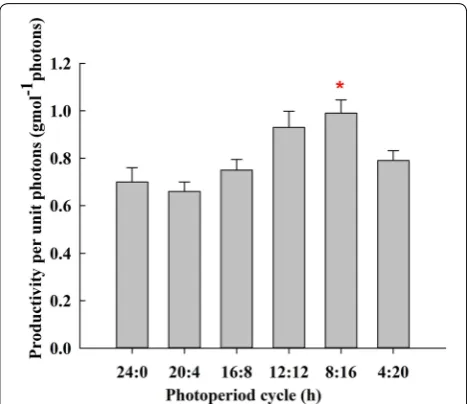
In unit photon utilisation, photoperiod was not pro-portional to photon utilisation. Figure 7 shows that the corresponding unit photon utilisation was 0.7 g mol−1 photons, which was lower than that in 4:20 L:D cycle (0.8 g mol−1 photons) under continuous illumination for 24 h. The highest unit photon utilisation of B. braunii
SAG 807-1 grown in the attached culture was approxi-mately 1.0 g mol−1 photons in 8:16 L:D cycle. The bio-mass energy of B. braunii was larger than the mean of other algae. The energy contained in 1 kg of B. braunii
biomass is approximately 28.3MJ (Ozkana et al. 2012). Thus, in 8:16 L:D cycle, the optical energy utilisation of visible light corresponding to unit photon utilisation was approximately 13.0%, which was higher than those under other L:D ratios.
Algal photosynthesis involves light and dark reactions. Continuous illumination rapidly increases the number of algal cells and improves their biomass productivity. This phenomenon was also the reason for the high biomass productivity of B. braunii SAG807-1 under continuous illumination (Fig. 6). By contrast, photosynthesis inten-sity under continuous illumination was low, resulting in
low unit photon utilisation and low photosynthesis. This phenomenon was also accounted for the lower number of cells generated from unit photon under 24 h of continu-ous illumination than that in 4:20 L:D cycle (Fig. 7). In an algal culture, a proper L:D cycle improved the photo-synthesis and growth rates of cells. Moreover, dark cycles contributed to the self-repair of damaged cells. However, with a prolonged L:D cycle, the photochemical quan-tum yield of algal cells, the conversion efficiency of opti-cal energy into chemiopti-cal energy, the growth rate of algal cells and the optical energy yield decrease (Merchuk et al. 1998).
Conclusions
In this study, seed age influenced the biomass of and hydrocarbon accumulation in B. braunii in the attached culture, and the initial inoculation density played impor-tant roles in B. braunii’s growth. The increasing CO2 concentration at an appropriate level of 1% in aerated gas improved B. braunii’s growth. The suitable light saturation point for algal growth was approximately 100–150 μmol m−2 s−1. A 24-h continuous illumination helped obtain the maximum biomass productivity; how-ever, periodical illumination in 8:16 L:D cycle induced the highest utilisation of photons at approximately 1.0 g of biomass per mole of photons.
Authors’ contributions
PC and YW conceived and designed the experiments. PC, YW and DOW per‑ formed the experiments. DL contributed to analytic tools. TL wrote the paper. All the authors read and approved the final manuscript.
Author details
1 School of Marine Sciences of Ningbo University, Ningbo 315211, China. 2 Poyang Lake eco‑economy Research Center of Jiujiang University,
Jiujiang 332005, China. 3 Electron Business College of Jiujiang University,
Jiujiang 332005, China. 4 School of Food and Biological Engineering, JiangSu
University, Zhenjiang 212013, China. 5 Qingdao Institute of Bioenergy and Bio‑
process Technology, Chinese Academy of Sciences, Qingdao 266101, China.
6 School of Architectural and Environment, Hubei University of Technology,
Wuhan 430072, China.
Acknowledgements
Not applicable.
Competing interests
The authors declare that they have no competing interests.
Availability of data and materials
The datasets supporting the conclusions of this article are included within the article.
Consent for publication
Not applicable.
Ethics approval and consent to participate
Not applicable.
Funding
This work was supported by the National Natural Science Foundation of China (31560724), the Natural Science Foundation of Jiangxi Prov‑ ince (20171BAB214014), the China Postdoctoral Science Foundation
(2016M600616, 2017T100583), and the Key Laboratory of Poyang Lake Eco‑ logical Environment and Resource Development (PK2017001).
Publisher’s Note
Springer Nature remains neutral with regard to jurisdictional claims in pub‑ lished maps and institutional affiliations.
Received: 19 October 2017 Accepted: 13 March 2018
References
An JY, Sim SJ, Lee JS, Kim BW (2003) Hydrocarbon production from secondarily treated piggery wastewater by the green alga Botryococcus braunii. Appl Phycol 15:185–191
Baba M, Kikuta F, Suzuki I, Watanabe M, Shiraiwa Y (2012) Wavelength specific‑ ity of growth, photosynthesis, and hydrocarbon production in the oil producing green alga Botryococcu braunii. Bioresour Technol 109:266–270 Banerjee A, Sharma R, Chisti Y, Banerjee UC (2012) Botryococcus braumii: a
renewable source of hydrocarbons and other chemicals. Rev Biotechnol 22:245–279
Berner F, Heimann K, Sheehan M (2015) Microalgal biofilms for biomass pro‑ duction. Appl Phycol 27:1793–1804
Cheng PF, Ji B, Gao LL, Zhang W, Wang JF, Liu TZ (2013) The growth, lipid and hydrocarbon production of Botryococcus braunii with attached cultiva‑ tion. Bioresour Technol 138:95–100
Cheng PF, Wang JF, Liu TZ (2014) Effects of nitrogen source and nitrogen sup‑ ply model on the growth and hydrocarbon accumulation of immobilized biofilm cultivation of B. braunii. Bioresour Technol 166:527–533
Cheng PF, Wang Y, Yang QY, Liu TZ (2017) Comparison of growth, hydrocarbon accumulation and metabolites of Botryococcus braunii between attached cultivation and aqueous‑suspension cultivation. Int J Agric Biol Eng 10:134–141
Chisti Y (2007) Biodiesel from microalgae. Biotechnol Adv 25:294–306 Dayananda C, Sarada R, Bhattacharya S, Ravishankar G (2005) Effect of media
and culture conditions on growth and hydrocarbon production by
Botryococcus braunii. Process Biochem 40:3125–3131
Fan J, Cui Y, Wan M, Wang W, Li Y (2014) Lipid accumulation and biosynthesis genes response of the oleaginous Chlorella pyrenoidosa under three nutrition stressors. Biotechnol Biofuels 7:1–24
Garde K, Cailliau C (2000) The impact of UV‑B radiation and different PAR intensities on growth, uptake of C‑14, excretion of DOC, cell volume, and pigmentation in the marine prymnesiophyte, Emilianiahuxleyi. Exp Mar Biol Ecol 247:99–112
Janssen M, Janssen M, De WM, Tramper J, Mur LR, Snel J et al (2000) Efficiency of light utilization of Chlamydomonas reinhardtii under medium‑duration light/dark cycles. Biotechnology 78:123–137
Janssen M, Slenders P, Tramper J, Mur LR, Wijffels R (2001) Photosynthetic efficiency of Dunaliella tertiolecta under short light/dark cycles. Enzyme Microb Technol 29:298–305
Ji CL, Wang JF, Zhang W, Liu JL, Wang H, Liu T (2014) An applicable nitrogen supply strategy for attached cultivation of Aucutodesmus obliquus. Appl Phycol 26:173–180
Khatri W, Hendrix R, Niehaus T, Chappell J, Curtis WR (2013) Hydrocarbon pro‑ duction in high density Botryococcus braunii race B continuous culture. Biotechnol Bioeng 111:493–503
Kuster A, Schaible R, Schubert H (2004) Light acclimation of photosynthesis in three charophyte species. Aquat Bot 79:111–124
Largeau C, Caradevall E, Berkaloff C, Dhamliencourt P (1980) Sites of accumula‑ tion and composition of hydrocarbons in Botryococcus braunii. Phyto‑ chemistry 19:1043–1051
Liu T, Wang J, Hu Q, Cheng P, Ji B, Liu J, Chen Y, Zhang W, Chen X, Chen L, Gao L, Ji C, Wang H (2013) Attached cultivation technology of microalgae for cost‑affordable biomass feedstock production. Bioresour Technol 127:216–222
Mata TM, Martins AA, Caetano NS (2010) Microalgae for biodiesel production and other applications: a review. Renew Sustain Energy Rev 14:217–232 Merchuk JC, Ronen M, Giris S, Arad S (1998) Light/dark cycles in the growth of
the red microalga Porphyridium sp. Biotechnol Bioeng 59:705–713 Ozkana A, Kinney K, Katz L, Berberoglu H (2012) Reduction of water and
energy requirement of algae cultivation using an algae biofilm photobio‑ reactor. Bioresour Technol 114:542–548
Ruangsomboon S (2012) Effect of light, nutrient, cultivation time and salinity on lipid production of newly isolated strain of the green microalga,
Botryococcus braunii KMITL 2. Bioresour Technol 109:261–265 Sawayama S, Minowa T, Dota Y, Yokayama S (1992) Growth of hydrocarbon
rich microalga Botryococcus braunii in secondarily treated sewage. Appl Microbiol Biotechnol 38:135–138
Service RF (2011) Algae’s second try. Science 333:1238–1239
Singh Y, Kumar HD (1992) Lipid and hydrocarbon production by Botryococ-cus spp. under nitrogen limitation and anaerobiosis. World Microbiol Biotechnol 8:121–124
Su G, Jiao K, Chang J, Li Z, Guo X, Sun Y, Zeng X, Lu Y, Lin L (2016) Enhancing total fatty acids and arachidonic acid production by the red microalgae
Porphyridium purpureum. Bioresour Bioprocess 3:1–9
Tasić MB, Pinto LFR, Klein BC, Veljković VB, Filho RM (2016) Botryococcus braunii
for biodiesel production. Renew Sustain Energ Rev 64:260–270 Van Den Hende S, Vervaeren H, Boon N (2012) Flue gas compounds and
microalgae: (Bio−) chemical interactions leading to biotechnological opportunities. Biotechnol Adv 30:1405–1424
Vervuren PJA, Beurskens SMJH, Blom CWPM (1999) Light acclimation, CO2
response and long‑term capacity of underwater photosynthesis in three terrestrial plant species. Plant Cell Environ 22:959–968
Wahidin S, Idris A, Shaleh SRM (2013) The influence of light intensity and photoperiod on the growth and lipid content of microalgae sp. Bioresour Technol 129:7–11
Wang JF, Han DX, Sommerfeld MR, Lu C, Hu Q (2013) Effect of Nannochloro‑ psis initial biomass density on growth and astaxanthin production of
Haematococcus pluvialis in an outdoor photobioreactor. Appl Phycol 25:253–260
Wang JF, Liu JL, Liu TZ (2015) The difference in effective light penetration may explain the superiority in photosynthetic efficiency of attached cultivation over the conventional open pond for microalgae. Biotechnol Biofuels 8:1–12
Wijihastuti RS, Moheimani NR, Bahri PA, Cosgrove JJ, Watanabe MM (2017) Growth and photosynthetic activity of Botryococcus braunii biofilms. Appl Phycol 29:1123–1134
Yoo C, Jun SY, Lee JY, Ahn CY, Oh HM (2010) Selection of microalgae for lipid production under high levels carbon dioxide. Bioresour Technol 101:S71–S74
Yoshimura T, Okada S, Honda M (2013) Culture of the hydrocarbon producing microalga Botryococcus braunii strain Showa: optimal CO2, salinity, tem‑