561
RECENT APPROACHES ON NO- REFERENCE IMAGE
QUALITY ASSESSMENT FOR CONTRAST DISTORTION
IMAGES WITH MULTISCALE GEOMETRIC ANALYSIS
TRANSFORMS: A SURVEY
1,ISMAIL T. AHMED, 2CHEN SOONG DER, 3BARAA TAREQ HAMMAD.
1 ,3College of Computer Sciences and Information Technology, University Tenaga Nasional, Malaysia.
1, 2,3 College of Computer Sciences and Information Technology, University of Anbar, Anbar, Iraq.
E-mail: [email protected], [email protected], [email protected]
ABSTRACT
The study of Image Quality Assessment (IQA) in digital image and video processing is challenging due to the existences of numerous types of distortions such as blur, noise, blocking, contrast change, etc. Nevertheless, it is interesting to devise a metric system in order to determine the quality of an image quantitatively. Currently, most of the existing No Reference(NR)-IQA metrics focus on the quality evaluation of distorted images due to compression, noise and blurring. The related work performed in the area of NR-IQA for Contrast Distortion Images (CDI) is quite limited unfortunately. Also, most of the existing NR-IQA metrics are designed in spatial domain and very little of them are devised based on Multiscale Geometric Analysis (MGA) Transforms. Therefore, in this paper, NR-IQA metrics are classified into two groups, i.e. NR-IQA Metrics for general purpose and NR-IQA Metrics for CDI. Due to the fact that our main focus is contrast distortion, NR IQA metrics have been overviewed in both spatial and transform domains. We classify the transform domain into traditional transform and MGA transform then focusing on MGA Transforms. Subsequently, the MGA transform which is suitable for the design of NR-IQA metric used to predict the quality of CDI is proposed. The presented survey will to keep up-to-date the researchers in the field of image quality assessment especially for CDI. Also, this survey provides an outlook for future work using many combinations among MGA Transforms to access to new IQA metric for CDI.
Keywords: Image Quality Assessment (IQA), Contrast Distortion Images (CDI), No-Reference Image Quality Assessment Algorithm (NR-IQA), Multiscale Geometric Analysis (MGA) Transforms.
1. INTRODUCTION
Distortions occurred during the acquisition, processing, compression, storage, transmission, reproduction and sharing time of information between the devices may affect the visual quality of images. Thus, it is always desirable to measure the image quality [1].
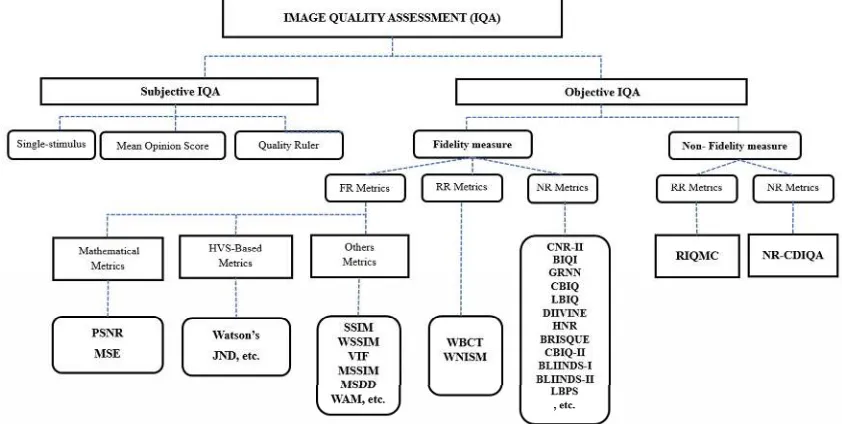
Generally, there are two measurement approaches for IQA or Video Quality Assessment (VQA), i.e. subjective and objective methods. Subjective quality assessment is time-consuming, expensive, and impractical in real-world applications especially for real-time applications. Therefore, Objective IQA algorithms are preferable in order to analyze the images and to predict the quality without human role. Depending on the availability of an “ideal quality” original image, objective IQAs are classified into Full Reference (FR), Reduce
Reference (RR), and No Reference (NR) (see [1, 2]). Figure 1 shows the general taxonomy of IQA/VQA.
In many applications, FR-IQA and RR-IQA are restricted by the requirement of a reference image. Therefore, No-Reference Image Quality Assessment (NRIQA) metrics are preferable whenever a reference image is unavailable [3]. Image distortions such as noise, blur, contrast change etc. present in most of the images. These distortions can degrade the entire quality of the image. For example in image compression, if the captured image contains distortions then it would not match with the original image that is stored in the database. So finding the quality of the image in those areas is very necessary [4, 5].
562 quality assessment of images distorted by compression, noise and blurring. Fig. 2 illustrates the reference image with five types of distortions. In general, a distorted image has the lower perceptual quality than its corresponding
ideal version. Contrast change, however, is distinct from the above distortion types for the reason that an image processed by a proper histogram mapping can obviously improve image contrast and visual quality. Fig. 3 illustrates the reference image with contrast
[image:2.612.101.522.191.403.2]distorted type.
[image:2.612.96.507.579.669.2]Figure 1: IQA Measurement Classifications
Figure 2: Reference Image with Five Distorted Types. (a) Reference Image (b) Gaussian Blur (c) Fast-Fading (d) Jpeg2000 Compression (e) Jpeg Compression (f) Gaussian White Noise [5]
563 Despite the importance of contrast change, most existing IQA models ignore it in the literature. Thus, this paper aim is to present an extensive review on existing NR-IQA metrics in both spatial and transform domains to identify the existing NR IQA metrics based on MGA transforms that are suitable for CDI.
An overview on some of the existing MGA transforms is highlighted in Section 2. Section 3 describes the current NR-IQA metrics. The results evaluated by using the Spearman Rank-Order Correlation Coefficient (SROCC) for various NR-IQA metrics are reported in section 4. Finally, Section 5 concludes the current work.
2. MULTISCALE GEOMETRIC ANALYSIS (MGA)
Traditional transforms such as wavelet and Gabor transforms fail to explicitly extract the image geometric information such as line, curve and contour. This problem can be circumvented by MGA transform. MGA is considered as one of the common feature extraction methods due to its optimal representation of high dimensional functions [7]. MGA has the following main properties:
i.
Multi- resolution mechanism can represent images in continuous resolution values, which is normally called band pass.ii.
In time and frequency domains, the basis of MGA are directional and local [8]. [image:3.612.311.528.101.242.2]The emergence of MGA [9] has increased the number of transforms by combining multiscale and multidirectional transform properties. MGA offers a series of transforms such as Ridgelets [10], Curvelets [11], Wave atoms [12], Contourlets [13], Complex wavelets [14], Cortex transform [15], Steerable pyramid, Bandelet [16], Wavelet-based Contourlet transform (WBCT) [17], and Hybrid Wavelets and Directional (HWD) filter banks [18]. MGA is an arising area of high-dimensional signal processing and data analysis which is commonly used in computer vision and machine learning. MGA transforms can extract features such as lines, curves, and contour of object from the decomposed images in order to simulate the multichannel structure of HVS. As mentioned in Table 1, different transforms of MGA are able to capture different features of an image while providing a perfect complement to each other.
Table 1: Main Features Captured By Different MGA Transforms [19]
2.1 Curvelet Transform
The Curvelet transform is a special member of the MGA transform designed to represent edges and other singularities along curves much more efficiently than traditional transforms [20]. Shen et al. [21] are the pioneers in using Curvelet with NR-IQA and they have shown that this technique appropriate to capture the curved singularities within the natural images. In addition, it can be used as a filter discriminator because the corresponding Curvelet coefficients are very sensitive to noise and blur. Curvelet transform has several properties such as approximate properties, high directional sensitivity, highly anisotropic, and its ability to treat the singularities and the curve of the edges accurately.
2.2 Wave Atoms Transform
Wave atoms transform is also one of the MGA methods. The name “wave atoms” comes from the representation of the propagation way of the wave atoms. The main characteristic of wave atoms transform is its ability to adapt to arbitrary local directions of a pattern and to sparsely represent
anisotropic patterns aligned with the axes [12].
2.3 Contourlet Transform
The Contourlet transform is one of the MGA algorithms designed based on two dimensional non-separable filter banks. Apart from providing abundant directional selectivity, it is able to deal with the singularity in two or higher dimensions and represent different directional smooth contours in natural images [22].
3. EXISTING NR-IQA METRICS
We classify the existing NR-IQA metrics into two groups of NR-IQA metrics, i.e. NR-IQA Metrics for general purpose and NR-IQA Metrics for CDI.
3.1 NR-IQA Metrics for General Purpose
Transform Main feature captured by MGA
methods
Wavelet Point
Curvelet Continues closed curve on smooth plane c2
Bandelet Continues closed curve on smooth plane c2 (α > 2)
Contourlet Area with subsection smooth contour
WBCT Area with smooth contour HWD Area with smooth contour with
564
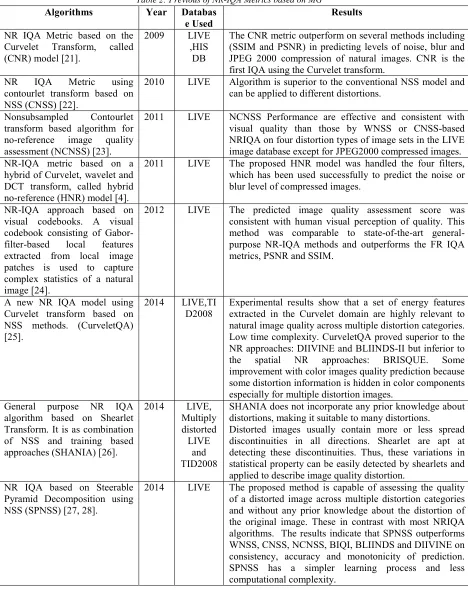
[image:4.612.86.554.143.733.2]Most of the current NR-IQA metrics focus on compression artifacts, noise and blurring. Table 2 shows various NR-IQA metrics based on MGA transforms.
Table 2: Previous of NR-IQA Metrics based on MG
Algorithms Year Databas
e Used
Results
NR IQA Metric based on the Curvelet Transform, called (CNR) model [21].
2009 LIVE
,HIS DB
The CNR metric outperform on several methods including (SSIM and PSNR) in predicting levels of noise, blur and JPEG 2000 compression of natural images. CNR is the first IQA using the Curvelet transform.
NR IQA Metric using contourlet transform based on NSS (CNSS) [22].
2010 LIVE Algorithm is superior to the conventional NSS model and can be applied to different distortions.
Nonsubsampled Contourlet transform based algorithm for no-reference image quality assessment (NCNSS) [23].
2011 LIVE NCNSS Performance are effective and consistent with visual quality than those by WNSS or CNSS-based NRIQA on four distortion types of image sets in the LIVE image database except for JPEG2000 compressed images. NR-IQA metric based on a
hybrid of Curvelet, wavelet and DCT transform, called hybrid no-reference (HNR) model [4].
2011 LIVE The proposed HNR model was handled the four filters, which has been used successfully to predict the noise or blur level of compressed images.
NR-IQA approach based on visual codebooks. A visual codebook consisting of Gabor-filter-based local features extracted from local image patches is used to capture complex statistics of a natural image [24].
2012 LIVE The predicted image quality assessment score was consistent with human visual perception of quality. This method was comparable to state-of-the-art general-purpose NR-IQA methods and outperforms the FR IQA metrics, PSNR and SSIM.
A new NR IQA model using Curvelet transform based on NSS methods. (CurveletQA) [25].
2014 LIVE,TI D2008
Experimental results show that a set of energy features extracted in the Curvelet domain are highly relevant to natural image quality across multiple distortion categories. Low time complexity. CurveletQA proved superior to the NR approaches: DIIVINE and BLIINDS-II but inferior to the spatial NR approaches: BRISQUE. Some improvement with color images quality prediction because some distortion information is hidden in color components especially for multiple distortion images.
General purpose NR IQA algorithm based on Shearlet Transform. It is as combination of NSS and training based approaches (SHANIA) [26].
2014 LIVE,
Multiply distorted LIVE
and TID2008
SHANIA does not incorporate any prior knowledge about distortions, making it suitable to many distortions.
Distorted images usually contain more or less spread discontinuities in all directions. Shearlet are apt at detecting these discontinuities. Thus, these variations in statistical property can be easily detected by shearlets and applied to describe image quality distortion.
NR IQA based on Steerable Pyramid Decomposition using NSS (SPNSS) [27, 28].
565 Most of the NR-IQA metrics are tested on LIVE database (comprises limited distortion types (5 types of distortions)) as shown in table 2. In addition, existing NR-IQA metrics focus on the quality evaluation of compression, noise or blurring distortions of images as highlighted by [29].
3.2 NR-IQA Metrics for Contrast Distortion Images (CDI)
On the other hand, NR-IQA is rarely applied for Contrast Distortion Images (CDI), which may be attributed to the lack of databases for CDI. Four databases i.e. TID2008, CSIQ and TID2013 and
CID2013 are used in the research of contrast-related IQA. Therefore, we will survey the existing NR-IQA-CDI in two domains (spatial and transform).
3.2.1 NR-IQA-CDI in spatial domain
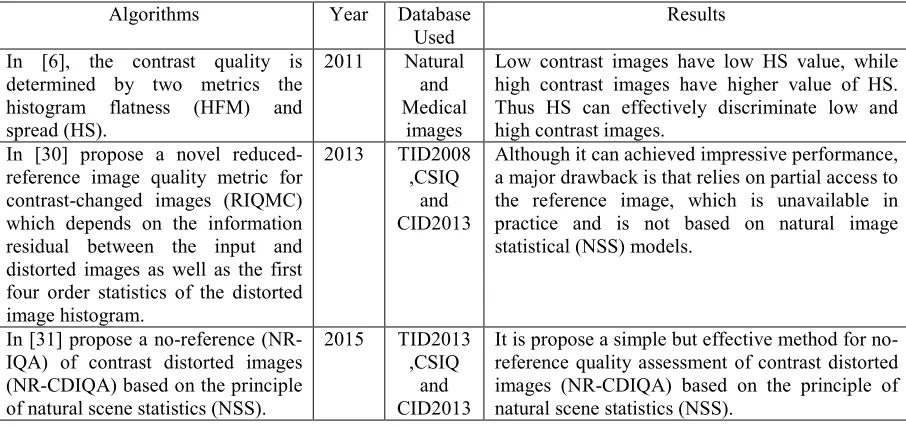
[image:5.612.80.533.308.521.2]Most of the existing methods judge the contrast quality in spatial domain [6, 30, 31]. Table 3 shows the related works in contrast distortion. In order to validate the results of different IQA algorithms with human (subjective) judgments of quality, different databases are used to test the performance of these algorithms. Details on these database are shown in table 4.
Table 3: List of the Most NR-IQA Measures for Contrast Distortion
Algorithms Year Database
Used
Results
In [6], the contrast quality is determined by two metrics the histogram flatness (HFM) and spread (HS).
2011 Natural and Medical
images
Low contrast images have low HS value, while high contrast images have higher value of HS. Thus HS can effectively discriminate low and high contrast images.
In [30] propose a novel reduced-reference image quality metric for contrast-changed images (RIQMC) which depends on the information residual between the input and distorted images as well as the first four order statistics of the distorted image histogram.
2013 TID2008 ,CSIQ
and CID2013
Although it can achieved impressive performance, a major drawback is that relies on partial access to the reference image, which is unavailable in practice and is not based on natural image statistical (NSS) models.
In [31] propose a no-reference (NR-IQA) of contrast distorted images (NR-CDIQA) based on the principle of natural scene statistics (NSS).
2015 TID2013 ,CSIQ
and CID2013
It is propose a simple but effective method for no-reference quality assessment of contrast distorted images (NR-CDIQA) based on the principle of natural scene statistics (NSS).
Table 4: Description of Publicly Available Databases
Dataset Ref.
Images No.
Distorted Images
No.
Distortion Types No.
Image Format
Subjects No.
Subjects score format (Range)
TID2008 [32] 25 1700 17 color 838 MOS(0-9)
CSIQ [33] 30 866 6 color 35 DMOS (0-1)
LIVE [29] 29 779 5 color 161 DMOS (0-100)
IVC [34] 10 185 4 color 15 MOS(1-5)
MICT [35] 14 168 2 color 16
WIQ 7 80 5 gray 60 DMOS (0-100)
A57 3 54 6 gray 7 DMOS (0-1)
TID2013 [36] 25 3000 25 color 971 MOS(0-9)
[image:5.612.77.538.553.708.2]566
3.2.2 NR-IQA-CDI in transform domain
We classify the transform domain into traditional transform e.g. FFT, DCT and Wavelet transform and MGA transform (e.g. Curvelet, Contourlet, Shearlet and SPD). In this paper, we focus on MGA transforms. Although the MGA methods are popular in contrast image applications (see [37, 38, 39, 40, 41]), its role in the research of IQA for contrast distortion images (CDI) is somehow limited.
The results of using MGA Transform to decompose the images at different scale, orientation and location are often promising. Curvelet transform, for example, has many applications in image processing such as contrast enhancement [37]. Also, it is used to overcome the drawbacks of traditional multi-scale representations such as wavelets. Due to the limited number of works dealing on the usage of MGA to assess the quality of CDI, we aim to identify the existing NR IQA metrics based on MGA transforms that are suitable for CDI.
4. THE EVALUATION RESULTS BY (SROCC) FOR VARIOUS NR-IQA METRICS
There are plenty of statistical measures used to evaluate the performance of IQA metrics such as Spearman Rank-Order Correlation Coefficient (SROCC), Pearson’s Linear Correlation Coefficient (PLCC) and Outlier Ratio (OR) between predicated quality score and Difference Mean Opinion Scores (DMOS). SROCC and LCC values that are close to 1 indicate good performance in terms of correlation with human perception. These metric measures the prediction monotonicity, prediction accuracy and prediction consistency.
We will classify the evaluation of NR-IQA Metrics into two groups: NR-IQA Metrics for general purpose and NR-IQA Metrics for contrast distortion.
4.1 Evaluation of NR-IQA Metrics for General Purpose
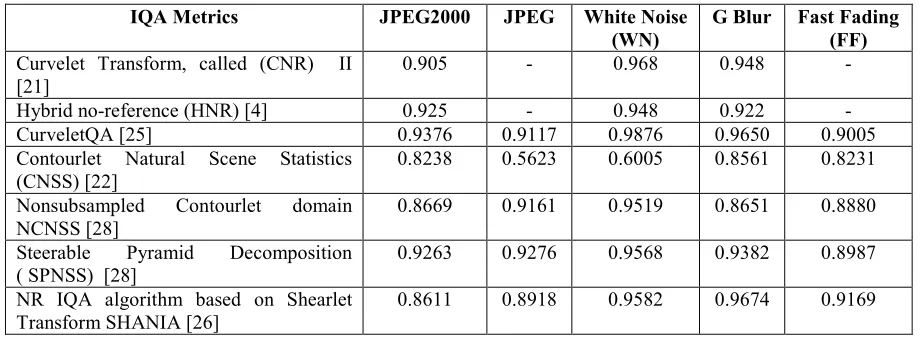
[image:6.612.82.542.451.621.2]Table 5 reports the evaluation results by (SROCC) for various NR-IQA metrics with different MGA transforms, e.g. Curvelet, Contourlet, Shearlet, and Wave atom.
Table 5: The Evaluation Results by (SROCC) For Various NR-IQA Metrics with Different MGA Transforms
The NR IQA metrics (general purpose) based on MGA transforms are shown in table 5. [21, 25, 4] have introduced a new NR- IQA Metric based on Curvelet Transform and NSS. In particular, [25] have proposed a good NR-IQA Metric through experimental results which have outperformed the existing MGA transforms.
4.2 Evaluation of NR-IQA Metrics for Contrast Distortion Images (CDI)
Most of the existing methods judge the contrast quality in spatial domain. But there is no other NR measure based on MGA transforms that has been developed specifically for contrast distortion. Table 6 illustrates the evaluation
IQA Metrics JPEG2000 JPEG White Noise
(WN)
G Blur Fast Fading
(FF)
Curvelet Transform, called (CNR) II [21]
0.905 - 0.968 0.948 -
Hybrid no-reference (HNR) [4] 0.925 - 0.948 0.922 -
CurveletQA [25] 0.9376 0.9117 0.9876 0.9650 0.9005
Contourlet Natural Scene Statistics (CNSS) [22]
0.8238 0.5623 0.6005 0.8561 0.8231
Nonsubsampled Contourlet domain NCNSS [28]
0.8669 0.9161 0.9519 0.8651 0.8880
Steerable Pyramid Decomposition ( SPNSS) [28]
0.9263 0.9276 0.9568 0.9382 0.8987
NR IQA algorithm based on Shearlet Transform SHANIA [26]
567 results of the existing IQA algorithms which are dedicated for CDI in spatial domain.
Table 6: The Evaluation Results by (SROCC) for Various IQA Metrics
The performance of the existing state-of-the-art IQA algorithms such as NR-IQACDI on CSIQ and TID2013 Databases can be improved. The current NR-IQACDI uses features in spatial domain; therefore, feature is used as well in MGA transform. It can be seen from table 5 that the Curvelet transform outperforms the existing MGA transforms. The Natural Scene Statistics (NSS) features in the Curvelet domain are useful in the assessment of the quality of image distorted by compression, noise and blurring. Therefore, we recommend Curvelet transform in IQA of CDI.
5. CONCLUSION
Although MGA methods are popular in contrast image applications, the understanding of its role in the research of IQA for contrast distortion is still vague.
NR-IQA approaches designed for CDI have been reviewed and we have highlighted the importance of IQA algorithms. Besides that, the weakness of the existing image quality measurement algorithms in both spatial and transform domains have been identified in order to find a good MGA transform for quality prediction.
From the literature review, most of the existing NR-IQA algorithms based on MGA transforms are designed for general-purpose. There is no NR measure based on MGA transforms that has been developed specifically for contrast distortion. From the current work, we found that CurveletQA outperforms the existing MGA transforms in terms of exhibiting high correlation with human perception. Therefore, Curvelet transform is recommended for designing the NR-IQA Metric used to predict the quality of Contrast Distortion Images (CDI).
REFERENCES
[1] Thakur, Niveditta, and Swapna Devi. "A new method for color image quality assessment."
International Journal of Computer
Applications 15, no. 2 (2011): 10-17.
[2] Gao, Xinbo, Wen Lu, Dacheng Tao, and Xuelong Li. "Image quality assessment based on multiscale geometric analysis." Image
Processing, IEEE Transactions on 18, no. 7
(2009): 1409-1423.
[3] Mohammadi, Pedram, Abbas Ebrahimi-Moghadam, and Shahram Shirani. "Subjective and objective quality assessment of image: A survey." arXiv preprint
arXiv:1406.7799 (2014).
[4] Shen, Ji, Qin Li, and Gordon Erlebacher. "Hybrid no-reference natural image quality assessment of noisy, blurry, JPEG2000, and JPEG images." Image Processing, IEEE
Transactions on 20, no. 8 (2011): 2089-2098.
[5] Zhang, Yi, and Damon M. Chandler. "An algorithm for no-reference image quality assessment based on log-derivative statistics of natural scenes." In IS&T/SPIE Electronic
Imaging, International Society for Optics and
Photonics, 2013, pp. 86530J-86530J.
[6] A. K. Tripathi, S.Mukhopadhyay, and A. K. Dhara, “Performance metrics for image contrast,” in IEEE Int. Conf. Image Information Processing, 2011.
[7] N. Damera-Venkata, T. D. Kite, W. S. Geisler, B. L. Evans, and A.C. Bovik, “Image quality assessment based on a degradation model,” IEEE Trans. Image Process., vol. 4, no. 4, pp. 636–650, Apr. 2000.
[8] Ramesh, K., and B. Das. "Multiscale geometric analysis based image quality assessment." In Electronics Computer Technology (ICECT),
2011 3rd International Conference on, vol. 4,
pp. 57-60. IEEE, 2011.
METRIC IQA
Kinds
CID2013 Database TID2013 Database CSIQ Database
PLCC SROCC RMSE PLCC SROCC RMSE PLCC SROCC RMSE
RIQMC[30] RR 0.9080 0.9133 0.2611 0.7848 0.7239 0.6079 0.9593 0.9576 0.0476 NR-CDIQA
[31]
568 [9] H. Führ, L. Demaret, F. Friedrich, “Beyond
wavelets: New image representation Paradigms ,” Survey article, preprint version, 2005.
[10] E. Candes, D. Donoho, “Ridgelets: A key to higher dimensional intermittency?”,
Philosophical transactions Royal Society,
Mathematical, physical and engineering
sciences, vol. 357, no. 1760, pp.2495- 2509,
1999.
[11] E. Candes, D. Donoho, “Curvelets - A surprisingly effective nonadaptive representation for objects with edges, curves and surfaces,” Curves and Surfaces, Vanderbilt
University Press, Nashville, TN, 1999.
[12] L. Demanet, L. Ying, “Wave atom and
sparsity of oscillatory patterns”, Appl.
Comput, vol. 23, Issue 3, pp. 368-387, 2007.
[13] Mingna Liu and Xin Yang, “Image quality assessment using contourlet transform”, optical
engineering, 48(10)107201, 2009.
[14] Z. Wang and EP Simoncelli. “Translation insensitive image similartity in complex wavelet domain”. ICASSP, Vol. 2, pp. 573- 576, March 2005.
[15] A. B. Watson, “The cortex transform: rapid computation of simulated neural images”, Computer Vision, Graphics, and Image
Processing, vol. 39(3), pp. 311_327, Sept.
1987.
[16] E. Le Pennec and S. G. Mallat, “Image compression with geometrical wavelets,” in
Proc. IEEE Int. Conf. Image Processing,
Vancouver, BC, Canada, 2000, pp. 661–664. [17] R. Eslami and H. Radha, “Wavelet-based
contourlet transform and its application to image coding,” in Proc. IEEE Int. Conf.
Image Processing, Piscateway, NJ, 2004, pp.
3189–3192.
[18] R. Eslami and H. Radha, “Newimage transforms using hybrid wavelets and directional filter banks: Analysis and design,” in Proc. IEEE Int. Conf. Image
Processing, Genova, Italy, 2005, pp. 11–14.
[19] H. R. Sheikh, A. C. Bovik, and L. Cormack, “No-reference quality assessment using natural scene statistics: JPEG2000,” IEEE
Trans. Image Process., vol. 14, no. 11, pp.
1918–1927, Nov. 2005.
[20] Ismail Taha Ahmed Salah Sleibi Al-Rawi Khattab M. Ali Baraa Tareq Hammad,” The Use of Two Transform Methods in Fingerprints Recognition”, J. of university of
anbar for pure science : Vol.6:NO.2 : 2012, ISSN: 1991-8941.
[21] Shen, Ji, Qin Li, and Gordon Erlebacher. "Curvelet based no-reference objective image Quality Assessment." In Picture Coding
Symposium, 2009. PCS 2009, pp. 1-4. IEEE,
2009.
[22] Lu, Wen, Kai Zeng, Dacheng Tao, Yuan Yuan, and Xinbo Gao. “No-reference image quality assessment in contourlet domain."
Neurocomputing 73, no. 4 (2010): 784-794.
[23] F. Lu, Q. Zhao, G. Yang, Nonsubsampled contourlet transform based algorithm for no-reference image quality assessment, Optical Engineering 50 (2011) 067010-1-067010-10.
[24] Ye, Peng, and David Doermann. "No-reference image quality assessment using visual codebooks." Image Processing, IEEE
Transactions on 21, no. 7 (2012):
3129-3138.
[25] Liu, Lixiong, Hongping Dong, Hua Huang, and Alan C. Bovik. "No-reference image quality assessment in curvelet domain." Signal Processing: Image Communication 29, no. 4 (2014): 494-505.
[26] Li, Yuming, Lai-Man Po, Xuyuan Xu, and Litong Feng. "No-reference image quality assessment using statistical characterization in the Shearlet domain." Signal Processing:
Image Communication 29, no. 7 (2014):
748-759.
[27] Lu, Fangfang, Qunfei Zhao, and Genke Yang. "A no-reference image quality assessment approach based on steerable pyramid decomposition using natural scene statistics."
Neural Computing and Applications 26, no.
1 (2015): 77-90.
[28] Fangfang LU,Qunfei ZHAO, Huanxi LIU.” A Statistical Method for No-reference Image Quality Assessment”. Journal of Computational Information Systems 10: 16 (2014) 7203–7212. Available at http://www.Jofcis.com.
[29] H. R. Sheikh, Z. Wang, L. Cormack, and A. C. Bovik, “Live image quality assessment database release 2.” [Online].Available: http://live.ece.utexas.edu/research/quality [30] K. Gu, G. Zhai, X. Yang, W. Zhang, and M.
569 [31] Fang, Yuming, Kede Ma, Zhou Wang, Weisi
Lin, Zhijun Fang, and Guangtao Zhai. "No-Reference Quality Assessment of Contrast- Distorted Images Based on Natural Scene
Statistics." Signal Processing Letters, IEEE 22, no. 7 (2015): 838-842.
[32] N. Ponomarenko, V. Lukin, A. Zelensky, K. Egiazarian, M. Carli, and F. Battisti, “TID2008 - A database for evaluation of full-reference visual quality assessment metrics,” Adv. Modern Radioelectron., vol. 10, pp. 30-45, 2009.
[33] E. C. Larson and D. M. Chandler, Categorical image quality (CSIQ) database [Online]. Available: http://vision.okstate.edu/csiq [34] Le Callet, Patrick, and Florent Autrusseau.
"Subjective quality assessment IRCCyN/IVC database." (2005): http://www2.irccyn.ec-nantes.fr/ivcdb [35] Horita, Yuukou, et al. "MICT image quality
evaluation database." Online], http://mict.
eng. u-toyama. ac. jp/mictdb. html (2011).
[36] N. Ponomarenko, O. Ieremeiev, V. Lukin, K. Egiazarian, L. Jin, J. Astola, B. Vozel, K. Chehdi, M. Carli, F. Battisti, and C.-C. Jay Kuo, “Color image database TID2013: Peculiarities, and preliminary results,” in Proc. 4th Europian Workshop on Visual Information.
[37] Starck, Jean-Luc, Fionn Murtagh, Emmanuel J. Candes, and David L. Donoho. "Gray and color image contrast enhancement by the curvelet transform." Image Processing,
IEEE Transactions on 12, no. 6 (2003):
706-717.
[38] Nezhadarya, Ehsan, and Mohammad B. Shamsollahi. "Image contrast enhancement by contourlet transform." In Proceedings
ELMAR 2006, pp. 81-84. IEEE, 2006.
[39] Zheng, Wei Tao, Tian Pu, Jian Cheng, and Hu Zheng. "Image contrast enhancement by contourlet transform and PCNN." In Audio, Language and Image Processing (ICALIP),
2012 International Conference on, pp.
735-739. IEEE, 2012.
[40] Gupta, Deep, R. S. Anand, and Barjeev Tyagi. "Enhancement of medical ultrasound images using multiscale discrete shearlet transform based thresholding." In Electronic System Design (ISED), 2012 International
Symposium on, pp. 286-290. IEEE, 2012.
[41] Premkumar, S., and K. A. Parthasarathi. "An efficient approach for colour image enhancement using Discrete Shearlet Transform." In Current Trends in Engineering and Technology (ICCTET),
2014 2nd International Conference on, pp.
![Table 1: Main Features Captured By Different MGA Transforms [19]](https://thumb-us.123doks.com/thumbv2/123dok_us/8907675.957598/3.612.311.528.101.242/table-main-features-captured-different-mga-transforms.webp)