2017 2nd International Conference on Computer Science and Technology (CST 2017) ISBN: 978-1-60595-461-5
Formalization of Hospital Workflow Process Based on
Polychromatic Sets Theory
Mei-mei RAN
1,c, Xiao-hua WANG
2,a*and Min YANG
1,b1School of Computer Science and Technology, Guizhou University, China
2Department of Medical Information Engineering, Zunyi Medical College, China
agzzywxh@hotmail. com, bameliamin@foxmail. com, c ranmeim@foxmail. com
*Corresponding author
Keywords: Polychromatic sets theory, Polychromatic graph, Workflow process.
Abstract. In order to establish the workflow model, formalized expression of workflow process was studied. The basic conception of polychromatic set is given, to describe the relationship between activities and activities, this paper extends the Boolean matrices in polychromatic sets, on the basis of 0,1 to increase the -1 to identify the relationship between the follow-up relationship, with "+" that the relationship between the activities of the precursor. In addition, in order to construct a complete workflow process, the polychromatic graph is extended. In this paper, the classification of nodes in polychromatic graphs and the addition, deletion and modification of polychromatic graphs are proposed, add a pair of <X, Y> to the edge of the polychromatic graph to indicate the time and resources required to complete the activity. Finally, using the theory presented in this paper to describe the workflow process of hospital radiology.
Introduction
The concept of Polychromatic Sets Theory
The polychromatic set theory is a kind of brand-new information processing tool and mathematical modeling tool [7]. The collection whole and the element can be painted with different "colors" to describe the relation between the set and the element or the element, the color refers to the nature of the object, features, attributes and so on. Polychromatic set theory consists of the following six components[8]: PSA=(A,F(a),F(A),[A×F(a),A×F(A),[A×A(F)]. Among them, A—ordinary set; F(a)—the color set of elements ai∈A; [A×F(a)]—the individual color of all the elements of object A; [ A×A(F)]—Polychromatic set the composition of all the elements of a body in which all uniform colors exist[8][9]. Workflow process is composed of a set of active activities, on the activities of the different colors that the overall nature of the activities and the relationship between activities. Through the polychromatic set theory, the workflow process is formalized and the relationship between the activities is more clearly, which facilitates the horizontal and vertical expansion of the whole workflow process.
Active Contour Matrix
A workflow is a fully or partially fully automated business process supported by a computer [10]. The formal expression of workflow process is to describe the orderly relationship among activities. The relationship between activities mainly includes the sequential, parallel, selection, loop structure. In order to describe the relationship among the activities in the process of workflow, this paper extends the typical contour matrix, and increased values other than 0,1 to identify the relationship between activities. If the activity ai is completed before aj and the activity ai has only one follow-up activity, then the corresponding value in the active matrix is 0, otherwise it is empty. If activity ai has two or more follow-up activities, and its follow-up activities must be completed in order to continue to complete other activities, called parallel structure, identified by the value 1 in the contour matrix; If an execution is selected from among its successor activities, it is called a selection structure, identified by -1 in the contour matrix. A loop structure can be thought of as a variation of the selection structure, and only a certain activity process can be performed more than a selection structure. In an active contour matrix, the activity is the starting activity if a column value is null, and the activity is a termination activity if the value of a row is null. The successor relationship between activities is identified by the numbers 0,1, -1, then the precursor relationship between the activities can be represented by the symbol "+" in the active channel matrix.
Table 1. Structre matrix. Subsequence
matrix
Parallel matrix Select matrix Loop smatrix
+
j i
j i
a a
a a
0
+ + + +
m k j i
m k j i
a a a a
a a a a
0 0 1 1
+ + + +
− −
m k
j i
m k j i
a a a a
a a a a
0 0 1 1
+ + + +
− −
m k j i
m k j i
a a a a
a a a a
0 0
1 1
painted with different "colors" to facilitate the modeling of complex objects. Its form is as follows: PG=(F(G),PSA,PSC). Where PSA is a polychromatic set of nodes[11]. PSA=(A,F(a),F(A),[A×F(a),A×F(A),[A×A(F)]. PSC is a polychromatic set of edges,PSC=(C,F(c),F(C),[C×F(c)],[C×F(C)],[C×C(F)]). F(G) is the uniform coloring of polychromatic graph. If the disjunction polychromatic graph, can be expressed as F∨(G); If the conjunction polychromatic graph is taken, it is expressed as F∧(G); indicates the individual coloring of all nodes; [A × F (A)] is the contour matrix that determines the node coloring; [C × F (C)] is used to determine the edge polychrome contour matrix. Since the polychromatic sets can be divided into conjunction polychromatic set and disjunction polychromatic set[12]. F(G)=F(A) ∪F(C), If the edges of the polychromatic graphs are not colored, the color of the PG is the color of the node, F(G)=F(A); If the nodes of the polychromatic graph have no color, the color of the PG is the color of the edge, F(G)=F(C). The contour Boolean matrices of the nodes are as follows (1)[13].
m F F
F1 2
[A×F(A)]=
n
a a a
2 1
nm n
n
m m
c c
c
c c
c
c c
c
2 1
2 22
21
1 12
11
(1)
m F F F1 2
[C×F(C)]=
n c c c
2 1
nm n
n
m m
e e
e
e e
e
e e
e
2 1
2 22 21
1 12 11
( )
2If cij = 1, then Fj is the component of the individual color of element ai. If only one row in the matrix has a value of 1, it means that the node can only be painted with a certain color, which is called monochrome node. Similarly, the edge of the perimeter Boolean matrix is as (2). If eij = 1, then Fj is the individual color of the element ci part. If the edges of polychromatic graph can only be painted with one color, only one value in a row of the matrix can be 1 and the rest is 0. If the nodes and edges can be painted with multiple colors, the rows of the matrix have multiple values of 1.
Expand the Polychromatic Graph
Table 2. Relational notation
Sequence Parallel Selection
X represents collection of time ,Y means a collection of resources
Node Addition and Deletion
When describing a workflow process with a polychromatic graph, it may be necessary to increase the corresponding atomic activity in a process and change the structure between the nodes. Changes in the basic structure of the workflow are to change the structure from one form to another [6]. Therefore, the study of polychromatic graph node changes has obvious advantages for the formalization of workflow process, which facilitates the vertical expansion of workflow process.
Subsequence relations add nodes is relatively simple, only need to insert the middle of the two nodes in the increase. However, its active contour matrix will change, (ai, ak) corresponding to the value of 0 to (ai, ak) and (ak, aj) the corresponding value is 0. Parallel relations: the parallel execution of the activity is unordered, only in the parallel structure of ai and am increase in the middle of the corresponding nodes, the active contour matrix changes as Figure 1, Polychromatic graph as follows Figure 2.
+ + + + + +
m n k j i
m n k j i
a a a a a
a a a a a
0 0 0 1 1 1
Figure 1. Active contour matrix. Figure 2. The nodes of the parallel structure increase. The deletion of the node has little effect on the order structure, except that the value of the active contour matrix will change a little. The deletion of the node can be divided into two types: First, there is a selection relation between the predecessor and the succeeding node after the deletion; Second, the entire selection relationship is deleted, precursor and successor only between the order of connection, the second change is larger. Deletion of nodes in parallel structures is similar to selecting structures. The addition and deletion of nodes in the loop structure is complicated. The increase of the nodes may occur before the loop body or the loop body, but the deletion of the nodes may turn the loop structure into a general order structure.
Changes of Nodes
same time, the active matrix is transformed from (ai,aj)=0 to(aj,ai)=0. Parallel structure of the exchange is more complex, if the parallel structure of the activity does not require the precursor of the data as input, and the output of the activity has nothing to do with the successor, you can swap each other, the parallel structure of the precursor and its successor to form a sequential relationship. as follows Figure 3. Changes between nodes can be a number of structural conversion between.
Figure 3. Parallel structure node changes.
Examples
The image examination of the hospital plays an indispensable role in the clinical diagnosis, therefore, this article for the radiology work flow research. Patients in the radiology of the inspection, may encounter a check too many people, lack of resources and other emergencies, At this point, the patient can go to other projects line up fewer departments to do additional inspection items, so that patients can not only save time, but also can improve the operation of the hospital.
Hospital workflow process description
The polychromatic set of workflow processes is described as follows (3)(4): )
, , , (a1 a2 an
A= (3)
[
] [
]
(
A,F(a),F(A), A F(a), A F(A))
PSA= × × (4)
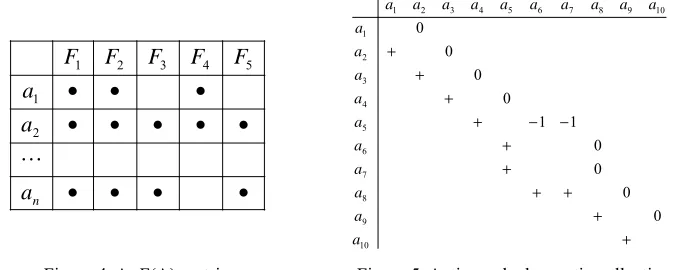
A is the set of activities in the workflow process; is the nature of a single activity; In the workflow process, all activities have some similar properties, these properties are summarized into F (A) set. That is, F (A) is the uniform color set of the node, which is used to describe the overall nature of the activities in the workflow, F(A)=(F1,F2,…,Fm); Among them, Fi is also a set, sd the activities of a specific nature of the collection, such as participants, resources, and so on. Some of the activities of the overall do not have the characteristics, [A×F(a)] is used to denote the correspondence between activities and individual activities. [A×F(A)] used to describe the correspondence between activities and overall activities, See Figure 4,F1
is the resource set, F2 is the participant, F3is the precursor, F4is the successor, F5is the conditional constraints. The transposition of the selection structure is similar to the parallel structure.
The relationship between activities and activities is clear, you can draw the edge of the polychromatic set PSC=(C,F(C)), F(C)=(F1,F2, F3, F4, F5), C is a set of edges in a polychromatic graph, describe the relationship between activities and activities, expressed by the matrix [A×A]; F1 indicates the sequential connection between activities; F2 is the and-split in the parallel structure; F3 is the and-join in the parallel structure; F4 is the choice of structure or-split; F5 is the choice of structure or-join[5], If activity and activity aj are sequential relations, then F1 (ai, aj) = 1, otherwise the corresponding person is 0, other relationship is similar.
+ + + + + + − − + + + + 10 9 8 7 6 5 4 3 2 1 10 9 8 7 6 5 4 3 2 1 0 0 0 0 1 1 0 0 0 0 a a a a a a a a a a a a a a a a a a a a
Figure 4. A×F(A) matrix. Figure 5. Active polychromatic collection. Therefore, the activity relationship in the contour Boolean matrix, the activity and the corresponding value of the relationship is 1, that the activities of the relationship between the Fj. The [A × A × F (C)] Boolean matrix is described as follows Figure 6.
0 0 1 1 0 0 0 0 0 0 0 0 0 0 1 1 0 0 0 0 0 0 0 0 0 0 0 0 0 0 0 0 0 0 0 0 0 0 0 0 1 1 0 0 0 0 1 1 1 1 ) , ( ) , ( ) , ( ) , ( ) , ( ) , ( ) , ( ) , ( ) , ( ) , ( 5 4 3 2 1 10 9 9 8 8 7 8 6 7 5 6 5 5 4 4 3 3 2 2 1 F F F F F a a a a a a a a a a a a a a a a a a a a
Figure 6 Workflow Process Model.
[image:6.612.145.483.71.206.2]The active polychromatic graphs are mapped by the activity relation matrix. In this process, a8 and a9 no data between the exchanges, there is a need to change the order of activities, as follows Figure 7.
Figure 7 Activity Polychromatic Graph
Conclusions
The theory presented in this paper can help to describe the formalization of complex workflow processes, so that disorderly activities form an ordered set, and finally build a workflow to complete a task process. Application of polychromatic sets theory and polychromatic graphs to describe the process of hospital workflow to facilitate horizontal and vertical expansion. The next step is to study the organizational resource modeling and research on the Interaction of Inter - system Activities by Polychromatic Sets Theory
Acknowledgement
This research was financially supported by the Guizhou Science and Technology Fund Project: Research on Collaborative Security Modeling of Full - PACS / RIS and HIS Based on IHE ([2012]2356), and by the Doctor Initial Foundation of Zunyi Medical College under grant No. F-335.
References
[2] Li P W, Kawaguchi Y, Yabe A. Transitional Heat Transfer and Turbulent Characteristics of Drag-reducing Flow through a Contracted Channel [J]. Journal of Enhanced Heat Transfer. 2001, 8(1):23-40.
[3] Wei Zeng, Bao-ping Yan. Study on Workflow Model [J]. Application Research of Computers. 2005, (05): 11-13 + 22. In Chinese.
[4] Xin-qin Gao, Zong-bin Li, Xuan Du, Li-jun Yan. Workflow organization resource modeling and its formalized allocation method [J]. Journal of Xi'an Jiaotong University, 2009, (01): 52-56. In Chinese.
[5] Xin-qin Gao, Li-da Xu, Xue-ping Wang, Yan Li, Ming-shun Yang, Yong Liu. Workflow process modelling and resource allocation based on polychromatic sets theory. Enterprise Information Systems Vol. 7, Iss. 2,2013.
[6] Xin-qin Gao, Zong-bin Li, Xuan Du. Study on Dynamic Change Model and Migration Method of Workflow Management System [J]. Computer Integrated Manufacturing Systems. 2008, (08): 1521-1528. In Chinese.
[7] Zong-bin Li, Tian-shi Li. Application of polychromatic graphs in simulation of complex objects and systems [J]. System Simulation. 2001, 06: 759-762. In Chinese. [8] Pavlov V V, Zong-bin Li, Feng Gao. Application of polychromatic sets in modeling and analysis of machining systems [J]. Journal of Xi'an Jiaotong University, 2001, (09): 926-929 + 986, In Chinese.
[9] Yong-gang Tang, Zong-bin Li, Shan-cang Li. Formal solution to conceptual design based on polychromatic set theory [J]. 2004, (01):68-72. In Chinese.
[10]Jun Yang. Workflow version management in the application of multi-color map [J]. China Manufacturing Information. 2010, 07: 17-20 +33. In Chinese.
[11]Li Z, Xu L, Zhao S. Polychromatic Sets Theory and its Application in Enterprise Information Systems [M]. Research and Practical Issues of Enterprise Information Systems. Springer US. 1970:721-728.
[12]Zong-bin Li, Chen Song, Tian-shi Li. Product Manufacturing Simulation Based on Polychromatic Sets and Multicolor Graphs [J]. Computer Integrated Manufacturing Systems-CIMS. 2001, (07): 67-72. In Chinese.