Available Online atwww.ijcsmc.com
International Journal of Computer Science and Mobile Computing
A Monthly Journal of Computer Science and Information Technology
ISSN 2320–088X
IJCSMC, Vol. 5, Issue. 2, February 2016, pg.62 – 67
A STUDY AND COMPARATIVE
ANALYSIS OF VARIOUS LANE
MARKING TECHNIQUES
Amandeep Katru
1, Anil Kumar
2¹Computer Engineering and Technology Department & Guru Nanak Dev University, India ²Computer Engineering and Technology Department & Guru Nanak Dev University, India
1
[email protected]; [email protected]
Abstract- Many people’s die every day because of road accidents .Lane detection is used to reduce the road
accident and also helps to improve the conditions of traffics. Lane detection helps the drivers in the driving
process using advanced driving assistance system. Advanced driver assistance system consists of collision
avoidance system, blind spot system and many more systems. This system is developed for safety and better
driving. In this paper, a comparison table is presented that show the comparison of various techniques with
their limitations, issues etc. The main objective of the paper is to overcome the limitations of the existing
techniques.
Keywords: lane detection, hough transform, inverse perspective mapping, RANSAC,B-snake.
1. INTRODUCTION
Lane detection is a process that is used to locate the lane markers on the road .With the help of this lane
markers presents these locations to an intelligent system. This system decreases the road accidents and
also helps to improves traffic conditions. Lane detection consists of specific types of primitives such as
road markings etc. lane detection represents the margins of path into a single framework. It supports various
applications like lane departure warning, lane keeping assists, lane centring etc. Lane departure warning gives us
a warning when the vehicle is veering off the lane without signalling. Lane detection also plays an important
role in advanced driver assistant system. This system helps the drivers in the driving process. This system is
system etc. Advanced driver assistance system consists of collision avoidance system, blind spot system and
many more systems. In lane detection there are many approaches that are applied like feature based and model
based. Feature based approach are used to detect edges and model based approach is a type of curve model.
2. TECHNIQUES
2.1 HOUGH TRANSFORM
Hough transform can be used to detect lines, circles or other parameter curves. The objective of Hough
transform is to locate the position of lines inside pictures. It has a capability to identify lines, circles and other
structures if whose parameter equation is well known. It is able to provide strong recognition in case of sound
and limited occlusion. The main goal of Hough transform is to find the location of lines in an existing image.
Hough transform was introduced in 1962 and first used to find the lines in images.
The Hough transform for straight line is:
x cosθ + y sinθ = ρ
The Hough transform for circle is:
(x − a)2 + (y − b)2 = c2
2.2 RANSAC
RANSAC is a random sample consensus. It is used for estimation of parameters because it is an iterative
method. It is a learning technique for estimation of parameters. Random sample consensus (RANSAC) can
estimate one model at a one time. It fails to find other one. It contains both inliers and outliers. RANSAC is
dependent on (inverse perspective mapping) top view of the image then filtered this image with any kind of
filter. RANSAC detects straight lane and also detect correctly for curved lane.
2.3 B –SNAKE
B-snake can be used to detect the boundaries of object with in an image. It is mainly used for curved lanes. It
can represent curves by control points. When control points are added the flexibility of the curves increases.
Control points may be used to illustrate the mid line of the road. It is a best technique for curved lane detection.
Tracking with snakes is also a technique which is used for finding the lanes and tracking the lanes on the road.
With the help of this technique also extracts and tracks lane boundaries. Hough transform have a capability to
extracts vanishing points of the road.
2.4 INVERSE PERSPECTIVE MAPPING
Inverse perspective mapping is a technique used to transform the binary image. It is used to remove the
perspective effect from the image. Inverse perspective mapping requires the knowledge of the camera position.
Inverse perspective mapping is a remapping domain. The application is that IPM requires knowledge of
3. LITERATURE REVIEW
Chung yi et al. (2015) [1] has discussed about driver assistant system that is based on various techniques of
image. In this detect the road lane markings a camera is mounted on the vehicle in front window. Thus helps us
to show all the position of vehicle with respect to the lane lines. Aly et al. (2015) [2] has shown that the Lane
quest leverages the low-energy sensors that is available in smart-phones which helps to provide an accurate
estimate of the car's current lane. Beyeler et al. (2014) [3] has presents an integrative approaches for
lane detection. The aim is to be as simple as possible to enable real-time computation. While being able to adapt
to a variety of urban and rural traffic scenarios. Deusch et al. (2012) [4] has discussed the Robust lane detection.
This is the precondition for advanced driver assistance systems like lane departure warning and overtaking
assistants. While detecting the vehicle's lane is sufficient for lane departure warning, overtaking assistants or
autonomous driving functions also need to detect adjacent lanes. Hunjae Yoo et al. (2013) [5] has discussed that
the Lane detection is an important in many advanced driver-assistance systems. Vision-based lane
detection algorithms are widely used. However, gradient values between lanes and roads vary with illumination
change, which degrades the performance of lane detection systems.
Chang et al. (2013) [6] has presented a lane detection systems using around view monitoring images. That helps
us for providing safe driving condition. The previous approaches that are used in this cannot detect lanes stably
in low visibility condition such as foggy or rainy days. The proposed method can be split into two stages:
generation of AVM images from four fisheye cameras and lane detection using AVM images. Satzoda and
Trivedi(2014) [7] have discussed on-road vehicle detection. Lane detection is an important in advanced driver
assistance systems. It introduces an integrated approach that approach is Vehicle detection with Integrated
Synergies. By using these approach inherent synergies exploits between lane and on the road vehicle detection.
Haloi and Jayagopi (2015) [15] have discussed a robust lane detection and departure warning technique. This
technique helps to improve the system and used to detect the lanes. For lane detection a modified Inverse
Perspective Mapping is used. yu and luen (2014)[8] has proposed the Lane detection critical to alert driver to
avert car departure from driving lanes is an important issue in Intelligent Vehicle Safety System.
Lane detection uses straight line detection approaches like Canny etc. These approaches are used to detect
driving lanes, but it is fail to detect curvy lanes. Guo et al. (2015) [10] has discussed about the
Lane detection based on computer vision is a technology of Automatic Drive System. This has proposed an
algorithm of real-time lane detection . In order to enhance lane boundary information use adopt canny algorithm
for edge detection for better points.
Baykal et al. (2014) [11] has discussed about a lane detection system based on one bit transform. The utilization
of lane detection systems as driver assist systems is increasing. The real-time operation requirement of lane
detection systems is an important aspect. If the vehicle is outside the lane boundaries is used to detect. Braga
and Jung (2013) [12] has presented the method for detection and recognition of road lane markings using a
camera. Lane boundaries are detected based on a linear parabolic model. Then, build a simple model to
represent pixels. This model explores the pixels related to lane markings. Kang et al. (2014) [13] has discussed
the Multi-lane detection algorithms. Feature-based algorithm is restricted to the illuminates variation and
adjacent lanes. Wang et.al (2014) [14] has discussed about the Urban lane detection. This also discussed an
approach of lane detection algorithm based on Inverse Perspective Mapping. By using Inverse Perspective
Mapping transforms binary image using algorithm k-means clustering. Chen et al. (2013) [9] has proposed an
effective blind spot warning system. This system improves daytime and night-time conditions. Under daytime
the system presents the Horizontal Edge and Shadow Composite Region method.
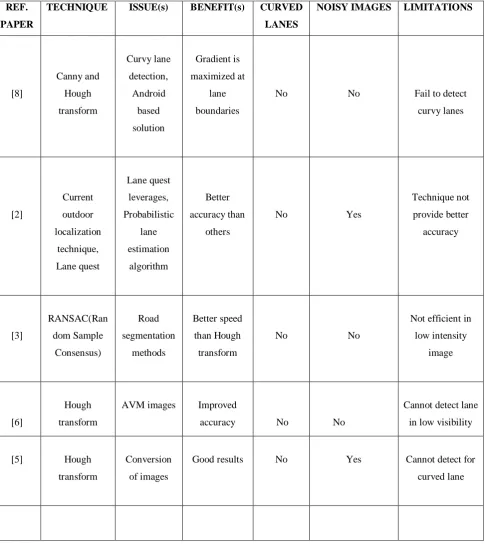
Table 1. Comparison of various lane marking techniques
REF.
PAPER
TECHNIQUE ISSUE(s) BENEFIT(s) CURVED
LANES
NOISY IMAGES LIMITATIONS
[8] Canny and Hough transform Curvy lane detection, Android based solution Gradient is maximized at lane boundaries
No No Fail to detect
curvy lanes [2] Current outdoor localization technique, Lane quest Lane quest leverages, Probabilistic lane estimation algorithm Better accuracy than others
No Yes
Technique not provide better accuracy [3] RANSAC(Ran dom Sample Consensus) Road segmentation methods Better speed than Hough transform
No No
Not efficient in
low intensity
image
[6]
Hough
transform
AVM images Improved
accuracy No No
Cannot detect lane
in low visibility
[5] Hough
transform
Conversion
of images
Good results No Yes Cannot detect for
4. CONCLUSION
In this paper, various techniques are defined for lane detection and the comparison table of various techniques.
Most of the previous work has focused only on the straight lane marking. Thus, it is required to develop the
detection algorithm for curved lane markings. The previous work is done by using the Hough transform; the
modification of Hough has been neglected by many researchers. The use of data parallelism is ignored in the
existing lane detection techniques. In near future we will propose a parallel lane detection technique to improve
the speed of lane detection. Also the additive Hough will be modified to improve the results for curved lanes.
REFERENCES
[1] Yi, Shu-Chung, Yeong-Chin Chen, and Ching-Haur Chang. "A lane detection approach based on intelligent
vision." Computers & Electrical Engineering 42 ,23-29 (2015).
[2] Aly, H.; Basalamah, A.; Youssef, M., "LaneQuest: An accurate and energy-efficient lane detection system,"
in Pervasive Computing and Communications (PerCom), 2015 IEEE International Conference on , vol., no.,
pp.163-171, 23-27 March 2015 [10]
Random
sample
consensus
(RANSAC)
Curve lane
parameter
model
Lane
boundaries fit
well in various
road
conditions
Yes No Cannot detect lane
at night time
[1] Modified
Hough
transform
Driver
assistant
system
Improved
lane line
detection and
lane departure
prediction.
No No Cannot detect for
curved lane
[16]
Inverse
perspective
mapping
Urban lane
detection Reduce noise No Yes
Focused only on
straight lanes
[15] RANSAC
Inverse
perspective
mapping
Reliability
detect lanes
and
boundaries
No No
focused only on
the straight lane
[3] Beyeler, M.; Mirus, F.; Verl, A., "Vision-based robust road lane detection in urban environments,"
in Robotics and Automation (ICRA), 2014 IEEE International Conference on , vol., no., pp.4920-4925, May 31
2014-June 7 2014
[4] Deusch, H.; Wiest, J.; Reuter, S.; Szczot, M.; Konrad, M.; Dietmayer, K., "A random finite set approach to
multiple lane detection," in Intelligent Transportation Systems (ITSC), 2012 15th International IEEE
Conference on , vol., no., pp.270-275, 16-19 Sept. 2012
[5] Hunjae Yoo; Ukil Yang; Kwanghoon Sohn, "Gradient-Enhancing Conversion for Illumination-Robust Lane
Detection," in Intelligent Transportation Systems, IEEE Transactions on , vol.14, no.3, pp.1083-1094, Sept.
2013
[6] Chang-Hoon Kum; Dong-Chan Cho; Moon-Soo Ra; Whoi-Yul Kim, "Lane detection system with around
view monitoring for intelligent vehicle," in SoC Design Conference (ISOCC), 2013 International , vol., no.,
pp.215-218, 17-19 Nov. 2013
[7] Satzoda, R.K.; Trivedi, M.M., "Efficient Lane and Vehicle Detection with Integrated Synergies (ELVIS),"
in Computer Vision and Pattern Recognition Workshops (CVPRW), 2014 IEEE Conference on , vol., no.,
pp.708-713, 23-28 June 2014
[8] Chien Tsung-Yu; Chung Sheng-Luen, "Android-based driving assistant for lane detection and departure
warning," in Control Conference (CCC), 2014 33rd Chinese , vol., no., pp.174-179, 28-30 July 2014
[9] Wu, Bing-Fei, Hao-Yu Huang, Chao-Jung Chen, Ying-Han Chen, Chia-Wei Chang, and Yen-Lin Chen. "A
vision-based blind spot warning system for daytime and nighttime driver assistance." Computers & Electrical
Engineering39, no. 3 , 846-862.2013
[10] Jie Guo; Zhihua Wei; Duoqian Miao, "Lane Detection Method Based on Improved RANSAC Algorithm,"
in Autonomous Decentralized Systems (ISADS), 2015 IEEE Twelfth International Symposium on , vol., no.,
pp.285-288, 25-27 March 2015
[11] Baykal, B.; Ozcan, A.R.; Erturk, S., "Lane detection system based on one bit transform," in Signal
Processing and Communications Applications Conference (SIU), 2014 22nd , vol., no., pp.2237-2240, 23-25
April 2014
[12] Braga de Paula, M.; Rosito Jung, C., "Real-Time Detection and Classification of Road Lane Markings,"
in Graphics, Patterns and Images (SIBGRAPI), 2013 26th SIBGRAPI - Conference on , vol., no., pp.83-90, 5-8
Aug. 2013
[13] Seung-Nam Kang; Soomok Lee; Junhwa Hur; Seung-Woo Seo, "Multi-lane detection based on accurate
geometric lane estimation in highway scenarios," in Intelligent Vehicles Symposium Proceedings, 2014 IEEE ,
vol., no., pp.221-226, 8-11 June 2014
[14] Jun Wang; Tao Mei; Bin Kong; Hu Wei, "An approach of lane detection based on Inverse Perspective
Mapping," in Intelligent Transportation Systems (ITSC), 2014 IEEE 17th International Conference on , vol.,
no., pp.35-38, 8-11 Oct. 2014
[15] Haloi, M.; Jayagopi, D.B., "A robust lane detection and departure warning system," in Intelligent Vehicles
Symposium (IV), 2015 IEEE , vol., no., pp.126-131, June 28 2015-July 1 2015
[16] Juseok Shin; Eunryung Lee; KeeKoo Kwon; SooIn Lee, "Lane detection algorithm based on top-view
image using random sample consensus algorithm and curve road model," in Ubiquitous and Future Networks