Introduction
Learning is a holistic human process and has been defined in a variety of ways by different educational psychologists. German educationist Knud Illeris defines learning as "any process that in living organisms leads to permanent capacity change which is not solely due to biological maturation and ageing process."1Learning is a multisensory process which results from interaction with the environment or experience, and produces a change in individuals' behaviour.2It is not limited to a deliberate or conscious activity and formal educational system, yet it is the very core of educational process and one of the most important activities in which humans engage.3
Theories of learning are the efforts to explain how learning takes place. They can be classified into three major groups: constructivism, stimulus-response theories or behaviourism, and cognitivism. According to constructivist approach, learning is more than providing information and it is facilitated by activating previous knowledge, arousing intense motivation and requiring the learner to engage actively in learning process. Each learner constructs his own meaning by building on his previous knowledge. It is the learner who is at the centre
of the educational process and teacher acts as a moderator or facilitator.4
Cognitivism is based on the investigation of human thought process and information processing pathway in brain as short-term memory which is transferred to long-term memory by rehearsal and encoding. Hermann Ebbinghaus, whose work was published in 1855, experimented and proved retention as a function of repeated learning.5Miller in 1955 suggested that seven plus or minus two items can be stored at one time in short-term memory. He called them as "magical number seven".6
American educationist David Kolb suggested a cycle of learning which begins with experience and progresses to reflection on experience leading to conceptualisation followed by experimentation.7 The iteration of the learning cycle leads to the growth in knowledge, depth of understanding and improved practice. Emphasis on experimental learning led to the first major scientific theory of learning — the behaviourism. Behaviourist concentrates on observable behaviour without considering motivation or other mental process. The desired behaviour is developed by careful planning and sequencing of learning events. The writing of objectives or goals in the form of learning outcomes is a consequence of behaviourist thinking. Teaching skills involves principles of behaviourism. Learning outcomes can be further refined using Miller's pyramid and Bloom's
KAP STUDY
Medical students’ learning habits: A mixed method study during clinical
rotation in general surgery
Hafiz Naweed Ahmad,1Mobeen Asif2
Abstract
Objective: To investigate medical students' study habits, their learning styles, and preferences, during general surgery rotation, for better understanding the art of pedagogy and improving the quality of teaching and learning.
Methods: This mixed-method study was conducted at the Quaid-i-Azam Medical College, Bahawalpur, Pakistan, from March 2013 to December 2014. Medical students of third and final years were asked to fill in a13-item questionnaire during surgery rotation.
Results: Of the 90 students, 54(60%) were third-year and 36(40%) were final-year students. The results did not show any significant gender difference (p>0.05). Moreover, 18(33%) and 14(39%) students in third and final years said they studied due to motivation of tests and exams. Besides, 44(81%) and 32(89%) used books as the primary source of knowledge, and 2(3.7%) 4(11%) in the respective groups used the internet. Peer discussion was effective in deep learning for 44(81%) and 32(89%) students respectively.
Conclusion: The majority of medical students used books and found algorithms, mind maps and peer discussion useful for their learning.
Keywords: Learning styles, Study habits, Learning theories. (JPMA 68: 600; 2018)
1Department of Surgery, Unit No. 04, Quaid-i-Azam Medical College, Bahawal
Victoria Hospital, Bahawalpur, 2Department of Mathematics, Institute of Suthren Punjab, Multan.
Taxonomy which has been revised by Anderson in 2001 (Figure-1).8
Learning styles can be described as a set of factors, behaviours and attitudes that facilitate learning for an individual in a given situation. There are three main types of learning styles depending upon one's brain style: visual learning, auditory learning and kinesthetic learning.9 Most people learn best through a combination of the three. The teaching strategy based on understanding of individual learning style is an effective way to ensure students' achievement and motivation.10 Newble and Entwistle have identified three basic approaches of learners: deep approach where students seek meaning and deep understanding of concepts, strategic approach where study is driven by desire for high achievement and surface approach which relies on rote-memorisation.11 Each learning approach results in a different learning outcome. Medical students mainly use deep and strategic learning approaches.12 Motivation for study can be extrinsic like environment, curriculum, assessment and rewards, etc, or it may be intrinsic like personality traits, habits and cognitive abilities.13
There are inventories designed to help learners to know their learning style.14 The educators need to know the learning styles and study habits of medical students for effective planning and delivery of teaching-learning activity. The current study was planned to investigate the learning styles and preferences of medical students and thus guide medical teachers to improve the quality of teaching and learning.
Subjects and Methods
The study was conducted at the department of surgery of the Quaid-e-Azam Medical College affiliated with the Bahawal Victoria Hospital, Bahawalpur, Pakistan, from March 2013 to December 2014. Ethics review committee of the department approved the study design and validated the questionnaire. The target population comprised students from third and final years of the Bachelor of Medicine, Bachelor of Surgery (MBBS) programme, during their clinical rotation in general surgery. The non-probability purposive sampling technique was adopted. The sample size was calculated to be 86.30 using Slovin's formula,15 considering confidence level of 90% and margin of error of 10%. The study was conducted using a combined approach of surveying the target population through a questionnaire, and quality assessment of the information by focus group interviews of randomly selected sample of 12 students; 6 from each group. A 13-item questionnaire was distributed among the students. A special session was arranged for
this purpose. Students were informed about the purpose and process of the study. Those who agreed to participate were included. Items of the questionnaire were projected one by one for two to three minutes through Microsoft PowerPoint slide projector. Two to three options were given against each item of the questionnaire. Students were asked to express their opinion by selecting one of the options. They had to write the answer on the response sheet. Separate sessions were arranged for third-year and final-year students at different occasions. The response sheets were collected at the end of the session. The data was processed and analysed in Microsoft Word 2007. Percentages were calculated for male and female students in both the groups. To ensure the quality of the questionnaire, focus group interviews were conducted from randomly selected students other than those who filled in the questionnaire. Six students were selected from the third year and six from the final year. Different sessions were arranged for both the groups and informed consent was obtained after explaining the purpose and process of the focus group. The issues of the questionnaire were presented by verbally questioning one by one and inviting each member of the group to give his or her opinion. The members of the group were allowed to interact with each other. The responses were recorded in the form of notes taken during the session. The content of focus group interviews was analysed and compared with the results of the questionnaire study.
Results
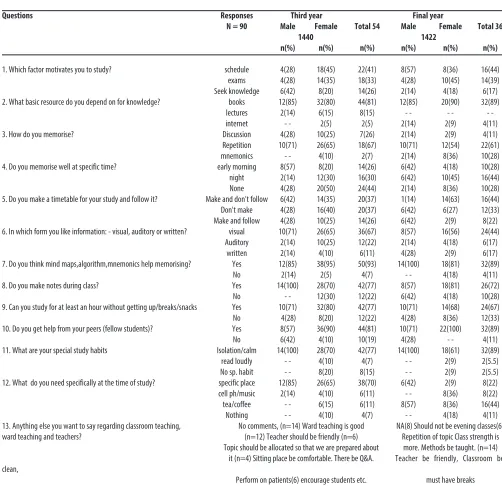
Of the 630 students, 90(14.3%) were included. Of them, 54(60%) were third-year and 36(40%) were final-year students. There were 14(25.9%) males and 40(74.1%) females, and 14(38.9%) males and 22(61.1%) females in the respective groups (Table). Moreover, 22(41%) students of the third year and 16(44%) of the final year followed a study schedule. Besides, 18(33%) and 14(39%) students of third and final years studied due to some motivation or stimulus of pre-test or examination. As for the primary source of knowledge, 44(81%) and 32(89%) students in the respective groups depended on books. Only 8(15%) students of the third year used their notes prepared during lectures and practical classes. The use of internet and information technology was very low: 2(3.7%) in third and 4(11%) among final-year students.
it on the walls of their rooms, on the tables and at the bedside. Moreover, 2(7%) students of the third year and 10(28%) of the final year used mnemonics for memory and retention. When asked about the best time they chose for their study, 16(30%) third-year and 16(44%) final-year students said that it was the night time when they were relaxed as there is complete silence and concentration. Some students went to the library and
hence followed library timings for study. On average, 22(24%) students made a timetable and followed it, especially near the exams. Also, 36(40%) did not follow their timetable and almost 31(35%) never made a time table for study.
[image:3.612.53.555.89.575.2]Visual information in the classes was liked by 36(67%) and 24(44%) students of the third and final years, respectively. Besides, 50(93%) and 32(89%) respondents Table: 'Students' learning habits' questionnaire results.
Questions Responses Third year Final year
N = 90 Male Female Total 54 Male Female Total 36 1440 1422
n(%) n(%) n(%) n(%) n(%) n(%)
1. Which factor motivates you to study? schedule 4(28) 18(45) 22(41) 8(57) 8(36) 16(44) exams 4(28) 14(35) 18(33) 4(28) 10(45) 14(39) Seek knowledge 6(42) 8(20) 14(26) 2(14) 4(18) 6(17) 2. What basic resource do you depend on for knowledge? books 12(85) 32(80) 44(81) 12(85) 20(90) 32(89) lectures 2(14) 6(15) 8(15) internet - - 2(5) 2(5) 2(14) 2(9) 4(11) 3. How do you memorise? Discussion 4(28) 10(25) 7(26) 2(14) 2(9) 4(11) Repetition 10(71) 26(65) 18(67) 10(71) 12(54) 22(61) mnemonics - - 4(10) 2(7) 2(14) 8(36) 10(28) 4. Do you memorise well at specific time? early morning 8(57) 8(20) 14(26) 6(42) 4(18) 10(28) night 2(14) 12(30) 16(30) 6(42) 10(45) 16(44) None 4(28) 20(50) 24(44) 2(14) 8(36) 10(28) 5. Do you make a timetable for your study and follow it? Make and don't follow 6(42) 14(35) 20(37) 1(14) 14(63) 16(44) Don't make 4(28) 16(40) 20(37) 6(42) 6(27) 12(33) Make and follow 4(28) 10(25) 14(26) 6(42) 2(9) 8(22) 6. In which form you like information: - visual, auditory or written? visual 10(71) 26(65) 36(67) 8(57) 16(56) 24(44) Auditory 2(14) 10(25) 12(22) 2(14) 4(18) 6(17) written 2(14) 4(10) 6(11) 4(28) 2(9) 6(17) 7. Do you think mind maps,algorithm,mnemonics help memorising? Yes 12(85) 38(95) 50(93) 14(100) 18(81) 32(89) No 2(14) 2(5) 4(7) - - 4(18) 4(11) 8. Do you make notes during class? Yes 14(100) 28(70) 42(77) 8(57) 18(81) 26(72) No - - 12(30) 12(22) 6(42) 4(18) 10(28) 9. Can you study for at least an hour without getting up/breaks/snacks Yes 10(71) 32(80) 42(77) 10(71) 14(68) 24(67) No 4(28) 8(20) 12(22) 4(28) 8(36) 12(33) 10. Do you get help from your peers (fellow students)? Yes 8(57) 36(90) 44(81) 10(71) 22(100) 32(89) No 6(42) 4(10) 10(19) 4(28) - - 4(11) 11. What are your special study habits Isolation/calm 14(100) 28(70) 42(77) 14(100) 18(61) 32(89) read loudly - - 4(10) 4(7) - - 2(9) 2(5.5) No sp. habit - - 8(20) 8(15) - - 2(9) 2(5.5) 12. What do you need specifically at the time of study? specific place 12(85) 26(65) 38(70) 6(42) 2(9) 8(22) cell ph/music 2(14) 4(10) 6(11) - - 8(36) 8(22) tea/coffee - - 6(15) 6(11) 8(57) 8(36) 16(44) Nothing - - 4(10) 4(7) - - 4(18) 4(11) 13. Anything else you want to say regarding classroom teaching, No comments, (n=14) Ward teaching is good NA(8) Should not be evening classes(6) ward teaching and teachers? (n=12) Teacher should be friendly (n=6) Repetition of topic Class strength is
Topic should be allocated so that we are prepared about more. Methods be taught. (n=14) it (n=4) Sitting place be comfortable. There be Q&A. Teacher be friendly, Classroom be clean,
Perform on patients(6) encourage students etc. must have breaks
from the respective groups believed that algorithms, mind maps and mnemonics helped them to retain the information. Some students liked auditory and written information. Almost 68(75%) students from both the groups took notes during their classes while the remaining did not do so.
Moreover, 66(73%) students said they could study for an hour or so without taking a break or snack, especially near the exams. Others said they took a break after 20 to 30 minutes and took snack, tea, coffee or move around, etc. Further, 44(81%) and 32(89%) students from respective groups said that they got help in their study from their peers. However, 10(19%) and 4(11%) said 'no' to this question. Besides, 42(77%) third-year and 32(89%)
final-year students preferred isolation and calmness for their study, whereas 4(7%) and 2(5.5%) had the habit of reading loudly. Moreover, 6(11%) third-year students depended on tea or coffee and as many on cell phone at the time of study, compared to 16(44%) and 8(22%) final-year students. In addition, 12(13.3%) students showed liking for practical ward-teaching. They believed that the classroom lecture should be easy enough to be understood according to their mental capacity, the
teacher should be
cooperative, friendly and encourage them before the patients, and topics should be pre-specified for clinical discussion. Generally, they opined that the teacher and teaching was okay.
For quality assurance of the above results, focus group interviews were conducted from 12(13.3%)
randomly selected
students, 6(50%) from each group. Content
analysis of these
style and improve their study habits. One of them said, "We were studying in the first two years and we started learning in the third year." They admired the teachers who had friendly interaction and gave frequent opportunity of discussion to the students.
Discussion
Within the last three decades the proposition that the students learn and study in different ways has emerged as a prominent pedagogical issue.16Human learning style is a component of the wider concept of personality traits. When approaches to learning are considered, students are classified into three groups: Those who learn mere facts are superficial learners. Others work for deep understanding of concepts and they are deep learners. Some learners are strategic and they are affected by the assessment system and plan to get through the tests and exams and achieve high scores.17The same is evident in response to item no. 01 of our study where 18(33%) and 14(39%) students of third and final years admitted that their study was driven by in-house tests and exams. Extrinsic motivation plays an important role in study habits of medical students. Research has shown that when even highly experienced workers and professionals are appropriately motivated, they are able to improve their objective performance, sometimes dramatically.18
In item one of our study, nearly 40% of students in both the groups worked according to a schedule due to their intrinsic motivation. More than 80% of our students used books as primary source of knowledge. In contrast, 40% American medical students rely on books and the rest of them use internal and external lecture notes and PowerPoint handouts.19 In our study, one-third of the students did not make a timetable, whereas another one-third made it but did not follow it. Moreover, less than one-third students studied according to their timetable. This situation reflects the need and importance of motivation provided by in-house formative assessment system.
Deep sleep plays an important role in memory consolidation. The time before sleep is best to review the notes or going through some flashcards, algorithms and mnemonics. And then recalling the information shortly after you wake up further strengthens your retention.20 Our students need to be guided regarding memory tips because most of them did not show any preference of time for memorising. Cooperative learning and peer discussion have been proved very useful to enhance conceptual understanding and increase students' confidence and performance.21 Concept maps, mind maps and mnemonics are effective for critical thinking
and have worked as an effective method in teaching and learning.22,23These trends of peer discussion and using algorithm, mnemonics and mind maps for learning and retention are obvious in our study(items no. 3 and 7). The majority of students relied on repetition for memorising the subject. Nearly 90% students from both the groups opined that concept maps, algorithms and mnemonics helped in understanding and retaining the subject. Most students admitted in medical colleges are abstract passive learners. However, as they progress through the programme, they evolve and adapt to active learning style.24The same is proved in response to question no. 6 of this study which showed that the liking for auditory and visual information decreased in final-year as compared to third-year students because they were more involved in practical teaching and learning clinical skills. Their liking for interactive clinical teaching in a friendly atmosphere also reflected in their answers to open question no. 13. Contemporary literature also shows that in most parts of the world, medical students like kinesthetic and multimodal learning styles.25
Poor academic performance is associated with poor time management approach to study, excessive use of social networking and poor study habits.26Therefore, we asked about the special study habits in questions 11 and 12. The majority of students, 42(77%) and 32(89%) in third and final years respectively, said that they needed isolation and calmness while 6(11%) and 8(22%) students respectively admitted that they had the habit of using mobile and music during study. Attention span of students is also a matter of concern for teacher as well as for the students. Recent studies suggest that the average attention span of both adults and children has decreased due to digital distractions in the 21st-century lifestyle.27In item no. 9 of our study, 12(33%) final-year students did realise this problem indicating their need for guidance in this connection. In response to open question in item no.13, we found some useful suggestions from the students.
lectures of different basic and clinical subjects were started simultaneously without any integration or logical sequence of subjects and topics. In response to pinpoint questions, they revealed the role of distractors and said that many students did not take interest in one-way teaching style during lectures and demonstrations, and remained busy in playing games and chatting on their mobiles. One of them said, "We were studying in first two years and we started learning in the third year." They admired the teachers who had friendly interaction and gave frequent opportunity of discussion to the students.
The current study had a few limitations as well. The items of the questionnaire addressed the variety of aspects and factors influencing students' learning. Sample size, though statistically significant, was relatively small. Certain other questions could have been added to the questionnaire.
Teaching the discipline of surgery to medical students depends on the practising clinical surgeon assuming the role of educator. Logical sequence and integration of subjects and topics can be achieved by working of teachers from different disciplines, as a team and periodic interdisciplinary meetings. Consideration of students' learning styles, preferences and study habits is important for effective teaching and meaningful learning. Medical institutions as well as the teachers should plan to create awareness on this subject and devise the strategies to incorporate the concept in teacher training workshops. Awareness sessions must be conducted to guide the students about their learning styles and improve their study habits, particularly when they newly enter the discipline.
Conclusion
The majority of medical students used books rather than the information media. They found algorithms, mind maps and peer discussion useful for learning. They liked multimodal, interactive, integrated, organised and friendly way of teaching. However, they lacked guidance to identify their learning style and improve their study habits. Formative assessment system is an important motivation for students. Their learning preferences, superficial, deep or strategic, are mostly determined by the assessment system adopted in in-house tests and examinations.
Acknowledgements:We are grateful to the students and all the staff of Surgical Unit II.
Disclaimer: The research was proposed, planned and conducted during a study course of medical teaching and was allowed by the institutional authority concerned.
Conflict of Interest:None.
Source of Funding:None.
References
1. KnudIlleris. A comprehensive understanding of human learning. IN: KnudIlleris Eds. Contemporary Theories of Learning. New York: Routledge, 2009; p- 07.
2. Rashid M, Iqbal JM. Psychological Foundation of Education. IN: study guide on foundations of education. Islamabad: AIOU, 2010; 45-62.
3. Shuell T. Theories of Learning. [Online][Cited 2016August 04].Available from: URL: http://www.education.com/print/theories-of-learning/.
4. Vleuten Ven CPM, Dolmans DHJM, Scherpbier AJJA. "The need for evidence in education. [Online] [Cited 2015 November 06]. Available from: URL:http://www.tandfonline.com/doi/abs/ 10.1080/01421590050006205.
5. Henry L Roediger III. Remembering Ebbingaus, Contemporary Psychology.[Online] [Cited 2016July 12].Available from:URL: https://www.google.com/search?q=5.+Henry+L+Roediger+III.+R emember+Ebbinghaus,+Contemporary+Psychology:+A+journal +of+reviews+1985,+vol.+30,+No.7:+519523&spell=1&sa=X&ved =0ahUKEwiVpuOa473VAhVE8RQKHWTMDEEQBQgkKAA&biw=14 40&bih=770.
6. Anderson GL. Basic Learning Theory for Teachers. IN: Rashid Ed. Allied material of educational psychology, course code: 840.Islamabad: Allama Iqbal Open University, 2015; pp- 589-641. 7. Carlile O. Jordan A. It works in practice but will it work in theory?
The theoretical underpinnings of pedagogy IN: O' Neill G. Moore S. McMillin B. Eds. Emerging issues in the practice of university learning and teaching. Dublin: AISHE, 2005; pp-11-26.
8. Taylor DC, Hamdy H. Adult Learning Theories: Implications for Learning and Teaching in medical education: AMEE guide no. 83. Med Teach. 2013; 35: 1561-72.
9. Fleming G. 10-greate study habits. Loma Linda University, school of medicine [internet][Cited September 24 2016] available fromURL: https://medicine.llu.edu/education/medical-student-education/academic-resources/10-great-study-habits.
10. Boström L, Lassen LM. "Unraveling learning, learning styles, learning strategies and meta?cognition". Education + Training. 2006; 48:178-89.
11. Newble DI. Entwistle NJ. Learning styles and approaches: implications for medical education. Med Educ. 1986; 20:162-75. 12. Shankar PR. Dubey AK. Binu VS. Subish P. Deshpande VY. Learning
styles of preclinical students in a medical college in western Nepal. KUMJ 2006.
13. Luqman M. Relationship of academic success of medical students with motivation and pre-admission grades. J Coll Physicians Surg Pak. 2013; 23:31-6.
14. Contessa J. Ciardiello KA. Perlman S. Surgery resident learning styles and academic achievement. Current Surgery. [Online] [
2017 August 04]. Available from URL:
https://www.ncbi.nlm.nih.gov/pubmed/15890222.
15. Ellen, S. Sciencing: Slovin’s Formula: Sampling Techniques [internet] (Cited 2017 January 24). Available from URL: https://sciencing.com/slovins-formula-sampling-techniques-5475547.html.
16. Hawk FT, Shah MJ. Using Learning Style Instruments to Enhance Student Learning. Dec Sci J Innov Educ. 2007; 5:1-19.
17. Cebeci S. Dane S. Kaya M. Yigitoglu R. Medical students' approaches to learning and study skills: 3rd World conference on learning, teaching and educational leadership.Procedia- Soc Behav Sci. 2013; 93:732-36.
maintenance of expert performance in medicine and related domains. Acad Med. 2004; 79:S70-81.
19. Manguvo A. Litzau M. Quaintace J. Ellison S. Medical students' NBME subject exam preparation habits and their predictive effects on actual scores. J Contemp Med Edu. 2015; 3:143-49.
20. Study Tips for Improving Long-Term Memory Retention and Recall. In:Whole Student Learning Series; Michigan State University College of Osteopathic Medicine. [Online] [Cited 2016 October 09]. Availablefrom:URL:http://com.msu.edu/Students/Academic_Guid ance/long_term_retention_recall.pdf
21. Smith MK. Wood WB. Adams WK. Wieman C. Knight JK. Guild N. et al. Why peer discussion improves student performance on in-class concept questions. Sci Jan. 2009; 323:122-24.
22. Torre DM. Daley B. Schweitzer TS. Siddartha S. Jenny P. Ziebert M. A qualitative evaluation of medical student learning with concept maps. Med Teach. 2007; 29:949-55.
23. Frrand P. Hussain F. Hennessy E. The efficacy of mind map study technique. Med Edu. 2002; 36: 426-31 [Online] [Cited 2017 August 04]. Available from URL: https://www.ncbi.nlm.nih.gov/ pubmed/12028392.
24. Bitran M. Zuniga D. Pedrals N. Padilla O. Mena B. Medical students change in learning styles during the course of the undergraduate program: from thinking and watching to thinking and doing. Can Med Educ J 2012; 3: 86.
25. Khanai L. Shah S. Koiral S. Exploration of preferred learning styles in medical education using VARK model. ROMJ 2014; 3:1-8. 26. Bickerdike A. Deasmhunaigh O. Flynn O.S. Tuathaigh OC. Learning
strategies study habits and social networking activity of undergraduate medical students.Int J Med Educ.2016; 17:230-6. 27. Gerschler J. Classroom Strategies for Maintaining Focus Among
Latin American ESL Students. Article number 420. [Online] [Cited
2016 October 09]. Available from URL: