International Journal of Emerging Technology and Advanced Engineering
Website: www.ijetae.com (ISSN 2250-2459,ISO 9001:2008 Certified Journal, Volume 3, Issue 12, December 2013)
717
Wavelete Based Texture Feature For Content Based Image
Retrieval
Amairullah Khan Lodhi
1, Ingole Snehal Diliprao
2, Kale Sindhu Subhas
3 1,2,3AEC, Beed
Abstract:- Worldwide networking permits our self to speak, share, and learn data within the international manner. Digital library and transmission databases square measure apace increasing; thus economical search algorithms ought to be developed. Retrieval of image knowledge has historically been supported human insertion of some text describing the scene, which may then be used for looking out by mistreatment keywords based mostly looking out strategies. this can be terribly time intense and tough for describing each color, texture, shape, and object among the image. we all know that a picture speaks thousands of words . thus rather than manually annotated by text-based keywords, pictures would be indexed by their own visual contents, like color, texture and form. So researchers turned attention to content based retrieval methods.
I. INTRODUCTION
An image retrieval system could be a computing system for browsing, looking and retrieving pictures in a picture info. Text-based and content-based ar the 2 techniques adopted for search and retrieval in image info. In text-based retrieval, pictures ar indexed victimization keywords, subject headings or classification codes, that successively ar used as retrieval keys throughout search and retrieval.Text-based retrieval is non-standardized as a result of completely different|completely different} users use different keywords for annotation. Text descriptions ar generally subjective and incomplete as a result of it cannot depict difficult image options o.k.. Examples ar texture pictures that can't be represented by text.
In text retrieval, humans ar needed to in person describe each image within the info, therefore for an oversized image info the technique is cumbersome, high-priced and labor-intensive.
Figure.1: Examples of Image Content Levels
Content-based image retrieval (CBIR) technique use image content to go looking and retrieve digital pictures . Content-based image retrieval system was introduced to deal with the issues related to text-based image retrieval.Various blessings of content-based image retrieval over text-based retrieval.
II. THEME
International Journal of Emerging Technology and Advanced Engineering
Website: www.ijetae.com (ISSN 2250-2459,ISO 9001:2008 Certified Journal, Volume 3, Issue 12, December 2013)
718
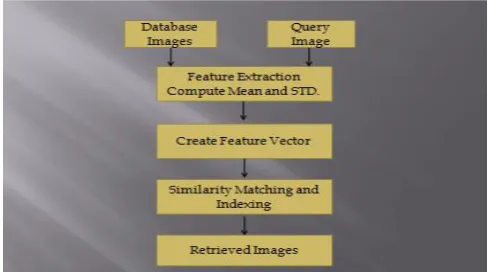
It decompose up to three level. when decomposition image options area unit extracted like , mean ,std. etc. The similarity is matching with the assistance geometer distance. Indexing is done with help of sorted distance and images will retrieved.Figure 2.1: Block Diagram of Wavelet BasedTexture Features for CBIR
The wave remodel may be a remodel of this kind. It provides the time-frequency illustration. (There square measure alternative transforms that provide this info too, like short time Fourier remodel, Eugene Paul Wigner distributions,etc.) typically times specific|a specific|a selected} spectral element occurring at any instant may be of particular interest. In these cases it should be terribly useful to grasp the time intervals these explicit spectral parts occur. for instance, in EEGs, the latency of associate degree event-related potential is of explicit interest (Event-related potential is that the response of the brain to a selected information like flash-light, the latency of this response is that the quantity of your time move on between the onset of the information and also the response).
[image:2.595.47.292.198.334.2]All the information pictures were rotten victimisation complete and overcomplete illustration of standard 2-band wave and (M=3) wave and options were computed on the rotten sub-bands. A Manhattan distance metric and Mahalanobis distance metric were wont to discriminate one hundred completely different textures pictures. an in depth comparison of the retrieval performance-using feature measures like variance, energy and mixtures of each victimisation Manhattan metric and Mahalanobis metric is conferred. The result indicates that wave improves retrieval performance considerably than standard 2-band wave.
Figure 2.2: Resulted Images for CBIR
III. OBJECTIVE
International Journal of Emerging Technology and Advanced Engineering
Website: www.ijetae.com (ISSN 2250-2459,ISO 9001:2008 Certified Journal, Volume 3, Issue 12, December 2013)
719
A Manhattan distance metric and Mahalanobis distance metric were accustomed discriminate 116 totally different textures. a close comparison of the retrieval performance-using feature measures like variance, energy and combos of each exploitation Manhattan metric and Mahalanobis metric is given. The result indicates that riffle improves retrieval performance considerably than typical 2-band riffle.IV. PRINCIPLE OF CBIR
A typical CBIR system as shown in Fig two.2 mechanically extract visual attributes (colour, shape, texture and abstraction information) of every image within the info supported its pel values and stores in an exceedingly totally different info at intervals the system referred to as feature info. The feature knowledge for every of the visual attributes of every image is extremely abundant smaller in size compared to the image knowledge. so the feature info contains AN abstraction (compact form) of the photographs within the image database; every image is described by a compact illustration of its contents (colour, texture, form and abstraction information) within the variety of a set length real-valued multi-component feature vectors or signature. The users typically formulate question image and gift to the system. The system mechanically extract the visual attributes of the question image within the same mode because it will for every info image, so identifies pictures within the info whose feature vectors match those of the question image, and types the most effective similar objects in step with their similarity price.
Throughout operation the system processes less compact feature vectors instead of the big size image knowledge so giving CBIR its low cost, quick and economical advantage over text-based retrieval. CBIR system is utilized in one in every of 2 ways that. First, precise image matching, that's matching 2 pictures, one AN example image and therefore the alternative, image in image info. Second is approximate image matching, that is finding most closely match pictures to a question image.
V. HISTORY OF DIFFERENT TYPES CBIR
An image retrieval system could be a automatic data processing system for browsing, looking and retrieving pictures in a picture information. Text-based and content-based area unit the 2 techniques adopted for search and retrieval in image information. In text-based retrieval, pictures area unit indexed mistreatment keywords, subject headings or classification codes, that successively area unit used as retrieval keys throughout search and retrieval.Text-based retrieval is non-standardized as a result of completely different|completely different} users use different keywords for annotation.
Text descriptions area unit generally subjective and incomplete as a result of it cannot depict difficult image options fine. Examples area unit texture pictures that can't be delineated by text. In text retrieval ,humans area unit needed to in person describe each image within the information, therefore for an oversized image information the technique is cumbersome, dear and effortful. Content-based image retrieval (CBIR) technique use image content to go looking and retrieve digital pictures [2].
Content-based image retrieval system was introduced to handle the issues related to text-based image retrieval. varied benefits of content-based image retrieval over text-based retrieval. However, text-based and content-based image retrieval techniques complement one another. Text-based techniques will capture high-level feature illustration and ideas. it's simple to issue text queries however text-based techniques cannot settle for pictorial queries. On the opposite hand, content-based techniques will capture low-level image options and settle for pictorial queries. however they can't capture high-level ideas effectively.The literature survey for this treatise is conducted for the treatise altogether doable suggests that, through media of text books, journal papers, international and national conference papers, technical magazines and net. particularly the efforts area unit created to check varied measures for performance analysis of ripple Besed Texture options for Content primarily based Image Retrieval. Literature survey is being conducted on following topics that reviews the realm.
Need ripple Besed Texture options for Content primarily based Image Retrieval. Hurdles of ripple Besed Texture options for Content primarily based Image Retrieval. completely different algorithms that may used for the event of ripple Besed Texture options for Content primarily based Image Retrieval.
VI. TEXTURE FEATURE EXTRACTION
Since there's no accepted mathematical definition for texture, many various ways for computing texture options are planned over the years. sadly, there's still no single methodology that works best with every kind of textures. The ordinarily used ways for texture feature description area unit applied math and transform-based ways.
International Journal of Emerging Technology and Advanced Engineering
Website: www.ijetae.com (ISSN 2250-2459,ISO 9001:2008 Certified Journal, Volume 3, Issue 12, December 2013)
[image:4.595.70.261.132.309.2]720
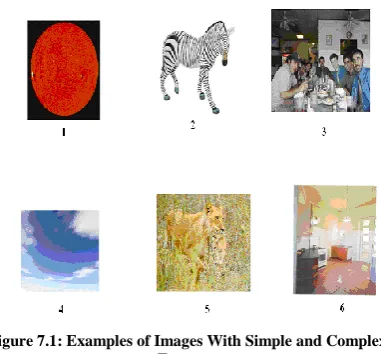
Figure 7.1: Examples of Images With Simple and Complex Features
Gray level co-occurrence methodology use grey-level co-occurrence matrix to sample statistically the means bound levels occur in relevance alternative grey-levels. Grey-level matrix may be a matrix whose parts live the relative frequencies of incidence of gray level combos among pairs of pixels with a such spatial relationship.
The theory of gray level co-occurrence matrix is explained below Given a picture Q (i, j), letp(I,j) be position operator, and A be N*N matrix whose component A(i , j) is that the range of times that points with gray level (intensity) g(i) occur, within the position such by the connection operator ,p, relative to points with gray level g(j). Let P be the N*N matrix that's created by dividing A with the whole range of purpose pairs that satisfy p. p(i , j) may be a live of the chance that a combine of points satisfying p can have values , g(i), g(j).p is named a co-occurrence matrix outlined by p. the connection operator is outlined by AN angle θ and distance d.
Gray-level co-occurrence matrix methodology of representing texture options have found helpful aplication in recognizing material defects. the idea of the applying springs from the actual fact that a material defect image is characterised by its primitive properties similarly because the spatial realtionships between them.
Figure 7.2: Demonstration of Co-occurrence Matrix Representation
A grey level co-occurrence is laid out in a matrix of the relative frequencies with that 2 neighboring pixels separated by a distance occur on the image. By applying the co-occurrence matrix and grey relative analysis of the grey theory, characteristic values of a cloth defect image is extracted and also the defects classified to acknowledge common issues like broken warps, broken wefts, holes, and oil stains [3].Other helpful applications of grey level co-occurrence matrix ways square measure in rock texture classification and retrieval.
Transform ways analyse the frequency content of the image to see texture options. Examples embody the employment of Fourier remodel to explain the worldwide frequency content of the image and multi-resolution analysis (wavelet remodel and Dennis Gabor wavelets) that uses a window operate whose breadth changes because the frequency changes.
A sinusoid is that the curve of the {sine|sin|trigonometric operate|circular function} function. it's typically referred to as trigonometric function as shown in Fig2.6.7(A) as a result of the essential feature of the {sine|sin|trigonometric operate|circular function} function is thought of as a degree on the road a circle during a uniform manner, and also the worth of sin being the peak of the purpose. Fig 2.6.7(B) details the profile of the sinusoid.
[image:4.595.323.536.539.718.2]The advanced sinusoid may be a two-dimensional sinusoid. the primary dimension is that the real axis. It contains a circular function wave. The second dimension is perpendicular to the primary dimension. it's the imagined axis and contains a undulation. Fig.2.5shows a posh sinusoid within the time domain. The profile of the advanced sinusoid, that is that the vector combination of the $64000 and imagined elements, as shown in the Fig. 2.5 may be a spiral circular wave.
Figure 7.3: The Sinusoid Waveform
[image:4.595.57.272.635.759.2]International Journal of Emerging Technology and Advanced Engineering
Website: www.ijetae.com (ISSN 2250-2459,ISO 9001:2008 Certified Journal, Volume 3, Issue 12, December 2013)
[image:5.595.327.534.111.298.2]721
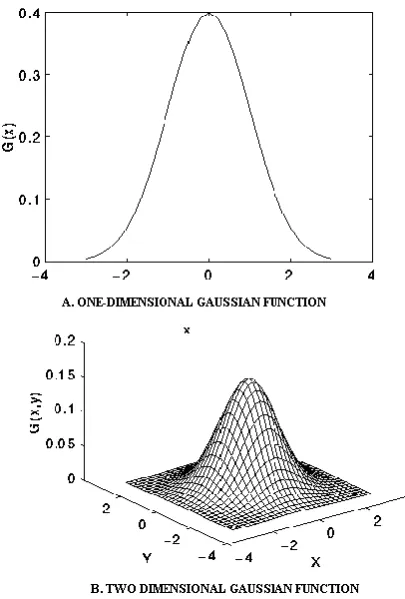
The Gaussian function is the mathematical expression for data which are randomly distributed about a mean value of with a dispersion σ. Fig.2.6 show a one and two dimensional Gaussian function having mean at the origin and standard deviation of unity.Figure 7.4: One and Two Dimensional Gaussian Function
Before 1946, the Fourier system was the state-of-the art in signal analysis. The basis of the Fourier system is representation of arbitrary signal with trigonometric functions called Fourier series. The Fourier analysis is a powerful tool with applications in diverse areas including mathematics, engineering and physics. However it has limitation. It is ideally suited to the study of stationary signals and processes that are statistically invariant over time. But there are many physical processes and signals that are non-stationary. Examples are speech and music. As far back as 1946, Dennis Gabor, the 1971 Nobel prize winner in Holography was, like every other scientist, interested in the problem of obtaining simultaneous localization in both time/space and frequency domains. He was motivated by developments in quantum mechanics including Heisenberg's uncertainty principle, and the fundamental results of Nyquist and Hartley on the limits for the transmission of information over a channel.
Fig.7.5: Global Frequency Spectrum Obtained from Fourier
VII. SPATIAL INFORMATION REPRESENTATION
[image:5.595.54.257.194.494.2]The use of symbolic images in CBIR system based on spatial information has been proposed . A symbolic image is a logical representation of the original image where each image objects or regions are uniquely labelled with symbolic names. The first step in deriving symbolic names for spatial information representation is to identify the local objects or regions in the image and their relative positions within the image Thereafter a symbolic image is obtained by associating a name with each of the objects identified. Centroid coordinates of the image objects with reference to the image frame are also extracted.
Figure. 8.1: Demonstration of Spatial Information
VIII. CONCLUSION
[image:5.595.318.536.483.658.2]International Journal of Emerging Technology and Advanced Engineering
Website: www.ijetae.com (ISSN 2250-2459,ISO 9001:2008 Certified Journal, Volume 3, Issue 12, December 2013)
722
However, it requires media specific understanding and high computing performance. This system developed an improved Wavelet based texture feature for image retrieval system. The algorithm has been implemented and tested using 100 texture images and the retrieval performance is compared to Wavelet based texture feature for image retrieval system algorithms The presented wavelet technique for content-based image retrieval are use of Texture database of 100 images is used to check the retrieval performance.REFERENCES
[1] Michael Eziashi Osadebey,”Integrated Content based Image retrieval using Texture, Shape and spatial Information”.
[2] Tomasz Andrysiak, Michakl Chora´s,”Image retrieval based on hierarchical Gabor Filtres’’, Institute of Telecommunications, University of Technology and Agriculture.
[3] Xu Wangming, Wu Jin, Liu Xinhai, Zhu Lei, Shi Gang,”Application of Image SIFT Features to The Context of
CBIR”, Engineering Research Center of
Metallurgical Automation and Measurement Technology, [4] T. Chang and C.C Kuo, “Texture analysis and classification with
tree-structured wavelet transform,” IEEE Trans on Image Processing, 2 (4), Oct 1993, pp. 429-441.
[5] Eka Aulia,” Hierarchical Indexing for Rergion based Image Retrieval”, B.S., Louisiana State University, 2001,May 2005, pp. 1-5.