Analytical Survey on Ant and Fuzzy Clustering Based
Data aggregation Techniques in Wireless Sensor Network
S. Vijiya Chandra
*, Dr. K. Alagarsamy
***
Research Scholar, Manonmanium Sundaranar University, Tirunelveli, Tamilnadu **
Associate Professor / Department of Computer Applications, Madurai Kamaraj University, Madurai, Tamilnadu
Abstract- Wireless Sensor Networks (WSNs) plays a vital role in different structured applications such as health scrutinizing, ecological observing in industries, farms, colonized areas and so on. Wireless sensor networks (WSN) engage numerous sensor nodes for data transmission with inadequate power. Due to lower cost property of wireless sensors, the degree of usability is also large in vast applications. Sensor networks are group of sensor nodes which forward sensed data to base station responsively. As sensor nodes are supported by battery, a proper utilization of energy is crucial to use networks for prolong lifetime. Hence, the challenge lies in reduce the sensor network traffic, collision found inside the network, and reduce degree of data that need to send to base station. The main objective of data aggregation algorithms is to collect and aggregate data in a proficient way so that network lifetime is enhanced. Most preferred manner to extend lifetime, reduce time and cost during data transmission enhances the WSN. One such technique is data aggregation, a more interesting approach for data collecting in shared environment and active access through wireless connectivity. The issue in data Aggregation is about the avoidance of several difficulties in terms of resource utilization, energy consumption, network lifetime, time utilized and cost required. The main problem in sensor network faces link failures and node collapses causing system failures intentionally. The principle objective of ant and fuzzy clustering based data aggregation research is not just to point out the fact about network risks keep on rising every day, but rather to defeat problems arising, just as any other system property. Extended Network lifetime should be tackled during data transmission with minimum cost and time through clustering techniques based data aggregation. This survey planned to concentrate on various data aggregation based clustering techniques in WSN, more specifically on ant and fuzzy clustering as a system property. A parametric comparison of these data aggregation techniques is also tabulated along with their advantages and issues.
I. INTRODUCTION
lustering based data aggregation in the recent research becomes an essential and recognized concern for WSN. The earlier stages of research involved large demerit in the capacity of node, also time needed for network processing is also high on wireless distributed systems. Researchers believe that in order to prolong network lifetime, a more concentration is required on the detection of node failures and link breakdown. Relevant to other clustering system and quality entity, node cooperation still needs more focus during data aggregation. However, network
functionality with sensor nodes still faces disconnection during data transmission. The huge time taken and expensive node usage, results in complexity as well as frequent unsuccessful network concerns, similar to other failure general purpose methods. Therefore, numerous exclusive and ensuing techniques to clustering based data aggregation techniques are recently proposed.
In the following survey intends in examining a variety of clustering techniques or methods for data aggregation in WSN more specifically regarding ant and fuzzy clustering. For the purposes of this survey, depict data aggregation clustering into three more convenient phases, such as general clustering technique in data aggregation along with analysis, ant clustering in data aggregation and finally fuzzy clustering in data aggregation of WSN. The review is more about evaluation agenda in clustering nodes that focus on each phase. The evaluation outline includes different issues and response conditions devised in order to explore operational functions of existing approaches in data aggregation based clustering and their respective needs in terms of energy conservation, network lifetime, packet delivery ratio, latency and various other parameters.
In this survey work, more application specific sensor network data gathering protocols, ant and fuzzy clustering techniques are discussed. The investigation is commonly on network lifetime issues in wireless sensor networks and made extensive ideas to categorize available data clustering techniques. More focus is made on three main issues, which are network lifetime, time and computational cost. This study denotes an exhibition of ant and fuzzy clustering based data aggregation model with respective concepts and issues targeting the sensor network.
The objectives of the survey is as follows
1) Spot the insufficiency or lack along with benefits of current clustering techniques and data aggregation approaches. 2) Exploit the outcomes from present techniques to decide
existing desires of clustering based data aggregation. 3) Verify whether certain techniques are valuable enough for
data aggregation and by this mean value further investigate the design presented in the existing models.
4) If no such technique is found valuable enough, the survey outline the foundation of the development of new fusion of clustering techniques with main objective to maximize the advantages and minimize the insufficiency found in existing techniques. More particularly in energy consumption, network lifetime, packet delivery ratio, latency and various other parameters.
Along with the objective for survey, a variety of principal expectation is set to anticipate survey to be more precious. The purpose of the survey is to outline the clustering techniques and data aggregation methods appropriate for application of technical principles. In addition, certain approach for developing, communicating, and managing sensor node in network. Generally, network lifetime and node cooperation through clustering is highlighted at various stages, more specifically the ant and fuzzy clustering is highly important.
II. CLUSTERING BASED DATA AGGREGATION METHODS
IN WSN
A WSN is an arrangement of large range of sensor nodes. In WSN, Sensor nodes are closely deployed. Normally sensor nodes are tiny as well as these tools are inadequate in energy computation capacities, storage, and probably pose global identification. Wireless sensor networks merge with hundreds to thousands of sensor nodes that gather information from a neglected position and transmit the gathered data to a particular user, as per constraint of application. In Wireless Sensor Network each individual sensor node is capable to sense in different approach but comprise restricted signal processing and communication potential.
Sensor nodes transmit the data to the base station. Since sensors are energy constrained, the challenge lies in transmitting data for all sensors directly to the base station protectively. Data generated from adjacent sensors is frequently unnecessary and highly interrelated. Moreover, the sum of data generated in large sensor networks is often enormous for the base station for handling. So data aggregation intends in collection of only most important data from the sensors and also make accessible to the sink in an energy efficient manner balancing minimum data latency. The principle objective of data aggregation is to merge the received data from various sensor nodes route and avoids redundancy as well as reduces the amount of transmissions, thus saving energy. With data aggregation, the strength and correctness of data obtained by entire network is enhanced. Additionally reduce the traffic load and conserves energy of the sensors in the network. Various data aggregation approaches in WSN are elaborated below
A. Structure Free Data Aggregation
In structure-free approaches the data aggregation is possible with the establishment of local information. The major advantage of structure-free data aggregation is no more additional energy is required to build any structure. Hence, probability of energy consumption is high. In structure-free data aggregations there is no preferred data gathering framework, each node along with incident data to proof sends any request initially for evaluating the next hop to the sink. Any node which receives this request is a next hop holder.
Data aggregation protocols more focused on tree-based or cluster-based structured approaches as presented in [1] minimizes the communication cost, thereby extending the lifetime of sensor networks. An adaptive energy aware aggregation tree for wireless sensor networks is proposed in [2] with highest energy available and is selected as the parent node for aggregation. Although structured approaches are appropriate
for data gathering applications, they gain high maintenance overhead in dynamic cases for event-based applications.
B. Structured Data Aggregation
Structured data aggregation is a kind of aggregation in which the network evolves specific structure. Structure based data aggregation is further categorized into four types namely cluster based, flat network based, tree based and grid based. Structured aggregation as the leading data gathering approach in WSNs suffers from high level maintenance overhead in dynamic states for event-based applications. The types of structured data aggregation are detailed below.
C. Cluster Based Data Aggregation
In cluster-based data aggregation protocols, sensor nodes are further classified into small groups termed clusters. The group formation holds a cluster head in each cluster. The cluster head is selected in order to aggregate data nearby and transmit the aggregation output to base station. The cluster head interacts with the sink node straightforwardly with the facility of extended range of radio transmission. On the other hand, this is moderately unproductive for energy controlled sensor nodes. Hence, cluster heads generally form a tree structure to send aggregated data. The main advantage of hierarchical or cluster based routing is the scalability and efficient communications. More researcher choice for data aggregation is cluster techniques due to its advantage. However, the cluster technique faces a load balancing problem. A detailed cluster based data aggregation techniques are discussed further, in order to pinpoint the merits and demerits.
III. ANALYSIS OF RECENT TRENDS IN CLUSTERING BASED
DATA AGGREGATION FOR WSN
Communication among sensors conserves a huge amount of energy and thus the sum of data transmission should be reduced in order to improve the lifetime of the sensors as well as successful bandwidth utilization. Hence, data aggregation process as elaborated in [3] is required in order to avoid redundancies in the received from various sensors. Similarly, an algorithm related to data aggregation in WSN is discussed in [4] detecting network utility maximization problem. Moreover, distributed energy efficient algorithms called AEEDPSH and ADLBPSH are presented in [5] based on the distance measured from the base station, sensor residual energy also arranging of sensor nodes to swap between sleep and active mode. Surveillance of various research papers for clustering based data aggregation techniques in WSN are detailed below:
A. Clustering Techniques in Data Aggregation
aggregation techniques. At the time of aggregation the amount of transmission are minimized by merging the similar data from the neighboring areas. With the facility of clustering technique and aggregating the correlated data, energy is greatly minimized in gathering and broadcasting the data. An energy efficient cluster based aggregation protocol (EECAP) for WSN is presented in [8] focusing mainly on aggregation protocol with divergent sink placements. The arrangements of sink like middle of the sensing field, border of the sensing field or at a location selected arbitrarily in the sensor field decides the system performances. EECAP provides better performance than LEACH as security is a concern. An enhancement of LEACH called secLEACH is proposed in [9] that maintain the structure of the original LEACH, as well as ability to perform data aggregation. In addition to EECAP, an Energy Efficient Clustering and Data Aggregation (EECDA) protocol for the heterogeneous WSNs is proposed in [10] which merge the concepts of energy efficient cluster based routing and data aggregation to achieve a better performance in terms of lifetime and stability.
Moreover, the challenging task in clustering based data aggregation is the election of cluster head (CH). The cluster head selection decides the sensor coverage range preservation in WSN. Cluster-Based Network Organization in [11] is based on a location of coverage-aware cost metrics that support nodes deployed in closely occupied network areas as better candidates for cluster head nodes, active sensor nodes and routers. Additionally, Adaptive Decentralized Re-Clustering Protocol (ADRP) for Wireless Sensor Networks in [12] also elects the CH and next heads based on residual energy of each node and the average energy of each cluster. However, ADRP with coverage-aware cost metrics increases coverage-time over the monitored area.
Moreover, Cluster-Based Network Organization [11] and ADRP [12] struggles in balancing the load. Therefore, the load balancing drawback is overcome in [13] location based clustering protocol guaranteeing balanced size cluster formation and balanced dissipation of node energy. Thus manages the load on the sensor nodes. The cluster head rotation protocol achieved balanced energy consumption among the nodes within the cluster thus prolonging the network lifetime.
Even though above data aggregation based clustering techniques are able to provide scalability, energy conservation and network lifetime, the single CH is more complex to manage the nodes even with better election process. Therefore, a novel technique is in need with a substitute for main CH in order to preserve sensor nodes.
B. Ant Clustering in Data Aggregation
Ant-colony algorithm to clustering mechanism selects the best path from cluster head to base station. The aggregation behavior of ant in communication with sensor nodes is discussed in [14] which spots the movement of an ant governed by the amount of pheromone deposited at different location of the search position. More ant-colony based clustering approaches are handles in the recent years of research for improving the network lifetime, stability and energy conservation. One such method is ant colony optimization algorithm (ACO) in [15] namely the ACO-MSS to solve the problem of examining the optimal movements of the mobile sink to maximize the network lifetime. The proposed
ACO-MSS takes favor of the large-scale finding capacity of ACO and incorporates successful heuristic information to search a near globally optimal solution. Multiple useful aspects such as the prohibited areas and the maximum moving space of the sink are considered to aid the real applications.
In addition to ACO-MSS, another clustering technique like an improved plain-based ant colony routing algorithm called IP-ACRA presented which optimizes the initial pheromone distribution. The IP-ACRA is modified to clustering-based routing algorithm termed IC-ACRA in [16]. The IP-ACRA intends at gathering the algorithm union velocity and maximizes the probability of determining the optimal path. Based on the IP-ACRA, IC-ACRA is applicable to a large scale network which is a drawback in ACO-MMS. Furthermore, a mathematical performance analysis between IP-ACRA and classic ant colony routing algorithm is determined to improve the network lifetime. The ant-colony based clustering technique in IP-ACRA faces an issue in providing QoS for wireless sensor network. This limitation is overcome with the development of routing scheme in [17] called ant-based clustered multi-path QoS routing (ACMQ). ACMQ intends at irregular clustering, sensor nodes struggle in cluster heads (CHs) using both the energy heterogeneity of adjacent sensors and the numerous cluster radius differing with their location from the Sink. Additionally, ACMQ adopts the M/M/1 queuing model to determine the numerical buffer memory. Also, the moving character of ant is proposed to build multi-path routing table in taking into account the buffer memory, the residual energy and the geographic location of relay CHs. Additionally, the similar Ant-based Clustered Multi-path is followed in [18], based on clustering and ant colony optimization for wireless sensor networks. A multipath routing protocol (MRP) based on dynamic clustering and ant colony optimization (ACO) is proposed to extend the network lifetime as in previous techniques. But both the techniques need an extra attention on bandwidth utilization.
Additionally, an algorithm for gathering sensor reading based on chain forming using Ant Colony Optimization (ACO) technique is presented in [19] in order to provide prolonged network lifetime. The ACO offers the shortest network nodes chaining instead of initiating from the extreme node and using Greedy algorithm. The head functions duration is defined for each node based on its required energy to perform the certain role in the recognized chain.
The role based activity restricts fast node’s energy reduction and thus extends network lifetime. However, the impact of data correlation on the network performance for this routing protocol still needs an additional focus, as role based activity traces single target. The problem of single target tracking in controlled mobility sensor networks is addressed in [20].
C. Fuzzy Clustering in Data Aggregation
Minimizing energy consumption and extending network lifetime are always been a challenging task in sensor networks. Most of the energy conservation during data transmission is due to the long distance of nodes from base station. Recent years researches regarding fuzzy clustering are a proficient manner of minimizing energy conservation and prolonging network lifetime of WSN. The fuzzy based clustering improves the network lifetime with better cluster head selection strategy. The three robust parameters like lifetime enhancement, energy consumption, transmission time and computational cost plays important role in deciding the performance of WSN. Fuzzy system selects the cluster head based on certain constraints like node density, residual energy and so on.
A cluster head selection strategy embedded with the traditional Fuzzy c-means algorithm is proposed in [21] with minimum distance and maximum residual energy criteria satisfied. The approach focus on residual energy of a node resulting in extended network lifetime. In Leach algorithm there is a straight interaction between cluster head with all other nodes in the cluster. But sometimes is not realistic if the cluster size is large. Similarly, a generalized fuzzy logic based approach is proposed in [22] for energy-aware routing in wireless sensor networks. This generalized approach is elastic, flexible and tunable. Hence the approach contains sensor networks with different kinds of sensor nodes holding different energy metrics.
The fuzzy sets not only prolongs the network lifetime also extends the sensor coverage of the network as in [23]. The approach determined the adjacent nodes distance measures of each sensor nodes to facilitate the data transmission. Based on the priority, nodes move from each other to increase the coverage area in the target field. In order to improve the energy efficiency and achieve the network load balance, an unequal clustering scheme based on fuzzy logic is presented in [24]. Local data of unsure cluster heads including residual energy, space to base station and local density were taken into account for the purpose of cluster construction. The CH possibility to final decision making in CH used adaptive max-min ACO to find optimal path between cluster head and base station.
Total lifetime is an important concern, which is straight associated to the energy. An energy efficient dynamic clustering protocol is proposed in [25] for WSN, which uses fuzzy logic to select the cluster heads. Here, the cluster head selection is centralized, but the data collection is shared. In contrast to LEACH, this approach is able to extend the sensor network lifetime and also attains the best number of clusters in every round. This algorithm is standard and holds less computational load for larger WSN but fails in achieving the QoS. The problem of evaluating the comparison of two sets of linguistic summaries of sensor data is discussed in [26]. The fuzzy measure similarity itself could be used openly, but since the beginning locate similarity hold a function of a level cut, an aggregation operator is also adopted.
The dynamic clustering protocol faces clustering problem and the node localization difficulties. An efficient algorithm termed fuzzy logic based energy efficient hierarchical clustering in [27] is proposed to solve the clustering problem and node localization. The algorithms evolve cluster construction and well-organized data transfer. Moreover, only few cluster head based techniques
minimizes the resource utilization. Clustering is renowned technique for attaining high scalability and well-organized resource allocation in WSN. A Fuzzy c-Means (FCM) clustering approach is proposed in [28] to determine the optimal number of clusters in WSN. Energy reduction analysis for sensor network denoted that the stability region holds advanced for finest selection of number of clusters.
Although, the fuzzy clustering techniques provides a better optimal solution in the determination of shortest path with the extended lifetime and energy utilization, an efficient technique is still required to offer prolonged lifetime, as single cluster heads struggles in the process of data transmission.
IV. PARAMETRIC EVALUATIONS
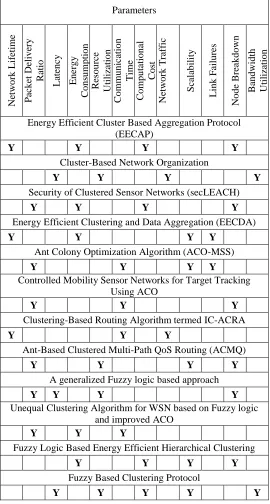
A survey of total 12 approaches is specifically elaborated below in table with distinct demerits in order to address network energy utilization, node cooperation, lifetime of network, latency, packet delivery ratio, and so on based on data aggregation and clustering techniques. Based on the results of the survey, a variety of observations and propose recommendations are provided for improving data aggregation in WSN. A table below depicts the parametric evaluations of the various approaches.
The aggregation protocol in EECAP [8] placement the sink at the middle, border or at a location selected arbitrarily in the sensor field making node alive. However, the stability of the node is better during the initial operations of the sensor networks and falls down gradually in final stages of packet transmission. Even though secLEACH [9] withstands the ability of data aggregation, the sensor node cooperation in the network is unnoticed, moving to and fro in search of neighboring areas sensing field.
Similar to EECAP, EECDA protocol in [10] incorporates cluster head election technique and selected path with maximum sum of energy residues for data transmission instead of the path with minimum energy consumption. Therefore, selection and calculation regarding sum of energy residues takes high computational time.
Since the cluster head selection is a major issue in the clustering based data aggregation techniques. Cluster-Based Network Organization in [11] concentrated on CH election but needs a few more attention on load balancing.
More particularly, the ant-colony based clustering techniques in data aggregation are focused. The ant colony optimization algorithm (ACO) in [15] namely the ACO-MSS solved optimal movement problem to maximize the network lifetime. But the issues lies in managing the large scale and also faces link failures.
Even though the limitation of ACO-MSS is resolved in clustering-based routing algorithm IC-ACRA [16], the network traffic occurrence is unnoticed during the transmission and needs an extra care on increasing QoS. In addition to ant-colony based clustering technique related approach in Ant-Based Clustered Multi-Path QoS Routing (ACMQ) [17] distributed traffic load among multiple paths.
for different network and node criteria basically by altering shapes of the fuzzy sets as in [22]. The generalized approach in [22] faces a high computational cost due to the evaluation of fuzzy sets shapes in each condition.
Table I: Performance Metric Evaluation on Clustering Based Data Aggregation Techniques in WSN
Parameters
Netwo
rk
L
if
etim
e
Pack
et
Deliv
er
y
R
atio
L
aten
cy
E
n
er
g
y
C
o
n
su
m
p
tio
n
R
eso
u
rce
Utilizatio
n
C
o
m
m
u
n
icatio
n
T
im
e
C
o
m
p
u
tatio
n
al
C
o
st
Netwo
rk
T
raf
fic
Scalab
ilit
y
L
in
k
Failu
res
No
d
e
B
rea
k
d
o
wn
B
an
d
wid
th
Utilizatio
n
Energy Efficient Cluster Based Aggregation Protocol (EECAP)
Y Y Y Y
Cluster-Based Network Organization
Y Y Y Y
Security of Clustered Sensor Networks (secLEACH)
Y Y Y Y
Energy Efficient Clustering and Data Aggregation (EECDA)
Y Y Y Y
Ant Colony Optimization Algorithm (ACO-MSS)
Y Y Y Y
Controlled Mobility Sensor Networks for Target Tracking Using ACO
Y Y Y
Clustering-Based Routing Algorithm termed IC-ACRA
Y Y Y
Ant-Based Clustered Multi-Path QoS Routing (ACMQ)
Y Y Y Y
A generalized Fuzzy logic based approach
Y Y Y Y
Unequal Clustering Algorithm for WSN based on Fuzzy logic and improved ACO
Y Y Y
Fuzzy Logic Based Energy Efficient Hierarchical Clustering
Y Y Y Y
Fuzzy Based Clustering Protocol
Y Y Y Y Y
The unequal clustering algorithm in [24] to determine the shortest path between CH and base station which provides lower communication cost. Still the unequal clustering algorithm fails in considering the main parameters like the maximum local density and the biggest competence radius in the process of inter-cluster routing. An energy efficient dynamic inter-clustering protocol as in [25] for WSN selects the cluster head using fuzzy logic.
The cluster head selection is centralized, but the data collection is shared. Even though, the algorithm involves less computational load, the QoS is left unnoticed during data transmission.
The same problem arises in fuzzy logic based energy efficient hierarchical clustering [27] for the more complex dynamic and distributed networks. The potential network generation is more complex. Therefore, novel technique challenges of the network are required in order to ensure service quality, network lifetime, time and computational cost.
V. CONCLUSION
A systematic review on clustering based data aggregation methods concludes the pros and cons of the existing approaches. Discussions regarding current trends in clustering techniques of data aggregation for WSN, more specifically the ant-colony and fuzzy clustering define the demands of network lifetime, energy consumption, transmission time and computational cost essential of a network. The parametric evaluation provides overall clustering based techniques and data aggregation performance. This survey motivation helps in the election of proper efficient approach. The survey offers the researchers not only with reasons to the responses given to each issue, but also a comparison from different features of all approaches surveyed.
The facts collected from the review and the data gathered from studies motivated further investigation on usefulness of developing novel WSN with prolonged lifetime, lower time and less computation cost.
A. Future Direction
Survey conveys the uncovered aspects of different areas in clustering based data aggregation techniques of WSN with lack of support. The future directions provides a way to better performance in upcoming novel techniques considering the above limitations
1) An extra attention is required more specifically in the parts of cluster head election, network lifetime, transmission time and computational cost.
2) A novel technique is in need to increase the lifetime of the nodes due to maximum number of node and link failures. 3) Moreover, the proposed techniques should provide a double
cluster heads as a substitute of main CH, in order to reduce the load of CH.
4) A novel technique with the adoption of ACO, is able to minimize the time and cost involved in collecting the local information.
Above areas of need become part of future work. On fulfilling the above needs, ant and fuzzy clustering based data aggregation techniques is able to achieve better network lifetime as well as minimized time and cost during information gathering for a complete wireless sensor network.
REFERENCES
[2] Deepali Virmani,Tanu Sharma and Ritu Sharma, “Adaptive Energy Aware Data Aggregation Tree for Wireless Sensor Networks”, International Journal of Hybrid Information Technology Vol. 6, No. 1, January, 2013. [3] Mukesh Kumar Jha, and T.P. Sharma, “Secure Data aggregation in Wireless
Sensor Network: A Survey”, International Journal of Engineering Science and Technology, Vol. 3 No. 3 March 2011.
[4] K. B. Ashwini and G. T. Raju, “Extending Network Lifetime by Time-Constrained Data Aggregation in Wireless Sensor Networks”, Springer, Advanced Computing, Networking, and Informatics, June 2013.
[5] Samayveer Singh and Ajay K Sharma, “Energy-Efficient Data Gathering Algorithms for Improving Lifetime of WSNs with Heterogeneity and Adjustable Sensing Range”, International Journal of Computer Applications, Volume 4 – No.2, July 2010.
[6] Peter Schaffera, Karoly Farkas, Adam Horvath, Tamas Holczer, Levente Buttyan, “Secure and Reliable Clustering in Wireless Sensor Networks: A Critical Survey”, Elsevier/ACM, International Journal of Computer and Telecommunications Networking, Volume 56 Issue 11, July, 2012. [7] Suat Ozdemir, and Yang Xiao, “Secure data aggregation in wireless sensor
networks: A comprehensive overview”, Elsevier Journal, Science Direct on Computer Networks, 2009.
[8] Prakashgoud Patil and Umakant P Kulkarni, “Energy Efficient Aggregation with Divergent sink placement for wireless sensor networks”, International Journal of Ad hoc, Sensor & Ubiquitous Computing (IJASUC) Vol.4, No.2, April 2013.
[9] Leonardo B. Oliveiraa,_, Adrian Ferreirac, Marco A. Vilac-ac, Hao Chi Wongb, Marshall Bernb, Ricardo Dahaba, Antonio A.F. Loureiro, “SecLEACH—On the security of clustered sensor networks”, Elsevier, Science Direct on Signal Processing, 2007.
[10] D. Kumar, T.C. Aseri, R.B. Patel, “EECDA: Energy Efficient Clustering and Data Aggregation Protocol for Heterogeneous Wireless Sensor Networks”, International Journal of Computers, Communications & Control, March 2011, pp. 113-124.
[11] D. Kumar, T.C. Aseri, R.B. Patel, “Cluster head election techniques for coverage preservation in wireless sensor networks”, Elsevier Science Direct on Ad Hoc Networks, 2009.
[12] Fuad Bajaber, and Irfan Awan, “Adaptive decentralized re-clustering protocol for wireless sensor networks”, Elsevier Journal of Computer and System Sciences, 2011.
[13] Ashok Kumar, Vinod Kumar and Narottam Chand, “Energy Efficient Clustering and Cluster Head Rotation Scheme for Wireless Sensor Networks”, International Journal of Advanced Computer Science and Applications, Vol. 3, No. 5, 2011.
[14] Susmita Ghosh, Megha Kothari, Anindya Halder, Ashish Ghosh, “Use of aggregation pheromone density for image segmentation”, Elsevier Science Direct on Pattern Recognition Letters, 2009.
[15] Jing-hui Zhong and Jun Zhang, “Ant Colony Optimization Algorithm for Lifetime Maximization in Wireless Sensor Network with Mobile Sink”, ACM Transaction, July 2012.
[16] Xiao CAO, Ruchuan WANG, Lijuan SUN, Haiping HUANG, “A Novel Clustering-based Ant Colony Routing Algorithm in Large Scale Wireless Multimedia Sensor Networks”, Journal of Computational Information Systems, 2011.
[17] Yuan RAO, Leiyang FU, Changan YUAN, Xing SHAO, Jun ZHU, “Ant-based Clustered Multi-path QoS Routing for Wireless Multimedia Sensor Networks”, Journal of Information & Computational Science, 2012. [18] Jing Yang, Wei Zhao, Mai Xu and Baoguo Xu, “A Multipath Routing
Protocol Based on Clustering and Ant Colony Optimization for Wireless Sensor Networks”, International Journal Computer Network and Information Security, 2009.
[19] Ouadoudi Zytoune and Driss Aboutajdine, “An Optimized Energy Aware Chaining Technique for Data Gathering in Wireless Sensor Networks”, International Journal of Digital Information and Wireless Communications, 2013.
[20] Farah Mourad, Hicham Chehade, Hichem Snoussi, Farouk Yalaoui, Lionel Amodeo, and Cedric Richard, “Controlled Mobility Sensor Networks for Target Tracking Using Ant Colony Optimization”, IEEE Transactions on Mobile Computing, Vol. 11, No. 8, August 2012.
[21] Sudakshina Dasgupta and Paramartha Dutta, "An improved Leach approach for Head selection Strategy in a Fuzzy-C Means induced clustering of a
Wireless Sensor Network", IEMCON 2011 organised by IEM in collaboration with IEEE on 5th & 6th of Jan,2011, pp. 203-208, 2010. [22] Tarique Haider and Mariam Yusuf, “A Fuzzy Approach to Energy
Optimized Routing for Wireless Sensor Networks” The International Arab Journal of Information Technology, Vol. 6, No. 2, April 2009.
[23] Bahareh J. Farahani, Hossein Ghaffarian, Mahmood Fathy, “A Fuzzy Based Priority Approach in Mobile Sensor Network Coverage”, International Journal of Recent Trends in Engineering, Vol 2, No. 1, November 2009. [24] MAO Song, ZHAO Cheng-lin, “Unequal clustering algorithm for WSN
based on fuzzy logic and improved ACO”, Elsevier Science Direct on Posts and Telecommunications, December 2011.
[25] Md. Abdul Alim, Yucheng Wu, and Wei Wang, “A Fuzzy Based Clustering Protocol for Energy-efficient Wireless Sensor Networks”, Proceedings of the 2nd International Conference on Computer Science and Electronics Engineering, 2013.
[26] Anna Wilbik and James M. Keller, “A Fuzzy Measure Similarity Between Sets of Linguistic Summaries”, IEEE Transactions on Fuzzy Systems, VOL. 21, NO. 1, February 2013.
[27] S. Swapna Kumar, M. Nanda Kumar, V.S Sheeba, “Fuzzy Logic based Energy Efficient Hierarchical Clustering in Wireless Sensor Networks”, International Journal of Research and Reviews in Wireless Sensor Networks (IJRRWSN) Vol. 1, No. 4, December 2011.
[28] A. S. Raghuvanshi, S Tiwari, R Tripathi and N. Kishor, “Optimal Number of Clusters in Wireless Sensor Networks: An FCM Approach”, IEEE International Conference on computer and communication Technology, September 2010.
AUTHORS
S. Vijiya Chandra, Research Scholar, Manonmanium Sundaranar
University, Tirunelveli, Tamilnadu and [email protected].
Dr. K. Alagarsamy, Associate Professor / Department of Computer