Munich Personal RePEc Archive
Data Revisions in India and its
Implications for Monetary Policy
Kishor, N. Kundan
University of Wisconsin-Milwaukee
July 2009
Online at
https://mpra.ub.uni-muenchen.de/16099/
Data Revisions in India and its Implications for
Monetary Policy
N. Kundan Kishor
University of Wisconsin-Milwaukee
yAbstract
This paper studies data revision properties of GDP growth and in‡ation as mea-sured by the Wholesale Price Index (WPI) for the Indian economy. We …nd that data revisions to GDP growth and WPI in‡ation in India are signi…cant. The results show that revisions to GDP growth and WPI in‡ation can not be characterized as either containing pure news or pure noise. We also …nd that there is a signi…cant predictable component in revisions to GDP growth and in‡ation. Our …ndings suggest that if the Reserve Bank of India were to follow a Taylor rule for its monetary policy formulation, then the interest rate based on the preliminary data would be much lower than the one based on the fully revised data.
1
Introduction
Most of the macroeconomic time-series data are subject to revisions. Data revisions pose a
problem for policymakers since they formulate policies in real-time without access to the fully
revised data. It also causes problems for economic researchers since their empirical work is
based on heavily revised data, and the policy conclusions based on the use of heavily revised
data can often be misleading in real-time. Recently there has been a surge in literature on
data revisions and its implications for policy making1. Most research on data revisions has
I am thankful to Mr. Ramesh Kolli of Central Statistical Organization, Government of India, for sharing the data on GDP releases.
yDepartment of Economics, Bolton Hall 806, University of Wisconsin-Milwaukee, WI-53201. E-mail: [email protected].
been performed on OECD countries especially the U.S. economy. The issue of data revisions
in developing countries has not attracted a great deal of attention due to lack of real-time
data2.
The macroeconomic time-series data in India are also subject to revisions. GDP growth
and the Wholesale Price Index (WPI)- the primary measure of in‡ation in India- undergo
heavy revisions. Figures 1 and 2 plot revisions to GDP growth and aggregate in‡ation in
India. It is evident from the graph that the …nal estimate of in‡ation is higher than the
preliminary estimate for the larger part of the sample since revisions are almost always
positive. The revisions to GDP growth show higher volatility before 2001, and has been
mostly positive though less volatile since then.
This paper studies the data revision properties of GDP growth and the WPI in‡ation
and its sub-components in India, namely, primary, manufacturing, and fuel in‡ation3. We
examine whether data revisions to GDP growth and in‡ation have zero mean, and whether
it can be forecasted using the information available at the time of the preliminary data
an-nouncement. This …ts in with the news versus noise literature in the data revision that has
been studied extensively for the key macroeconomic variables in the U.S.4. Conventional
wisdom also suggests that data revisions pose a serious problem for monetary policy
formu-lation, as the monetary policy makers are uncertain about the true state of the economy on
the basis of preliminary estimate of macroeconomic variables. We also examine the e¤ect
of data revisions on monetary policy formulation in India. Speci…cally, we examine how the
interest rate prescribed by a Taylor rule would di¤er if real-time data is used instead of the
fully revised data.
Literature on data revisions has become quite extensive after compilation of the
real-time data set at the Federal Reserve Bank of Philadelphia by Croushore and Stark (2001).
Croushore and Stark (2001) show that the data revisions pose a serious challenge for policy
2Notable exceptions are Urdaneta (1974), Van de Eng (1999), Chumacero and Gallego (2001) and Palis
et al. (2003)
formulation as well as the econometric estimation of the macroeconomic models. A big
part of the literature on data revisions investigate the revision properties, and tests whether
these revisions are predictable or not. Mankiw et al. (1984) tests whether preliminary
announcement of money stock are rational forecasts of …nal announcements. Mankiw and
Shapiro (1986) applied the similar analysis to GNP data. Faust et al. (2005) tested the
news versus noise hypothesis for revisions to the OECD output data, and found evidence
in support of the noise hypothesis. Croushore (2008) studied the patterns of data revisions
to the in‡ation rate in the U.S., and found that it is possible to forecast revisions from the
initial release. He noted that the initial release of in‡ation is likely to be revised up, as the
initial release is usually too low.
We …nd that revisions to GDP growth between 1997 and 2001 are characterized by
two regimes: volatile and insigni…cant revisions between 1997-2001:Q1 and mostly positive
and signi…cant revisions after 2001:Q1. The revisions to GDP growth after 2001 are also
associated with lower volatility. Data revisions to in‡ation in India are always signi…cant.
Speci…cally, we …nd that revisions to the WPI in‡ation and its sub-components are likely to
be revised up, as the preliminary estimates are too low. This e¤ect is especially pronounced
for manufacturing in‡ation which accounts for the biggest share of aggregate in‡ation.
Our results show that the data revisions to output growth and in‡ation in India can not
be strictly characterized as either containing pure news or pure noise. There is evidence of
predictability in data revisions using the preliminary announcement. We …nd that 39
per-cent of the variation in the data revisions to GDP growth between 1997:Q2-2001:Q1 can be
explained using preliminary release of GDP growth, whereas the corresponding explanatory
power of the initial release is 22 percent after 2001:Q1. Around 17 percent of the variation
in data revision to aggregate in‡ation can be explained by the initial release of the in‡ation.
The degree of predictability is greater for revisions to the manufacturing component of
in-‡ation as compared to the fuel and light, and the primary products. Around 39 percent of
the variations in revisions to manufacturing in‡ation can be explained using the preliminary
con-sistent with the late arrival of source data for the manufacturing component of the WPI.
The rejection of the pure news and the pure noise hypothesis is consistent with what has
been found by Mork (1987), and Aruoba (2008) for most of the U.S. macroeconomic time
series data. The ex-post predictability of data revision does not imply that data revisions
are forecastable in real-time. To investigate the real time predictability of data revisions, we
compare the forecast error of revision forecast generated in real-time with the actual revision
(assuming preliminary data as forecast of the …nal data), and we …nd that revision forecasts
can be substantially improved upon in real-time.
Our results show that ignoring data revision can have serious implications for monetary
policy formulation. We …nd that if the Reserve Bank of India were to follow the Taylor
rule in setting the interest rate, then the interest rate based on heavily revised data is
signi…cantly di¤erent than the one based on real-time data. The Taylor interest rates based
on the preliminary data tends to be usually too low. This implies that if the Reserve Bank
of India does not take into account the data revision that could take place in future, then
the monetary policy action may turn out to be too expansionary ex-post.
The plan of the remainder of this paper is as follows. Section 2 discusses the data
and its properties. Section 3 reviews the standard models of revision process and presents
the empirical results. Section 4 assesses the impact of data revisions on monetary policy
formulation in India and section 5 summarizes the main results.
2
Data Description
2.1
GDP Growth
The quarterly estimates of the GDP in India were introduced in 1999 beginning with the
year 1996-975. The quarterly GDP estimates once released are not revised till the release of
Q4 estimates of GDP. This implies that the GDP growth rates of Q1, Q2 and Q3 are revised
only at the time of releasing the fourth quarter GDP estimates.
5The …scal year in India runs from April to March. Hence 1996-97 implies April 1996 to March 1997. Q1
The revisions to the GDP growth are performed annually6. The Advanced Estimates
of annual national income are released two months before the close of the year. These
advanced estimates are subsequently revised and released alongwith 4th quarterly estimates
of GDP, on the last working day of June, i.e. with a lag of 3 months. The Quick Estimates
are released in the month of January of the following year with 10 months lag. Alongwith
the Quick Estimates, the estimates for the previous years are also revised and released
simultaneously. The quarterly estimates are also revised alongwith the annual estimates in
January. Revisions in GDP growth rates take place over a period of four years with the …rst
revision termed as Quick Estimates. All these revisions take place annually, at the end of
January.
In this paper, we focus on the …rst release and the current estimate of the GDP growth.
Ideally, it would have been more interesting to examine the data revision properties of
di¤erent vintages of output growth, however, we are constrained by data availability and
focus on the …nal revisions in this paper.
2.2
In‡ation
Three di¤erent price indices are published in India: the Wholesale Price Index (WPI), the
Consumer Price Index (CPI), and the GDP de‡ator. The CPI has di¤erent classi…cations:
CPI for industrial workers, CPI for urban non-manual employees, and the CPI for the rural
sector. The WPI is a weekly series announced every Thursday, the CPI is a monthly index
and is made available with a lag of about one month, while GDP de‡ator data are available
annually.
The WPI is the most comprehensive measure of prices in India, and is used widely for
policy deliberations7.. The Reserve Bank of India (RBI) also cites WPI movements in every
policy draft. The WPI covers 447 commodities and is heavily weighted towards manufactured
products. The WPI has three main sub-components: primary product, fuel, power and light,
and manufacturing products. Primary products mainly include food products. The current
weights of these three components in the calculation of the WPI are 22%, 14% and 64%
respectively. The WPI represents the quoted price of bulk transaction generally at primary
stage. It di¤ers from producer prices as the latter excludes all kind of taxes and transport
charges8.
The …rst release of the WPI is provisional with a two week lag. There is only one round
of revision and the …nal index is released after a gap of eight weeks. The di¤erence between
provisional and the …nal index is mainly due to the poor response from the manufacturing
sector. The Department of Industrial Policy and Promotion (DIPP) is able to collect only
20 per cent of the data sought from the manufacturing sector when the …rst numbers are
released. But when the …nal numbers are released, the response increases to 65 per cent.
There is an almost 100 per cent reporting in primary goods when the …nal numbers are
released.
Our sample period runs through 1998:Q2 to 2008:Q4. The quarterly estimate of WPI
is calculated using the average of the weekly estimates of WPI, and the in‡ation rate is
the quarterly changes in the price level. These quarterly changes are in percentage terms
and annualized. The sample size is constrained by the availability of the data set on the
Reserve Bank of India’s website. Unlike the U.S., there is no central database for real-time
data in India. We gather provisional data on WPI and its sub-components from the weekly
statistical supplement (WSS) published by the Reserve Bank of India. The supplement also
publishes data on the di¤erent components of WPI.
3
Forecastability of Data Revisions
3.1
Bias in Revisions and Other Summary Statistics
Table 1 shows the summary statistics of revisions to GDP growth. While we …nd that
revi-sions are insigni…cant for the whole sample, the graph of revirevi-sions in …gure 1 indicates that
the period prior to 2001 is characterized by huge swings in revisions. We suspect that the
huge revisions prior to 2001 may disproportionately a¤ect the results for the whole sample.
Therefore we divide the sample into pre-2001:Q1 and 2001:Q1-2008:Q4 subperiods9. Our
…ndings suggest that revisions are highly variable though insigni…cant in the …rst subsample
with maximum revision at 3.6 percent and minimum at -2 percent. The mean revision after
2001 has been larger and signi…cant at 10 percent. We use Newey-West (1987)
heteroskedas-ticity and autocorrelation consistent errors to test for the signi…cance of data revisions.
Table 2 reports summary statistics of data revisions to in‡ation and its sub-components
for the Indian economy. The results indicate that revisions are quite large and positive for
all variables. Among the sub-components of in‡ation, fuel component has the highest mean
revision, though the standard deviation of revision is also very high. The revisions to in‡ation
and its sub-components are signi…cant, as t-statistics are greater than two for the null of
mean revision equal to zero. The t-stat is based on Newey-West (1987) heteroskedasticity
and autocorrelation consistent errors. The interpretation of this result is that the initial
announcements of the statistical agencies are biased estimates of the …nal values. On average
the preliminary in‡ation is revised upwards with the mean annualized revision around 1.3
percent for the aggregate in‡ation. Table 2 also reports the minimum and the maximum
revisions for di¤erent components of in‡ation. The range of revisions are quite large for
in‡ation and its sub-components. The revision variability is highest for fuel followed by
primary components. We …nd that the range of revisions to manufacturing is small relative
to the other sub-components, and similar to the overall in‡ation. This is not surprising
since manufacturing accounts for two-thirds of the overall WPI in India. Hence, our results
indicate that revisions to in‡ation are signi…cant and positive, and the …nal estimate of
in‡ation is usually larger than the preliminary estimate.
3.2
Data Revisions: News or Noise
There are two extreme cases of data revision characterized by either containing news or noise
according to Mankiw, Runkle, and Shapiro (1984) and Mankiw and Shapiro (1986). Under
the news view, a statistical agency optimally uses all the available information in
announc-ing the preliminary data and revisions must re‡ect news that arrive after the preliminary
announcement. Therefore revisions must be orthogonal to all the available information at
that time. Under the noise characterization, the preliminary announcement is a noisy
mea-sure of the …nal announcement and this noise gets reduced after rounds of revisions. These
two types of data revision properties have implications for the standard error of preliminary
data and the …nal release of data. The standard error of preliminary release data is higher
than that of the …nal release under noise hypothesis, whereas the standard error of the …nal
release is higher than the preliminary release if the data revisions are characterized as news.
Formally speaking, if ypt is the preliminary estimate of variable yt and y f
t is the …nal
estimate, then we can characterize the preliminary data as equal to the …nal plus an error
term:
ypt =y f
t +"t (1)
If the noise model is correct, then the error term is orthogonal to ytf; whereas the error
term is orthogonal to the preliminary data if the news hypothesis is correct. In a regression
framework, Mankiw et al. (1984) considered the following framework:
ypt = 1+ 1y
f t +"
1
t (2)
yft = 2+ 2y
p t +"
2
t (3)
where the noise hypothesis implies testing a joint hypothesis of 1 = 0; 1 = 1;while a joint
hypothesis of 2 = 0; 2 = 1tests the news hypothesis. As argued by Aruoba (2008), these
two hypotheses are mutually exclusive but are not collectively exhaustive, that is, we can
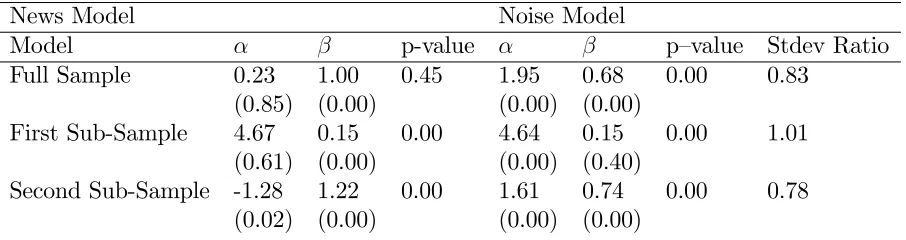
Table 3 reports the estimate of news versus noise model for GDP growth. The results
show that except for the news model for the whole sample, we reject the null of news as
well as the noise model for all sample periods. P-value in the table is the P-value for a null
hypothesis of i = 0; i = 1; i= 1;2:We observe a signi…cant di¤erence in the estimate of
and for di¤erent subsamples. The constant term is relatively large for the …rst subsample,
whereas the coe¢cient on the preliminary estimate for the news model and the …nal estimate
for the noise model is insigni…cant. This implies that revisions are on average large though
highly volatile. The results for the second subsample also rejects both the news and the
noise hypothesis. In both models, signi…cant unconditional mean is the main source of the
rejection of both hypotheses.
Table 4 reports the results for news versus noise test for aggregate in‡ation and its
sub-components. The results indicate that both the news and the noise hypotheses are rejected at
10% signi…cance level for all variables. Among the sub-components of WPI, manufacturing
provides the strongest evidence against both hypotheses. When we investigate the source of
the rejection of both hypotheses, we …nd that the constant is signi…cantly zero in all cases,
and the slope coe¢cient is statistically di¤erent from zero for manufacturing and aggregate
in‡ation. This implies that the positive unconditional mean of revisions is the main source
of the rejection of the news and the noise hypotheses.
Therefore our results suggest that revisions to GDP growth and in‡ation in India can
not be characterized as optimal forecast error or measurement error. The results obtained
here is consistent with what Mork (1987) and Aruoba (2008) found for the U.S. data.
3.3
Ex-Post Forecastability of Data Revisions
The results presented in the previous section suggest that data revisions to GDP growth
and in‡ation in India can not be characterized as either containing pure news or pure noise.
Rejection of pure news hypothesis implies that there is some degree of forecastability present
in the data revision. If revisions are not forecastable, then the conditional mean of revision
To test the degree of forecastability present in the revision process, we run the following
baseline regression:
rt= + ytp+vt (4)
where rt is the di¤erence between the …rst release and the …nal estimate of GDP growth and
in‡ation10. We test for joint hypothesis of = = 0: This equation can also be augmented
by including the variables known at time t11. This test of ex-post forecastability of data
revisions is sometimes called the Mincer-Zarnowitz test.
Table 5 presents estimation results for output growth. The results are consistent with
the rejection of the news hypothesis in the previous section. We …nd that revisions to GDP
growth for the whole sample can not be predicted using the preliminary estimate12. However,
there is strong evidence of predictability in revisions when we perform the same analysis
for di¤erent subsamples. The results imply that the coe¢cient on the explanatory variable
cancels each other out when the whole sample is taken into account. Surprisingly, the results
for the sample period before 2001:01 show that a percentage increase in the growth rate of
preliminary estimate of real GDP leads to a downward revision of 0.85 percent. Thirty two
percent of the variations to revisions in the …rst subsample is explained by the preliminary
estimate. Our results show that around 22 percent of the variations in revisions after 2001:02
are explained by the preliminary estimate. The estimated results indicate that a percentage
increase in preliminary estimate of GDP growth leads to a 0.22 percent increase in revisions.
For in‡ation, the results indicate that the preliminary announcement of WPI and its
components help in predicting subsequent revisions in 3 out of 4 cases. The degree of
predictability varies across di¤erent components. The results show that preliminary measure
of manufacturing in‡ation explains 39% of the variations in subsequent revisions, whereas
the preliminary measure of the aggregate in‡ation explains 17% of the variation in revisions.
10The test of forecastability is very similar to testing for the news hypothesis.
11Similar tests have been performed by several researchers for the U.S. data, examples include Faust et al.
(2005), Kavajecz and Collins (1995), Aruouba (2008), Croushore (2008).
12We test for the stability of equation (4) using Andrews-Ploberger test, and …nd that the null of no
For revisions to primary goods in‡ation, 10 percent of its variations can be explained by
its preliminary measure. Our results show that preliminary estimate explains 7 percent
of the variations in revisions to fuel in‡ation. Overall, results indicate that preliminary
announcement of di¤erent components of in‡ation can be used to predict the subsequent
revisions, though the degree of predictability di¤ers for di¤erent components of in‡ation.
3.4
A Real-Time Forecasting Exercise For In‡ation
The forecastability result obtained above does not imply that the data revisions are
fore-castable in real-time. The estimation results can only be observed after the fact from the
complete sample. We use the full sample information to estimate equation (4), whereas a
forecaster in real-time does not have the access to the future data. For example, if one’s goal
in 1999:Q2 is to forecast the data revisions in future, one is constrained by the availability
of data in1999:Q2 and hence can not use the future data.
Since we are constrained by the availability of di¤erent vintages of data for the GDP
growth, we focus on forecasting revisions to in‡ation in time. To investigate the
real-time predictability of data revisions in in‡ation in India, we perform the following recursive
exercise. The …rst step, using t+1 vintage data is to run the following regression:
r(t; t+ 1) = + ytp+vt (5)
where r(t; t+ 1) is the revision of period-t in‡ation that becomes available at t+1. Since
we are using quarterly data, and there is a lag of one period in the announcement of the
…nal data, the …nal estimate of period-t in‡ation and the preliminary estimate of period-t+1
in‡ation are available at t+1. Therefore using the information available at time t+1, we run
a simple OLS regression of the revision on its preliminary estimate ytp: Using the estimated
value of and ;and the preliminary estimateypt+1;which is available at t+1, we predict the
revision of period-t+1 in‡ation r(t+ 1; t+ 2). In the second step, we calculate the forecast
of the …nal estimate of in‡ation by adding the revision to the preliminary estimate, and
procedure is repeated for every new release from 2002:Q2 to 2008:Q4. Total number of
forecasts for this exercise turns out be 41. This recursive forecasting exercise provides us the
real-time forecasts of revisions.
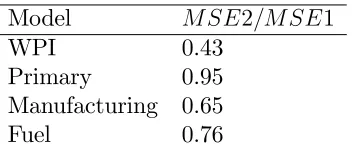
Table 7 reports the ratio of mean squared errors (MSE) of the real-time forecasts
gen-erated from the above methodology and mean squared error computed with preliminary
data as the forecast of the …nal estimate of in‡ation. The ratio below unity represents a
superior forecasting performance of the real-time recursive forecast. The results in table 4
indicate that except for fuel component of WPI in‡ation, we are able to reduce the MSE of
the revision forecasts in real-time signi…cantly. The degree of reduction in MSE is highest
for the manufacturing component, which is not surprising since the preliminary
announce-ment of manufacturing in‡ation explains 35 percent of the variation in revisions ex-post.
We do not observe a big improvement in the forecast of fuel in‡ation, which is consistent
with Mincer-Zarnowitz test results. The improvement in forecasting performance is driven
by the biasedness and the predictability of data revisions. Our examination of the property
of data revisions in previous sections shows that revisions to in‡ation are not insigni…cant,
in fact, they are large and signi…cant for aggregate and manufacturing in‡ation. Similarly,
we …nd that a signi…cant portion of the variation in revisions to in‡ation can be explained
using the preliminary announcement. The results obtained in this section indicate that we
can use preliminary data to predict data revisions in real-time, and the improvement can be
substantial for aggregate and manufacturing in‡ation.
4
Impact of Data Revisions on Monetary Policy
For-mulation
The results obtained in the previous section suggest that the GDP growth and in‡ation
undergo signi…cant revisions. As a result, it is possible that the monetary policy that may
seem appropriate in real-time may turn out to be either too tight or too loose. To investigate
the potential impact of data revisions on monetary policy in India, we perform a very simple
as well as the fully revised data. In doing so, we do not intend to evaluate the actual impact
of data revisions on the monetary policy actions of the Reserve Bank of India. Our simple
goal is to examine the di¤erences in the interest rates suggested by Taylor rule that could
arise as a result of data revisions.
We follow Taylor (1993) in computing the appropriate interest rate, which is based on
in‡ation and output gap. Taylor (1993) considers a representative policy rule which looks
like:
rt= +:5y+:5( 2) + 2 (6)
where rtis the federal funds rate implied by Taylor rule, is the rate of in‡ation, y is output
gap. We calculate …rst release and current vintage output gap using Christiano-Fitzgrald
asymmetric …lter1314.
The interest rates based on the …rst release and the latest vintage data of in‡ation and
output gap are shown in …gure 3. It is evident from the graph that the interest rate based on
fully revised data is higher on average than the interest rate based on …rst release data. This
is not surprising since our previous results show that in‡ation is most likely to be revised up
after the …rst release. To make the comparison between interest rates of these two vintages,
we also plot the di¤erence between the interest rate based on fully revised data and the …rst
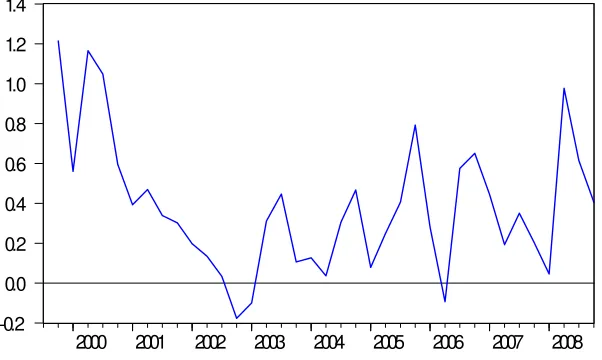
release data. As shown in …gure 4, except for a short span in 2002 and 2006, the di¤erence
is always positive. In fact, the mean of the di¤erence between the interest rates is 40 basis
points and it is signi…cant15. The results imply that if monetary policy is based on the …rst
release data, then according to the Taylor rule, the interest rates will be too loose and may
in‡ate the economy.
13The results are qualitatively similar if we use HP …lter.
14We are also aware of the problems associated with estimation of output gap, especially in a developing
country like India, however, the purpose of this exercise is not to estimate output gap but to assess the impact of data revisions on monetary policy. As long as estimated output gaps based on di¤erent methods do not move in opposite direction, the results obtained will be qualitatively similar.
15To test the signi…cance of the di¤erence beween interest rates, we regress the di¤erence on a constant.
5
Concluding Remarks
This paper studies the data revision properties of GDP growth and in‡ation and its
implications for monetary policy formulation in the Indian economy. While the GDP
un-dergoes multiple rounds of revisions, WPI which is the primary measure of prices in India,
and is used widely for policy deliberations undergoes one round of revision with a lag of
eight weeks. We …nd that revisions to WPI in‡ation and its sub-components are positive
and signi…cant. The results indicate that on average the …nal estimate of in‡ation is higher
than the preliminary estimate, and is likely to be revised up. The revisions to GDP growth
were volatile and insigni…cant before 2001, but positive and signi…cant after 2001.
Our results show that the data revisions to GDP growth and WPI in‡ation and its
sub-components can not be characterized as either containing pure news or pure noise. We …nd
that the use of preliminary data can signi…cantly improve the naive zero-forecast, which
would be optimal if the preliminary announcements are the optimal forecasts of the …nal
values. This holds for both in an ex-post forecasting exercise, as well as real-time forecasting
exercise for in‡ation.
Our results indicate that around 22 percent of the variations in revisions to output growth
after 2001:Q1 can be explained using the preliminary estimate of GDP growth, whereas the
corresponding number for aggregate in‡ation is 17 percent. The degree of predictability
for data revisions to manufacturing in‡ation is higher than the other sub-components of
in‡ation. We …nd that 39 percent of the variations in revisions to manufacturing in‡ation
can be explained using the …rst release.
The results obtained in this paper suggest that ignoring data revisions in GDP growth
and WPI in‡ation can have signi…cant policy consequences. If the Reserve Bank of India
were to follow a Taylor rule in monetary policy formulation, then our results indicate that
monetary policy based on preliminary data is too expansionary ex-post. More speci…cally,
interest rates based on preliminary data turns out to be lower than the interest rates based
References
[1] Aruoba, S. Boragan (2008),“Data Revisions are not Well Behaved, ”Journal of Money,
Credit and Banking, 40, pp. 319-340.
[2] Business Standard (2008), “Final Estimate of WPI Good Enough,” August 23.
[3] Chumacero, R. A., and Gallego, F.A., (2001), “ Trends and Cycles in Real-Time,”
Central Bank of Chile Working Paper No. 130.
[4] Croushore, Dean and Tom Stark (2001), “A Real-Time Data Set for Macroeconomists,”
Journal of Econometrics, 105, pp. 111-130.
[5] Croushore, Dean (2008a), “Revisions to PCE In‡ation Measures: Implications for
Mon-etary Policy,” Federal Reserve Bank of Philadelphia Working Paper.
[6] Croushore, Dean (2008b), “Frontiers of Real-Time Data Analysis,” Working Paper.
[7] Faust, Jon, John H. Rogers, and Jonathan H. Martin (2005), “News and Noise in G-7
GDP Announcements,” Journal of Money, Credit and Banking, 37, pp. 403-419.
[8] Government of India, Ministry of Commerce and Industry (2009), “Manual:
Compila-tion of WPI,”.
[9] Kavajecz, K.A. and S. Collins (1995), “Rationality of Preliminary Money Stock
Esti-mates,” Review of Economics and Statistics, 77, pp. 32-41
[10] Kolli, Ramesh (2004), “ Revisions in India’s GDP Estimates,” OECD/ONS Workshop
on Assessing and Improving Statistical Quality, October 2004.
[11] Mankiw, N. Gregory, and Matthew D. Shapiro (1986), “News or Noise: An Analysis of
[12] Mankiw, N. Gregory, David E. Runkle, and Matthew D. Shapiro (1984), “ Are
Prelim-inary Announcements of the Money Stock Rational Forecasts?,” Journal of Monetary
Economics, 14, pp. 15-27.
[13] Mork, Knut A. (1987), “Ain’t Behavin’: Forecast Errors and Measurement Errors in
Early GNP Estimates,” Journal of Business and Economic Statistics, 5, pp. 165-175.
[14] Newey, W. and K. West (1987), “A Simple Positive Semi-De…nite, Heteroskedasticity
and Autocorrelation Consistent Covariance Matrix,” Econometrica, 55, 703-708.
[15] Palis, Rebeca de la Rocque, Roberto Luis Olinto Ramos, and Patrice Robitaille (2004),
“News or Noise? An Analysis of Brazilian GDP Announcements,” International Finance
Discussion Papers, Federal Reserve Board.
[16] Reserve Bank of India Weekly Statistical Supplements.
[17] Taylor, J.B. (1993), “ Discretion versus Policy Rules in Practice,” Carnegie-Rochester
Series on Public Policy, 23, pp. 194-214.
[18] Urdaneta, L. (1976), “Some Aspects of the Revision of the System of National Accounts
in Venezuela,” Review of Income and Wealth, v. 22, iss. 1, pp. 37-47.
[19] Van de Eng, P.(1999), “ Some Obscurities in Indonesia’s New National Accounts,”
Figure 1: Revisions to GDP Growth
-3 -2 -1 0 1 2 3 4
97 98 99 00 01 02 03 04 05 06 07 08
REV_GDP
Figure 2: Revisions to WPI In‡ation
-1 0 1 2 3 4
99 00 01 02 03 04 05 06 07 08
[image:18.612.146.436.109.339.2]Figure 3: Interest Rates Based on Taylor Rule for Preliminary and Heavily Revised Data
0 4 8 12 16 20
2000 2001 2002 2003 2004 2005 2006 2007 2008
Taylor_Prelim Taylor_Current
Figure 4: Di¤erence in the Interest Rates Based on Taylor Rule for Preliminary and Heavily Revised Data
-0.2 0.0 0.2 0.4 0.6 0.8 1.0 1.2 1.4
[image:19.612.139.440.461.641.2]Table 1: Summary Statistics of Revisions to GDP Growth
Model Mean Minimum Maximum Std Dev t-stat
Full Sample (1997:02-2008:04) 0.23 -2 3.6 1.26 1.16 First Sub-Sample (1997:02-2001:01) 0.01 -2 3.6 1.89 0.03 Second Sub-Sample (2001:02-2008:04) 0.35 -1.2 2.1 0.78 1.70
a
Revision is …nal minus preliminary estimate. The t-stat is based on autocorrelation and heteroskedastic consistent errors and
are for the hypothesis that the mean of the revision is zero.
Table 2: Summary Statistics of Revisions to In‡ation
Model Mean Minimum Maximum Std Dev t-stat
WPI 0.89 -0.84 3.19 0.78 6.22
Primary 0.50 -2.63 6.73 1.82 1.95 Manufacturing 0.97 -1.41 3.10 0.83 6.29
Fuel 1.13 -7.48 14.42 3.22 1.83
a
The …nal and the preliminary numbers are calculated as quarterly changes in the price level, and is annualized. Revision is
…nal minus preliminary estimate. The t-stat is based on autocorrelation and heteroskedastic consistent errors and are for the
[image:20.612.67.520.537.657.2]hypothesis that the mean of the revision is zero.
Table 3: News versus Noise Model (Output Growth)
News Model Noise Model
Model p-value p–value Stdev Ratio
Full Sample 0.23 1.00 0.45 1.95 0.68 0.00 0.83 (0.85) (0.00) (0.00) (0.00)
First Sub-Sample 4.67 0.15 0.00 4.64 0.15 0.00 1.01 (0.61) (0.00) (0.00) (0.40)
Second Sub-Sample -1.28 1.22 0.00 1.61 0.74 0.00 0.78 (0.02) (0.00) (0.00) (0.00)
a
Table 4: News versus Noise Model (In‡ation)
News Model Noise Model
Model p-value p–value Stdev Ratio
WPI 0.56 1.07 0.00 -0.42 0.91 0.00 0.86 (0.00) (0.00) (0.02) (0.00)
Primary 0.10 1.09 0.02 0.11 0.88 0.00 0.88 (0.61) (0.00) (0.41) (0.00)
Manufacturing 0.45 1.16 0.00 -0.29 0.84 0.00 0.77 (0.00) (0.00) (0.00) (0.00)
Fuel 1.91 0.90 0.07 -1.15 1.00 0.15 0.95 (0.02) (0.00) (0.10) (0.00)
a
P-values are in parentheses. Newey-West heteroscedastic errors are used in estimation.
Table 5: Mincer-Zarnowitz Test (Output Growth)
Model p-value R2
SerialCorrelation
Full Sample (1997:02-2008:04) 0.23 0.01 0.45 0.00 0.21 (0.85) (0.99) (0.10) First Sub-Sample (1997:02-2001:01) 4.67 -0.85 0.00 0.39 0.16
(0.61) (0.00) (0.00) Second Sub-Sample (2001:02-2008:04) -1.27 0.22 0.00 0.22 0.30
(0.00) (0.00) (0.00)
a
[image:21.612.66.539.514.622.2]Table 6: Mincer-Zarnowitz Test (In‡ation)
Model p-value R2
SerialCorrelation
WPI 0.56 0.08 0.00 0.17 0.24 (0.00) (0.00) (0.10) Primary 0.10 0.09 0.02 0.10 0.05
(0.61) (0.00) (0.00) Manufacturing 0.45 0.16 0.00 0.39 0.28
(0.00) (0.00) (0.00) Fuel 1.91 -0.09 0.07 0.08 0.37
(0.02) (0.04) (0.18)
a
P-values are in parentheses. Newey-West heteroscedastic errors are used in estimation.
Table 7: Real-Time Forecasting Performance
Model M SE2=M SE1
WPI 0.43
Primary 0.95 Manufacturing 0.65
Fuel 0.76
a
MSE1 is the mean squared error when the preliminary data is the forecast of the …nal data. MSE2 is the mean squared error
[image:22.612.206.382.517.594.2]