Time Management Practices in Large Construction
Projects
Aftab Hameed Memon
1, Ismail Abdul Rahman
2, Ismaaini Ismail
3, Noor Yasmin Zainun
41,2
Faculty of Civil and Environmental Engineering, Universiti Tun Hussein Malaysia
86400 Parit Raja, Batu Pahat, Johor, Malaysia
1[email protected], 2[email protected], 3[email protected], 4[email protected]
Abstract— Challenge of completing construction projects within estimated time frame is biggest concern amongst the practitioners. Several approaches and tools have been introduced over the past years to enhance the management of the construction projects. This paper has identified commonly used techniques and software packages of time management together with their effectiveness level in large construction projects of Malaysia. Data was gathered through survey technique amongst the practitioners involved in handling large construction projects. Relative Importance Index calculation was employed to assess the level of effectiveness for time management techniques and software packages adopted in the construction project. The results highlighted that most common and effective time management technique and software Package are CPM and Microsoft Project respectively. Although, this technique and software package in almost every project is applied, but still the industry practitioners fail in achieving effective time management. Hence, this study recommends the further investigation be carried out in uncovering the related issue which hindrance in achieving the benefits of these in construction projects.
Index Terms— Time management, Large Construction, Time management techniques, Time control Software
I.INTRODUCTION
Time management is important in any construction project. Without proper time management, many problems will occur such as extension of time or time overrun. Some of the researchers describe time overrun as delay and some of them describe that the time overrun is an effect from the construction delay, no matter what it was described, time overrun become the most general problem in construction industry worldwide [1]-[8]. Time overrun occur when the actual progress of a construction project is slower than the planned schedule [9]. Delay or time overrun will affect all parties involved in the project. It will affect the profits which would be obtained if the project can be completed on the schedule. But due to the time overrun, contractors had to spend more money on labor, plant and may lose the opportunity to get the next project. Hence, effective time management is very important and crucial to achieve successful completion of construction projects. The aim of the study is to investigate the common application of
time management techniques and software packages in construction projects and determine the level of effectiveness both of them.
II.RELATEDWORKS
In the pursuit of efficient project performance, time control is one of the most important functions. It is more crucial in large scale and megaprojects; where various risk variables cause schedule delays. Hence, there are numerous time management techniques and software packages used for project planning and scheduling worldwide. Each of the techniques has different functions and process in providing a list of dates on which certain items are to be completed. Following sections explain all the related techniques/methods and available software packages used for time management.
A.Time Management Techniques/Methods
Time management is one of the keys to effective project management as weaknesses in the time management will cause delays in project completion [10]. Hence, time in construction projects need to be controlled from the beginning of the construction process until the project is totally completed. There are several techniques or methods commonly used for managing time in construction projects as discussed below:
1) Gantt Bar Chart
Gantt charts are simple and easy to construct and hence are the most commonly used method of scheduling and controlling in construction industry [11-12]. Besides that, Gantt charts help in managing the dependencies between tasks and determining the resources required for each activity. These are used in monitoring progress of the project. The main advantages of Gantt charts are as follows:
a) Gantt charts are useful tools for planning and scheduling projects.
b) Gantt charts allow assessment on how long a project should take.
c) Gantt charts determine the resources needed. 2) Critical Path Networks/Method
administration tasks, supporting project managers to ensure project is completed on time andbudget [14]. Critical path methods are used to determine project duration, early and late start dates float time, critical path, logical constraints and a number of other activity characteristics [15]. The major objective is to build up the feasible duration plan required to perform a specific project [16].
3)Milestone Date Programming Techniques
Milestones are important phases or direct deadline stipulations within the overall project schedule. Besides that, milestone schedule is one of the most critical schedules that must be maintained and referred throughout the project’s lifecycle. It is a summary level schedule where the project team leader can do a review and identify if any problems occur in the progress and make sure that no activity falls behind the schedule. Milestone schedule provides an estimated timeline for the project life. It includes all project activities and interim steps needed to implement the project.
4)Program Evaluation and Review Technique (PERT) The program evaluation and review technique (PERT) is a network model that allows for randomness in activity completion times. PERT was originated by the U.S. Navy in 1958 as a tool for scheduling the development of a complete weapon system [17]. The main advantages of PERT are:
a) The primary use of PERT is for the projects which have not been done before.
b) PERT provides a basis from which time and cost performance can be estimated.
c) PERT provides an assessment of the probability of reaching certain milestones by specified dates or of achieving overall project completion within a specified time period [18].
5) Elementary Trend Analysis/Line of Balance Method (LOB)
Line-of-Balance (LOB) scheduling is “a visual scheduling technique that allows the planner to explain the flow of the project explicitly” [19]. Some of the LOB scheduling advantages are listed below:
a) It clearly shows the amount of work taking place in a certain area at a specific time of the project.
b) It has the ability to highlight and optimize the resources used by large number of repeated activities, executed in several zones or locations.
c) It makes cost and time optimization analysis easier because of all the information available for each activity in the project
6) Precedence Network Diagram
The fundamental concept for precedence diagramming technique was introduced by a professor from Stanford University, John W. Fondahl in 1961 [18]. Precedence Network Diagram is quite similar with CPM, and it also widely used in the construction industry. Precedence diagrams are also easier to draw and modify; additional activities can be inserted without changing node reference numbers. There is less risk of making logical errors with precedence diagrams, since each activity is connected to others by a relationship.
7) Simulation
In construction planning, simulation is commonly used for analyzing risk events associated with the planning of construction projects [20]. Earth moving [21], aggregate production [20], tunnel construction [22], are few applications of risk analysis of the construction operation using discrete event simulation. This simplifies the skills and knowledge required for modeling a simulation network as general simulation programme can be difficult for general users [23]. B.Software for Time Management
Keeping a project on track throughout its life cycle can help in saving money by eliminating the chance for a missed deadline. There are many scheduling and management software packages to help effective scheduling and time management in construction industry as described below:
1) Primavera Project Planner
Primavera has been called one of the technology leaders in the project portfolio management. Primavera Project Planner (P3) can manage all kind of project whether large or short duration event critical project because it was designed to handle large-scale, intricate and multifaceted projects. This program is capable of organizing the resources (such as labour, material and equipment) needed by the company for managing complex and integrated projects. The main benefits of P3 include that it can handle the smaller to medium size of the project, produces various reports needed to document the project progress, and it can give real time comparison on where the project is at compared to the objectives in the business plan.
2) Microsoft Project
Microsoft project was designed to assist the project manager in developing a plan, assigning resources to tasks tracking progress, managing the budget and analysing workloads. This program has many different versions where it allows the user to understand and control project schedules and finances, to communicate and present project information, and to organize work and people to make sure that projects are completed on schedule. It also provides functionality for the user to create reports that communicate the status and progress of the project.
3) Asta Power Project
This program was developed for project planning. Asta Power Project is professional project management software where it is easy to use, and it helps to deliver the construction project in all types and size of organizations on time and within budget. Asta Power Project have same intuitive look and feel as a Microsoft office application. The activities are directly drawn onto the bar chart by using mouse or type in the spreadsheet. Asta Power Project is good planning software where it can produce professional looking project plans quickly and easily. So, it can help to win tenders and impress clients.
4) Microsoft Excel
analysis with large data sets. Excel's statistical formulas and graphing help researchers to perform various types of analysis.
5) Project Commandar
Project Commander is an extremely cost-effective planning tool written by experts in project management and enthusiastically endorsed by satisfied customers worldwide. It covers all aspects of project management from producing simple plans through to fully customizable professional output. This software is ideal for all those involved in project and resource planning, job scheduling or departmental. Besides that, Project Commander is one of the easiest software to use and also the most cost effective planning solution. It has the capability to exchange information with Microsoft Project, Power Project and Primavera.
6) Deltek Open Plan
Deltek open plan is also well known software for project planning and scheduling. This software also offers the power and flexibility to serve the differing needs of business, resource and project managers. It is because, Deltek Open Plan provides multi-project analysis, critical path planning, and sophisticated resource management. There are several advantages by using Deltek Open Plan in project planning and scheduling such as it support enterprise-level program management, improves project planning, leverage system and processes, and able to manage resources.
III.DATACOLLECTIONANDANALYSIS
This study involved quantitative mode of research using structured questionnaire survey. The respondents were asked to specify the method and software they practice in their project and their relative effectiveness using 3-likert scales. Data collection was carried out amongst clients, consultants and contractors involved in construction projects who are registered under CIDB and PKK. More than 300 sets of survey questionnaires were distributed to respondents. As a result, only 127 completed questionnaires could be collected which were analysed statistically with statistical software package SPSS. Relative importance index (RII) method was used to assess the effectiveness of time management methods and software packages. RII value was calculated with following formula:
Where;
w = weighting given to each factor by respondents and it ranges from 1 to 3
x = frequency of ith response given for each cause A = highest weight (i.e. 3 in this case)
N = total number of participants
IV.RESULTSANDDISCUSSIONS
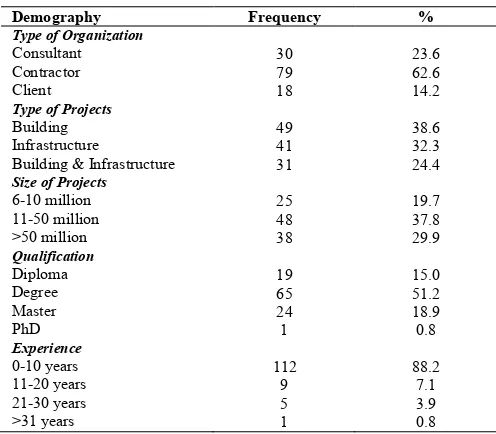
The demography of respondents is presented in Table 1.
TABLE I. RESPONDENTS’DEMOGRAPHY
Demography Frequency %
Type of Organization
Consultant Contractor Client
30 79 18
23.6 62.6 14.2
Type of Projects
Building Infrastructure
Building & Infrastructure
49 41 31
38.6 32.3 24.4
Size of Projects
6-10 million 11-50 million >50 million
25 48 38
19.7 37.8 29.9
Qualification
Diploma Degree Master PhD
19 65 24 1
15.0 51.2 18.9 0.8
Experience
0-10 years 11-20 years 21-30 years >31 years
112 9 5 1
[image:3.595.306.554.67.284.2]88.2 7.1 3.9 0.8
Table I indicates that the majority of the respondents were working with contractor organizations which represent 62.6% of respondents followed by consultants and clients with %age of 23.6 and 14.2 respectively. The respondents were involved in handling both type of project i.e. building and infrastructure. Majority of the respondents i.e. 37.8% involved in projects cost 11-50 million. Most of the respondents involved in the survey were holding bachelor degree in term of education qualification with the highest percentage 51.2% compare to others. Survey statistics showed that 88.2% of the respondents have experience below 10 years, 7.1% of respondents with 11 to 20 years’ experience, 3.9% with 21 to 30 years of experience and only 0.8% of respondents with above 31 years’ experience. A.Time Management Techniques
[image:3.595.315.555.501.648.2]Figure 1 shows %age of respondents having practices various techniques in their project. The level of effectiveness for the techniques is ranked by using the Relative Important Index (RII) for overall analysis as shown in table II.
Fig. 1. Technique/Methods for Time Management
of 97.6% of respondents, followed by Gantt Bar Chart with 92.1% of respondents and Milestone technique with 81.9% of respondents.
Table II shows the ranking of techniques of time control analysed based on RII values. Results show that CPM is the most effective method of time management paced at first ranked (with RII=0.73.) With RII value of 0.64, Gantt Bar Chart was ranked at second place while third ranked was found as Milestone with RII=0.61. LOB and Precedence Network Diagram were at same rank as 4th ranked, followed by PERT and Simulation.
TABLE II. EFFECTIVENESS OF TIME MANAGEMENT TECHNIQUES
B.Software Packages
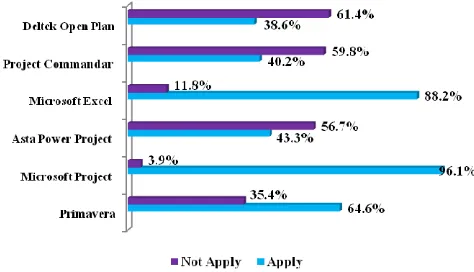
[image:4.595.304.564.162.275.2]There are many scheduling and management software packages to help in achieving effective scheduling and time management in the construction industry. Figure 2 shows the result of software packages commonly applied in construction projects. Data gathered was also analysed to show the level of effectiveness for each software packages as presented in table III.
Fig. 2. Software Packages for time control
Figure 2 shows that most of the organization with 96.1% of respondents used Microsoft Project software to control construction time in the projects. This might be because of it is easy to operate and obtain progress directly. The second commonly used software is Microsoft Excel with 88.2% of respondents applies this software. While, Primavera Project Planner is the third software that applied by respondents with 64.6%.
From table III, the software packages are listed in rank based on the RII value. Microsoft Project is placed at first rank with RII=0.73, second ranked software is Microsoft Excel with RII=0.61, and Primavera Project Planner is third ranked software package with RII= 0.50. It is followed by Project Commandar, Asta Power Project and the lowest rank is Deltek Open Plan software.
TABLE III. EFFECTIVENESS OF TIME MANAGEMENT SOFTWARE
Software Packages RII Rank
Primavera Project Planner 0.50 3
Microsoft Project 0.73 1
Asta Power Project 0.28 5
Microsoft Excel 0.61 2
Project Commandar 0.29 4
Deltek Open Plan 0.26 6
V.CONCLUSION
Through questionnaire survey, frequency and effectiveness of various techniques and software packages of time management was assessed. The finding of the study indicated that most common and effective method of time management as perceived by the respondents was Critical Path Method (CPM). The respondent recorded that most commonly adopted software package is Microsoft Project and also this software was ranked as most effective package.
ACKNOWLEDGMENT
The authors would like to thank Centre of Research and Innovations, Universiti Tun Hussein Onn Malaysia, for encouragement and support in carrying out this research work. Also, we are thankful to construction practitioners for providing comprehensive & important information; a lot of cooperation which made data collection easier. The authors also wish to thank the anonymous reviewers of the paper for their constructive comments, valuable guidance and advice. Finally, Aftab Hameed Memon is grateful to Quaid-e-Awam University of Engineering, Science and Technology also for granting permission to carryout research work at Universiti Tun Hussein Onn Malaysia.
REFERENCES
[1] Hussin, J. Md, I. A. Rahman, and A. H. Memon, “The way
forward in sustainable construction: issues and challenges,” International Journal of Advances in Applied Sciences, vol 2(1), 2012.
[2] A. H. Memon, I. A. Rahman, M. R. Abdullah, and A. A. Abdul
Azis, “Time overrun in Malaysian construction projects: perspective of project management consultant,” Journal of Surveying, Construction and Property, vol. 2 (1), pp. 54-66, 2011.
[3] F. D. K. Fugar and A. B. Agyakwah-Baah, “Delays in building
construction projects in Ghana,” Australasian Journal of Construction Economics and Building, vol. 10 (1), 2010.
[4] Endut, I. Rohani, A. Akintoye, and J. Kelly, “Cost and time
overruns of projects in Malaysia,” Proceedings of the 2nd
Technique / Method RII Rank
Gantt Bar Chart 0.64 2
CPM 0.73 1
Milestone 0.61 3
PERT 0.49 5
LOB 0.51 4
Precedence Network Diagram 0.51 4
[image:4.595.56.293.447.583.2]Scottish Conference for Postgraduate Researchers of the Built and Natural Environment (PRoBE), Glasgow Caledonian University. Rotterdam (Netherlands), pp. 243-252, 2009.
[5] A. Enshassi, J. Al-Najjar and M. Kumaraswamy, “Delays and
cost overruns in the construction projects in the Gaza Strip,” Journal of Financial Management of Property and Construction, vol. 14 (2), pp.126-151, 2009.
[6] L. Le-Hoai, Y. D. Lee and J. Y. Lee, “Delay and cost overruns
in Vietnam large construction projects: a comparison with other selected countries,” KSCE Journal of Civil Engineering, vol. 12(6), pp. 367-377, 2008.
[7] M. Sambasivan, Y. W. Soon, “Causes and effects of delays in
Malaysian construction industry,” International Journal of Project Management, vol. 25, pp. 517–526, 2007.
[8] Y. A. Olawale and M. Sun, “Cost and time control of
construction projects: inhibiting factors and mitigating measures in practice,” Construction Management and Economics, vol. 28, pp. 509-526, 2010.
[9] M. Ibrahim, “Risk matrix for factors affecting time delay in road
construction projects: owners’ perspective,” Engineering, Construction and Architectural Management, Emerald Group Publishing Limited, pp. 609-617, 2011.
[10]K. Harold, “Project management (a systems approach to
planning, scheduling, and controlling)”, Ninth Edition. New Jersey. John Wiley & Sons, Inc.
[11]W. C. Chi, P. H. Liu, and Y. C. Tsai, “Resource-constrained
project management using enhanced theory of constraint,” International Journal of Project Management vol. 20,(7), pp. 561-567, 2002.
[12]D. Arditi, P. Sikangwan, and O. B. Tokdemir, “Scheduling
system for high rise building construction,” Construction Management & Economics vol. 20(4), pp.353-364, 2002.
[13]L. Ming and S. M. AbouRizk, “Simplified CPM/PERT
simulation model,” Journal of Construction Engineering and Management, vol. 126(3), pp. 219-226, 2000.
[14]K. Kyunghwan and J. M. Garza, “Phantom float,” Journal of
construction Engineering and Management, vol. 129(5), pp. 507-517, 2003.
[15]N. N. Chehayeb and S. M. AbouRizk, “Simulation-based
scheduling with continuous activity relationships,” Journal of Construction Engineering and Management, vol. 124(2), pp. 107-115, 1998.
[16]S. S. Leu and C. H. Yang, “A genetic-algorithm-based
resource-constrained construction scheduling system,” Construction Management & Economics, vol. 17(6), pp. 767-776, 1999.
[17]W. D. Cottrell, “Simplified program evaluation and review
technique (PERT),” Journal of construction Engineering and Management, vol. 125(1), pp. 16-22, 1999.
[18]M. T. Callahan, D. G. Quackenbush and J. E. Rowings,
“Construction project scheduling,” New York: McGraw Hill, Inc., 1992.
[19]R. Jongeling and T. Olofsson, “A method for planning of
work-flow by combined use of location-based scheduling and 4D CAD,” Elsevier Science Direct, November 15, 2007.
[20]D. Hajjar and S. M. AbouRizk, “Unified modeling methodology
for construction simulation”, Journal of Construction Engineering and Management, vol. 128(2), pp. 174-185, 2002.
[21]S. D. Smith, J. R. Osborne and M. C. Forde, “Analysis of earth
moving systems using discrete-event simulation,” Journal of
Construction Engineering and Management, vol. 121(4), pp. 388-396, 1995.
[22]J. Y. Ruwanpura, S. M. Abourizk, K. C. Er and S. Fernando,
“Special purpose simulation templates for tunnel construction operations”, Canadian Journal of Civil Engineering, vol. 28(2), pp. 222-237, 2001.
[23]J. Shi, and S. M. AbouRizk, “Resource-based modeling for