N A N O E X P R E S S
Open Access
Nano-structure fabrication of GaAs using AFM
tip-induced local oxidation method: different
doping types and plane orientations
Jung-Joon Ahn
1, Kyoung-Sook Moon
2and Sang-Mo Koo
1*Abstract
In this study, we have fabricated nano-scaled oxide structures on GaAs substrates that are doped in different conductivity types of p- and n-types and plane orientations of GaAs(100) and GaAs(711), respectively, using an atomic force microscopy (AFM) tip-induced local oxidation method. The AFM-induced GaAs oxide patterns were obtained by varying applied bias from approximately 5 V to approximately 15 V and the tip loading forces from 60 to 180 nN. During the local oxidation, the humidity and the tip scan speed are fixed to approximately 45% and approximately 6.3μm/s, respectively. The local oxidation rate is further improved in p-type GaAs compared to n-type GaAs substrates whereas the rate is enhanced in GaAs(100) compared to and GaAs(711), respectively, under the identical conditions. In addition, the oxide formation mechanisms in different doping types and plane
orientations were investigated and compared with two-dimensional simulation results.
Introduction
Atomic force microscopy (AFM) is considered as a pro-mising tool to analyze and modify the nano-scaled struc-tures and devices, and thus AFM-based local oxidation (AFM-LO) process has been intensively investigated to fabricate and modulate nano-structures and devices such as field-effect transistors and single-electron transistors with various samples including metals, semiconductors, and even insulators [1,2]. The AFM-LO process is basi-cally an anodic oxidation, where the AFM tip and sub-strate act as the cathode and anode, respectively. Thus, by applying a negative bias to a conductive AFM tip, an intense localized electric field is created at the substrate close to the tip and the mechanism of AFM-LO has been understood in terms of field-induced oxidation, which requires larger local electric field than the critical electric field of typical about 1 V/nm to dissolve the water mole-cules to H+ and OH- ions in water bridge formed around the tip [3,4] and the sample surface. Then, OH- ions are transported to the positively biased sample surface in the direction of the electric field and form the oxide structures as reacting with atoms in the sample surface [3-6].
Recently, AFM-LO has been investigated primarily on Si [5-8] and further extended to wide band gap tors [9], graphene [10], and other compound semiconduc-tors such as GaAs and AlGaAs [11-16]. In case of GaAs, AFM-LO on heavily doped p-type GaAs has been studied to improve aspect ratios and lateral resolutions of oxide structures [16]. However, the AFM local oxidation studies comparing different doping types and plane orientations of GaAs have not been reported.
In this study, we systematically performed AFM-based local oxidation on both n- and p-GaAs of different plane orientations with (100) and (711), respectively. We used a contact mode AFM for oxidation [17], which allows varying the loading forces of the tip onto the sample surfaces as the oxide structure is formed. The influence of the applied vol-tages on the formation of local oxide was also investigated and compared with numerical simulations [18,19].
Experimental
A commercial AFM (N8 ARGOS, Bruker AXS Inc., Madison, WI, USA) was used to perform AFM-LO in contact mode AFM and topography measurement in non-contact mode AFM. A Si cantilever with a Pt-coated conductive tip (ANSCM series, Appl Nano, Santa Clara, CA, USA) having a diameter of approximately 100 nm was used. The spring constant and the resonance * Correspondence: [email protected]
1
Department of Electronic Materials Engineering, Kwangwoon University, Seoul 139-701, South Korea
Full list of author information is available at the end of the article
frequency were set to 3 N/m and 70 kHz, respectively. Before performing AFM-LO, the GaAs samples were cleaned by NH4OH/H2O mixtures to remove metal
taminations and native oxides. For environmental con-trol, the microscope was placed into a closed box with the relative humidity around 45%.The local oxide pat-terns were generated on n- and p-type GaAs(100) and GaAs(711), respectively, with a doping concentration of approximately 1019cm-3, at room temperature during the experiments. The oxide structures were formed electro-chemically on the GaAs reactive surface by applying a negative bias voltage between the sample surface and the AFM probe. The electrical field was then created between the native oxide layer and the substrate, which caused the oxyanions (OH-) to drift through the oxide film [3-6]. During the AFM local oxidation in contact mode, the tip applied bias was varied in the range of 5 to 15 V and the tip loading force was modulated from approximately 60 nN to approximately 180 nN. The scan speed was fixed to 6.028μm/s, during the process.
During the AFM local oxidation in contact mode, the voltage was varied in the range of 5 to 15 V and the tip loading force was modulated from approximately 60 nN to approximately 180 nN. In addition, the chemical com-position of the grown local oxides was analyzed by an Auger electron spectroscopy (AES) system with a Schottky field emission electron source. Numerical simulations
were performed by using COMSOL Multiphysics software (FEMLAB, Burlington, MA, USA).
Results and discussion
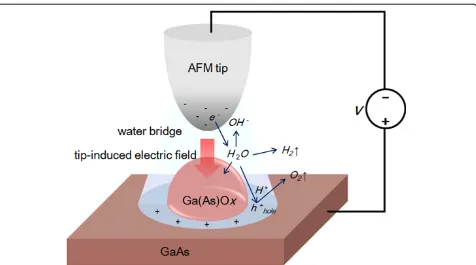
The mechanism of local oxidation on the GaAs surface by contact mode AFM using Pt-coated probe is described in Figure 1. As an AFM probe is approaching to a GaAs, a water bridge is developed around the tip-sample junction due to the capillary force. The AFM probe performs as an electrode at the sample surface which is anodically biased, while the layer of absorbed water on the surface dissoci-ates by a high electric field and acts as an electrolyte pro-ducing this electrochemical reaction. The chemical reactions and charge transfer processes can be considered as follows [12]:
1. Reactions at the GaAs surface:
2GaAs + 6H2O + 12h+hole→Ga2O3+ As2O3+ 12H+
6H2O + 12h+hole→3O2↑+12H+
2. Reaction at an AFM probe:
12H2O + 12e−→6H2↑+12OH−
3. Reaction in water:
[image:2.595.61.537.436.701.2]12H++ 12OH−→6H2O
Here, h+holerepresents positively charged holes on the
GaAs surface. During the oxidation process, it is expected that the H+ and OH- ions generated at the GaAs surface and an AFM probe will recombine immediately according to the recombination reaction in water and Ga2O3 and
As2O3are formed on the reactive surface as Ga(As)Oxis
formed.
The oxidation kinetics reported for Si [5-8] and GaAs [12-14] indicate that regardless of the materials, the observed self-limiting growth behavior is universal in AFM tip-induced oxidation and its kinetics shows some differences with the Cabrera-Mott theory [20] for field-induced oxidation. In 1997, Avouris et al. [8] proposed that the growth kinetics can be described as dh/dt∝exp (-h/lc), wherehis the oxide thickness at timetandlcis a
characteristic decay length depending on the anodization voltage. This implies that lower scan rate can be more effective in fabricating oxide structures. Other than the scan rate and anodization voltage, in performing AFM
local oxidation with contact mode AFM, we need to con-sider the tip loading force. The height and aspect ratio of oxide structures can be improved with a proper loading force integrated with the tip-surface electric field.
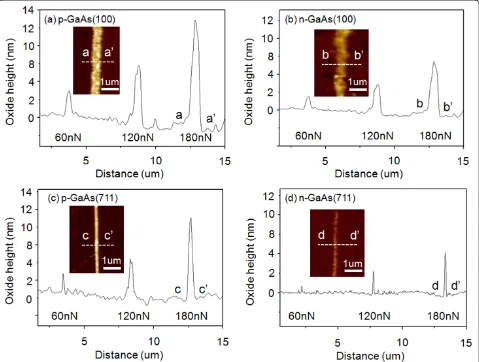
Figure 2 depicts a cross section of AFM local oxide line patterns formed on p-GaAs(100), n-GaAs(100), p-GaAs(711), and n-GaAs(711) substrates, respectively. The patterns in Figure 2 were obtained by using a con-stant negative tip voltage of 5 V at the different oxida-tion loading forces of 60, 120, and 180 nN.
By varying the loading forces from 60 to 180 nN with a fixed applied negative bias of 5 V, the height of modified oxide structures was controlled in the range of approxi-mately 3 nm to approxiapproxi-mately 14 nm. As the loading force increases from 60 to 180 nN, the height of the oxidation pattern structures increases.
[image:3.595.59.538.340.702.2]It is interesting to note that the oxide structures that are formed in p-GaAs(100) is about doubled in height to that of n-GaAs(100). We observed that increasing
loading force can result in larger and higher oxide pat-terns on GaAs with each doping type. It has been reported that increasing applied voltages can enhance the electric field between AFM tip and sample surface and cause larger oxide formation [5-7].
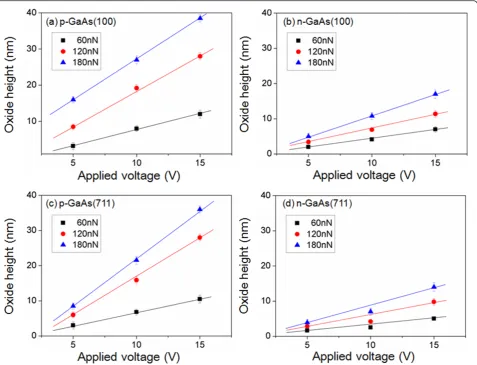
Figure 3 represents the height of oxide patterns gener-ated on GaAs substrates with different doping types and plane orientations, as a function of applied voltages from 5 to 15 V. During the local oxidation, tip loading forces in the range of 60 to180 nN were induced. The oxide pat-terns are formed at loading force of over 60 nN with an applied voltage of 5 V, which is a threshold bias voltage considering the circumstances.
The oxide heights of p-type GaAs(100) are varied from approximately 3.2 nm to approximately 39 nm which is clearly higher than that of n-GaAs(100). In the case of a n-GaAs(711), the oxide is rarely formed to be around 1.6 to 2.8 nm. It is observed that the oxide height increases, as the anodization voltage and as the loading force is
increased, as can also be seen from the linear fit to experimental data. In order to control the size of oxide patterns, the anodization voltages should also be modu-lated in close relation to the tip loading forces.
In case of p-GaAs(100), the slope extracted from the linear fit varies from 1.44 to 2.7, whereas the slope for n-GaAs(100) increases from 0.28 to 1.03, which indi-cates that the oxidation rate p-type GaAs is not only high for but is also more sensitive to the bias change than for n-type GaAs.
In order to investigate the impact of applied voltages and loading forces on tip-induced electric field, we per-formed two-dimensional simulations (COMSOL Multi-physics software, FEMLAB).
By combining the definition of potential with Gauss’ law and the equation of continuity, it is possible to derive the following Poisson’s equation:
[image:4.595.60.538.338.703.2]−∇ ·(ε0εr∇V) =ρ
whereε0is the permittivity of free space,εris the relative
permittivity, andris the space charge density. The basic geometries are shown in Figures 4 and 5, and the regions are coupled via boundary conditions;n(D1-D2) = 0 on the surfaces of substrate as continuity condition andn·D= 0 on all outer boundaries as symmetry condition andV=
V0electric potential boundary condition, wherenis the
outer normal vector to the boundary.
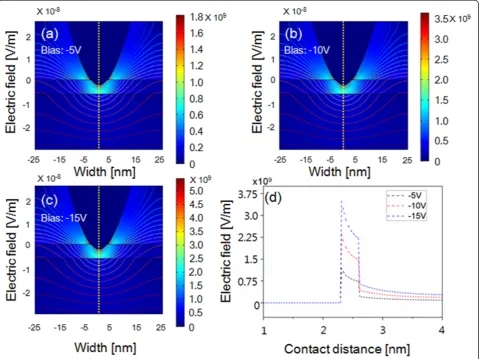
[image:5.595.59.539.345.704.2]As shown in the electric field and potential distribu-tions of Figure 4, an intense localized electric field maxi-mum is created at the edge of the tip close to the substrate for different bias conditions of -5, -10, and -15 V. The electric field is enhanced around the edge of AFM tip and substrate region. Figure 4d compares the electric field profile along the vertical cross-sectional lines for dif-ferent bias conditions. As observed in the experiments, the increased bias results in an increase in a local maxi-mum electric field and thus improved local oxidation.
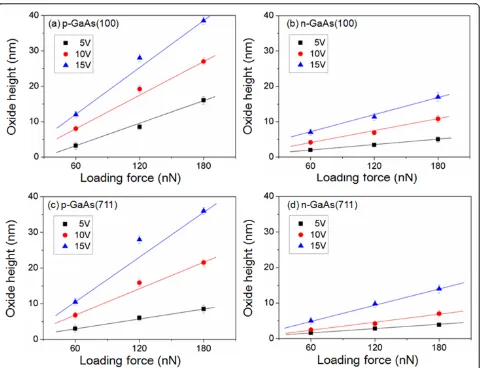
Figure 6 shows the loading force-dependent local oxide height for GaAs with different doping types and
plane orientations. The loading forces are changed from 60 to 180 nN. It can be seen that the oxide height almost linearly increases as when the loading force is increased. The slope, from the oxide height versus load-ing force plots of Figure 6, varies from 0.96 to 2.3 for p-GaAs, whereas the slope changes from 0.48 to 1.3 n-GaAs, depending on the applied bias. This behavior is similar to the experimental results on bias dependence shown in Figure 3. It is thus crucial to modulate the dis-tance between AFM tip and oxide-substrate surface so as to control the oxidation rate.
Figure 5 shows the electric field distributions and equi-potential lines in the AFM tip and substrates struc-tures with different tip-penetration depths of 0.5, 1.0, and 2.0 nm, respectively. As shown in Figure 5d, the maximum electric field forms around the edge of the tip and the surface, and therefore the distance between the maximum fields increases as the penetration depth increases. Note that the level of maximum electric field does not change much and still well above threshold
electric field of approximately 109V/m. The penetration depth, which is basically deformation of the formed oxide or substrate through water layer, is dependent on the applied loading force to the tip, which suggests improved oxidation for a higher loading force.
Figure 7 summarizes the height of oxide patterns for the GaAs samples with different doping types and plane orien-tations, as a function of applied voltages (5 and 15 V) and loading forces (60 and 180 nN). It can be observed that the oxide height is further improved by adjusting the load-ing force, for the same applied bias. Comparload-ing the oxide height of different doping type and plane orientation, it is clearly shown that p-GaAs have higher oxidation rate in both plane orientations of (100) and (711). On the other hand, GaAs(100) shows higher oxidation rate than GaAs (711) under the identical conditions.
In order to understand the behavior further and to investigate the chemical composition of the oxide
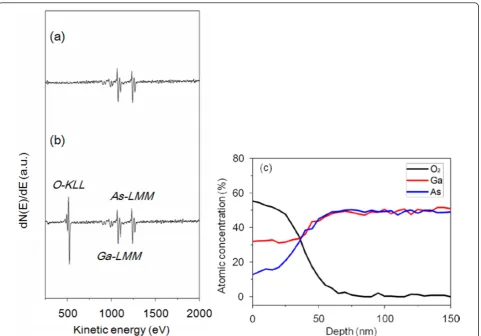
structures, AES analysis was conducted on an oxidized area of 5 × 5 μm2 (35 nm to approximately 42 nm oxide height). The Auger spectra taken from the GaAs surface without any local oxidation are compared with the local oxide patterned GaAs as shown in Figure 8a. Both spectra have emission peaks of Ga-LMM at approximately 1, 065 eV and As-LMMat approximately 1, 225 eV. The emission peak of O-KLLAuger electrons having a kinetic energy of approximately 512 eV was detected in patterned area. The atomic concentration at Ga(As)Oxand GaAs is shown in Figure 8c. The compo-sition ratio of Ga(As)Oxwas as a function of depth by sputtering into the oxidized area about 150 nm. Note that the relative atomic concentration ratio of Ga2O3is
about two times larger than that of As2O3 The results
suggest that the predominant oxide is Ga2O3, and
[image:6.595.57.544.88.474.2]surface states between Ga-rich GaAs(100) and As-rich GaAs(711) faces.
Conclusions
To summarize, the AFM tip-induced local oxidation technique has been used to investigate the oxidized nano-structures on GaAs of different doping types and plane orientations. The local oxide growth rate on GaAs is found to be proportional to both applied voltages and loading forces. Two-dimensional simulation was carried out to investigate the impact of applied voltages and loading forces on tip-induced electric field between AFM tip and GaAs surface.
[image:7.595.59.542.86.454.2]The experimental results indicate that AFM local oxi-dation on p-GaAs is further enhanced, compared to n-GaAs, and this can be attributed to the predominant oxide proportion in Ga(As)Ox that is composed of Ga2O3 and As2O3. The atomic concentration in Ga(As)
Figure 6AFM local oxidation results. Of (a) p-GaAs(100), (b) n-GaAs(100), (c) p-GaAs(711), and (d) n-GaAs(711) as a function of the applied bias voltages and the loading forces.
[image:7.595.57.292.518.695.2]Oxwas analyzed by AES analysis, and the results indi-cate that Ga(As)Ox contains both Ga2O3 and As2O3
and the atomic concentration of Ga is approximately two times larger than that of As. It supports that the predominant oxide is Ga2O3. In addition, the AFM local
oxidation on different plane orientations, GaAs(100) and GaAs(711), was investigated. The improved oxidation on (100) plane orientation has been explained by the differ-ent atomic density and surface states between Ga-rich GaAs(100) and As-rich GaAs(711) faces.
Acknowledgements
This work was supported by the Research Grant from Kwangwoon University in 2011 and by the National Research Foundation Grant: 2011-0003298..
Author details
1Department of Electronic Materials Engineering, Kwangwoon University,
Seoul 139-701, South Korea2Department of Mathematics and Information, Kyungwon University, Seongnam 461-701, South Korea
Authors’contributions
JJA carried out the AFM local oxidation process and prepared the manuscript initially. KSM participated in data analysis and performed two-dimensional numerical simulations. SMK conceived the study and
participated in its design and coordination. All authors read and approved the final manuscript.
Competing interests
The authors declare that they have no competing interests.
Received: 15 July 2011 Accepted: 6 October 2011 Published: 6 October 2011
References
1. Irmer B, Kehrle M, Lorenz H, Kotthaus JP:Nanolithography by non-contact AFM-induced local oxidation: fabrication of tunnelling barriers suitable for single-electron devices.Semicond Sci Technol1998,13:A79-A82. 2. Kremmer S, Peissl S, Teichert C, Kuchar F, Hofer H:Modification and
characterization of thin silicon gate oxides using conducting atomic force microscopy.Mater Sci Eng B2003,102:88.
3. García R, Calleja M, Rohrer H:Patterning of silicon surfaces with noncontact atomic force microscopy: field-induced formation of nanometer-size water bridges.J Appl Phys1999,86:1898.
4. Gomez-Monivas S, Saenz J, Calleja M, Garcia R:Field-induced formation of nanometer-sized water bridges.Phys Rev Lett2003,91:056101. 5. Snow ES, Jernigan GG, Campbell PM:The kinetics and mechanism of
scanned probe oxidation of Si.Appl Phys Lett2000,76:1782. 6. Dagata JA, Perez-Murano F, Abadal G, Morimoto K, Inoue T, Itoh J,
Yokoyama H:Predictive model for scanned probe oxidation kinetics.Appl Phys Lett2000,76:2710.
[image:8.595.59.541.87.423.2]8. Avouris PH, Martel R, Hertel T, Sandstrom R:AFM-tip-induced and current-induced local oxidation of silicon and metals.Appl Phys A1998,66: S659-S667.
9. Ahn JJ, Jo YD, Kim SC, Lee JH, Koo SM:Crystallographic plane-orientation dependent atomic force microscopy-based local oxidation of silicon carbide.Nanoscale Research Letters2011,6:235.
10. Masubuchi S, Ono M, Yoshida K, Hirakawa K, Machida T:Fabrication of graphene nanoribbon by local anodic oxidation lithography using atomic force microscope.Appl Phys Lett2009,94:082107.
11. Reinhardt F, Dwir B, Biasiol G, Kapon E:Atomic force microscopy of III-V nanostructures in air.Appl Surf Sci1996,104/105:529-538.
12. Huang WP, Cheng HH, Jian SR, Chuu DS, Hsieh JY, Lin CM, Chiang MS:
Localized electrochemical oxidation of p-GaAs(100) using atomic force microscopy with a carbon nanotube probe.Nanotechnology2006,
17:3838-3843.
13. Jian SR, Fang TH, Chuu DS:Mechanisms ofp-GaAs(100) surface by atomic force microscope nano-oxidation.J Phys D: Appl Phys2005,38:2424-2432. 14. Okada Y, Iuchi Y, Kawabe M:Scanning probe microscope tip-induced
oxidation of GaAs using modulated tip bias.J Appl Phys2000,87:12. 15. Graf D, Frommenwiller M, Studerus P, Ihn T, Ensslin K, Driscoll DC,
Gossard AC:Local oxidation of Ga[Al]As heterostructures with modulated tip-sample voltages.J Appl Phys2006,99:053707.
16. Shirakashi J, Matsumoto K, Konagai M:An AFM-based surface oxidation process for heavily carbon-doped p-type GaAs with a hole concentration of 1.5 × 1021cm-3.Appl Phys A1998,66:S1083-S1087.
17. Miyahara K, Nagashima N, Ohmura T, Matsuoka S:Evaluation of mechanical properties in nanometer scale using AFM-based nanoindentation tester.Nano Structured Materials1999,12:1049-1052. 18. Langehanenberg P, Bally G, Kemper B:Autofocusing in digital holographic
microscopy.3D Res2011,02:01004.
19. Merola F, Miccio L, Coppola S, Vespini V, Paturzo M, Grilli S, Ferraro P:
Exploring the capabilities of digital holography as tool for testing optical microstructures.3D Res2011,02:01003.
20. Zhdanov VP, Kasemo B:Cabrera-Mott kinetics of oxidation of nm-sized metal particles.Chemical Physics Letters2008,452:285-288.
doi:10.1186/1556-276X-6-550
Cite this article as:Ahnet al.:Nano-structure fabrication of GaAs using AFM tip-induced local oxidation method: different doping types and plane orientations.Nanoscale Research Letters20116:550.
Submit your manuscript to a
journal and benefi t from:
7 Convenient online submission 7 Rigorous peer review
7 Immediate publication on acceptance 7 Open access: articles freely available online 7 High visibility within the fi eld
7 Retaining the copyright to your article