BIROn - Birkbeck Institutional Research Online
Fairbairn, Ben (2015) Hypercubes as dessins d’enfant.
Working Paper.
Birkbeck, University of London, London, UK.
Downloaded from:
Usage Guidelines:
Please refer to usage guidelines at or alternatively
Hypercubes as
dessins
d’enfant
By
Ben Fairbairn
Birkbeck Pure Mathematics Preprint Series Preprint Number #9
Hypercubes as
dessins d’enfant
Ben Fairbairn
16 April 2015
Abstract
We describe the action of the group GL2(Z) on embeddings of hypercubes on compact
orientable surfaces, specifically classifying the elements of finite order that can change the genus of the underlying surface by an arbitrarily large amount. In doing so we give an explicit illustration of the kind of computations encountered in the study of dessins d’enfants in the hope that those new to the area may find such an explicit example useful.
1
Introduction
We first recall the definition of a dessin d’enfant.
Definition 1. A dessin d’enfant, or simply a dessin, is an ordered pair (S,D) where S is an oriented compact surface and D ⊂ S is a finite graph such that
(a) D is connected; (b) D is bipartite;
(c) X\ D is a union of finitely many topological spaces all of which are homeomorphic to the unit disc, which we call the facesof the dessin.
When the underlying surface S is clear we tend to write D instead of (S,D). We define the
genus of the dessin (S,D) to be the genus of the surface S and write g(D) for this.
Another approach to understanding Gal(Q/Q) is through its relationship to other groups. For example, some recent work of Guillot in [3] embeds this group inside the Grothendieck-Teichm¨uller group dGT0 which is also of interest to mathematical physicists. Here we discuss
another, less studied, action on dessins, namely the action of the general linear group GL2(Z)
that we shall describe in more detail in Section 2.
Some significant differences between GL2(Z) and Gal(Q/Q) are the following. The only
non-trivial elements of Gal(Q/Q) of finite order are conjugates of complex conjugation whilst in GL2(Z) there are several such classes (we shall describe these explicitly in Section 2).
Fur-thermore, the action of Gal(Q/Q) on dessins preserves the underlying genus of a dessin whilst an element of GL2(Z) can map a dessin to one with a different genus. We might naturally hope
that elements of finite order in GL2(Z) resemble elements of finite order in Gal(Q/Q) and have
no, or at least a bounded, effect on the genus of the underlying dessins. The following result dashes any such hope with the news that elements of finite order in GL2(Z) can be arbitrarily
badly behaved.
Theorem 2. Given n ∈Z+, there exist elements M ∈ GL
2(Z) of finite order such that there
exists a dessin D with the property that |g(DM)−g(D)|> n.
In other words, elements of GL2(Z) of finite order can change the genus of a dessin by an
arbitrarily large amount.
In fact we prove something slightly stronger — we classify which of the elements of finite order have precisely the property described in the above Theorem. Indeed, the proof of the above gives an explicit and unusually easy to describe example of what is otherwise a somewhat difficult action to visualise and it is hoped that those new to the area may benefit from seeing such a ‘down to Earth’ example explicitly spelt out.
Several excellent general accounts of these and related matters have appeared in recent years, for example see those given by Girondo and Gonz´alez-Diez in [2, Chapter 4], by Guillot in [3] and by ˇSir´an in [10]. The reader is warned that owing to the somewhat disparate history of the subject, the terminology here is far from being fully standardised yet. For example, what Grothendieck considered to be a dessin [4], Jones and Singerman [7] call an ‘oriented map’ and is today known as a ‘clean’ dessin in which every vertex in one of the classes (the red/white vertices — see next section) has degree 2 (see [2, Remark 4.3]).
2
Preliminaries
Recall from Definition 1 that a dessin D is a bipartite graph. Conventionally, the vertices of D are referred to as being coloured black and white but in the interests of clarity in later diagrams we will consider the vertices here as being blue and red. Aside from this, unless otherwise stated, we follow the conventions adopted in [2].
With any dessin we can associate its ‘permutation representation’, sometimes called the ‘monodromy group’ of the dessin, defined as follows. First we fix an orientation of the underlying surface. To obtain our ‘blue permutation’ we consider a small disc around each of the blue vertices and permute the edges adjoined to that vertex moving around it in a way that is consistent with the chosen orientation. We call this σ0. The ‘red permutation’, that we denote
σ1, is defined similarly around the red vertices. Just as the permutations σ0 and σ1 can be
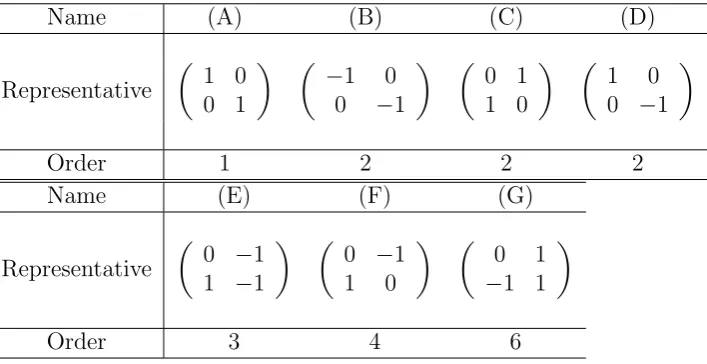
Name (A) (B) (C) (D) Representative 1 0 0 1
−1 0 0 −1
0 1 1 0
1 0 0 −1
Order 1 2 2 2
Name (E) (F) (G)
Representative
0 −1 1 −1
0 −1 1 0
0 1
−1 1
[image:5.595.66.420.93.275.2]
Order 3 4 6
Table 1: The conjugacy classes of elements of GL2(Z) of finite order.
viewed as permutations of the edges around points of the surface located at the vertices of the graph, their compositionσ2 =σ1σ0 can be viewed as a permutation of the edges around points
located at the centers of the faces.
The genus of the underlying surface of the dessin can be deduced from the cycle types of the permutations described in the previous paragraph thanks to the following result, a manifestation of the Euler-Poincar´e formula. Given a permutationπ we write #π for the number of cycles of
π.
Proposition 3. For a dessin D of genusg with N edges corresponding to the permutations σ0,
σ1 and σ2 we have that
2−2g = #σ0+ #σ1+ #σ2−N.
Proof. See [2, Proposition 4.10].
The bijective correspondence between the dessins and the 2-generated permutation groups
hσ0, σ1i gives us a natural action of GL2(Z) on dessins as follows. Any finite 2-generated
group is a quotient of the free group on two generators F2 :=hX, Y | −iby a normal subgroup
M ≤ F2. Since the action of the inner automorphism group of F2 is trivial on the set of all
such normal subgroups it follows that we have an action of the outer automorphism group
Out(F2) =Aut(F2)/Inn(F2) on these subgroups and thus on dessins. For any n ≥ 1 there is
an epimorphism
Out(Fn)→Aut(Fnab=Fn/Fn0 ∼=Z
n) = GL n(Z).
It may be shown that in the case n= 2 this epimorphism is in fact an isomorphism defining an action of GL2(Z) on dessins. In [5] James showed that this action is faithful.
The elements of finite order in GL2(Z) are well known — see the discussion given by Jones
and Pinto in [6]. We list these in Table 1.
3
Effects of elements of finite order on genera
3.1
Elements preserving the genus
By Proposition 3 any element of GL2(Z) that preserves the set of cycle types of σ0,σ1 and σ2,
and thus #σ0+ #σ1+ #σ2, will preserve the genus of the corresponding dessin. Now,
• type (A) elements preserve all three permutations and thus their cycle types;
• type (B) elements invertσ0 and σ1 whilst
σ1−1σ−01 =σ1−1(σ1σ0)−1σ1 =σ1−1σ
−1 2 σ1
so the cycle types are all preserved;
• type (C) elements interchange σ0 and σ1 whilst
σ0σ1 =σ0(σ1σ0)σ0−1 =σ0σ2σ−01
so the set of cycle types is preserved;
• type (E) elements simply permute our elements
σ0 7→σ1 7→σ2 7→σ0
so the set of cycle types is again preserved;
• finally type (G) elements are simply the product of the type (B) element with a type (E) element and therefore has no effect on the genus by the above calculations.
The type (A), (C) and (E) permutations are sometimes referred to as the ‘Mach`ı operations’ [9].
3.2
Elements not preserving the genus
It remains to determine the effect of type (D) and type (F) elements. We will first discuss the type (D) elements.
Let n be a positive integer. Recall that the hypercube Qn (sometimes called an ‘n-cube’) is
the graph whose vertices are precisely the 2n strings of the symbols 0 and 1 of length n with two strings adjoined by an edge if and only if they differ in just one place, so for example in the 7-cube the vertex 0111001 is adjoined to both of 0110001 and 1111001 (among others) but none of 1111101, 0011011, 0100001 and 0000001 (among others). Since a dart is distinguished by a vertex and an edge adjoined to it, in a hypercube we can denote a dart by specifying the vertex with a string of 0s and 1s and distinguishing which entry is changed to determine the edge. For example, in the 7-cube, the dart determined by the vertex 0111001 and the edge whose end points are 0111001 and 0110001 will be denoted 0111001. Note that the darts 0111001 and 0110001 correspond to the same edge.
It is not too difficult to see that we can define a permutation of the edges that is consistent with a choice of orientation of the underlying surface as follows. At a vertex we simply move
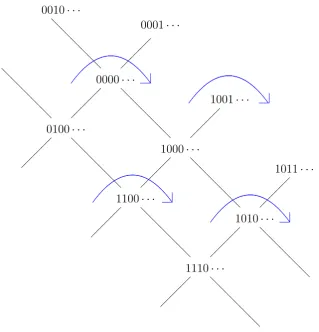
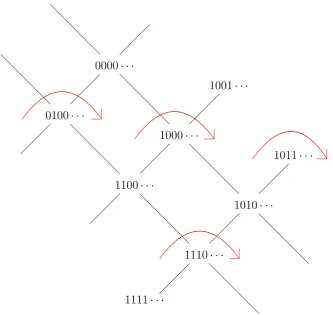
from left to right along the sequence defining that vertex changing the entries one at a time. Performing this operation at every vertex defined by a string with an even number of entries equal to 1 gives us the ‘blue’ permutation of the dessin — see Figure 1. Performing the same operation at all the other vertices, that is, the vertices defined by a sequence with an odd number of 1s, defines a red permutation that is consistent with the opposite orientation. To see this, recall that either by definition, if we view a Riemann surface as being a complex 1-manifold, or by the Riemann existence theorem, if we view a Riemann surface as being a complex algebraic curve, we can focus on a simply connected neighborhood of a vertex of the dessin where this all becomes clear — see Figure 2. (This is sometimes called a ‘Petrie walk’.) For example, the permutation defined by the vertices of the hypercube Q4 corresponding to
sequences with an even number of 1s in them using the above procedure is the blue permutation
(0000,0000,0000,0000)(1100,1100,1100,1100)(1010,1010,1010,1010)
(1001,1001,1001,1001)(0110,0110,0110,0110)(0101,0101,0101,0101)
(0011,0011,0011,0011)(1111,1111,1111,1111).
Applying the same procedure to the other vertices gives a permutation defined by the op-posite orientation, but implementing the procedure by moving along the sequence not from left to right but from right to left instead soon remedies this. For example, applying this procedure to the vertices of the 4-cube corresponding to sequences with an odd number of 1s in them gives the red permutation
(1000,1000,1000,1000)(0100,0100,0100,0100)(0010,0010,0010,0010)
(0001,0001,0001,0001)(1110,1110,11110,1110)(1101,1101,1101,1101)
(1011,1011,1011,1011)(0111,0111,0111,0111).
It is clear that this is a degree n2n−1 action and that every cycle of the permutations
constructed by the above procedures has lengthn and so the two permutationsσ0 and σ1 both
have 2n−1 cycles, that is #σ0+ #σ1 = 2n. The only ambiguity in determining the genus of the
dessin is the number of cycles of the product of the blue and red permutations by Proposition 3.
Recall that each edge has two names in terms its relationship to its vertices, for example 000· · · and 100· · · are the same edge. Direct calculation now gives us the following.
0000· · ·/1000· · · σ0
−→ 0000· · ·/0100· · ·
σ1
−→ 0100· · ·/1100· · ·
σ0
−→ 10000· · ·/1100· · ·
σ1
@ @ @ @ @ @ @ @ @ @ @ @ @ @ @ @ @ @ @ @ @ @ @ @ @ @ @ @ @ @ @ @ @ @ @ @ @ @ @ @
0000· · ·
1000· · ·
0100· · ·
0010· · ·
1100· · ·
1110· · ·
1010· · ·
0001· · ·
1001· · ·
[image:8.595.59.379.155.488.2]1011· · ·
Figure 1: The orientation of the blue permutation σ0.
@ @
@ @
@
@ @
@ @
@
@ @
@ @
@
@ @
@ @
@ @
@ @
@ @
@ @
@ @
@
@ @
@ @
@
@ @
@ @
@
0000· · ·
1000· · ·
0100· · ·
1111· · ·
1100· · ·
1110· · ·
1010· · ·
1001· · ·
[image:9.595.60.394.140.455.2]1011· · ·
It is easy to see from the above that calculations performed on other edges will give similar results and so o(σ0σ1) = 2. It follows that σ2 has n2n−2 cycles and so from Proposition 3 the
genus in this case for n >1 will be 1 + 2n−3(n−4).
If we apply the type (D) element given in Table 1 to this dessin, then this has the effect of inverting one of the two permutations. If we invert σ1, then to determine the genus of the
image of our dessin we need to calculate σ1−1σ0. Direct calculation now gives us the following.
0000· · ·/1000· · · σ0
−→0000· · ·/0100· · · σ
−1 1
−−→0110· · ·/0100· · ·
The permutation σ1−1σ0 has the effect of ‘changing 0/1s in the sequences in pairs’. In
particular, we have that o(σ1−1σ0) =n and so this permutation has 2n−1 cycles. It follows from
Proposition 3 that the genus in this case is 1 + 2n−2(n−3)≥ 1 + 2n−3(n−4). In particular,
the increase in the genus of our dessin under the action of our element is 2n−3(n−2) and this can be made arbitrarily large by taking n to be large enough. This proves Theorem 2.
For completeness, we describe the action of type (F) elements. The element given in Table 1 has the effect of replacing σ0 with σ1 and replacing σ1 with σ−01. Since σ
−1
0 σ1 = (σ1−1σ0)−1
the effect on the cycle types of these permutations and thus the genus of the underlying surface will be the same as that of the type (D) elements that we described above.
4
Concluding remarks
Question 4. Does there exist a family of graphs Dn and a finite order element M such that
g(DM
n )/g(Dn)→ ∞ as n→ ∞.
References
[1] G. V. Bely˘ı “Galois extensions of a maximal cyclotomic field” Ivz. Akad. Nauk SSSR Ser. Mat., 43(2): 267–276, 479, 1979
[2] E. Girondo and G. Gonz´alez-Diez “Introduction to Compact Riemann Surfaces and Dessins d’Enfants” London Mathematical Society Student Texts79, Cambridge University Press, Cambridge, 2012
[3] P. Guillot “An elementary approach to dessins d’enfants and the Grothendieck-Teichm¨uller group” to appear in L’enseignement Math´ematiquearXiv:1309.1968
[4] A. Grothendieck “Esquisse d’un programme” In Geometric Galois Actions, 1, volume 242 of London Mathematical Society Lecture Note Series, 5–48, Cambridge University Press, Cambridge, 1997 (English translation on pages 243–283)
[5] L. D. James “Operations on Hypermaps and Outer Automorphisms” Europ. J. Combina-torics (1988) 9, 551–560
[6] G. A. Jones and D. Pinto “Hypermap operations of finite order” Discrete Math. 310 (2010) 1820–1827 arXiv:0911.2644
[7] G. A. Jones and D. Singerman “Theory of maps on orientable surfaces” Proc. London Math. Soc. (3) 37 (1978), no. 2, 273–307
[8] S. Levy “The Eightfold Way: The Beauty of Klein’s Quartic Curve” Cambridge University Press, Cambridge 2001http://library.msri.org/books/Book35/contents.html
[9] A. Mach`ı “On the complexity of a hypermap” Discrete Math. 42 (1982), no. 2–3, 221–226