ISSN: 1992-8645 www.jatit.org E-ISSN: 1817-3195
LINKING NATIONAL STANDARDS OF DISTANCE
EDUCATION WITH E-LEARNING ECOSYSTEM
PAULA DEWANTI
STMIK STIKOM Bali, Jl. Raya Puputan No.86, Denpasar Tim., Kota Denpasar, Bali 80234, Indonesia TEL: +62 361 244445
E-mail Address: [email protected]
ABSTRACT
The standards in the educational system present specific expectations on the students’ ability in comprehending the information provided in theories and practices as well as setting guidelines to set estimation on students’ performance. It is improved in a planned, targeted, and sustainable in accordance with the changing demands of local, national, and global. Education ecosystem is seen as a compilation of supportive and complementing education institutions which feature different approaches such as the numbers of student enlisting, nationality, cultural surrounding, types of activity, level of academy, subjects and/or disciplines of the study, interest for the research and value. Given the increase in the number of students studying at colleges and universities outside their home countries, recently the research community has believed that an e-Learning Ecosystem is the next generation of the e-Learning. Accordingly, any education superintendents need to pay attention and put quality as a means to obtain the benefits of the global competition that can improve and enhance education activities. This paper seeks to provide a new multi-criteria approach to assess thus recognize any opportunity in a way that can provide a better learning experience and helping students to achieve their full potential thus escalating the level of quality for higher education to better support learners and keeping up with the global progress.
Keywords: Standards, Distance Learning, Higher Education, E-Learning Ecosystem, Educational System
1. INTRODUCTION
Applications Education opens and encourages our mind to explore further than the visible existing possibilities, which in turn will encourage the creative ability of our brain. Thus the presence of information technologies in it takes on a major part in assisting every learner to perform and proceed to their maximum potential. The approaches used in educational system have been experiencing changes since the 20th century; from the method of remedial repetition it has developed into recent approach emphasizing independent learning process [1]. To address the on-going challenge of life-long learning and to ensure learners’ productivity, e-Learning systems must be developed with flexibility and individualization in mind [3]. E-Learning, here explained as the use of internet technologies in learning process both in giving and receiving knowledge, is seen by far as the most effective answers to meet the increasing demands for education. With the economic return to college reaching the highest levels in decades, it is no surprise that individuals and nations are looking to increase their investment in higher education. A number of countries have undertaken substantive
reform of their higher education systems in recent years. Our academic programs have changed with the increase in student mobility and the freer exchange of knowledge across border [10].
E-Learning is a broad term that encompasses many teaching approaches, types of technologies and administrative practices. A challenge in analyzing e-Learning is that the technologies and their educational applications are developing extremely rapidly [14]. How can learning concretely be enhanced? With the increasing
amount of academic institutions accepting
international students, how can we globally make sure e-Learning Ecosystem is effective? These are the points that came into thoughts in this paper, enable to recognize a common set of measures across diverse nations and identify best practices.
A comparison was made between five Nations comprising China, Singapore, Japan, Finland and
United State, against Indonesia’s National
ISSN: 1992-8645 www.jatit.org E-ISSN: 1817-3195
(2) identify what advancing e-Learning
Ecosystem’s strength, and (3) make changes to existing e-Learning Ecosystem with an action plan that is more effective and meaningful to ensure
better student engagement in e-Learning.
Comparative analysis may allow identifying best practices contained in each of the specified Nations; recognizing any opportunity in a way that can provide a better learning experience, avoiding the mistake made by others and helping students to maximize their potential. The goal is to provide a new criteria approach that allows measuring the level of student engagement in learning that is supported by the e-Learning Ecosystem, by identifying what drives engagement in learning and adjust the e-Learning Ecosystem by creating effective and meaningful action plans. Establishing an e-Learning Ecosystem which creates changes of behavior, performance improvement and increased multiple abilities, which are the expected outcome of successful e-Learning, so that students will have access to gain full benefits from this specific learning experience.
2. E-LEARNING ECOSYSTEM
2.1 The Concept and Definition of e-Learning
Ecosystem
In many respects, an e-Learning Ecosystem is very similar to a scientifically-based ecosystem. According to the Encyclopedia Britannica, a natural ecosystem is the complex of living organism, their
tangible surrounding as well as their
interconnectivities within a specific compound. Furthermore, it has characteristic such as equilibration, closure, stability, persistence, fluxes, permitted dynamic and so on. An ecosystem facilitates the circulation of materials and the flow of energy, with a strong organizing and self-regulation. Every organism has a role to fulfil and there must be a harmonious balance between all aspects of the ecosystem in order for the organisms to flourish and evolve.
The ecosystem of learning is prompted by the unique approach of basic ecological idea with its holistic element and valid application to different subjects. Referring to the definition of education ecosystem as a compilation of supportive and complementing education institutions which feature different approaches such as the numbers of student enlisting, nationality, cultural surrounding, types of activity, level of academy, subjects and/or disciplines of the study, interests for the research and value; connectivity within the institutions will
elevate education standards, create more choice for students and enrich the overall student experience.
An e-Learning ecosystem transposes to concepts to the e-Learning domain, reproducing the desirable mechanisms of a natural ecosystem. Extending the definition to the Learning environment, an e-Learning ecosystem is a learning environment of which the main goal is to ensure learners acquiring intensive comprehension and extending abilities with the up-to-date technologies in educational system and authoring tools. Each participant of this particular environment is required to take part and actively contribute for the purpose of obtaining maximum outcome for all participants; and at the same time encouraging all learners to obtain beneficial features in the system to achieve their goals and objectives [4].
The main interests in the learning domain are connectivity and reciprocal actions in regards to the available information, as well as the shared knowledge and expected changes which follow after. In light of this, some conclusions are identified. Similar as those of a biological ecosystem, this system of learning environment allows individuals to form groups spontaneously and therefore encourage proactive communication among themselves or with the available learning facilities provided at personal or group level. It also provides space for them to present, alternate or blending particular behaviors in order to contribute to or perturb to the expected level of achievement in this specific learning ecosystem.
Changes in the learning ecosystem conditions influence the “behavior” outcome for the whole entity and its elements. In order to contribute and achieve the best result for this environment, every participant both in person and group will need to immerse in the existing environment in order to obtain their respective fulfilment. As such, to ensure that this system function perfectly, requirement for adequate tools and facilities need to be met.
ISSN: 1992-8645 www.jatit.org E-ISSN: 1817-3195
Figure 2: Simplified representation for the Learning Ecosystem (LES) [3]
2.2 Basic Components of an e-Learning
Ecosystem
Some of the important potential contributions of e-Learning programs in such educational systems include [14]:
(1) Addresses the shortage of teachers, especially science and other specialty teachers. It can do this by providing high quality teaching materials, such as videos, interactive software or information from a “cloud” on the Internet or a local computer. In a distant classroom or video conferencing approach, the number of students who receive live instruction from teachers in specialty subjects can be much larger. (2) Addresses the shortage of learning material such as textbooks for students. The material could be made available on hand-held devices such as e-readers or mobile phones. Interactive features such as quizzes or games could improve the level of learning and understanding. (3) Improves the quality of education by providing improved informational content and learning approaches. Interactive, communicative e-Learning may promote the development of skills in students (so called “21st Century Skills”) such as critical thinking and problem solving, communication, collaboration and creativity. (4) Provides students information and communications technology skills. The graduates will be better equipped to contribute to the knowledge-centered globalized economy of their counties.
There are a variety of elements that come into play within the e-Learning ecosystem. All of these elements must be present if both the learners and the entire e-Learning ecosystem as a whole are to thrive. According to the scientific definition, in every ecosystem there are three main components:
organisms, a physical environment, and
relationships between the organisms and their
environment. Likewise, an e-Learning ecosystem must also have these three main components in order to be successful: (1) learners/facilitators, the actual “organisms” of the e-Learning ecosystem, (2) the e-Learning space and resources, in other words the e-Learning platform where learning will actually take place and the e-Learning content learners will access, respectively, and finally (3) the e-Learning culture, that sets a positive attitude towards the overall e-Learning process and participants’ interaction with the e-Learning course.
As a thriving new ecosystem, e-Learning also consists of several basic standards which include the following: (1) Interactive features of e-Learning. A crucial element of successful ecosystem in e-Learning includes interactive features that encourage emotional connection of learners with the available courses. The features should be made in various options such as written contents, branching scenarios or even presentations in multimedia formats. All of the features should complement learners in improving learning behavior to achieve their goals while enabling themselves for better quality in life. (2) Timely continuous review. As the main element of all learning process, reviews are much needed to enable learners in obtaining maximum benefit. It is only effective when applied with appropriate timing, for example at the completion of each subject, session or module. Not only enabling the e-Learning professionals to monitor the learners’ advancement and the information they gain, reviews also enable learners to instil the information within. Various forms of e-Learning reviews may come in scenario trivia, examination online or simulations. (3) Up-to-date technologies. Other supporting factors are the application of the latest technologies and learning equipment which enable learners to perform their particular part in this unique learning environment. These two factors
will provide learners with the necessary
ISSN: 1992-8645 www.jatit.org E-ISSN: 1817-3195 successful ecosystems, particularly e-Learning
environment. Learners will not be able to perform their best in this ecosystem without stable and well-developed support system to help them proceeding. Lack of this factor will only discourage learners from being proactive in this learning environment due to no adequate and sufficient support provided. As such, including this factor is a must while continuously encouraging learning behavior.
There are some key components of successful
learning programs. Selecting only a few
components to highlight is challenging and involves an examination of a broad range of issues with each interdependent upon the other. Although particular components may assist in providing success, a sustainable program requires a multi-level approach. This would include: (1) Policy (government regulations) (a) National ministerial levels (b) District and local levels (2) Standards (a) Teacher standards (b) Student standards (c)
Administrator standards; (3) Curriculum (4)
Infrastructure (a) Hardware, software (b) Electricity (c) Connectivity (d) Technical support (5) Professional Development (a) Pre-service teacher training programs / colleges of education / teacher training colleges (b) In-service teacher training: Formal training and Informal training (c) ICT training: Training for how to use technology and Training for how to teach with technology (6) Instructional Resources.
The online access to supplemental information must be readily available to provide support for learners in developing their basic knowledge and enhance their comprehension on a specific module. A good system should also enable learners to communicate in ease with their instructors and peers for any necessary assistance; which will be encouraging for learners when they are lack of sufficient information. Learners can seek for support and shared knowledge from other learners and instructors to keep progressing and accomplish their goals in the e-Learning courses. The most important key to a successful e-Learning ecosystem is an encouraging environment that motivates every learner to proactively take part in the group.
3. NATIONAL EDUCATION STANDARDS
As quoted by Andrew S. Tanenbaum, the nice thing about standards is that there are so many to choose from. The provision of education has not been immune to standardization, with considerable activity happening in the area of e-Learning and also disproportionate attention on e-Learning
standards and quality assurance processes from Governments: Formal, transparent and credible systems of quality assurance will help guarantee a successful future for Australian universities [9]. …universities are expected to engage in a pro-active, rigorous and ongoing process of planning and self-assessment which will enable them to ensure the quality outcomes expected by their students and the wider community [9]. Teachers need technical standards to enable them to share and build on each other’s ideas, and learners need to be ensured of the quality of e-Learning materials [9]. Standards can be held to be an aspect of professionalism [9]. The inability to identify educational benefits by those involved in standards work may reflect, in part, a weakness inherent to standards which is apparent from the ISO definition of a standard: a document, established by consensus, that provides, for common and repeated use, rules, guidelines or characteristics for activities or their results, aimed at the achievement of the optimum degree of order in a given context [9].
3.1 Indonesia’s National Standards of
Education
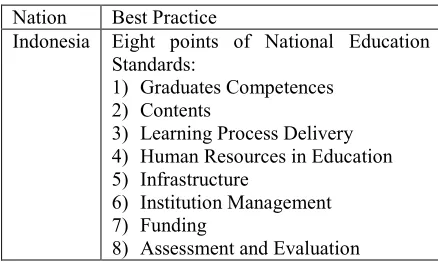
Indonesia, through Government Regulation No. 19 of 2005 established National Education Standards. It is the minimum criteria used in the educational system throughout the territory of the Republic of Indonesia and serve as basic referral in the whole process of education which include planning, application and supervision of the implementation to measure the quality of our national education. National Education Standards are established to ensure the delivery of high qualification education as its main role is to educate the nation, as character development and a dignified civilization. The purpose also includes improvement in a planned, targeted, and sustainable system in accordance with the demands of changes in local, national, and global. The National Education Standards consist of: (1) Graduates Competences (2) Contents (3) Learning Process Delivery (4) Human Resources in Education (5) Infrastructure (6) Institution Management (7) Funding (8) Assessment and Evaluation.
ISSN: 1992-8645 www.jatit.org E-ISSN: 1817-3195 of learning which need to be completed by learners
according to their respective grade and study specification. (3) Learning Process Delivery Standards are national standards relating to the implementation of learning in the educational unit to achieve competency standards. (4) Human Resources in Education are the educational criteria before serving as teachers and feasibility of physically and mentally, as well as in-service education. (5) Infrastructure Standards are national standards relating to the minimum criteria of the facilities, as well as other learning re, which are necessary to support the learning process, including the use of information and communication technology. (6) Management Standards are national standards relating to the planning, implementation, and monitoring of educational activities at the unit level, district / municipal, provincial, or national level in order to achieve efficiency and effectiveness of education. (7) Funding is a standard that governs the operation of components and the cost of education unit which is valid for one year; and (8) Assessment and Evaluation Standards are national standards relating to the mechanisms, procedures and instruments of assessment of learning outcomes of students.
3.2 The New Curriculum Reform (NCR) in
China
This country with undeniably remarkable progress has the biggest and longest public education system, with the ever-growing demand to keep transforming its educational system by revolving the curriculum nationwide. The country is having an ongoing process on their New Curriculum Reform (NCR), aiming for K-12 school education that involves 474,000 schools, 10 million teachers and more than 200 million students (China Education and Research Network, 2011). The value and practice which have been maintained traditionally in Chinese education system is now taking dramatic turn which will both present new opportunities as well as serious challenge for the educators given the collective responsibilities of transforming the new curriculum into applicable actions.
In early 1980s, Chinese Governmental Officials made a historic decision to shift China’s economic system from a planned economy to a market economy [2]. The dramatic change of the economic system initiated consequential changes in the political system toward decentralization and democracy. The rapid social, economic, and political development in China called for
fundamental changes in education. To improve the educational system and its quality as well as to prepare citizens with the necessary information and abilities to adapt and grow in this progressing world, the Ministry of Education in China released the Basic Education Curriculum Reform Outline in June 2001 and officially started the most unprecedented basic education reform in Chinese modern education history: the New Curriculum Reform (NCR).
The philosophy underpinning the new curriculum is for each individual student’s development [6]. Basic Education Curriculum Reform Outline (2001), the national policy issued by Ministry of Education in China specifies the following six objectives of this large-scale curriculum change: (1) Develop a comprehensive and harmonious basic education system. Change the function of curriculum from knowledge transmission to helping students become active lifelong learners; (2) Construct new curriculum structure. Change the subject-centered curriculum structure into a balanced, integrated, and optional curriculum structure to meet the diverse needs of schools and students; (3) Reflect modern curriculum content. Reduce the difficulty and complexity of the old curriculum content and reflect the new essential knowledge, skills and attitudes that students need to be lifelong learners. Strengthen the relevance of the curriculum content to students’ lives; (4) Promote constructive learning. Change the passive learning and rote learning styles into a more proactive environment with focus on problem-solving in order to increase the students’ general competencies in processing the information, obtaining the knowledge, problem-solving thinking process, and
cooperative learning; (5) Form appropriate
assessment and evaluation rationales. Curriculum assessment and evaluation shifts from its selective purpose to improving the quality of teaching and learning. The new curriculum will require combined application of evaluation that comes in effective format and summaries; and (6) Promote curriculum democracy and adaptation. Curriculum administration is decentralized toward a joint effort of central government, local governments, and educational institutions to enhance the relevance between the new applied curricula with local circumstances.
These six objectives indicate the scope and complexity of this reform and have called for transformative changes in all areas of Chinese
education system, including educational
ISSN: 1992-8645 www.jatit.org E-ISSN: 1817-3195 curricula standards and content, pedagogy, the
development and use of curriculum re, curricula assessment and evaluation, and teacher education and development [2]. Representing a radical departure from traditional Chinese education, these transformative changes require teachers to re-conceptualize their understanding of teaching and learning as well as their identities formed in an examination-orientated and very competitive elitist education system. Teachers are required to become thoughtful and tactful pedagogues with the capacity for thinking, introspection, reflecting, accepting and appreciating the complexity of the new curriculum and its application to their situations.
The new curriculum advocates an alternative paradigm of pedagogy where the teaching is not going to be the main focus, but rather on the learning and development of students. This fundamental change meant dramatic shifts in their work, such as: from primarily lecturing in classroom to facilitating students’ learning; from transmitting knowledge to developing students’ multiple abilities; from focusing on education results to paying greater attention to education process. The other positive changes are reflected in the formation of teachers’ new understandings of curriculum, pedagogy, the importance of pedagogy
relationship, and effective integration of
educational technology into educational practices. The new Chinese curriculum provides an unprecedented opportunity and domain to engage in transnational conversations about how curriculum can facilitate teaching and learning sensitive to multiple modes of reasoning, worldviews, and cultures. This massive curriculum change should not simply be the content of transnational conversations, but a domain for conversations between East and West. At a time where a whole education system is changing as a response to globalization, such a space is not only necessary, but critical for meaningful discussions on connecting educators across borders with these diverse ways of knowing and being.
3.3 National Education of Singapore
The importance of National Education was highlighted by Prime Minister Goh Chok Tong at the Teachers' Day Rally on September 8, 1996 where he pointed out that "National Education must be a vital component of our education process…. It is an exercise to develop instincts that become part of the psyche of every child. It must engender a shared sense of nationhood, an understanding of
how our past is relevant to our present and future. It must appeal to both heart and mind."
Singapore National Education is an integral part of the government's strategies in education as it is crucial to the continued success and well-being of
Singapore in the 21st century. The National
Education Committee was set up subsequently and has developed the strategic approaches and measures to be adopted in the implementation of National Education. These measures cover both the formal and informal curriculum and will extend to all levels of the education system.
National Education in Singapore aims to strengthen the national unity, ability to survive the challenges and solid basic towards the future, (1) By encouraging self-respect with pride and sense of identity as Singaporeans; (2) United as a nation; (3) By intensive comprehension on what makes Singapore different than other countries with its unique obstacles, limitations and vulnerabilities; and (4) Embodying their way of lives with the important core values and determination to overcome challenges which will see them progressing successfully in the future.
Singapore education system that is more flexible and diverse. The aim is to provide students with greater choice to meet their different interests and ways of learning. Being able to choose what and how they learn will encourage them to take greater ownership of their learning. We are also giving our students a more broad-based education to ensure their all-round or holistic development, in and out of the classroom [11].
National Education implemented through both the formal and informal curricula. Teachers will have to identify with their mission of providing their pupils not only with skills and knowledge for the future, but with the values and attitudes to be good citizens, conscious of their responsibilities to family, community and country [11].
The Singapore education system aims to help the student discover their talents, realize their potential, and develop a passion for learning that lasts through life. The Government is however concerned that they are not being equipped with the necessary skills and knowledge to be productive citizens in a knowledge-based economy. Hence, the Committee on Compulsory Education in Singapore (CCES) was formed in December 1999 to review
whether compulsory education should be
ISSN: 1992-8645 www.jatit.org E-ISSN: 1817-3195 education should be introduced. (2) Responsibility
for sending children to school and ensuring that they attend school should still remain with the parents. (3) Compulsory education should be up to Primary 6 as this is considered the minimum period of education for all Singapore children. (4) Certain categories of children, e.g. those with special needs will be exempted from compulsory education.
A child of compulsory school age born after 1st January 1996, and who is citizen of Singapore residing in Singapore, has to attend a national primary school1 as a pupil regularly, unless he/she has been exempted from compulsory education, e.g. a child with special needs, a child attending a designated school, a child receiving home-schooling.
Statute of the Compulsory Education Act (Cap
51) was passed by Parliament on October 9th, 2000
and assented to by the President on October 16th,
2000. It provides for compulsory primary education in Singapore and related matters [11].
Last but not least, the penalty. According to the Compulsory Education Act (Cap 51), where a child fails to attend regularly as a pupil at a national primary school or a designated school/be home-schooled (where exemption is granted), the parent/guardian of the child may be guilty of an offence. The penalties provided in the Act for a person convicted for the offence are a fine not exceeding $5,000, or to imprisonment for a term not exceeding 12 months, or to both.
What are the Desired Outcomes of Education? The Desired Outcomes of Education (DOE), were first formulated in 1997, are attributes that educators aspire for every Singaporean to have by the completion of his formal education. These outcomes establish a common purpose for educators, drive our policies and programs, and allow us to determine how well our education system is doing. The DOE are translated into a set of developmental outcomes for each key stage of our education system. The Key Stage Outcomes spell out what the Education Service aspires to develop in our students through Primary, Secondary, and Secondary education. Post-Secondary includes the Pre-university Institutions, Institute of Technical Education (ITE) and the Polytechnics.
Each educational level builds upon the previous stages and lays the foundation for subsequent ones. For example, primary school students start by learning to know and love Singapore. In doing so, their belief in Singapore will be strengthened and
they will understand what matters to Singapore by secondary school. They will grow to be proud of Singapore and understand our country within the global context at the post-secondary level.
3.4 Education System in USA
USA is quite dissimilar from other individual countries. The United States government does not determine what students should know and be able to do in any subject at any level of schooling.
Expectations and standards for students'
performance are the responsibility of state and local authorities; therefore, these vary greatly by state, district, and even school [7].
In recent years, public dissatisfaction with education has led educators, citizens, and policymakers to consider creating a national system of standards and assessments. This dissatisfaction resulted in movement to establish national standards and assessments in U.S. education [15].
The National Commission on Teaching and America’s Future is on record saying that “research correlating teacher effort and experience with student results clearly demonstrate that focused teaching produces learning” [2]. The central question of the standards based education reform model, then, is whether standards contribute significantly to focused teaching. Surely, they can’t do so by themselves. To think so is “folly” [13].
Rather, they have to be considered in conjunction with how we reorganize time, professional development of all staff (principals and central office staff, as well as teachers), distribution of resources, use of computers and distance learning, report cards, parent engagement, press coverage of education, state legislation, teacher preparation and licensure, and post-secondary education. Some states’ standards are quite succinct. Others are detailed and voluminous. A perennial critique of this latter group of standards is the extraordinary amount of time it would take to systematically teach them. Some contended it would take “14 hour days”, “a 365-day year, at least a 12-hour school day, seven days a week", or even the amount of time it takes to acquire a master’s degree [2].
ISSN: 1992-8645 www.jatit.org E-ISSN: 1817-3195 The U.S. maximizes their existing Common Core
State Standards which provide students with precision and consistency to achieve their learning purpose and equip them with necessary knowledge for advance education, working environment and personal life. There are certain expectations set in the standards for students at each grade, therefore it enables parents and educators to comprehend and provide support for the learning process.
The above mentioned Common Core State Standards are made of the following: (1) Research and evidence are always used as the factual referral. (2) Clear, understandable, and consistent. (3) Aligned with college and career expectations. (4) Based on effective features and implementation of information with advanced thought process. (5) Established from the most beneficial materials and experiences from the current standards. (6) Contributed by leading countries to enable the students in overcoming future challenges in global economy and society to achieve their success.
3.5 Education System in Finland
The Finnish education system is composed of: (1) nine-year basic education (comprehensive school) for the whole age group, preceded by one year of voluntary pre-primary education; (2) upper secondary education, comprising general education and vocational education and training (vocational
qualifications and further and specialist
qualifications); and (3) higher education, provided by universities and polytechnics [5]. The Finnish education system has no dead-ends. Learners can always continue their studies on an upper level of education, whatever choices they make in between. The practice of recognition of prior learning has been developed in order to avoid unnecessary overlapping of studies. Students' opportunities to progress from one level of education to the next are safeguarded by legislation. Both general and vocational upper secondary certificates provide eligibility for further studies [5].
Higher education is offered by universities and polytechnics. Both sectors have their own profiles. Universities emphasize scientific research and
instruction. Polytechnics, also known as
universities of applied sciences, adopt a more practical approach. Adult education is provided at all levels of education. Adults can study for a general education certificate or for a vocational qualification, or modules included in them, take other courses developing citizenship and work skills, or pursue recreational studies.
The welfare of Finnish society is built on education, culture and knowledge. The flexible education system and basic educational security make for equity and consistency in results [5].
The Finland educational environment is based on three primary reasons. Firstly, the education system in Finland prioritize more on individualized learning process and creativity which is seen as a crucial factor to rate the school’s performance. It overvalues the assessment practice which has been rooted in the national curriculum. This system allows personalized review of each student’s progress and skills instead of solely based on statistic reports. Second, the education system emphasizes teachers to practice through curriculum application, teaching methods and learning process as recommended by education professionals; instead of conducting tests. The assessment for students in Finland is instilled in the teaching methods and learning process, which support improvement during the education period for both teachers and students. The last reason for Finland’s educational system is focusing on the role and responsibility of the students’ respective school in
reviewing their academic performances; it
encourages less involvement by outside assessors [16]. Schools in Finland compromise on some limitations which may surface when teachers perform the entire reviews for students’ grading. Meanwhile, the same issues of limitation are often related to few external causes which affect the review – reducing the curriculum, continuous teaching to the time of examination and the slacking quality in competition among educational institutions — that can elevate the existing issues. Due to the requirements for Finnish teachers to create and implement the assessment process based on appropriate curriculum in order to document students’ achievement; review on the classroom performance and evaluation by the school standard play significant roles in the teachers’ development in education and professionalism [5].
ISSN: 1992-8645 www.jatit.org E-ISSN: 1817-3195 and cultural environment. (2) The need to extend a
systematic and professional culture in developing teachers’ qualification. Both education and professional advancement should complement the continuous efforts for the teachers to keep
developing their professionalism. Authorized
institutions should also encourage easier access for the teachers wishing to improve their skills and knowledge. (3) Every university should implement specific program for teachers’ education. Those universities need to establish an effective, up-to-date and comprehensive strategy for the said program, which should be well coordinated within its different units and enabling mobility within its entity. The program will see universities as supportive environments for development by extending in-service training and professional development to teachers. (4) Strengthening research on teacher education. Research on teacher education should be strengthened through a better, more coordinated national research program that includes conducting research on effective teacher education.
Finland’s excellent outcome in education is unanimous around the world. And observations prove that highly qualified educators are the main indicator of that success. Some of the inspirational focuses which can be derived from the Finland government are:
• Continuously and effectively developing
program for the teachers education which is solely based on the research; that will empower educators with informative, educating theories as well as enabling them to perform self-researches, including practical implementation mentored by former practitioners who are experts in their respective field;
• To support financially the implementation of
effective teachers’ education for their
professional development in addition to
appropriate waging system and create
accommodating work environments;
• Instilling the sense of respect towards
educational professionals by empowering them with certain level of authority and autonomy. This will include their crucial roles in designing curriculum and performance review, where it involves them further in the continuous analysis and improvement of the practices.
The systematic teachers’ education has enabled educators to classroom-teaching while actively take part in their professional community. And it is equally important to create an image of respected independent profession of an educator in order to
attract potential specific age-group on this work, as opposed to rigid image of technical profession conducting strict standards and tests. A solid competency and maturity of the teachers in their performance encourage this profession as highly- regarded career by the professional autonomy.
Finnish teachers possessing a master’s degree have the right to participate in post-graduate studies to supplement their professional development. Many teachers take advantage of the opportunity to pursue doctoral studies in education, often while simultaneously teaching school. For doctoral studies in education, students must complete advanced studies in the educational sciences. This means that subject teachers much change their focus from their initial academic concentration, e.g., chemistry, to education, so that they not only understand their subject expertly, but also how the content can be better taught [16].
3.6 Education Standards in Japan
The focus on education environment in Japan occurred by the end of 1990’s when overall academic performance in Japan fell short of the expected outcome. During a national discussion which follow afterward, conclusion was made where the cause of those symptoms was focused on the slacking approach in the education standard
namely yutori kyōiku. Yutori meaning “relaxed” or
“pressure-free” is a Japan education standard that gives children room to grow. The current applied
standards will reverse the yutori reform [8].
ISSN: 1992-8645 www.jatit.org E-ISSN: 1817-3195 Public education in Japan is mostly based on the
American method adopted post World War II. Figure 1 displays the publicly supported schools as majority. Japanese educational system applies the
basic nine-year compulsory education namely gimu
kyoiku, which comprises of a six-year elementary
level known as shogakko and followed by
three-year lower secondary level known as chugakko.
[image:10.612.78.297.263.365.2]These basic educations is completed by nearly all Japanese students, from which 95 percent of them will proceed to the higher secondary school with less than 2 percent drop out prior completing the study [12].
Figure 3: Organization of Japanese School System [12]
Compared to the United States, Japan establishes more solid education system where the programs for all level of basic education are formulated by
the Ministry of Education, known as Mombusho.
The Mombusho will introduce an updated Standard
Course of Study on almost every ten years. This standard features intensive and detailed guidelines for every subject applied in elementary and secondary schools. Any required revision(s) will be recommended by competent elements in education such as curriculum specialists, professors of university, practical classroom teachers, those with important positions in the local education committee, and others [12].
4. FINDING
Education ecosystem is identified as a compilation of enabling, fulfilling education institutions that comes from various elements such as the amount of students’ enrolment, nationalities, cultural surrounding, type of activity, the level in academy, majors/subjects in academy, interests of research and pricing. In order to achieve expected level of quality for advanced educational institutions, several areas of education should meet national standards.
Developing countries have respective brief history of this new environment of e-Learning, which offer some key lessons in what activities
work, and what produce sustainable programs. Many of the program activities that are successful are centered on the teacher: strong teacher training
and professional development, mentorship,
networking, and support to integrate e-Learning pedagogical approaches into classroom practice and curriculum. The e-Learning methods and delivery need to be modified in order to adapt to different circumstances and requirements on each location, for example content needs to be not only contribute to the curriculum and in the local language, but it also need to reflect cultural norms. Sustainable e-Learning programs themselves require a multi-level approach from national level policy to Ministry curriculum revision to local infrastructure support. This involves strong national leadership and many participating actors. Critical national institutions include teacher training colleges, the Ministry of Education, and the private sector. International partners can play an important synergistic role providing technical expertise and financial support.
The research method using comparative studies. China is selected since this country has the biggest and rapid population growth, Singapore where educational achievement is the highest in Southeast Asia, Japan for the advancement of technology,
United States as one of superpowers in the 20th
[image:10.612.307.526.473.604.2]century and Finland with its high level of educational achievement and attainment as the best education in the world.
Table 1: Summary of National Education Standards and Best Practice – Indonesia
Nation Best Practice
Indonesia Eight points of National Education Standards:
1) Graduates Competences
2) Contents
3) Learning Process Delivery
4) Human Resources in Education
5) Infrastructure
6) Institution Management
7) Funding
[image:10.612.306.528.639.689.2]8) Assessment and Evaluation
Table 2: Summary of National Education Standards and Best Practice – China
Nation Best Practice
China 1) Policy
2) Curriculum
ISSN: 1992-8645 www.jatit.org E-ISSN: 1817-3195 Table 3: Summary of National Education Standards and
Best Practice – Singapore
Nation Best Practice
Singapore 1) Knowledge
2) Skills
3) Values
4) Attitudes
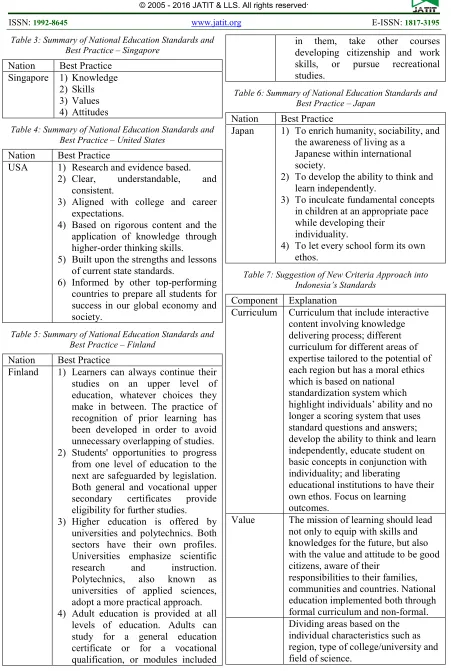
Table 4: Summary of National Education Standards and Best Practice – United States
Nation Best Practice
USA 1) Research and evidence based.
2) Clear, understandable, and
consistent.
3) Aligned with college and career
expectations.
4) Based on rigorous content and the
application of knowledge through higher-order thinking skills.
5) Built upon the strengths and lessons
of current state standards.
6) Informed by other top-performing
countries to prepare all students for success in our global economy and society.
Table 5: Summary of National Education Standards and Best Practice – Finland
Nation Best Practice
Finland 1) Learners can always continue their
studies on an upper level of education, whatever choices they make in between. The practice of recognition of prior learning has been developed in order to avoid unnecessary overlapping of studies.
2) Students' opportunities to progress
from one level of education to the next are safeguarded by legislation. Both general and vocational upper
secondary certificates provide
eligibility for further studies.
3) Higher education is offered by
universities and polytechnics. Both sectors have their own profiles. Universities emphasize scientific
research and instruction.
Polytechnics, also known as
universities of applied sciences, adopt a more practical approach.
4) Adult education is provided at all
levels of education. Adults can study for a general education certificate or for a vocational qualification, or modules included
in them, take other courses
developing citizenship and work
skills, or pursue recreational
studies.
Table 6: Summary of National Education Standards and Best Practice – Japan
Nation Best Practice
Japan 1) To enrich humanity, sociability, and
the awareness of living as a Japanese within international society.
2) To develop the ability to think and
learn independently.
3) To inculcate fundamental concepts
in children at an appropriate pace while developing their
individuality.
4) To let every school form its own
ethos.
Table 7: Suggestion of New Criteria Approach into Indonesia’s Standards
Component Explanation
Curriculum Curriculum that include interactive content involving knowledge delivering process; different curriculum for different areas of expertise tailored to the potential of each region but has a moral ethics which is based on national standardization system which highlight individuals’ ability and no longer a scoring system that uses standard questions and answers; develop the ability to think and learn independently, educate student on basic concepts in conjunction with individuality; and liberating
educational institutions to have their own ethos. Focus on learning outcomes.
Value The mission of learning should lead
not only to equip with skills and knowledges for the future, but also with the value and attitude to be good citizens, aware of their
ISSN: 1992-8645 www.jatit.org E-ISSN: 1817-3195
5. CONCLUSION
Found common ground in the implementation of the education system in the countries that have been chosen as the research objectives, comprising China, Singapore, Japan, Finland, United State and Indonesia. As a result of this comparison, determined a new multi-criteria approach to govern the educational ecosystem that can be used to improve the quality of students in higher education, in line with the global progress that is supported by the e-Learning Ecosystem that is expected to create
an e-Learning Ecosystem that encourages
behavioral change, performance improvement, and skill set development, which play the important role for a successful implementation of e-Learning itself. Furthermore, students will get the chance to take maximum benefits from their e-Learning experience.
REFRENCES:
[1] J. Bransford, A. Brown, & R. Cocking, (Eds.), “How People Learn: Brain, Mind, Experience, and School”, Expanded Edition, Washington DC: National Academies Press, 2000.
[2] B. Brown, (2009). “Standards-Based
Education Reform in the United States Since “A Nation at Risk”.
[3] V. Chang, & C. Gütl, (2007). “E-Learning Ecosystem (ELES) – A Holistic Approach for the Development of more Effective Learning Environment for Small-to-Medium Sized Enterprises (SMEs),” Proceeding of IEEE
International Digital EcoSystems
Technologies Conference (IEEEDEST 2007), Cairns, Australia.
[4] V. Chang, & L. Uden, (2008). "Governance
for E-learning ecosystem," Digital Ecosystems
and Technologies, 2008. DEST 2008. 2nd
IEEE International Conference on, vol., no.,
pp.340, 345, 26-29 Feb.
[5] Finland Ministry of Education and Culture,
2015, August 14. Retrieved from
http://www.minedu.fi/
[6] L. Guo, (2012). "New Curriculum Reform in
China and its Impact on Teachers," Canadian
and International Education /Education
canadienne et internationale: Vol. 41: Iss. 2,
Article 6.
[7] W. Harold, K. Stevenson, S. Lee, & R. Nerison-Low, (1996). Contemporary Research in the United States, Germany, and Japan on Five Education Issues: Structure of the Education System, Standards in Education, the Role of School in Adolescents’ Lives, Individual Differences Among Students, and Teachers’ Lives.
[8] N. Koichi, (2014). Japan’s Drifting Education System: The Debate over Japan’s Academic Decline.
[9] S. Marshall, (2004). “E-learning standards: Open enablers of learning or compliance strait jackets?” In R. Atkinson, C. McBeath, D.
Jonas-Dwyer & R. Phillips (Eds), Beyond the
comfort zone: Proceeding of the 21st
ASCILITE Conference (pp. 596-605). Perth,
5-8 December.
[10] M. McPherson, & M. Schapiro, (2002). “Global Issues in Higher Education – What American College Should Know”.
[11] Ministry of Education Singapore, 2015,
August 13. Retrieved from
http://www.moe.gov.sg/
[12] S. Murata, & S. Stern, (1993). Technology Education in Japan, Journal of Technology Education, Volume 5, Number 1.
[13] S. Ohanian, (1999). “One Size Fits Few: The Folly of Educational Standards”.
[14] J. Olson, J. Codde, K. deMaagd, E. Tarkelson, J. Sinclair, S. Yook, & R. Egidio, (2011). “An Analysis of e-Learning Impacts & Best Practices in Developing Countries”.
[15] D. Ravitch, (1995). National Standards in American Education: A Citizen's Guide.
![Figure 2: Simplified representation for the Learning Ecosystem (LES) [3]](https://thumb-us.123doks.com/thumbv2/123dok_us/8908970.958274/3.612.92.296.74.243/figure-simplified-representation-learning-ecosystem-les.webp)