Abstract—In this study, an ant colony system (ACS) algorithm with local search is proposed for solving the unequal area facility layout problem using a flexible bay structure (FBS) representation. Eight international benchmark problems are used to test the performance of the proposed meta-heuristics.
Compared with the previously best known solutions, ACS can obtain the same or better solutions to some benchmark problems.
Index Terms—Unequal-area facility layout, ant colony system, flexible bay structure, constrained combinatorial optimization.
I. I NTRODUCTION
Facility layout problems (FLP) occur in many organizations, including manufacturing cell design, hospital design, and service center design. One of the most critical and difficult design tasks, FLP aims to find the optimal arrangement of a given number of non-overlapping departments with unequal area requirements within a facility, so as to minimize the costs associated with projected interactions between departments. The common objective is to minimize the total material handling costs among departments. The department areas do not have to be same, but each department should follow certain ratio constraints or minimum length constraints. The problem was originally formalized by [1].
FLP can be represented by many schemes that define how departments can be arranged within the facility area. The flexible bay structure (FBS), first defined by [2], is a continuous layout representation assuming rectangular departmental shapes placed in bays and allowing the departments to be located only in parallel bays with varying widths. Therefore, the problem complexity is reduced into determining the department placement order and the total number of departments that each bay will contain. The width of a bay is adjusted by the number of departments contained.
In addition, FBS has an advantage in that the bay structure can be regarded as candidates for aisles that are necessary in
This work was supported in part by the National Science Council, Taiwan, under Grants NSC 99-2410-H-033-025-MY2.
Mei-Shiang Chang is with the Civil Engineering Department, Chung Yuan Christian University, Taoyuan 32023, Taiwan (phone: +886-3-2654210;
fax: +886-3-2654299; email: [email protected]).
Hsin-Yi Lin is with the Civil Engineering Department, Chung Yuan Christian University, Taoyuan 32023, Taiwan (email:
[email protected]).
the consideration of an actual facility design [3]. FBS has received much attention from researchers [3-14].
Due to the computational intractability of the FLP, only the FLP with fewer than 14 departments can be optimally solved.
Therefore, the majority of research on the FLP has focused on heuristic approaches to find good solutions. Metaheuristic approaches such as simulated annealing (SA) [15], genetic algorithms (GAs) [5], [16-18], tabu search (TS) [8, 19-21], the ant system (AS) [11, 22], ant colony optimization (ACO) [12], particle swarm optimization (PSO) [13], and the artificial immune system (AIS) [14] have been previously applied to FLPs.
II. M ETHODOLOGY
The Ant Colony Optimization (ACO) algorithm mimics the foraging behavior of the ant species for combinatorial optimization problem solving. In 1996, Dorigo et al. [23]
developed the first ACO algorithm, called the ant system (AS). The AS was introduced using the travelling salesperson problem (TSP) as an example application. Thereafter, AS was applied to solve various kinds of discrete optimization problems including quadratic assignment problems, vehicle routing problems, sequential ordering problems, job-scheduling problems, and resource constrained project scheduling problems.
Numerous variations of ACO have been studied, including the ant system (AS), elitist ant system (EAS), rank-based ant system (RAS), max-min ant system (MMAS) and ant colony system (ACS). ACS differs AS by introducing the state transition rule and local pheromone update as well as by using the best-so-far solution update rule [24]. In general, ACS produces better efficiency than AS.
Recently, various ACO approaches have been used to solve different FLPs. Most of them formulate FLP as a quadratic assignment problem (QAP), such as the static equal area FLP [25], [26] and the dynamic equal area FLP [27], [28]. A hybrid approach is used to solve the discrete FLP [25].
This algorithm combines an ACO algorithm and the extended great deluge local search technique. The performance of the proposed algorithm is compared to construction and improvement heuristics as well as to other ant colony implementations for QAP. The experimental results indicate that the proposed meta-heuristic offers advantages in terms of solution quality. In [26], they propose a hybrid ACO approach coupled with a guided local search to solve a train maintenance facility layout problem modeled as a QAP.
A Flexible Bay Structure Representation and Ant Colony System for Unequal Area Facility Layout
Problems
Mei-Shiang Chang and Hsin-Yi Lin
Experimental results show that this algorithm performs better for small examples, but its performance is also acceptable for large examples.
The ACO algorithm has been applied to solve the DLP with budget constraints [27]. Hybrid ant systems (HAS) were developed to solve the dynamic FLP [28]. Local search techniques, pairwise exchange, and simulated annealing are individually combined with AS. Both of these approaches also formulate the FLP as a QAP and obtain promising solutions to several test problems.
Recently, an AS, the first algorithm among ACO approaches, was presented to solve the unequal FLP [22].
This algorithm uses slicing tree representation to easily represent the FLP and can create layouts that are impossible to achieve by the FBS. In addition, nine types of local search are incorporated to improve the search performance. Overall, the proposed algorithm shows encouraging results in solving UA-FLPs.
An ACO approach is proposed to solve the unequal area FLP with FBS [12]. Compared with metaheuristics such as GA, TS, and AS as well as with exact methods from the literature, this ACO approach is shown to be very effective in finding previously known best solutions and making notable improvements.
As mentioned above, the previous ACO approaches based on QAP can be extended for solving the continuous FLP. An ACS approach to the FLP with the FBS has not been reported in the literature. In this study, we propose an ant colony system to solve the unequal area FLP with the FBS.
III. S OLUTION A LGORITHM A. Solution Representation
The proposed ACS algorithm uses a flexible bay structure (FBS) to represent an FLP. Without loss of generality, the facility is divided vertically. The bay width is flexible, depending on the departments that it contains. We adopt the ant solution representation proposed by [29] for solving FLPs.
Each ant solution consists of two parts: the department sequence codes and the bay break codes. The former represents the order of n departments, which will be placed into the facility. The latter is n-1 binary numbers. Here, 1 represents a bay break and 0 otherwise. The bay width is adjusted by dividing the sum of department areas contained in this bay by the facility length.
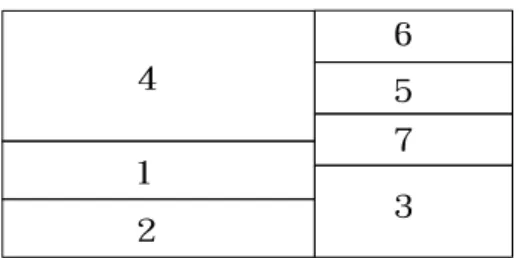
For example, a FLP with seven departments is shown in Figure 1. There are two bays: the first bay contains departments {2, 1, 4}, and the second bay contains departments {3, 7, 5, 6}. Thus, the bay break codes are 0-0-1-0-0-0. Furthermore, bays run vertically; the departments are placed from bottom to top and left to right.
The department sequence codes are 2-1-4-3-7-5-6 accordingly. We use the ant solution (2-1-4-3-7-5-6)-(0-0-1-0-0-0) to represent this layout solution.
Fig. 1 A Layout Example Using a FBS Representation B. Ant Solutions Construction
The proposed algorithm employs the pheromone information and heuristic information for constructing ant solutions. Note that the two parts of an ant solution are not constructed concurrently. First, the department sequence codes are constructed based on pheromone information and heuristic information. The bay break codes are generated based on the proposed space filling heuristic.
Space Filling Heuristic
Step 1: Randomly generate a number of bay breaks, B.
Step 2: Calculate the initial value of each bay width. Set , where W is the width of a facility.
Step 3: Apply parallel sweep method to generate facilities layout according to the department sequence codes and initial bay widths.
Step 3.1: Initialize the bay counter. Set l = 1.
Step 3.2: Gradually place unassigned departments into the l-th bay of the facility until there is not enough space to contain the oncoming department.
Step 3.3: If the available space of this bay is more than 50% of total area of the oncoming department, locate this department at bay l.
Step 3.4: Update the bay counter. Set l := l+1.
Step 3.5: If l equals to B, all of the unassigned departments are located in the last bay; go to Step 4. Otherwise, go to Step 3.2.
Step 4: Generate the bay breaks codes of ant m to present the implementations of Step 3.
Step 5: Calculate bay widths of ant m, that is, H
a l
iBli
b
,
where a
iis the required area of department i; 𝐵 is the subset of departments which are placed at bay l; and H is the height of a facility.
The main procedures of the proposed ant solution construction are given below:
Step 1: Based on a state transition rule, generate the department sequence for ant m until the complete department sequence codes have been built.
Step 2: Perform the proposed space filling heuristic to generate the corresponding bay breaks codes of ant m.
Step 3: Perform the local pheromone update and update the heuristic information.
2 1 4
3 7 5 6
2 1 4
3
7
5
6
C. State Transition Rule and Heuristic Information Definition
The state transition rule is given by Eq. (1), which shows how the ant k in department i chooses the j-th position of the department sequence to move to
otherwise ,
if , max
arg 0
S
q q
s ij ij
(1)
where q is a random number uniformly distributed in [0, 1];
q
0is a fixed parameter (0 q
0 1); s is a probability to locate department i to the j-th position of the positioning order of departments; is a parameter which determines the relative weight of pheromone information; is a parameter which determines the relative weight of heuristic information;
ijis the pheromone value defined as the relative desirability of assigning department i to the j-th position of the department sequence; and is the heuristic information related to assigning department i to the j-th position of the department sequence.
In [29], the following intuitive rule is presented: “A department with higher material flow should be located nearer to the center of the facility.” In this study, the heuristic information function is defined by Eq. (2).
2 2 2 2
y W W x H
m i H j j
ij (2)
where m
iis the sum of material flow from and to department i;
x
jis the x-coordinate of the centroid of the department which is located at the j-th position of the department sequence; and y
jis the y-coordinate of the centroid of the department which is located at the j-th position of the department sequence.
If q is greater than q
0, every position of the department sequence has a probability to be chosen by an ant k located in department i equal to
otherwise ,
0
if ,
i
N q
iq iq
ij ij k
ij
N j P
S
i