Multi-modal Visualization and Search for Text and Prosody Annotations
Markus G¨artner Katrin Schweitzer Kerstin Eckart Jonas Kuhn
Institute for Natural Language Processing University of Stuttgart
{markus.gaertner,kati,eckartkn,kuhn}@ims.uni-stuttgart.de
Abstract
We present ICARUS for intonation, an in-teractive tool to browse and search au-tomatically derived descriptions of fun-damental frequency contours. It offers access to tonal features in combination with other annotation layers like part-of-speech, syntax or coreference and visual-izes them in a highly customizable graphi-cal interface with various playback func-tions. The built-in search allows multi-level queries, the construction of which can be done graphically or textually, and includes the ability to search F0 contours
based on various similarity measures.
1 Introduction
In this paper we presentICARUS for intonation, a new module for the query and visualization tool ICARUS by G¨artner et al. (2013).1
So far, ICARUS included modules for the han-dling of dependency treebanks (G¨artner et al., 2013) and coreference data (G¨artner et al., 2014), thus supporting typical annotation layers from the processing of written data. However, the graphi-cal query builder and the intuitive example-based search could prove just as expedient for other types of data, such as speech corpora, transcribed and annotated for sub word features. This also al-lows combined research on speech and text data, e.g. the analysis of different tonal realizations of a certain syntactic structure.
ICARUS for intonation allows to import syllable-based prosodic features into ICARUS, which can then be visualized and queried either
1ICARUS for intonation is written in Java and is
therefore platform independent. It is open source (un-der GNU GPL) and we provide both sources and binaries for download onhttp://www.ims.uni-stuttgart. de/data/icarus.html
individually or in a combined search with e.g. syn-tactic features or coreference information. The latter targets several user groups: speech data ex-perts can adjust fine-grained settings on pitch ac-cent shapes in their queries and can easily add con-straints on part-of-speech or syntax information, while an expert user of dependency treebanks can get a simple visualization of the intonation contour of a sentence.
Furthermore ICARUS focuses on automatic an-notations to allow for search on large data sets. Thus ICARUS for intonation’s main features for prosodic search are based on PaIntE, a parametric intonation model (M¨ohler, 1998; M¨ohler, 2001). So far, most data in intonation research is man-ually annotated, which is a very time consuming task: the time for annotating speech data is many times higher than the real time of the audio record-ing. For example the Tones and Break Indices (ToBI) system for American English (Beckman and Hirschberg, 1999) takes experienced annota-tors about 100-200 times the real time (Syrdal et al., 2001). While manual annotations for pitch accents and prosodic phrase boundaries can also be imported, our main goal with this module is to provide intonation researchers with a customiz-able tool to conduct thorough studies on very large sets of only automatically annotated speech data.
In Sections 2 and 3 we introduce the PaIntE model and describe the current input format for the data importer. Section 4 demonstrates several visualization functionalities, and Section 5 dis-cusses the search facilities, including dependency and intonation as well as coreference and intona-tion queries. After discussing some related work in Section 6 we conclude in Section 7.
2 The PaIntE Model
The PaIntE model (M¨ohler, 1998; M¨ohler, 2001) approximates a peak in the F0 contour by em-ploying a model function operating on a 3-syllable
a1
a2
Hz
[image:2.595.306.526.61.162.2]time (syllable−normalized)
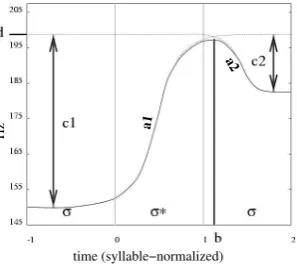
Figure 1: The PaIntE model function and its pa-rameters. Figure adapted from (M¨ohler, 2001).
window. There are 6 free parameters in the func-tion term which are set by the model so that the actual F0 shape is fit best. They are linguistically meaningful: parameterb locates the peak within the 3-syllable window, parameterdencodes its ab-solute height. The remaining parameters specify the steepness and amplitude of the rise before, and the fall after the peak (parameters a1 anda2 for the steepness andc1/c2for the amplitude).
Figure 1 illustrates the function. It displays the syllable for which the parametrization is carried out (σ∗) and its immediate neighbors. The x-axis indicates time (normalized for syllable duration, the current syllable spans from 0 to 1) and the y-axis displays the fundamental frequency in Hertz. The PaIntE model has been used for the model-ing of different languages, e.g. Norwegian, Ital-ian, German and English (Cosi et al., 2002; Kelly and Schweitzer, in press; Schweitzer et al., 2015).
3 Data Representation
ICARUS for intonation ships with reader imple-mentations for two very different formats. One is an extended version of the format used for the 2011 and 2012 CoNLL shared tasks (Pradhan et al., 2011; Pradhan et al., 2012) with a number of additional columns to accommodate features for the syllable level. This format stores all annota-tions corresponding to a word token in one line and packs syllable features into a list separated by pipe-characters (’|’). To address syllable cen-tric data like the typical output of speech process-ing systems, a second flexible tabular format was specified where each line of text corresponds to a single syllable and a global header describes the content of all columns and how to read and map them to the internal data model of ICARUS.
Figure 2: PaIntE Editor currently displaying 2 curves and their respective parameters. The lower section shows saved and named prototypes.
To enable audio playback functionality ICARUS for intonation requires access to the appropriate sound files. In both formats described above, special properties define the name of a sound file to be used for playback. Timestamp values on various levels (syllable, word, sentence or document) point to the respective section in the audio data, which currently is required to be in the Waveform Audio File Format (*.wav files). 4 Visualization
Since the ICARUS for intonation module is build on the data model used for corpora with corefer-ence annotations in ICARUS, existing visualiza-tions for coreference data can be used. However, they make no use of syllable level features and do not provide playback functionality. Therefore a couple of new visualizations have been imple-mented, adding visual information about PaIntE curves in several levels of granularity.
4.1 PaIntE Editor
To get familiar with the visualization of PaIntE pa-rameters the PaIntE Editor (Figure 2) offers users with little or no knowledge about PaIntE a starting point to directly see the impact of changes to cer-tain parameters. In this editor the user can define multiple PaIntE curves either from scratch or by importing them from real examples in a corpus. Changes to individual parameters can be applied via sliders or input fields and are displayed in real-time. Additionally a persistent storage of PaIntE curves is provided where the user can save param-eter sets that are of interest to him along with a description and identifier, the latter of which can be used when searching (see Section 5).
4.2 Curve Preview
[image:2.595.108.257.62.194.2]“pre-view” on the sentence level (lower parts of Fig-ures 3 and 4b). Instead of drawing the full curves for all syllables, only syllables in which a peak was found (based on the peak’s timing encoded in the PaIntE parameterb) are displayed. The visual-ization of the curve then only uses the amplitudes of rise and fall and the absolute height of the peak (c1,c2andd). Since the user can freely customize the filter window for the peak this curve preview offers a fast way to spot interesting parts of the F0
contour when exploring data manually.
4.3 Document Outline
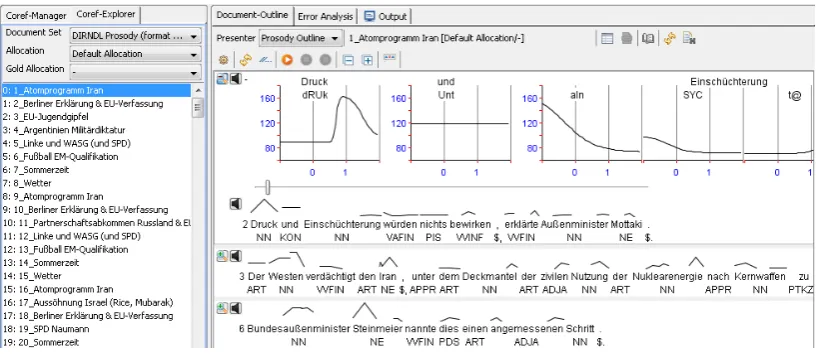
Figure 3 shows parts of the main entry point for manual exploration in ICARUS for intonation. Having selected a section of the corpus the user wishes to inspect (with sentences grouped into documents in the left section of the figure) he then gets a detailed outline of the contents of that doc-ument using one of several available presentation modes. The default visualization for data holding PaIntE annotations arranges the document’s con-tent one sentence per line, making use of the above mentioned curve preview to provide the user with a very compact overview of an entire document. For each sentence a detail panel can be unfolded which renders the complete PaIntE curves above the preview area. Several aspects of the visualiza-tion are highly customizable (like the number of words to show detailed curves for) and the user can select the content of the detail panel by mov-ing a slider through the sentence.
An important feature of the Document Outline is the fine-grained playback functionality. The user is free to play a variety of sections of the sound data linked to the document currently being displayed. Speaker buttons at the left border play predefined parts of the sound data like sentences or the current content of a detail panel. By clicking on individual word or syllable labels in the detail panel the playback can be selected even finer.
4.4 Sentence Outline
When only single sentences are visualized, ICARUS for intonation displays a more detailed outline showing the PaIntE curves for all syllables in the sentence grouped by the surrounding words. In Figure 4b part of a sentence is visualized in this way (the screenshot also contains visual highlight-ing as its content is the result of a search).
In contrast to the more condensed document outline, this visualization offers a great deal more
space for additional information on the syllable level to be displayed. As for playback function-ality it offers granularity similar to the document outline, allowing the user to play the entire sen-tence or restrict it to individual words or syllables.
4.5 Label Patterns
Both formats currently read by ICARUS for in-tonation can contain more information on the syllable and word level than can be presented to the user without overloading the visualiza-tion. Therefore the two visualizations described above make heavy use of so called label pat-ternsto produce the actual text displayed at var-ious locations. A label pattern is a string de-scribing a format according to which a certain text should be created. Expressions of the form “{<level>:<property>}” define where informa-tion extracted from the visualized data should be inserted. The <level>specifies the level of data to query ({syl,word,sent,doc}for the syllable, word, sentence and document levels). For example the default pattern “{word:form}\n{word:pos}”, used in the Document Outline (see Section 4.3) to display the text for a sentence, extracts the surface form and part-of-speech tag for a word and places them below each other as shown in Figure 3. The user can freely define the default patterns for a number of locations as well as change the patterns used for the active visualization on the fly. Besides directly extracting data and displaying it as text, patterns offer additional options that define how to convert e.g. numerical values into strings or how to post process or aggregate generated texts. How-ever, going into details of the pattern engine is be-yond the scope of this paper.
5 Search
ICARUS for intonation augments both the coref-erence and dependency search facilities already available in ICARUS by adding access to vari-ous syllable features and implementing multiple specialized search constraints based on the PaIntE model. For example the user can search for prede-fined F0 contours (rise,fall,rise-fallor
unaccented) based on customizable criteria or
use one of several similarity measures available, like Euclidean distance or cosine similarity.
Figure 3: Visualization of the first few sentences in a document with preview curves painted above the raw text outline. The top sentence has its detail panel unfolded, showing PaIntE curves for all syllables of a selected number of words.
by name (see Section 4.1). The ICARUS search engine allows queries to be created either graphi-cally (by creating nodes and attaching constraints to them) or textually via a simple query language (G¨artner et al., 2013).
The following two sections outline some exam-ple use cases that combine prosodic features with structural information on different layers for anal-ysis and Section 5.3 shows some of the similar-ity measures used for searching. Example data in those sections is taken from the DIRNDL corpus (Eckart et al., 2012) with coreference information (Bj¨orkelund et al., 2014) and some added features.
5.1 Syntax and Intonation
As part of a recent study (Riester and Pio-ntek, in press) adjective-noun sequences from the DIRNDL corpus have been analyzed based on their tonal realization. Of interest in this study concerning relative givenness (Wagner, 2006) were those adjective-noun sequences where the adjective was tonally more prominent than the ad-jacent noun. An example of how to find them is shown in Figure 4. The query (Figure 4a) will match adjectives (ADJA) adjacent to a following noun (NN) which must not have another dependent that is either a modifying noun or name (NE). The results are presented to the user using the detailed Sentence Outline (Figure 4b) from Section 4.4.
5.2 Coreference and Intonation
Besides finding exact matches in a data set the search engine in ICARUS can be used to analyze value distributions for an annotation. Using the
query in Figure 5a the search engine is asked to look for mentions the size of up to 2 words that are not the root of a coreference chain. The spe-cialgrouping operator<*>results in the creation of a frequency list (Figure 5b) over the Boolean
tonal prominenceproperty (which purely relies on the peak excursion with a customizable threshold) of the head word of each mention that was found based on the above constraints. By clicking on one of the entries in this list the user will then be pre-sented with all the instances that contributed to the respective frequency for further exploration.
5.3 Similarity Search
The continuous nature of the PaIntE parameters makes using absolute values to search for curve forms very impractical. Therefore ICARUS for intonation provides a collection of similarity mea-sures and other constraints that can be used to find syllables with PaIntE curves similar to a given pro-totype. Most of them are customizable by the user and investigation and refinement of the available similarity measures is subject of ongoing work.
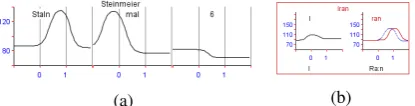
Figure 6 shows an example of using co-sine similarity to find instances in the data set that are similar to a defined prototype curve. In this case the first syllable of the accented word “Steinmeier” was found to be of interest and saved in the PaIntE editor with the identifier prototype stein. The query [painteAngle$"$prototype stein"<="5.0"] then looks for PaIntE curves which do not differ from the prototype by more than 5 degrees.
(a) graphical query
(b) result outline with highlighting
Figure 4: Example search query combining syntax and intonation constraints and an excerpt of the corresponding result outline.
(a) (b)
Figure 5: Simple search combining coreference and intonation features. It is meant to investigate the distribution of “tonally prominent” mentions that aregiven(already introduced) in a discourse.
[image:5.595.217.509.62.190.2](a) (b)
Figure 6: Prototype of a PaIntE curve as found in the data and an example result of a search using cosine similarity.
constraint the corresponding result visualization will render those curves when highlighting result instances as can be seen on the first peak (dashed blue curve) in Figures 6b. This provides the user with accurate information on how “visually close” a match is towards the used constraints.
6 Related Work
A number of well established tools exist for visual-ization of text corpora annotated with dependency or coreference, many of which have been dis-cussed in other ICARUS related papers (G¨artner et al., 2013; G¨artner et al., 2014). In terms of search functionality those tools offer a broad range of complexity, ranging from string-searching on surface forms2 up to queries on multi-level
anno-2http://code.google.com/p/whatswrong/
tations (Zeldes et al., 2009; Pajas and ˇStˇep´anek, 2009). However, they do not support a dedicated search and visualization for prosodic syllable level annotations. Tools like ELAN (Wittenburg et al., 2006) provide an interface for adding (flat) anno-tations to multi-modal corpora, but focus on audio and video data. More importantly, ICARUS for intonation is so far the first tool using the PaIntE model for F0 contour visualizations, a task
pre-viously worked around via general curve plotting tools like R3and also is first to provide a collection
of search constraints dedicated to PaIntE curves. Eckart et al. (2010) describe a database that serves as a generic query tool for multiple anno-tation layers. It allows to take annoanno-tations of tonal features into account and has also been tested with the DIRNDL corpus. However, this database has been designed as an expert system, e.g. for inter-nal use in projects that create annotations. It does not provide any visualization or query functions besides basic SQL queries and no sound playback. The focus on preprocessed or completely anno-tated data in ICARUS distinguishes it from typical tools in the domain of Spoken Document Retrieval (SDR) or Spoken Term Detection (STD). These use automatic speech recognition and information retrieval technologies in order to prepare and pro-cess audio data (Garofolo et al., 2000).
7 Conclusion
We presented ICARUS for intonation, a flexible visualization and search tool for multi-modal (text and speech) data. The tool augments existing vi-sualization and search features of ICARUS to han-dle prosodic annotations and introduces a
[image:5.595.81.286.263.315.2] [image:5.595.80.288.395.448.2]tion of novel visualizations and search functional-ities. In addition to the highly customizable visu-alizations it allows for a very fine-grained play-back of speech data for displayed sections of a corpus directly from within the graphical user in-terface. The built-in search engine lets the user combine prosodic constraints with constraints of other annotation layers like syntax or coreference, thereby supporting complex search queries, and it features aggregated result views. Being based on the ICARUS platform’s plugin-engine, the module can be extended to cover additional data formats. Acknowledgments
This work was funded by the German Federal Ministry of Education and Research (BMBF) via CLARIN-D, No. 01UG1120F and the German Research Foundation (DFG) via the SFB 732, project INF.
References
Mary Beckman and Julia Hirschberg. 1999. The ToBI
Annotation Conventions. http://www.ling.
ohio-state.edu/˜tobi/ame_tobi/ annotation_conventions.html.
Anders Bj¨orkelund, Kerstin Eckart, Arndt Riester, Nadja Schauffler, and Katrin Schweitzer. 2014. The Extended DIRNDL Corpus as a Resource for
Coref-erence and Bridging Resolution. InLREC.
P. Cosi, C. Avesani, F. Tesser, R. Gretter, and F. Pi-anesi. 2002. A modified “PaIntE” model for
Ital-ian TTS. InSpeech Synthesis, 2002. Proceedings of
2002 IEEE Workshop on, pages 131 – 134.
Kerstin Eckart, Kurt Eberle, and Ulrich Heid. 2010. An Infrastructure for More Reliable Corpus
Analy-sis. InLREC: Workshop on Web Services and
Pro-cessing Pipelines in HLT, pages 8–14, Valletta. Kerstin Eckart, Arndt Riester, and Katrin Schweitzer.
2012. A Discourse Information Radio News
Database for Linguistic Analysis. In Christian
Chiarcos, Sebastian Nordhoff, and Sebastian
Hell-mann, editors,Linked Data in Linguistics, pages 65–
75. Springer, Heidelberg.
John S. Garofolo, Cedric G. P. Auzanne, and Ellen M. Voorhees. 2000. The TREC Spoken Document
Re-trieval Track: A Success Story. Inin Text Retrieval
Conference (TREC) 8, pages 16–19.
Markus G¨artner, Gregor Thiele, Wolfgang Seeker, An-ders Bj¨orkelund, and Jonas Kuhn. 2013. ICARUS – An Extensible Graphical Search Tool for
Depen-dency Treebanks. InACL: System Demonstrations,
pages 55–60, Sofia, Bulgaria.
Markus G¨artner, Anders Bj¨orkelund, Gregor Thiele, Wolfgang Seeker, and Jonas Kuhn. 2014. Visualiza-tion, Search, and Error Analysis for Coreference
An-notations. In ACL: System Demonstrations, pages
7–12, Baltimore, Maryland.
Niamh Kelly and Katrin Schweitzer. in press. Examin-ing Lexical Tonal Contrast in Norwegian UsExamin-ing
Into-nation Modelling. InProceedings of the 18th
Inter-national Congress of Phonetic Sciences, Glasgow, UK.
Gregor M¨ohler. 1998. Describing intonation with a
parametric model. InICSLP, volume 7, pages 2851–
2854.
Gregor M¨ohler. 2001. Improvements of the PaIntE
model for F0parametrization. Technical report,
In-stitute of Natural Language Processing, University of Stuttgart. Draft version.
Petr Pajas and Jan ˇStˇep´anek. 2009. System for
Querying Syntactically Annotated Corpora. In
ACL-IJCNLP: Software Demonstrations, pages 33–36, Suntec, Singapore.
Sameer Pradhan, Lance Ramshaw, Mitchell Marcus, Martha Palmer, Ralph Weischedel, and Nianwen Xue. 2011. CoNLL-2011 Shared Task: Modeling
Unrestricted Coreference in OntoNotes. InCoNLL:
Shared Task, pages 1–27, Portland, Oregon, USA. Sameer Pradhan, Alessandro Moschitti, Nianwen Xue,
Olga Uryupina, and Yuchen Zhang. 2012. CoNLL-2012 Shared Task: Modeling Multilingual
Unre-stricted Coreference in OntoNotes. In
EMNLP-CoNLL: Shared Task, pages 1–40, Jeju Island, Ko-rea.
Arndt Riester and J¨orn Piontek. in press. Anarchy in the NP. When new nouns get deaccented and given
nouns don’t. Lingua.
Katrin Schweitzer, Michael Walsh, Sasha Calhoun, Hinrich Sch¨utze, Bernd M¨obius, Antje Schweitzer, and Grzegorz Dogil. 2015. Exploring the relation-ship between intonation and the lexicon: Evidence
for lexicalised storage of intonation. Speech
Com-munication, 66(0):65–81.
Ann K. Syrdal, Julia Hirschberg, Julie McGory, and Mary Beckman. 2001. Automatic ToBI Predic-tion and Alignment to Speed Manual Labeling of
Prosody.Speech Commun., 33(1-2):135–151.
Michael Wagner. 2006. Givenness and Locality. In Masayuki Gibson and Jonathan Howell, editors,
Proceedings of SALT XVI, pages 295–312.
P. Wittenburg, H. Brugman, A. Russel, A. Klassmann, and H. Sloetjes. 2006. ELAN: a Professional
Framework for Multimodality Research. InLREC.
Amir Zeldes, Julia Ritz, Anke L¨udeling, and Christian Chiarcos. 2009. ANNIS: A Search Tool for
Multi-Layer Annotated Corpora. In Proceedings of