129
Automatic Generation of High Quality CCGbanks
for Parser Domain Adaptation
Masashi Yoshikawa1 yoshikawa.masashi.yh8@
is.naist.jp
Hiroshi Noji2
Koji Mineshima3
Daisuke Bekki3
1Nara Institute of Science and Technology, Nara, Japan 2Artificial Intelligence Research Center, AIST, Tokyo, Japan
3Ochanomizu University, Tokyo, Japan
Abstract
We propose a new domain adaptation method for Combinatory Categorial Grammar (CCG) parsing, based on the idea of automatic gen-eration of CCG corpora exploiting cheaper re-sources of dependency trees. Our solution is conceptually simple, and not relying on a spe-cific parser architecture, making it applicable to the current best-performing parsers. We conduct extensive parsing experiments with detailed discussion; on top of existing bench-mark datasets on (1) biomedical texts and (2) question sentences, we create experimen-tal datasets of (3) speech conversation and (4) math problems. When applied to the proposed method, an off-the-shelf CCG parser shows significant performance gains, improving from 90.7% to 96.6% on speech conversation, and from 88.5% to 96.8% on math problems.
1 Introduction
The recent advancement of Combinatory Cate-gorial Grammar (CCG; Steedman (2000)) pars-ing (Lee et al., 2016; Yoshikawa et al., 2017), combined with formal semantics, has enabled high-performing natural language inference sys-tems (Abzianidze, 2017; Mart´ınez-G´omez et al., 2017). We are interested in transferring the suc-cess to a range of applications, e.g., inference sys-tems on scientific papers and speech conversation. To achieve the goal, it is urgent to enhance the CCG parsing accuracy on new domains, i.e., solv-ing a notorious problem ofdomain adaptationof a statistical parser, which has long been addressed in the literature. Especially in CCG parsing, prior work (Rimell and Clark,2008;Lewis et al.,2016) has taken advantage of highly informative cate-gories, which determine the most part of sentence structure once correctly assigned to words. It is demonstrated that the annotation of only pre-terminal categories is sufficient to adapt a CCG
parser to new domains. However, the solution is limited to a specific parser’s architecture, making non-trivial the application of the method to the current state-of-the-art parsers (Lee et al., 2016; Yoshikawa et al.,2017;Stanojevi´c and Steedman, 2019), which require full parse annotation. Addi-tionally, some ambiguities remain unresolved with mere supertags, especially in languages other than English (as discussed inYoshikawa et al.(2017)), to which the method is not portable.
Distributional embeddings are proven to be powerful tools for solving the issue of domain adaption, with their unlimited applications in NLP, not to mention syntactic parsing (Lewis and Steed-man, 2014b; Mitchell and Steedman, 2015; Pe-ters et al., 2018). Among others, Joshi et al. (2018) reports huge performance boosts in con-stituency parsing using contextualized word em-beddings (Peters et al., 2018), which is orthogo-nal to our work, and the combination shows huge gains. IncludingJoshi et al.(2018), there are stud-ies to learn from partially annotated trees (Mir-roshandel and Nasr, 2011; Li et al., 2016; Joshi et al.,2018), again, most of which exploit specific parser architecture.
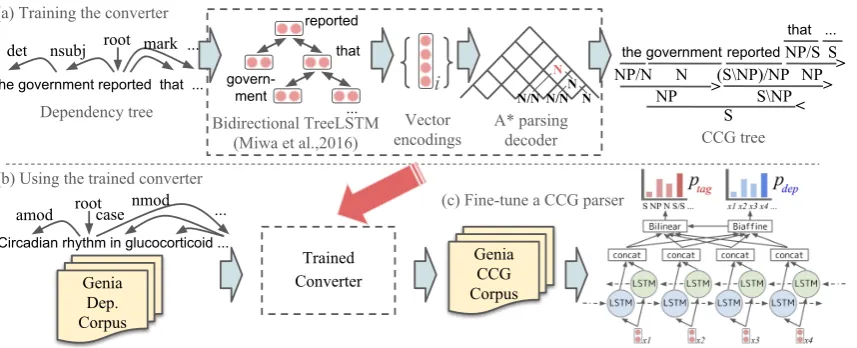
In this work, we propose a conceptually simpler approach to the issue, which is agnostic on any parser architecture, namely,automatic generation of CCGbanks(i.e., CCG treebanks)1 for new do-mains, by exploiting cheaper resources of depen-dency trees. Specifically, we train a deep conver-sion model to map a dependency tree to a CCG tree, on aligned annotations of the Penn Tree-bank (Marcus et al.,1993) and the English CCG-bank (Hockenmaier and Steedman, 2007) (Fig-ure1a). When we need a CCG parser tailored for
1In this paper, we call a treebank based on CCG
Trained Converter
the government reported that ...
det nsubj mark ...
the government reported that ...
NP/N N (S\NP)/S S
NP S\NP
S
reported
govern-ment
that
... Bidirectional TreeLSTM
(Miwa et al.,2016)
i
Vector encodings Dependency tree
CCG tree (a) Training the converter
A* parsing decoder
Circadian rhythm in glucocorticoid ...
amod casenmod ...
Genia Dep. Corpus
Genia CCG Corpus
(b) Using the trained converter
root
root (c) Fine-tune a CCG parser
N/N N/N N N
N
the
NP/N NP
government reported that
N
NP/S
S
...
S NP S\NP
>
> > <
[image:2.595.88.517.66.240.2](S\NP)/NP
Figure 1: Overview of the proposed method. (a) A neural network-based model is trained to convert a dependency tree to a CCG one using aligned annotations on WSJ part of the Penn Treebank and the English CCGbank. (b) The trained converter is applied to an existing dependency corpus (e.g., the Genia corpus) to generate a CCGbank, (c) which is then used to fine-tune the parameters of an off-the-shelf CCG parser.
a new domain, the trained converter is applied to a dependency corpus in that domain to obtain a new CCGbank (1b), which is then used to fine-tune an off-the-shelf CCG parser (1c). The assumption that we have a dependency corpus in that target domain is not demanding given the abundance of existing dependency resources along with its de-veloped annotation procedure, e.g., Universal De-pendencies (UD) project (Nivre et al.,2016), and the cheaper cost to train an annotator.
One of the biggest bottlenecks of syntactic pars-ing is handlpars-ing of countless unknown words. It is also true that there exist such unfamiliar input data types to our converter, e.g., disfluencies in speech and symbols in math problems. We ad-dress these issues by constrained decoding (§4), enabled by incorporating a parsing technique into our converter. Nevertheless, syntactic structures exhibit less variance across textual domains than words do; our proposed converter suffers less from such unseen events, and expectedly produces high-quality CCGbanks.
The work closest to ours isJiang et al. (2018), where a conversion model is trained to map de-pendency treebanks of different annotation princi-ples, which is used to increase the amount of la-beled data in the target-side treebank. Our work extends theirs and solves a more challenging task; the mapping to learn is to more complex CCG trees, and it is applied to datasets coming from plainly different natures (i.e., domains). Some prior studies design conversion algorithms to in-duce CCGbanks for languages other than English
from dependency treebanks (Bos et al.,2009; Am-bati et al.,2013). Though the methods may be ap-plied to our problem, they usually cannot cover the entire dataset, consequently discarding sentences with characteristic features. On top of that, un-avoidable information gaps between the two syn-tactic formalisms may at most be addressed prob-abilistically.
To verify the generalizability of our approach, on top of the existing benchmarks on (1) biomed-ical texts and (2) question sentences (Rimell and Clark,2008), we conduct parsing experiments on (3) speech conversation texts, which exhibit other challenges such as handling informal expres-sions and lengthy sentences. We create a CCG version of the Switchboard corpus (Godfrey et al., 1992), consisting of full train/dev/test sets of auto-matically generated trees and manually annotated 100 sentences for a detailed evaluation. Addition-ally, we manually construct experimental data for parsing (4)math problems(Seo et al.,2015), for which the importance of domain adaptation is pre-viously demonstrated (Joshi et al.,2018). We ob-serve huge additive gains in the performance of the
depccgparser (Yoshikawa et al.,2017), by
com-bining contextualized word embeddings (Peters et al.,2018) and our domain adaptation method: in terms of unlabeled F1 scores, 90.68% to 95.63% on speech conversation, and 88.49% to 95.83% on math problems, respectively.2
2All the programs and resources used in this work
cats
Ncats
NPcats
un
that
(NPx\NPx)/(S/NPx)
Kyle
NPkyle
Sy/(Sy\NPkyle)
T
wants
(Swants\NPz,1)/(Sw,2\NPz)
to
(Su\NPv)/(Su\NPv)
see
(Ssee\NPs,1)/NPt,2
(Ssee\NPv)/NPt:u=see, v=s >B
(Swants\NPz)/NPt:w=see, z=v
>B
Sy/NPt:y=wants, z=kyle
>B
NPx\NPx:x=t
>
[image:3.595.80.528.64.132.2]NPcats:x=cats <
Figure 2: Example CCG derivation tree for phrasecats that Kyle wants to see. Categories are combined using rules such as an application rule (marked with “>”,X/Y Y⇒X) and a composition rule (“>B”:X/Y Y/Z⇒X/Z). SeeSteedman(2000) for the detail.
2 Combinatory Categorial Grammar
CCG is a lexicalized grammatical formalism, where words and phrases are assigned categories with complex internal structures. A categoryX/Y
(orX\Y) represents a phrase that combines with a Y phrase on its right (or left), and becomes an
Xphrase. As such, a category(S\NP)/NP repre-sents an English transitive verb which takes NPs on both sides and becomes a sentence (S).
The semantic structure of a sentence can be ex-tracted using the functional nature of CCG cate-gories. Figure 2shows an example CCG deriva-tion of a phrasecats that Kyle wants to see, where categories are marked with variables and constants (e.g., kyle in NPkyle), and argument ids in the
case of verbs (subscripts in(Ssee\NPs,1)/NPt,2).
Unification is performed on these variables and constants in the course of derivation, resulting in chains of equations s = v = z = kyle, andt = x = cats, successfully recovering the first and second argument of see: Kyle and cats (i.e., capturing long-range dependencies). What is demonstrated here is performed in the stan-dard evaluation of CCG parsing, where the num-ber of such correctly predicted predicate-argument relations is calculated (for the detail, see Clark et al.(2002)). Remarkably, it is also the basis of CCG-based semantic parsing (Abzianidze, 2017; Mart´ınez-G´omez et al., 2017; Matsuzaki et al., 2017), where the above simple unification rule is replaced with more sophisticated techniques such asλ-calculus.
There are two major resources in CCG: the English CCGbank (Hockenmaier and Steedman, 2007) for news texts, and the Groningen Meaning Bank (Bos et al.,2017) for wider domains, includ-ing Aesop’s fables. However, when one wants a CCG parser tuned for a specific domain, he or she faces the issue of its high annotation cost:
• The annotation requires linguistic expertise,
being able to keep track of semantic compo-sition performed during a derivation.
• An annotated tree must strictly conform to the grammar, e.g., inconsistencies such as combiningN andS\NP result in ill-formed trees and hence must be disallowed.
We relax these assumptions by usingdependency tree, which is a simpler representation of the syn-tactic structure, i.e., it lacks information of long-range dependencies and conjunct spans of a coor-dination structure. However, due to its simplicity and flexibility, it is easier to train an annotator, and there exist plenty of accessible dependency-based resources, which we exploit in this work.
3 Dependency-to-CCG Converter
We propose a domain adaptation method based on the automatic generation of a CCGbank out of a dependency treebank in the target domain. This is achieved by our dependency-to-CCG converter, a neural network model consisting of a dependency tree encoder and a CCG tree decoder.
In the encoder, higher-order interactions among dependency edges are modeled with a bidirec-tional TreeLSTM (Miwa and Bansal,2016), which is important to facilitate mapping from a depen-dency tree to a more complex CCG tree. Due to the strict nature of CCG grammar, we model the output space of CCG trees explicitly3; our de-coder is inspired by the recent success of A* CCG parsing (Lewis and Steedman,2014a;Yoshikawa et al.,2017), where the most probable valid tree is found using A* parsing (Klein and D. Manning, 2003). In the following, we describe the details of the proposed converter.
3
Firstly, we define a probabilistic model of the dependency-to-CCG conversion process. Accord-ing to Yoshikawa et al. (2017), the structure of a CCG tree y for sentence x = (x1, ..., xN) is almost uniquely determined4 if a sequence of the pre-terminal CCG categories (supertags) c = (c1, ..., cN) and a dependency structured = (d1, ..., dN), where di ∈ {0, ..., N} is an index of dependency parent of xi (0 represents a root node), are provided. Note that the dependency structuredis generally different from an input de-pendency tree.5 While supertags are highly in-formative about the syntactic structure (Bangalore and Joshi, 1999), remaining ambiguities such as attachment ambiguities need to be modeled us-ing dependencies. Let the input dependency tree of sentence x be z = (p,d0,`), where pi is a part-of-speech tag ofxi,d0i an index of its depen-dency parent,`i is the label of the corresponding dependency edge, then the conversion process is expressed as follows:6
P(y|x,z) = N
Y
i=1
ptag(ci|x,z) N
Y
i=1
pdep(di|x,z).
Based on this formulation, we model ci and di conditioned on a dependency tree z, and search forythat maximizesP(y|x,z)using A* parsing.
Encoder A bidirectional TreeLSTM consists of two distinct TreeLSTMs (Tai et al., 2015). A bottom-upTreeLSTM recursively computes a hid-den vectorh↑i for eachxi, from vector representa-tioneiof the word and hidden vectors of its depen-dency children{h↑j|d0j = i}. Atop-down TreeL-STM, in turn, computesh↓i usingei and a hidden vector of the dependency parent h↓d0
i. In total, a
bidirectional TreeLSTM returns concatenations of hidden vectors for all words:hi=h↑i ⊕h
↓ i. We encode a dependency tree as follows, where ev denotes the vector representation of variablev, andΩandΞd0are shorthand notations of the series
of operations of sequential and tree bidirectional LSTMs, respectively:
e1, ...,eN = Ω(ep1 ⊕ex1, ...,epN ⊕exN),
h1, ...,hN = Ξd0(e1⊕e`
1, ...,eN ⊕e`N).
4
The uniqueness is broken if a tree contains a unary node.
5In this work, input dependency tree is based on
Uni-versal Dependencies (Nivre et al.,2016), while dependency structuredof a CCG tree is Head First dependency tree in-troduced inYoshikawa et al.(2017). See§5for the detail.
6Here, the independence of eachc
is anddis is assumed.
Decoder The decoder part adopts the same ar-chitecture as in Yoshikawa et al. (2017), where
pdep|tag probabilities are computed on top of
{hi}i∈[0,N], using a biaffine layer (Dozat and
Manning,2017) and a bilinear layer, respectively, which are then used in A* parsing to find the most probable CCG tree.
Firstly a biaffine layer is used to compute uni-gram head probabilitiespdepas follows:
ri =ψdepchild(hi), rj =ψdephead(hj),
si,j =riTWrj+wTrj,
pdep(di =j|x,z)∝exp(si,j),
where ψ denotes a multi-layer perceptron. The probabilitiesptagare computed by a bilinear trans-formation of vector encodingsxiandxdˆi, wheredˆi is the most probable dependency head ofxi with respect topdep:dˆi =argmaxjpdep(di=j|x,z).
qi=ψchildtag (hi), qdˆi =ψheadtag (hdˆi),
si,c=qTi Wcqdˆi+vcTqi+uTcqdˆi+bc,
ptag(ci =c|x,z)∝exp(si,c).
A* Parsing Since the probabilityP(y|x,z)of a CCG treeyis simply decomposable into probabil-ities of subtrees, the problem of finding the most probable tree can be solved with a chart-based al-gorithm. In this work, we use one of such algo-rithms, A* parsing (Klein and D. Manning,2003). A* parsing is a generalization of A* search for shortest path problem on a graph, and it controls subtrees (corresponding to a node in a graph case) to visit next using a priority queue. We follow Yoshikawa et al.(2017) exactly in formulating our A* parsing, and adopt an admissible heuristic by taking the sum of the max ptag|dep probabilities outside a subtree. The advantage of employing an A* parsing-based decoder is not limited to the op-timality guarantee of the decoded tree; it enables constrained decoding, which is described next.
4 Constrained Decoding
decoder based on A* parsing, it is possible to per-form such a controlled generation of a CCG tree by imposingconstraintson the space of trees.
A constraint is a triplet (c, i, j) representing a constituent of category c spanning over words
xi, ..., xj. The constrained decoding is achieved by refusing to add a subtree (denoted as(c0, k, l), likewise, with its category and span) to the priority queue when it meets one of the conditions:
• The spans overlap:i < k≤j < lork < i≤
l < j.
• The spans are identical (i = k andj = l), while the categories are different (c6=c0) and no categoryc00 exists such thatc0 ⇒ c00 is a valid unary rule.
The last condition on unary rule is necessary to prevent structures such as (NP (N dog)) from being accidentally discarded, when using a con-straint to make a noun phrase to be NP. A set of multiple constraints are imposed by checking the above conditions for each of the constraints when adding a new item to the priority queue. When one wants to constrain a terminal category to be c, that is achieved by manipulating ptag:
ptag(c|x,z) = 1 and for all categories c0 6= c,
ptag(c0|x,z) = 0.
5 Experiments
5.1 Experimental Settings
We evaluate our method in terms of performance gain obtained by fine-tuning an off-the-shelf CCG parserdepccg(Yoshikawa et al.,2017), on a va-riety of CCGbanks obtained by converting exist-ing dependency resources usexist-ing the method.
In short, the method ofdepccgis equivalent to omitting the dependence on a dependency tree z fromP(y|x,z)of our converter model, and run-ning an A* parsing-based decoder onptag|dep cal-culated onh1, ...,hN = Ω(ex1, ...,exN), as in our
method. In the plain depccg, the word repre-sentationexi is a concatenation of GloVe
7vectors
and vector representations of affixes. As in the previous work, the parser is trained on both the English CCGbank (Hockenmaier and Steedman, 2007) and the tri-training dataset by Yoshikawa et al.(2017). In this work, on top of that, we in-clude as a baseline a setting where the affix vectors
7https://nlp.stanford.edu/projects/ glove/
Method UF1 LF1
depccg 94.0 88.8
+ ELMo 94.98 90.51
[image:5.595.350.481.61.122.2]Converter 96.48 92.68
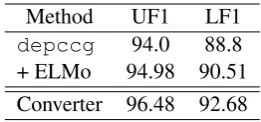
Table 1: The performance of baseline CCG parsers and the proposed converter on WSJ23, where UF1 and LF1 represents unlabeled and labeled F1, respectively.
are replaced by contextualized word representa-tion (ELMo;Peters et al.(2018)) (exi =x
GloV e xi ⊕
xELM oxi ),8 which we find marks the current best
scores in the English CCGbank parsing (Table1). The evaluation is based on the standard eval-uation metric, where the number of correctly predicted predicate argument relations is calcu-lated (§2), wherelabeledmetrics take into account the category through which the dependency is con-structed, whileunlabeledones do not.
Implementation Details The input word repre-sentations to the converter are the concatenation of GloVe and ELMo representations. Each of epi ande`iis randomly initialized 50-dimensional
vectors, and the two-layer sequential LSTMs Ω
outputs 300 dimensional vectors, as well as bidi-rectional TreeLSTMΞd0, whose outputs are then
fed into 1-layer 100-dimensional MLPs with ELU non-linearity (Clevert et al.,2016). The training is done by minimizing the sum of negative log like-lihood ofptag|depusing the Adam optimizer (with
β1 =β2 = 0.9), on a dataset detailed below.
Data Processing In this work, the input tree to the converter follows Universal Dependencies (UD) v1 (Nivre et al.,2016). Constituency-based treebanks are converted using the Stanford Con-verter9 to obtain UD trees. The output depen-dency structuredfollows Head First dependency tree (Yoshikawa et al.,2017), where a dependency arc is always from left to right. The conversion model is trained to map UD trees in the Wall Street Journal (WSJ) portion 2-21 of the Penn Treebank (Marcus et al.,1993) to its correspond-ing CCG trees in the English CCGbank (Hocken-maier and Steedman,2007).
8We used the “original” ELMo model, with
1,024-dimensional word vector outputs (https://allennlp. org/elmo).
Relation Parser Converter # (a) PPs attaching to NP / VP
(N P\NP)/N P 90.62 97.46 2,561
(S\N P)\(S\NP))/N P 81.15 88.63 1,074
(b) Subject / object relative clauses
(N P\NP)/(Sdcl\N P) 93.44 98.71 307
[image:6.595.73.289.61.146.2](N P\NP)/(Sdcl/N P) 90.48 93.02 20
Table 2: Per-relation F1 scores of the proposed con-verter and depccg + ELMo (Parser). “#” column shows the number of occurrence of the phenomenon.
Fine-tuning the CCG Parser In each of the fol-lowing domain adaptation experiments, newly ob-tained CCGbanks are used to fine-tune the param-eters of the baseline parser described above, by re-training it on the mixture of labeled examples from the new target-domain CCGbank, the En-glish CCGbank, and the tri-training dataset.
5.2 Evaluating Converter’s Performance
First, we examine whether the trained converter can produce high-quality CCG trees, by applying it to dependency trees in the test portion (WSJ23) of Penn Treebank and then calculating the stan-dard evaluation metrics between the resulting trees and the corresponding gold trees (Table1). This can be regarded as evaluating the upper bound of the conversion quality, since the evaluated data comes from the same domain as the converter’s training data. Our converter shows much higher scores compared to the current best-performing
depccgcombined with ELMo (1.5% and 2.17%
up in unlabeled/labeled F1 scores), suggesting that, using the proposed converter, we can obtain CCGbanks of high quality.
Inspecting the details, the improvement is ob-served across the board (Table 2); the converter precisely handles PP-attachment (2a), notoriously hard parsing problem, by utilizing input’s pobj
dependency edges, as well as relative clauses (2b), one of well-known sources of long-range depen-dencies, for which the converter has to learn from the non-local combinations of edges, their la-bels and part-of-speech tags surrounding the phe-nomenon.
5.3 Biomedical Domain and Questions
Previous work (Rimell and Clark,2008) provides CCG parsing benchmark datasets in biomedical texts and question sentences, each representing two contrasting challenges for a newswire-trained parser, i.e., a large amount of out-of-vocabulary
Method P R F1
C&C 77.8 71.4 74.5
EasySRL 81.8 82.6 82.2
depccg 83.11 82.63 82.87
+ ELMo 85.87 85.34 85.61
+GENIA1000 85.45 84.49 84.97
[image:6.595.320.513.62.158.2]+ Proposed 86.90 86.14 86.52
Table 3: Results on the biomedical domain dataset (§5.3). P and R represent precision and recall, respec-tively. The scores of C&C andEasySRL fine-tuned on the GENIA1000is included for comparison (ex-cerpted fromLewis et al.(2016)).
Method P R F1
C&C - - 86.8
EasySRL 88.2 87.9 88.0
depccg 90.42 90.15 90.29
+ ELMo 90.55 89.86 90.21
+ Proposed 90.27 89.97 90.12
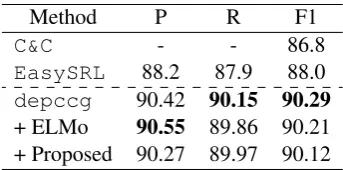
Table 4: Results on question sentences (§5.3). All of baselineC&C,EasySRLanddepccgparsers are re-trained onQuestionsdata.
words (biomedical texts), and rare or even unseen grammatical constructions (questions).
Since the work also provides small training datasets for each domain, we utilize them as well: GENIA1000 with 1,000 sentences and
Questions with 1,328 sentences, both
anno-tated with pre-terminal CCG categories. Since pre-terminal categories are not sufficient to train
depccg, we automatically annotate Head First
dependencies using RBG parser (Lei et al.,2014), trained to produce this type of trees (We follow Yoshikawa et al.(2017)’s tri-training setup).
Following the previous work, the evaluation is based on the Stanford grammatical relations (GR; Marneffe et al.(2006)), a deep syntactic represen-tation that can be recovered from a CCG tree.10
Biomedical Domain By converting the Genia corpus (Tateisi et al., 2005), we obtain a new CCGbank of 4,432 sentences from biomedical pa-pers annotated with CCG trees. During the pro-cess, we have successfully assigned the category
NPto all the occurrences of complex biomedical terms by imposing constraints (§4) thatNPspans in the original corpus be assigned the categoryNP
in the resulting CCG trees as well.
[image:6.595.330.502.239.324.2]Table 3 shows the results of the pars-ing experiment, where the scores of previ-ous work (C&C (Clark and Curran, 2007) and
EasySRL (Lewis et al., 2016)) are included for
reference. The plain depccg already achieves higher scores than these methods, and boosts when combined with ELMo (improvement of 2.73 points in terms of F1). Fine-tuning the parser
on GENIA1000 results in a mixed result, with
slightly lower scores. This is presumably because the automatically annotated Head First dependen-cies are not accurate. Finally, by fine-tuning on the Genia CCGbank, we observe another improve-ment, resulting in the highest 86.52 F1 score.
Questions In this experiment, we obtain a CCG version of the QuestionBank (Judge et al.,2006), consisting of 3,622 question sentences, excluding ones contained in the evaluation data.
Table4compares the performance ofdepccg
fine-tuned on the QuestionBank, along with other baselines. Contrary to our expectation, the plain
depccgretrained onQuestionsdata performs
the best, with neither ELMo nor the proposed method taking any effect. We hypothesize that, since the evaluation set contains sentences with similar constructions, the contributions of the lat-ter two methods are less observable on top of
Questionsdata. Inspection of the output trees
reveals that this is actually the case; the majority of differences among parser’s configurations are ir-relevant to question constructions, suggesting that the models capture well the syntax of question in the data.11
5.4 Speech Conversation
Setup We apply the proposed method to a new domain, transcription texts of speech conversation, with new applications of CCG parsing in mind. We create the CCG version of the Switchboard corpus (Godfrey et al.,1992), by which, as far as we are aware of, we conduct the first CCG pars-ing experiments on speech conversation.12 We ob-tain a new CCGbank of 59,029/3,799/7,681
sen-11Due to many-to-many nature of mapping to GRs, the
evaluation set contains relations not recoverable from the gold supertags using the provided script; for example, we find that from the annotated supertags of sentenceHow many bat-tles did she win ?, the(amod battle many) relation is obtained instead of the golddetrelation. This implies one of the difficulties to obtain further improvement on this set.
12Since the annotated part-of-speech tags are noisy,
we automatically reannotate them using thecore web sm model of spaCy (https://spacy.io/), version 2.0.16.
a. we should cause it does help
b. the only problem i see with term limitations is that i think that the bureaucracy in our government as is with most governments is just so complex that there is a learning curve and that you ca n’t just
[image:7.595.331.504.206.306.2]send someone off to washington and expect his first day to be an effective congress precision
Table 5: Example sentences from the manually anno-tated subset of Switchboard test set.
Error type #
PP-attachment 3
Adverbs attaching wrong place 11
Predicate-argument 5
Imperative 2
Informal functional words 2
Others 11
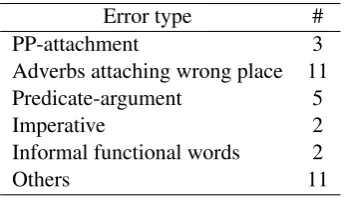
Table 6: Error types observed in the manually anno-tated Switchboard subset data.
tences for each of the train/test/development set, where the data split follows prior work on depen-dency parsing on this dataset (Honnibal and John-son,2014).
In the conversion, we have to handle one of the characteristics of speech transcription texts, disflu-encies. In real application, it is ideal to remove disfluencies such as interjection and repairs (e.g.,I want a flight to Boston um to Denver), prior to per-forming CCG-based semantic composition. Since this corpus contains a layer of annotation that la-bels their occurrences, we perform constrained de-coding to mark the gold disfluencies in a tree with a dummy category X, which can combine with any category from both sides (i.e., for all cate-goryC,C X ⇒ C andXC ⇒ C are allowed). In this work, we perform parsing experiments on texts that are clean of disfluencies, by removing
X-marked words from sentences (i.e., a pipeline system setting with an oracle disfluency detection preprocessor).13
Another issue in conducting experiments on this dataset is evaluation. Since there exists no evalua-tion protocol for CCG parsing on speech texts, we evaluate the quality of output trees by two proce-dures; in the first experiment, we parse the entire test set, and convert them to constituency trees
us-13We regard developing joint disfluency detection and
if
((S\NP)/(S\NP))/Sdcl CD
N NPun
=
(Sdcl\NP)/NP 8
N NPun
Sdcl\NP >
Sdcl
<
and
conj
BE
N NPun
=
(Sdcl\NP)/NP 2
N NPun Sdcl\NP
>
Sdcl
<
Sdcl\Sdcl
Φ
Sdcl
<
(S\NP)/(S\NP) >
,
,
find
(Sdcl\NP)/NP AE
N NPun Sdcl\NP
>
Sdcl\NP
rp..
Sdcl\NP
rp
Sdcl\NP
[image:8.595.76.528.65.148.2]>
Figure 3: Parse output by the re-trained parser for sentenceif CD = 8 and BE = 2, find AE.from math problems.
Method Whole Subset
P R F1 UF1 LF1
[image:8.595.76.287.190.252.2]depccg 74.73 73.91 74.32 90.68 82.46 + ELMo 75.76 76.62 76.19 93.23 86.46 + Proposed 78.03 77.06 77.54 95.63 92.65
Table 7: Results on speech conversation texts (§5.4), on the whole test set and the manually annotated subset.
Method UF1 LF1
depccg 88.49 66.15
+ ELMo 89.32 70.74
+ Proposed 95.83 80.53
Table 8: Results on math problems (§5.5).
ing a method byKummerfeld et al.(2012).14 We report labeled bracket F1 scores between the re-sulting trees and the gold trees in the true Switch-board corpus, using the EVALB script.15 How-ever, the reported scores suffer from the compound effect of failures in CCG parsing as well as ones occurred in the conversion to the constituency trees. To evaluate the parsing performance in de-tail, the first author manually annotated a subset of randomly sampled 100 sentences from the test set. Sentences with less than four words are not contained, to exclude short phrases such as nod-ding. Using this test set, we report the standard CCG parsing metrics. Sentences from this domain exhibit other challenging aspects (Table 5), such as less formal expressions (e.g., use ofcause in-stead ofbecause) (5a), and lengthy sentences with many embedded phrases (5b).16
Results On the whole test set, depccg
shows consistent improvements when combined with ELMo and the proposed method, in the constituency-based metrics (Whole columns in
14
https://github.com/jkkummerfeld/ berkeley-ccg2pst
15
https://nlp.cs.nyu.edu/evalb/
16FollowingHonnibal and Johnson(2014), sentences in
this data are fully lower-cased and contain no punctuation.
Table 7). Though the entire scores are rela-tively lower, the result suggests that the proposed method is effective to this domain on the whole. By directly evaluating the parser’s performance in terms of predicate argument relations ( Sub-setcolumns), we observe that it actually recovers the most of the dependencies, with the fine-tuned
depccg achieving as high as 95.63% unlabeled
F1 score.
We further investigate error cases of the fine-tuned depccg in the subset dataset (Table 6). The tendency of error types is in accordance with other domains, with frequent errors in PP-attachment and predicate-argument structure, and seemingly more cases of attachment errors of ad-verbial phrases (11 cases), which occur in lengthy sentences such as in Table5b. Other types of er-ror are failures to recognize that the sentence is in imperative form (2 cases), and ones in handling in-formal functional words such ascause(Table5a). We conclude that the performance on this domain is as high as it is usable in application. Since the remaining errors are general ones, they will be solved by improving general parsing techniques.
5.5 Math Problems
[image:8.595.114.250.297.353.2]CCG tree from this domain, successfully parsed by fine-tuneddepccg.
Results Table8shows the F1 scores ofdepccg
in the respective settings. Remarkably, we observe huge additive performance improvement. While, in terms of labeled F1, ELMo contributes about 4 points on top of the plain depccg, adding the new training set (converted from dependency trees) improves more than 10 points.17 Examin-ing the resultExamin-ing trees, we observe that the huge gain is primarily involved with expressions unique to math. Figure3is one of such cases, which the plain depccg falsely analyzes as one huge NP
phrase. However, after fine-tuning, it successfully produces the correct “IfS1 andS2, S3” structure,
recognizing that the equal sign is a predicate.
6 Conclusion
In this work, we have proposed a domain adap-tation method for CCG parsing, based on the au-tomatic generation of new CCG treebanks from dependency resources. We have conducted ex-periments to verify the effectiveness of the pro-posed method on diverse domains: on top of ex-isting benchmarks on biomedical texts and ques-tion sentences, we newly conduct parsing experi-ments on speech conversation and math problems. Remarkably, when applied to our domain adapta-tion method, the improvements in the latter two domains are significant, with the achievement of more than 5 points in the unlabeled metric.
Acknowledgments
We thank the three anonymous reviewers for their insightful comments. This work was in part supported by JSPS KAKENHI Grant Number JP18J12945, and also by JST AIP-PRISM Grant Number JPMJCR18Y1, Japan.
References
Lasha Abzianidze. 2017. LangPro: Natural Language Theorem Prover. InProceedings of the 2017 Con-ference on Empirical Methods in Natural Language Processing: System Demonstrations, pages 115– 120. Association for Computational Linguistics.
17
Note that, while in the experiment on this dataset in the previous constituency parsing work (Joshi et al.,2018), they evaluate on partially annotated (unlabeled) trees, we perform the “full” CCG parsing evaluation, employing the standard evaluation metrics. Given that, the improvement is even more significant.
Bharat Ram Ambati, Tejaswini Deoskar, and Mark Steedman. 2013. Using CCG categories to improve Hindi dependency parsing. In Proceedings of the 51st Annual Meeting of the Association for Compu-tational Linguistics, pages 604–609. Association for Computational Linguistics.
Srinivas Bangalore and Aravind K. Joshi. 1999. Su-pertagging: An Approach to Almost Parsing. Com-putational Linguistics, 25(2):237–265.
Johan Bos, Valerio Basile, Kilian Evang, Noortje J. Venhuizen, and Johannes Bjerva. 2017. The Gronin-gen Meaning Bank. InHandbook of Linguistic An-notation, pages 463–496. Springer Netherlands.
Johan Bos, Bosco Cristina, and Mazzei Alessandro. 2009. Converting a Dependency Treebank to a Cate-gorial Grammar Treebank for Italian. InIn Proceed-ings of the Eighth International Workshop on Tree-banks and Linguistic Theories, pages 27–38.
Stephen Clark and James R. Curran. 2007. Wide-Coverage Efficient Statistical Parsing with CCG and Log-Linear Models. Computational Linguistics, 33(4):493–552.
Stephen Clark, Julia Hockenmaier, and Mark Steed-man. 2002. Building Deep Dependency Structures with a Wide-coverage CCG Parser. InProceedings of the 40th Annual Meeting on Association for Com-putational Linguistics, pages 327–334. Association for Computational Linguistics.
Djork-Arn´e Clevert, Thomas Unterthiner, and Sepp Hochreiter. 2016. Fast and Accurate Deep Net-work Learning by Exponential Linear Units (ELUs).
ICLR.
Timothy Dozat and Christopher D. Manning. 2017. Deep Biaffine Attention for Neural Dependency Parsing. ICLR.
John J. Godfrey, Edward C. Holliman, and Jane Mc-Daniel. 1992.SWITCHBOARD: Telephone Speech Corpus for Research and Development. In Pro-ceedings of the 1992 IEEE International Conference on Acoustics, Speech and Signal Processing, pages 517–520. IEEE Computer Society.
Julia Hockenmaier and Mark Steedman. 2007. CCG-bank: A Corpus of CCG Derivations and Depen-dency Structures Extracted from the Penn Treebank.
Computational Linguistics, 33(3):355–396.
Matthew Honnibal and Mark Johnson. 2014. Joint Incremental Disfluency Detection and Dependency Parsing. Transactions of the Association for Com-putational Linguistics, 2:131–142.
Vidur Joshi, Matthew Peters, and Mark Hopkins. 2018.
Extending a Parser to Distant Domains Using a Few Dozen Partially Annotated Examples. In Proceed-ings of the 56th Annual Meeting of the Association for Computational Linguistics, pages 1190–1199. Association for Computational Linguistics.
John Judge, Aoife Cahill, and Josef van Genabith. 2006. QuestionBank: Creating a Corpus of Parse-Annotated Questions. InProceedings of the 21st In-ternational Conference on Computational Linguis-tics and 44th Annual Meeting of the Association for Computational Linguistics, pages 497–504. Associ-ation for ComputAssoci-ational Linguistics.
Dan Klein and Christopher D. Manning. 2003. A* Parsing: Fast Exact Viterbi Parse Selection. In Pro-ceedings of the 2003 Human Language Technology Conference of the North American Chapter of the Association for Computational Linguistics, pages 40–47. Association for Computational Linguistics.
Jonathan K. Kummerfeld, Dan Klein, and James R. Curran. 2012. Robust Conversion of CCG Deriva-tions to Phrase Structure Trees. In Proceedings of the 50th Annual Meeting of the Association for Com-putational Linguistics, pages 105–109. Association for Computational Linguistics.
Kenton Lee, Mike Lewis, and Luke Zettlemoyer. 2016.
Global Neural CCG Parsing with Optimality Guar-antees. InProceedings of the 2016 Conference on Empirical Methods in Natural Language Process-ing, pages 2366–2376. Association for Computa-tional Linguistics.
Tao Lei, Yu Xin, Yuan Zhang, Regina Barzilay, and Tommi Jaakkola. 2014. Low-Rank Tensors for Scoring Dependency Structures. In Proceedings of the 52nd Annual Meeting of the Association for Computational Linguistics, pages 1381–1391. Asso-ciation for Computational Linguistics.
Mike Lewis, Kenton Lee, and Luke Zettlemoyer. 2016.
LSTM CCG Parsing. InProceedings of the 2016 Conference of the North American Chapter of the Association for Computational Linguistics: Human Language Technologies, pages 221–231. Associa-tion for ComputaAssocia-tional Linguistics.
Mike Lewis and Mark Steedman. 2014a. A* CCG Parsing with a Supertag-factored Model. In Pro-ceedings of the 2014 Conference on Empirical Meth-ods in Natural Language Processing, pages 990– 1000. Association for Computational Linguistics.
Mike Lewis and Mark Steedman. 2014b. Improved CCG Parsing with Semi-supervised Supertagging.
Transactions of the Association for Computational Linguistics, 2:327–338.
Zhenghua Li, Min Zhang, Yue Zhang, Zhanyi Liu, Wenliang Chen, Hua Wu, and Haifeng Wang. 2016.
Active Learning for Dependency Parsing with Par-tial Annotation. InProceedings of the 54th Annual
Meeting of the Association for Computational Lin-guistics, pages 344–354. Association for Computa-tional Linguistics.
Mitchell P. Marcus, Beatrice Santorini, and Mary Ann Marcinkiewicz. 1993. Building a Large Annotated Corpus of English: The Penn Treebank. Computa-tional Linguistics, 19(2):314–330.
M. Marneffe, B. Maccartney, and C. Manning. 2006.
Generating Typed Dependency Parses from Phrase Structure Parses. In Proceedings of the Fifth In-ternational Conference on Language Resources and Evaluation, pages 449–454. European Language Resources Association.
Pascual Mart´ınez-G´omez, Koji Mineshima, Yusuke Miyao, and Daisuke Bekki. 2017. On-demand In-jection of Lexical Knowledge for Recognising Tex-tual Entailment. InProceedings of the 15th Confer-ence of the European Chapter of the Association for Computational Linguistics, pages 710–720. Associ-ation for ComputAssoci-ational Linguistics.
Takuya Matsuzaki, Takumi Ito, Hidenao Iwane, Hi-rokazu Anai, and Noriko H. Arai. 2017. Semantic Parsing of Pre-university Math Problems. In Pro-ceedings of the 55th Annual Meeting of the Asso-ciation for Computational Linguistics, pages 2131– 2141. Association for Computational Linguistics.
Seyed Abolghasem Mirroshandel and Alexis Nasr. 2011. Active Learning for Dependency Parsing Using Partially Annotated Sentences. In Proceed-ings of the 12th International Conference on Parsing Technologies, pages 140–149. Association for Com-putational Linguistics.
Jeff Mitchell and Mark Steedman. 2015. Parser Adaptation to the Biomedical Domain without Re-Training. InProceedings of the Sixth International Workshop on Health Text Mining and Information Analysis, pages 79–89. Association for Computa-tional Linguistics.
Makoto Miwa and Mohit Bansal. 2016. End-to-End Relation Extraction using LSTMs on Sequences and Tree Structures. InProceedings of the 54th Annual Meeting of the Association for Computational Lin-guistics, pages 1105–1116. Association for Compu-tational Linguistics.
Joakim Nivre, Marie-Catherine de Marneffe, Filip Gin-ter, Yoav Goldberg, Jan Hajic, Christopher D. Man-ning, Ryan McDonald, Slav Petrov, Sampo Pyysalo, Natalia Silveira, Reut Tsarfaty, and Daniel Zeman. 2016. Universal Dependencies v1: A Multilingual Treebank Collection. InProceedings of the Tenth In-ternational Conference on Language Resources and Evaluation, pages 1659–1666. European Language Resources Association.
Zettlemoyer. 2018.Deep Contextualized Word Rep-resentations. In Proceedings of the 2018 Confer-ence of the North American Chapter of the Associ-ation for ComputAssoci-ational Linguistics: Human Lan-guage Technologies,, pages 2227–2237. Association for Computational Linguistics.
Laura Rimell and Stephen Clark. 2008. Adapting a Lexicalized-Grammar Parser to Contrasting Do-mains. InProceedings of the 2008 Conference on Empirical Methods in Natural Language Process-ing, pages 475–484. Association for Computational Linguistics.
Minjoon Seo, Hannaneh Hajishirzi, Ali Farhadi, Oren Etzioni, and Clint Malcolm. 2015. Solving geom-etry problems: Combining text and diagram inter-pretation. In Proceedings of the 2015 Conference on Empirical Methods in Natural Language Pro-cessing, pages 1466–1476. Association for Compu-tational Linguistics.
Miloˇs Stanojevi´c and Mark Steedman. 2019. CCG Parsing Algorithm with Incremental Tree Rotation. InProceedings of the 2019 Conference of the North American Chapter of the Association for Computa-tional Linguistics: Human Language Technologies, pages 228–239. Association for Computational Lin-guistics.
Mark Steedman. 2000. The Syntactic Process. The MIT Press.
Kai Sheng Tai, Richard Socher, and Christopher D. Manning. 2015. Improved Semantic Representa-tions From Tree-Structured Long Short-Term Mem-ory Networks. InProceedings of the 53rd Annual Meeting of the Association for Computational Lin-guistics and the 7th International Joint Conference on Natural Language Processing, pages 1556–1566. Association for Computational Linguistics.
Yuka Tateisi, Akane Yakushiji, Tomoko Ohta, and Jun’ichi Tsujii. 2005. Syntax Annotation for the GENIA Corpus. InCompanion Volume to the Pro-ceedings of Conference including Posters/Demos and tutorial abstracts, pages 220–225. Association for Computational Linguistics.