Work Hard, Play Hard: Email Classification on the Avocado and Enron
Corpora
Sakhar Alkhereyf
Department of Computer Science Columbia University
New York, U.S.A.
Owen Rambow
Center for Computational Learning Systems Columbia University
New York, U.S.A.
Abstract
In this paper, we present an empirical study of email classification into two main categories “Business” and “Personal”. We train on the Enron email corpus, and test on the Enron and Avocado email corpora. We show that information from the email exchange networks improves the perfor-mance of classification. We represent the email exchange networks as social net-works with graph structures. For this classification task, we extract social net-works features from the graphs in addi-tion to lexical features from email content and we compare the performance of SVM and Extra-Trees classifiers using these fea-tures. Combining graph features with lex-ical features improves the performance on both classifiers. We also provide manually annotated sets of the Avocado and Enron email corpora as a supplementary contri-bution.
1 Introduction
Email has quickly become a crucial communica-tion medium for both individuals and organiza-tions. Kiritchenko and Matwin (2011) show that a typical user daily receives 40-50 emails. Be-cause of its popularity, different research problems related to email classification tasks have arisen. These tasks include spam-filtering, assigning pri-ority to messages, and foldering messages ac-cording a user-specified strategy (Klimt and Yang,
2004). In spite of the popularity of email, many classification tasks have been hampered due the lack of availability of task-related data, due to the privacy issues surrounding email. However, two large data sets are available. First, a large dataset of real emails, the Enron corpus, was made
publicly available by the Federal Energy Regula-tory Commission (FERC) during the legal inves-tigation of the company’s collapse. Second, in February 2015, the Linguistic Data Consortium distributed a data set of emails from an anonymous defunct information technology company referred as Avocado (Oard et al.,2015).
In this paper, we present an empirical study on email classification into two categories: Business and Personal. We train only on the Enron corpus, but test on both the Enron and Avocado corpora for this classification task in order to investigate how dependent on the training corpus the learned models are. In addition, we provide new annotated datasets based on the two corpora1.
We manually annotated datasets based on the Enron and Avocado corpora for this classification task. We use lexical features as well as social net-work features extracted from the email exchange network of both Enron and Avocado. The ex-periments show that when the social network fea-tures combined with lexical feafea-tures outperforms the lexical features alone.
We first present some related work on both the En-ron and Avocado corpora (Section2). Then in Sec-tion3, we describe the datasets and the annotation scheme used in this paper. We discuss lexical fea-tures in Section4, and show how to extract social network features from the email exchange in Sec-tion5. Finally, we present some experiments with different settings (Section 6). The experiments show that adding features extracted from graphs of the email exchange to the lexical features im-proves the classification performance.
1http://www.cs.columbia.edu/˜sakhar/
resources.html
2 Related Work
Since the Enron corpus has been made publicly available, many researchers have worked on the Enron corpus with different tasks. To our knowl-edge, the previous effort most closely related to this paper is that ofJabbari et al.(2006). They re-leased a large set of manually annotated emails, in which they categorize a subset of more than 12,000 Enron emails into two main categories: “Business” and “Personal” and then into sub-categories “Core Business” and “Close Personal”. These sub-categories represent the two main cate-gories respectively. The “Core Business” category has more than 4,500 emails while the “Close Per-sonal” has more than 1,800. We compare our data to their data in detail in Section3.
Agarwal et al. (2012) released a gold standard of the Enron power hierarchy and predict the dom-inance relations between two employees using the degree centrality of the email exchange network. They released this gold standard of the Enron cor-pus with thread structure as a MongoDB database.
Hardin et al.(2014) study the relation between six social network centrality measures and the hierar-chal ranking of Enron employees.
Mitra and Gilbert(2013) study gossip in the En-ron corpus. They use the data set inJabbari et al.
(2006) to study the proportion of gossip in busi-ness and personal emails and find that gossip ap-pears in both personal and business emails and at all levels of the organizational hierarchy. They use an NER classifier to label person names in emails then classify emails mentioning a person not in the recipient list nor the sender as gossip.
A related task is to predict the recipient of an email. Graus et al. (2014) propose a generative model to predict the recipient of an email using the email communication graph and the email content. The model is trained on Enron and tested on Avo-cado. The full enterprise email exchange network is used to build the communication graph as a di-rected graph, as we do in Section5. They report that the optimal performance is achieved by com-bining the communication graph and email con-tent.
3 Datasets and Annotation Scheme As a part of the work in this paper, we have used the Amazon Mechanical Turk (AMTurk) crowd-sourcing platform to annotate a subset of the En-ron corpus. In addition, due to license constraints,
we have in-house annotated a subset of the Avo-cado corpus. We use these two sets as well as the dataset distributed byJabbari et al.(2006) (which we refer to as the “Sheffield set”) for the classifi-cation task in this paper.
3.1 Labeling
Unlike Jabbari et al. (2006), we are interested in maintaining the thread structure of emails (for fu-ture work). Annotators were given email threads of various lengths and asked to annotate each email in the thread and to annotate the thread as a whole. However, classifying email content into business and personal can be a subjective task. For example, if an email talks about an invitation to a picnic for the employees families, one annotator might label this email as business email with the perspective that it talks about a business-related event. On the other hand, another annotator might have a perspective that this is personal event even though it is organized by the company.
We have provided instructions for the annota-tors to annotate each email with one of the follow-ing labels and criteria:
1. Business: The content of the message is clearly professional (even if the language used is very friendly) and it does not contain any personal content; it should be related to the company work.
2. Somehow Business: The main purpose of the message is professional but it has some per-sonal parts.
3. Mixed: the content of the message belongs to two or more of the categories (typically be-cause the sender combines different content in one email).
4. Somehow Personal: The main purpose of the message is personal but it has some business-related content.
5. Personal: The content of the message is clearly personal (even if the language used is very formal) and it does not contain any pro-fessional part.
6. Cannot Determine: If the there is no enough content to determine the category.
Threads Emails
Set Business Personal Total Business Personal Total
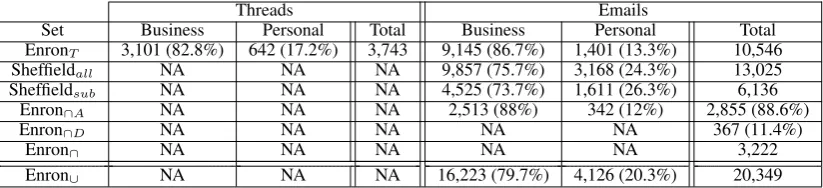
EnronT 3,101 (82.8%) 642 (17.2%) 3,743 9,145 (86.7%) 1,401 (13.3%) 10,546
Sheffieldall NA NA NA 9,857 (75.7%) 3,168 (24.3%) 13,025
Sheffieldsub NA NA NA 4,525 (73.7%) 1,611 (26.3%) 6,136
Enron∩A NA NA NA 2,513 (88%) 342 (12%) 2,855 (88.6%)
Enron∩D NA NA NA NA NA 367 (11.4%)
Enron∩ NA NA NA NA NA 3,222
[image:3.595.94.506.62.156.2]Enron∪ NA NA NA 16,223 (79.7%) 4,126 (20.3%) 20,349
Table 1: Summary of the Enron datasets
• If a message is about a social event inside the company, such as celebrating a new baby of an employee, or a career promotion, it belongs to the second category (“somehow business”).
• If a message is about a social event outside the company but still related to the company, such as a picnic (usually family members are invited), it belongs to the fourth category (“somehow personal”).
• If a message is about a social event which is not related to the company such as a char-ity but company employees are encouraged to participate, it belongs to the fourth cate-gory (“somehow personal”).
• If a message is too short to determine its cate-gory (or even empty), it should have the same category as the message it is responding to, or the message it is forwarding.
• If a message is ambiguous, try to read other messages in the thread to clarify.
• If a message is spam or in the rare case that the first message of a thread is very short or empty, say “cannot determine”.
3.2 Annotators
In the AMTurk task (i.e. Enron), each email thread was annotated by three different turkers. The group of turkers differs from a thread to another. We first ran several batches on AMTurk in which we assigned 5 annotators to each HIT; by studying the resulting data sets, we found that 3 annotators is sufficient and less costly, and most of the data was annotated using 3 Turkers.
To determine the consensus label, we give each of the categories in the above list a numerical label between 1 and 6, with 6 being “cannot determine” and otherwise a larger number indicating that the
email is more personal. First, we discard any “can-not determine” label. Therefore, if there is one or more labels other than “cannot determine” we limit voting to these labels. If all labels are “can-not determine”, the result of voting is “can“can-not de-termine” too. Then, we compute the majority vote of all labels from the three turkers, in case of ties, we take the floor of the mean of ties. For instance, if the labels are{1, 2, 6} the majority vote result is{1, 2}. The mean is 1.5 and the floor is 1. Thus, the final label is 1. There are 5,372 (50.8%) emails in which all annotators gave the same label. The number of emails for each category with consen-sus among all annotators as follows:
Business 4,882 Somehow Business 17
Mixed 8
Somehow Personal 438
Personal 0
Cannot Determine 27
The average standard deviation of ordinal values (i.e. 1: business, 2: Somehow Business ... etc) in Enron emails= 0.37. For computing the aver-age of standard deviation, we exclude any “Cannot Determine” label before computing the standard deviation per email, and if the email has less than two labels other than “Cannot Determine”, we ex-clude that email too. We do so because “Cannot Determine” has no actual ordinal value.
For the annotation of the Avocado corpus, we hired two in-house undergraduate students to an-notate two overlapping subsets of the Avocado corpus, using the same instructions as we gave the Turkers. The licensing conditions for this corpus appear to prohibit using AMTurk. In case of dis-agreement in Avocado∪ (described in3.4), we
annota-tors, we exclude any email labeled “Cannot De-termine” by any annotator. The inter-annotator agreement in Avocado emailsκ = 0.58(Cohen’s kappa).2
The complex labeling scheme described here will be useful for different tasks in the future. However, for the goal of this paper, we aim to group these labels into binary classes: business and personal. Therefore, we normalize the labels as follows: we group “Business” and “Somehow Business” into one category “Business”, and “Per-sonal”, “Somehow Personal” and “Mixed” into one category “Personal”. “Cannot Determine” re-mains the same.
Finally we exclude emails with labels other than “Business” or “Personal” (i.e. emails labeled as “Cannot determine”). These emails are discarded in both training and evaluation. This label is very rare; it occurs only 0.26% of the time in the Enron data, and 0.38% in the Avocado data.
3.3 Enron Datasets
The annotated emails by turkers are a subset of the Enron corpus released by Agarwal et al. (2012), which has more than 36,000 threads and 270,000 emails. We choose this version of Enron because it maintains the thread structure of emails. From this collection, we have randomly sampled total of 3,941 threads with different numbers of emails per thread (2, 3, 4, and 5). The total number of emails is 10,573. We exclude 198 threads (5%) and 27 additional emails (0.26%) labeled as “Cannot de-termine”. The sample has 3,222 emails overlap-ping with the Sheffield set ofJabbari et al.(2006) (after excluding “Cannot determine” emails). We also exclude all emails in the Sheffield set that we could not match with an email in (Agarwal et al.,
2012). After obtaining the final labels as described in3.2, we got 3,743 threads and 10,546 emails la-beled as either “Business” or “Personal” from the Enron corpus. Table1shows the summary of the Enron datasets with the following notations:
• EnronT: The threads and emails obtained from AMTurk as in3.2.
• Sheffieldall: All the Sheffield set except those that we could not match in (Agarwal et al.,
2012).
2we treat classes as completely different categories when
computing Cohen’s kappa
• Sheffieldsub: A subsample of the the Sheffield set (“Business Core” and “Personal Close”).
• Enron∩A: The intersection between EnronT and Sheffieldallin which both agree in labels.
• Enron∩D: The intersection between EnronT and Sheffieldallin which disagree in labels.
• Enron∩: The intersection between EnronT and Sheffieldall.
• Enron∪: Sheffieldall ∪(EnronT −Enron∩).
In case of disagreement, we use Sheffieldall labels.
3.4 Avocado Datasets
The Avocado Email Collection has 62,278 threads and 937,958 emails.
We have randomly sampled total of 2,000 threads and 5,339 emails from the Avocado cor-pus with different number of emails per thread as in Enron.
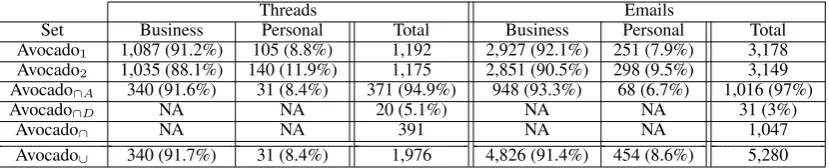
As described in Section3.2, each annotator la-beled 1,200 threads, with 400 threads in common. The first annotator has 3,197 emails, while the sec-ond has 3,207, and 1,065 emails are in common. After obtaining the final labels as described in Sec-tion 3.2, we got total of 1,976 threads and 5,280 emails labeled as either “Business” or “Personal” from the Avocado corpus. Table2shows the sum-mary of the Avocado datasets with the following notations:
• Avocado1: The threads and emails labeled by
the first annotator as in3.2.
• Avocado2: The threads and emails labeled by
the second annotator as in3.2.
• Avocado∩A: The intersection between Avocado1and Avocado2in which both agree
in labels.
• Avocado∩D: The intersection between Avocado1 and Avocado2 in which they
disagree in labels.
• Avocado∩: The intersection between
Avocado1and Avocado2.
• Avocado∪: All the threads and emails
la-beled as in 3.2: Avocado1 ∪ (Avocado2 −
Avocado∩). In case of disagreement, we use
Threads Emails
Set Business Personal Total Business Personal Total
Avocado1 1,087 (91.2%) 105 (8.8%) 1,192 2,927 (92.1%) 251 (7.9%) 3,178
Avocado2 1,035 (88.1%) 140 (11.9%) 1,175 2,851 (90.5%) 298 (9.5%) 3,149
Avocado∩A 340 (91.6%) 31 (8.4%) 371 (94.9%) 948 (93.3%) 68 (6.7%) 1,016 (97%)
Avocado∩D NA NA 20 (5.1%) NA NA 31 (3%)
Avocado∩ NA NA 391 NA NA 1,047
[image:5.595.93.508.62.146.2]Avocado∪ 340 (91.7%) 31 (8.4%) 1,976 4,826 (91.4%) 454 (8.6%) 5,280
Table 2: Summary of the Avocado datasets
3.5 Train, Development and Test Sets
For the binary classification task in this paper, only emails are used as data points. We defer the clas-sification of threads to future work. We use three datasets for the experiments, namely: Enron∪,
Enron∩A, and Avocado∪(described in Section3.3
and Section 3.4). Enron∪ and Enron∩A are di-vided into into train, development and test sets with 50%, 25% and 25% of the emails respec-tively. Avocado∪ is divided equally into
devel-opment and test sets (since we will not train on Avocado). For the rest of this paper, we refer to the train, development and test sets by subscripts
tr, dev,andtesrespectively.
4 Lexical and Local Features
For the classification task, we use pre-trained GloVe embedding vectors as lexical features (Pennington et al.,2014). There are various word vector sets available online, each trained from different corpora and embedded into various dimension sizes.
We use GloVe pre-trained word vector sets such that each email is represented by a vector of a fixed number of dimensions equal to the dimen-sionality of GloVe word vector set. We average all word vectors in the email using the pre-trained word vectors as follows:
ej =
Pn
i fej,vivi
Pn
i fej,vi
Here, fej,vi is the frequency of the word
cor-responding to vectorviin emailej,viis the word embedding vector in GloVe set. Both the body and subjects are included in the email content.
In addition to the contextual features, we use the number of recipient and the length of the email (in words) as meta-information that can be extracted from the email locally without looking at the email exchange network.
5 Social Network Features
The email exchange network can be represented as social networks with different structures. One pos-sible structure is to represent the email exchange network as a bipartite graph with two disjoint sets of nodes, emails and employees (i.e. email ad-dresses) such that edges connect emails with em-ployees, as edges between an email and employees exist if and only if their email address appears as either the sender or a recipient in that email; we refer to this structure as the email-centered net-work. Another structure is a graph (not necessarily bipartite) whose nodes represent employees (i.e. email addresses) and whose edges represent email communication such that and edge exists if there is a least one email has been exchanged between the two end nodes; we refer to this structure as the address-centered network. Figure1illustrates these two types of graphs. In both graphs we nor-malize multiple email addresses belonging to the same person into one email address (node).
For each corpus (i.e. Enron and Avocado), we construct directed and undirected graphs from these two networks (i.e. email-centered and address-centered). In directed graphs, each edge has a source and destination node, which shows explicitly the directionality of the email (i.e. sender and recipients), while in undirected graphs, the directionality of communication is not re-flected within edges. In the case of the address-centered graph, the edge weight reflects the num-ber of emails that have been exchanged between the two ends and the direction; in the case of the email-centered network, the weights are always 1. Different features from these types of graphs can be extracted.
e1 e2 e3 . . . en
a1 a2 a3 . . . am
(a) Email-centered network
a1
a2
a3 am 1
2
1
[image:6.595.96.505.159.606.2](b) Address-centered network
Figure 1: Email Exchange graph
In-degree;,†,w,u indeg(v) =P
u∈VAu,v
where: Au,vis the weight of edge fromutov
Out-degree;,†,w,u outdeg(v) =P
u∈VAv,u
where: Av, uis the weight of edge fromvtou
Degree;,,†,w,u deg(v) =indeg(v) +outdeg(v)
# common neighbors,†,u |S
r∈recΓ(s)∩Γ(r)|
where:recis the list of recipients
sis the sender # Sender’s triangles,†,u 1
2
P
v∈Γ(s)|Γ(s)∩Γ(v)|
where:sis the sender Jaccard’s coefficient,†,u |S
r∈recΓ(s)∩Γ(r)|
|S
r∈recΓ(s)∪Γ(r)|
where:recis the list of recipients
sis the sender Fraction of triangles,†,u 2|S
r∈recΓ(s)∩Γ(r)| P
v∈Γ(s)|Γ(s)∩Γ(v)|
where:recis the list of recipients
sis the sender In-degree centrality;,†,w indeg(u)
|V|−1
Out-degree centrality;,†,w outdeg(u)
|V|−1
Degree centrality;,,†,w,u deg(u)
|V|−1
Betweenness centrality;,,†,‡, w, u P
s,t∈V σσ(s,t(s,t|v))
where:σ(s, t)is the number of shortest paths betweensandt σ(s, t|v)is the number of these paths that pass throughv
Eigenvector centrality;,,†,‡,u For a nodev:x v
where:xis the eigenvector corresponding to the largest eigenvalue of A
Ax=λx
Closeness centrality;,,‡,w,u |V|−1
P
u∈Vd(v,u)
where:d(v, u)is the shortest-path distance betweenvandu.
Auth Score;,,†,‡,w,u The authority score for a node using HITS algorithm (Kleinberg,1999)
Hub Score;,,†,‡,w,u The hub score for a node using HITS algorithm.
;Extracted from directed graphs.
Extracted from undirected graphs.
†Features of senders/recipients in the Address-centered network. ‡Features of emails in the Email-centered network.
wUses edge weights.
uAll edge weights are considered equal to 1.
Table 3: Social Network Features. A: the adjacency matrix for a graph (weighted or unweighted),Γ(v): The set of neighbors of the nodev
.
average the value corresponding to each feature.
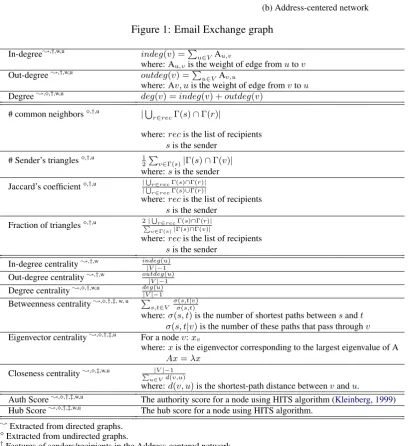
Table3summarizes the social network features. 6 Experiments
Classifier Parameter Parameter Space
SVM γ 10
−4,−3,−2,−1,0
kernel rbf, linear
C 1,10,100,1000
Extra-Trees Split Criteria# trees 10,20Gini, Entropy,30,50,100,200 Min Sample 1, 3, 10 Both Class-weights {{B:1, P:1P:1, B:3}},, balanced{P:1, B:2}
Table 4: Grid-search parameter space. B: Busi-ness, P: Personal. Balanced: class weights are ad-justed inversely proportional to class frequencies in the training set
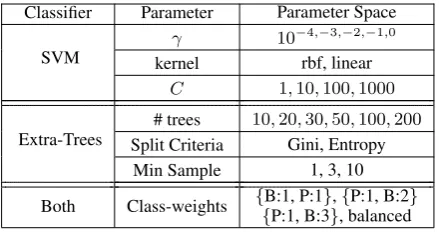
experiments on lexical and social network feature sets. We use three metrics to measure the per-formance, namely: accuracy score, Business F-1 score and Personal F-1 score. We are mainly in-terested in improving the Personal F-1 score since it is the minority class. We compare the per-formance of SVM classifiers and extremely ran-domized trees (commonly known as Extra-Trees) (Geurts et al.,2006) as implemented in the scikit-learnpython library (Pedregosa et al.,2011). We tune the hyper-parameters using grid-search with 3-fold cross-validation on the training set. Table
4 shows the grid-search space for the two clas-sifiers. As a preprocessing step, we apply loga-rithmic transformation on the network and meta-information feature values to be approximately normal in distribution. Then, all feature values (i.e. lexical, network and meta-info) are standard-ized to have zero-mean and unit-variance.
Vector Set Accuracy (%) F-1 B (%) F-1 P (%)
BOW 92.3 95.6 71.2
6B.50d 93.0 95.9 75.7
6B.100d 93.0 95.9 75.5
6B.200d 95.0 97.1 80.0
27B.25d 94.5 96.8 80.0
27B.50d 94.3 96.7 79.2
27B.100d 95.0 97.1 80.7
27B.200d 93.7 96.3 77.6
42B.300d 95.4 97.3 83.1
[image:7.595.72.292.61.177.2]840B.300d 95.1 97.2 80.5
Table 5: Results from different GloVe word vector sets and a BOW model as a baseline trained on Enron∩A tr and tested on Enron∩A dev.
6.1 Obtaining Best GloVe Vector Set
First, in order to obtain the GloVe vector set that maximizes the performance, we experiment with
different GloVe pre-trained vectors as lexical fea-tures (meta-information feafea-tures are not included). Table5 shows the results of classification of dif-ferent GloVe pre-trained vector sets trained on Enron∩A tr and tested on Enron∩A dev. In addi-tion, a bag-of-words (BOW) model is shown as a baseline. In this model, we represent each email as a vector of frequencies (term counts), then we select the top 500 words using χ2 feature
selec-tion method. In all models (i.e. GloVe vectors and BOW), we use SVM classifiers and we tune pa-rameters using grid-search.
The results show that, in general, more train-ing data is better, and more dimensions are bet-ter. However, the best set is the 300-dimensional 42B.300d which is trained on a large 42 billion token corpus, rather than the larger 840 B words-based embeddings. We use these embeddings in all further experiments.
6.2 Experiments with Different Features and Sets
In this subsection, we perform experiments with different models tested on Enron∪dev and Avocado∪dev. We assume that the ultimate appli-cation of our work is a setting in which we train models on a company (i.e. Enron) and apply it to another company (i.e. Avocado).
First, we tune the hyper-parameters using grid-search with 3-fold cross-validation on Enron∪tr and Enron∩A tr three times: first, using network and meta-information features only, second, using lexical (embedding) features only, third, using all features.
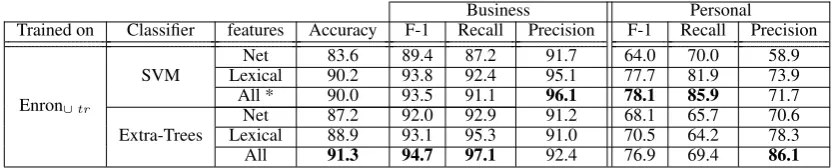
Then, we select the best SVM and Extra-trees models with the lexical features only and the mod-els with all features. We apply a paired t-test on the personal F-1 scores of of the models (i.e. SVM and Extra-trees models with lexical features only and with all features) using 10-fold cross-validation.
The results of the paired t-test show that the im-provement obtained from adding the network fea-tures is statistically significant on Enron∪tr (p <
0.05), but not on Enron∩A tr(p >0.05) using both SVM and Extra-trees classifiers.
[image:7.595.74.289.528.644.2]Trained on Classifier features Accuracy F-1 Recall Precision F-1 Recall Precision
Enron∪tr
SVM LexicalNet 83.690.2 89.493.8 87.292.4 91.795.1 64.077.7 81.970.0 58.973.9
All * 90.0 93.5 91.1 96.1 78.1 85.9 71.7
Extra-Trees LexicalNet 87.288.9 92.093.1 92.995.3 91.291.0 68.170.5 64.265.7 70.678.3
All 91.3 94.7 97.1 92.4 76.9 69.4 86.1
Table 6: Results of different classifiers tested on Enron∪dev. Net features include meta-information features
Business Personal
Trained on Classifier features Accuracy F-1 Recall Precision F-1 Recall Precision
Enron∪tr
SVM LexicalNet 85.789.2 92.193.9 89.989.9 94.398.2 26.753.0 80.134.3 21.939.6
All 90.2 94.5 91.7 97.5 52.6 71.6 41.5
Extra-Trees LexicalNet 91.192.0 95.395.7 97.694.8 93.196.5 17.552.9 58.712.4 29.848.2
All 92.3 95.8 95.6 96.1 51.2 52.7 49.8
Enron∩A tr
SVM LexicalNet 89.294.3 95.896.9 95.697.3 96.196.5 51.260.7 57.752.7 49.864.1
All * 95.0 97.3 98.2 96.5 63.0 56.2 71.5
Extra-Trees LexicalNet 92.093.7 95.996.7 99.598.9 92.594.6 43.23.7 31.32.0 23.569.2
[image:8.595.90.507.62.146.2]All 93.8 96.7 99.0 94.6 43.2 30.8 72.1
Table 7: Results of different classifiers tested on Avocado∪dev. Net features include meta-information features
Business Personal
Trained on Tested on Accuracy F-1 Recall Precision F-1 Recall Precision
Enron∪tr Enron∪ts 91.2 94.4 92.1 96.7 79.9 87.5 73.5
Enron∩A tr Avocado∪ts 93.5 96.4 96.9 96.0 64.7 62.1 67.7
Table 8: Applying best models on test sets. Both models are SVM classifiers trained with all features.
show that adding network features helps in retriev-ing more personal emails (increasretriev-ing the personal recall) when using both classifiers. In addition, it is clear from the results that the network features are more effective with Extra-Trees since adding them improves all the scores.
To evaluate the cross-corpora performance, we test on Avocado∪dev using different models trained on Enron∪tr and Enron∩A tr. Table 7 summarizes the cross-corpora results. We use Enron∩Atr in this experiment to test how well a model performs on another corpus when train-ing on a dataset with few but high-confidence labels, in comparison with training on a larger dataset with labels of lesser confidence. The re-sults show that a model trained on a large dataset with lesser confidence labels (i.e. Enron∪tr ) us-ing lexical feature alone can retrieve many per-sonal emails, but with a poor precision. Unlike the intra-corpus setting, adding network features
always increases the personal precision but de-creases the personal recall. However, the best per-formance as measured by f-measure is achieved by combining the network and lexical features, and using SVMs, which is the same best configuration as in the intra-corpus evaluation setting. For the inter-corpora evaluation, the best result is achieved using the smaller training corpus with higher qual-ity labels.
In both settings (i.e. intra-corpus and cross-corpora), Extra-Trees classifiers suffer in retriev-ing personal emails causretriev-ing a decrease in the F-1 personal score in comparison with SVM classi-fiers.
6.3 Performance on the test set
[image:8.595.88.510.199.346.2]per-formance of the best models on the test sets. The results show that in an intra-corpus setting, we can achieve a high personal F-1 score. Also, it is pos-sible to get a good performance on a corpus (i.e. Avocado) when training on another one (Enron).
7 Conclusion and Future Work
In this paper, we have shown that classifying emails into business and personal can be predicted with good performance using conventional clas-sifiers trained with pre-trained word embeddings that are available online. We performed different experiments on two corpora, Enron and Avocado. The cross-corpora results show that it is possible to classify emails of a company using models trained on another company with a good performance. In addition, we have shown that including features obtained from the graphs representing the email exchange network improves the classification per-formance.
We observe that the percentage of personal email decreases from 20%(in Enron) to less than
10%(in Avocado). It is not clear whether this is due to the nature of two companies or due to the spread of free email services such as Hotmail and Gmail.
In the future, we plan to experiment with adding more network features that can capture more global network features using approaches such as graph spectral analysis and graph kernels.
8 Acknowledgements
We would like to thank Ibrahim Almosallam for helpful discussions. We would like to thank the anonymous reviewers for their valuable feedback. The first author was supported by the KACST Graduate Studies program. The second author was supported for this work in part by the DARPA DEFT program. The views expressed here are those of the authors and do not reflect the official policy or position of the U.S. Department of De-fense or the U.S. Government.
References
Apoorv Agarwal, Adinoyi Omuya, Aaron Harnly, and Owen Rambow. 2012. A comprehensive gold stan-dard for the enron organizational hierarchy. In Pro-ceedings of the 50th Annual Meeting of the Associ-ation for ComputAssoci-ational Linguistics: Short Papers-Volume 2. Association for Computational Linguis-tics, pages 161–165.
Pierre Geurts, Damien Ernst, and Louis Wehenkel. 2006. Extremely randomized trees. Machine learn-ing63(1):3–42.
David Graus, David Van Dijk, Manos Tsagkias, Wouter Weerkamp, and Maarten De Rijke. 2014. Recip-ient recommendation in enterprises using commu-nication graphs and email content. InProceedings of the 37th international ACM SIGIR conference on Research & development in information retrieval. ACM, pages 1079–1082.
Johanna Hardin, Ghassan Sarkis, and PC Urc. 2014. Network analysis with the enron email corpus.
arXiv preprint arXiv:1410.2759.
Sanaz Jabbari, Ben Allison, David Guthrie, and Louise Guthrie. 2006. Towards the Orwellian nightmare: separation of business and personal emails. In Pro-ceedings of the COLING/ACL on Main conference poster sessions. Association for Computational Lin-guistics, pages 407–411.
Svetlana Kiritchenko and Stan Matwin. 2011. Email classification with co-training. InProceedings of the 2011 Conference of the Center for Advanced Studies on Collaborative Research. IBM Corp., pages 301– 312.
Jon M Kleinberg. 1999. Authoritative sources in a hy-perlinked environment. Journal of the ACM (JACM)
46(5):604–632.
Bryan Klimt and Yiming Yang. 2004. The enron cor-pus: A new dataset for email classification research. InMachine learning: ECML 2004, Springer, pages 217–226.
Tanushree Mitra and Eric Gilbert. 2013. Analyzing gossip in workplace email. ACM SIGWEB Newslet-ter WinNewslet-ter5.
Douglas Oard, William Webber, David Kirsch, and Sergey Golitsynskiy. 2015. Avocado research email collection. Philadelphia: Linguistic Data Consor-tium.
Fabian Pedregosa, Ga¨el Varoquaux, Alexandre Gram-fort, Vincent Michel, Bertrand Thirion, Olivier Grisel, Mathieu Blondel, Peter Prettenhofer, Ron Weiss, Vincent Dubourg, et al. 2011. Scikit-learn: Machine learning in Python. Journal of Machine Learning Research12(Oct):2825–2830.