A Thesis Submitted for the Degree of PhD at the University of Warwick
http://go.warwick.ac.uk/wrap/77519
This thesis is made available online and is protected by original copyright. Please scroll down to view the document itself.
Permutation Patterns, Graph Arrangements,
and Matroid Parameters
by
Luk´
aˇs Mach
Thesis
Submitted in partial fulfilment of the requirements
for the degree of
Doctor of Philosophy
Contents
Acknowledgements 3
Declarations 5
Abstract 7
1 Introduction 8
2 Preliminaries 16
2.1 Basic notation . . . 16
2.2 Permutations . . . 17
2.3 Graphs . . . 17
2.4 Algorithms . . . 19
2.5 Complexity classes . . . 22
2.6 Common hypotheses in complexity theory . . . 23
2.7 Exponential Time Hypothesis . . . 24
2.8 Expanders . . . 26
2.9 Parameterized complexity and kernelization . . . 27
2.10 Matroids . . . 30
2.11 Width parameters for matroids . . . 32
3 Permutation Pattern Matching 35
3.1 Problem definition and additional notation . . . 37
3.2 Kernelization lower bounds . . . 38
3.3 Conclusion . . . 48
4 Optimum Linear Arrangement 49 4.1 Sparse reduction to OLA . . . 52
4.2 Structure of the solution . . . 56
4.3 Conclusion . . . 63
5 Amalgam-width of matroids 64 5.1 Matroid amalgams . . . 66
5.2 Amalgam-width . . . 70
5.3 Algorithms . . . 72
5.4 Conclusion . . . 80
6 Branch-depth of matroids 84 6.1 Definition and basic properties . . . 86
6.2 Technical lemmas . . . 91
6.3 Approximating branch-depth . . . 94
6.4 Conclusion . . . 99
7 Conclusion and future work 101
List of Abbreviations 111
Acknowledgements
I am grateful to my supervisor, Dan Kr´al’, for all the opportunities, support, and
guidance provided during my doctoral studies. The feedback provided by my
viva examiners, Graham Cormode and Daniel Paulusma, is greatly appreciated.
I want to thank all the researchers who have co-authored a paper with me:
Ivan Bliznets, Marek Cygan, Frantiˇsek Kardoˇs, Pavel Klav´ık, Pawe l Komosa,
Dan Kr´al’, Anita Liebenau, Andrej Mikul´ık, Micha l Pilipczuk, Jean-Sebastien
Sereni, and Tom´aˇs Toufar. My bachelor students at Charles University in Prague,
Adam Dominec and Viktorie V´aˇsov´a, were great collaborators as well.
I happily acknowledge the support provided by the following organizations:
Computer Science Institute of Charles University in Prague, the Grant Agency
of Charles University (GAUK), University of Warwick, the Centre for Discrete
Mathematics and its Applications (DIMAP) at Warwick, University of Warsaw,
and the Warsaw Center of Mathematics and Computer Science (WCMCS).
Dur-ing my studies, I have received support from the European Research
Coun-cil under the European Union’s Seventh Framework Programme
(FP7/2007-2013)/ERC grant agreement no. 259385 and from the student project GAUK
no. 592412.
I want to thank all the great people and friends I have met before and
during my studies at Warwick, in particular Rafael Barbosa, Martin B¨ohm,
Michail Fasoulakis, Matthew Felice-Pace, Tereza Hulcov´a, Marcin Jurdzinski,
Tereza Klimoˇsov´a, Matjaˇz Krnc, Luk´aˇs L´ansk´y, Bernard Lidick´y, Felix Ling,
Jirka Matˇejka, Nick Matsakis, Ta´ısa Martins, Luk´aˇs Novotn´y, Ad´ela Peterov´a,
Jakub Polonsk´y, Jakub Sliacan, Vojta T˚uma, Danuˇse Vavˇrinov´a, Honza Volec,
and Nick Zervoudis.
I would like thank to my family, especially my mother, father, and brother,
Declarations
The majority of this thesis is based on results that are either already published or
whose publication is currently in preparation. Below, we list these publications
including submitted papers (and papers in preparation). The thesis is divided
into seven chapters:
Chapter 1 gives an overview of the obtained results and a commentary on how they relate to the current state of the art in computer science.
Chap-ter 2 provides the reader with background maChap-terial of the relevant areas and
fixes notation used throughout the text. This notation and the statements
of definitions, lemmas, hypotheses, and theorems from this chapter are
of-ten identical or similar to those used in one of the standard introductory
monographs referenced in the text.
Chapter 3 is based on the result [5]. This collaboration with Ivan Bliznets,
Marek Cygan, and Pawe l Komosa has been published in Information
Pro-cessing Letters.
The results presented in Chapter 4 are a joint work [6] with Ivan Bliznets,
Marek Cygan, Pawe l Komosa, and Micha l Pilipczuk. They were accepted
for presentation at the SODA 2016 conference.
Chapter 5 is a joint work with Tom´aˇs Toufar. The corresponding article [64]
is a contribution to the8th International Symposium on Parameterized and
Exact Computation (IPEC 2013), where it has been awarded the IPEC
Excellent Student Paper award. The results of this chapter overlap
signifi-cantly with the Bachelor thesis of Tom´aˇs Toufar.
In Chapter 6, we study the algorithmic aspects of the matroid branch-depth
parameter. These results were obtained together with Frantiˇsek Kardoˇs,
Daniel Kr´al’, and Anita Liebenau. The corresponding paper [52]
(submit-ted for a journal publication) introduces this parameter and gives both
structural and algorithmic theorems.
Conclusion of the work with some indication of possible future research
directions is given in Chapter 7.
With the exception of the contents of Chapter 5 (mentioned above), no result of
this thesis already appeared in another academic thesis. The scientific
contribu-tion of the individual authors of the above results is roughly proporcontribu-tional to the
number of authors of each result. This thesis has not been previously submitted
Abstract
The theory of parameterized complexity is an area of computer science focusing
on refined analysis of hard algorithmic problems. In the thesis, we give two
complexity lower bounds and define two novel parameters for matroids.
The first lower bound is a kernelization lower bound for the Permutation Pattern Matching problem, which is concerned with finding a permutation
pattern inside another input permutation. Our result states that unless a
cer-tain (widely believed) complexity hypothesis fails, it is impossible to construct a
polynomial time algorithm taking an instance of the Permutation Pattern Matching problem and producing an equivalent instance of size bounded by a
polynomial of the length of the pattern. Obtaining such lower bounds has been
posed by St´ephane Vialette as an open problem.
We then prove a subexponential lower bound for the computational
com-plexity of the Optimum Linear Arrangement problem. In our theorem, we
assume a conjecture about the computational complexity of a variation of the
Min Bisection problem.
The two matroid parameters introduced in this work are called
amalgam-width and branch-depth. Amalgam-amalgam-width is a generalization of the branch-amalgam-width
parameter that allows for algorithmic applications even for matroids that are not
finitely representable. We prove several results, including a theorem stating that
deciding monadic second-order properties is fixed-parameter tractable for
gen-eral matroids parameterized by amalgam-width. Branch-depth, the other newly
introduced matroid parameter, is an analogue of graph tree-depth. We prove several statements relating graph tree-depth and matroid branch-depth. We also
present an algorithm that efficiently approximates the value of the parameter on
a general oracle-given matroid.
Chapter 1
Introduction
Efficient computation is one of the main focal points of computer science. Since
the beginnings of the field, researchers have attempted to either find algorithms
minimizing resources exerted for obtaining the correct answer to algorithmic
problems or to find negative results – reasons why some problems should not
admit algorithms above certain levels of efficiency. The first theoretical notion
trying to characterize what is practically computable was the class P of
algo-rithmic problems solvable in polynomial number of steps. From a practical
standpoint, this mathematical formalization has several major issues. One
par-ticular is that many algorithmic problems widely believed to lie outside of P are
actually routinely solved in the real world, e.g. by CSP-solvers. The instances
encountered as a result of real applications sometimes seem to posses certain
structural properties that help to accelerate the computation. A more detailed
look at the (conjectured) land behind the boundaries of Pis certainly warranted.
Parameterized complexity, the area to which this thesis mainly contributes,
provides a framework for such refined analysis. In this field, the set of all possible
inputs of an algorithmic problem (e.g., the set of all graphs) is divided into an
infinite number of layers by equipping the individual instances with a
parame-ter value. Different parameterizations of the same set of inputs are sometimes
sensible. Ideally, the parameter should, roughly speaking, correspond to the
al-gorithmic difficulty of resolving the instance. One of the main aims of the area
is to obtain fixed-parameter tractable (FPT) algorithms for parameterized
prob-lems. These are algorithms with the running time of O f(k)·nc
, where f(·) is a computable function,n the size of the input of the instance, k the value of the parameter, and ca real constant.
An example of a parameterization is given by the classical notion of graph
tree-width, employed prominently in the proof of the Robertson-Seymour
theo-rem (see, e.g., [76]). The tree-width of a graph is a value proportional to the
“distance” the graph is from being a tree (or a forest). Graphs with tree-width 1
are actually precisely forests. The formal definition is given as Definition 8 in
Section 2.3. A large number of difficult (NP-hard) problems on graphs are easy
to solve on graphs of bounded tree-width: for any choice of a constant k, there exists a polynomial algorithm solving the problem for graphs of tree-width at
mostk. Many of the corresponding algorithms are FPTunder this parameteriza-tion. A classical result of Courcelle [21] generalizes this to all decision problems
expressible as formulas in monadic second-order logic.
Theorem 1 (Courcelle, [21]). Let ϕ be a fixed formula in monadic second-order logic andk ∈N. Then, there is an algorithm deciding whether a graphGsatisfies
ϕ in linear time for graphs of tree-width at most k.
Parameterized complexity also provides us with the first formal framework to
theoretically analyze preprocessing algorithms through the notion of
a problem to an equivalent instance of strictly smaller size. Such algorithms are
useful when it comes to solving difficult problems in practice: an efficient
prepro-cessing algorithm is applied exhaustively after which another approach is used to
solve the reduced instance. Obviously, it is desirable for the size of the reduced
instance to be as small as possible. We say that a parameterized problem has
a kernel if there exists a polynomial time preprocessing algorithm guaranteed to
produce an instance of size and parameter value bounded by a function of the
parameter of the initial instance. Such algorithm is then called a kernelization
algorithm. Conveniently, the class of FPT problems and the class of problems
with a kernel coincide [27]. A stronger notion is represented by the class of
problems with a polynomial kernel. For these, there is a kernelization algorithm
always producing an instance of size bounded by a polynomial of the parameter
value of the initial instance.
The first result of this thesis is a kernel size lower bound for thePermutation
Pattern Matching problem. A permutation π contains a permutation σ as
a pattern if it contains a subsequence of length |σ| whose elements are in the same relative order as in the permutation σ. The Permutation Pattern Matching problem is the corresponding algorithmic problem. The standard
parameterization is by |σ|. Guillemot and Marx [39] recently resolved the issue of whether the problem is in FPTaffirmatively, implying that the problem has a
kernel. Vialette [82] asked for lower bounds on the size of this kernel. We prove
the following:
Theorem 2. Unless NP ⊆ co-NP/poly, the Permutation Pattern Match-ing problem does not have a polynomial kernel.
in the field of computational complexity and one of the typical starting points
for obtaining kernelization lower bounds. Its failure would imply the collapse of
the polynomial hierarchy to the third level. Consequently, there is a high degree
of confidence in its validity within the research community. The proof of this
theorem is given in Chapter 3.
A lower bound of a different kind is presented in Chapter 4, where we are
concerned with the standard (i.e., non-parameterized) Optimum Linear
Ar-rangement problem. We prove a hardness result relative to the computational
complexity of the gap version of theMin Bisection problem. (The precise
def-initions of these algorithmic problems are deferred to Chapter 4.) Specifically,
we formulate the following conjecture:
Conjecture 3. There exist d0 ∈ N and α, β ∈ (0,1), α < β such that for each
d≥d0 there is no 2o(n) time algorithm for (d, α, β)-Gap Min Bisection.
The (d, α, β)-Gap Min Bisectionproblem is defined in Chapter 4. Essentially, it is a gap version of the Min Bisection problem on regular graphs. The
mo-tivation for this conjecture is given in Chapter 4. There, we prove the theorem
below.
Theorem 4. Unless Conjecture 3 fails, there is no 2o(n+m) time algorithm for
Optimum Linear Arrangement, where n is the number of vertices of the
input graph and m the number of its edges.
This is a similar kind of computational complexity bound to those based
on the Exponential Time Hypothesis (ETH), which stipulates that there is no
algorithm for theq-SATproblem running in 2o(n) time, wherenis the number of
reported in [6] we prove complexity lower bounds for several graph completion
problems first under the ETH and then apply Conjecture 3 and Theorem 4 to
substantially strengthen them.
Let us briefly comment on some results from [6] that are not part of this
thesis. Hopefully, they provide additional level of justification for our conjecture
and illuminate the relevance of Theorem 4. Graph completion problems are
algo-rithmic problems where the question to be decided is whether a certain number
of edges can be added to the input graph in such a way that the resulting graph
belongs to some class, e.g., the class of chordal graphs. We consider the natural
parameterization of these problems by the number of edges to be added and give
the following bounds. (We refer the reader to Section 2.4 for the definitions of
the algorithmic problems in question.)
Theorem 5 (Bliznets et al., [6]). Unless the ETH fails, there exists c > 0 such that none of the following problems has a 2O(k14/logck)
·nO(1) algorithm, where k
is the value of the parameter and n is the input size: Chordal Completion, Trivially Perfect Completion, Proper Interval Completion, and
Interval Completion.
The parameterized problems from the above theorem have been studied
exten-sively in the literature [34]. Theorem 4 allows us to obtain lower bounds that
essentially match the fastest presently known parameterized algorithms.
Theorem 6 (Bliznets et al., [6]). Unless Conjecture 3 fails, for all ε > 0 there is no 2O(
√ k1−ε)
·nO(1) algorithm for any of the following problems: Chordal Completion, Trivially Perfect Completion, Proper Interval
For example, the currently fastest known parameterized algorithm for Chordal
Completionruns in 2O( √
klogk)+nO(1) steps [34].
In Chapter 5, we introduce the notion of amalgam-width. This is an attempt
to generalize the notion of width parameters to matroids. Several such
param-eters have already been introduced in the literature, including a direct
general-ization of tree-width [44] and clique-width [22]. However, our aim is to obtain
one that allows the algorithmic applications even for non-representable matroids.
Furthermore, amalgam-width has the nice property that it corresponds to a
nat-ural, standard gluing operation called amalgamation. We prove the following
theorem:
Theorem 7. For eachk ∈N and each formulaϕ in monadic second-order logic there is an algorithm deciding whether a matroid M satisfiesϕ in linear time for matroids of amalgam-width bounded from above byk (assuming the corresponding amalgam decompositionT of the matroid is given explicitly as a part of the input).
Amalgam-width generalizes a parameter based on 2-sums introduced in [81]
and branch-width for matroids representable over finite fields. The later
gener-alization is in the sense that amalgam-width can be bounded by a function of
branch-width. The proof of this claim (Proposition 46) is constructive and leads
to an efficient algorithm constructing such amalgam decompositions.
The next chapter introduces another matroid parameter, the matroid
branch-depth. This time, the main motivation for our algorithmic results is structural.
The parameter is a matroid analogue of graph tree-depth, an established graph
parameter used among others by Neˇsetˇril and Ossona de Mendez in their research
on combinatorial limits [66]. There, the notion of tree-depth is used to constrain
a combinatorial limit called modeling can be guaranteed. In [52] we extend
this theory to matroids by introducing matroid modelings, the branch-depth
parameter, and the notion of first-order convergent sequences of matroids. Apart
from a number of negative results, we also prove a theorem analogous to the
abovementioned result on graphs. Specifically, we show that every first-order
convergent sequence of matroids with bounded branch-depth representable over
a finite field has a matroid modeling. The similarity between this statement and
the aforementioned result of [66] indicates that at least from some perspective
the branch-depth parameter is an analogous notion to tree-depth.
In Chapter 6 of this thesis, we focus exclusively on the algorithmic aspects of
the branch-depth parameter and on its relationship with tree-depth. We provide
an efficient algorithm approximating the parameter value for any oracle given
matroid. The close relation with tree-depth is substantiated by the following
properties:
The branch-depth of a graphic matroid M(G) is at most the tree-depth
of G. Furthermore, it can be bounded from below by a function of the tree-depth if G is 2-connected.
Both branch-depth and tree-depth are minor monotone parameters.
The branch-depth of a matroid is at most the square of the length of its largest circuit (recall that the tree-depth of a graphGis at most the length of its longest path).
The branch-depth of a matroid is at least the logarithm of the length of
The branch-depth parameter is defined through a particular kind of
Chapter 2
Preliminaries
In this chapter, we review the notation adopted by this thesis and reference results
from literature utilized in the proofs of the subsequent chapters. The contents
are not intended as an introductory text to the field. Rather, we hope to provide
a sufficient amount of context for our results while maintaining brevity. Many
of the elementary notions are mentioned simply to fix the notation. We refer
the reader to the monographs [25] and [71] for a comprehensive introduction to
graph theory and the theory of matroids, respectively. Parameterized algorithms
are treated in the recent book [23].
2.1
Basic notation
The set {i, i+ 1, . . . , j−1, j} is denoted by [i, j]. We let [n] := [1, n]. The set of all subsets of the set X is denoted by S(X) and Xr is the set of all subsets of X of size r ∈ N. For a function f and a set X we define f(X) to be the set
{f(x) :x∈X}. For a matrixM, the element in thei-th row and thej-th column is denoted by Mi,j. A submatrix of a matrix M is a matrix obtained by deleting
some rows and/or columns of M. For a non-empty set Σ, we denote by Σ∗ the set of all sequences of finite length composed of elements from Σ. For example
{0,1}∗ is the set of all finite binary strings. A formula in conjunctive normal
form (CNF) is a formula C1 ∧C2 ∧. . .∧Ck, where Ci are clauses of the form
Ci =`i1∨`i2∨. . .∨`iki, where`ij is a literal (either a variable or a negated variable).
This formula is a q-CNF formulaif all its clauses have precisely q literals.
2.2
Permutations
A permutationπis a bijection from [n] to [n]. The valueπ(i) is calledthe entry of
π at positioni(orindexi). We use|π|to denote the size of the domain ofπ. Two common representations of a permutation π are used in the thesis: the vector (π(1), π(2), . . . , π(n)) and the corresponding permutation matrix. The latter is a
|π| × |π| binary matrix with 1-entries precisely on coordinates (π(i), i).
2.3
Graphs
A graph is a pair (V, E), where V is the set of vertices and E ⊆ V2
is the set of
edges. Therefore, unless otherwise specified, graphs in this thesis are undirected,
loopless, and without edge multiplicities. In line with common practice, an edge
e={u, v} is denoted by (u, v) although the pair is not ordered. We say that an edge e is incident with the vertex v if v ∈e. The set of vertices of G is denoted
V(G) whileE(G) is its edge-set. A hypergraphis a pair (V, E), whereE ⊆ S(V). An r-uniform hypergraphis a hypergraph whereE ⊆ Vr
. Therefore, the notions
of a graph and a 2-uniform hypergraph coincide. A graph H is a subgraph of G
E(H) =E(G)∩ V(2H)
. We use G[X] to denote an induced subgraph of G with vertex set X. A complete graph Kn on n vertices is the graph (V, V2
), where
V = [n]. A graph G contains a clique of size l if an isomorphic copy of Kl is
a subgraph of G.
For a vertex v, deg(v) is its degree: the number of edges incident with v. We say that a graph is d-regular if all its vertices have degree d. We use ∆(G) := max{deg(v) : v ∈V(G)} to denote the maximum degree of G. The set N(v) :=
{w : (v, w) ∈ E(G)} is the neighbourhood of v. This notation is extended to subsets of vertices X, i.e. N(X) = S
v∈XN(v)\X.
If X, Y ⊆ V are disjoint, then E(X, Y) is the set of edges between X and
Y. We use G[X, Y] to denote the induced bipartite subgraph of G with parts
X and Y. That is, G[X, Y] is the graph with vertex set X∪Y that contains precisely the edges E(X, Y). For X ⊆ V, we denote by δ(X) the set of edges with exactly one endpoint in X. A bipartition of a graph G is a pair (A, B), where A, B ⊆ V(G), A∩B = ∅, and A∪B = V(G). A balanced bipartition of a graph G is a bipartition (A, B) such that |A| − |B|
≤ 1. We define a cut as
the set of edges E(A, B), for a bipartition (A, B) of V. A balanced cut is the set
E(A, B) where (A, B) is balanced bipartition. The number |E(A, B)| is called the size of the cut. A complement of G is the graph with the vertices V and edges V2\E. We denote it byG. We add subscripts to the above notation, e.g., degG(v), NG(X), δG(X), or EG(U, V), when it is not clear from context which
graph we refer to.
not a part of the edge-set of the cycle. An interval graphis a graphG such that
V(G) can be placed in correspondence to a set of intervals on the real line and two vertices are connected precisely when they have a non-empty intersection. (We
also use the terminterval graph for graphs isomorphic to such graphs.) A proper
interval graphis an interval graph where no pair of vertices corresponds to a pair
of intervals such that one properly contains the other. A trivially perfect graph
is an interval graph where each pair of vertices corresponds to a pair of intervals
that are either disjoint or one contains the other.
A k-tree is either a clique of size k+ 1 or a graph that can be obtained from a smallerk-tree by adding a new vertex and connecting it tok vertices that already form a clique.
Definition 8. Tree-width of a graph G is the least number k ∈ N such that G
is a subgraph of a k-tree.
2.4
Algorithms
Formally, an algorithmic problem is a mapping f :{0,1}∗ → {0,1}∗ prescribing
each binaryinputthe appropriateoutput. We are interested in the construction of
Turing machines encoding the function f while simultaneously satisfying certain requirements, typically on running time. Such a Turing machine (and the
corre-spondingalgorithm) is said to solvethe particular problemf. Complementarily, we sometimes try to find reasons why a Turing machine with certain
proper-ties should not exist. For those arguments, additional hypotheses are typically
A decision problem is a special kind of algorithmic problem where the set
of values of the mapping is simply {0,1}. The instances mapping to 1 are sometimes termed the “YES” instances, while the rest are “NO” instances. A
decision problem can be identified with the subset of inputs {0,1}∗ where the
mapping f from the above definition attains the value of 1. Such a set is often called a language. We say that the Turing machine solving the decision problem
in questionrecognizesthis set. Since this thesis is not concerned with the low-level
implementation details of Turing machines, we abuse the notation and identify
the finite binary sequences with the discrete structures (graphs, permutations,
formulas, subsets of vertices, etc.) they are representing. The particular choice
of representation is almost never an issue as long as it is reasonably efficient.
We now give an overview of the algorithmic problems that appear in this
thesis. SAT,Clique, andDominating Setare well knownNP-hard problems:
SAT
Input: A formulaϕin the conjunctive normal form.
Question: Is there an assignment of values to the free variables ofϕsatisfying the formula?
Clique
Dominating Set
Input: A graphG= (V, E), an integer k.
Question: Does G contain a dominating set of size k?
There are many variations on the SAT problem in the literature. Of particular
importance is the q-SAT problem, where q ∈N.
q-SAT
Input: A formula ϕ in the conjunctive normal form where each clause con-tains q distinct literals.
Question: Is there an assignment of values to the free variables of ϕ satis-fying the formula?
Graph completion problems are a particular type of decision problems where
we ask whether a number of edges can be added to an input graph so that the
resulting graph belongs to a certain class of graphs, e.g., chordal graphs. The
following completion problems areNP-hard. Their parameterized variants (where
k is the parameter) are inFPT.
Chordal Completion
Input: A graphG, an integer k.
Question: Can k edges be added to G so that Gis a chordal graph?
Trivially Perfect Completion
Input: A graphG, an integer k.
Proper Interval Completion
Input: A graphG, an integer k.
Question: Can kedges be added toGso thatGis a proper interval graph?
Interval Completion
Input: A graphG, an integer k.
Question: Can k edges be added to G so that Gis an interval graph?
2.5
Complexity classes
A complexity class is a (typically infinite) set of decision problems. The two
most fundamental complexity classes are P and NP. The former is the set of all
decision problems solvable by a Turing machine in polynomial time. The latter
is a set of decision problems that can be decided in polynomial time when an
appropriate certificate (i.e., an appropriate input dependent string of bits with
polynomial length) is given to the Turing machine in addition to the input. If C
is a complexity class, then co-C is the class
n
{0,1}∗ \X :X ∈C
o
.
For example, co-NP is the class of all problems, where the “NO” instances can
be identified in polynomial time when an appropriate certificate is provided.
Deciding a problem in NP is equivalent to determining if there exists a
poly-nomially long string of bits satisfying a certain property from P. When resolving
P holds for all such strings. This leads to a method that takes a class of
prob-lems and generates a definition of a new complexity class. Iterating this gives us
the polynomial hierarchy of complexity classes. Structural complexity is not the
focus of this thesis and we reference the polynomial hierarchy in only a limited
number of places to provide basic information about how certain conjectures fit
within the rest of the theory. We therefore omit the precise definition of the
hierarchy and only recall two key properties. Firstly, the base level of the
hier-archy consists of the class P with the next level being formed by NP and co-NP.
Secondly, any class from the hierarchy is a superset of each of the classes on the
levels beneath it. These inclusions are widely believed to be strict. The famous
P 6=NP conjecture corresponds to a strict inclusion between the first two levels
of the polynomial hierarchy.
We can also define a so called non-uniform class C/poly for each complexity class C. A decision problem L is in C/poly if there exists a set A ∈ C and an advice function g :N→ {0,1}∗ with the properties:
1. there existsk ∈N such that|g(n)| ≤nk for all n∈N,
2. x∈L⇔(x, g(|x|))∈A.
2.6
Common hypotheses in complexity theory
The following two hypotheses are routinely assumed to hold in the area of
com-putational complexity:
Hypothesis 9. P6=NP.
Of course, Hypothesis 9 is the more likely answer to the central question of
computer science. Its failure would imply the collapse of the entire polynomial
hierarchy, something generally considered quite unlikely. Hypothesis 10 is slightly
stronger. Its failure would imply the collapse of the polynomial hierarchy to the
third level [20]. Still, even this stronger hypothesis is considered to be very safe
and is often used by researchers as a starting point from which complexity lower
bounds are derived. Yet another standard complexity hypothesis is discussed in
the following section.
2.7
Exponential Time Hypothesis
The trivial approach of solving the 3-SAT problem where the input formula ϕ
has n variables and m clauses uses O(m2n) steps. Although some
improve-ments on this are possible, the current state of research strongly suggests that
this exponential time complexity is unavoidable. This leads us to the following
hypothesis, which is called the Exponential Time Hypothesis (ETH) [49].
Exponential Time Hypothesis. The infimum of the set of constants c for which there exists an algorithm solving 3-SAT in time O∗(2cn) is strictly larger
than zero.
The ETH asserts that 3-SAT cannot be solved in 2o(n) time. (There is a
stronger variant of the ETH, calledthe Strong Exponential Time Hypothesis [50].
However, the confidence in its validity is significantly weaker than the confidence
in the ETH.)
As already mentioned in the previous chapter, the ETH can be employed to
algo-rithmic problems. Suppose there is an efficient reduction from 3-SAT to some
decision problem Q. An algorithm solving Q “too quickly” would then violate the ETH. The precise lower bound on the runtime of any algorithm solving Q
obtained in this way depends on the properties of the reduction. Specifically,
we are concerned with the size of the instances of Qgenerated from an instance of 3-SAT with n variables. Reductions that are guaranteed to generate smaller
instances result in stronger bounds on the complexity of Q.
Two issues come into the picture. Firstly, there might be an inherent blow-up
in the size of the instances when reducing to Q. For example, a 3-SAT instance
with n variables and m clauses might require instances of Q of size at least n2. Secondly, we do not have exact knowledge of the number of clauses of the instance
of 3-SAT and thus can only assume m ≤ n3. Since polynomial reductions from
3-SAT often explicitly encode the individual clauses of the formula, this could
again result in a weaker bound. Fortunately, the second problem can be dealt
with through the Sparsification Lemma:
Theorem 11 (Sparsification Lemma, [50]). For any ε > 0 and q > 0, there exists a constant C = C(ε, q) such that any q-CNF formula ϕ with n variables can be expressed as Vt
i=1ψi, where t≤2εn and each ψi is a q-CNF formula with
the same variable set as ϕand number of clauses bounded by Cn. Moreover, this formula can be constructed in O∗(2εn) steps.
When combined, the Exponential Time Hypothesis and Sparsification Lemma
imply there is no 2o(n+m) algorithm for
3-SAT. A reduction from 3-SATto some
decision problemQthat results in instances of size bounded from above byf(n+
m) therefore implies there are no algorithms recognizing Q in 2o(f−1(n+m))
steps
2.8
Expanders
Expanders are sparse graphs that behave in a random-like manner. Their key
property is that if we look at any subset X of the vertex set of such a graph, we are guaranteed to see a lot of edges going between X and the remainder of the vertex set. In this work, expanders are used as a black box for a construction in
Chapter 4.
The Cheeger number h(G) of a graph G is the quantity
h(G) := min
|
δ(X)|
|X| :X ⊆V(G),|X| ≤
|V(G)|
2
.
We say that a graph G is a (d, e)-expander if it is d-regular and has h(G) ≥ e. The following theorem provides us with an explicit construction of expander
graphs [45].
Theorem 12. For every primepand everyk ∈Nwe can construct in polynomial time (d,d−2
√ d−1
2 )-expanders, where d =p k+ 1.
We use Gn,d to denote a d-regular expander graph on n vertices such that
h(G)≥ d
3.
The above theorem provides us with a polynomial deterministic algorithm
2.9
Parameterized complexity and kernelization
A parameterized problem is a set Q ⊆ Σ∗ ×N, where Σ is a fixed alphabet. The value k of the instance (x, k) ∈ Q is its parameter. A problem Q is in
FPT if there is an algorithm deciding (x, k)∈Qin time f(k)|x|O(1), where f is a
computable function. Similarly to the situation in “standard” complexity theory,
a hierarchy of classes of parameterized problems can be introduced along with
a suitable notion of fixed-parameter tractable reductions. One of such standard
hierarchies is the W-hierarchy, introduced by Downey and Fellows [27]:
FPT⊆W[1]⊆W[2]⊆. . .⊆W[P].
Similarly to the situation with the polynomial hierarchy discussed in Section 2.5,
we are not focusing on the structural aspects of parameterized complexity in
this work and the W-hierarchy is referenced only in a handful of places to pro-vide additional context. The reader is referred to [33] for a detailed structural
treatment of the theory of parameterized complexity, the precise definitions of
the above complexity classes, and the notion of fixed-parameter tractable
reduc-tions. For our work, the following properties of the hierarchy are relevant. The
above inclusions are conjectured to be strict. In fact, the ETH discussed in
Sec-tion 2.7 impliesFPT6=W[1]. TheCliqueproblem (parameterized by the size of
the clique) is complete for the class W[1], while the Dominating Set problem
(parameterized by the size of the dominating set) is complete for W[2].
Algorithms solving a decision problem are required to either output YES
or NO. This can be relaxed by not requiring the algorithm to output a definite
one that is as small as possible. This leads us to the notion of kernelization
algorithms, which we have already discussed in the previous chapter. Below, we
provide a rigorous definition.
Definition 13. A kernelization algorithm for a parameterized problem Q is an algorithm that given an instance (x, k)∈Σ∗×N produces in p(|x|+k) steps an instance (x0, k0) such that
1. (x, k)∈Q⇔(x0, k0)∈Q and
2. |x0|, k0 ≤f(k),
where p(·) is a polynomial and f(·) a computable function.
If there is a kernelization algorithm for Q, we say thatQ has a kernel. If the function f(·) in the above definition can be bounded by a polynomial, we say that Q has a polynomial kernel.
There is a simple relationship between the class FPT and problems with a
kernel given by the theorem below.
Theorem 14 (Theorem 1.39 in [33]). For every parameterized problem Q, the following are equivalent:
1. Q is in FPT.
2. Q is decidable and has a kernel.
A result of Bodlaender et al. [8], which builds on [7, 35], is often used to
de-rive kernelization lower bounds under the widely believed complexity assumption
We start a brief exposition of this standard machinery with two technical
definitions.
Definition 15 (Bodlaender et al., [8]). An equivalence relation R onΣ∗ is called a polynomial equivalence relation if the following two conditions hold:
1. There is an algorithm that given two strings x, y ∈ Σ∗ decides whether x
and y belong to the same equivalence class in (|x|+|y|)O(1) time.
2. For any finite set S∈Σ∗ the equivalence relation R partitions the elements of S into at most (maxx∈S|x|)O(1) equivalence classes.
An example of such a relation is the grouping of instances of the same size.
Definition 16 (Bodlaender et al., [8]). Let L ⊆ Σ∗ be a set and let Q ⊆ Σ∗ ×
N be a parameterized problem. We say that L cross-composes into Q if there is a polynomial equivalence relation R and an algorithm which, given t strings
x1, x2, . . . , xt belonging to the same equivalence class of R, computes an instance
(x∗, k∗)∈Σ∗×N in time polynomial in Pt
i=1|xi| such that:
1. (x∗, k∗)∈Q⇔xi ∈L for some 1≤i≤t,
2. k∗ is bounded by a polynomial in maxt
i=1|xi|+ logt.
As the following theorem states, widely believed complexity assumptions
im-ply that it is unlikely for anNP-hard problem to cross-compose into a
parameter-ized problem with a polynomial kernel. The reason behind this is that it would
then allow us to find a satisfiable instance of SAT among a very large set of
SAT-instances by dividing it in two halves, cross-composing the first half of the
instances, kernelizing the resulting instance, solving the resulting instance, and
Of course, the running time of this routine is not polynomial but the existence of
such a “detection” algorithm is still something that is generally considered very
unlikely for SAT.
Theorem 17 (Bodlaender et al., [8]). Let L⊆Σ∗ be an NP-hard language. If L
cross-composes into the parameterized problem Q and Q has a polynomial kernel then NP ⊆co-NP/poly.
2.10
Matroids
We now present the basic concepts and definitions of the theory of matroids.
A matroid M is a tuple (E,I) such that E is finite and I ⊆ S(E) is the set of independent sets ofM. The setIis not a general set system – rather, it is required to satisfy the following matroid axioms. Firstly,Iis not empty. Secondly, it must
contain as elements all subsets of any independent set (including the empty set).
Finally, the set I must satisfy the exchange axiom:
∀F, F0 ∈ I satisfying |F|<|F0| there is x∈F0 :F ∪ {x} ∈ I.
The set E is termed the ground set. For a general matroid M, we denote the ground set by E(M) and call its elements the elements of M. If a set is not independent, we call itdependent. Any minimal dependent set is calleda circuit.
The set of all circuits of the matroid, denoted by C(M), uniquely determines the matroid. Any maximal independent set is a basis of M. We note that while we only work with finite matroids in this thesis, there are generalizations of the
theory to infinite matroids [13].
that I ∈ I. The closure operator cl(F) acting on subsets of E(M) is defined as cl(F) :=
x : r(F ∪ {x}) = r(F) . It can be shown that r(cl(F)) = r(F). A loop of M is an element e such that {e} is a circuit (alternatively, r({e}) = 0) and a bridge is an element such that r(M \ {e}) = r(M)−1. A set F satisfying cl(F) = F is called a flat.
By M \ F we denote the matroid resulting from deleting the elements of
F ⊆ E(M): the elements of M \F are E(M)\F, with F0 ⊆ E(M \F) being independent inM\F if and only if it is independent in M. The restrictionM|F
ofM toF is the matroidM\Fs, whereFsdenotes the complement ofF inE(M). Similarly to graphs, we also define element contraction: the matroid M/F is a matroid with ground setE(M)\F where a setF0 ⊆E(M)\F is independent in
M/F if and only if r(F∪F0) = r(F) + r(F0). Matroid isa minor of a matroid M
if it can be obtained fromM by a sequence of element deletions and contractions. We refer to any bipartition of E(M) into A and B as a separation (A, B). Thesize of the separation(A, B) is equal to r(A) + r(B)−r(M) + 1. A separation of size at most k is a k-separation. A matroid M is connected if the only two subsets F ⊆E(M) satisfying r(F) + r(Fs) = r(M) are the empty set andE(M). A component of M is an inclusion-wise maximal set F ⊆E(M) such that M|F
is connected.
Examples of matroids include graphic matroids and vector matroids. The
former are derived from graphs in the following way: their elements are edges
and a set of edges is independent if it does not span a cycle. Vector matroids have
vectors as their elements and a set of vectors is independent if the vectors in the
it is representable over the binary field and it is regularif it is representable over
any field. Finally, a uniform matroid Ur
n is a matroid defined on the universe of
size n where independent sets are precisely those with at most r elements. When a matroid is given as the input of an algorithm by an oracle (e.g., by an
oracle encoding the set systemI), the number of elements of the matroid is used
instead of the input length when discussing the time complexity. Furthermore,
the time the oracle spends computing the answer is not counted towards the
number of steps the main algorithm took – only the time spent on constructing
the input for the oracle and reading its output is accounted for in the overall
runtime.
2.11
Width parameters for matroids
A branch decomposition of a matroidM = (E,I) corresponds to how the matroid
M might be constructed by “gluing” elementary matroids along separations of small size. The decomposition is an unrooted tree T in which all inner nodes have degree exactly 3 and the leaves ofT are in one-to-one correspondence with the elements of E. Let us consider an edge e of T and define E1 and E2 as the
subsets of E(M) corresponding to the leaves of the two components of T \e. Then the width of an edge e of T is defined as r(E1) + r(E2)−r(E) + 1 (note
that (E1, E2) is a separation in M and the width of e is equal to its size). The
width of the branch decomposition T is defined as the maximum width of an edge
e ∈ T. The branch-width bw(M) of a matroid is the least value k for which a branch decomposition of M with widthk exists.
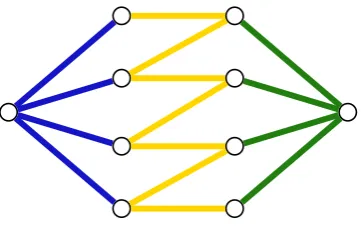
Figure 2.1: The underlying graphs of a pair of matroids (left) and the underlying graph
of the graphic matroidM1p1,p2M2 (right), whereM1, M2 is the pair of matroids shown
in the left part of the figure and p1, p2 are the edges represented by dashed lines.
settled in [69, 70] for general matroids (given by an oracle).
Theorem 18 (Corollary 7.2, [69]). For each k, there is an O(|E|4) algorithm
constructing a decomposition of width at most 3k − 1 or concluding that the matroid has branch-width at least k+ 1.
Moreover, for matroids representable over a fixed finite field, an efficient
algo-rithm for constructing a branch decomposition of optimal width is given in [43].
Let M1 and M2 be two matroids satisfying pi ∈E(Mi), for i∈ {1,2}. Then,
the 2-sum M1p1,p2 M2 is defined as the matroid with the set of circuits below:
C =C(M1\p1)∪ C(M2 \p2) ∪
{(C1\p1)∪(C2\p2) :pi ∈Ci ∈ C(Mi) for i∈ {1,2}}.
An example of a 2-sum of a pair of graphic matroids can be found in Figure 2.1.
A monadic second-order (MSO) formula ψ for a matroid M can contain the following:
logical connectives∨,∧,¬,⇒,
quantifications∃xover elements ofE(M) – in this case, we callxan element variable,
quantifications∃X over subsets ofE(M) – there,X is calleda set variable,
the predicate x∈X of containment of an element in a set,
and, finally, the independence predicate ind(X) determining whether a
sub-setX of E(M) is independent.
In line with the above, lowercase letters (such asx1, x2, . . .) are used to denote
el-ement variables while uppercase letters (such asX1, X2, . . .) denote set variables.
Deciding MSO properties of matroids is NP-hard in general, since, for
exam-ple, the property that a graph is hamiltonian can be determined by deciding the
following formula on the graphic matroid corresponding to the input graph:
∃H∃e is circuit(H)∧is base(H\ {e}),
where H is a set variable, e an element variable, and is circuit(·) and is base(·) are predicates testing the property of being a circuit and a base, respectively.
These can be defined in MSO logic as follows:
is circuit(H)≡ ¬ind(H)∧ ∀e: (e ∈H)⇒ind(H\ {e}),
is base(H)≡ ¬ ∃e: ind(H∪ {e})
Chapter 3
Permutation Pattern Matching
In this chapter, we study an algorithmic problem where we are given two
permu-tationsσ andπ and are interested in whetherσ is a pattern ofπ. A permutation
π contains a permutation σ as a pattern if it contains a subsequence of length
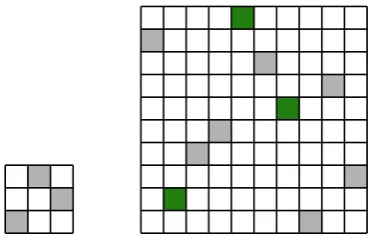
[image:37.595.225.412.465.583.2]|σ| whose elements are in the same relative order as in the permutation σ. This is illustrated in Figure 3.1.
Figure 3.1: A representation of the permutation matrices of permutations (1,3,2)
and(9,2,4,5,10,8,6,1,7,3). White positions of the grid correspond to 0-entries of the
permutation matrix, non-white positions to 1-entries, the columns are indexed from left
to right, the rows from bottom to top. Thus, the (1,1)entry of both matrices is located
in the bottom-left corner. The former permutation is contained within the latter as a
pattern. One of the occurrences of the pattern is highlighted in green.
The properties of such a partial order on the set of all permutations have
been investigated from a variety of angles in discrete mathematics, particularly
in enumerative combinatorics. Knuth [55] has shown that the number of
permu-tations avoiding (2,3,1) is the nth Catalan number. Various choices of prohibited
patterns have been studied among others by Lov´asz [60], Rotem [77], and Simion
and Schmid [80]. This culminated in the Stanley-Wilf conjecture stating that for
every fixed prohibited pattern, the number of permutations of length n avoiding it can be bounded by cn for some constant c. Klazar [54] reduced the question
to the F¨uredi-Hajnal conjecture, which was ultimately proved by Marcus and
Tardos in 2004 [65].
Wilf [83] also asked the algorithmic question of whether detecting a given
pattern (of length `) in a given permutation (of length n) can be done in subex-ponential time. Subsequently, the problem was shown to be NP-hard in [12].
Ahal and Rabinovich have obtained an O(n0.47`+o(`)) time algorithm [1]. Fast
algorithms have been found for certain restricted versions of the problem [12, 48].
The linear time dynamic programming algorithm for finding the longest
increas-ing subsequence [78] is even a standard content of many undergraduate courses
on algorithms.
Pattern matching has also received interest in the context of parameterized
complexity. Several groups of researchers have obtained W[1]-hardness results
for generalizations of the problem [15, 39]. For example, in one such
gener-alization the input permutations are colored and the requirement is to find a
color-preserving occurrence of the pattern. In [14] it was shown that the problem
is in FPT when parameterized by the number of runs (maximal monotonic
con-secutive subsequences) in the target permutation. The authors of [14] raise the
issue of whether their problem has a polynomial size kernel as an open problem.
has been resolved by Guillemot and Marx [39], who obtained an algorithm with
asymptotic running time of 2O(`2log`)
·n. This implies the existence of a kernel for the problem. Obtaining kernel size lower bounds was posed as an open question
during a plenary talk at Permutation Patterns 2013 by St´ephane Vialette.
In what follows, we prove that the permutation pattern problem under the
standard parameterization by` does not have a polynomial size kernel (assuming
NP 6⊆co-NP/poly). This is achieved by introducing a novel polynomial reduction from theCliqueproblem toPermutation Pattern Matchingand applying
the cross-composition machinery described in Section 2.9.
3.1
Problem definition and additional notation
Definition 19. A permutation σ on the set [l] is a pattern of a permutation π
on the set [n] if there exists an increasing function ϕ: [l]→[n] such that
∀x, y ∈[l] :σ(x)< σ(y) if and only if π(ϕ(x))< π(ϕ(y)).
We say that the mapping ϕcertifies the pattern.
Permutation Pattern Matchingis the following parameterized
algorith-mic problem:
Input: a permutation σ on [`], a permutationπ on [n]. Parameter: `.
Question: isσ a pattern of π?
the target permutation.
In the sections below, we use the following additional notation. Recall there
are two common representations of a permutation πare used in the thesis: using the vector (π(1), π(2), . . . , π(n)) and using a permutation matrix. Both are illus-trated in Figure 3.1. A vector obtained from the vector representation by omitting
some entries is a subsequence of the permutation. Such subsequence is a
consec-utive subsequence if it contains precisely the entries with indexes from [i, j] for somei, j ∈N. We useπ[i, j] to denote the set of entries{π(i), π(i+ 1), . . . , π(j)}. A monotonic subsequence is a subsequence whose entries form a monotonic
se-quence. A run is a maximal monotonic consecutive subsequence. For example,
(4,5,3,1,2) contains a (decreasing) run of length 3.
3.2
Kernelization lower bounds
The main result of this thesis is the following theorem, which has already been
stated in Introduction.
Theorem 2. Unless NP ⊆ co-NP/poly, the Permutation Pattern Match-ing problem does not have a polynomial kernel.
We prove Theorem 2 using Theorem 17. However, this requires a polynomial
time reduction that allows cross-composition without significantly increasing the
parameter value. Reductions described in the literature [12, 15] have resisted our
attempts to apply the framework. Therefore, we introduce a new NP-hardness
proof that directly leads to a cross-composition. The new reduction is from the
well known Clique problem.
producing a permutation. The key property of the encoding is that for any
clique Kl on l vertices and any graphH we have Kl ⊆H if and only if πz(Kl) is
a pattern ofπz(H) for some particular choice of z. (The value of z depends only
on the size of the largest connected component of H.) This allows us to express the Clique problem in terms of Permutation Pattern Matching.
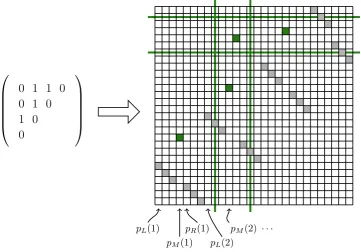
The definition of π(·) is somewhat technical although the basic idea is quite simple: we embed the upper-triangular submatrix of the adjacency matrix of the
input graph into a permutation. This is illustrated in Figure 3.2, where one can
see the permutation matrix of one such encoding permutation. In what follows,
we first give a rough sketch of how the construction of the encoding is organized.
Then, we describe the individual parts of the resulting permutation in more detail
and introduce some notation. Finally, the precise definition is given.
The encoding permutation itself consists of two types of entries: encoding
entries and separating entries. The former encode the edges of G. The encoding entries of the same vertex form a consecutive subsequence of the permutation.
The separating entries form decreasing runs used to separate encoding entries
of different vertices. Looking at πz(G) as an embedding of the upper-triangular
submatrix of the adjacency matrix ofGoffers another perspective: the separating runs mark where each row and column begins and ends, the encoding entries
determine where the 1-entries of the matrix are.
We start constructing πz(G) by imposing a total order onV(G) placing
assume that V(G) = [n] and set
NG+(v) :={u:u > v∧ {u, v} ∈E(G)}, NG−(v) :={u:u < v∧ {u, v} ∈E(G)},
deg+G(v) :=|NG+(v)|,
deg−G(v) :=|NG−(v)|.
The vertices from the sets NG+(v) and NG−(v) are calledthe right-neighbours and left-neighbours ofv, respectively. We now give a general overview of the structure of the permutation πz(G); the specification of the exact values and indexes
employed is postponed to the following paragraphs. The permutation starts
with a decreasing run of lengthz, continues with the entries encoding the vertex 1 (i.e., encoding NG+(1)), which is then followed by another decreasing run of lengthz. This finishes the part of the permutation dedicated to the vertex 1 and the segment for the vertex 2 begins. Again, it starts with another decreasing run
of length z, continues with the encoding entries of NG+(2), and is finished by a decreasing run of lengthz. This continues for all vertices ofG. Note that for each vertex v there is a pair of decreasing runs immediately surrounding the entries encoding NG+(v), one from left and one from right. These are called the left and right separating runs of v, respectively. Together, we call these entries the pair of separating runs of v. For example, four pairs of separating runs are depicted in Figure 3.2.
To facilitate the formal definition ofπz(G), we begin by introducing a notation
for important positions and values of the resulting permutation’s entries. This
they start, or the positions where the parts encodingNG+(v), for individual choices of v, start.
We use pL(v) and pR(v) as a shorthand for the positions on which the left
and right separating run of v starts, respectively. The first position of the seg-ment encoding NG+(v) is denoted by pM(v). This is illustrated in Figure 3.2.
Specifically, we set pL(1) := 1, pM(1) := z + 1, and pR(1) := z + 1 + deg+G(1).
pL(1)
pM(1)
pR(1)
pL(2)
pM(2) · · ·
[image:43.595.138.500.253.505.2]0 1 1 0 0 1 0 1 0 0
Figure 3.2: Left part shows the upper triangular submatrix of the adjacency matrix
of a graph G = {1,2,3,4},
{1,2},{2,3},{2,4},{3,4} . The right part shows the permutation matrix representation of its encoding permutation π3(G). Once again,
the columns of both matrices are indexed from left to right, the rows from bottom to
top. White positions of the grid on the right correspond to 0-entries of the
permu-tation matrix, non-white positions are 1-entries. Separating runs are colored in light
gray, encoding entries in dark green. Note the one-to-one correspondence between the
1-entries of the matrix on the left with the encoding entries of the permutation matrix.
Horizontal green lines represent values attained at positions L(4) and R(4). Vertical
green lines denote indexes L(2) and R(2). Note that these four green lines induce a
rectangle with a single 1-entry. This encodes the 1-entry in the top-most position of the
second column of the adjacency matrix. Arrows below the permutation matrix illustrate
For v ≥2, we have:
pL(v) :=pR(v−1) +z,
pM(v) :=pL(v) +z,
pR(v) :=pM(v) + deg+G(v).
We also introduce notation for the values used by the separating runs. The left
separating run of v starts at the position pL(v) with the value qL(v). The right
separating run starts at pR(v) with the value qR(v). Finally, qM(v) is the least
value used by the encoding entries of vertices from NG−(v) to determine their connection to v. (Specifically, vertices of NG−(v) use the values [qM(v), qM(v) +
deg−G(v)−1] to encode this. If degG−(v) is zero, the value qM(v) is actually not
used.) We setqL(1) := 2z, qM(1) :=z+ 1, and qR(1) :=z. For v ≥2, let
qR(v) :=qL(v−1) +z,
qM(v) :=qR(v) + 1,
qL(v) :=qM(v) +z+ deg−G(v)−1.
We now define the values of π=πz(G). For eachv, we introduce a decreasing
π(pL(v)) :=qL(v),
π(pL(v) + 1) :=qL(v)−1,
π(pL(v) + 2) :=qL(v)−2,
. . .
π(pL(v) +z−1) :=qL(v)−(z−1).
We also insert a decreasing run which starts at the position pR(v) with the value
qR(v):
π(pR(v)) :=qR(v),
π(pR(v) + 1) :=qR(v)−1,
π(pR(v) + 2) :=qR(v)−2,
. . .
π(pR(v) +z−1) :=qR(v)−(z−1).
This describes the entries represented by gray squares in Figure 3.2.
The remaining values are used to encode the edges of G. The neighbourhood
NG+(v) is encoded by an increasing run on positionspM(v), pM(v)+1, . . . , pM(v)+ |NG+(v)| − 1. We fix a vertex v ∈ V(G) and iterate through the neighbours
{u1, u2, . . . , uk}=NG+(v). Assume u1 < u2 < . . . < uk. For i∈[k], we set:
where `(v, ui) =|{w :w < v∧ {w, ui} ∈E(G)}|. The term `(v, ui) ensures that
no value in π is repeated.
The above procedure is carried out for each v ∈ V(G). This finishes the construction of πz(G). We now provide two observations.
Observation 20. For any graph Gand z ∈N the functionπz(G) is a
permuta-tion.
Proof. Let π :=πz(G). It is straightforward to verify that π is a mapping from
[p] to [p], for p = 2zn+|E(G)|. It remains to show that π is injective, i.e. that there is no pair of distinct indexes i, j such that π(i) = π(j). It can easily be seen that such i andj cannot both be an index of an entry forming a separating run, since the separating runs are explicitly constructed so that the sets of their
values are disjoint. For each vertex v there are exactly deg−G(v) values between the values of its left and right separating run. These values are used to encode
the deg−G(v) edges connecting v to its left-neighbours. The left-most neighbour is using the least value, the subsequent vertices are using values that increase by
1 with each neighbour (cf. the term `(v, ui) in equation (3.1)). Therefore, we
have neither a collision between a separating entry and an encoding entry nor
a collision between two entries encoding NG−(v) for the same v. Finally, it can be easily seen that the sets of values encoding NG−(v) are pairwise disjoint for different choices ofv.
Observation 21. For any choice of z ∈N and any choice of u, v ∈V(G), there is at most one 1-entry of πz(G) with an index in [pM(u), pR(u)−1] and value
in [qM(v), qM(v) + deg−G(v)−1]. Furthermore, there is an edge between vertices
Proof. The entries ofπ:=πz(G) with indexes from [pM(u), pR(u)−1] encode the
neighbourhood of the vertex u, i.e., NG+(u). For each neighbour v from NG+(u), we insert a single entry with value from [qM(v), qM(v) + deg−G(v)−1]. This is
because in equation (3.1) the term `(v, ui) is always strictly less than deg−G(v).
This implies both parts of the observation.
For the purpose of the proof of the lemma below, we define the following:
C(v) := [pM(v), pR(v)−1],
L(v) := pL(v) +bz2c,
R(v) := pR(v) +bz2c.
Therefore,C(v) is the set of entries of π encoding the vertex v,L(v) denotes the middle entry of the left separating run of v, and R(v) is the middle entry of the right separating run of v. Once more, Figure 3.2 illustrates the notation.
The following lemma implies NP-hardness of the studied problem:
Lemma 22. For every clique G, Kl is a subgraph of G if and only ifπz(Kl) is a
pattern of πz(G), for z = 4n0+ 4,where n0 is the number of vertices in the largest
connected component of G.
Proof. We let σ:=πz(Kl) and π :=πz(G).
IfGcontains a cliqueKlof sizel as a subgraph, thenπcontains the patternσ
by construction. This is because if we consider the permutation matrix
represen-tation ofπ and delete all columns except the ones that correspond to separating and encoding entries for vertices ofKl⊆G, we get a matrix that differs from the
the connection of the vertices of Kl to the vertices outside of Kl. By deleting
these columns (and the empty rows resulting from the above deletions) we arrive
at the permutation matrix representation of σ, implyingσ is a pattern ofπ. For the other direction, assume there is a function ϕ: [|σ|]→[|π|] certifying the pattern. We start by noting that there are no decreasing subsequences of
length 14z in π avoiding all separating runs. This is because such a sequence contains at most one entry from C(v) for each v ∈ V(G). At the same time, it cannot simultaneously contain an entry from C(u) and C(v) for u, v chosen from different connected components. This is because the construction of the
encoding permutation places vertices from the same component consecutively
and the entries encoding a component placed earlier in the ordering have strictly
smaller values than those from a later component. This bounds the length of the
subsequence by n0 < 14z.
Furthermore, any decreasing subsequence of π contains entries from at most one pair of separating runs. This is because once the sequence hits a separating
run of a vertexv, all its subsequent entries can only be from the pair of separating runs ofv. Any decreasing subsequence therefore starts with less than 14zencoding entries, which are then followed by entries of a pair of separating runs of some
vertex.
We now show that the certifying function ϕ naturally leads to a mapping from V(Kl) to V(G). Consider any vertex v ∈ V(Kl). The function ϕ maps
implies that the middle entryL(v) of the left separating run ofv inσneeds to be mapped by ϕto the left separating run ofu∈G. Additionally, the middle entry
R(v) of the right separating run ofv inσ needs to be mapped byϕsomewhere in the right separating run of the same vertex u. The above establishes a mapping from V(Kl) to V(G) denoted byfϕ.
We claim fϕ to be a graph homomorphism. Fix any pair of vertices v1, v2
of Kl such that v1 < v2. We show that fϕ(v1), fϕ(v2) are connected by an
edge in G. Since there is an edge between v1 and v2 in Kl, Observation 21
implies that the set of values σ[L(v1), R(v1)] contains precisely one number p
with σ(R(v2))≤ p≤ σ(L(v2)). Since ϕ certifies the pattern σ in π, there needs
to be an entry of π with an index between ϕ(L(v1)) and ϕ(R(v1)) and value
between π(ϕ(R(v2))) and π(ϕ(L(v2))). Observation 21 then implies there is an
edge between fϕ(v1) and fϕ(v2). Thus, fϕ is a homomorphism and Gcontains a
clique of size l.
The above reduction can be directly used within the cross-composition
frame-work to show our result.
Proof of Theorem 2. We set L to be the set of all pairs (Kl, G), where Kl is a
clique, G is a connected graph containingKl as a subgraph. It is widely known
that deciding x∈L is NP-complete.
We introduce a cross-composition ofLintoPermutation Pattern
Match-ing. Let R be an equivalence relation on {0,1}∗ with the following properties:
the binary sequences that are not representing a pair (Kl, G), where Kl is a clique
respectively, is related in R if and only if|V(K1)|=|V(K2)|,|V(G1)|=|V(G2)|.
Clearly,R is a polynomial equivalence relation. For instances (Kl, G1), (Kl, G2),
(Kl, G3), . . ., (Kl, Gt) from the same equivalence class of R, we produce an
in-stance of the Permutation Pattern Matching problem where we ask if
πz(Kl) is in πz(G), where G is a disjoint union of graphsG1, . . . , Gt and z is set
to 4· |V(G1)|+ 4. Lemma 22 shows that the answer to this problem is YES if
and only if at least one of the instances (Kl, Gi) belongs to L. Since the
pa-rameter of the pattern matching instance is |πz(Kl)|, which can be bounded by |V(Gi)| ·2z+|V(Gi)|2 for any i, we can apply Theorem 17.
3.3
Conclusion
Guillemot and Marx [39] have shown that thePermutation Pattern
Match-ing problem can be solved in 2O(`2log`) ·n time. They raised the question of
whether a faster FPT algorithm could be obtained and outlined a strategy for
achieving this using their notion of decompositions of permutations. This relied
on the bound from the Stanley-Wilf conjecture not being tight. However, Fox [36]
has shown the bound is actually tight for almost all permutations. (Still, Fox [36]
gives an improved 2O(`2)
·n algorithm.)
Note that in order to rule out kernels of size P(n) for any polynomial P(·), it suffices to find a cross-composition satisfying some polynomial constraint on
the value of the parameter of the resulting instance. In particular, the strength
of our bound does not depend on how slowly the value of the parameter of the
resulting instance grows. Our result rules out all polynomial upper bounds on
Chapter 4
Optimum Linear Arrangement
In the present chapter we give subexponential computational complexity lower
bounds for theOptimum Linear Arrangement problem relative to theMin
Bisection problem ond-regular graphs. This is achieved by introducing a
poly-nomial reduction from (a variant of) the Min Bisection problem to the
Op-timum Linear Arrangement problem. The key property of this reduction,
which allows us to prove our bounds, is that the instances of the former problem
result in instances of Optimum Linear Arrangement with at most O(nd)
edges. Therefore, the size of the instance is increased only linearly.
This reduction employs expanders in a black-box manner. We use the
al-gorithm implicit in Theorem 12 to construct these expanders. Other efficient
constructions could be substituted. Actually, any efficient construction
generat-ing d-regular graphs G with Cheeger number h(G) ≥ d
C for some fixed constant
C ∈ N would suffice – potentially at the cost of an increase in multiplicative constants irrelevant for the main hardness result. Let us note that this is one
of the aspects in which the contents of this chapter differ from the treatment in
the corresponding conference paper [6]. In this thesis, we assume the expander