Speech-input multi-target machine translation
Alicia P´erez, M. In´es Torres
Dep. of Electricity and Electronics University of the Basque Country
M. Teresa Gonz´alez, Francisco Casacuberta
Dep. of Information Systems and Computation Technical University of Valencia
Abstract
In order to simultaneously translate speech into multiple languages an extension of stochastic finite-state transducers is pro-posed. In this approach the speech trans-lation model consists of a single network where acoustic models (in the input) and the multilingual model (in the output) are em-bedded.
The multi-target model has been evaluated in a practical situation, and the results have been compared with those obtained using several mono-target models. Experimental results show that the multi-target one re-quires less amount of memory. In addition, a single decoding is enough to get the speech translated into multiple languages.
1 Introduction
In this work we deal with finite-state models which constitute an important framework in syntactic pat-tern recognition for language and speech processing applications (Mohri et al., 2002; Pereira and Riley, 1997). One of their outstanding characteristics is the availability of efficient algorithms for both optimiza-tion and decoding purposes.
Specifically, stochastic finite-state transducers (SFSTs) have proved to be useful for machine trans-lation tasks within restricted domains. There are several approaches implemented over SFSTs which range from word-based systems (Knight and Al-Onaizan, 1998) to phrase-based systems (P´erez et al., 2007). SFSTs usually offer high speed during
the decoding step and they provide competitive re-sults in terms of error rates. In addition, SFSTs have proved to be versatile models, which can be easily integrated with other finite-state models, such as a speech recognition system for speech-input transla-tion purposes (Vidal, 1997). In fact, the integrated architecture has proved to work better than the de-coupled one. Our main goal is, hence, to extend and assess these methodologies to accomplish spo-ken language multi-target translation.
As far as multilingual translation is concerned, there are two main trends in machine translation de-voted to translate an input string simultaneously into
m languages (Hutchins and Somers, 1992): inter-lingua and parallel transfer. The former has his-torically been a knowledge-based technique that re-quires a deep-analysis effort, and the latter consists on m decoupled translators in a parallel architec-ture. These translators can be either knowledge or example-based. On the other hand, in (Gonz´alez and Casacuberta, 2006) an example based technique consisting of a single SFST that cope with multiple target languages was presented. In that approach, when translating an input sentence, only one search through the multi-target SFST is required, instead of them independent decoding processes required by the mono-target translators.
lan-guages. If we supplant the m translators with the multi-target SFST, the problem would be reduced to
2 searching stages. Nevertheless, in this paper we propose a natural way for acoustic models to be in-tegrated in the multilingual network itself, in such a way that the input speech signal can be simulta-neously decoded and translated into m target lan-guages. As a result, due to the fact that there is just a single searching stage, this novel approach entails less computational cost.
The remainder of the present paper is structured as follows: section 2 describes both multi-target SF-STs and the inference algorithm from training ex-amples; in section 3 a novel integrated architecture for speech-input multi-target translation is proposed; section 4 presents a practical application of these methods, including the experimental setup and the results they produced; finally, section 5 summarizes the main conclusions of this work.
2 Multi-target stochastic finite-state transducers
A multi-target SFST is a generalization of standard SFSTs, in such a way that every input string in the source language results in a tuple of output strings each being associated to a different target language. 2.1 Definition
Amulti-target stochastic finite-state transduceris a tupleT =hΣ,∆1. . .∆m, Q, q0, R, F, Pi, where:
Σ is a finite set of input symbols (source vocabu-lary);
∆1. . .∆maremfinite sets of output symbols (tar-get vocabularies);
Qis a finite set of states;
q0∈Qis the initial state;
R ⊆Q×Σ×∆∗1. . .∆∗m×Qis a set of transitions such as(q, w,p˜1, . . . ,p˜m, q0), which is a tran-sition from the stateq to the state q0, with the source symbolwand producing the substrings
(˜p1, . . . ,p˜m);
P :R → [0,1]is the transition probability distri-bution;
F :Q → [0,1]is the final state probability distri-bution;
The probability distributions satisfy the stochastic constraint:
∀q ∈Q (1)
F(q)+ P w,p˜1,...,p˜m,q0
P(q, w,p˜1, . . . ,p˜m, q0) = 1
2.2 Training the multilingual translation model
Both topology and parameters of an SFST can be learned fully automatically from bilingual ex-amples making use of underlying alignment mod-els (Casacuberta and Vidal, 2004). Furthermore, a target SFST can be inferred from a multi-lingual set of samples (Gonz´alez and Casacuberta, 2006). Even though in realistic situations multilin-gual corpora are too scarce, recent works (Popovi´c et al., 2005) show that bilingual corpora covering the same domain are sufficient to obtain generalized cor-pora based on which one can subsequently create the required collections of aligned tuples.
The inference algorithm, GIAMTI (grammatical inference and alignments for multi-target transducer inference), requires a multilingual corpus, that is, a finite set of multilingual samples(s,t1, . . . ,tm) ∈
Σ∗×∆∗1×· · ·×∆∗m, wheretidenotes the translation
of the source sentencesinto thei-th target language;
Σdenotes the source language vocabulary, and∆i the i-th target language vocabulary; the algorithm can be outlined as follows:
1. Each multilingual sample is transformed into a single string from an extended vocabulary
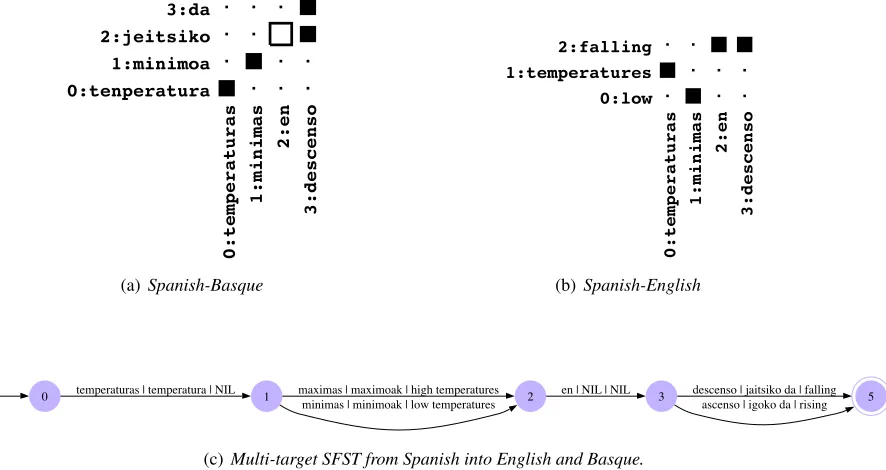
Alignment #0 0:tenperatura
1:minimoa 2:jeitsiko 3:da
0:temperaturas
1:minimas
2:en
3:descenso
(a)Spanish-Basque
Alignment #0 0:low
1:temperatures 2:falling
0:temperaturas
1:minimas
2:en
3:descenso
(b)Spanish-English
0 temperaturas | temperatura | NIL 1 maximas | maximoak | high temperatures 2
minimas | minimoak | low temperatures 3
en | NIL | NIL descenso | jaitsiko da | falling 5 ascenso | igoko da | rising
[image:3.612.101.544.59.294.2](c) Multi-target SFST from Spanish into English and Basque.
Figure 1:Example of a trilingual alignment over a trilingual sentence extracted from the task under consid-eration;the related multi-target SFST (with Spanish as input, and English and Basque as output).
or more words from each target language in their turn.
2. Once the set of multilingual samples has been converted into a set of single extended strings (z ∈ Γ∗), a stochastic regular grammar can be inferred. Specifically, in this work we deal with k-testable in the string-sense grammars (Garc´ıa and Vidal, 1990), which are considered to be a syntactic approach of the n-gram models. In addition, they allow the integration of several order models in a single smoothed automa-ton (Torres and Varona, 2001).
3. The extended symbols associated with the transitions of the automaton are transformed into one input token and m output phrases (w/p1˜ |. . .|p˜m) by the inverse labeling function (L−m), leading to the required transducer. Example An illustration of the inference of the multi-target SFST can be shown over a couple of simple trilingual sentences from the corpus (where “B” stands for Basque, “S” for Spanish and “E” for English):
1-B tenperatura maximoa jaitsiko da 1-S temperaturas m´aximas en descenso
1-E high temperatures falling
2-B tenperatura minimoa igoko da 2-S temperaturas m´ınimas en ascenso
2-E low temperatures rising
From the alignments, depicted in Figures 1(a) and 1(b), an input-language-synchronized monotonous segmentation can be built (bear in mind that we are considering Spanish as the input language). The corresponding extended strings with the following constituents for the first and second samples respectively are the following ones:
1 temperaturas|tenperatura|λ
m´ınimas|minimoa|low temperatures en|λ|λ
2 temperaturas|tenperatura|λ
m´aximas|maximoa|high temperatures en|λ|λ
ascenso|igoko da|rising
Finally, from this representation of the data, the multi-target SFST can be built as shown in Fig-ure 1(c).
2.3 Decoding
Given an input strings(a sentence in the source lan-guage), the decoding module has to search the opti-malmoutput stringstm ∈∆∗1× · · · ×∆∗m (a sen-tence in each of the target language) according to the underlying translation model (T):
c
tm= arg max
tm∈∆∗
1×···×∆∗m
PT(s,tm) (2)
Solving equation (2) is a hard computational prob-lem, however, it can be efficiently computed under the so calledmaximum approachas follows:
PT(s,tm)≈ max
φ(s,tm)PT(φ(s,t
m)) (3)
where φ(s,tm) is a translation form, that is, a se-quence of transitions in the multi-target SFST com-patible with both the input and themoutput strings.
φ(s,tm) : (q0, w1,p˜m1 , q1)· · ·(qJ−1, wJ,p˜mJ, qJ)
The input string (s) is a sequence of J input sym-bols, s = wJ1, and each of the m output strings consists ofJ phrases in its corresponding language tm = (t1,· · · ,tm) = ( ˜p1)J1,· · · ,( ˜pm)J1. Thus, the
probability supplied by the multi-target SFST to the translation form is given by:
PT(φ(s,tm)) =F(qJ) J Y
j=1
P(qj−1, wj,p˜mj , qj)
(4) In this context, the Viterbi algorithmcan be used to obtain the optimal sequence of states through the multi-target SFST for a given input string. As a result, the established m translations are built con-catenating the (J) output phrases for each language through the optimal path.
3 An embedded architecture for
speech-input multi-target translation
3.1 Statistical framework
Given the acoustic representation (x) of a speech signal, the goal of multi-target speech translation is to find the most likely m target strings (tm); that is, one string (ti) per target language involved (i ∈ {1, . . . , m}). This approach is summarized in eq. (5), where the hidden variable s can be in-terpreted as the transcription of the speech signal:
c
tm = arg max
tm P(t
m|x) = arg max
tm X
s
P(tm,s|x)
(5) Making use of Bayes’ rule, the former expression turns into:
c
tm = arg max
tm X
s
P(tm,s)P(x|tm,s) (6)
Empirically, there is no loss of generality if we as-sume that the acoustic signal representation depends only on the source string, i.e. P(x|tm,s) is inde-pendent oftm. In this sense, eq. (6) can be rewritten as:
c
tm= arg max
tm X
s
P(tm,s)P(x|s) (7)
Equation (7) combines a standard acoustic model,
P(x|s), and a multi-target translation model,
P(tm,s), both of whom can be integrated on the fly during the searching routine as shown in Figure 2. That is, each acoustic sub-network is only expanded at decoding time when it is required.
The outer sum is computationally very expensive to search for the optimal tuple of target strings tm in an effective way. Thus we make use of the so called Viterbi approximation, which finds the best path over the whole transducer.
3.2 Practical issues
The underlying recognizer used in this work is our own continuous-speech recognition system, which implements stochastic finite-state models at all lev-els: acoustic-phonetic, lexical and syntactic, and which allows to infer them based on samples.
1 /e/ | NIL | NIL /n/ | NIL | NIL 2
Figure 2:Integration on the fly of acoustic models in one edge of the SFST shown in Figure 1(c)
by a typical left to right hidden Markov model. A phonetically-balanced Spanish database, called Al-bayzin (Moreno et al., 1993), was used to train these models.
The lexical model consisted of the extended to-kens of the multi-target SFST instead of running words. The acoustic transcription for each extended token was automatically obtained on the basis of the input projection of each unit, that is, the Spanish vo-cabulary in this case.
Instead of the usual language model, we make use of the multi-target SFST itself, which had the syn-tactic structure provided by a k-testable in the strict sense model, with k=3, and Witten-Bell smoothing. Note that the SFST implicitly involves both input and output language models.
4 Experimental results
4.1 Task and corpus
The described general methodology has been put into practice in a highly practical application that aims to translate on-line TV weather forecasts into several languages, taking the speech of the presen-ter as the input and producing as output text-strings, or sub-titles, in several languages. For this purpose, we used the corpus METEUS which consists of a set of trilingual sentences, in English, Spanish and Basque, as extracted from weather forecast reports that had been published on the Internet. Let us no-tice that it is a real trilingual corpus, which they are usually quite scarce.
Basque is a pre-Indoeuropean language of still unknown origin. It is a minority language, spo-ken in a small area of Europe and also within some small American communities (such as that in Reno, Nevada). In the Basque Country (located in the north of Spain) it has an official status along with Spanish. However, despite having coexisted for cen-turies in the same area, they differ greatly both in
syntax and in semantics. Hence, efforts are being devoted nowadays to machine translation tools in-volving these two languages (Alegria et al., 2004), although they are still scarce. With regard to the or-der of the phrases within a sentence, the most com-mon one in Basque isSubject plus Objects plus Verb
(even though some alternative structures are also ac-cepted), whereas in Spanish and English other con-structions such asSubject plus Verb plus Objectsare more frequent (see Figures 1(a) and 1(b)). Another difference between Basque and Spanish or English is that Basque is an extremely inflected language.
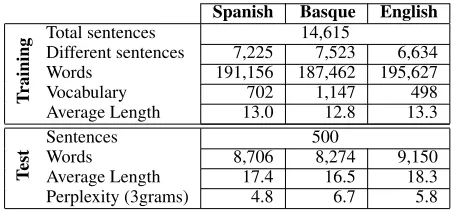
In this experiment we intend to translate Span-ish speech simultaneously into both Basque and En-glish. Just by having a look at the main features of the corpus in Table 1, we can realize that there are substantial differences among these three languages, in terms both of the size of the vocabulary and of the amount of running words. These figures reveal the agglutinant nature of the Basque language in com-parison with English or Spanish.
Spanish Basque English
T
raining
Total sentences 14,615
Different sentences 7,225 7,523 6,634
Words 191,156 187,462 195,627
Vocabulary 702 1,147 498
Average Length 13.0 12.8 13.3
T
est
Sentences 500
Words 8,706 8,274 9,150
Average Length 17.4 16.5 18.3
Perplexity (3grams) 4.8 6.7 5.8 Table 1: Main features of the METEUScorpus.
[image:5.612.313.540.465.570.2]speaker-independent if it is to be realistic. 4.2 System evaluation
The performance obtained by the acoustic integra-tion has been experimentally tested for both multi-target and mono-multi-target devices. As a matter of com-parison, text-input translation results are also re-ported.
The multi-target SFST was learned from the train-ing set described in Table 1 ustrain-ing the previously de-scribed GIAMTI algorithm. The500test sentences were then translated by the multi-target SFST. The translation provided by the system in each language was compared to the corresponding reference sen-tence. Additionally, two mono-target SFSTs were inferred with their outputs for the aforementioned test to be taken as baseline. The evaluation includes both computational cost and performance of the sys-tem.
4.2.1 Computational cost
The expected searching time and the amount of memory that needs to be allocated for a given model are two key parameters to bear in mind in speech-input machine translation applications. These val-ues can be objectively measured in terms of the size and on the average branching factor of the model displayed in Table 2.
multi-target mono-target S2B S2E Nodes 52,074 35,034 20,148
Edges 163,146 115,526 69,690
[image:6.612.334.522.172.224.2]Branching factor 3.30 3.13 3.46 Table 2: Features of multi-target model and the two decoupled mono-target models (one for Spanish to Basque translation, referred to as S2B, and the sec-ond for Spanish to English, S2E).
Adding the edges up for the two mono-target SF-STs that take part in the decoupled architecture (see Table 2), we conclude that the decoupled model needs a total of 185,216 edges to be allocated in memory, which represents an increment of 13%
in memory-space with respect to the multi-target model.
On the other hand, the multi-target approach of-fers a slightly smaller branching factor than each mono-target approach. As a result, fewer paths have
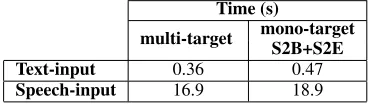
to be explored with the multi-target approach than with the decoupled one, which suggests that search-ing for a translation might be faster. As a matter of fact, experimental results in Table 3 show that the mono-target architecture works 11% more slowly than the multi-target one for speech-input machine translation and decoding, and 30% for text to text translation.
Time (s)
multi-target mono-target S2B+S2E Text-input 0.36 0.47
Speech-input 16.9 18.9
Table 3: Average time needed to translate each input sentence into two languages.
Summarizing, in terms of computational cost (space and time), a multi-target SFST performs bet-ter than the mono-target decoupled system.
4.2.2 Performance
So far, the capability of the systems has been as-sessed in terms of time and spatial costs. However, the quality of the translations they provide is, doubt-less, the most relevant evaluation criterion. In or-der to determine the performance of the system in a quantitative manner, the following evaluation pa-rameters were computed for each scenario:bilingual evaluation under study (BLEU), position indepen-dent error rate(PER) andword error rate (WER). Both text and speech-input translation results pro-vided by the multi-target and the mono-target mod-els respectively are shown in Table 4.
As can be derived from the translation results, for text-input translation the classical approach per-forms slightly better than the multi-target one, but for speech-input translation from Spanish into En-glish is the other way around. In any case, the dif-ferences in performance are marginal.
[image:6.612.78.297.442.493.2]we are making use of different SFST models that de-code and translate at the same time.
multi-target mono-target S2B S2E S2B S2E
T
ext
BLEU 42.7 66.7 43.4 67.8
PER 39.9 19.9 38.2 19.0
WER 48.0 27.5 46.2 26.6
Speech
BLEU 39.5 59.0 39.2 61.1
PER 42.2 25.3 41.5 23.6
WER 51.5 33.9 50.5 31.9
[image:7.612.73.297.90.188.2]recognition WER 10.7 9.3 9.1 Table 4: Text-input and speech-input translation re-sults for Spanish into Basque (S2B) and Spanish into English (S2E) using a multi-target SFST (columns on the left) or two mono-target SFSTs (columns on the right). The last row shows Spanish speech de-coding results using each of the three devices.
In these series of experiments the same task has been compared with two extremely different lan-guage pairs under the same conditions. There is a noticeable difference in terms of quality between the English and the Basque translations. The underlying reason might be due to the fact that SFST models do not capture properly the rich morphology of the Basque as they have to face long-distance reordering issues. These differences in the performance of the system when translating into English or into Basque have been previously detected in other works (Or-tiz et al., 2003). In our case, a manual review of the models and the obtained translations encourage us to make use of reordering models in future work, since they have proved to report good results in a similar framework (Kanthak et al., 2005).
5 Concluding remarks and further work
The main contribution of this paper is the proposal of a fully embedded architecture for multiple speech translation. Thus, acoustic models are integrated on the fly into a multi-target translation model. The most significant feature of this approach is its abil-ity to carry out both the recognition and the transla-tion into multiple languages integrated in a unique model. Due to the finite-state nature of this model, the speech translation engine is based on a Viterbi-like algorithm.
In contrast to the mono-target systems, multi-target SFSTs enable the translation from one source
language simultaneously into several target lan-guages with lower computational costs (in terms of space and time) and comparable qualitative re-sults. Moreover, the integration of several languages and acoustic models is straightforward on means of finite-state devices.
Nevertheless, the integrated architecture needs more parameters to be estimated. In fact, as the amount of targets increase the data sparseness might become a difficult problem to cope with. In future work we intend to make a deeper study on the per-formance of the multi-target system with regard to the amount of parameters to be estimated. In ad-dition, as the first step of the learning algorithm is decisive, we are planning to make use of reordering models in an attempt to face up to with long dis-tance reordering and in order to homogenize all the languages involved.
Acknowledgments
This work has been partially supported by the Uni-versity of the Basque Country and by Spanish CI-CYT under grants 9/UPV 00224.310-15900/2004, TIC2003-08681-C02-02, and CICYT es TIN2005-08660-C04-03 respectively.
References
I˜naki Alegria, Olatz Ansa, Xabier Artola, Nerea Ezeiza, Koldo Gojenola, and Ruben Urizar. 2004. Repre-sentation and treatment of multiword expressions in basque. In Takaaki Tanaka, Aline Villavicencio, Fran-cis Bond, and Anna Korhonen, editors, Second ACL Workshop on Multiword Expressions: Integrating Pro-cessing, pages 48–55, Barcelona, Spain, July. Associ-ation for ComputAssoci-ational Linguistics.
Peter F. Brown, Stephen A. Della Pietra, Vincent J. Della Pietra, and R. L. Mercer. 1993. The mathematics of statistical machine translation: Parameter estimation. Computational Linguistics, 19(2):263–311.
Francisco Casacuberta and Enrique Vidal. 2004. Ma-chine translation with inferred stochastic finite-state transducers. Computational Linguistics, 30(2):205– 225.
Machine Translation using Finite-State Transducers. InProceedings of TC-Star Speech to Speech Transla-tion Workshop, pages 105–110.
John Hutchins and Harold L. Somers. 1992. An In-troduction to Machine Translation. Academic Press, Cambridge, MA.
Stephan Kanthak, David Vilar, Evgeny Matusov, Richard Zens, and Hermann Ney. 2005. Novel reordering ap-proaches in phrase-based statistical machine transla-tion. InProceedings of the ACL Workshop on Building and Using Parallel Texts, pages 167–174, Ann Arbor, Michigan, June. Association for Computational Lin-guistics.
K. Knight and Y. Al-Onaizan. 1998. Translation with finite-state devices. In4th AMTA (Association for Ma-chine Translation in the Americas).
Mehryar Mohri, Fernando Pereira, and Michael Ri-ley. 2002. Weighted finite-state transducers in speech recognition. Computer, Speech and Language, 16(1):69–88, January.
A. Moreno, D. Poch, A. Bonafonte, E. Lleida, J. Llisterri, J. B. Mario, and C. Nadeu. 1993. Albayzin speech database: Design of the phonetic corpus. InProc. of the European Conference on Speech Communications and Technology (EUROSPEECH), Berl´ın, Germany.
Franz J. Och. 2000. GIZA++:
Train-ing of statistical translation models.
http://www.fjoch.com/GIZA++.html.
Daniel Ortiz, Ismael Garc´ıa-Varea, Francisco Casacu-berta, Antonio Lagarda, and Jorge Gonz´alez. 2003. On the use of statistical machine translation techniques within a memory-based translation system (AME-TRA). In Proc. of Machine Translation Summit IX, pages 115–120, New Orleans, USA, September.
Fernando C.N. Pereira and Michael D. Riley. 1997. Speech Recognition by Composition of Weighted Fi-nite Automata. In Emmanuel Roche and Yves Sch-abes, editors,Finite-State Language Processing, Lan-guage, Speech and Communication series, pages 431– 453. The MIT Press, Cambridge, Massachusetts.
Alicia P´erez, M. In´es Torres, and Francisco Casacuberta. 2007. Speech translation with phrase based stochas-tic finite-state transducers. InProceedings of the 32nd International Conference on Acoustics, Speech, and Signal Processing (ICASSP 2007), Honolulu, Hawaii USA, April 15-20. IEEE.
Maja Popovi´c, David Vilar, Hermann Ney, Slobodan Joviˇci´c, and Zoran ˇSari´c. 2005. Augmenting a small
ceedings of the ACL Workshop on Building and Us-ing Parallel Texts, pages 41–48, Ann Arbor, Michigan, June. Association for Computational Linguistics.
M. In´es Torres and Amparo Varona. 2001. k-tss lan-guage models in speech recognition systems. Com-puter Speech and Language, 15(2):127–149.