Abstract— knowing the time of a process change would
simplify the search, identification, and removal of the special causes that disturbed the process. Since, in many real world manufacturing systems, the production of goods comprises several autocorrelated stages; in this paper, the problem of the change point estimation for such processes is addressed.
A first order autoregressive model (AR(1)) is used to model a multistage process observations, where a X-chart is established for monitoring its mean. A step change is assumed for the location parameter of the model. After receiving an out-of-control signal, in order to determine the stage and the sample that caused the change (hence finding the time of the step change), two maximum likelihood estimators are proposed. At the end, the applicability of the proposed estimators is demonstrated by a numerical example.
Index Terms— Statistical Process Control, Change Point, Multistage Quality Control, Maximum Likelihood Function, AR(1).
I. INTRODUCTION AND LITERATURE REVIEW The definition of multistage processes can be found in many research works ( e.g., [1], [2] and [3]). According to [3], multistage manufacturing processes (MMPs) are the processes in which multiple stations are set up to manufacture a specific product. Examples of MMPs are: (1) an automotive body assembly that has multiple parts assembled at multiple stations; (2) an engine head production that involves multiple machining operations of a single part at multiple stations; (3) a transfer or progressive stamping process that involves multiple die stations to form a part; and (4) semiconductor manufacturing processes in which a silicon wafer develops in several stages with several layers to form a chip.
Several methods have been developed in literature to model the MMPs. [4, 5] proposed the regression adjustment approach to monitor multistage processes. [6], [7], [8], [9], [10], and [11] developed multistage engineering models with linear state space structure to describe quantitative data of a multistage process. Some other research works have used autocorrelated AR(1) model to detect shifts in various multistage processes (e.g., [12], [1] and [13]). [14] and [15]
Manuscript received March 12, 2011; revised April 13, 2011.
S. T. A. Niaki is the department of Industrial Engineering, Sharif University of Technology, Azadi Av., Tehran, Iran (e-mail:
M. Davoodi is with the department of Industrial Engineering, Sharif University of Technology, Azadi Av., Tehran, Iran (Mehdi Davoodi is the corresponding author, phone: +98-21-44668132, +98-912-2268950; (e-mail: [email protected]).
E. Asghari is with the department of Industrial Engineering, Amirkabir University of Technology, 424 Hafez Av., Tehran, Iran (e-mail:
employed a Bayesian approach to model short run processes.
When an out-of-control signal is received by a control chart, the exact time at which the process went out of control is usually not the time of the signal. Quality and process engineers desire to have a good estimate of the exact time (the change point) to search for special causes that disturbed the process. This problem is so called the change point estimation. So far, few studies have been conducted with the aim of process monitoring and change point detection in multistage processes, in which most of them have been performed using the linear state space model to describe multistage processes.
In the current work, a multistage production process is first modeled by a first-order autoregressive model (AR(1)), and then a maximum likelihood change point estimation method is proposed to determine the time of a step-change in the location parameter by identifying both the stages and the samples of an out-of-control process. The remainder of the paper is organized as follows.
In the next section, the required background of this research is briefly introduced. In section III, the autocorrelated multistage process is described. In addition, the likelihood function is derived and maximized to determine the time of the step-change in the location parameter. A numerical example is used in section IV to illustrate the applications of the proposed estimators. Conclusion and recommendations for future study are presented in section V.
II. BACKGROUND
Xiang and Tsung [16] used a linear state space model given in (1) for monitoring a multistage process.
, , ,
, 1 1, ,
1, 2, , ; 1, 2, ,
k j k k j k j
k j k k j k j
y C x x A x
j m k N
(1) Where yk,j is the quality characteristic of the jth product
in stage k of the process, k,j ~ N
0,2
, and
2
,j ~ 0, k
k N
. Further, A and C are the data matrices
of the process, and the model parameters that need to be estimated are (2).
2 2 2 2
1 2
, , , , N T
(2)
Since the likelihood function is too complex to be maximized, they used the EM algorithm with a Kalman filter. Then they proposed a group exponential weighted moving average chart (GEWMA) to monitor the mean of the process.
Assuming known process parameters, [11] used the
Change Point Estimation of Location Parameter
in Multistage Processes
Seyed Taghi Akhavan Niaki1, Mehdi Davoodi1, Elnaz Asghari Torkamani2
model of [16] to describe multistage processes. They developed a directional multivariate exponential weighted moving average chart (DEWMA) to monitor the mean of a multistage process by the use of extended maximum likeliness ratio. They showed the performance of their proposed DEWMA chart to be superior to GEWMA chart. Moreover, they developed maximum likelihood estimators for estimating out-of-control stage and product (sample) when a signal was received from the proposed DEWMA control chart.
III. AUTOCORRELATED MULTISTAGE PROCESSES Consider a process including M stages, where in each
[image:2.595.321.537.313.449.2]stage an equal number of characteristics are measured. Every characteristic is correlated with its corresponding characteristic in previous stages. Such a process is called an autocorrelated multistage process (AMP). One of the main assumptions of AMP is that the samples are independent. For each sample, there are pquality characteristics that must be measured and controlled. Each sample passes all stages of production process and all characteristics in various steps are to be measured. Fig. 1 shows the passing of one sample through all the stages of an AMP [13].
Fig. 1. The Pass of a sample through all the stages of an autocorrelated process
Let
t j i
x, , be ith measured characteristic of jth sample in th
t stage, in which i1,,p, j1,,n and M
t 1,, . Assuming n to be the sample number based
on which the control chart signals an out-of-control condition, the aim is to identify both the stage and the sample at which the out-of-control has been initiated. The knowledge of the change point can greatly aid process engineers in identifying special causes and running suitable correction action.
IV. PROCESS MODELING
[17] used AR(1) time series to model processes with autocorrelated observation. We use the same concept to model the autocorrelated multistage process with the difference that stages have replaced observations and despite the original model, samples or observations that are taken from the process are independent from each other. Then, Equation (3) can describe an AMP.
t j t j t
j x
x , ,1 , (3)
Where is the location parameter, xj,t is the measured
qualitative characteristic of jth sample in tth stage, is
the autocorrelation coefficient, and j,t are independent random variables following a normal distribution with mean zero and variance 2, i.e., N
0,2
. Now if the samplespass through stages to exit the process, the probability
density function of the jth sample is given in (4) ([17, 18]).
,1 ,2 , 1 2 2 2 2
2 2
,1 2
2
, , 1
2
( ) ( , ,..., ) (2 ) (1 )
(1 ) 1 1
e xp 2
.
j j j j Q
Q
j Q
j t j t
t
f X f x x x
x
x x
(4)
Where Xj is the characteristic vector of jth sample at th
Q stage.
A. Changein Location Parameter
Assume a multistage process starts with an initial value of
0
. When a step change occurs in the process, the value of
0
becomes 1 0d . This change happens in th
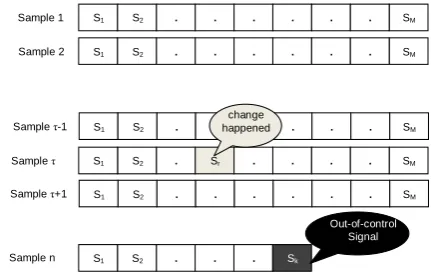
sample of stage r. The control chart detects this change in th
n sample and kth stage with a delay. Therefore, the point
of receiving signal differs from the actual change time. (see Fig. 2 in which Si ; i 1, 2,...,M denotes the ith stage).
Fig. 2. Signal time of control chart differs from the actual change time B. Likelihood Function Derivation
The likelihood function of the process is derived by multiplication of the probability density functions (pdf) of all taken samples, where the pdf of each sample is given in (4). In the likelihood function derivation process two points should be taken into account. First, one notices that for each sample the probability density function in (4) comprises of two parts. The first part corresponds to the first stage and the second part relates to the rest of the stages. However, the location parameter exists in both parts causing the form of pdf to depend on the stage in which the change has happened. In other words, the shape of pdf will be different if the change happens in the first stage compared to the condition that the change happens during one of the next stages. The second important point is the time of receiving signal and the question is whether this time corresponds to the stage in which the change has happened on in other stages. If the control chart signals at the same stage, the shape of likelihood function will be different from Fig. 2. Nonetheless, the derivation of the likelihood function depends on these conditions.
If the change happens in any other stages than the first and the control chart signals in the next stage(s), the logarithm of likelihood function is expressed in(5).
Stage 1 Stage 2 Stage M
1, ,1
2, ,1
, ,1
j j
p j
x
x
x
1, ,2
2, ,2
, ,2
j j
p j
x
x
x
1, ,
2, ,
, ,
j M j M
p j M
x
x
x
Sample n Sample τ-1
Sample 1 S1 S2 . . . . . . SM
S1 S2 . . . . . . SM
S2 . . . Sk
Out-of-control Signal
S1 S2 . . . . . . SM
S2 . Sr . . . . SM
change happened
S2 . . . . . . SM
Sample 2
Sample τ
Sample τ+1
S1
S1
[image:2.595.60.283.338.402.2]
1 1 2 2 2 2 0 ,1 1 1 2, 0 , 1
1 2
2
, 0 , 1
2
2
, 1 , 1
2 1
2 ,1
log ( , , | )
( 1) log(2 ) log(1 )
2 2 (1 ) 1 . . 1 . 2 (1 ) j j M
j t j t
j t r t t t M t t t r j
L r X
n M k n
x x x x x x x x
2 1 1 1 2, 1 , 1
1 2
2
, 1 , 1
2 1 . . n j n M
j t j t
j t
k
n t n t
t x x x x
(5)However, if the change happens in the first stage and the control chart signals during the next stage(s), the logarithm likelihood function becomes (6).
1 2 2 2 2 1 2 0 ,1 1 1 2, 0 , 1
1 2 2 2 1 ,1 2 2
, 1 , 1
2
log ( , 1, | )
( 1)
log 2 log 1
2 2 (1 ) 1 . 1 (1 ) 1 2 . j j M
j t j t
j t n
j j
M
j t j t
t
L r X
n M k n
x x x x x x
1 2, 1 , 1
2
.
n j k
n t n t
t x x
(6)Moreover, if the change happens in a stage other than the first stage and the control chart signals during the same stage the change has happened, the logarithm of likelihood function can be expressed as (7).
1 3 2 2 2 2 0 ,1 1 1 2, 0 , 1
1 2
2
2
, 0 , 1
2
2
, 1 , 1
1
log ( , , | )
( 1) log(2 ) log(1 )
2 2 (1 ) 1 . 1 2 . . n j j n M
j t j t
j t r
n t n t
t k
n t n t
t r
L n r X
n M k n
x x x x x x x
(7)Finally, if the change happens in the first stage and the control chart signals in the same stage, the logarithm of likelihood function can be derived as (8).
1 4 2 2 2 1 2 0 ,1 1 1 2, 0 , 1
1 2
2 2
2 1
,1
2
, 1 , 1
2
log ( , 1, | )
( 1) log 2 log 1
2 2 (1 ) 1 . 1 2 (1 ) 1 . n j j n M
j t j t
j t
n k
n t n t
t
L n r X
n M k n
x x x x x x
(8)C.
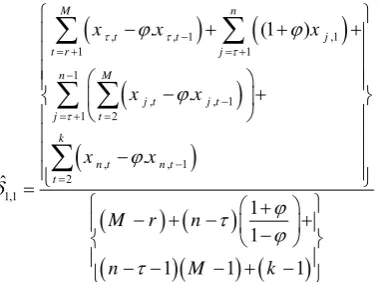
The Proposed Change Point EstimatorsAs previously mentioned the form of the likelihood function depends both on the stage in which the change happens and on the signaling sample; implying four separate estimations. We note that the stage and the out-of-control sample are discrete variables with known limits. Therefore, in the estimation process the partial deviations of the logarithm of the likelihood function with respect to the location parameter should be obtained. The MLE of and
r
is the value of the estimated stage and the out-of-control sample that maximize the likelihood function or equivalently its logarithm.
, , 1 ,1
1 1
1
, , 1
1 2
, , 1
2 1,1
. (1 )
.
. ˆ
1 1
1 1 1
M n
t t j
t r j
n M
j t j t
j t
k
n t n t t
x x x
x x
x x
M r n
n M k
(9)If the change happens at the first stage and out-of-control signal comes in the next stages, then (10) expresses the estimation of the location parameter. Note that the stage is known in this situation.
,1
1
, , 1 , , 1
2 2
1,2
(1 )
. .
ˆ
1
1 1 1
1
n
j j
n M k
j t j t n t n t
j t t
x
x x x x
n n M k
(10)If the change occurs at a stage other than the first and out-of-control signal comes on the same stage, the location parameter estimation is given in (11).
, , 1
1 1,3
. ˆ
k
n t n t t r
x x
k r
(11)Finally, if the change happens at the first stage and the receiving signal is in the stage in which the change has occurred the estimation of the location parameter is stated in (12).
,1 , , 1
2 1,4
1 .
ˆ
1 1
1
k
n n t n t
t
x x x
k
(12)
2) Estimating the out-of-control stage and sample
In order to estimate the out-of-control stage and the sample simultaneously, the log likelihood function for each combination of and r with corresponding estimated
location parameter should be evaluated. The combination set of and r that provides a maximum of the log likelihood
function is the estimator denoted by ˆ and rˆ, respectively.
They are given in Error! Reference source not found..
1
1,1
2
1,2
3
1,3
4
1,4
, ˆ
1 , 1,
, ˆ
1 , 1,
ˆ
ˆ, arg max
, ,
ˆ
, 1,
ˆ
, 1,
L
n r
L
n r r
L r
n r
L
n r
(17)
V. NUMERICAL EXAMPLE
In this section, the application of the proposed MLE estimators for the location parameter, the out-of-control sample, and the out-of-control stage is illustrated. Consider an AMP with a single quality characteristic at four stages. Fifteen samples, each containing 4 observations, are generated for a process with 0.5, 1.0 and
5 . 2
0
[image:4.595.51.245.51.192.2] . The subsequent samples are observed from a similar AMP with 1 3.250. The X chart is used for monitoring purposes. This chart signals in sample 18 of stage 3. Table I shows the estimates of the location parameter, the out-of-control sample, and the out-of-control stage. In addition, the samples obtained in each stage, the log likelihood values, and the estimation of the location parameter for every sample at each stage is shown in this table. It can be seen that sample 16 in stage 2 is the simultaneous estimate of the out-of-control sample and stage, respectively.
Table 1. Estimating the location parameter, the out-of-control sample, and the out-of-control stage
Observ ed quality characteristic Estimated Location Parameter Log Likelihood Functions
sa
m
p
le
s
tag
e 1
s
tag
e 2
s
tag
e 3
s
tag
e 4 ˆ1,1 ˆ1,2 ˆ1,3 ˆ1,4 log L1 log L2 log L3 log L4
[image:4.595.308.547.469.673.2]--VI. CONCLUSION
In this study, an autocorrelated multistage process was first introduced. For such a process, there are usually some quality characteristics at each stage that should be monitored. The quality characteristics of any stage are autocorrelated with the corresponding ones of the previous stage(s). Then, we considered an autocorrelated multistage process of a single quality characteristic at each stage. Next, the process was modeled and for an out-of-control signal obtained by an X-bar control chart, the likelihood function to estimate the location parameter, the out-of-control sample, and the out-of-control stage was derived. Finally, a numerical example was given to demonstrate the applicability of the proposed estimators.
REFERENCES
[1]. Agrawal, R., J.F. Lawless, and R.J. MacKay, “Analysis of Variation Transmission in Manufacturing Processes-part II”. Journal of Quality Technology, vol. 31, no., pp. 143-154, 1999
[2]. Zhou, S., Q. Huang, and J. Shi, “State Space Modeling of Dimensional Variation Propagation in Multistage Machining Process Using Differential Motion Vectors”. Robotics and Automation, IEEE Transactions on, vol. 19, no. 2, pp. 296-309, 2003
[3]. Shi, J., Stream of Variation Modeling and Analysis for Multistage Manufacturing Processes, CRC Press, Taylor & Francis Group, 2007. [4]. Hawkins, D.M., “Multivariate quality control based on regression
adjusted variables”. Technometrics, vol. 33, no., pp. 61-75, 1991 [5]. Hawkins, D.M., “Regression adjustment for variables in multivariate
quality control”. Journal of Quality Technology, vol. 25, no., pp. 170-182, 1993
[6]. Jin, J. and J. Shi, “State Space Modeling of Sheet Metal Assembly for Dimensional Control”. Journal of Manufacturing Science and Engineering, vol. 121, no. 4, pp. 756-762, 1999
[7]. Ding, Y., J. Shi, and D. Ceglarek, “Diagnosability Analysis of Multi-Station Manufacturing Processes”. Journal of Dynamic Systems, Measurement, and Control, vol. 124, no. 1, pp. 1-13, 2002
[8]. Huang, Q., S. Zhou, and J. Shi, “Diagnosis of Multi-Operational Machining Processes Through Variation Propagation Analysis”. Robotics and CIM Journal, vol. 18, no., pp. 233–239, 2002
[9]. Djurdjanovic, D. and J. Ni, “Linear State Space Modeling of Dimensional Machining Errors”. Transactions of NAMRI/SME, vol., no., pp. 541–548, 2001
[10]. Zhou, S., Y. Chen, Y. Ding, and J. Shi, “Diagnosability Study of Multistage Manufacturing Processes Based on Linear Mixed-Effects Models”. Technometrics, vol. 45, no. 4, pp. 312-325, 2003
[11]. Zou, C. and F. Tsung, “Directional MEWMA Schemes for Multistage Process Monitoring and Diagnosis”. Journal of Quality Technology, vol. 40, no. 4, pp. 407-427, 2008
[12]. Lawless, J.F., R.J. MacKay, and J.A. Robinson, “Analysis of Variation Transmission in Manufacturing processes—part I”. Journal of Quality Technology, vol. 31, no., pp. 131–142, 1999
[13]. Niaki, S.T.A. and M. Davoodi, “Designing a Multivariate-Multistage Quality Control System Using Artificial Neural Networks”. International Journal of Production Research, vol. 47, no. 1, pp. 251 - 271, 2009
[14]. Tsiamyrtzis, P., “A Bayesian Approach to Quality Control Problems”, Faculty of the Graduate School, University of Minnesota, 2000 [15]. Son, Y.S. and S.W. Kim, “Bayesian Single Change Point Detection in
a Sequence of Multivariate Normal Observations”. Statistics, vol. 39, no. 5, pp. 373 - 387, 2005
[16]. Xiang, L. and F. Tsung, “Statistical Monitoring of Multi-Stage Processes Based on Engineering Models”. IIE Transactions, vol. 40, no. 10, pp. 957(14), 2008
[17]. Timmer, D.H., J. Pignatiello, and M. Longnecker, “The development and evaluation of CUSUM-based control charts for an AR(1) process”. IIE Transactions, vol. 30, no. 6, pp. 525-534, 1998