FORMULATION DEVELOPMENT AND IN VITRO EVALUATION OF
EXTENDED RELEASE MEBEVERINE HCL PELLETS
Amtun Noor1*, P.R.Sathesh Babu1, P. Aravind2
1
Department of Pharmaceutics, Gokaraju Rangaraju College of Pharmacy, Hyderabad, India.
2
Nosch labs private limited, Prashanthi Nagar, Kukatpally, Hyderabad.
ABSTRACT
The present study was aimed to formulate and evaluate extended
release mebeverine hydrochloride pellets using fluidized bed coater.
Mebeverine hydrochloride anti spasmodic drug being highly water
soluble drug with a half life of 2 h suitable to develop extended action
for treatment of irritable bowel syndrome. Nine formulations (M1-M9)
of mebeverine hydrochloride pellets were prepared using a
combination of two rate controlling polymers ethyl cellulose and
HPMCP HP 55 and other standard excipients. The prepared pellets
were subjected to micrometric properties and In vitro drug release
studies. The optimized formulation M9 showed 87.91% drug release
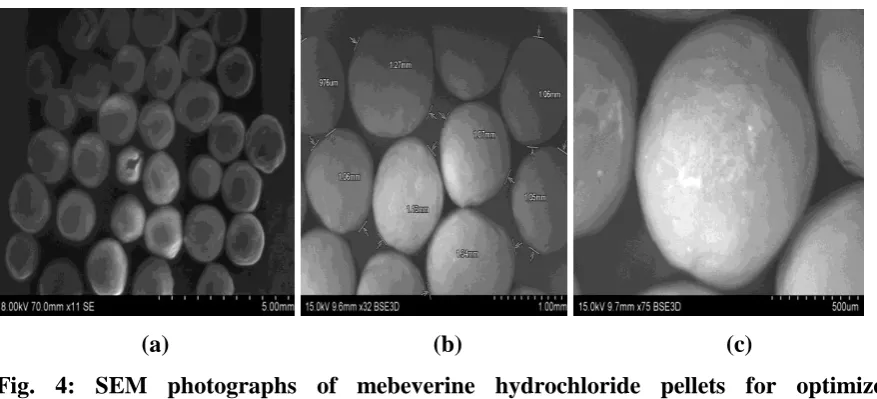
after 12 h. Scanning electron microscopy (SEM) studies revealed that
the prepared pellets for mebeverine hydrochloride are spherical in shape. The release profile
for optimized formulation M9 was comparable with that of marketed formulation (MEVA
SR) for mebeverine hydrochloride. The mathematical model was built on the hypotheses that
drug diffusion and drug dissolution in the release environment are the key phenomena
affecting drug release kinetics and it was found to be followed first order and diffusion
mechanism.
Keywords: Mebeverine hydrochloride; extended release; fluidized bed coater; irritable bowel syndrome.
INTRODUCTION
Pellets are agglomerates of fine powders or granules of bulk drugs and excipients. They
consist of small, free flowing spherical or semispherical solid units ranging from about 0.5-
1.5 mm. These are intended usually for oral administration. Pellets, give more stability from
compression and other stress conditions during formulation and storage conditions1,2.
Volume 3, Issue 3, 4783-4796. Research Article ISSN 2277 – 7105
Article Received on 12 March 2014,
Revised on 05 April 2014, Accepted on 28 April 2014
*Correspondence for Author
Amtun Noor
Moreover, pellets being multi-unit particulate dosage forms, can offer some additional
advantages such as easy dispersion in GI tract, increased drug absorption, and minimum
potential for local irritation of the drug3. The micropellets can be filled into hard gelatin
capsules or be compressed into tablets. The compression of multiparticulates into tablets is
becoming more popular, because of no problems of tampering4. The present study focused on
the development of extended release capsule containing mebeverine hydrochloride pellets.
Irritable bowel syndrome (IBS) is a disorder characterized most commonly by cramping,
abdominal pain, bloating, constipation, and diarrhoea5. IBS causes a great deal of discomfort
and distress, but it does not permanently harm the intestine and does not lead to a serious
disease, such as cancer. An anti spasmodic is usually prescribed which assists to control
colon muscle spasms and reduce abdominal pain. Oral ingestion is traditionally preferred
route of drug administration, providing a convenient method of effectively achieving both
local and systemic effects. Mebeverine hydrochloride is anti-spasmodic drug, chemically it is
(RS)-4-[ethyl (4-methoxy-α-methylphenyl) amino] butyl veratrate hydrochloride, is widely
used and having a direct non-specific relaxant effect on vascular, cardiac and other smooth
muscles5. Mebeverine HCl is a musculotropic antispasmodic drug without atropic side-effects
whose major therapeutic role is in the treatment of irritable bowel syndrome6. The short biological half life of 2 h with high solubility suggests its extended action in the treatment of
intestinal bowel syndrome.
MATERIALS AND METHODS
Bulk drug (mebeverine hydrochloride) and all other excipients (sucrose spheres, PVPK30,
maize starch, ethyl cellulose, HPMCP HP55, cetyl alcohol, sodium lauryl sulfate,
microcrystalline cellulose, mannitol, ethyl alcohol, isopropyl alcohol, acetone) were obtained
as gift samples from Nosch labs private limited, Hyderabad.
Drug – Excipient compatability studies
FT – IR studies: In this study, potassium bromide disc method was employed. IR studies of pure drug and physical mixtures of drug and excipients were done7. The powdered sample
was intimately mixed with dry powdered potassium bromide. The mixture was then
compressed into transparent disc under high pressure using special dies. The disc was placed
in IR spectrophotometer (Schimadzu FT – IR 8700) using sample holder and spectrum was
Stability studies: The drug and excipient compatibility study was done at accelerated conditions for short period of time (40 ± 2 ˚C / 75 ± 5 % RH) and long-term conditions (25 ±
2 ˚C /60 ± 5% RH) with periodic observation and physical evaluation. Samples of
mebeverine and individual excipients were intimately mixed in equal parts (1:1) ratio by
weight and filled in glass vials. Samples were physically observed at the end of 1st week, 2nd
week and 4th week.
Preparation of Mebeverine hydrochloride Pellets Preparation of drug loaded pellets
Mebeverine Hydrochloride was pulverized into a fine powder and kept aside. Load the
material (Mannitol, MCC) in a clean dry pulverizer/mill fitted with # 0.5 mm mesh. Pass the
API and above milled material through a clean sifter with # 20 sieve. Blend the above
materials along with SLS up to 45 min. Ethyl alcohol was taken in clean stainless steel vessel
which is kept under stirring, add PVP-K30 until to get clean solution. Pass above solution
through # 100 silk cloth filters, collect filtered solution in a clean stainless steel kettle. Charge
sucrose spheres (#30/40) into clean dry coating pan, coat the above sucrose spheres with
PVP-K30 solution till sucrose spheres are wetted. Continue process of wetting of spheres with
PVP-K30 solution and feeding of mixed API-Excipient blend till complete consumption of
blended powder is done. Pelletization time should be around 2 to 3 h. After completion of
coating, the coated pellets are dried in coating pan by maintaining inlet temperature at 50 ± 2
ºC for 3 h.
Coating-I of Mebeverine hydrochloride pellets (Sub coating)
A laboratory scale Umang Fluid bed multiple processor (Umang Pharma Tech Pvt Ltd) was
used for coating of pellets. Charge the ethyl alcohol in a clean stainless steel vessel kept
under homogenizer. Add ethyl cellulose under stirring; continue stirring until to get
homogenous solution (keep vessel under closed conditions). Coat drug pellets with ethyl
cellulose coating solution. Drug loaded pellets were transferred into the FBC and coated with
the above prepared coating solution. The air pressure was maintained at 3 - 3.5 kg/cm2, and
bed temperature was maintained at 40 ± 2 ºC. The bed temperatures are noted at every 1 h. In
order to dry ethyl cellulose coated pellets, temperature is maintained at 50 ± 2 ºC for 3h. The
conditions used in the coating are spray rate was 10-70 g/min, atomizing air pressure was 1-3
bar, fluidization air volume was 70-150 m3/h and inlet air temperature were adjusted in such a
Coating II of Mebeverine hydrochloride pellets (Enteric coating): Isopropyl alcohol and acetone were taken in clean stainless steel vessel and kept under homogenizer. Added cetyl
alcohol, hypromellose phthalate under stirring to get homogenous solution. Enteric coating
solution was sprayed into fluidized bed coater while maintaining air pressure at 3.5-5 kg/cm2
and bed temperature at 40 ± 2 ºC. Then the enteric coated pellets were dried at 50 ± 2 ºC for
30 min and allowed to cool. The coated pellets were transferred into the FBC and coated with
the above prepared coating solution. The coating process variables are same as above. The
dried pellets are sized on a sifter to remove agglomerates, broken pellets and fine powder and
these pellets are ready for filling into capsules.
Formulation trials: Formulation of mebeverine hydrochloride extended release pellets are based on preformulation data of various excipients and their compilation is shown in the
Table.1
Evaluation of pellets
Moisture content: It is determined with Karl-Fischer method. About 30 to 40 ml of methanol is taken into titration vessel and the solvent is neutralized with standard K.F.
reagent, then 0.3 g of the powdered pellet sample was accurately weighed and transferred into
titration vessel. The contents are titrated with Karl Fischer reagent to end point and
determined the moisture content.
Infrared spectroscopy analysis of drug and excipients: FT-IR spectra7 were obtained using FT-IR spectrometer (Model Schimadzu 8700) by the conventional KBr pellet method. The
samples were grounded gently with anhydrous KBr and compressed to form pellet and
recorded the spectrum. Scanning range was 400-4000 cm-1.
Flow properties: Bulk and tapped density of pellets was determined using USP bulk density apparatus. The bulk density, tapped densities were determined initially from which Hausners
ratio was calculated. The angle of repose was determined using fixed funnel method.
Sieve analysis: A series of sieves were arranged in the order of their decreasing pore diameter (increasing sieve number) (sieve # 10, 12, 14 and 18). Twenty grams of mebeverine
hydrochloride pellets was weighed accurately and transferred to sieve # 10 which was kept on
top. The sieves were shaken for about 10 min. Then the pellets retained on each sieve were
Abrasion resistance: A pre-weighed sample (approximately 10 g) was placed in an abrasion drum that was configured to raise and drop the pellets from 200 mm. The stress levels on
pellets were enhanced by adding 1 mm glass beads. After 100 revolutions at 25 rpm, the mass
retained on the sieve (1190 µm) was weighed and the abrasion resistance was calculated as
the percentage loss of mass between initial and final weights of each pellet batch. Each batch
is analyzed in triplicate.
Uniformity of weight (weight variation test): Ten capsules were randomly selected from each batch and individually weighed8. The average weight and standard deviation of ten
capsules were calculated. The batch passes the test for weight variation if the % deviation
is within the permissible limits (+ 5%).
.
Pellet shape analysis: To understand changes in the surface morphology, the topography of pellets was analyzed with help of scanning electron microscopy. A small amount of pellets
was spread on glass stub. Afterwards, the stub containing the sample was placed in the
scanning electron microscope chamber. The scanning electron photomicrograph was taken at
the acceleration voltage of 4 kV, chamber pressure of 19.7 mm Hg at different magnification
levels.
Estimation of drug content for mebeverine hydrochloride pellets
Five gms of pellets are grinded in a motor to a fine powder; equivalent to 200 mg of drug
accurately weighed which is dissolved with few drops of distilled water and made up to the
mark in 100 ml volumetric flask. The solution is kept for sonication followed by cyclomixing
and absorbance is measured at λmax of 263 nm.
In vitro release studies for mebeverine hydrochloride pellets
In vitro drug release was determined using USP Type-I dissolution testing apparatus (basket
method). Weigh accurately, about 290 mg of mebeverine hydrochloride pellets filled into
each capsule and placed in each of the dissolution flasks, containing 750 ml of 0.1 N HCl
previously which has been equilibrated to the temperature of 37 ºC ± 0.5 ºC. Start the
apparatus and run for 2 h. Withdraw 5 ml aliquot and replace with 5 ml of fresh 0.1 N HCl.
Take above 5 ml aliquot in 25 ml volumetric flask and make up to the volume with 0.1 N HCl
phosphate so that the pH gets adjusted to 6.8. Continued the dissolution apparatus and collect
the sample and repeat the same for every 3, 4, 6, 7, 9, 10, 11 and 12 h. The sample solutions
were diluted and spectrophotometry was carried out at a wavelength of 263 nm. Dissolution
studies were performed in triplicate.
RESULTS AND DISCUSSION
Extended release pellets were developed for an anti spasmodic drug with a view to deliver the
drug in a controlled manner using fluidized bed processor technique. The details of results
and discussion were given in the following sections.
Estimation of mebeverine hydrochloride
The drug estimation was made in 0.1 N HCl and phosphate buffer pH 6.8 at λmax of 263 nm
using UV spectrophotometer (Schimadzu UV – 1700). Calibration curve obeyed Beer –
Lambert’s law in the concentration range of 5 – 30 µg/mL with R2
= 0.9969 for 0.1 N HCl
and concentration range of 5 – 35 µg/mL with R2 = 0.9982 using phosphate buffer pH 6.8.
Drug-excipient compatability studies for mebeverine hydrochloride pellets FT-IR studies for mebeverine hydrochloride
The FT-IR scans for mebeverine hydrochloride drug and for mixtures of mebeverine with
different excipients, and mebeverine hydrochloride pellets are taken and reproduced in
Figure 1 (a), (b) and (c). The data obtained from the FT-IR spectrum are reported in Table 2.
The results shown in the Table 2 indicated that the characteristic bands obtained for the pure
drug are retained in the formulation mixture as well as in the prepared pellets. These studies
indicated a prima – facie evidence of compatability of drug and excipients used in the
formulation.
Characterization of mebeverine hydrochloride pellets
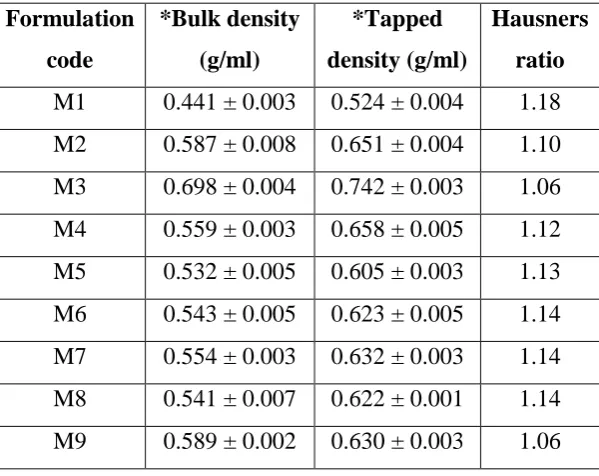
Flow properties of mebeverine hydrochloride pellets: All the nine different formulations of mebeverine hydrochloride pellets (M1 to M9) are subjected for evaluating the flow
properties. The different tests carried out on these pellets are given in the Table 3.
A perusal to the Table 3 shown were well within the specification limits for bulk density and
tapped density indicated that the flow properties for all the mebeverine hydrochloride pellets
Particle size distribution for mebeverine hydrochloride pellets
The various formulations of mebeverine hydrochloride pellets (M1 to M9) are subjected for
particle size distribution by sieve analysis. The percentage of pellets retained on different
sieves after shaking the sieve shaker for the specified period for all nine formulations are
obtained. From the obtained results, the particle size distribution revealed that, all the
formulations passed the test.
Physicochemical characterization of mebeverine hydrochloride pellets
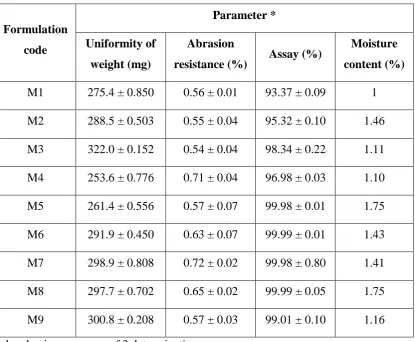
The prepared pellets (M1 to M9) were subjected to physicochemical characterization. The
results obtained from these studies are recorded in the Table 4. A perusal to the Table 4,
weight variation of pellets is in range from 253 to 322 mg and observed within specifications.
Abrasion resistance was found to be less than 1% for all formulations. The percentage
moisture content ranges from 1 to 1.75 % for different formulation (M1 to M9). Assay results
were found to be well within the specifications for all nine formulations (93.37 to 99.99%).
In vitro dissolution studies
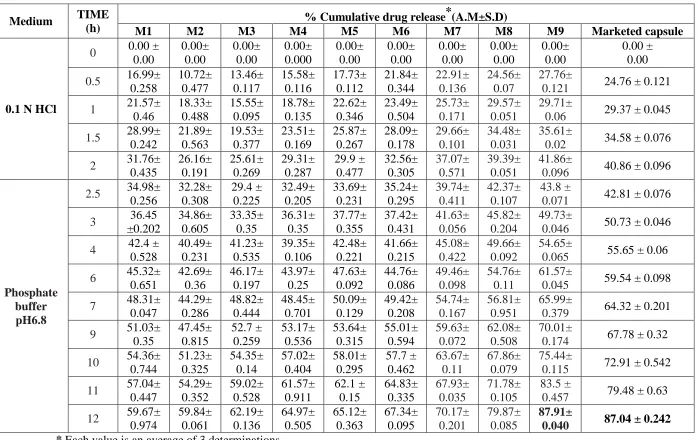
The prepared pellets (M1 –M9) are subjected to in vitro release studies in 0.1 N HCl for 2 h
and followed by phosphate buffer pH 6.8 for another 10 h as dissolution media using USP
Type I dissolution apparatus. The data obtained from the study was shown in the Table 5 and
recorded in Figure 2 from various formulations (M1-M9). A perusal to the Figure 2 and Table
5, it is evident that the drug release was found to be in range of 59.67 to 87.91% for the
formulations M1-M9 in 12 h. Thus the studies indicated that drug release was consistent for
all formulations. The effect of polymers HPMCP HP 55 and ethyl cellulose was clearly
indicated in the release studies. From these studies, the formulations M9 is optimized as the
drug release is more consistent and found to be highest in 12 h. Further, the optimized
formulation M9 was used to compare with marketed formulation MEVA SR as shown in
Figure 3, which indicated that the release for M9 is comparable as that of marketed
formulation.
Pellet shape analysis for mebeverine pellets by scanning electron microscopy
Scanning electron photomicrographs of optimized formulation of mebeverine hydrochloride
pellets M9 were taken. Acceptable shape was obtained indicating perfect sphericity of pellets
Kinetics of drug release from optimized formulation for mebeverine hydrochloride pellets
The in vitro drug release studies obtained for optimized formulation, M9, was subjected for
kinetics of drug release. The regression value for M9 is higher with first order than zero order
and therefore the release kinetics followed first order. Hixson-Crowell cube root law and
Higuchi’s models were applied to test the release mechanism. The R2
values are higher for
Higuchi law of diffusion in comparison to Hixson Crowell cube root law and hence release
followed diffusion rate controlled mechanism.
Table no. 1: Formulae used for mebeverine hydrochloride pellets.
Ingredients (mg or ml)
# Formulation code
M1 M2 M3 M4 M5 M6 M7 M8 M9
Powder blend Mebeverine
HCl 200 200 200 200 200 200 200 200 200 MCC 11.4 11.4 11.4 11.4 11.4 11.4 11.4 11.4 11.4 Mannitol 28.0 24.0 22.0 20.0 20.0 18.0 18.0 16.0 20.0 SLS 2.0 2.0 2.0 2.0 2.0 2.0 2.0 2.0 2.0
Coating of blended powder Sucrose
spheres (30#40)
34.0 34.0 34.0 34.0 34.0 34.0 34.0 34.0 34.0
Drug layering
PVP-K 30 6.0 6.0 6.0 6.0 6.0 6.0 6.0 6.0 6.0
Ethanol-syrup preparation
q.s q.s. q.s. q.s. q.s. q.s. q.s. q.s. q.s.
Sub coating Ethyl
cellulose 4.0 6.0 6.0 4.0 12.0 12.0 6.0 10.0 8.0 Ethyl
alcohol q.s. q.s. q.s. q.s. q.s. q.s. q.s. q.s. q.s. Enteric coating
HPMCP
HP 55 4.0 6.0 8.0 12.0 4.0 6.0 12.0 10.0 8.0 Cetyl
alcohol 0.6 0.6 0.6 0.6 0.6 0.6 0.6 0.6 0.6 Isopropyl
alcohol q.s q.s. q.s. q.s. q.s. q.s. q.s. q.s. q.s. Acetone. q.s q.s q.s q.s q.s q.s q.s q.s q.s # Weight of each unit = 290 mg.
Table no. 2: Characteristic bands for mebeverine hydrochloride, formulation mixture and mebeverine hydrochloride pellets obtained in FT-IR spectrum.
Functional group
Bands in pure drug (cm-1)
Bands in formulation mixture (cm-1)
Bands in mebeverine pellets (cm-1) O-H stretching 2998.3 2980.02 2991.59 C=O(saturated
acyclic compounds)
1717.6 1718.58 1716.65
C-H stretching 2839.73 2881.56 2310.72 N=O stretching 1291.6 1280.73 1267.23 C=O (presence of
ketone group) 1678.2 1718.58 1601.77 C-H deformation
(presence of methyl group)
961.9 881.47 960.55
-OH stretching (Intra molecular hydrogen bond)
[image:9.595.112.486.128.372.2]3420.8 3288.6 2883.58
Table no. 3: Flow properties of mebeverine hydrochloride pellets.
Formulation code
*Bulk density (g/ml)
*Tapped density (g/ml)
Hausners ratio M1 0.441 ± 0.003 0.524 ± 0.004 1.18
M2 0.587 ± 0.008 0.651 ± 0.004 1.10
M3 0.698 ± 0.004 0.742 ± 0.003 1.06
M4 0.559 ± 0.003 0.658 ± 0.005 1.12
M5 0.532 ± 0.005 0.605 ± 0.003 1.13
M6 0.543 ± 0.005 0.623 ± 0.005 1.14
M7 0.554 ± 0.003 0.632 ± 0.003 1.14
M8 0.541 ± 0.007 0.622 ± 0.001 1.14
M9 0.589 ± 0.002 0.630 ± 0.003 1.06
[image:9.595.149.449.424.662.2]Table no. 4: Physicochemical characterization of mebeverine hydrochloride pellets.
Formulation code
Parameter * Uniformity of
weight (mg)
Abrasion
resistance (%) Assay (%)
Moisture content (%) M1 275.4 ± 0.850 0.56 ± 0.01 93.37 ± 0.09 1
M2 288.5 ± 0.503 0.55 ± 0.04 95.32 ± 0.10 1.46
M3 322.0 ± 0.152 0.54 ± 0.04 98.34 ± 0.22 1.11
M4 253.6 ± 0.776 0.71 ± 0.04 96.98 ± 0.03 1.10
M5 261.4 ± 0.556 0.57 ± 0.07 99.98 ± 0.01 1.75
M6 291.9 ± 0.450 0.63 ± 0.07 99.99 ± 0.01 1.43
M7 298.9 ± 0.808 0.72 ± 0.02 99.98 ± 0.80 1.41
M8 297.7 ± 0.702 0.65 ± 0.02 99.99 ± 0.05 1.75
M9 300.8 ± 0.208 0.57 ± 0.03 99.01 ± 0.10 1.16
Table no. 5: Dissolution profile for mebeverine hydrochloride pellets (M1 to M9) and marketed capsule
Medium TIME
(h)
% Cumulative drug release*(A.M±S.D)
M1 M2 M3 M4 M5 M6 M7 M8 M9 Marketed capsule
0.1 N HCl
0 0.00 ± 0.00 0.00± 0.00 0.00± 0.00 0.00± 0.000 0.00± 0.00 0.00± 0.00 0.00± 0.00 0.00± 0.00 0.00± 0.00 0.00 ± 0.00
0.5 16.99± 0.258 10.72± 0.477 13.46± 0.117 15.58± 0.116 17.73± 0.112 21.84± 0.344 22.91± 0.136 24.56± 0.07 27.76±
0.121 24.76 ± 0.121
1 21.57± 0.46 18.33± 0.488 15.55± 0.095 18.78± 0.135 22.62± 0.346 23.49± 0.504 25.73± 0.171 29.57± 0.051 29.71±
0.06 29.37 ± 0.045
1.5 28.99± 0.242 21.89± 0.563 19.53± 0.377 23.51± 0.169 25.87± 0.267 28.09± 0.178 29.66± 0.101 34.48± 0.031 35.61±
0.02 34.58 ± 0.076
2 31.76± 0.435 26.16± 0.191 25.61± 0.269 29.31± 0.287 29.9 ± 0.477 32.56± 0.305 37.07± 0.571 39.39± 0.051 41.86±
0.096 40.86 ± 0.096
Phosphate buffer pH6.8
2.5 34.98± 0.256 32.28± 0.308 29.4 ± 0.225 32.49± 0.205 33.69± 0.231 35.24± 0.295 39.74± 0.411 42.37± 0.107 43.8 ±
0.071 42.81 ± 0.076
3 36.45 ±0.202 34.86± 0.605 33.35± 0.35 36.31± 0.35 37.77± 0.355 37.42± 0.431 41.63± 0.056 45.82± 0.204 49.73±
0.046 50.73 ± 0.046
4 42.4 ± 0.528 40.49± 0.231 41.23± 0.535 39.35± 0.106 42.48± 0.221 41.66± 0.215 45.08± 0.422 49.66± 0.092 54.65±
0.065 55.65 ± 0.06
6 45.32± 0.651 42.69± 0.36 46.17± 0.197 43.97± 0.25 47.63± 0.092 44.76± 0.086 49.46± 0.098 54.76± 0.11 61.57±
0.045 59.54 ± 0.098
7 48.31± 0.047 44.29± 0.286 48.82± 0.444 48.45± 0.701 50.09± 0.129 49.42± 0.208 54.74± 0.167 56.81± 0.951 65.99±
0.379 64.32 ± 0.201
9 51.03± 0.35 47.45± 0.815 52.7 ± 0.259 53.17± 0.536 53.64± 0.315 55.01± 0.594 59.63± 0.072 62.08± 0.508 70.01±
0.174 67.78 ± 0.32
10 54.36± 0.744 51.23± 0.325 54.35± 0.14 57.02± 0.404 58.01± 0.295 57.7 ± 0.462 63.67± 0.11 67.86± 0.079 75.44±
0.115 72.91 ± 0.542
11 57.04± 0.447 54.29± 0.352 59.02± 0.528 61.57± 0.911 62.1 ± 0.15 64.83± 0.335 67.93± 0.035 71.78± 0.105 83.5 ±
0.457 79.48 ± 0.63
12 59.67± 0.974 59.84± 0.061 62.19± 0.136 64.97± 0.505 65.12± 0.363 67.34± 0.095 70.17± 0.201 79.87± 0.085 87.91±
0.040 87.04 ± 0.242
500 750 1000 1250 1500 1750 2000 2500 3000 3500 4000 1/cm 80 82.5 85 87.5 90 92.5 95 97.5 100 %T 29 97 .3 8 29 81 .9 5 25 57 .6 1 24 59 .2 4 24 39 .9 524 05 .2
3 2384
.0 2 23 51 .2 3 23 16 .5 1 17 16 .6 5 16 04 .7 7 15 12 .1 9 14 85 .1 9 14 56 .2 6 13 94 .5 3 13 40 .5 3 13 13 .5 2 12 90 .3 8 12 67 .2 3 12 49 .8 7 12 17 .0 8 11 74 .6 5 11 30 .2 9 10 26 .1
3 960.
55 87 3. 75 83 1. 32 81 7. 82 76 3. 81 mebev erine (a) 500 750 1000 1250 1500 1750 2000 2500 3000 3500 4000 1/cm 94.5 95.25 96 96.75 97.5 98.25 99 99.75 %T 32 21 .1 2 29 80 .0 2 28 81 .6 5 28 19 .9 3 24 65 .0 3 23 03 .0 1 17 18 .5 8 15 10 .2 6 14 81 .3 3 14 21 .5 4 13 98 .3 9 13 38 .6 0 13 07 .7 4 12 80 .7 3 12 51 .8 0 12 17 .0 8 10 80 .1 4 10 18 .4 1 92 9. 69 88 1. 47 63 2. 65 58 4. 43 41 8. 55 mebev erine-excipients (b) 500 750 1000 1250 1500 1750 2000 2500 3000 3500 4000 1/cm 90 91.5 93 94.5 96 97.5 99 %T 29 91 .5 9 28 83 .5 8 25 59 .5 4 24 59 .2 4 23 49 .3 0 23 10 .7 2 20 38 .7 6 18 94 .1 0 17 16 .6 5 16 04 .7 7 15 14 .1 2 14 81 .3
31452
.4 0 13 96 .4 6 13 40 .5 3 13 09 .6 7 12 92 .3 1 12 67 .2
3 1249
.8 7 12 19 .0 1 11 76 .5 8 11 30 .2 9 10 26 .1 3 96 0. 55 87 3. 75 81 7. 82 76 1. 88
mebev erine pellets
(c)
[image:12.595.127.469.72.664.2]0 20 40 60 80 100
0 2 4 6 8 10 12
Time (h)
M1
M2
M3
M4
M5
M6
M7
[image:13.595.153.461.97.241.2]M8
[image:13.595.135.477.306.478.2]Fig. 2: In vitro dissolution profile for the mebeverine HCl pellets from formulations M1 to M9.
Fig. 3: In vitro dissolution profile obtained for the optimized formulation of mebeverine hydrochloride M9 and marketed capsule ‘Meva SR’.
(a) (b) (c)
[image:13.595.74.513.526.725.2]CONCLUSION
Oral multiparticulate drug delivery systems of extended release mebeverine hydrochloride in
the form of pellets were successfully developed. The developed formulations were found to
have positive impact on in vitro dissolution behavior. The optimized formulations showed
gradual release and the release is comparable with marketed formulation. Thus, the fluidized
bed coating technique delayed the drug release for mebeverine hydrochloride pellets to the
desired extent.
ACKNOWLEDGEMENTS
The authors are thankful to Gokaraju Rangaraju College of Pharmacy and Nosch labs Pvt
Ltd, Hyderabad, (Andhra Pradesh, India) for providing all the chemicals and equipments and
other facilities required to carry out the present research project.
REFERENCES
1. Issac Ghebre Sellassie. Pharmaceutical Pelletization Technology. Marcel Dekker 1989
Vol 37 P: 1 – 10.
2. Vikash Dash, Behera SK, Rohit Agarwal, Nitu Sinha, Pelletization technique in drug
delivery system. Journal of Current Pharmaceutical Research, 2012 9(1) P: 19-25.
3. Behzadi SS, Stefan Toegel and Helmut Viernstein. Innovations in Coating Technology,
Recent Patents on Drug Delivery and Formulation, Vol 2, November 2008, P: 209-238.
4. Ozarde YS, Serri sarvi, Polshettiwar SA, Kuchekar BS. Multiple unit pellet System
(MUPS). A Novel Approach for Drug Delivery, Drug invention today, 2012 4(2) P:
603-609.
5. Mahnaz Darvish Damavandi, Shekoufeh Nikfar, Mohammad Abdollahi. A Systematic
review of efficacy and tolerability of mebeverine in irritable bowel syndrome World J
Gastroenterol Feb 2010 16 (5) P: 547-553.
6. Rang HP, Dale MM Text book of Pharmacology Churchill living stone, Elsiever
publications, 6th ed P: 326, 327, 395.
7. Francis X. Webster, Robert Silverstein M. Spectrometric identification of organic
compounds, Wiley student edition 2010 6th ed P: 79 - 108.
8. Lieberman HA, Leon Lachman and Schwartz JB. Pharmaceutical dosage forms-tablets