P R O T O C O L
Open Access
A systematic review of adolescent
physiological development and its
relationship with health-related behaviour:
a protocol
Jan Pringle
1*, Kate Mills
1, John McAteer
1, Ruth Jepson
1, Emma Hogg
2, Neil Anand
2and Sarah-Jayne Blakemore
3Abstract
Background:At any one time, there are one billion people worldwide who are in the second decade of their life, and 1.8 billion in the 10–24 age range.
Whilst a great deal of focus has been placed on healthy early years development, the adolescent years are also a unique period of opportunity: exposure to health-influencing behaviours such as alcohol consumption or cigarette smoking, may serve to establish patterns that have significant health consequences in later life. Although there is often an emphasis on risk-taking and detrimental health behaviours during adolescence, these years also provide significant opportunities for behaviour to be shaped in positive ways that may improve longer term health outcomes. However, it is firstly important to understand the complex physiological changes that are taking place within the human body during this period and their relationship with health-related behaviour. Such knowledge can help to inform health policy and intervention development.
Aim:The aim of this study is to gain a comprehensive understanding of the relationship between physiological development and health-related behaviours in adolescence.
Methods:The principles of an integrative review will be used. Such reviews are of use where research has emerged in different fields, to combine existing knowledge and produce a more extensive understanding. Studies from a range of different methodological approaches, published or unpublished, will be included. A range of databases and literature depositories will be searched using a pre-defined search strategy. The review will include studies that focus on adolescents (nominally, those aged 10–24 years). We will seek papers that focus on both physiological development and health behaviour, or papers focusing solely on physiological development if there are clear implications for health behaviour. Studies with a focus on participants with specific health conditions will be excluded.
Two reviewers will independently screen potential studies for eligibility and quality; members of the project team will act as third reviewers in the case of uncertainty or discrepancy.
Further analyses (e.g. meta-analysis, meta-synthesis, meta-summary) will be decided upon, and sub-set analyses carried out. Finally, an integrative summation will be produced, giving a critical analysis of the results and providing conclusions and recommendations.
* Correspondence:[email protected]
1Scottish Collaboration for Public Health Research & Policy (SCPHRP), University of Edinburgh, 20 West Richmond St, Edinburgh EH8 9DX, UK Full list of author information is available at the end of the article
Introduction and background
At any one time, there are one billion people worldwide who are in the second decade of their life [1] and 1.8 billion in the 10–24 age range [2]. Broadly speaking, adolescence occurs in and around the second decade and is the transi-tional developmental period between childhood and adult-hood. The term adolescence, derived from the latin meaning for‘growing up’, has no universally accepted defin-ition. For example, WHO [2] describes adolescence as a period in human growth and development that occurs nominally between the ages of 10 and 19. Others define it as incorporating young adulthood, spanning a variable period of time between the ages of 10 and 24 [3]. There is widespread agreement that adolescence starts at puberty and ends with the uptake of mature social roles, such as employment and child rearing. Due to the later transition into these roles in many developed countries, the longer and later definition may therefore be more appropriate. There are, however, recognised wide variations in the start and end points of adolescence, including differences between cultures and individuals [4].
Whilst a great deal of focus has been placed on the im-portance of healthy early childhood development [5–7], the adolescent years are a unique period in their own right. For example, during this period, there is increased exposure to health-influencing behaviours such as alcohol consumption and cigarette smoking. These behaviours, in conjunction with peer group pressure, may contribute to the establishment of patterns that have significant health consequences in later life [8]. However, whilst there is often an emphasis on risk and detrimental health behav-iours during adolescence [9], these years also provide significant opportunities for behaviour to be shaped in positive ways that may improve longer term health out-comes [1]. The capacity of adolescents to make decisions and take control of their own future life course should not be underestimated, especially if they are appropriately informed.
Intervening to support positive health choices during adolescence therefore has the potential to lessen the likeli-hood of developing a health condition in later life, with possible positive implications for future health service provision and resources. An understanding of the complex physiological changes that are taking place within the human body during this period and the relationship with health-related behaviours is the first step towards recog-nising adolescence as a transition period that warrants a specific focus as a unique period of opportunity. Such knowledge can help to inform health policy and interven-tion development.
The aim of this systematic review is to gain an under-standing of the relationship between physiological develop-ment and health-related behaviours in adolescence. The objectives are to:
(1)Identify and describe the range of evidence that explores the relationship between physiological development and health behaviours in adolescence (2)Determine the strength of such evidence
This review forms the first phase of a wider adolescent and young adult research programme (see Additional file 1). It is hoped that the findings of the review will help to inform policy, practice, and future research priorities.
Methods
Previous associated reviews [9, 10], which have both focussed on adolescent health in more general terms, indi-cate that data may be found from a broad range of sources. In order to encompass such a wide variety of literature, this systematic review will be based on the principles of an inte-grative review. This approach can be used to capture an extensive range of studies with a common focus on the chosen topic of interest [11]. Integrative reviews are the most comprehensive of all review approaches, facilitating the inclusion of different methodological approaches, and both published or unpublished literature [12]. Such reviews can combine existing knowledge to produce a more exten-sive understanding [13].
Within a systematic integrative review, similar studies can be grouped together (e.g. clinical trials and compara-tive studies or qualitacompara-tive and descripcompara-tive studies). Quality criteria instruments and analytical methods can then be selected to be relevant to each type.
The stages of the review are summarised in Table 1, with key elements of the review being further detailed below.
Variables of interest
The purpose of the review is to gain a comprehensive understanding of the complex and potentially multifa-ceted relationship between physiological development and health-related behaviours in adolescence. The main variables of interest are theories and hypotheses related to physiological development in adolescence and rela-tionships with health-related behaviour. In particular, the review will aim to assess the strength of such evidence.
Focus and boundaries
To assist with the classification of the review studies, all identified material will be screened for relevance using the broad inclusion criteria of adolescent physiological devel-opment and health behaviours. Physiological develdevel-opment will encompass a broad range of biological systems (e.g. musculo-skeletal, nervous, endocrine, integumentary, cardiovascular, respiratory, digestive, reproductive) and associated biochemical and hormonal processes.
smoking), sexual behaviours, and sleep. Outcome mea-sures will potentially refer to any of these systems or behaviours.
Where there is insufficient evidence in the title and abstract to make a decision, full-text papers/reports will be retrieved and narrow screening criteria used on all full text papers.
Narrow screening will focus on the study design, population, intervention, and outcome (SPIO) criteria:
Study design This review will consider all research designs and types of publication. Randomised controlled trials, non-randomised controlled trials, comparative stud-ies, case control studstud-ies, and cohort studies will all be con-sidered for inclusion. Qualitative data will be included, if relevant, as will published reports and grey literature such as unpublished dissertations/theses (where accessible) to reduce the likelihood of publication bias.
PopulationStudies that include adolescents aged nomin-ally between≥10 and≤24 years will be included, although no definitive age barriers will be used to avoid excluding potentially relevant research, with the proviso that the topic focus relates to the adolescent life stage. Papers reporting exclusively on younger children and/or adults will be excluded. Studies of non-human subjects will be included if they supplement the knowledge base (e.g. add further information regarding mechanisms).
Studies with an exclusive focus on participants with spe-cific clinical health conditions will be excluded, since these groups may have distinct needs in terms of development
and health behaviour. These groups include individuals diagnosed with eating disorders, addictions, or major mental health disorders. Studies that focus exclusively on individuals with morbid (or severe) obesity will be ex-cluded, due to the clinical impact on health and subse-quent health-related behaviours.
InterventionsAll types of intervention will be included, if relating to adolescent physiological development and including explicit or implicit links to health behaviour.
Outcomes Included outcome measures will not be restrictive, with the proviso that there is a relationship between physiological development and health behaviour.
Physiological development will include such elements as relate to healthy and normal functioning and the physical and chemical phenomena involved therein [14].
Health behaviours will relate to behaviours that have the potential to impact on health, such as dietary intake, physical exercise, sexual behaviour, sleep, and substance use (including alcohol, drugs, smoking, and solvents). Papers that solely focus on situations where substance use had evolved into an addiction will be excluded, as will studies involving gambling.
We will include studies that examine pre-adolescent biological development if these studies also relate this to adolescent physiology and health-related behaviour. We will also include studies that assess the impact of adoles-cent physiological development on health-related behav-iour in adulthood.
Table 1Five stages of an integrative literature review (summarised from Whittemore and Knafl [11])
Stages of review Aim/purpose Details
(1) Problem formulation
To clearly state topic
of interest and purpose of review •
List variables of interest •Set focus and boundaries (2) Literature
search
To make explicit and justify search strategy and sampling criteria
•Specify databases and other search methods
•State type of literature to be included (e.g. published/unpublished) •Detail key words
•Acknowledge publication bias (3) Data
evaluation
To assess type, scope, diversity, and quality of accessed literature
•Specify different types of study found and classify into sub-groups •Decide on quality criteria instruments for each type of study
(4) Data synthesis To specify systematic analytical method
To create an innovative synthesis To formulate a unified
and integrated conclusion
•Data reduction: simplify sub-groups into a manageable framework according to the type (e.g. qualitative, comparative, experimental); create short summaries of each primary source •Data display: create charts or visual network displays to show connection within each sub-group type
•Data comparison: identify patterns, themes, relationships, and major variables within and between sub-groups •Conclusion drawing and verification: creative and critical analysis of data, acknowledging commonalities and differences, and including any justifiable generalisations
•Production of integrative summation (5) Presentation To capture the depth and breadth of the topic and
produce a comprehensive understanding •
Theoretical or discussion papers will be included if they contribute to our understanding of mechanisms or effects. We will exclude protocols that do not contain results.
Studies dating from 1980 will be included. Health promotion was formally acknowledged and defined as an important part of healthcare professional’s work by WHO in 1986, as part of the Ottawa Charter [15]. It was therefore largely from this decade onwards that more formal initiatives started to be used and became the focus of research work. However, important earl-ier theoretical papers which contribute to our under-standing will be considered for inclusion.
No initial language limitations will be applied. If necessary, we will seek translation of papers that appears to meet the inclusion criteria. Similarly, no geographical boundaries will be set.
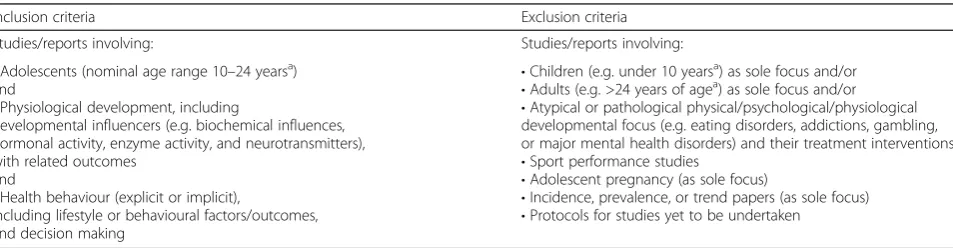
Details regarding inclusion and exclusion criteria are summarised in Table 2.
The project group for this review will monitor all stages of the review process and is comprised of researchers with a background in public health, neuroscience, adolescence, and systematic reviewing, as well as policy/decision makers with a remit to improve health for young people across Scotland. An advisory group, including lay adolescent members, will provide additional guidance as necessary.
Literature search
Search strategy
A comprehensive search strategy that aims to be both sensitive and specific will be used in this review. An ini-tial search strategy will be devised using the MEDLINE thesaurus and indexing system to identify appropriate MeSH headings and key/text words associated with the terms ‘adolescence’, ‘physiology’, and ‘health-related be-haviour’. This will be adapted for use across all included databases as necessary.
Stages in the literature search
Stages in the literature search are summarised in Fig. 1. Although not limited to empirical evidence, we will use
the Preferred Reporting of Systematic Reviews and Meta-Analysis (PRISMA) flow chart format to visually display the processes and findings of the review.
Databases
Details of databases to be used in the review are given in Table 3.
Grey literature
The term‘grey literature’came into common use in the 1970s [16] and is generally considered to refer to unpub-lished research.
In this review, Electronic theses On-line Service (EthOS) 1980–2015 and Zetoc conference proceedings (1980–2015) will be searched electronically. Google and Google Scholar will also be searched using key phrases.
In addition, key professionals and voluntary/third sec-tor organisations will also be contacted for resources and reports that may not have been identified through routine searches of databases.
Reference lists of all eligible research or reports will also be scanned to identify potentially relevant refer-ences not retrieved by the database searches.
Screening
Two review authors will independently screen potential studies for eligibility at both broad and narrow screening stages. Members of the project or advisory teams will act as third reviewers in the case of eligibility uncertainty or discrepancy.
Bibliographic management
A bibliographic data management system (RefWorks™) will be used to store and manage the results of the elec-tronic database searches. This will also provide an audit trail of identified resources and give indicators of how they are subsequently classified and sub-divided during the broad and narrow screening processes.
Table 2Inclusion/exclusion criteria
Inclusion criteria Exclusion criteria
Studies/reports involving: Studies/reports involving:
•Adolescents (nominal age range 10–24 yearsa) and
•Physiological development, including
developmental influencers (e.g. biochemical influences, hormonal activity, enzyme activity, and neurotransmitters), with related outcomes
and
•Health behaviour (explicit or implicit),
including lifestyle or behavioural factors/outcomes, and decision making
•Children (e.g. under 10 yearsa) as sole focus and/or •Adults (e.g. >24 years of agea) as sole focus and/or •Atypical or pathological physical/psychological/physiological developmental focus (e.g. eating disorders, addictions, gambling, or major mental health disorders) and their treatment interventions •Sport performance studies
•Adolescent pregnancy (as sole focus)
•Incidence, prevalence, or trend papers (as sole focus) •Protocols for studies yet to be undertaken
a
Data evaluation
Classification of result resources
Data extraction sheets and tables will be developed, tai-lored to the resources found. These will give an overview summary to assist in the production of groupings and classifications of the types of resources identified by the literature searches.
The different types of study or report will be classified into major groups and then divided into sub-groups, as necessary and relevant.
Critical appraisal
To assess the quality of papers selected for inclusion in the review, the UK Critical Appraisal Skills Programme [17] provides tools suitable for the evaluation of individ-ual study qindivid-uality. Qindivid-uality assessment will address issues such as whether study aims are clearly stated and whether findings and conclusions are valid and/or cred-ible. Two review authors will independently quality appraise included studies and agree the final assessment; a third reviewer will assist in the event of a discrepancy.
The critical appraisal of studies will assist with asses-sing the strength of evidence from individual and grouped studies.
Data synthesis
Once the final number of studies has been identified and appraised, the task of data synthesis will commence. It is anticipated that this will involve analysis within and
across groupings, which could potentially include and compare:
Population/age groupings
Behaviours and risk
Developmental stage
Socioeconomic factors
Gender
Individual or multiple lifestyle factors
Outcome measures
Theory or hypotheses bases
Depending on the findings, the type and scope of further analyses (e.g. meta-analysis, meta-synthesis, meta-summary) will be decided upon, and sub-set analyses carried out as necessary and/or feasible. Rele-vant statistical software will be used, if appropriate.
Charts and other visual displays will be used to show the patterns, connections, and variables within and across the data sources. These will assist in the production of an integrative summation, giving a critical analysis of the results as a whole and providing any conclusions, general-isations, and recommendations from the review.
Presentation
The integrative summation will form the basis of a report on the findings of the review. Presentation and dissemination of results will be through local, national, and international publications and conferences, via a variety of media (e.g. slide presentations, podcasts,
Stages in the literature search process
Refine the topic being searched, and decide on inclusion/exclusion criteria
Identify key words
Search electronic database(s) using combinations of key words and Boolean strategies
Remove duplicates
Read titles and abstracts, and assess for relevance
Read full articles, where relevant, and assess, using inclusion criteria
Repeat above steps as necessary
Scan reference lists for further articles; do citation searches of most relevant work; contact key personnel
Organise material in preparation for analysis and inclusion in the review
written summaries) and for a variety of audiences (e.g. academic/health professionals, lay audiences, including adolescents and pictorial versions for those with read-ing difficulties).
Discussion
Strengths and limitations of the review
This review seeks to provide a comprehensive under-standing of the complexities surrounding adolescent physiological development and the relationship and links to health behaviour. As such, the review aims are ambi-tious in their scope and depth. Although the review will use a clear and systematic approach to searching, screening, and reviewing studies, the search strategies and engines may not capture all relevant material. The findings may also be open to selection bias. The pres-ence of the wider project research team and advisory/ reference groups will serve to minimise such bias.
Relevance of the review
It is anticipated that the results of the review will be of interest to a wide variety of policy makers, organisations, and individuals working with adolescents across health,
social care, and education. We will therefore seek to make the findings from the review widely available. The findings will also be used to inform future research strat-egies, by identifying areas where further evidence would be beneficial and providing the necessary background information to justify research funding allocation and priority.
Additional file
Additional file 1:Adolescent project overview.This provides details of where this current review is placed within the broader context of adolescent study by the project team. (DOCX 28 kb)
Competing interests
The authors declare that they have no competing interests.
Authors’contributions
JMcA, RJ, EH, NA, and SJB were involved in the conceptualisation of the study; JP, JMcA, KM, and RJ contributed to the protocol construction; and JP, JMcA, and KM carried out the manuscript draft. All authors read and approved the final manuscript.
Acknowledgements
We would like to thank our advisory group members for supporting this project and funders: MRC (MR/KO 023209/1), CSO, and NHS Health Scotland.
Author details
1Scottish Collaboration for Public Health Research & Policy (SCPHRP), University of Edinburgh, 20 West Richmond St, Edinburgh EH8 9DX, UK. 2NHS Health Scotland, Edinburgh, UK.3University College London, London, UK.
Received: 17 September 2015 Accepted: 18 December 2015
References
1. Dick B, Ferguson BJ. Health for the world’s adolescents: a second chance in the second decade. J Adolesc Health. 2015;56:3–6.
2. World Health Organisation (WHO): Adolescent development. 2015 http:// www.who.int/maternal_child_adolescent/topics/adolescence/development. Accessed 06/03/15.
3. Sawyer SM, Afifi RA, Bearinger LH, Blakemore S-J, Dick B, Ezeh AC, et al. Adolescence: a foundation for future health. Lancet. 2012;379:1630–40. 4. Adams GR, Berzonsky M. Blackwell handbook of adolescence. Oxford: John
Wiley & Sons; 2008.
5. Black MM, Hurley KM. Investment in early childhood development. Lancet. 2014;384:1244–5.
6. Jolly R. Early childhood development: the global challenge. Lancet. 2007; 369:8–9.
7. World Health Organisation (WHO): Early child development. 2015. http:// www.who.int/social_determinants/themes/earlychilddevelopment. Accessed 3 Apr 2015.
8. Call KT, Riedel AA, Hein K, McLoyd V, Petersen A, Kipke M. Adolescent health and well-being in the twenty-first century: a global perspective. J Res Adolesc. 2002;12:69–98.
9. Jackson CA, Henderson M, Frank JW, Haw SJ. An overview of prevention of multiple risk behavior in adolescence and young adulthood. J Public Health. 2012;34 suppl 1:i31–40.
10. Oliver S, Kavanagh J, Lorenc T, Oliver K, Harden A, Thomas J, et al. Health promotion, inequalities and young people’s health: a systematic review of research. London: EPPI-Centre, Social Science Research Unit, Institute of Education, University of London; 2008. Report.
11. Whittemore R, Knafl K. The integrative review: updated methodology. J Adv Nurs. 2005;52:546–53.
12. de Souza M, de Silva M, Carvalho R. Integrative review: what is it? How to do it? Einstein. 2010;8:102–6.
Table 3Databases to be used in the systematic review
Database Details
AMED Allied and Complimentary Medicines Database, with a focus on complimentary medicine, palliative care, and professions allied to medicine
ASSIA Applied Social Sciences Index and Abstracts; includes literature from psychology, sociology, medicine, anthropology, politics, and law
CENTRAL Cochrane Central Register of Controlled Trials; summary details of published and unpublished trials
CINAHL Cumulative Index to Nursing and Allied Health Literature. Includes over 2.6 million records dating back to 1981; books and dissertations also included
EMBASE Excerpta Medica Database covers biomedical and pharmacological literature
ERIC Education Resources Information Center (ERIC); described as the world’s largest database of educational literature
HMIC The Health Management Information Consortium; brings together the bibliographic databases of two UK health and social care management systems: the Dept of Health’s library and information services and King’s Fund information and library services. Includes grey literature
MEDLINE Covers health-related journals worldwide, focusing on evidence/research based work; includes in-process and non-indexed items
PsycINFO Abstract database providing systematic coverage of psychological literature as far back as the 1800s
PubMed Includes Medline, plus a comprehensive and broad-ranging selection of health-related journals and books
13. Torraco RJ. Writing integrative literature reviews: guidelines and examples. Hum Resour Dev Rev. 2005;4:356–67.
14. Physiological. Merriam-Webster 2015. http://www.merriam-webster.com. Accessed 16 Jul 2015.
15. World Health Organisation (WHO) The Ottawa Charter for Health Promotion http://www.who.int/healthpromotion/conferences/previous/ottawa. Accessed 7 Jul 2014.
16. Benzies KM, Premji S, Hayden KA, Serrett K. State-of-the-evidence reviews: advantages and challenges of including grey literature. Worldviews Evid Based Nurs. 2006;3:55–61.
17. Critical Appraisal Skills Programme (CASP). Qualitative research checklist. Oxford: CASP; 2013.
18. Aveyard H. Doing a literature in health and social care: a practical guide. 3rd ed. Maidenhead: Open University Press; 2014.
• We accept pre-submission inquiries
• Our selector tool helps you to find the most relevant journal
• We provide round the clock customer support
• Convenient online submission
• Thorough peer review
• Inclusion in PubMed and all major indexing services
• Maximum visibility for your research
Submit your manuscript at www.biomedcentral.com/submit
![Table 1 Five stages of an integrative literature review (summarised from Whittemore and Knafl [11])](https://thumb-us.123doks.com/thumbv2/123dok_us/9566752.1939679/3.595.57.536.97.348/table-stages-integrative-literature-review-summarised-whittemore-knafl.webp)
![Fig. 1 Stages in the literature search process (summarised from Aveyard [18])](https://thumb-us.123doks.com/thumbv2/123dok_us/9566752.1939679/5.595.55.540.89.343/fig-stages-literature-search-process-summarised-aveyard.webp)