SINGLE-VALUED NEUTROSOPHIC HYPERGRAPHS
MUHAMMAD AKRAM1, SUNDAS SHAHZADI1, A.BORUMAND SAEID2,§
Abstract. We introduce certain concepts, including single-valued neutrosophic
hyper-graph, line graph of single-valued neutrosophic hyperhyper-graph, dual single-valued neutro-sophic hypergraph and transversal single-valued neutroneutro-sophic hypergraph.
Keywords: single-valued neutrosophic hypergraph, dual single-valued neutrosophic hy-pergraph.
AMS Subject Classification: 03E72, 05C72, 05C78, 05C99.
1. Introduction
Fuzzy set theory was introduced by Zadeh [17] to solve difficulties in dealing with un-certainties. Since then the theory of fuzzy sets and fuzzy logic have been examined by many researchers to solve many real life problems, involving ambiguous and uncertain environment. Atanassov [3] introduced the concept of intuitionistic fuzzy set as an exten-sion of Zadeh’s fuzzy set [17]. An intuitionistic fuzzy set can be viewed as an alternative approach when available information is not sufficient to define the impreciseness by the conventional fuzzy set. In fuzzy sets the degree of acceptance is considered only but in-tuitionistic fuzzy set is characterized by a membership(truth-membership) function and a non-membership(falsity-membership) function, the only requirement is that the sum of both values is less and equal to one. Intuitionistic fuzzy set can deal only with incomplete information but not the indeterminate information and inconsistent information which commonly exist in certainty system. In intuitionistic fuzzy sets, indeterminacy is its hesi-tation part by default. Smarandache [13] initiated the concept of neutrosophic set in 1998. “It is the branch of philosophy which studies the origin, nature and scope of neutralities, as well as their interaction with different ideational spectra”[13]. A neutrosophic set is characterized by three components: truth-membership, indeterminacy-membership, and falsity-membership which are represented independently for dealing problems involving imprecise, indeterminacy and inconsistent data. In neutrosophic set, truth-membership, falsity-membership are independent, indeterminacy membership quantified explicitly, this assumption helps in a lot of situations such as information fusion when try to combine the data from different sensors. A neutrosophic set is a general framework which generalizes the concept of fuzzy set, interval valued fuzzy set, and intuitionistic fuzzy set. The single
1 Department of Mathematics, University of the Punjab, New Campus, Lahore, Pakistan.
e-mail: [email protected], [email protected];
ORCID: http://orcid.org/0000-0001-7217-7962, http://orcid.org/0000-0002-3969-9336.
3
Department of Pure Mathematics, Faculty of Mathematics and Computer, Shahid Bahonar University of Kerman, Kerman, Iran.
e-mail: [email protected], ORCID: http://orcid.org/0000-0001-9495-6027. § Manuscript received: August 09, 2016; accepted: October 19, 2016.
TWMS Journal of Applied and Engineering Mathematics, Vol.8, No.1 cI¸sık University, Department of Mathematics, 2018; all rights reserved.
valued neutrosophic set was introduced for the first time by Smarandache in 1998 in his book: F. Smarandache, Neutrosophy / Neutrosophic probability, set, and logic, American Res. Press, see pages 7-8, 1998, which is also mentioned by Denis Howe, from England, in The Free Online Dictionary of Computing, 1999. Wang [15] discussed theoretic operators on single-valued neutrosophic set. Fuzzy hypergraph was introduced by the Kaufmann [7]. Chen [5] introduced interval-valued fuzzy hypergraphs. Lee-kwang et al. general-ized the concept of fuzzy hypergraph and redefined it to be useful for fuzzy partition of a system. Akram and Dudek [1] investigated some properties of intuitionistic fuzzy hypergraph and gave applications of intuitionistic fuzzy hypergraph. In this paper, we introduce certain concepts, including single-valued neutrosophic hypergraph, line graph of single-valued neutrosophic hypergraph, dual single-valued neutrosophic hypergraph and transversal single-valued neutrosophic hypergraph.
2. Single-Valued Neutrosophic Hypergraphs
Definition 2.1. [15] Let X be a space of points (objects), with a generic element in
X denoted by x. A single-valued neutrosophic set (SVNS) A in X is characterized by
truth-membership function TA(x), indeterminacy-membership function IA(x) and
falsity-membership function FA(x). For each point x in X, TA(x), IA(x), FA(x) ∈ [0,1], i.e., A={hx, TA(x), IA(x), FA(x)i:x∈X} and 0≤TA(x) +IA(x) +FA(x)≤3.
Definition 2.2. The support of a single-valued neutrosophic setA={(x, TA(x), IA(x), FA(x)) : x∈X} is denoted by supp(A), defined by supp(A) ={x | TA(x) 6= 0, IA(x)6= 0, FA(x) 6=
0}.The support of a single-valued neutrosophic set is a crisp set.
Definition 2.3. The height of a single-valued neutrosophic setA={(x, TA(x), IA(x), FA(x)) :
x ∈ X} is defined as h(A) = (sup
x∈X
TA(x),sup x∈X
IA(x),inf
x∈XFA(x)). We call single-valued
neutrosophic set A is normal if there exist at least one element x∈X such that TA(x) =
1, IA(x) = 1, FA(x) = 0.
Definition 2.4. Let A = {(x, TA(x), IA(x), FA(x)) : x ∈ X} be a single-valued
neu-trosophic set on X and let α, β, γ ∈ [0,1] such that α + β + γ ≤ 3. Then the set
A(α,β,γ) = {x | TA(x) ≥ α, IA(x) ≥ β, FA(x) ≤ γ} is called (α, β, γ)−level subset of A. (α, β, γ)−level set is a crisp set.
Definition 2.5. Let V ={v1, v2,· · ·, vn} be a finite set andE ={E1, E2,· · · , Em} be a
finite family of non-trivial single-valued neutrosophic subsets ofV such that
V =[
i
supp(Ei), i= 1,2,3,· · · , m,
where the edgesEi are single-valued neutrosophic subsets ofV,Ei={(vj, TEi(vj), IEi(vj),
FEi(vj))}, Ei 6= ∅, for i = 1,2,3,· · ·, m. Then the pair H = (V,E) is a single-valued
neutrosophic hypergraph onV,E is the family of single-valued neutrosophic hyperedges of
H and V is the crisp vertex set of H.
In single-valued neutrosophic hypergraph two vertices u and v are adjacent if there exist an edge Ei ∈ E which contains the two vertices v and u, i.e., u, v ∈ supp(Ei). In
single-valued neutrosophic hypergraphs H, if two vertices u and v are connected then there exists a sequence u = u0, u1, u2,· · · , un = v of vertices of H such that ui−1 is adjacent ui for i = 1,2,· · · , n. A connected single-valued neutrosophic hypergraph is a
their intersection is non-empty, i.e., supp(Ei)∩supp(Ej) 6= ∅, i 6= j. The order of a
single-valued neutrosophic hypergraph is denoted by |V| and size (number of edges) is denoted by |E|. If |supp(Ei)|= k for each Ei ∈ E, then single-valued neutrosophic
hy-pergraph H = (V,E) is k-uniform single-valued neutrosophic hypergraph. The element
aij of the single-valued neutrosophic matrix represents the truth-membership
(participa-tion) degree, indeterminacy-membership degree and falsity-membership of vi to Ej (that
is (TEj(vi), IEj(vi), FEj(vi))). Since the diagram of single-valued neutrosophic hypergraph
does not imply sufficiently the truth-membership degree, indeterminacy-membership de-gree and falsity-membership dede-gree of vertex to edges, we use incidence matrix MH for
the description of single-valued neutrosophic hyperedes.
Definition 2.6. The height of a single-valued neutrosophic hypergraph H = (V,E), is denoted by h(H),is defined by h(H) =W
i
{h(Ei)| Ei∈E}.
Definition 2.7. LetH= (V,E)be a single-valued neutrosophic hypergraph, the cardinality of a single-valued neutrosophic hyperedge is the sum of truth-membership, indeterminacy-membership, and falsity-membership values of the vertices connected to an hyperedge, it is denoted by |Ei|. The degree of a single-valued neutrosophic hyperedge, Ei ∈ E is its
cardinality, that is dH(Ei) =|Ei|. The rank of a single-valued neutrosophic hypergraph is
the maximum cardinality of any hyperedge inH, i.e., max
Ei∈E
dH(Ei)and anti rank of a
single-valued neutrosophic is the minimum cardinality of any hyperedge in H, i.e., min
Ei∈E
dH(Ei).
Definition 2.8. A single-valued neutrosophic hypergraph is said to be linear single-valued
neutrosophic hypergraph if every pair of distinct vertices of H = (V,E) is in at most
one edge of H, i.e., |supp(Ei)∩supp(Ej)| ≤ 1 for all Ei, Ej ∈ E. A 2−uniform linear
single-valued neutrosophic hypergraph is a single-valued neutrosophic graph.
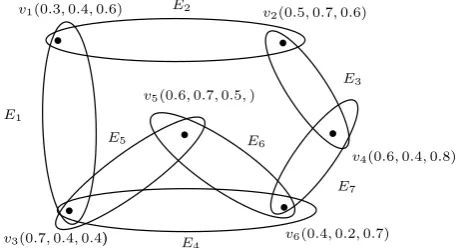
Example 2.1. Consider a single-valued neutrosophic hypergraph H = (V,E) such that V ={v1, v2, v3, v4, v5, v6},E={E1, E2, E3, E4, E5, E6}, whereE1 ={(v1,0.3,0.4,0.6),(v3, 0.7,0.4,0.4)}, E2={(v1,0.3,0.4,0.6),(v2,0.5,0.7,0.6)}, E3 ={(v2,0.5,0.7,0.6),(v4,0.6, 0.4,0.8)}, E4 ={(v3,0.7,0.4,0.4),(v6,0.4,0.2,0.7)}, E5 ={(v3,0.7,0.4,0.4),(v5,0.6,0.7,0.5)},
E6={(v5,0.6,0.7,0.5),(v6,0.4,0.2,0.7)}, andE7={(v4,0.6,0.4,0.8),(v6,0.4,0.2,0.7)}.
b b
b
b
b
v1(0.3,0.4,0.6) v2(0.5,0.7,0.6)
v5(0.6,0.7,0.5,)
v4(0.6,0.4,0.8)
v6(0.4,0.2,0.7)
v3(0.7,0.4,0.4)
b
E1
E2
E3
E4
E7
E6
E5
Figure 1. Single-valued neutrosophic hypergraph.
MH E1 E2 E3 E4 E5 E6 E7
v1 (0.3,0.4,0.6) (0.3,0.4,0.6) (0,0,0) (0,0,0) (0,0,0) (0,0,0) (0,0,0)
v2 (0,0,0) (0.5,0.7,0.6) (0.5,0.7,0.6) (0,0.,0) (0,0,0) (0,0,0) (0,0,0)
v3 (0.7,0.4,0.4) (0,0,0) (0,0,0) (0.7,0.4,0.4) (0.7,0.4,0.4) (0,0,0) (0,0,0)
v4 (0,0,0) (0,0,0) (0.6,0.4,0.8) (0,0,0) (0,0,0) (0,0,0) (0.6,0.4,0.8)
v5 (0,0,0) (0,0,0) (0,0,0) (0,0,0) (0.6,0.7,0.5) (0.6,0.7,0.5) (0,0,0)
v6 (0,0,0) (0,0,0) (0,0,0) (0.4,0.2,0.7) (0,0,0) (0.4,0.2,0.7) (0.4,0.2,0.7)
Definition 2.9. Let H = (V,E) be a single-valued neutrosophic hypergraph, the degree dH(v) of a vertex v in H is dH(v) =
P
v∈Ei
(TEi(v), IEi(v), FEi(v)), where Ei are the edges
that contain the vertexv. The maximum degree of a single-valued neutrosophic hypergraph
is 4(H) = max
v∈V (dH(v)). A single-valued neutrosophic hypergraph is said to be regular
single-valued neutrosophic hypergraph in which all the vertices have same degree.
Proposition 2.1. Let H = (V,E) be a single-valued neutrosophic hypergraph, then
X
v∈V
dH(v) =
X
Ei∈E
dH(Ei).
Proof. LetMH be the incidence matrix of single-valued neutrosophic hypergraphH, then
the sum of the degrees of each vertexvi ∈V and the sum of degrees of each edge Ei∈E
are equal. We obtain P
v∈V
dH(v) = P Ei∈E
dH(Ei).
Definition 2.10. The strengthη of a single-valued neutrosophic hyperedgeEi is the
min-imum of truth-membership, indeterminacy-membership and maxmin-imum falsity-membership values in the edge Ei, i.e.,
η(Ei) ={min vj∈Ei
(TEi(vj)|TEi(vj)>0),min
vj∈Ei
(IEi(vj)|IEi(vj)>0),max
vj∈Ei
(FEi(vj)|FEi(vj)>0)}.
The strength of an edge in single-valued neutrosophic hypergraph interprets that the edge Ei group elements having participation degree at least η(Ei).
Example 2.2. Consider single-valued neutrosophic hypergraph as shown in Figure. 1, the height ofHish(H) = (0.7,0.7,0.4), the strength of each edge isη(E1) = (0.3,0.4,0.6), η(E2) = (0.3,0.4,0.6), η(E3) = (0.5,0.4,0.8), η(E4) = (0.4,0.2,0.7), η(E5) = (0.6,0.4,0.5), η(E6) = (0.4,0.2,0.7) and η(E7) = (0.4,0.2,0.8), respectively. The edges with high strength are called the strong edges because the interrelation (cohesion) in them is strong. Therefore, E5 is stronger than each Ei, for i= 1,2,3,4,6,7.
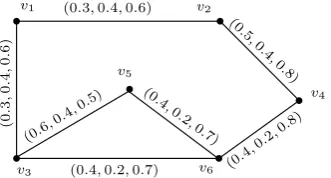
If we assign η(Ei) = (Tη(Ei), Iη(Ei), Fη(Ei)) to each clique in single-valued neutrosophic
graph mapped to an edge Ei in valued neutrosophic hypergraph, we obtain a
single-valued neutrosophic graph which represents subset with grouping strength (interrelation-ship).
MH E1 E2 E3 E4 E5 E6 E7
v1 (0.3,0.4,0.6) (0.3,0.4,0.6) (0,0,0) (0,0,0) (0,0,0) (0,0,0) (0,0,0)
v2 (0,0,0) (0.3,0.4,0.6) (0.5,0.4,0.8) (0,0,0) (0,0,0) (0,0,0) (0,0,0)
v3 (0.3,0.4,0.6) (0,0,0) (0,0,0) (0.4,0.2,0.7) (0.6,0.4,0.5) (0,0,0) (0,0,0)
v4 (0,0,0) (0,0,0) (0.5,0.4,0.8) (0,0,0) (0,0,0) (0,0,0) (0.4,0.2,0.8)
v5 (0,0,0) (0,0,0) (0,0,0) (0,0,0) (0.6,0.4,0.5) (0.4,0.2,0.7) (0,0,0)
b b
b b
b
b
v1
v3
v5
v2
v6
v4
(0
.
3
,
0
.
4
,
0
.
6
)
(0.3,0.4,0.6)
(0. 5,
0. 4,
0. 8)
(0.4,0.2,0.7) (0.4
,0
.2,
0. 7) (0.6,
0.4, 0.5)
(0.4
,0.2 ,0.8)
Figure 2. Corresponding single-valued neutrosophic graph.
We see that a single-valued neutrosophic graph can be associated with a single-valued
neutrosophic hypergraph, a hyperedge with its strengthη in the single-valued neutrosophic
hypergraph is mapped to a clique in the single-valued neutrosophic graph, all edges in the clique have the same strength. Figure. 2 shows corresponding single-valued neutrosophic
graph to the single-valued neutrosophic hypergraphHshown in Figure. 1. In corresponding
single-valued neutrosophic graph, the numbers attached to the edges represents the truth-membership, indeterminacy-membership and falsity-membership of the edges.
Proposition 2.2. Single-valued neutrosophic graphs and single-valued neutrosophic di-graphs are special cases of the single-valued neutrosophic hyperdi-graphs.
Definition 2.11. A single-valued neutrosophic setA={(x, TA(x)), IA(x), FA(x)|x∈X}
is an elementary single-valued neutrosophic set if A is single-valued on supp(A). An
ele-mentary single-valued neutrosophic hypergraphH = (V,E) is a single-valued neutrosophic
hypergraph in which each element ofE is elementary.
Definition 2.12. A single-valued neutrosophic hypergraph H = (V,E) is called simple
single-valued neutrosophic hypergraph ifE has no repeated single-valued neutrosophic
hy-peredges and whenever Ei, Ej ∈ E and TEi ≤ TEj, IEi ≤ IEj, FEi ≥ FEj, then TEi =
TEj, IEi = IEj, FEi = FEj. A single-valued neutrosophic hypergraph is called support
simple, if wheneverEi, Ej ∈E, Ei ⊂Ej and supp(Ei) =supp(Ej),thenEi=Ej.A
single-valued neutrosophic hypergraph is called strongly support simple if whenever Ei, Ej ∈E,
and supp(Ei) =supp(Ej), thenEi =Ej.
Definition 2.13.LetH = (V,E)be a single-valued neutrosophic hypergraph. Suppose that α, β, γ∈[0,1]. Let E(α,β,γ)={Ei(α,β,γ)| Ei ∈E} and V(α,β,γ) = S
Ei∈E
Ei(α,β,γ). H(α,β,γ) =
(V(α,β,γ), E(α,β,γ)) is the (α, β, γ)-level hypergraph of H = (V,E), where E(α,β,γ) 6= ∅. H(α,β,γ) is a crisp hypergraph.
Remark 2.1. (1) A single-valued neutrosophic hypergraph H = (V,E) is a
single-valued neutrosophic graph (with loops) if and only if H is elementary, support
simple and each edge has two (or one) element support.
(2) For a simple single-valued neutrosophic hypergraph H = (V,E), (α, β, γ)-level hy-pergraphH(α,β,γ) may or may not be simple single-valued neutrosophic hypergraph. Clearly it is possible that Ei(α,β,γ)=Ej(α,β,γ) for Ei 6=Ej.
(3) HandH0are two families of crisp sets (hypergraphs) produced by the(α, β, γ)−cuts of a single-valued neutrosophic hypergraph share an important relationship with
each other such that for each set H ∈ H there is at least one set H0 ∈ H0 which
absorbs H while H0 ∩ H = ∅, we have that H ⊆ H0 implies H v H0, but the converse is generally false, If H v H0 and H 6=H0, then H@H0.
Definition 2.14. Let H = (V,E) be a single-valued neutrosophic hypergraph, and let h(H) = (r, s, t), H(ri,si,ti) = (V(ri,si,ti), E(ri,si,ti)) be the (r
i, si, ti)−level hypergraphs ofH.
The sequence of real numbers {(r1, s1, t1),(r2, s2, t2),· · · ,(rn, sn, tn)}, 0 < rn < rn−1 <
· · · < r1 = r, 0 < sn < sn−1 < · · · < s1 = s, and tn > tn−1 > · · · > t1 = t > 0, which
satisfies the properties:
(1) if ri+1 < r0 < ri, si+1 < s0 < si, ti+1 > t0 > ti(ti < t0 < ti+1), then E(r
0,s0,t0)
=
E(ri,si,ti),
(2) E(ri,si,ti) @E(ri+1,si+1,ti+1),
is called the fundamental sequence ofH, and is denoted byF(H)and the set of(ri, si, ti)−level
hypergraphs {H(r1,s1,t1), H(r2,s2,t2),· · · , H(rn,sn,tn)} is called the set of core hypergraphs of
H, and is denoted by C(H).
If r1 < r≤1, s1 < s≤1,0≤t < t1, thenE(r,s,t)={∅}and H(r,s,t) does not exist.
Definition 2.15. Suppose H = (V,E) is a single-valued neutrosophic hypergraph with
F(H) ={(r1, s1, t1),(r2, s2, t2),· · ·,(rn, sn, tn)}andrn+1= 0, sn+1 = 0, tn+1 = 0. ThenH
is called sectionally elementary if for eachEi ∈E and each (ri, si, ti)∈F(H), Ei(ri,si,ti) = Ei(r,s,t) for all (r, s, t)∈ (ri+1, si+1, ti+1),(ri, si, ti)
.
Definition 2.16. Suppose that H = (V,E) and H0 = (V0,E0) are single-valued
neutro-sophic hypergraphs. H is called a partial single-valued neutrosophic hypergraph of H0 if
E⊆E0. If H is partial single-valued neutrosophic hypergraph ofH0, we write H⊆H0. If
H is partial single-valued neutrosophic hypergraph of H0 and E ⊂E0, then we denote as
H⊂H0.
Example 2.3. Consider the single-valued neutrosophic hypergraph H = (V,E), where V = {v1, v2, v3, v4} and E = {E1, E2, E3, E4, E5}, which is represented by the following
incidence matrix:
MH E1 E2 E3 E4 E5
v1 (0.7,0.6,0.5) (0.9,0.8,0.1) (0,0,0) (0,0,0) (0.4,0.3,0.3)
v2 (0.7,0.6,0.5) (0.9,0.8,0.1) (0.9,0.8,0.1) (0.7,0.6,0.5) (0,0,0)
v3 (0,0,0) (0,0,0) (0.9,0.8,0.1) (0.7,0.6,0.5) (0.4,0.3,0.3)
v4 (0,0,0) (0.4,0.3,0.3) (0,0,0) (0.4,0.3,0.3) (0.4,0.3,0.3)
Clearly, h(H) = (0.9,0.8,0.1), E1∗ = E(0.9,0.8,0.1) = {{v2, v3}}, E2∗ = E(0.7,0.6,0.5) =
{{v1, v2}} and E3∗ = E(0.4,0.3,0.3) = {{v1, v2, v4},{v2, v3},{v2, v3, v4}}. Therefore,
funda-mental sequence is F(H) ={(r1, s1, t1) = (0.9,0.8,0.1),(r2, s2, t2) = (0.7,0.6,0.5),(r3, s3,
t3) = (0.4,0.3,0.3)} and the set of core hypergraph is C(H) ={H(0.9,0.8,0.1) = (V1, E1∗),
H(0.7,0.6,0.5)= (V
2, E2∗), H(0.4,0.3,0.3) = (V3, E3∗)}.
Note that, E(0.9,0.8,0.1) v E(0.4,0.3,0.3) and E(0.9,0.8,0.1) 6= E(0.4,0.3,0.3). As E5 ⊆ E2, H is
not simple single-valued neutrosophic hypergraph butH is support simple. In single-valued
neutrosophic graphH= (V,E), E(r,s,t) 6=E(0.9,0.8,0.1) for(r, s, t) = (0.7,0.6,0.5),H is not sectionally elementary.
The partial single-valued neutrosophic hypergraphs, H0= (V0, E0),where E0 ={E2, E3,
E4, E1}is simple,H00 = (V00, E00),whereE00={E2, E3, E5}is sectionally elementary, and
Definition 2.17. A single-valued neutrosophic hypergraphH is said to be ordered ifC(H)
is ordered. That is, if C(H) = {H(r1,s1,t1), H(r2,s2,t2),· · · , H(rn,sn,tn)}, then H(r1,s1,t1) ⊆
H(r2,s2,t2) ⊆ · · · ⊆ H(rn,sn,tn). The single-valued neutrosophic hypergraph H is simply
ordered if C(H) is ordered and if whenever E∗ ∈Ei∗+1 \ Ei∗, thenE∗ *Vi.
Proposition 2.3. If H = (V,E) is an elementary single-valued neutrosophic hypergraph, thenH is ordered. Also, ifH= (V,E)is an ordered single-valued neutrosophic hypergraph withC(H) ={H(r1,s1,t1), H(r2,s2,t2),· · ·, H(rn,sn,tn)} and ifH(rn,sn,tn) is simple, thenH is
elementary.
Definition 2.18. A single-valued neutrosophic hypergraph H = (V,E) is called a Et
tempered single-valued neutrosophic hypergraph of H∗ = (V, E∗) if there is a crisp
hy-pergraph H∗ = (V, E∗) and single-valued neutrosophic set Et is defined on V, where
TEt :V → (0,1], IEt :V → (0,1], and FEt :V → (0,1] such that E = {CE | E ∈ E∗},
where
TCE(x) =
∧{TEt(y) | y∈E}, if x∈E;
0, otherwise.
ICE(x) =
∧{IEt(y) |y∈E}, if x∈E;
0, otherwise.
FCE(x) =
∨{FEt(y) | y∈E}, if x∈E;
0, otherwise.
We let Et ⊗H∗ denotes the Et tempered single-valued neutrosophic hypergraph of H∗
determined by the crisp hypergraph H∗ = (V, E∗) and the single-valued neutrosophic set
Et.
Example 2.4. Consider the single-valued neutrosophic hypergraphH = (V,E), whereV =
{v1, v2, v3, v4} and E = {E1, E2, E3, E4}, which is represented by the following incidence
matrix:
MH E1 E2 E3 E4
v1 (0.3,0.4,0.6) (0,0,0) (0.1,0.4,0.5) (0.3,0.4,0.5)
v2 (0,0,0) (0.1,0.4,0.3) (0,0,0) (0.3,0.4,0.5)
v3 (0.3,0.4,0.6) (0,0,0) (0,0,0) (0,0,0)
v4 (0,0,0) (0.1,0.4,0.3) (0.1,0.4,0.5) (0,0,0)
DefineEt={(v1,0.3,0.4,0.5),(v2,0.6,0.5,0.2),(v3,0.5,0.4,0.6),(v4,0.1,0.4,0.3)}. Note
that
T{v1,v3}(v1) =TET(v1)∧TET(v3) = 0.3, I{v1,v3}(v1) =IEt(v1)∧IEt(v3) = 0.4, F{v1,v3}(v1) =
FET(v1) ∨FET(v3) = 0.6, and T{v1,v3}(v3) = TET(v3) ∧TET(v1) = 0.3, I{v1,v3}(v3) =
IEt(v3)∧IEt(v1) = 0.4, F{v
1,v3}(v3) =FET(v3)∨FET(v1) = 0.6, then C{v1,v3} =E1.Also
C{v2,v4} =E2, C{v1,v4}=E3, C{v1,v2}=E4.Thus H is E
t tempered.
Theorem 2.1. A single-valued neutrosophic hypergraph H = (V,E) is a Et tempered
single-valued neutrosophic hypergraph of some crisp hypergraph H∗ if and only if H is
elementary, support simple and simple ordered.
Proof. Suppose H = (V,E) is a Et tempered single-valued neutrosophic hypergraph of
some crisp hypergraphH∗. Clearly,H is elementary and support simple. We show thatH
is simply ordered. Let C(H) ={H(r1,s1,t1)= (V
1, E1∗), H(r2,s2,t2)= (V2, E2∗),· · ·, H(rn,sn,tn) = (Vn, E∗n)}.SinceH is elementary, it follows from Proposition 2.3His ordered. To show
that H is simply ordered, suppose there exist E ∈ Ei∗+1 \Ei∗. Then there exist v ∈ E
si+1 < si, and FE(v) = ti+1 > ti, it follows that v /∈ Vi and E *Vi, hence H is simply
ordered.
Conversely, suppose H = (V,E) is elementary, support simple and simply ordered. For C(H) = {H(r1,s1,t1) = (V
1, E1∗), H(r2,s2,t2) = (V2, E∗2),· · · , H(rn,sn,tn) = (Vn, En∗)},
funda-mental sequence is F(H) ={(r1, s1, t1),(r2, s2, t2),· · · ,(rn, sn, tn)} with 0< rn < rn−1 <
· · ·< r1,0< sn < sn−1 <· · ·< s1,and 0< t1 < t2 <· · ·< tn. H(rn,sn,tn)= (Vn, En∗) and
single-valued neutrosophic set Eton Vn defined by
TEt(v) =
r1, ifv∈V1;
ri, if v∈Vi\Vi−1, i= 2,3,· · · , n.
IEt(v) =
s1, ifv∈V1;
si, if v∈Vi\Vi−1, i= 2,3,· · ·, n.
FEt(v) =
t1, ifv∈V1;
ti, if v∈Vi\Vi−1, i= 2,3,· · · , n. We show thatE={CE |E ∈En∗},where TCE(x) =
∧{TEt(y) |y∈E}, ifx∈E;
0, otherwise.
ICE(x) =
∧{IEt(y) |y∈E}, ifx∈E;
0, otherwise.
FCE(x) =
∨{FEt(y) |y∈E}, ifx∈E;
0, otherwise.
Let E ∈ En∗. Since H is elementary and support simple there is a unique single-valued neutrosophic hyperedge Ej in E having support E ∈E∗n.We have to show that Et
tem-pered single-valued neutrosophic hypergraphH = (V,E) determined by the crisp graph
Hn∗ = (Vn, En∗),i.e., CE∈E∗
n =Ei, i= 1,2,· · · , m.
As all single-valued neutrosophic hyperedges are elementary andHis support simple, then different edges have different supports, that ish(Ej) is equal to some member (ri, si, ti)
of F(H). Consequently, E ⊆Vi and ifi >1,thenE ∈Ei∗\Ei∗−1, TE(v)≥ri, IE(v)≥si,
andFE(v)≤ti for somev∈E.
Since E ⊆ Vi, we claim that TEt(v) = ri, IEt(v) = si, FEt(v) = ti for some v ∈ E, if
not thenTEt(v)≥ri−1, IEt(v)≥si−1, FEt(v)≤ti−1 for allv∈E which implies E⊆Vi−1
and since H is simply ordered, E ∈ Ei∗ \Ei∗−1, then E * Vi−1, a contradiction. Thus
CE =Ei, i= 1,2,· · ·, m, by the definition ofCE.
Corollary 2.1. Suppose H = (V,E) is a simply ordered single-valued neutrosophic hy-pergraph and F(H) = {(r1, s1, t1),(r2, s2, t2),· · ·,(rn, sn, tn)}. If H(rn,sn,tn) is a simple
hypergraph, then there is a partial single-valued neutrosophic hypergraph H0 = (V,E0) of
H such that following statements hold.
(1) H0 is a Et tempered single-valued neutrosophic hypergraph of H(rn,sn,tn).
(2) F(H0) = (H) and C(H0) = C(H).
Proof. Since H is simple ordered, then H is an elementary single-valued neutrosophic
hypergraph. We obtain the partial fuzzy hypergraph H0 = (V,E0) of H = (V,E) by removing all edges fromE that are properly contained in another edge ofH, whereE0 =
{Ei ∈ E | if Ei ⊆ Ej and Ej ∈ E, then Ei = Ej}. Since H(rn,sn,tn) is simple and
all edges are elementary, any edge in H contain another edge then both have the same support. Hence F(H0) = H and C(H0) = C(H). By the definition ofE0,H0 is elementary, support simple. Thus by the Theorem 2.1H0 is aEttempered single-valued neutrosophic
Definition 2.19. Let L(G∗) = (C, D) be a line graph of G∗= (V, E), where C={{x} ∪ {ux, vx} | x ∈ E, ux, vx ∈ V, x = uxvx} and D ={SxSy | Sx∩Sy 6=∅, x, y ∈ E, x 6= y}
and whereSx={{x} ∪ {ux, vx}}, x∈E.Let G= (A1, B1) be a single-valued neutrosophic
graph with underlying setV. LetA2 be the single-valued neutrosophic vertex set onC, B2
be the single-valued neutrosophic edge set onD. The single-valued neutrosophic line graph of G is a single-valued neutrosophic graphL(G) = (A2, B2) such that
(i) TA2(Sx) =TB1(x) =TB1(uxvx),
IA2(Sx) =IB1(x) =IB1(uxvx),
FA2(Sx) =FB1(x) =FB1(uxvx), (ii) TB2(SxSy) = min{TB1(x), TB1(y)},
IB2(SxSy) = min{IB1(x), IB1(y)},
FB2(SxSy) = max{FB1(x), FB1(y)} for allSx, Sy ∈C, SxSy ∈D.
Proposition 2.4. L(G) = (A2, B2) is a single-valued neutrosophic line graph of some
single-valued neutrosophic graphG= (A1, B1) if and only if
TB2(SxSy) = min{TA2(Sx), TA2(Sy)},
IB2(SxSy) = min{IA2(Sx), TA2(Sy)},
FB2(SxSy) = max{FA2(Sx), FA2(Sy)},
for allSxSy ∈D.
Definition 2.20. Let H = (V,E) be a single-valued neutrosophic hypergraph of a simple graph H∗ = (V, E), and L(H∗) = (X, ε) be a line graph of H∗. The single-valued neu-trosophic line graph L(H) of a single-valued neutrosophic hypergraph H is defined to be a pair L(H) = (A, B), where A is the vertex set of L(H) and B is the edge set of L(H) as follows:
(i) A is a single-valued neutrosophic set of X such that
TA(Ei) = max v∈Ei
(TEi(v)),
IA(Ei) = max v∈Ei
(IEi(v)),
FA(Ei) = min v∈Ei
(FEi(v)) for allEi ∈E,
(ii) B is a single-valued neutrosophic set of εsuch that TB(EjEk) = min
i {min(TEj(vi), TEk(vi))}, TB(EjEk) = min
i {min(TEj(vi), TEk(vi))}, TB(EjEk) = max
i {max(TEj(vi), TEk(vi))},where vi ∈Ei∩Ej, j, k= 1,2,3,· · · , n.
Example 2.5.ConsiderH∗ = (V, E);V ={v1, v2, v3, v4, v5, v6}andE={E1, E2, E3, E4, E5, E6},
where E1 = {v1, v3}, E2 = {v1, v2}, E3 = {v2, v4}, E4 = {v3, v6}, E5 = {v3, v5}, E6 =
{v5, v6}, and E7 ={(v4, v6}, H= (V,E) as E={E1, E2, E3, E4, E5, E6, E7}, such that
E1={(v1,0.3,0.4,0.6),(v3,0.7,0.4,0.4)}, E2 ={(v1,0.3,0.4,0.6),(v2,0.5,0.7,0.6)},
E3={(v2,0.5,0.7,0.6),(v4,0.6,0.4,0.8)}, E4 ={(v3,0.7,0.4,0.4),(v6,0.4,0.2,0.7)},
E5={(v3,0.7,0.4,0.4),(v5,0.6,0.7,0.5)}, E6 ={(v5,0.6,0.7,0.5),(v6,0.4,0.2,0.7)},
E7={(v4,0.6,0.4,0.8),(v6,0.4,0.2,0.7)}.
The single-valued neutrosophic hypergraphH = (V,E) is shown in Figure. 1.
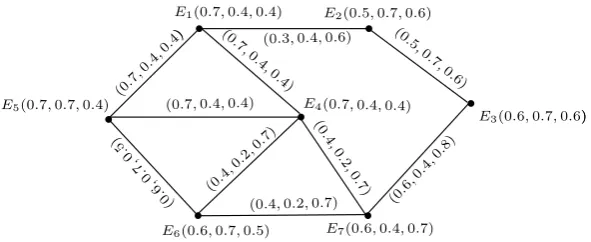
The line graph L(H) of single-valued neutrosophic hypergraph H is L(H) = (A, B), where
(E4E7,0.4,0.2,0.7),(E5E6,0.6,0.7,0.5),(E6E7,0.4,0.2,0.7)} is the edge set of the
single-valued neutrosophic line graph ofH.
E1(0.7,0.4,0.4) E2(0.5,0.7,0.6)
E4(0.7,0.4,0.4)
E5(0.7,0.7,0.4)
E7(0.6,0.4,0.7)
E6(0.6,0.7,0.5)
E3(0.6,0.7,0.6)
b b
b b
(0.7 ,0.4
,0. 4)
b
b
b
(0 . 6 , 0 . 7 , 0 . 5)
(0. 7,
0. 4,
0. 4)
(0. 5,
0. 7,
0. 6)
(0.6
,0.
4,0
.8)
(0. 4,
0. 2,
0. 7)
(0.4
,0.2 ,0.7)
(0.7,0.4,0.4)
(0.4,0.2,0.7)
(0.3,0.4,0.6)
Figure 3. Single-valued neutrosophic line graph L(H) of single-valued neutrosophic hypergraph H.
Proposition 2.5. A single-valued neutrosophic hypergraph is connected if and only if line graph of a single-valued neutrosophic hypergraph is connected.
Definition 2.21. The 2−section of a single-valued neutrosophic hypergraph H = (V,E), denoted by [H]2, is a single-valued neutrosophic graph G= (A, B), where A is the
single-valued neutrosophic vertex ofV,B is the single-valued neutrosophic edge set in which any two vertices form an edge if they are in the same single-valued neutrosophic hyperedge such that
TB(e) = min{TEk(vi), TEk(vj)},
IB(e) = min{IEk(vi), TEk(vj)},
FB(e) = max{FEk(vi), FEk(vj)},
for allEk∈E, i6=j, k= 1,2,· · ·, m.
We now introduce the concept of dual single-valued neutrosophic hypergraph for a single-valued neutrosophic hypergraph.
Definition 2.22. The dual of a single-valued neutrosophic hypergraph H = (V,E) is a single-valued neutrosophic hypergraph H∗ = (E,V); E = {e1, e2,· · · , en} set of vertices
corresponding toE1, E2, ,· · ·, En,respectively and V={V1, V2,· · ·, Vn} set of hyperedges
corresponding to v1, v2,· · · , vn, respectively.
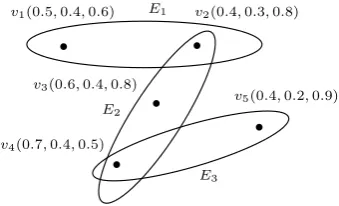
Example 2.6. Consider a single-valued neutrosophic hypergraph H = (V,E) such that
V ={v1, v2, v3, v4, v5}andE={E1, E2, E3}, whereE1 ={(v1,0.5,0.4,0.6),(v2,0.4,0.3,0.8)}, E2=
b b
b
b
b
v1(0.5,0.4,0.6) v2(0.4,0.3,0.8)
v3(0.6,0.4,0.8)
v4(0.7,0.4,0.5)
v5(0.4,0.2,0.9)
E1
E2
E3
Figure 4. Single-valued neutrosophic hypergraph.
The single-valued neutrosophic hypergraph can be represented by the following incidence matrix:
MH E1 E2 E3
v1 (0.5,0.4,0.6) (0,0,0) (0,0,0)
v2 (0.4,0.3,0.8) (0.4,0.3,0.8) (0,0,0)
v3 (0,0,0) (0.6,0.4,0.8) (0,0,0)
v4 (0,0,0) (0.7,0.4,0.5) (0.7,0.4,0.5)
v5 (0,0,0) (0,0,0) (0.4,0.2,0.9)
Consider the dual single-valued neutrosophic hypergraph H∗ = (E,V) of H such that
E={e1, e2, e3},V={V1, V2, V3, V4, V5},whereV1 ={(e1,0.5,0.4,0.6),(e2,0,0,0),(e3,0,0,0)},
V2 ={(e1,0.4,0.3,0.8),(e2,0.4,0.3,0.8),(e3,0,0,0)},V3={(e1,0,0,0),(e2,0.6,0.4,0.8),(e3,0,0,0)},
V4 ={(e1,0,0,0),(e2,0.7,0.4,0.5),(e3,0.7,0.4,0.5)}andV5={(e1,0,0,0),(e2,0,0,0),(e3,0.4,0.2, 0.9)}.
b
e1 e2
b
e3
b
V1
V3
V5
V2 V
4
Figure 5. Dual single-valued neutrosophic hypergraph H∗.
The dual single-valued neutrosophic hypergraph is shown in Figure. 5 and its incidence matrixMH∗ is defined as follows:
MH∗ V1 V2 V3 V4 V5
e1 (0.5,0.4,0.6) (0.4,0.3,0.8) (0,0,0) (0,0,0) (0,0,0)
e2 (0,0,0) (0.4,0.3,0.8) (0.6,0.4,0.8) (0.7,0.4,0.5) (0,0,0)
e3 (0,0,0) (0,0,0) (0,0,0) (0.7,0.4,0.5) (0.4,0.2,0.9)
Remark 2.2. H∗ is a single-valued neutrosophic hypergraph whose incidence matrix is the transpose of the incidence matrix ofH and4(H) =rank(H∗). The dual single-valued
neutrosophic hypergraph H∗ of a simple single-valued neutrosophic hypergraph H may or
may not be simple.
Proof. Let H be a linear hypergraph. Assume that H∗ is not linear. There is two dis-tinct hyperedges Vi and Vj of H∗ which intersect with at least two vertices e1 and e2. The definition of duality implies that vi and vj belong to E1 and E2 (the single-valued neutrosophic hyperedges of H standing for the vertices e1, e2 of H∗ respectively) so H is not linear. Contradiction since H is linear. Hence dual H∗ of a linear single-valued neutrosophic hypergraph without isolated vertex is also linear single-valued neutrosophic
hypergraph.
Definition 2.23. Let H = (V,E) be a valued neutrosophic hypergraph. A
single-valued neutrosophic transversal τ of H is a single-valued neutrosophic subset of V with
the property thatτh(E)∩Eh(E)6=∅ for eachE ∈E, whereh(E) is the height of hyperedge
E. A minimal single-valued neutrosophic transversal τ for H is a transversal of H with
the property that ifτ0 ⊂τ, thenτ0 is not a single-valued neutrosophic transversal of H.
Proposition 2.7. Ifτ is a single-valued neutrosophic transversal of a single-valued neutro-sophic hypergraphH = (V,E), thenh(τ)> h(E) for eachE ∈E. Moreover, ifτ is a min-imal single-valued neutrosophic transversal of H, then h(τ) =∨{h(E) |E ∈E}=h(H).
Theorem 2.2. For a single-valued neutrosophic hypergraphH, T r(H)6=∅,where T r(H)
is the family of minimal single-valued neutrosophic transversal ofH.
Proposition 2.8. Let H = (V, E) be a single-valued neutrosophic hypergraph. The fol-lowing statements are equivalent:
(i) τ is a single-valued neutrosophic transversal of H
(ii) For each E ∈ E, h(E) = (r0, s0, t0), and each 0 < r ≤ r0,0 < s ≤ s0, t ≥ t0, τ(r,s,t)∩E(r,s,t)6=∅
If the (r, s, t)−cut τ(r,s,t) is a subset of the vertex set of H(r,s,t) for each (r, s, t), 0< r ≤
r0,0< s≤s0, t≥t0,then
(iii) For each (r, s, t), 0< r≤r0,0< s≤s0, t≥t0, τ(r,s,t) is a transversal of H(r,s,t)
(iv) Every single-valued neutrosophic transversal τ of H contains a single-valued
neu-trosophic transversal τ0 for each (r, s, t), 0< r≤r0,0< s≤s0, t≥t0, τ0(r,s,t) is a transversal of H(r,s,t)
Observation: If τ is a minimal transversal of single valued neutrosophic graph H, then τ(r,s,t) not necessarily belongs to T r(H(r,s,t)) for each (r, s, t), satisfying 0 < r ≤
r0,0< s ≤s0, t≥t0. Let T r∗(H) represents the collection of those minimal single valued neutrosophic transversal,τ ofH, whereτ(r,s,t)is a minimal transversal ofH(r,s,t), for each (r, s, t), 0< r≤r0,0< s ≤s0, t ≥t0, i.e., T r∗ ={τ ∈T r(H) | h(τ) =h(H) and τ(r,s,t)∈
T r(H(r,s,t))}.
Example 2.7. Consider the single-valued neutrosophic hypergraph H = (V,E), where V = {v1, v2, v3} and E = {E1, E2, E3}, which is represented by the following incidence
matrix:
MH E1 E2 E3
v1 (0.9,0.6,0.1) (0,0,0) (0.4,0.3,0.2)
v2 (0.4,0.3,0.2) (0.4,0.3,0.2) (0.4,0.3,0.2)
v3 (0,0,0) (0,0,0) (0.4,0.3,0.2)
Clearly, h(H) = (0.9,0.6,0.1), the only minimal transversal τ of single-valued neutro-sophic hypergraph H isτ(H) ={(v1,0.9,0.6,0.1),(v2,0.4,0.3,0.2)}. The fundamental
se-quence ofH isF(H) ={(0.9,0.6,0.1),(0.4,0.3,0.2)},τ(0.9,0.6,0.1)={v
1}andτ(0.4,0.3,0.2) =
{{v1, v2},{v2},{v1, v2, v3}}, it follows that the only minimal transversal τ of H is not a
member ofT r∗(H). Hence T r∗(H) =∅.
References
[1] Akram,M. and Dudek,W.A., (2013), Intuitionistic fuzzy hypergraphs with applications, Information Sciences, 218, pp.182-193.
[2] Akram,M. and Alshehri,N.O., (2015), Tempered interval-valued fuzzy hypergraphs, University po-litehnica of bucharest scientific bulletin-series a-applied mathematics and physics, 77, pp.39-48. [3] Atanassov,K.T., (1983), Intuitionistic fuzzy sets, VII ITKR’s Session, Deposed in Central for
Science-Technical Library of Bulgarian Academy of Sciences, 1697/84, Sofia, Bulgaria.
[4] Broumi,S., Talea,M., Bakali,A., and Smarandache,F., (2016), Single-valued neutrosophic graphs, Jour-nal of New theory, 10, pp.86-101.
[5] Chen,S.M., (1997), Interval-valued fuzzy hypergraph and fuzzy partition, IEEE Transactions on Sys-tems, Man, and Cybernetics, Part B (Cybernetics), 27(4), pp.725-733.
[6] Dhavaseelan,R., Vikramaprasad,R., and Krishnaraj,V., (2015), Certain types of neutrosophic graphs, Int Jr. Math. Sci. App., 5, pp.333-339.
[7] Kauffmann,A., (1973), Introduction a la theorie des sous-ensembles flous, 1, Masson.
[8] Lee-kwang,H. and Lee,L.M., (1995), Fuzzy hypergraph and fuzzy partition, IEEE Trans. Syst. Man Cybernet., 25, pp.196-201.
[9] Maji,P.K., (2012), A neutrosophic soft set approach to a decision making problem. Annals of Fuzzy Mathematics and Informatics, 3, pp.313-319.
[10] Majumdar,P. and Samanta,S.K., (2014), On similarity and entropy of neutrosophic sets, Journal of Intelligent and Fuzzy Systems, 26, pp.1245-1252.
[11] Mordeson,J.N. and Nair,P.S., (2001),Fuzzy graphs and fuzzy hypergraphs, Physica Verlag, Heidelberg. [12] Rosenfeld,A., (1975), Fuzzy graphs, fuzzy Sets and their Applications to Cognitive and Decision Processes (Proceeding of U.S.-Japan Sem., University of California, Berkeley, Calif, 1974) (L. A. Zadeh, K. S. Fu, and M. Shimura, eds.), Academic Press, New York, pp.77-95.
[13] Smarandache,F., (1998), Neutrosophy. Neutrosophic Probability, Set, and Logic, Amer. Res. Press, Rehoboth, USA, 105.
[14] Smarandache,F., (2005), Neutrosophic set, a generalization of the Intuitionistic Fuzzy Sets, Interna-tional Journal of Pure and Applied Mathematics, 24, pp.287-297.
[15] Wang,H., Smarandache,F., Zhang,Y., and Sunderraman,R., (2010), Single-valued neutrosophic sets, Multispace and Multistructure, 4, pp.410-413.
[16] Ye,J. (2014), Similarity measures between interval neutrosophic sets and their applications in multi-criteria decision-making. Journal of Intelligent and Fuzzy Systems, 26, pp.165-172.
[17] Zadeh,L.A., (1965), Fuzzy sets, Information and Control, 8, pp.338-353.
Sundas Shahzadihas submitted her Ph.D. dissertation for award of degree in the Department of Mathematics, University of the Punjab, Lahore Pakistan. She received her undergraduate as well as postgraduate degrees in mathematics from Bahauddin Zakariya University, Multan. She received her M.Phil degree in mathematics from University of the Punjab, Lahore. She received awards for academic excellence. Her current research interests include fuzzy graphs, neutrosophic graphs and its generaliza-tions. She has published 12 research articles in international peer-reviewed journals.