EMPEROR INTERNATIONAL JOURNAL OF
FINANCE AND MANAGEMENT RESEARCH
[EIJFMR]
ISSN : 2395-5929
Founder | Publisher | Editor Dr. R. MAYAKKANNAN, Assistant Professor of Commerce,
Sri Sankara Arts & Science College,
Enathur, Kanchipuram,
Tamilnadu, India. Chief Editor
Dr. C. THIRUCHELVAM,
Head & Associate Professor of Commerce H.H.The Rajah’s College (Autonomous),
Pudukkottai, Tamilnadu.
Volume-II Issue-03 March- 2016
Mayas Publication™
45/5, Unathur & Post, Attur Tk., Salem Dt. Tamilnadu, India – 636112
Emperor International Journal of Finance and Management Research [EIJFMR]
Published by
Mayas Publication™
# 45/5 Unathur. Post Attur. Tk, Salem. Dt Tamilnadu, India
Board of Editor’s
SCHOOL OF COMMERCE, MANAGEMENT, ECONOMICS
Dr.Balakrishnan
Department of International Business, Administration,
Nizwa College of Applied Science, Sultanate of Oman
Dr.Pratapsingh Chauhan
Dean and Syndicate Member, Saurashtra University, Rajkot, Gujarat. India
Dr.Kuppusamy Singaravelloo
Department of Administrative Studies and Politics,
Faculty of Economics and Administration,
University of Malaya, Malaysia.
Dr. Bharati Pathak
Professor, School of Commerce, Gujarat University, Ahmadabad, India
Dr. Mohan
Professor of Commerce,
Management and Information Sciences, Sri Venkateswara University, Thirupati, Andhra Pradesh, India
Dr.Meenu Meheshwari
Assistant Professor,
Department of Commerce and Management, University of Kota, Kota
Dr. G. Raju
Professor of Commerce,
School of Management Studies, University of Kerala
Thiruvanathapuram- 695 581 Kerala, India
Dr.Vijaya
Professor of Commerce, Gulbarga University, Gulbarga, Karnataka state
Dr. R. Periyasamy
Head & Assistant Professor, Department of Commerce,
Barathiyar University Constitutional College, Coimbatore, Tamilnadu, India
Dr.T.J.Arun
Associate Professor of Commerce, Annamalai University, Chidambaram, Tamilnadu,India.
www.eijfmr.com
[email protected]Chief Editor
Dr. C. THIRUCHELVAM,
Head & Associate Professor of Commerce
H.H.The Rajah’s College (Autonomous), Pudukkottai, Tamilnadu
Editor & Founder
Dr. R. MAYAKKANNAN,
Assistant Professor of Commerce,
Sri Sankara Arts & Science College,
Dr.A.Ravikumar
Associate Professor of Commerce, Bishop Heber College (Autonomous), Puttur, Trichy-17
Dr.N.Bharathidhasan
Assistant Professor in Commerce, Dr.Ambedkar Goverment Arts College (Autonomous),Vyasarpadi, Chennai. Tamilnadu
Dr.Leela
Professor of Commerce, T.S.Narayanaswami College, Chennai, Tamilnadu
Dr .K.Krishnamurthy
Assistant Professor of Commerce, Periyar Government Arts College,
Cuddalore
Dr. C. Saraswathy
Assistant Professor of Commerce, VELS University, Chennai, Tamilnadu
Dr. R. Mathavan
Assistant Professor of Commerce, Kandaswami Kandar’s College, P.Velur, Namakkal (DT) Tamilnadu
Dr. S.Prabhu
Head & Assistant Professor of Commerce Bharthi College of Arts and Science, Thanjavur -613 007 Tamilnadu
Dr.F.Elayaraja
HOD of Commerce TKU Arts College Karanthai, Thanjavur, Tamilnadu.
Dr. R. Hariharan
Associate Professor of Commerce, National College,
Trichy, Tamilnadu
Dr. L.Gomathy
Assistant Professor of Commerce, Agurchand Manmull Jain College, Meenambakkam, Chennai – 600114
Dr.S.Raju
Assistant Professor of Commerce A.V.V.M Sri Pushpam College (Autonomous)
Poondi-613503, Thanjavur.
Dr.V.Dheenadhayalan
Assistant Professor in Commerce, Annamalai University, Chidambaram.
Dr.Bama Sampath
Assistant Professor of Commerce Dr.Ambedkar Govt. Arts College Chennai-39.
Dr. R. Vasudevan
Assistant Professor in Corporate Secretary
Ship, D. G. Vaishnav College, Chennai
Dr.A.L.Mallika
Associate Professor and Head, Department of Management Studies, Mother Teresa Women’s University, Kodaikanal.
Dr. P. Uma Meheshwari
Assistant Professor of Economics Barathiyar University College, Coimbatore, Tamilnadu, India
Dr.Dhanalakshmi Acharya
Bangalore Business School, Andhrhalli Main Road, Bangalore
Dr.A.Vijaykanth
Assistant Professor of Economics, Dr.Ambedkar Government Arts College (Autonomous),
Dr. V. Rengarajan
Assistant Professor, Management Studies SASTRA University, Thanjavur.
Dr.Ramanathan,
Principal and Head,
Nethaji Subbash Chandra Bose College,
Tiruvaurur
Dr.P.Arunachalam
HOD , Department of applied Economics, Cochin University, Kerala.
Dr.S.R.Keshava
Professor of Economics
Bangalore University, Bangalore.
Dr.S.Chinnammai
Associate Professor of Economics, University of Madras, Chennai,
Dr.A.Ranga Reddy
Professor Emeritus,
Sri Venkateshwara University Andhra Pradesh.
Dr. V.Vijay Durga Prasad
Professor and Head Department of Management Studies
PSCMR College of Engineering and Technology
Kothapet, Vijayawada -520 001 A.P
Dr.A.Alagumalai
Associate Professor of Political Science, P.T.M.T.M.College Kamudhi, 623 604
Ch. Anjaneyulu
Assistant Professor
Department of Business Management Telangana University
Dichpally—Nizamabad, Telangana—India
Dr .Ishwara P
Professor in Commerce Department of Commerce, Mangalore University Karnataka
Dr.G.Parimalarani
Associate Professor
Department of Bank Management Alagappa University
Karaikudi, Tamilnadu
Dr.Rambabu Gopisetti
Chairman, Board of Studies in Commerce Department of Commerce
Telangana University Dichpally, Nizamabad Telangana State -503322
Ms.Bhagyshreehiremath
Assistant Professor of Economics
Indian Institute of Information Technology Dharwad
Prof.M.Yadagiri
Head & Dean
Faculty of Commerce Telangana University
Dichpally--Nizamabad--503322 Telangana State – India
Dr. C. Theerthalingam
Head & Assistant Professor of Economics, Government Arts College (Men),
Krishnagiri – 635001
Dr.G. Uppili Srinivasan,
SCHOOL OF COMPUTER SCIENCE, ENGINEERING & TECHNOLOGY
Prof. Naveen Kumar
Associate Professor
Department of Computer Science, University of Delhi, India-110007
Dr. Rakesh Kumar
Mandal Secretary, CSI, Siliguri Chapter Assistant Professor
School of Computer Science & Application North Bengal University P.O.
Darjeeling West Bengal – 734013
Dr. D. Roy Chowdhury
Assistant Professor
School of Computer Science & Application University of North Bengal
Dr. Ardhendu Mandal
Assistant Professor
School of Computer Science and Application
University of North Bengal (N.B.U)
Dr. Ms. Bhagyashree D. Hiremath
Assistant Professor
Department of Computer Science and Engineering
SCHOOL OF AGRICULTURAL & RURAL DEVELOPMENT AND EDUCATIONAL TECHNOLOGY, ENVIRONMENTAL SCIENCE
Dr.V.M.Indumathi
Assistant Professor
Dept. of Agricultural and Rural Management
Tamil Nadu Agricultural University, Coimbatore - 641 003
Dr. M.Mirunalini
Assistant Professor
Department of Educational Technology Bharathidasan University,
Khajamalai Campus Thruchirappalli – 620 023
Dr.S.Angles
Assistant Professor
Department of Agricultural Economics, Tamil Nadu Agricultural University, Coimbatore, Tamil Nadu, India Pin Code – 641003
Dr. K. Boomiraj
Assistant Professor
Department of Environmental Sciences, Tamil Nadu Agricultural University, Coimbatore- 3.
R.Ganesan
Professor and Head, Department of English, Kongu Engineering College,
Perundurai--638 052
Prof. V.Murugaiyan
Assistant Professor
Post Graduate & Research Department of History
H.H.Rajah’s College, Pudukottai.
Dr.P.Bamalin
Assistant Professor of English
Sri Bharathi Arts & Science College for Women
SCHOOL OF MATHEMATICS, PHYSIC, EARTH SCIENCE, BOTANY, CHEMISTRY, MOLECULAR BIOLOGY, ZOOLOGY
Dr. P.K. Omana
Scientist
Ministry of Earth System Science, Government of India
National Centre for Earth Science Studies, Trivandrum, Kerala
Dr. S. Loghambal
Assistant professor
Department of Mathematics V V College of Engineering Tisaiyanvilai – 627 657
Tamil Nadu, South India
Dr. M.Kumaresan
Professor and Head Department of Chemistry,
Erode Sengunthar Engineering College, Perundurai, Erode, Tamilnadu
Dr. Pradip Sarawade
Assistant Professor, School of Physics
University of Mumbai.
Mumbai-400098 India
Prof.B.Vidya vardhini
Professor in Botany
Principal, University College of Science Head, Department of Botany
Telangana University
Dichpally, 503322 Nizamabad Andhra Pradesh, India
Dr. Dhiraj Saha,
Assistant Professor (Senior Scale),
Insect Biochemistry and Molecular Biology Laboratory,
Department of Zoology, University of North
Bengal,
Dr.Biju V
Assistant Professor of Mathematics, College of Natural & Computational Sciences,
Debre Markos University,
Federal Democratic Republic of Ethiopia
Dr.S.Priyan
Assistant Professor,
Department of Mathematics,
MepcoSchlenk Engineering College, Virudhunagar- 626 005
Dr. M. Aruna
Associate Professor & Head Department of Botany Telangana University
Emperor International Journal of Finance and Management Research [EIJFMR] ISSN: 2395-5929
Emperor International Journal of Finance and Management Research [EIJFMR] ISSN: 2395-5929 Page 22
A STUDY ON CUSTOMER INFORMATION WITH REFERENCE TO VIRTUAL BANKING SERVICES IN CHENNAI CITY
Mr. S.GOPINATHAN
Assistant Professor of Business Administration, Sri Sankara Arts and Science College,
Enathur, Kanchipuram
Abstract
Indian Banking industry is witnessing a
supreme opposition. To stay ahead, banks
are coming up with buildup of services to
attract customers. Services including
24-hours banking, Service at entrance step,
Telephone banking, Internet banking,
Extended Business Hours (EBH), With
convenience, speed, competence and
efficiency, these virtual banks, in effect
have opened up a new world of
possibilities and brought major changes in
providing a broad range of services.
Virtual banks are currently seen as a
response with respect to the confront of
design a new service channel that is fully
secure, useful and which customers can
with pleasure learn to use and trust it.
Virtual banking, a powerful "value added"
tool, has become the important tool for
banks to draw and keep customers.
Though, the aim of these services is to
satisfy customers, there is a need to
understand customer awareness,
observation and the level of maintaining it.
In the present
Research work, attempts are made to
measure these issues on four virtual
banking services existing in the city banks.
Keywords: telephone banking, internet
banking, extended business hours
Introduction
The aim of virtual banking services is to
satisfy customers, present is a want to
know customer attentiveness, awareness
and significantly the level of satisfaction.
In the present research work, attempts are
made to determine the satisfaction level on
four virtual banking services offered by
banks customers of Chennai city only.
These services include Automated Teller
Machine (ATM), Telephone Banking,
Internet Banking and Integrated Voice
Response System (IVRS).
Objective of the Study
The objectives of this study are as follows
1. To measure the customers' knowledge
and perception and the level of
fulfillment with consideration to
virtual banking services presented by
the banks in Chennai city of
Emperor International Journal of Finance and Management Research [EIJFMR] ISSN: 2395-5929
Emperor International Journal of Finance and Management Research [EIJFMR] ISSN: 2395-5929 Page 23 2. The present study aims to explore the
major factors responsible for virtual
banking based on respondents’
perception on various virtual banking
services.
Period of the Study
The study period is based on the secondary
data collection from various available
sources and from primary sources through
a well-designed questionnaire. So the
period of study differs from the data
collection point of view. Minimum ten
years of data and information was
collected through feedback instant
questionnaire for an empirical research
work.
Data Collection
Two types of data were collected for
study, such as primary and secondary.
Primary data collection was entirely based
on feedbacks from the sample respondents
through a questionnaire. The mode of
collection of data from secondary sources
would be backed by available sources like
journals, magazines, articles, news papers,
periodicals, and from relevant useful
websites. For primary data collection a
20-item 3-point Likert scale was developed.
Items in the questionnaire covered four
important services i.e., Internet Banking,
Mobile Banking, Telephone Banking,
IVRS, and ATM services offered by
Indian banks. The questionnaire was
administered inside the banks’ branch
premises. To maintain the heterogeneity in
the sample, two different time periods in a
day, morning and evening hours were
chosen. Sample size for the study is 75
among them only 50 samples were found
suitable for this study. The collection of
data began in the month of July 2014 and
was completed in November 2014.
Scope of the Study
The scope of the study is to fill the gap in
the literature by focusing on the
customer’s preferences for
virtual-banking. Findings of this study will be
useful for the banking segment in
assessing the force of virtual banking, in
order to formulating suitable strategies for
structure customers’ reliability thereby
enabling them to retain customers.
Limitations of the Study
Like other researches, this study suffers
from the following limitations that should
be considered carefully at the time of
generalizing the findings of the study:
Sample size is restricted only to Chennai
city. The sample size may not adequately
represent the national market. Another
limitation is the study has use of only
quantitative data to validate the study,
excluding the qualitative data score. Many
of the customers are not using virtual
banking facilities till date or not aware of
it. Time factor is a vital constraint in the
Emperor International Journal of Finance and Management Research [EIJFMR] ISSN: 2395-5929
Emperor International Journal of Finance and Management Research [EIJFMR] ISSN: 2395-5929 Page 24
Data Analysis
In this study various factors like age,
monthly income, qualification, nature of
employment determined to know the
overall idea about the users of the virtual
banking services.
Table 1
Users of virtual banking services as per various parameters
Age Education Gender Occupation
Mean 2.44 2.18 1.3 3.16 Median 2.00 2.00 1.00 3.0 Std.D 1.19 .774 .478 1.29 Sk .555 .496 .697 -.06 Error .337 .337 .337 .337 The study revealed that age, income, qualification and nature of employment play an important role in usage of virtual banking services. From the table it can be concluded that the age group between 25 years to 35 years are the main users of virtual banking. The monthly average income of virtual banking users is between Rs. 15000 to Rs. 25000.The users of the virtual banking customers are mainly graduates and post graduates. The service holders are mainly the users of the virtual banking.
Table - 2
Awareness about the various virtual banking services by the respondents
Freque ncy Percen t Valid % Internet Banking 1 2.0 2.0 Mobile Banking 10 20.0 20.0
Telephone Banking 15 30.0 30.0
24 hours banking 15 30.0 30.0
Debit cum ATM 9 18.0 18.0
Total 50 100.0 100.0
Sources: primary data
Hypothesis Testing
Two hypotheses were framed for the
study about the level of satisfaction about
virtual banking: H0 = Customers are not
satisfied with the virtual banking services;
H1 = Customers are satisfied with the
virtual banking services. A questionnaire
comprising 50 questions about the level of
satisfaction of the virtual banking services
rendered by various commercial banks was
prepared and 75 respondents were asked to
rank these questions on a 3-point Likert
scale of one to three. Very satisfied is
ranked three, followed by satisfied, not
satisfied with two and one respectively.
Out of 75samples only 50 samples were
used for the purpose of study as many of
samples are invalid for the purpose of
study.
Table -3
Collection of samples from various stations
Station Bank details
N Vali d Inv alid Medical College Indian Bank
15 12 03
Old bus stand
SBI Bank
13 08 05
New bus stand
ICICI Bank
20 11 09
Balaji nagar
Canara Bank
15 09 06
Kela vassal HDFC Bank
12 10 02
Total 75 50 25
Sources: primary data
Table- 3 exhibits the true structure of data
collection process which is taken as the
base for drawing the empirical concluding
Emperor International Journal of Finance and Management Research [EIJFMR] ISSN: 2395-5929
Emperor International Journal of Finance and Management Research [EIJFMR] ISSN: 2395-5929 Page 25 scientific statistical tool like Chi -square
test. The reason behind selection of that
specific tool is to underlined on the
standard belief of testing the hypothesis
already drawn in the methodology.
Table 4
Level of the customers Satisfaction Frequency Perce
nt
Valid %
Valid
Very Satisfied 15 30.0 30.0 Satisfied 17 34.0 34.0 not Satisfied 18 36.0 36.0 Total 50 100.0 100.0 The above table shows the various reasons
of satisfaction / dissatisfaction regarding
virtual banking service
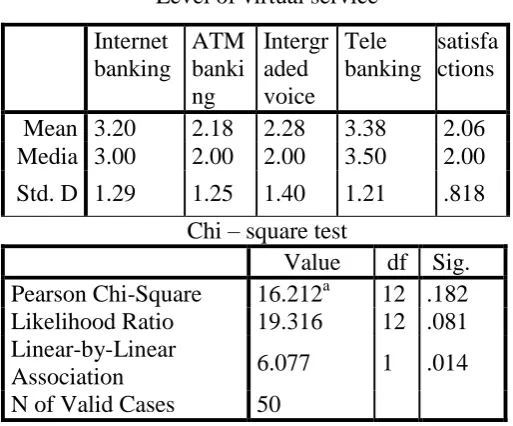
Level of virtual service
Internet banking ATM banki ng Intergr aded voice Tele banking satisfa ctions
Mean 3.20 2.18 2.28 3.38 2.06 Media 3.00 2.00 2.00 3.50 2.00
Std. D 1.29 1.25 1.40 1.21 .818
Chi – square test
Value df Sig. Pearson Chi-Square 16.212a 12 .182 Likelihood Ratio 19.316 12 .081 Linear-by-Linear
Association 6.077 1 .014 N of Valid Cases 50
Table-4 shows the number of parameters fall
under each level of satisfaction i.e. very
satisfied, satisfied and not satisfied/lowest
satisfied respectively. Now we have to test
the hypothesis by the statistical tool χ2
(Chi-square test) at 5% level of significance that
whether customers are satisfied/not satisfied
with the virtual banking services offered by
various commercial banks
Suggestions
Now a day the public sector banks also
introducing various virtual banking
services in order to be contention with the
private sector banks because a large
section of Indian population still trusts the
public sector banks for their day to day
banking activities. In case of the
consumers who don’t use virtual banking
services, having all facilities at their
disposal, technology is not the biggest
issue. Even though these groups are liable
towards the manual banking, these can be
crooked to prospective customers, it is
well proven thing, which says the
surrounding influences the individual’s
behavior or in India only environment that
surrounds the public determines the
behavior and decisions of the persons. So
situation of consumer sees the majority of
their generation or friends who surround
him using virtual banking then it may
influence their decision to follow virtual
banking option.
Conclusion
Thus from the above study it is evident
that due to the increase in various virtual
banking services provided by banking
sector, the satisfaction level of customers
increases day by day. Banks should
introduce various innovative ways of
virtual banking services in order to retain
Emperor International Journal of Finance and Management Research [EIJFMR] ISSN: 2395-5929
Emperor International Journal of Finance and Management Research [EIJFMR] ISSN: 2395-5929 Page 26 level. At the same time there is the need
that private sector banks should review
their charges and rationalize them so that
customers start getting the various virtual
banking services at reasonable rates.
Customer orientation through various
innovative ways of virtual banking
services is the need of the hour. When this
is made possible, even the ultimate
profitability of the banks will rise. Thus
overall satisfaction of customers,
employees and banks will reach the higher
level. When investigating all the variables
and the response by consumers, we can
say that the perception of the consumers
may be misused by awakening program,
forthcoming usage, less charges, proper
safety measures, and the best comeback to
the services offered.
Reference
1. Business World, the Marketing White
book 2010-2011
2. Rinku Chaudri “ customer service as a
source of competitive advantage”
insurance chronicle, may 2002,p 10
3. Mirchandani, Rahul (2006), “Evolving a