Available Online at www.ijpret.com 791
INTERNATIONAL JOURNAL OF PURE AND
APPLIED RESEARCH IN ENGINEERING AND
TECHNOLOGY
A PATH FOR HORIZING YOUR INNOVATIVE WORK
IMAGE PROCESSING IN INDUSTRIAL ROBOTICS USING MATLAB
VIREN PEREIRA1, ANKUR NAUSO KEPKAR2, CLINCIO JOYLON DIAS2, JOYLEN ASHLEY DA’SILVA2, SHARON LOREEN DIAS2
1. Dept. of General Engineering, Shree Rayeshwar Institute of Engineering & Information Technology, Shiroda - Goa – India.
2. Dept. of Electronics & Telecommunication Engineering, Shree Rayeshwar Institute of Engineering & Information Technology, Shiroda - Goa – India.
Accepted Date: 05/03/2015; Published Date: 01/05/2015
\
Abstract: In today’s world Image processing grabs massive attentions as it leads to possibilities to Broaden application in many fields of high technology. The major objective is to improve existing sorting system application which consists of two integrated stations of processing and handling with new image processing feature. Also many times we come across situations where in the count of some products could be compromised. Here is one solution for such a problem which minimizes the chances of the count value being tampered. Our paper aims in developing a classification and counting system for products being manufactured by the industry. We make use of image processing in MATLAB for developing such a system. Also we will use proximity sensors to avoid false count.
Keywords: ATmega32; relay; TSOP sensor; Image Processing ; MATLAB
Corresponding Author: MR. VIREN PEREIRA
Access Online On:
www.ijpret.com
How to Cite This Article:
Viren Pereira, IJPRET, 2015; Volume 3 (9): 791-799
Available Online at www.ijpret.com 792 As the purpose of our project is for counting, quality checking and correlating products, there is no better method than digital image processing for the same. This method can be implemented by using MATLAB. MATLAB is a high level language and provides interactive environment for numerical computation, visualization and programming, you can analyze data, develop algorithm and create models and applications. Much progress has been made in developing robust algorithm and technology to transfer such image analysis from theory to successful automated system for various applications.
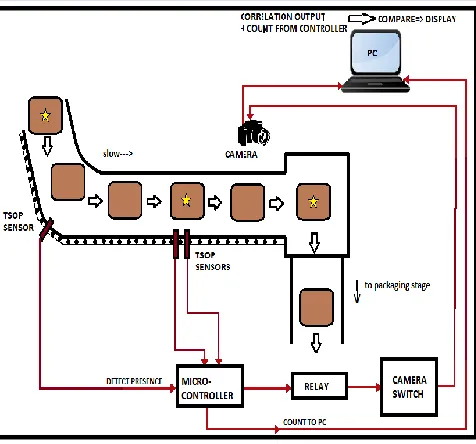
By using digital image processing by MATLAB we can help in the counting mechanism on conveyor system that are manufactured at very high rate and thus reject the defective products with the use of sensor technology and controlling unit. Our paper’s main focus is on this concept.
Since there is a lot of advancement in technological field companies need to be in par with the demand. So such kind of methods that involve correlation as well as counting mechanism are constantly in use.
HARDWARE
Available Online at www.ijpret.com 793
Figure 1. Entire setup
o TSOP Sensor
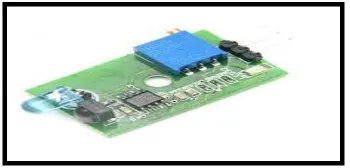
In any production company the number of output products needs to be counted before verifying and packaging, so technologically advanced industry would employ sensors to do the counting instead of manual counting. A general purpose sensor which are employed in most industries are Infrared sensors. The sensor we would be using the Infrared TSOP (Thin Small Outline Package) sensors. Usually it is used for collision detection or obstacle detection. The module consists of an Infrared emitter and a TSOP receiver. It has edge over the other sensors for being precise, detecting signal of fixed frequency and have internal filter for Pulse Code Modulation (PCM) frequency.
There is also an onboard LED (Light Emitting Diode) Indicator, that helps to check the status of sensor without using any additional hardware and hence the power consumption of this sensor module is low. This sensor is basically a photodetector and preamplifier stacked in one package. The sensor has an advantage of high immunity against ambient light such as in a room where the light intensity is low and deteriorates with time, and also compatible with Transistor Logic (TTL) And Complementary Metal Oxide Semiconductor (CMOS) and transmits continuous data up to 2400 bps.
Available Online at www.ijpret.com 794
Figure 2. TSOP Sensor
o ATmega32 Microcontroller
A general purpose microcontroller such as ATmega32 can be made to use .ATmega32 is an 8 bit high performance microcontroller of Atmel Mega AVR family. It is based on Reduced Instruction Set Computer (RISC) which have leverage over the Computer Instruction Set computer (CISC) architecture microcontroller. ATmega32 can work on maximum frequency of 16 MHz .It is mostly used than other microcontroller because of its high performance, low power and also because of its high endurance, non volatile memory segments .Some of the features it holds are
a) 131 powerful Instructions
b) 32*8 General purpose register
c) 32 kb of in system self programmable flash program memory
d) 1024 Bytes EEPROM
e) 2 kb of Internal SRAM
Moreover this microcontroller is demand of its
a) Ease of availability
b) Inexpensive
Available Online at www.ijpret.com 795
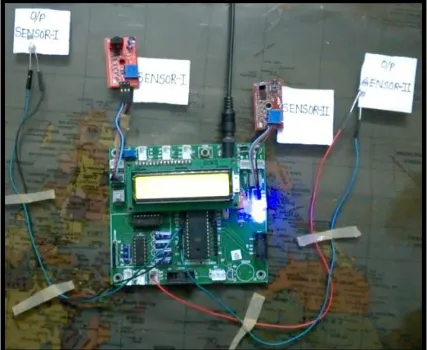
Figure 3. Microcontroller sensor connections
o Working of Hardware
Available Online at www.ijpret.com 796
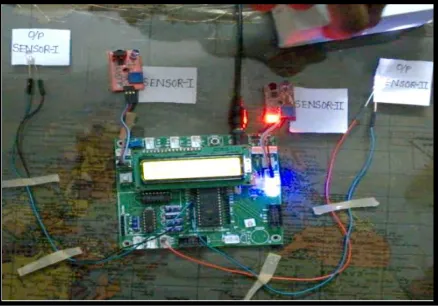
Figure 4. Output when sensor 1 triggered
Figure 5. Output when sensor 2 triggered
SOFTWARE
The software aspect plays a crucial role. Instead of just mere counting we provide flexibility to classify, verify the count or maybe to also perform analysis for quality checking and so on as desired. For this we make use of MATLAB software. MATLAB is a software package for high-performance numerical computation and visualization. It provides an interactive environment with hundreds of built-in functions for technical computation, graphics, and animation. It also provides easy extensibility with its own high-level programming language.
Available Online at www.ijpret.com 797
o Image Database
The first step towards the image processing is the need of database management. The best thing about MATLAB is that it does not require other software for a database management. It is done by MATLAB itself. Any data placed into the MATLAB folder of its current directory can be accessed directly by MATLAB. Any other location needs to be specified by the path. While creating the database we take good quality precise images as per desired qualities needed for match as default images.
We make use of the following algorithm in order to read both the default database images and images taken into MATLAB:
Set the path into a variable
Load all the details of the images into a structure
Get total number of images using length() function
Create 2cell arrays of length of image numbers
Read all images using the imread() function
Depending on if the images are taken in grayscale or RGB we will add another step in the algorithm to convert the images to grayscale using rgb2gray().
o Classifying the images
Using the Image Processing Toolbox for classifying the images we use the corr2 function which calculates the two-dimensional correlation coefficient value. Basically it will compare two images and return a value between zero and one which tells us how similar the images are.
Its syntax is given as below:
R=corr2(A,B)
r = corr2(A,B) returns the correlation coefficient r between A and B, which are called matrices or vectors of the same size. r is a scalar double.
Available Online at www.ijpret.com 798 Using this function we match the image taken to one of the database images so as to identify the image and classify it and count each category.
Corr2 is 2-D correlation coefficient function hence the inputs to his function needs to be a two dimensional matrix of equal sizes.
The following algorithm depicts how we go about the above.
Create a cell array to store the correlation values.
Run a loop for the number of images taken
i. Take the first image as A
ii. Run loop for the number of default images
a. Take the first default image as B
b. Check if the answer is greater than 0.9
c. Increment count of the particular category
d. Break to the next taken image
e. Else, continue to next default image
f. Repeat b.
Run loop and calculate the total number of images and compare with the count obtained by
the hardware section.
We create a GUI (Graphical user interface) for the same for easier execution of code.
Available Online at www.ijpret.com 799 The verification of the count of the microcontroller and MATLAB correlation results is in order to thwart away with any false taken images or any error whiles comparing. Since we cannot have real time count values transferred to MATLAB, we obtain the final count of the shift. The obtaining of count from microcontroller and execution of the code is done using a GUI created for easier use and avoid tampering of the code.
RESULTS & DISCUSSION
Thus we will be able to compare and correlate images of the product in order to classify them by their category. To count the number of products in each category by electronic means. To do away with any tampering or false count being delivered. Hence by this we ease the work of the supervisors monitoring the job process. Also by this we will be able to detect any errors made in the production process.
FUTURE SCOPE
The scope of this paper extends to different applications by altering the database as desired for different industrial applications. In Automated Industries it can be used as carter with no human operator. One can also detect objects for various purposes and also where human reach is not possible. Since image processing technique is adaptable it can be used in all current, developing industries.
REFERENCES
1. Object sorting system in matlab using robotic arm - Monal S. Telgote, Ganesh S. Sable
2. Design and Development of 5"DOF Color Sorting Manipulator for Industrial Applications - Atef. A. Ata, Sohair F.Rezeka
3. http://www.mathworks.com/products/matlab/description1.html, retrieved on 10 March, 2011.