Available Online at www.ijpret.com 656
INTERNATIONAL JOURNAL OF PURE AND
APPLIED RESEARCH IN ENGINEERING
AND TECHNOLOGY
A PATH FOR HORIZING YOUR INNOVATIVE WORK
A REVIEW ON UNAUTHORISED OBJECT DETECTION USING IR RADAR
ADITYA A. AWAGHATE, TANMAY V. SAKHARE, ABHIJEET V. TELKHADE, PRIYANKA S. THAKARE, KOMAL V. YAWALE, RASHMI M. JUNGHARE, PROF. P. M. MASLEY
1. P.G student, E&TC department MGI-COET Shegaon. 2. Faculty Member, E&TC department MGI-COET Shegaon.
Accepted Date: 15/03/2016; Published Date: 01/05/2016
\
Abstract-This paper describes the infrared radar to measure the angle of the object located at the medium. Data received by the IR sensor that is fully controlled by Arduino as a microcontroller. Arduino is an open source prototyping platform based on easy to use hardware and software. We propose to simulate this concept using Infrared technology. Our system consists of an IR sensor radar that rotates constantly at 180 degrees. The radar constantly emits IR rays and measure reflection. On detecting reflection from any object within its range the radar records angle at which the object is detected. We here use a small IR transmitter receiver pair. The pair is interfaced with arduino to control the circuit working. The microcontroller constantly receives the input from IR receiver. The Arduino now gets the data in the form angle of object. Radar is used in airports as well as military bases for unauthorized object detection. IR radar work on the principle of reflected signal received by the IR sensor in order to detect objects. In air the reflection of IR waves is measured on the basis of time taken to receive the signal. Based on this data object angle is detected.
Keywords: Infrared radar, sensor, automotive radar, Arduino and object detection.
Corresponding Author: MS. ADITYA A. AWAGHATE
Access Online On:
www.ijpret.com
How to Cite This Article:
Aditya A. Awaghate, IJPRET, 2016; Volume 4 (9): 656-662
Available Online at www.ijpret.com 657 INTRODUCTION
In this system detection and recognitions of ground as well as air objects is done using IR radar. The focus has been on detection and recognition of unauthorized objects i.e. unauthorized airplanes, vehicles in outdoor scenes [1]. Military electronic systems are usually designed to perform such function as general surveillance, identification, detection, and communications. Radar is an object detection system that uses radio waves to determine the range, angle, or velocity of objects. It can be used to detect aircraft, ships, spacecraft, guided missiles, motor vehicles, weather formations, and terrain radar transmits radio waves or microwaves that reflect from any object in their path. Radar was secretly developed by several nations in the period before and during World War II. The term RADAR was coined in 1940 by the United States Navy as an acronym for Radio Detection and Ranging.[4].The modern uses of radar are highly diverse, including air and terrestrial traffic control, radar astronomy, air defence systems, antimissile systems; marine radars to locate landmarks and other ships; aircraft anti-collision systems; ocean surveillance systems, outer meteorological precipitation monitoring; altimetry and flight control systems; ground penetrating radar for geological observations; and range controlled radar for public.[4] High tech radar systems are associated with digital signal processing, machine learning and are capable of extracting useful information from very high noise levels. More precise definition of radar is that it ions an electromagnetic system for detection, location and sometimes for recognition of target objects, which operates by transmitting electromagnetic signals, receiving echoes from target objects within its volume of converge, and extracting location and other information from the echo signals. IR radar is an application of automotive radar, where this type of pulse radar is operating by sending short pulse to make scanning. Actually with small range (don’t offer more than 1.5 meter). The goal of this proper is to create a working IR radar system to detect close proximity targets at an angle of 180 degrees, with range (10-80cm) [1].
LITERATURE REVIEW:
then-under-Available Online at www.ijpret.com 658
development Next Generation Weather Radar (NEXRAD) and included analyses of ground-clutter suppression requirements [13] and experimental evaluation of Doppler spectrum based turbulence estimators [14]. In response to a series of commercial aviation accidents caused by low-altitude wind shear, the Federal Aviation Administration (FAA) initiated a fast-track program to develop a Terminal Doppler Weather Radar (TDWR) that detects and warns against this hazard at major airports. The Laboratory’s role in developing detection algorithms for TDWR, demonstrating these operationally on a transportable testbed, and transferring key technology elements to industry was critical to the successful deployment of this system [15]. A complementary wind-shear detection system utilizing deployed Airport Surveillance Radars (ASR-9) was developed by the Laboratory [16]
PROPOSED SYSTEM:
WHY IR RADAR?
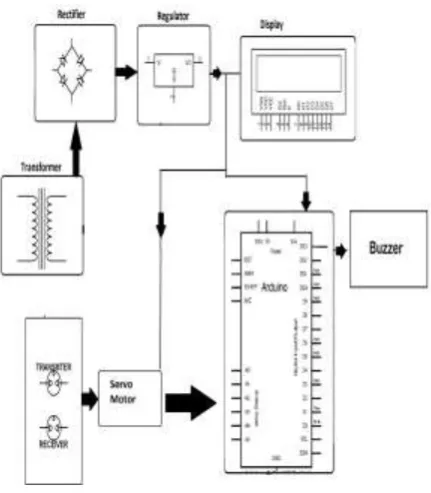
Available Online at www.ijpret.com 659 Fig (1):- Schematic Block Diagram
The key to successful development of radar system for many of the applications lies in harnessing the basic technologies involved in the modern radar system design. [4]. Target localization and tracking, the common key technology. The servo motor will be turned on with instruction to rotate 180 by arduino. Servo motor will drive the IR sensor this sensor consists of emitter and detector. The emitter will send an infrared signal to detect an object. When this signal hits the object, the signal will be reflected back to detector. Then the detector will send analog signal with suitable voltage and angle. Arduino is simple and accessible. Arduino has been used in thousands of different projects and applications. The Arduino software is easy-to-use for beginners. Arduino is used to build low cost scientific instruments. The main feature of
Arduino is we can program it over and over. The messy details of microcontroller programming is wrap up inside Arduino which makes it an easy to use package for anyone.
WORKING MODEL:
In the system input AC supply is provided to step down transformer which reduce the given input AC supply to some extent which is further given to rectifier to get converted from AC input to DC the output of the given rectifier is followed by regulator to provide constant DC supply which is further divided into various section such as LCD display which will display output after the object is detected another output of regulator is given to servo motor which will remain continuously in motion in 180o. The emitter will send an infrared
Available Online at www.ijpret.com 660
output whether the object is detected or not, using LCD display. If the object is detected the output is displayed showing the angle at which the object is detected.
Fig (2) : The Hardware Connection of Our Designed system ADVANTAGES:
1. The system is used to detect unauthorised objects in protected geographical area.
2. We can measure the angle of detected object which concludes the direction of that object.
3. Accurate detection even of small object.
4. System operates in real time and detect movement, making them ideal for security purposes.
5. IR Radar Sensors are active systems that are not affected by weather conditions.
LIMITATIONS:
1. The effectiveness of system can be degraded by many factors including the presence of noise and blurring due to fundamental physical effects.
2. Target can be detected in only 180o horizontal plane.
3. Only one object is been detected and result is shown at a time.
CONCLUSION:
IR Radar is an application of automotive radar, where this type of pulse radar is operating by sending short pulse to make scanning. The goal of this project is to create working IR Radar system to DETECT close proximity targets in its RANGE.
FUTURE SCOPE:
Forward looking infrared (FLIR) cameras, typically used on military and civilian aircraft, use a thermo graphic cameras the senses infrared radiation.
The sensors installed in forward-looking infrared cameras as well as those of other thermal imaging cameras use detection of infrared radiation, typically emitted from a heat source (thermal radiation), to create a “picture” assembled for video output.
Available Online at www.ijpret.com 661
REFERENCES:
1. “Yahya S. H. Khraisat ” Contemporary Engineering Sciences, Vol. 5, 2012, no. 3, 111 – 117
2. An INTRODUCTION TO RADAR by Merrill I. Skolnik.
3. Infrared Technology and Applications XLI, 20–23 April 2015, Part of Proceedings of SPIE, Vol. 9451.
4. Bulletin of defence research & Development organisation VOL.21 No.2 April 2013
5. Wireless Sensor Network, 2010, 2, 173-185 doi:10.4236/wsn.2010.22023 published.Online,February.2010(http://www.SciRP.org/journal/wsn/)
6. Introduction to Radar By LOUIS N. RIDENOUR.
7. W. Herschel, “Experiments on the refrangibility invisible rays of the Sun,” Phil. Trans. Roy. Soc. London 90,284–292(1800).
8. Coolcmos.ipac.caltech.edu/sitemap.html#cosmicclassroom
9. E.S. Barr, “Historical survey of the early development of the infrared spectral region,” Amer. J. Phys. 28, 42–54 (1960).
10. R.A. Smith, F.E. Jones, and R.P. Chasmar, The Detection and Measurement of Infr red Radiation, Clarendon, Oxford,1958.
11. P.W. Kruse, L.D. McGlauchlin and R.B. McQuistan, Elements of Infrared Technology, Wiley, New York, 1962.
12. Baharuddin Mustapha, Aladin Zayegh, Rezaul K. Begg, “Ultrasonic and Infrared Sensors Performance in a Wireless Obstacle Detection System”
Available Online at www.ijpret.com 662
14. M. Labitt, “Coordinated Radar and Aircraft Observations of Turbulence,” Lincoln
Laboratory Project Report ATC-108
(20 May 1981).
15. J. Evans and D. Turnbull, “Development of an Automated Windshear Detection
System Using Doppler Weather Radar,”
Proc. IEEE 77 (11), 1989, pp. 1661–1673.