Journal of Caring Sciences, 2013
, 2(1), 11-18
doi: 10.5681/jcs.2013.002http:// journals.tbzmed.ac.ir/ JCS
* Corresponding Author: Mohamad Khajegodary (MSc), E-mail: [email protected]
This study was approved by the ethics committee of Tabriz University of Medical Sciences, Tabriz, Iran (ethical code: 9681; project number: 906;
Effect of Educational Program on Quality of Life of Patients with Heart
Failure: A Randomized Clinical Trial
Sima Lakdizaji1, Hadi Hassankhni1, Alireza Mohajjel Agdam1, Mohammad Khajegodary1*, RezvaniehSalehi2
1 Department of Medical Surgical Nursing, Faculty of Nursing and Midwifery, Tabriz University of Medical Sciences, Tabriz,
Iran
2Department of Cardiology, Faculty of Medicine, Tabriz University of Medical Sciences, Tabriz, Iran
ARTICLE INFO ABSTRACT
Article type: Original Article
Introduction: Heart failure is one of the most common cardiovascular diseases which decrease the quality of life. Most of the factors influencing the quality of life can be modified with educational interventions. Therefore, this study examined the impact of a continuous training program on quality of life of patients with heart failure.
Methods: This randomized clinical trial study was conducted during May to August 2011. Forty four participants with heart failure referred to Shahid Madani's polyclinics of Tabriz were selected through convenient sampling method and were randomly allocated to two groups. The intervention group (n = 22) received ongoing training including one-to-one teaching, counseling sessions and phone calls over 3 months. The control group (n = 22) received routine care program. Data on quality of life was collected using the Minnesota Living with Heart Failure Questionnaire at baseline as well as three months later. Results: The statistical tests showed significant differences in the physical, emotional dimensions and total quality of life in intervention group. But in control group, no significant differences were obtained. There was not any significant association in demographic characteristics and quality of life. Conclusion:
Ongoing training programs can be effective in improving quality of life of patients with heart failure. Hence applying ongoing educational program as a non-pharmacological intervention can help to improve the quality of life of these patients.
Article History: Received: 24 Jun. 2012 Accepted: 6 Sep. 2012 ePublished: 26 Feb.2013
Keywords: Education Quality of life Heart failure
Introduction
Heart failure (HF) is one of the most common chronic cardiovascular disorders with progressive and debilitating results. The prevalence of the HF has increased dramatically throughout the world over the last decade.1 Heart disease accounts for about
half of our country's mortalities.2 The
complex, progressive nature of HF often results in adverse outcomes. Heart failure causes multiple physical symptoms which lead to activity intolerance in patients and changes in life that affects their quality of life (QOL).3
Some studies have presented that 76.4% of patients with heart failure had relatively poor QOL and heart failure has a negative effect on QOL.4 Patients in class II and III
heart failure of New York Heart Association (NYHA) classification cannot normally do their daily activities. On the other hand the primary source of depression and poor QOL in these patients is due to the multiple
physical symptoms of the disease.5 With
It has been shown that continuous nursing educational and caring interventions are associated with less readmission. Since the hospital stay in these patients is associated with high economic costs, attention to strategies that promote QOL is critical to
reduce readmissions.7
One way to prevent frequent readmissions and improve positive health outcomes in patients with HF is to ensure that these patients have adequate knowledge and ability for self-care.7 Inadequate education of
patients and families are important risk factors in preventable re-hospitalization of these patients.8 The Heart Failure Society of
America has training modules for patients with heart failure, which offer guidance for
disease control, medication, self-care,
physical activity, feelings, tips for family and etc. The guidelines are simple and have clear explanation. Since the disease has effects on all aspects of the patient’s physical, psychological and social conditions, nurses should do more accurate planning by collecting comprehensive information about patients.
It is expected that patient training enhances quality of life; however, only a few studies have reported continuous teaching programs in heart failure. Some studies showed reduction in readmissions in HF patients with ongoing care.9 Therefore, it
was proposed to regard improvement of QOL for these patients as important duties of the nurses.
Despite numerous studies on QOL of patients with heart failure, its complexity and the extent of dimensions, demands new studies on the issue.10 In addition, much of
the previous researches were focused on HF symptom management and did not encompass a boarder view about continuous training. Therefore, studies about QOL could be seen in terms of reduced symptoms and cost effectiveness. This study was performed to determine the effect of ongoing training on QOL dimensions in patients with heart failure.
Materials and methods
This study was a randomized clinical trial, with the control group, registered in Iranian Registry of Clinical Trial (IRCT) and was approved by ethics committee of Tabriz University of Medical Science (Figure 1). Following determination of eligi- bility and
obtaining consent, using the www.
randomizer. org website, the participants who referred to the Tabriz Shahid Madani Heart Polyclinic from May to June 2011, were randomly assigned to control and inter- vention groups. Random allocation was performed by a person other than the researchers.
The sample size was estimated 14 for each group according to a pilot study on eligible subjects who fulfilled inclusion criteria, with α = 0.05, a power of 90%, [X (SD): 65.7 (3.3)] in quality of life. However, for more accuracy, 22 subjects were selected in each group (n = 44). The control group received usual care and training (n = 22) but the intervention group received usual care plus the three months ongoing training program (n = 22).
Inclusion criteria comprised of patients above 18 years of age, diagnosed with heart failure approved for at least one month by the cardiologist team, in class II or III heart failure of NYHA, literacy, ability to communicate, no acute medical problems or mental problems and no self-reported addiction. Exclusion criteria were unwillingness to continue the study and any medical problem during the training period. None of the participants was excluded during the study.
Eligible patients were given a detailed explanation regarding their follow up schedule. Interventions in this study was according to Heart Failure Society of America Modules included education related to control of heart failure, low salt regimen,
medicines, self-care, physical activity,
hospitals, to improve the awareness, prevention, treatment and recovery.
Within three months, the control group received only routine caring and teaching. But the intervention group first received one-to-one meeting for introducing the objectives of study, content of program and taking educational needs of participants and pretest. At the first appointment, each patient in the intervention group was given a booklet, entitled ‘How can I learn to live with heart failure’ based on modules, provided by the researcher.
Then home meeting happened every three weeks, took approximately one hour for reviewing previous goals and progression toward goals. To ensure between these meetings, a phone call were given to answer patients’ questions in the intervention group. After three months of training and follow-up, QOL questionnaire of participants were completed through self-report or structured interviews by the researcher (Figure 1).
9 weeks
12 weeks Phone contact
Home meeting for assessment of progression and training
Phone contact Allocation to intervention group
(n = 22) None excluded
Baseline
6 weeks 3 weeks
Home meeting for assessment of progression and training Home meeting for reviewing goals
and assessment of progress One-to-one interview:
Patient identification form, assessment form and MLWHFQ was applied as pretest.
- Booklet (control disease, diet, medicines, activity) was presented.
Phone contact
Randomized (n = 44)
MLWHFQ was applied as posttest
Allocation to control group (n = 22)
None excluded
One-on-one interview: Patient identification form, Assessment form and MLWHFQ was applied as pretest.
Routine caring and teaching was performed
MLWHFQ was applied as posttest
MLWHFQ: Minnesota Living with Heart Failure Questionnaire
Data was collected using a characteristic and physical information form and the Minnesota Living With Heart Failure Questionnaire (MLWHFQ). It contains 21 items using a 6-point (zero to five) Likert scale, with a maximum score of 105. The lower scores indicate better QOL. The instrument consists of three separate dimensions: physical, emotional and total score. Total score is used as the best measure of the impact on disease prevention and it is considered to measure the effects of
symptoms, functional limitations and
psychological distress on quality of life. The sum of responses reflects the overall effects of heart failure and treatments on individual’s quality of life.11
After forward-back translation process, validity of questionnaire was obtained by
content validity method. Reliability
calculated as the internal consistency responses of 20 patients who had inclusion criteria in which Cronbach's alpha was obtained 0.89.
Data was presented using descriptive statistics including frequency, percentage, mean with standard deviation (SD). Moreover, independent t-test, paired t-test, and ANOVA were used to compare the means. All analysis was performed in SPSS version 13 (SPSS, Inc., Chicago, IL, USA). In all tests, p-value less than 0.05 was considered statistically significant.
Ethical considerations
This study was approved by the Research Ethics Committee in Tabriz University of Medical Sciences. So to follow the ethical considerations, the researcher described the study objectives to the participants and
assured them for confidentiality of
information and they were free to leave the study. Moreover, the control group received routine caring and training.
Results
A total of 44 participants were enrolled in the
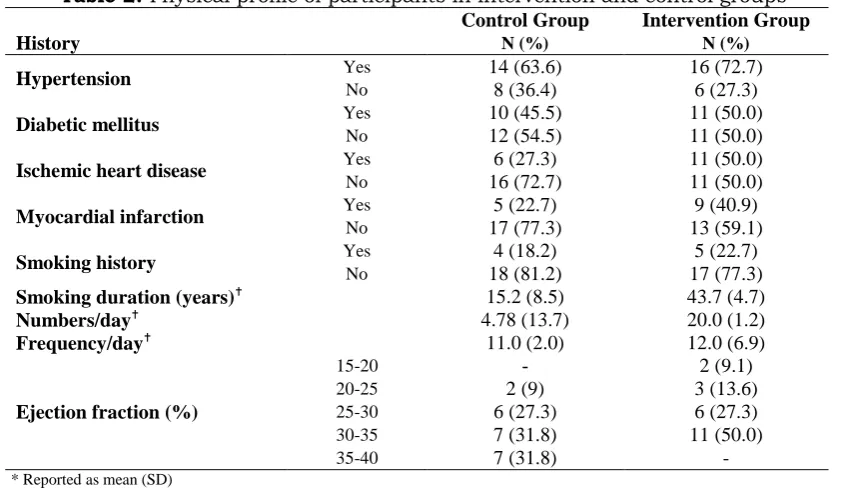
study. The majority of participants [25 (56.8%)] were male, 30 (68.2%) were married, and 21 (47.7%) lived with spouse and children. Most subjects [30 (68.2%)] were at elementary education level, 15 (34.1%) were self-employed and 25 (58.8%) reported low income. The mean age of participants was 61.7 ± 9.4 years and duration of HF was 34.5 ± 3.1 months. There were no statistically significant difference between experimental and control groups in terms of sex, marital status, lifestyle, occupation, income, age and duration, except for educational level. In physical characteristics, 30 (68.2%) subjects did not have hypertension, 38 (86.4%) did not reported diabetics, 43 (97.7%) subjects were without history of ischemia and 38 (86.4%) without myocardial infarction. Eighteen subjects (40.9%) had 30-35% ejection fraction (Tables 1 and 2). Thirty subjects (68.2%) were using ACE inhibitors, 36 (81.8%) β blockers, 38 (86.4%) anticoagulants and 23 (52.3%) diuretics.
At baseline, there were no significant differences between the two groups in terms of QOL. The interventional group showed significant (p < 0.01) decrease on physical, emotional and total dimensions of QOL over three months, indicating improvement due to ongoing teaching program (Table 3). Independent t-test showed significantly increase in all three dimensions of QOL compared to control group after training programs. In control group, no significant
differences observed (Table 4). The
relationship between QOL and demographics was not statistically significant.
Discussion
The main goal of this study was to improve the QOL of patients with heart failure. These patients suffer from lack of enough knowledge about the disease, its treatment, proper diet, activity and self-care as well as
impaired QOL.4,5,7 According to some studies,
Table 1. Demographic profile of participants in intervention and control groups (n = 22 in each group)
Characteristic
Control Group Intervention Group
Statistical indicators
N (%) N (%)
Sex Male Female
13 (59.1) 12 (54.5)
t = 0.18, P = 0.67, df = 42 9 (40.9) 10 (45.5)
Marital status Married Single
17 (77.3) 13 (59.1)
t = 1.66, P = 0.20, df = 42 5 (22.7) 9 (40.9)
Life style Alone With spouse Wife and children With children
3 (13.6) 6 (27.3)
F = 0.97, P = 0.32, df = 3 3 (13.6) 3 (13.6)
12 (54.5) 9 (40.9) 4 (18.2) 4 (18.2) Education
Primary Secondary
High school/ diploma College
Graduated
12 (54.5) 18 (81.8)
F = 5.25, P = 0.02, df = 4 3 (13.6) 2 (9.1)
4 (18.2) 2 (9.1)
1 (4.5) -
2 (9.1) -
Occupation Office worker Unemployed Worker Military Retired Self- employed
5 (22.7) 1 (4.5)
F = 1.79, P = 0.18, df = 5 3 (13.6) 5 (22.7)
1 (4.5) 1 (4.5)
3 (13.6) -
5 (22.7) 5 (22.7) 5 (22.7) 10 (45.5) Income
Low Medium High
11 (50) 14 (63.6)
F = 0.97, P = 0.67, df = 2 11 (50) 6 (27.3)
- 2 (9.1)
Age (year) 60.6 (9.5) 62.8 (9.5) t = 0.74, p = 0.46, df= 42
Duration (month) 28.0 (2.2) 41.0 (3.8) t = 1.38, p = 0.17, df = 42
Values are expressed as Mean (SD), F: indicates ANOVA test
Table 2. Physical profile of participants in intervention and control groups
History
Control Group Intervention Group
N (%) N (%)
Hypertension Yes 14 (63.6) 16 (72.7)
No 8 (36.4) 6 (27.3)
Diabetic mellitus Yes 10 (45.5) 11 (50.0)
No 12 (54.5) 11 (50.0)
Ischemic heart disease Yes 6 (27.3) 11 (50.0)
No 16 (72.7) 11 (50.0)
Myocardial infarction Yes 5 (22.7) 9 (40.9)
No 17 (77.3) 13 (59.1)
Smoking history Yes 4 (18.2) 5 (22.7)
No 18 (81.2) 17 (77.3)
Smoking duration (years) 15.2 (8.5) 43.7 (4.7)
Numbers/day 4.78 (13.7) 20.0 (1.2)
Frequency/day 11.0 (2.0) 12.0 (6.9)
Ejection fraction (%)
15-20 - 2 (9.1)
20-25 2 (9) 3 (13.6)
25-30 6 (27.3) 6 (27.3)
30-35 7 (31.8) 11 (50.0)
35-40 7 (31.8) -
Table 3. Comparison of quality of life dimensions in intervention and control groups based on Minnesota Living with Heart Failure Questionnaire
Dimensions
Intervention Group (n = 22) Control Group (n = 22)
Mean(SD) Mean difference (CI%95)
Statistical indicators
Mean(SD) Mean difference (CI%95)
Statistical indicators
Physical df=211
t=3.40 P< 0.01
df=21 t=1.46 P=0.16 Baseline 28.1 (1.4)
18.5 (15.6-21.4) 28.2 (4.0) 2.72 (1.19-6.67)
3 months 9.6 (6.8) 23.2 (6.9)
Emotional df=21
t=3.48 P< 0.01
df =21 t= 1.49 P= 0.14 Baseline 15.5 (1.0)
11.1 (9.3-12.9) 9.7 (1.2) 1.30 (0.5-3.11)
3 months 4.4 (3.5) 11.0 (5.8)
Total df=21
t=1.36 P< 0.01
df= 21 t= 1.69 P= 0.10 Baseline 67.8 (3.3) 42.2 (36.6-47.8) 61.8 (2.7)
5.05 (49.3-64.2)
3 months 25.5 (2.8) 56.8 (3.5)
CI: confidence interval; t: paired t-test
Table 4. Comparison of mean pretest-posttest differences of quality of life dimensions based on
Minnesota Living with Heart Failure Questionnaire
Groups Dimensions
Intervention (n = 22) Control (n = 22) Total (n = 44)
CI 95% Statistical indicators
Mean difference (SD) Mean difference (SD) Mean difference (SD) df t p
Physical 14.7 (1.3) 3.7 (1.8) 11.9 (2.3) 7.46-16.50 21 5.36 < 0.01
Emotional 11.1 (0.8) 1.3 (0.8) 12.4 (1.2) 9.98-14.90 21 4.52 < 0.01
Total 42.2 (2.6) 5.0 (2.9) 37.3 (4.2) 29.10-45.30 21 9.25 < 0.01
CI: Confidence Interval; t: Independent t-test
In this study, there was no difference between groups in baseline QOL. After three months educational intervention based on training modules there were significant differences in QOL in experimental group compared to control group. In addition, compared to baseline, there were statistically significant differences in QOL for participants in the experimental group, so that they had significantly improved QOL. However, no significant differences were observed in the control group. Considering the similarity of participants in the two groups, the improvement of QOL in intervention group could be related to ongoing teaching program.
The improvement in self-care behaviors is one of the non-pharmacological goals of nurses. Sadeghi et al. in 2009 conducted a study concerning the effect of sustained training program on QOL in heart failure patients.12 In their study, 30 male and 19
female with HF were under follow-up training program. The interventions included training about medications, duration of activity, diet, complications, changing behaviors and lifestyle. The results presented significant improvement in three dimensions
of QOL. The mean QOL during four months in their study was 71, 41.7, 37.7 and 33.5, respectively. These findings about effects of ongoing training program on QOL are consistent with our study that showed a decrease in total QOL scores during three months from 67.8 to 25.5. Moreover, in Rezai et al. study in 2009, entitled "The impact of self-care education on QOL of patients with heart failure" high mean scores of QOL and self-care in the intervention group was due to self-care educational program.13
In Meyer et al. study about the impact of a comprehensive rehabilitation program on QOL of patients with heart failure, by interventions such as medication, exercise and physical activity, education, counseling and training over 12 weeks, statistically significant improvement in QOL and activity capacity was observed.14 In this regard, Scott et al.
study entitled "The effect of nursing interventions on QOL and mental health" were also consistent with results of the two studies.15
and the high cost of treatment in heart failure.16
In addition, Jolly et al. showed that exercise training at home over a 6-month period by a specialist nurse in cardiac care improved QOL in heart failure patients with reduced costs paid for treatment in intervention group compared to control group.17
Dracup et al. in a clinical randomized trial on 173 patients with heart failure gave exercise training and walking at home by a nurse specializing in cardiac care in the intervention group. In a 12-months follow-up of cardiac function, quality of life, readmission to hospital and mortality were evaluated. In the intervention group compared to the control group, no significant differences were observed in heart function, mortality and quality of life. However the mean hospitalization rate was reduced in the intervention group compared to the control group.18
Several other studies also showed similar results consistent with findings of this study.19-22
Generally, if patients with chronic diseases, especially heart disease were followed by the treatment team and received additional visits for treatment, drugs and self-care needs, they would present reduced rate of hospitalization except for the designated time for training.23
Comprehensive heart failure management programs including patient education, self-control strategies that are followed by multidisciplinary team of specialists, showed QOL improvement and reduction in hospital admissions.24-26
Abedi et al. study showed that women had lower physical functioning and mental health compared to men but except for these two dimensions of QOL, there were no significant differences in their quality of life. Moreover, they showed a significant relationship between age and quality of life so that ageing and smoking worsen the physical functioning, but this was not consistent with our study.27
Conclusion
Our findings highlighted the significant impact of consistent educational interventions
on promotion of quality of life in patients with heart failure. Ongoing education improved the physical and emotional dimensions of QOL as well as total QOL in these patients. With regard to the impact of chronic diseases on social health, ongoing educational programs are necessary for consistent promotion of self-care behaviors, controlling symptoms and prevention of complications. Therefore, with increasing heart failure rate, consistent programs are recommended.
Ethical issues
None to be declared.
Conflict of interest
The authors declare no conflict of interests in this study.
Acknowledgments
This article was derived from an MSc thesis in nursing presented by Mohammad Khajegodary in Tabriz University of Medical Sciences. We appreciate Research Deputy of Tabriz University of Medical Sciences for providing necessary facilities to support the study. Moreover, we are thankful for patients with heart failure in Shahid Madani Polyclinics who participated in this study.
References
1. Woods SL, Sivarajan Froelicher ES, Underhill Motzer S, Bridges EJ. Heart failure and cardiogenic shock in cardiac nursing. In: Kaplow R, Hardin SR, Editors. Critical Care Nursing: Synergy for Optimal Outcomes. Sudbury: Jones & Bartlett Learning; 2010.
2. Nagavi M. Face of death in 10 provinces, Ministry of Health and Medical Education. Tehran: Publication of World Health Organization Representative Office; 2000. (Persian)
3. Dunderdale K, Thompson DR, Miles JN, Beer SF, Furze G. Quality-of-life measurement in chronic heart failure: do we take account of the patient perspective? Eur J Heart Fail 2005; 7(4): 572-82. 4. Shojaei F. Quality of life in patients with heart failure.
Hayat 2008;14(2): 5-13.(Persian)
5. Buapan A. Factors influencing adaptation in heart failure patients [Master Thesis]. Bangkok: School of Graduate Studies, Mahidol University; 2008.
discharged patients with heart failure. Hayat 2009; 15(4):43-9. (Persian)
7. Artinian NT, Magnan M, Sloan M, Lange MP. Self-care behaviors among patients with heart failure. Heart Lung 2002; 31(3): 161-72.
8. Gregg W, Klingner J, Casey M, Prasad S, Moscovice I. Evidence-Based heart failure quality improvement programs & strategies for critical access hospitals [Internet]. USA: Flex Monitoring Team; 2012 [cited 2012 Sep 12]. Available from:http :/ /flexmonitoring. org/documents/PolicyBrief26-Heart-Failure-QI-CAHs.pdf/
9. Hernandez AF, Greiner MA, Fonarow GC, Hammill BG, Heidenreich PA, Yancy CW, Peterson ED, Curtis LH. Relationship between early physician follow-up and 30-day readmission among Medicare beneficiaries hospitalized for heart failure. JAMA 2010; 303(17): 1716-22.
10.King CR, Hinds PS. Quality of life from nursing and patient perspectives: theory, research, practice. Sudbury: Jones & Bartlett; 1998.
11.Learn More About Minnesota Living With Heart Failure Questionnaire [Internet].USA: University of Minnesota; 2010. [cited 2012 Jun 25]; Available from:http://www.license.umn.edu/Products/Minnesota -Living-With-Heart-FailureQuestionnaire_ Z94019. aspx/
12.Sadeghi Sherme M, Alavi Zerang F, Ahmadi F, Karimi Zarchi A, Babatabar HD, Ebadi A. Haji Amini Z, Mahmoudi H. Effect of applying Continuous Care Model on quality of life in heart failure patients. Journal of Behavioral Sciences 2009; 3(1): 9-13. (Persian)
13.Rezaie Luye H, Dalvandi A, Hosseini M, Rahgozar M. Effect of self care on quality of life of patients with heart failure. Journal of Rehabilitation 2009; 10(2): 21-6. (Persian)
14.Meyer K, Laederach-Hofmann K. Effects of a comprehensive rehabilitation program on quality of life in patients with chronic heart failure. Prog Cardiovasc Nurs 2003; 18(4): 169-76.
15.Scott LD, Setter-Kline K, Britton AS. The effects of nursing interventions to enhance mental health and quality of life among individuals with heart failure. Appl Nurs Res 2004; 17(4): 248-56.
16.Malek M, Eskandarian R, Moosavi SH, Malek F, Babaie M, Jandagi E, Gorbani R. Precipitating factors in heart failure in admitted patients to Fatemieyh hospital in Semnan, Iran. Hormozgan Medical Journal 2004; 8(1): 7-12. (Persian)
17.Jolly K, Taylor RS, Lip GY, Davies M, Davis R, Mant J, Singh S, Greenfield S, Ingram J, Stubley J, et al. A
randomized trial of the addition of home-based exercise to specialist heart failure nurse care: the Birmingham Rehabilitation Uptake Maximisation study for patients with Congestive Heart Failure (BRUM-CHF) study. Eur J Heart Fail 2009; 11(2): 205-13.
18.Dracup K, Evangelista LS, Hamilton MA, Erickson V, Hage A, Moriguchi J, Canary C, MacLellan WR, Fonarow GC. Effects of a home-based exercise program on clinical outcomes in heart failure. Am Heart J 2007; 154(5): 877-83.
19.Vavouranakis I, Lambrogiannakis E, Markakis G, Dermitzakis A, Haroniti Z, Ninidaki C, Borbantonaki A, Tsoutsoumanou K. Effect of home-based intervention on hospital readmission and quality of life in middle-aged patients with severe congestive heart failure: a 12-month follows up study. Eur J Cardiovasc Nurs 2003; 2(2):105-11.
20.Erlinda C, Wheeler EC, Waterhouse JK. Telephone interventions by nursing students: improving outcomes for heart failure patients in the community. J Community Health Nurs 2006; 23(3):137-46.
21.Grady KL, Dracup K, Kennedy G, Moser DK, Piano M, Stevenson LW, Young JB. Team management of patients with heart failure: A statement for healthcare professionals from The Cardiovascular Nursing Council of the American Heart Association. Circulation 2000; 102(19):2443-56.
22.De la Porte PW, Lok DJ, van Veldhuisen DJ, van Wijngaarden J, Cornel JH, Zuithoff NP, Badings E, Hoes AW. Added value of a physician-and-nurse-directed heart failure clinic: results from the Deventer-Alkmaar heart failure study. Heart 2007; 93(7):819-25. 23.Ditewig JB, Blok H, Havers J, van Veenendaal H.
Effectiveness of self-management interventions on mortality, hospital readmissions, chronic heart failure hospitalization rate and quality of life in patients with chronic heart failure: a systematic review. Patient Educ Couns 2010; 78(3):297-315.
24.Wright SP, Walsh H, Ingley KM, Muncaster SA, Gamble GD, Pearl A, Whalley GA, Sharpe N, Doughty RN. Uptake of self-management strategies in a heart failure management programme. Eur J Heart Fail 2003; 5(3):371-80.
25.Triposkiadis F, Karayannis G, Giamouzis G, Skoularigis J, Louridas G, Butler J. The sympathetic nervous system in heart failure physiology, pathophysiology, and clinical implications. J Am Coll Cardiol 2009; 54(19):1747-62.
26.Lainscak M. Implementation of guidelines for management of heart failure in heart failure clinic: effects beyond pharmacological treatment. Int J Cardiol 2004; 97(3):411-6.