Contents lists available at www.innovativejournal.in
Asian Journal of Computer Science And Information Technology
Journal Homepage: http://www.innovativejournal.in/index.php/ajcsit
ENERGY EFFICIENT M-OLSR FOR MANET
1Mr. K.Prabu, 2Dr. A.Subramani
1Research Scholar, Manonmaniam Sundaranar University, Tirunelveli
Asst.Prof, Department of Computer Applications, Shree Ragavendra Arts & Science College, Chidambaram.
2Research Supervisor, Manonmaniam Sundaranar University, Tirunelveli
Prof & Head, Department of MCA, KSR College of Engineering, Tiruchengode.
ARTICLE INFO ABSTRACT
Corresponding Author: Mr. K.Prabu
Research Scholar, Manonmaniam Sundaranar University,
Tirunelveli
Asst.Prof, Department of Computer Applications, Shree Ragavendra Arts & Science College, Chidambaram
Keywords: - Adhoc Networks, MANET, OLSR, Routing Protocols, Energy Efficient
Mobile Adhoc Networks (MANET) represent distributed systems that comprises wireless mobile nodes that may freely organize it into temporary unintentional network topologies. A MANET could be a assortment of nodes that's connected through a wireless medium forming dynamic topologies. If a node is employed oftentimes for transmission or overhearing of knowledge packets, a lot of energy is consumed by that node and once specific amount of your time the energy state might not be spare for information transmission leading to link failure. Edouard Manet square measure typically powered devices; the important facet is to cut back the energy consumption of nodes, in order that the network life may be extended. during this paper introduces AN algorithmic program of Multipath-Optimized Link State Routing (M-OLSR) for energy improvement of the nodes within the network. it's complete that this answer improves the amount of nodes alive by regarding ten to twenty fifth by continuously selecting energy optimized methods within the network with some increase in normalized routing overheads.
2013, AJCSIT, All Right Reserved.
INTRODUCTION
Mobile ad hoc network (MANET) appeared in the 1970s with the Packet Radio Network (PRNET) program of the Defense Advanced Research Projects Agency (DARPA). Initially designed for tactical networks, MANET has benefited from a growing interest in the research community since the 1980s. Indeed, since no fixed infrastructure manages the network, the MANET experiences several problems, such as frequent disconnections of links, hidden nodes, varying topology due to mobility, more interference and limited bandwidth due to the shared medium, and quick power consumption on the mobile nodes. For these reasons and many others, it has become a challenging research area, and the MANET group of the Internet Engineering Task Force (IETF) has proposed some design guidelines for MANET routing protocols [1]. A Mobile Ad Hoc Network (MANET) consists of a set of wireless mobile hosts (or nodes) that are free to move in any directions at any speed in Fig.1. Since nodes in a MANET operate on batteries and have limited transmission ranges, minimizing unnecessary communications is essential to improve the network life and throughput.
Figure 1: A Mobile ad hoc Network Characteristics of a MANET
MANET is characterized by some specific features as follows:
Wireless: The nodes are connected by wireless links and the communication among nodes is wirelessly.
Ad hoc based: A MANET is a need based network formed by the union of nodes and the connecting links in an arbitrary fashion. The network is temporary and dynamic.
Dynamic Topologies: Due to arbitrary movement of nodes at varying speed, the topology of network may change unpredictably and randomly.
Multi hop Routing: There is no dedicated router and every node acts as a router to pass packets to other nodes.
distributed peer-to-peer capable of acting as an independent router as well as generating independent data.
Energy Constraint: Energy conservation becomes the major design issue as nodes in the MANET rely on batteries or some other exhaustible source of energy [2].
Routing is one of the major challenges in MANETs due to their highly dynamic and distributed nature. MANET routing protocols depending on how the protocols handle the packet to deliver from source to destination. The routing protocols can be classified into two parts in Fig.2: Proactive (Table driven) and Reactive (Source initiated) routing protocols. Depending on the network structure these are classified as flat routing, hierarchical routing and geographic position assisted routing. The combination of Reactive (On demand) and Proactive (Table driven) protocols is called Hybrid Routing Protocols.
Figure 2: MANET Routing Protocols
Proactive routing protocols: Each node has one or more tables that contain the latest information of the routes to any node in the network. Each node maintain routing tables and respond to the changes in the network topology by propagating updates throughout the network in order to maintain a consistent view of the network. Many proactive routing protocols have been proposed, for e.g. Destination Sequence Distance Vector (DSDV), Optimized Linked State Routing (OLSR) and so on.
Reactive protocols: Unlike proactive routing protocols, the reactive routing protocols create routes once a node wants to transmit data to a destination. The source node initiates route discovery process by flooding route query within the network. When the destination is reached, route reply request will be sent back to the source. Once the route has been found, it is maintained until either destination becomes inaccessible or the route is no longer desired then route discovery process will be invoked again. Several reactive protocols have been proposed such as Dynamic Source Routing protocol (DSR), Ad hoc On-demand Distance Vector (AODV), and so on.
Hybrid routing protocols: In such network, hybrid routing protocols, i.e. combining proactive and reactive routing protocols, are used in order to take advantages on these two routing protocols where proactive maintains route in a cluster and reactive maintains route between clusters. Several hybrids routing protocols have been proposed such as Zone Routing Protocol (ZRP), Zone-based Hierarchical Link State (ZHLS) and so on.
I. OPTIMIZED LINK STATE ROUTING PROTOCOL
OLSR [3][4] is an optimization of pure link state routing protocol like Open Shortest Path First (OSPF). This
optimization is related to concept of multipoint relay (MPR). A multipoint relay reduces the size of control messages. The use of MPRs also minimizes flooding of control traffic. Multipoint relays forward control messages, providing advantage of reduction in number of retransmissions of broadcast control messages. OLSR contains two types of control messages: neighborhood and topology messages, known as Hello messages and Topology Control (TC) messages. OLSR provides two main functionalities: Neighbor Discovery and Topology Dissemination. With the help of these two functionalities, each node computes routes to all known destinations.
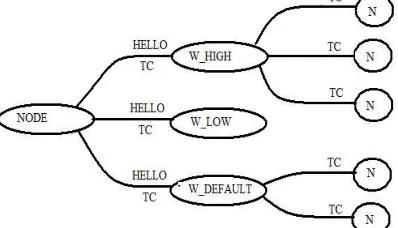
Figure 3.Selection of MPR and Broadcasting TC packets
Selection of Multipoint Relay (MPR) using HELLO messages Each node periodically broadcasts Hello messages, containing list of neighbors known to node and link status. The link status can be either symmetric or asymmetric, multipoint relay, or lost link. The Hello messages are received by all one-hop neighbors and not forwarded. Hello messages discover one-hop neighbors as well as its two-hop neighbors. Hello messages are broadcast at regular interval (Hello_interval). The neighborhood and two hop neighborhood information has holding time (Neighbor_hold_time), after which it is not valid. With the help of this information node selects its own set of MPRs among one-hop neighbors. Multipoint relays computed whenever there is change in one-hop neighborhood and two-hop neighborhood. MPR is one-two-hop neighbors with symmetric link, such that all two-hop neighbors has symmetric link with multipoint relays. Fig 3 shows selection of MPR node using HELLO packets. Node is selected as MPR node when it has willingness high i.e. W_HIGH or default i.e. W_DEFAULT otherwise rejected.
Significance of TC messages Each node of the network maintains topological information about the network obtained with help of TC messages. Each node selected as MPR, broadcasts TC message at regular interval (TC_interval). The TC message originated from node which declares MPR selectors of that node. If change occurs in MPR selector set, then TC message can be sent earlier than pre-specified interval. The TC messages are sent to all nodes in the network by taking advantage of MPR nodes to avoid number of retransmissions. Fig 3 shows broadcasting of TC message with the help of MPR nodes.
shortest path algorithm. Hence, they are optimal with respect to the number of hops. Moreover, for any route, any intermediate node on this route is a MPR of the next node. The routing table is computed whenever there is a change in neighborhood or topology information.
HELLO and TC packet format
Reserved HTime Willingness
Link Code Reserved Link Message Service
Neighbor Interface Address Neighbor Interface Address
Figure 4.OLSR HELLO Packet Format
ANSN Reserved
Advertised Neighbor Main Address Advertised Neighbor Main Address
...
Figure 5.OLSR TC Packet Format
Fig.4 shows HELLO packet format for OLSR. The Reserved
portion in HELLO packets is used for further modification.
Htime specifies time before transmission of next HELLO
packet. Willingness entry specifies node willingness to forward traffic. Link Code gives the information about link between sender node and neighbor node. It represents status of neighbor node. Neighbor interface address denotes address of interface of neighbor node. Link Message size gives total length of link message. Fig.5 represents TC packet format for OLSR. Advertised Neighbor Sequence Number (ANSN) which increments sequence number whenever there is change in neighbor set. Reserved field is used for further modification in TC packets. Advertised Neighbor Main Address field contains main address of neighbor node.
II. MODIFIED OLSR [OLSR]
OLSR applies shortest hop routing method for the transmission of data. It leads the congestion on specific path, or rise in energy expenditure of particular intermediate nodes. If multiple paths are available, then congestion can be avoided, and energy expenditure of all nodes would be uniform. To achieve this, following changes are carried out. Following are the changes made in OLSR protocol [5][6][7]:
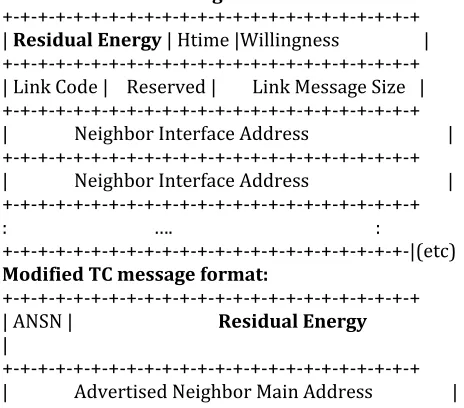
Changes in control messages The ‘reserved’ field available in HELLO and TC message format is used to pass residual energy. This residual energy is further used to find out appropriate path.
Modified HELLO message format:
+-+-+-+-+-+-+-+-+-+-+-+-+-+-+-+-+-+-+-+-+-+-+-+ | Residual Energy | Htime |Willingness | +-+-+-+-+-+-+-+-+-+-+-+-+-+-+-+-+-+-+-+-+-+-+-+ | Link Code | Reserved | Link Message Size | +-+-+-+-+-+-+-+-+-+-+-+-+-+-+-+-+-+-+-+-+-+-+-+
| Neighbor Interface Address |
+-+-+-+-+-+-+-+-+-+-+-+-+-+-+-+-+-+-+-+-+-+-+-+
| Neighbor Interface Address |
+-+-+-+-+-+-+-+-+-+-+-+-+-+-+-+-+-+-+-+-+-+-+-+
: …. :
+-+-+-+-+-+-+-+-+-+-+-+-+-+-+-+-+-+-+-+-+-+-+-|(etc)
Modified TC message format:
+-+-+-+-+-+-+-+-+-+-+-+-+-+-+-+-+-+-+-+-+-+-+-+
| ANSN | Residual Energy
|
+-+-+-+-+-+-+-+-+-+-+-+-+-+-+-+-+-+-+-+-+-+-+-+ | Advertised Neighbor Main Address | +-+-+-+-+-+-+-+-+-+-+-+-+-+-+-+-+-+-+-+-+-+-+-+
| Advertised Neighbor Main Address | +-+-+-+-+-+-+-+-+-+-+-+-+-+-+-+-+-+-+-+-+-+-+-+ | ... |
+-+-+-+-+-+-+-+-+-+-+-+-+-+-+-+-+-+-+-+-+-+-+-|(etc)
Changes in Routing table and Topology table In OLSR, user is not aware of intermediate nodes present on the path and also its residual energies. The modified Routing Table of Multipath OLSR is as follows- from the modified routing table, information of residual energies of intermediate nodes are obtained.
Dest next iface dist 14 20 37 3 20
11 14
Residual energy of intermediate node1 Residual energy of intermediate node2 …….
So from the modified Routing Table, for the given source-destination pair, multiple paths are available. Now to select one of the available path, energy aware metric is applied. The energy expenditure (in Joules) needed to transmit a packet p is given by,
E(p) = i * v * tp
Where i is the current value, v is the voltage,
tp the time taken to transmit the packet p. For our simulation, the voltage is chosen as 5 V.
Algorithm for modified OLSR [8][9]:
• Maintain all one hoping nodes for each node using modified HELLO message, with the residual energy of the nodes. • Based on its one hop table, insert the appropriate entries to its routing table.
• Match the entries with topology set and add to the routing table.
• For each node, see recursively its last address until reached to the destination node, record the complete path information in the routing table using modified TC message (with the residual energy of the nodes).
• Discard the loop entries.
• Get all the paths for given source-destination pair, with the residual energy of each node to the entire network.
• Select all paths, for given source-destination pair
• Find out minimum energy of node, E(min), on each selected paths.
• Find out maximum energy of node, E(max), out of that E(min) values.
• Use this selected path.
III. SIMULATION AND RESULT
We use network simulator ns2 to analyses OLSR and OLSRM routing protocols and measure Number of node alive and Average end to end delay with varying Nodes’ velocity and node density. For simulation, two ray ground propagation models is used. The nodes are 40 in the area of 1000 X 1000 square meters. Traffic type used is CBR (Constant Bit Rate), Packet send rate is 20 packets/sec and Packet size is 512 Bytes[10].
We evaluate essential Quality of Service parameters to analyses the performance differences of OLSR and OLSRM.
More number of alive nodes implies the optimization of energy. The parameter Delay is chosen to study the effect of, addition of multipath technique and energy aware metric to the original OLSR Number of Nodes Alive: This is one of the important metric to evaluate the energy efficiency of the routing protocol. It tells about Network Lifetime,
• The time to the first node failure due to battery outage • The time to the unavailability of an application functionality First point gives the failure of first node, whereas second gives the time when only one node is alive (for communication at least two nodes must be alive). Both can be extracted from the trace file and tells about time at which first node died and the information about how alive nodes changes with the simulation time. Average End to End Delay: This is the time difference between sending of data packets and time at which the same data packet is received. Normalized Routing Overhead: It is the ratio of total number
of routing packets to the total number of delivered data packets.
A. Effect of Node Mobility and Node Density on Number of Nodes Alive:
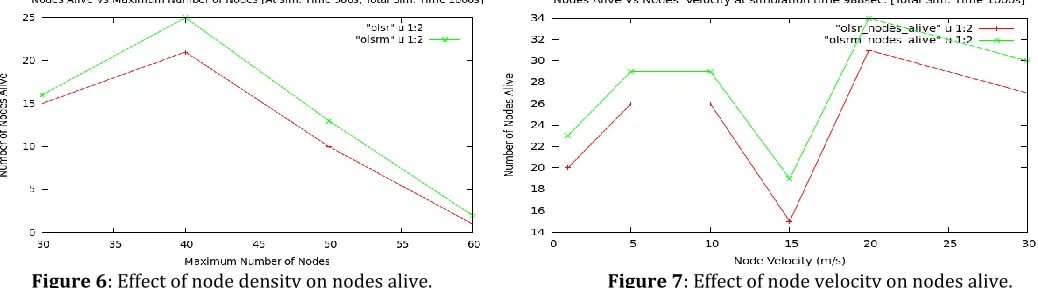
In case of OLSR, the shortest hop path is always chosen; whereas in OLSRM the path for the data delivery is considered with the available energy of nodes (at that instant) on the path, even if the path is long (in terms hop). Therefore OLSRM has more number of nodes alive compared to OLSR. As the node mobility increases, the number of alive nodes in OLSRM increases implies that modified protocol is suitable for dynamic network. By varying number of nodes, it has been observed that OLSRM has more number of nodes, for high node density. It is obvious, as multiple paths will be more for large number of nodes. So it can be seen from the results, OLSRM is best suitable for dynamic and dense network [11][12] in Fig.6&7.
Figure 6: Effect of node density on nodes alive. Figure 7: Effect of node velocity on nodes alive.
B. Effect of Node Mobility and Node Density on Average End-to-End Delay:
In Fig.8&9. For various Node’s maximum velocity, OLSRM has less end-to-end delay, as multiple paths are available, than that of OLSR. By varying node density, it has been observed that end-to-end delay is less for OLSRM than that of OLSR [13].
Figure 8: Effect of node density on average end-to-end delay. Figure 9: Effect of node velocity on average end-to-end delay
C. Effect of Node Mobility on normalized routing overhead:
In Fig.10. To find the optimized energy path from the available source to destination multiple paths, it is expected that there will be increase in routing overheads compared to OLSR [14][15]
CONCLUSIONS
We examine the performance differences of OLSR and OLSRM. We measure Number of alive nodes and average end-to-end delay as QoS parameters. OLSR always uses shortest hop route, so congestion occurs and distribution of load is not considered. Also, OLSR does not consider available node energy of nodes for path selection and communication purposes. In this paper, algorithm for M-OLSR with the addition of energy aware metric is given and simulation is performed using NS-2. Our simulation results show that modified OLSR with multipath are outperforms than OLSR for number of alive nodes by 10 to 25% with considering performance parameters as node velocity and node density. As expected, there is rise in routing overheads about 5-10% for node velocities up to 30 m/s. Thus, congestion of the network disappears and load is transmitted uniformly throughout the network. The modified OLSR also gives the reduction in average end-to-end delay.
REFERENCES
[1] M.S. Corson, J. Macker, Mobile Ad Hoc Networking (MANET): Routing Protocol Performance Issues and Evaluation Considerations, IETF, RFC 2501, 1999.
[2] C.-K. Toh, (2001) “Maximum Battery Life Routing to Support Ubiquitous Mobile Computing in Wireless Ad Hoc Networks”, IEEE communication magazine, pp. 138-147.
[3] T. Clausen and P. Jacquet, “rfc3626.txt”, Network working group DRAFT for OLSR protocol, Oct’03 [4] T. Clausen, P. Jacquet, Optimized Link State Routing
Protocol (OLSR), IETF RFC 3626, 2003.
[5] Pinki Nayak, Rekha Agarwal, Seema Verma “An Overview of Energy Efficient Routing Protocols in Mobile Ad Hoc Network” IJRRAN Vol. 2, No. 1, March 2012,
[6] Floriano De Rango and Macro Fotino “Energy Efficient OLSR performance Evaluation under Energy Aware Metrics”, SPECTS 2009. IEEE 2009 pages: 193-198(2009)
[7] Thomas Kunz, (2008) “Energy-Efficient Variations of OLSR”, IEEE Transactions, pp. 517-522.
[8] May Zin Do and Mazliza Othman “Performance comparisons of AOMDV and OLSR routing protocols for MANET”, IEEE 2010. Iccea, vol. 1, pp.129-133(2010)
[9] Dinesh Singh, Deepak Sethi, Pooja “Comparitive Analysis of Energy Efficient Routing protocols in MANETs(Mobile Ad Hoc Networks)” IJCST Vol. 2, Issue 3, September 2011
[10] S.Rajeswari and Dr.Y.Venkataramani “An Adaptive Energy Efficient and Reliable Gossip Routing Protocol For Mobile Adhoc Networks” International Journal of Computer Theory and Engineering, Vol. 2, No. 5,October, 2010
[11] C.Yu, B.Lee, H.Yong Youn“Energy Efficient Routing Protocols for Mobile Ad Hoc Networks”
[12] Ajay Shah Hitesh Gupta Mukesh Baghel “Energy Efficient Routing Protocols in Mobile Ad hoc Networks”,IJCTA.Vol3(4).
[13] S.-M. Senouci and G. Pujolle “Energy Efficient Routing in Wireless Ad Hoc Networks”
[14] ShivaPrakash, J. P. Saini, “A review of Energy Efficient Routing Protocols for Mobile Ad Hoc Wireless Networks”, IJCIS Vol. 1, No. 4, 2010
[15] Tanu Preet Singh, Shivani Dua, Vikrant Das, “Energy- Efficient Routing Protocols In Mobile Ad-Hoc Networks” Volume 2, Issue 1, January 2012
AUTHOR BIOGRAPHY
K. Prabu has received his MCA and M.Phil from Annamalai University, Chidambaram in the year of 2006 and 2008. He is currently working as an Asst Professor in Dept of Computer Applications, Shree Ragavendra Arts & Science College, Chidambaram and as a Research Scholar in Manonmaniam Sundaranar University, Tirunelveli. His Research interested is Ad hoc Networks. . He has published more that 7 technical papers at various International Journals/National Conference He is a life member of ISTE, IACSIT.