www.astesj.com 374
NonLinear Control via Input-Output Feedback Linearization of a Robot Manipulator
Wafa Ghozlane*,Jilani Knani
Laboratory of Automatic Research LA.R.A, Department of Electrical Engineering, National School of Engineers of Tunis ENIT, University of Tunis ElManar, 1002 Tunis, Tunisia.
A R T I C L E I N F O A B S T R A C T
Article history:
Received: 08 September, 2018 Accepted: 13 October, 2018 Online: 18 October, 2018
This paper presents the input-output feedback linearization and decoupling algorithm for control of nonlinear Multi-input Multi-output MIMO systems. The studied analysis was motivated through its application to a robot manipulator with six degrees of freedom. The nonlinear MIMO system was transformed into six independent single-input single-output SISO linear local systems. We added PD linear controller to each subsystem for purposes of stabilization and tracking reference trajectories, the obtained results in different simulations shown that this technique has been successfully implemented.
Keywords:
Input-Output Feedback linearization
Nonlinear system Robot manipulator MIMO nonlinear system SISO linear systems PD controller
1. Introduction
In recent years, Feedback linearization has been attracted a great deal of interesting research. It's an approach designed to the nonlinear control systems, which based on the idea of transforming nonlinear dynamics into a linear form. The base idea of this technique is to algebraically transform a nonlinear dynamics system into a totally or partially linear one, so that linear control techniques can be applied. This notion can be used for both stabilization and tracking control objectives of SISO or MIMO systems, and has been successfully applied to a number of practical nonlinear control problems such as [1-4].
In fact, this technique has been successfully implemented in several faisable applications of control, such as industrial robots, high performance aircraft, helicopters and biomedical dispositifs, more tasks used the methodology are being now well advanced in industry [5-6].
In this case, we applied this technique to lead the control for each joint of a robot manipulator that is has six degrees of freedom, which the equations of motion form a nonlinear, complex dynamic and multivariable system, then, we elaborated a PD linear controller for each decoupled linear subsystem to control
theangular position of each joint of this robot arm for stabilization and tracking purposes. The obtained results in different simulations shown the efficiency of the derived approach [7].
This paper is organized as follows: It is divided into five sections. In Section 2, a description of the input-output feedback linearization approach is detailed. In Section 3, a simplified dynamic model of a robot manipulator with six degrees of freedom is presented, the input-output feedback linearization method is applicated to the above robot and the construction of linear PD controller is derived. In Section 4, the simulation results are presented. Finally, the conclusion was elaborated in Section 5.
2. Input-Output feedback linearization for MIMO nonlinear system.
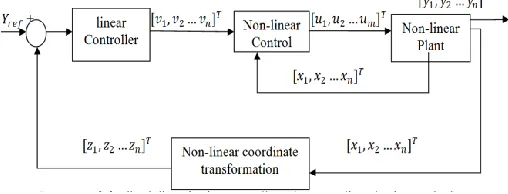
In this section, we discussed the approach of input-output feedback linearization of nonlinear systems, the central goal of feedback-linearization is to design a nonlinear-control-law as assumed that the inner-loop control is, in the most suitable case, precisely linearizes the nonlinear system after appropriate state space modification of coordinates [1]. The developer can then build an outer-loop-control in the new coordinates to obtain a linear relation between the output Y and the input V and to satisfy the traditional control design specifications such as tracking, disturbance rejection, as shown in Figure 1.
ASTESJ
ISSN: 2415-6698
*Corresponding Author: Wafa Ghozlane, Email: [email protected]
www.astesj.com
www.astesj.com 375 Figure 1. Structure of Input-Output Feedback Linearization Approach.
The basic condition for using feedback linearization method is nonlinear dynamic MIMO of n -order with p number of inputs and outputs described in the affine form;
{
𝑋̇(𝑡) = 𝑓(𝑋(𝑡)) + ∑ 𝑔𝑖(𝑋(𝑡))𝑈𝑖(𝑡) 𝑝
𝑖=1 𝑌𝑖(𝑡) = ℎ𝑖(𝑋(𝑡))
𝑖 = 1,2, … 𝑝
(1)
Where,
𝑋 = [𝑥1, 𝑥2… 𝑥𝑛]𝑇 ∈ 𝑅𝑛: is the state vector.
𝑈 = [𝑢1, 𝑢2… 𝑢𝑝]𝑇 ∈ 𝑅𝑝: is the control input vector.
𝑌 = [𝑦1, 𝑦2… 𝑦𝑝]𝑇∈ 𝑅𝑝: is the output vector, 𝑓(𝑋),𝑎𝑛𝑑 𝑔 𝑖(𝑋): are n-dimentional smooth vector fields.
ℎ𝑖(𝑋): 𝑖𝑠 smooth nonlinear functions,with i=1,2...n.
Theorem1:
Let f: ℛn→ ℛnrepresent a smooth vector field on ℛn and let
h : ℛn→ ℛnrepresent a scalar function. The Lie Derivative of h, with respect to f, denoted Lfh, is defined as [1-2].
𝐿𝑓ℎ = 𝜕ℎ
𝜕𝑥𝑓(𝑥) = ∑ 𝜕ℎ 𝜕𝑥𝑖
𝑓𝑖(𝑥) (2) 𝑝
𝑖=1
The Lie derivative is the directional derivative of h in the direction of f(x), in an equivalent way, the inner product of the gradient of h and f. We defined by Lf2h the Lie Derivative of Lfh with respect to f:
𝐿𝑓2ℎ = 𝐿𝑓 ( 𝐿𝑓ℎ) (3)
In general we define:
𝐿𝑓𝑘ℎ = 𝐿𝑓(𝐿𝑓𝑘−1ℎ) 𝑓𝑜𝑟 𝑘 = 1, . . . , 𝑝 (4)
with 𝐿𝑓0ℎ = ℎ
Theorem2:
The function Φ: ℛn→ ℛn defined in a region Ω⊂ ℛn he is called difeomorphisme if it checks the following conditions:
Firstly, a diffeomorphism is a differentiable function whose inverse exists and is also differentiable. Second, we should assume that both the function and its inverse to be infinitely differentiable, such functions are usually referred to as ℂ∞ diffeomorphisms [3-4].
The diffeomorphism is used to transform one nonlinear system in another nonlinear system by making a change of variables of the form:
𝑧 = 𝛷(𝑥) (5)
Where Φ(x) represents n variables;
𝛷(𝑥) = [ 𝛷1 𝛷2 ⋮ 𝛷𝑛
] = [
[ℎ1 𝐿𝑓ℎ1 … 𝐿𝑓𝑟1−1ℎ1] 𝑇
⋮
[ℎ𝑝 𝐿𝑓ℎ𝑝 … 𝐿𝑓𝑟𝑝−1ℎ𝑝] 𝑇
], (6)
𝑥 = [𝑥1, 𝑥2… 𝑥𝑛]𝑇
The goal is to obtain a linear relation between the inputs and the outputs by differentiating the outputs 𝑦𝑗 until the inputs appear. Suppose that 𝑟𝑗 is the smallest integer such that fully one of the inputs appears in 𝑦𝑗(𝑟𝑗) using this expression:
yj(rj)= L
frjhj(x) + ∑ Lgi(Lf
(rj−1)h
j(x))ui p
i=1
(7)
i, j = 1,2, … p
Where, 𝐿𝑓𝑖ℎ𝑗 and 𝐿𝑔𝑖ℎ𝑗: Are the 𝑖𝑡ℎ Lie derivatives of h j(x) respectively in the direction of f and g.
𝐿𝑓ℎ𝑗(𝑥) = 𝜕ℎ𝑗
𝜕𝑥𝑓(𝑥), 𝐿𝑔ℎ𝑗(𝑥) = 𝜕ℎ𝑗
𝜕𝑥 𝑔𝑖(𝑥) (8) rj: is the relative degree corresponding to the yj output, it's the number of necessary derivatives so that at least one of the inputs appear in the expression [5].
If expression 𝐿𝑔ℎ𝑗(𝑥) = 0 , for all i, then the inputs have not appeared in the derivation and it's necessary to continu the derivation of the output yj.
The system (1) has the relative degree (r) if it satisfies:
{ 𝐿𝑔𝑖𝐿𝑓
𝑘ℎ
𝑗= 0 0 < 𝑘 < 𝑟𝑗−1, 0 ≤ 𝑖 ≤ 𝑛, 0 ≤ 𝑗 ≤ 𝑛 (9) 𝐿𝑔𝑖𝐿𝑓
𝑘ℎ
𝑗≠ 0 𝑘 = 𝑟𝑗−1
The total relative degree (r) was considered as the sum of all the relative degrees obtained using (7) and must be less than or equal to the order of the system (10):
𝑟 = ∑ 𝑟𝑗≤ 𝑛 𝑛
𝑗=1
(10)
www.astesj.com 376 [𝑦1𝑟1… 𝑦
𝑝𝑟𝑝] 𝑇
=∝ (𝑥) + 𝛽(𝑥). 𝑈 (11)
𝑉 = [𝑣1 𝑣2… 𝑣𝑝] 𝑇
= [𝑦1𝑟1… 𝑦𝑝𝑟𝑝] 𝑇
(12)
Where:
∝ (𝑥) =
[
𝐿𝑓𝑟1ℎ1(𝑥) . . . 𝐿𝑓𝑟𝑝ℎ
𝑝(𝑥)
]
(13)
𝛽(𝑥) =
[ 𝐿𝑔1(𝐿𝑓
(𝑟1−1)ℎ1(𝑥)) 𝐿𝑔 2(𝐿𝑓
(𝑟1−1)ℎ1(𝑥)) … 𝐿𝑔 𝑝(𝐿𝑓
(𝑟1−1)ℎ1(𝑥))
𝐿𝑔1(𝐿𝑓(𝑟2−1)ℎ2(𝑥)) . . .
𝐿𝑔2(𝐿𝑓(𝑟2−1)ℎ2(𝑥)) … .
. .
… 𝐿𝑔𝑝(𝐿𝑓
(𝑟2−1)ℎ 2(𝑥)) . . . 𝐿𝑔1(𝐿𝑓(𝑟𝑝−1)ℎ𝑝(𝑥)) 𝐿𝑔
2(𝐿𝑓
(𝑟𝑝−1)ℎ𝑝(𝑥)) … 𝐿𝑔 𝑝(𝐿𝑓
(𝑟𝑝−1)ℎ𝑝(𝑥))]
(14)
If β (x) is not singular, then it is possible to define the input transformation "the nonlinear control law " which has this form:
𝑈 = 𝛽(𝑥)−1. (−∝ (𝑥) + 𝑉) (15)
𝑉 = [𝑣1 𝑣2… 𝑣𝑝]𝑇
𝑈 = [𝑢1 𝑢2… 𝑢𝑝]𝑇
𝑦𝑗𝑟𝑗 = 𝑣
𝑗
where
V: Is the new input vector. is called a decoupling control law
β(x):Is the invertible (pxp) matrix. Is called a decoupling matrix of the system.
2.1.Non-linear coordinate transformation:
𝑍 = [ z1 z2 ⋮ z𝑛
] = [ Φ1 Φ2 ⋮ Φ𝑛
] = [
[ℎ1 𝐿𝑓ℎ1 … 𝐿𝑓𝑟1−1ℎ1] 𝑇
⋮
[ℎ𝑝 𝐿𝑓ℎ𝑝 … 𝐿𝑓𝑟𝑝−1ℎ𝑝] 𝑇
] (16)
By applying the linearizing law to the system,we can transforme the nonlinear system into linear form [7-8]:
{Ż = Az + BV
Y = CZ (17)
With,
A = [
Ar1 … 0
… … …
0 … Arp
] , B = [
Br1 … 0
… … …
0 … Brp
],
C = [
Cr1 … 0
… … …
0 … Crp]
And,
Ari= [
0 1 … 0
0 0 … 0
… 0 0
… 0 0
… … …
… 1 0
] ∈ ℛri×ri; B
ri= [
0 ⋮ 1
] ∈ ℛri;
Cri= [1 0 … 0] ∈ ℛri
2.2.Design of the new control vector V:
The vector v is designed to according the control objectives, for the tracking problem considered, it must satisfy:
vj= ydjrj+ K
rj−1(ydj
rj−1− y
jrj−1) + ⋯
+ K1(ydj− yj) ; (18)
1 ≤ 𝑗 ≤ 𝑝 where,
{ydj, ydj
2, … . , y dj
rj−1, y
dj
rj} denote the imposed reference
trajectories for the different outputs. If the 𝐾𝑖are chosen so that the polynomial [9-10];
𝑠𝑟𝑗+ 𝐾
𝑟𝑗−1𝑠
𝑟𝑗−1+ ⋯ + 𝐾
2𝑠 + 𝐾1= 0 are Hurwitz (has roots with negative real parts). Then it can be shown that the error 𝑒𝑗(𝑡) = 𝑦𝑑𝑗(𝑡) − 𝑦𝑗(𝑡), satisfied lim𝑡→∞𝑒𝑗(𝑡) = 0.
3. Input-Output feedback linearization approach applied to a robot manipulator with six degrees of freedom
3.1.Dynamic modeling of a robot manipulator
In this section, we have applied the proposed approach to a dynamic multivariable system which represent a robot arm with six degrees of freedom "EPSON C4". This is an open chain kinematic manipulator robot consisting of seven rigid bodies interconnected by six revolute joints n = 6 as [11]. So, deriving the motion of robot is a complex task due to the nonlinearities present in this system and the large number of degrees of freedom [12-13]. Then, it is essential to understand exactly the dynamics of this interconnected chain of rigid bodies, to detemine the inverse dynamics model such as relation (19), we analyzed the evolution of motion of this mechanical non linear system by using the Euler-Lagrange equations, which is represented by the equation (20).
Γ= f(q, q̇, q̈ , fe) (19)
Γi= ∑ d
(∂Lj
∂qi̇)
dt − ∂Lj
∂qi
n
j=1 i, j = 1, … , n (20)
where Γ, q, q̇, q̈ and fe depicting Torques, articular positions, velocities, accelerations and the external force.
𝐿𝑗: Defines the lagrangian of the 𝑗th link, which is the difference
of the kinetic and potential energy, equal to 𝐸𝑗 - 𝑈𝑗.
www.astesj.com 377
The calculation of the kinetic energy;
In this section, we have calculated the total kinetic energy of the system which depends on the configuration and joint velocities, such that [13], then, it was described by the equation (21).
E = ∑n Ej
j=1 (21)
𝐸𝑗: means the kinetic energy of the link 𝐶𝑗, which can be formulated such that (24). Firstly, we have calcuated the linear velocity and the angular velocity using the equations (22) and (23).
𝑉 𝑗
𝑗 = 𝐴
𝑗−1
𝑗 ( 𝑉
𝑗−1
𝑗−1 + 𝑊
𝑗−1 𝑗−1 × 𝑃
𝑗
𝑗−1) + 𝜎
𝑗𝑞̇𝑗𝑎𝑗 (22)
𝑊 𝑗
𝑗 = 𝐴
𝑗−1
𝑗 × 𝑊
𝑗−1 𝑗−1 + 𝜎̅
𝑗× 𝑞̇𝑗× 𝑎𝑗 (23)
𝑉 𝑗−1 𝑗−1
: The linear velocity, itis the derivative of the position vector 𝑃𝑗𝑗−1.
𝑊 𝑗−1 𝑗−1
: The angular velocity.
The initial conditions for a robot which the base is fixed, are
𝑉 0
0 = 0 and 𝑊 0 0 = 0.
Then,we have expressed these relations (22) and (23) in Equation (24) as.
𝐸𝑗= 1 2[ 𝑊𝑗
𝑗 𝑇 𝐽 𝑗
𝑗 𝑊
𝑗
𝑗 + 𝑀
𝑗𝑗𝑉 𝑗 𝑇 𝑉
𝑗
𝑗 + 2𝑀𝑆 𝑗𝑇( 𝑉𝑗
𝑗 ∧ 𝑊
𝑗 𝑗 )]
(24)
where
𝑎𝑗 :is the unit vector along axis 𝑧𝑗.
Mj, jjMS et jjJ:are the inertial standard parameters.
Mj : is the mass of link 𝐶𝑗.
MS j j
:design the first moments of inertia of link 𝐶𝑗 about the
origin of the frame 𝑅𝑗 It is equal to MSjj =[ MXj MYj MZj ]T.
J j j
: is the inertial tensor matrix (3x3) of link Cj with respect to the frame 𝑅𝑗, it is expressed by the matrix (25).
Jjj == [
IXXj IXYj IXZj IXZj IYYj IYZj
IXZj IYZj IZZj
] (25)
IXXj, IXYj, IXZj, IYYj, IYZj and IZZj represent the elements of the
inertial tensor the symetric matrix jjJ of each link 𝐶𝑗 which is expressed by the matrix (25), we have defined all these inertial parameters values in our recent work [14].
The calculation of the potential energy;
In this section, we have represented the potential energy for a manipulator arm [14], which is written by the equation (26).
U = ∑n Uj
j=1 (26)
Uj: Defines the potential energy of the link 𝐶𝑗, which is expressed by the equation (27):
Uj= −g0T(Mj× P0j + A0j × MSj)
= −[g0T 0] × T0j× [ MSj
Mj
] (27)
Then, we have followed the Euler-Lagrange formalism such that equation (20), we obtained the following relation (28):
Γ= A(q)q̈ + C(q, q ̇)q̇ + Q(q) (28)
where
A(q): Represents the matrix of kinetic energy (n × n), these elements are calculated as follows:
−𝐴𝑖𝑖 is equal to the coefficient of q̇i
2
2 located in the expression of the kinetic energy.
-𝐴𝑖𝑗 is equal to the coefficient of 𝑞̇𝑖𝑞̇𝑗
𝐶(𝑞, 𝑞 ̇)𝑞̇: Defines the vector of coriolis and centrifugal forces/torques (n × 1), these elements are calculated from the Christoffel symbol 𝑐𝑖,𝑗𝑘 such as system (29):
{
cij= ∑nk=1ci,jkq̇k
ci,jk=1 2[
∂Aij
∂qk+
∂Aik
∂qj −
∂Ajk
∂qi]
(29)
Q(q): Represents the vector of torques/forces of gravity, these
elements are calculated as: 𝑄𝑖= 𝜕𝑈 𝜕𝑞𝑖
The elements of A, C and Q are according to the geometric and inertial parameters of the mechanism. The dynamic equations of the robot form a system of n differential equations of the second order, coupled and nonlinear. Then, since the inertia matrix A is invertible for q ∈ ℛ𝑛 we may solve for the acceleration q̈ of the manipulator as [14].
q̈ = f(q, q̇,Γ) (30)
q̈ = −A(q)−1[C(q, q ̇)q̇ + Q(q) − Γ] (31)
With,
q = [q1 q2 q3 q4 q5 q6]T: The angular position vector (6x1).
𝑞̇ = [𝑞̇1 𝑞̇2 𝑞̇3 𝑞̇4 𝑞̇5 𝑞̇6]𝑇: The angular velocity vector (6x1). 𝑞̈ = [𝑞̈1 𝑞̈2 𝑞̈3 𝑞̈4 𝑞̈5 𝑞̈6]𝑇: The angular acceleration vector (6x1).
𝛤 = [𝛤1 𝛤2 𝛤3 𝛤4 𝛤5 𝛤6]𝑇: The input torques vector(6x1).
3.2.Application of the input-output feedback linearization approach to a robot manipulator with six degrees of freedom:
www.astesj.com 378 x1= q1, x2= q̇1, x3= q2, x4= q̇2, x5= q3, x6= q̇3,
x7= q4, x8= q̇4, x9= q5, x10= q̇5, x11= q6, x12= q̇6,
After derivation of the above state variables, we written the obtained system as;
{
x1̇ = x2 x2̇ = q̈1= −A(x1)−1[C(x
1, x2)x2+ Q(x1) −Γ1] x3̇ = x4
x4̇ = q̈2= −A(x3)−1[C(x
3, x4)x4+ Q(x3) −Γ2] x5̇ = x6
x6̇ = q̈3= −A(x5)−1[C(x
5, x6)x6+ Q(x5) −Γ3] x7̇ = x8
x8̇ = q̈4= −A(x7)−1[C(x7, x8)x8+ Q(x7) −Γ4] x9̇ = x10
x10̇ = q̈5= −A(x9)−1[C(x9, x10)x10+ Q(x9) −Γ5] x11̇ = x12
x12̇ = q̈6= −A(x11)−1[C(x
11, x12)x12+ Q(x11) −Γ6] (32)
Then, the affine form of nonlinear, multivariable and dynamic model of the robot manipulator is appeared which given by the following system (33):
{
Ẋ(t) = f(X(t)) + ∑ gi(X(t))Ui(t) p
i=1 Yi(t) = hi(X(t))
i = 1,2, … 6
(33)
where,
𝑓(𝑥) =
[
𝑥2
−𝐴(𝑥1)−1[𝐶(𝑥1, 𝑥2)𝑥2+ 𝑄(𝑥1)] 𝑥4
−𝐴(𝑥3)−1[𝐶(𝑥3, 𝑥4)𝑥4+ 𝑄(𝑥3)] 𝑥6
−𝐴(𝑥5)−1[𝐶(𝑥
5, 𝑥6)𝑥6+ 𝑄(𝑥5)] 𝑥8
−𝐴(𝑥7)−1[𝐶(𝑥7, 𝑥8)𝑥8+ 𝑄(𝑥7)] 𝑥10
−𝐴(𝑥9)−1[𝐶(𝑥
9, 𝑥10)𝑥10+ 𝑄(𝑥9)] 𝑥12
−𝐴(𝑥11)−1[𝐶(𝑥11, 𝑥12)𝑥12+ 𝑄(𝑥11)]] ;
𝑔1(𝑥) =
[ 0 𝐴(𝑥1)−1
0 0 0 0 0 0 0 0 0 0 ]
; 𝑔2(𝑥) =
[ 0 0 0 𝐴(𝑥3)−1
0 0 0 0 0 0 0 0 ]
; 𝑔3(𝑥) =
[ 0 0 0 0 0 𝐴(𝑥5)−1
0 0 0 0 0 0 ]
𝑔4(𝑥) =
[ 0 0 0 0 0 0 0 𝐴(𝑥7)−1
0 0 0
0 ]
; 𝑔5(𝑥) =
[ 0 0 0 0 0 0 0 0 0 𝐴(𝑥9)−1
0
0 ]
; 𝑔6(𝑥) =
[ 0 0 0 0 0 0 0 0 0 0 0 𝐴(𝑥11)−1]
And,
𝑋 = [𝑥1, 𝑥2, 𝑥3, 𝑥4, 𝑥5, 𝑥6𝑥7, 𝑥8, 𝑥9, 𝑥10, 𝑥11, 𝑥12]𝑇; 𝑋̇ = [𝑥̇1, 𝑥̇2, 𝑥̇3, 𝑥̇4, 𝑥̇5, 𝑥̇6𝑥̇7, 𝑥̇8, 𝑥̇9, 𝑥̇10, 𝑥̇11, 𝑥̇12]𝑇; 𝑈 = [𝑢1, 𝑢2, 𝑢3, 𝑢4, 𝑢5, 𝑢6]𝑇= [𝛤
1, 𝛤2, 𝛤3, 𝛤4, 𝛤5, 𝛤6]𝑇;
Links positions
{
𝑦1= ℎ1(𝑥) = 𝑥1= 𝑞1; 𝑦2= ℎ2(𝑥) = 𝑥3= 𝑞2; 𝑦3= ℎ3(𝑥) = 𝑥5= 𝑞3; 𝑦4= ℎ4(𝑥) = 𝑥7= 𝑞4; 𝑦5= ℎ5(𝑥) = 𝑥9= 𝑞5; 𝑦6= ℎ6(𝑥) = 𝑥11 = 𝑞6;
(34)
So, we made the derivation of each output 𝑦𝑖 intel the inputs appeared in the expression and we computed the relative degrees 𝑟𝑖 for each joint of the robot as follows [17-18];
{
𝑦1= ℎ1(𝑥) = 𝑥1 𝑦̇1= 𝐿𝑓ℎ1(𝑥) = 𝑥̇1= 𝑥2 𝑦1(2)= 𝐿
𝑓2ℎ1(𝑥) + 𝐿𝑔𝐿𝑓ℎ1(𝑥)𝑢 𝑟1= 2
𝑦2= ℎ2(𝑥) = 𝑥3 𝑦̇2= 𝐿𝑓ℎ2(𝑥) = 𝑥̇3= 𝑥4 𝑦2(2)= 𝐿
𝑓2ℎ2(𝑥) + 𝐿𝑔𝐿𝑓ℎ2(𝑥)𝑢 𝑟2= 2
⋮
𝑦6= ℎ6(𝑥) = 𝑥11
(35)
𝑦̇6= 𝐿𝑓ℎ6(𝑥)𝑥̇11= 𝑥12 𝑦6(2)= 𝐿𝑓2ℎ6(𝑥) + 𝐿𝑔𝐿𝑓ℎ6(𝑥)𝑢
𝑟6= 2
Therefore, the relative degree of each joint 𝑟𝑖 is well defined and is equal to 2, so we computed the nonlinear control law 𝑢𝑖(𝑡)of each joint of the system as this relation (36);
𝑢𝑖(𝑥(𝑡)) = − 𝐿𝑓 𝑟𝑖ℎ
𝑖(𝑥(𝑡)) 𝐿𝑔𝑟𝑖−1𝐿𝑓ℎ𝑖(𝑥(𝑡))
+ 𝑣𝑖(𝑡) 𝐿𝑔𝑟𝑖−1𝐿𝑓ℎ𝑖(𝑥(𝑡))
(36)
𝑖 = 1 … 6
www.astesj.com 379 {𝑍̇ = 𝐴𝑧 + 𝐵𝑉
𝑌 = 𝐶𝑍 (37)
where,
𝑍 = [ 𝑧1 𝑧2 ⋮ 𝑧12
] =
[ ℎ1 𝐿𝑓ℎ1
ℎ2 𝐿𝑓ℎ2
. .. ℎ6 𝐿𝑓ℎ6]
= [ 𝑥1 𝑥2 ⋮ 𝑥12
] ; 𝑍̇ = [ 𝑧̇1 𝑧̇2 ⋮ 𝑧̇12
] = [ 𝑥̇1 𝑥̇2 ⋮ 𝑥̇12
] ; V = [ v1 v2 ⋮ v6
]
A =
[
0 1
0 0
⋱
⋯ 0
⋮
⋱ ⋯
⋯ 00 10 ⋱
⋮
⋮ ⋮ 0
⋯
⋱ ⋮
⋱ ⋱ ⋮
⋱ ⋮
⋯ 0 1
0 0] ;
B =
[ 0
1 ⋯ 0
⋮
⋱ ⋯
⋯ 0
1 ⋮
⋮ ⋮ 0
⋯
⋱ ⋮
⋯ 0
0 1]
; C =
[
1 0
0 ⋯ 0
⋮
⋱ ⋯
⋯ 1 0
⋱ ⋮
⋮ ⋮ 0
⋯
⋱ ⋮
⋱ ⋱
0 1 0]
The above matrices A,B and C are of dimension respectively : (12 × 12), (12 × 6) 𝑎𝑛𝑑 (6 × 12).
We note that, the obtained linear system (37) definied by six decoupled and linear subsystems that is has the following form (38), and i=1...6;
{𝑧̇𝑖= [ 0 1 0 0] 𝑧𝑖+ [
0 1] 𝑣𝑖 𝑦𝑖= [1 0]𝑧𝑖
(38)
where,
𝑧𝑖= [ 𝑧2𝑖−1
𝑧2𝑖 ]
For the objective of linear control, we added to each subsystem a linear PD controller which has represented equation (39) as;
𝑣𝑖(𝑡) = 𝐾𝑝𝑖(1 + 𝐾𝑑𝑖𝑠)𝑒𝑖(𝑡) ; 𝑖 = 1 … 6 (39)
𝑒𝑖(𝑡) = 𝑦𝑑𝑖(𝑡) − 𝑦𝑖(𝑡) (40)
𝑣𝑖= 𝑦𝑖
𝑟𝑖 (41)
we obtained the relative degree for each subsystem as : 𝑟𝑖= 2
𝑣𝑖= 𝐾𝑑𝑖(𝑦𝑑𝑖
(𝑟𝑖−1)− 𝑦
𝑖(𝑟𝑖−1)) + 𝐾𝑝𝑖(𝑦𝑑𝑖− 𝑦𝑖) (42)
𝑣𝑖(𝑡) = [𝐾𝑝𝑖 𝐾𝑑𝑖] [
𝑦𝑑𝑖(𝑡) − 𝑦𝑖(𝑡)
𝑦𝑑𝑖(𝑟𝑖−1)(𝑡) − 𝑦
𝑖(𝑟𝑖−1)(𝑡)
] (43)
Then, we used the diffeomorphic transformation (16) presented above, we considered these relations for each SISO subsystem:
{ 𝑧1 𝑖= ℎ
𝑖(𝑥(𝑡)) − 𝑦𝑑𝑖
𝑧2𝑖 = 𝐿𝑓ℎ𝑖(𝑥(𝑡)) − 𝑦̇𝑑𝑖
(44)
That is leads to the non-linear coordinate transformation given by:
{ 𝑧̇1
𝑖= 𝑧
2𝑖 = 𝐿𝑓ℎ𝑖(𝑥(𝑡)) − 𝑦̇𝑑𝑖
𝑧̇2𝑖 = 𝐿
𝑓2ℎ𝑖(𝑥(𝑡)) + 𝐿𝑔𝐿𝑓ℎ𝑖(𝑥(𝑡))𝑢𝑖(𝑥(𝑡)) − 𝑦̈𝑑𝑖
(45)
𝑣𝑖(𝑡) = − ∑𝑟𝑖−1𝑗=0 𝐾𝑗𝑍𝑖= − ∑𝑟𝑖−1𝑗=0𝐾𝑗[𝐿𝑓(𝑗)ℎ𝑖(𝑥(𝑡)) − 𝑦𝑑𝑖(𝑗)(𝑡)] (46)
So, we expressed the relation (46) in equation (36),we obtained:
𝑢𝑖(𝑥(𝑡)) = −
𝐿𝑓𝑟𝑖ℎ𝑖(𝑥(𝑡)) 𝐿𝑔𝑟𝑖−1𝐿𝑓ℎ𝑖(𝑥(𝑡))
+− ∑ 𝐾𝑗[𝐿𝑓
(𝑗)
ℎ𝑖(𝑥(𝑡)) − 𝑦𝑑𝑖(𝑗)(𝑡)] 𝑟𝑖−1
𝑗=0
𝐿𝑔𝑟𝑖−1𝐿𝑓ℎ𝑖(𝑥(𝑡))
(47)
𝑖 = 1 … 6
Next, we expressed the equation (47) in the subsystem (45), the non linear subsystem (45) was transformed to a linear subsystem which expressed as relation (48):
[𝑧̇1 𝑖
𝑧̇2𝑖
] = [𝐾0 1 𝑝𝑖 𝐾𝑑𝑖] [
𝑧1𝑖 𝑧2𝑖 ]
𝑖 = 1 … 6
(48)
The obtained linear subsystem consists of a second order system with linear output, that is can be computed the poles of the above subsystem as;
𝑠1,2= −𝜉𝜔𝑛∓ 𝜔𝑛√1 − 𝜉2 (49)
Where, 𝜉: means damping ratio, 𝜔𝑛:means natural frequency, for goal of stability we chosed the parameters of each PD controller applied to each subsystem as [19]:
{𝐾𝑝 𝑗= 𝜔
𝑛2
𝐾𝑑𝑗= 𝜉𝜔𝑛 𝑗 = 1 … 6 (50)
4. Simulation Results
www.astesj.com 380 defined, we presented the simulation results depicting the output
𝑦𝑖𝑟𝑖(𝑡)of each joint i=1...6 as shown in Figures 2,3,4,5,6,7,8-9.
Figure 2. The outputs 𝑦𝑖𝑟𝑖(𝑡) plot of each joint, the relative degrees 𝑟 𝑖= 0, i=1...6.
Firstly, we made the simulation of the outputs of each joint of the robot, 𝑦𝑖(𝑡) = ℎ𝑖(𝑥(𝑡)) = 𝑥𝑖(𝑡), the results are therefore given in Figure 2, we can see the non linearity of each subsystem. Second, we applied the Lie derivation to each output we shown the results presented in Figure 3 as.
Figure 3. The outputs 𝑦𝑖𝑟𝑖(𝑡) plot of each joint, the relative degrees 𝑟𝑖= 1, i=1...6.
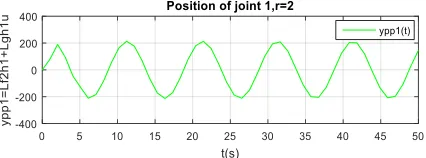
In this case, the relative degrees equal to 𝑟𝑖= 1, 𝐿𝑔𝐿𝑓ℎ𝑖(𝑥(𝑡)) = 0, so no one input has been appeared, as shown in Figure 3, the system still non linear. Finally, we made the derivation again of each recent output 𝑦𝑖̇ the inputs appeared in the expression and we computed the final relative degrees 𝑟𝑖= 2 for each joint of the robot, 𝑦𝑖(2)= 𝐿𝑓2ℎ𝑖(𝑥) + 𝐿𝑔𝐿𝑓ℎ𝑖(𝑥)𝑢, 𝐿𝑔𝐿𝑓ℎ𝑖(𝑥) ≠ 0, the results was illustrated in these Figures 4,5,6,7,8-9.
Figure 4. The output 𝑦𝑖𝑟𝑖(𝑡) plot of the joint 1, the relative degree 𝑟 1= 2.
Figure 5. The output 𝑦𝑖𝑟𝑖(𝑡) plot of the joint 2, the relative degree 𝑟 2= 2.
Figure 6. The output 𝑦𝑖𝑟𝑖(𝑡) plot of the joint 3, the relative degree 𝑟 3= 2.
Figure 7. The output 𝑦𝑖𝑟𝑖(𝑡) plot of the joint 4, the relative degree 𝑟4= 2.
Figure 8. The output 𝑦𝑖𝑟𝑖(𝑡) plot of the joint 5, the relative degree 𝑟 5= 2.
Figure 9. The output 𝑦𝑖𝑟𝑖(𝑡) plot of the joint 6, the relative degree 𝑟 6= 2.
These Figures 4,5,6,7,8-9 shown that the output of each SISO subsystem asymptotically tracks the sinusoidal input trajectory with minimum of oscillation and the efficiency of the studied approach.
5. Conclusion
www.astesj.com 381 diffeomorphic transformation, we converted the non linear and
decoupled dynamics model of the robot to linear system. Then, we designed a linear PD control law for each decoupled subsystem to control the angular position of each joint of this robot for tracking purposes. Finally, the obtained results in different simulations illustrated the accuracy of the proposed approach.
References
[1] MW. Spong, S.Hutchinson, and M. Vidyasagar. Robot Dynamics and Control , Second Edition. January 28, 2004.
[2] J.-J. Slotine & W. Li, Applied Nonlinear Control, Prentice-Hall, Englewood Cliffs, NJ, 1991.
[3] A. Isidori. Nonlinear Control Systems. Springer Verlag, 1989.
[4] H. Khalil. Nonlinear Systems. Prentice Hall, Upper Saddle River, Second Edition, 1996.
[5] J.Hauser,S.Sastry, and P.Kokolovic,“Non linear control via approximate Input_Output Linearization,The Ball and Beam Exemple”. IEEE Transactions onAutomatic Control ,Vol 37,No.3 March 1992.
[6] E.D. Sontag,M. Thoma,A. Isidori and J.H. van Schuppen. Nonlinear and Adaptive Control with Applications, 2008 Springer-Verlag London Limited. [7] H. Nijmeijer and A. J. van der Schaft, Nonlinear Dynamical Control
Systems, Springer-Verlag, New York, 1990.
[8] M. Vidyasagar. Nonlinear Systems Analysis. Prentice Hall,Second Edition, 1993.
[9] K.M. Hangos, J. Bokor et G. Szederkényi, Analysis and Control of Nonlinear Process Systems, Springer-Verlag London Limited, 2004.
[10] J.HAUSER, SH. SASTRY and G. MEYER. “Nonlinear Control Design for Slightly Non minimum Phase Systems: Application to V/STOL Aircraft”. International Federation of Automatic Control. Vol. 28, No. 4, pp. 665-679, 1992.
[11] W.Ghozlane and J.Knani.“Modelling and Simulation Using Mathematical and CAD Model of a Robot with Six Degrees of Freedom,”CEIT-2016, 4thInternational Conference on Control Engineering & Information
Technology on IEEE.16-18 December 2016-Hammamet, Tunisia. [12] B.Siciliano and O. Khatib, Handbook of Robotics: Springer, 2007. [13] W. Khalil and E. Dombre, Modeling Identification and Control of Robots,
Hermes Penton London, 2002.
[14] Thomas R. Kurfess, Robotics and Automation Handbook, CRC press, 2005. [15] Y . L . Chen: “ Nonlinear Feedback and Computer Control of Robot Arms”.
D.Sc. Dissertation, Washington University, St. Louis 1984.
[16] V.D. Yurkevich, Design of Nonlinear Control Systems with the Highest Derivative in Feedback,World Scientific Publishing, 2004.
[17] Frank L.Lewis, Robot dynamics and control, in robot Handbook: CRC press, 1999.
[18] L. Sciavicco and B. Siciliano, Modeling and control of robot manipulators, 2nd edition, Springer-Verlag London Limited, 2000.
[19] C.T.Leondes. Control and Dynamic Systems,Advances In Theory and Applications, part 1 of 2,USA,1991.
[20] Zakaria, M. Z., Jamaluddin, H., Ahmad, R. & Loghmanian, S. M. R. (2010). “Multiobjective Evolutionary Algorithm Approach in Modeling Discrete-Time Multivariable Dynamics Systems”. Computational Intelligence, Modelling and Simulation (CIMSiM), 2010 Second International Conference on, Bali, Indonesia. 28-30 Sept. 2010. 65-70.