Volume 01, No.1, Jan 2015
P
age
1
An Overview – Artificial Neural Network Based Advanced Face
and Non-Face Recognition
Nilesh S. Wadhe
*,Dr. Sharad W. Mohod
**& Prof. Nikkoo N. Khalsa
**** Prof. Ram Meghe College of Engineering & Management, Badnera-Amravati.
**Prof. Ram Meghe Institute of Technology & Research, Badnera –Amravati.
***Prof. Ram Meghe Institute of Technology & Research, Badnera –Amravati
ABSTRACT:
Face and Non Face detection is a technology with a hefty range of applications such as access banking, information security, human computer communication, fundamental reality, and database recovery etc. This paper addresses the building of face detection system by using an image-based approach towards artificial intelligence and image compression using two-dimensional discrete cosine transform. The restraints are removed after face and non-face images using DCT. An unverified self-organizing map (SOM) method is used to categorize DCT-based features into groups to identify if the input image is found or not in the database of an image. The classification of intensity values of gray scale pixels of an image into different groups of an image is carried out by self-Organizing Method for face and non-face recognition.
Keywords: - Face and Non-face recognition, discrete cosine transform, self-organizing map, neural network.
I. INTRODUCTION
Face and non-face recognition is an active research area from more than last 25 years.
Especially, after 11thSeptember the terrorist attacks on the United States and the parliament of
India, security systems identifies biometric features, such as, fingerprint, iris pattern, voice, face, etc. are attracting a lot of attention from all over the world. Face and non-face recognition system is most natural and effective method to identify a person. For creating most robust systems in face and non-face recognition, personal facial feature extraction is used.
This paper presents an approach suggested by Hjelmås and Low for face and non-face
Volume 01, No.1, Jan 2015
P
age
2
Figure. 1. The Representation of Face and Non-Face Recognition System.
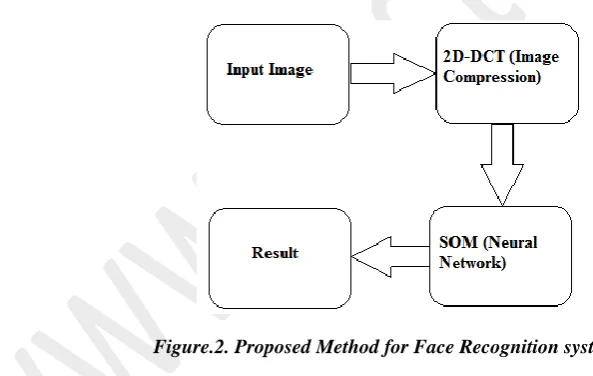
The skin color of an individual human varies; the research is related to that intensity of skin color than chrominance. The amount of an image is typically used for further processing by using compression by 2D-DCT method [2]. The greyscale of an image contains intensity values of skin pixels. The proposed technique of the face and non-face recognition system is represented in Fig. 2. The block diagram contain of three stages, the first stage is the input stage where input face image is gives as an input the second stage is a 2D-DCT from the discrete cosine transform coefficients every input face image is computed and feature vectors are formed. The third stage is a self-organizing map(SOM) which is used for the classification of an input image is a part of image database or not. As a result, if the input image is classified as present, the greatest match image originate in the training database is presented, else the input image is considered as a non-face image or the input image is not present in the database.
Figure.2. Proposed Method for Face Recognition system.
AN OVERVIEW-FACE RECOGNITION:
Solving the face recognition problem many algorithms have been proposed. To represents a face in terms of an optimal coordinate system which containing the most significant Eigen
faces and the mean square error is minimal is proposed by Turk &Pentland, 1991 on the basis
of Karhunen-Loeve transform and PCA algorithm [1]. Another algorithm is proposed by
Brunelli & Poggio in 1993; Wiskott et al in1997 for real time face recognition application based on Feature-based approach which uses the relationship between facial features, such as the locations of mouth, ear, nose and eye. The Implementation of this algorithm was very fast but face recognition is depends on the location of facial features and hence it cannot give a satisfied recognition result [2]. The other algorithms have been implement for face
Volume 01, No.1, Jan 2015
P
age
3
1996[3], neural network proposed by Chellappa et al. in 1995[4], multi-scale integration
technique and local autocorrelations proposed by Li & Jain in 2005, and other techniques was
proposed by Goudail et al. in1996[5]; Moghaddam &Pentland in 1997[6]; Lam & Yan in
1998[7]; Zhao in 2000[8]; Kotani et al. in 2002[9]; Karungaru et al in 2005; Aly et al.in 2008.
Ming Zhangand John Fulcher was proposed a “Face Recognition Using Artificial Neural Network Group-Based Adaptive Tolerance (GAT) Trees”, in which they shown how it can be applied to a complex real-world problem, namely translation invariant face recognition but the GAT tree model is eminently suited for large sized face databases GAT tree is one kind of neural network group-based model which not only offers a means whereby we can describe very complex systems [11].
MengJooEr, Shiqian Wu, Juwei Lu, and Hock Lye Toh was proposed, “Face Recognition
with Radial Basis Function (RBF) Neural Networks”, in this paper the feature vectors are only extracted from gray scale information. If more features extracted from the gray scale image then this method is used for a real-time face detection and recognition system[12]. A survey of methods and the comparative results from literature serve are presented below in Table 1 [13, 14, 15, 16, 17].
Methods for Feature extraction
Database Used for
Face Recognition Result of face recognition
FSS or Eigen faces
method
Yale face database and
constructed a particular
database
FSS is varying from 67.8 to 84.3%
Eigen face is varying from 65.6to 76%
Eigen faces method,
ICA, or LDA
FERET data set Varying from 64.94 to 83.85%
Edge information +
traditional PCA + ICA
Indian face database and Asian face database
Varying from 74 to 88.65%
Kernel discriminate
analysis
FERET, ORL and GT
databases
Error recognition rate varying
from 43 to 1.5%
Eigen faces or Fisher faces
FERET dataset Error recognition rates ranging
from 35 to 1.5%
Eigen faces, MLP as a
Feature extractor.
Volume 01, No.1, Jan 2015
P
age
4
II. DISCRETE COSINE TRANSFORM
This algorithm is mostly used in different applications. Especially for the purpose of data compression, as it gives global average for loss image density, this algorithm called as JPEG [18]. For a typical image it has the property that, information about the image is concentrated in just a few coefficients. For recognition tasks remove DCT coefficients and can be used as a type of signature for face recognition [19, 20].
The processing speed and memory utilization are affected due to high correlation and redundant information which is present in a face image as images are transformed from the spatial domain to the frequency domain by using DCT algorithm. There are two different types of frequency coefficients are present in an image. The lower frequencies are most visually significant in an image than higher frequencies. The DCT drops higher frequency coefficients and the lower frequency are quantizes the remaining coefficients. This algorithm reduces data size without disturbing the quality of an image [21]. The DCT of an M × N matrix A is shown below.
0≤ p≤M-1, 0≤ q≤N-1,Where, Bpq The coefficient of DCT,
AmnInverse of DCT.
And it is defined as,
0≤ p≤M-1, 0≤ q≤N-1,
Volume 01, No.1, Jan 2015
P
age
5
The proposed method uses the DCT transform matrix in the MATLAB Image Processing Toolbox. With the help of this method the square inputs is converted into image blocks 8 × 8 pixels. The M × M transform matrix T is given by
III. SELF-ORGANIZING MAPS
The self-organizing map is one of the types of artificial neural network it is also called as Kohonen Map. It is an unsupervised learning process, in which any class information distributes a set of patterns. It is the property of topology protection. Competition is done in the neurons for activation or fired. The neuron which wins the competition only that neuron will fired and called as winner [24]. A winning neuron is identified by SOM network using the same procedure which is applied in a competitive layer. The Kohonen rule is used for updating not only the wining neuron but all the neuron which is neighbourhood of the winning neuron. With the help of Kohonen rule the weights of a neuron is train an input vector and hence, it is useful for face recognition applications. In this way, this system is employed a SOM network to classify DCT based vector for identification of a subject in the input image is found or not found in the image database [22].
Figure.3. Simple Architecture of SOM neural Network
ARCHITECTURE OF SOM ALGORITHM:
Volume 01, No.1, Jan 2015
P
age
6
by DCT into the row of pixels. The input vector p and the input weight matrix IW1-1, is received by the distance box which produces a vector having S1 elements. The elements S1 are the negative distances between the input vector p and vectors IW1, 1 which designed from the rows of the input weight matrix. With the help finding the Euclidean distance between input vector p and the input weight vectors the distance box calculates the net input n1 of a competitive layer. The competitive layer transfer function C which accepts a input vector and returns neuron outputs of 0 for all neurons excluding for the winner, the neuron related with the most positive element of input n1. The champion neuron gives the output is 1. The neuron having weight vector is nearest to the input vector have the least negative net input and, hence, wins the race to output a 1. Hence the output element a1 i corresponding to i* for the winner neuron is produces by the competitive transfer function C for a 1 inputs element. Remaining all other output elements in a1inputs element is 0[25].
n1=-IW1,1 –p
a1=compete (n1)
Thus, when the weights of wining neuron are represented by a vector p then close neighbours neuron move toward input vector p. After the training the neighbouring neurons learn similar vectors [25]. Hence, in this way the SOM network train to categorize the input vectors p.
The SOM network which is used in this paper containing N number of nodes connected in a two-dimensional lattice structure. Each node has 2 to 4 neighbouring nodes, respectively. The SOM of a neural network having of three phases:
1. The learning phase
2. The training phase and
3. The testing phase.
1. Learning phase
During the learning phase, the weight of the neighbouring neuron which is equal to the input vector p is considered as a winning neuron. All the weights of neighbourhood of winning the neuron are adjusted by the amount of inversely proportional to the Euclidean distance between them. It collects and categorise the data set based on the basis of features used. The learning phase algorithm is shown below [24]:
1.1Initialization of learning: For the initial weight vectors wj(0) choose random values, the weight vectors should be different for j = 1,2,...,l where „l‟ is the total number of neurons is available in SOM.
wi = [wi1 , wi2 ,...,wil ]T∈ℜn
1.2Sampling of learning: Find „x‟ from the input space vector with a certain probability.
Volume 01, No.1, Jan 2015
P
age
7
1.3Similarity Matching: Find out the best matching winning neuron i(x) at time t, 0 < t ≤ n by using the minimum Euclidean distance technique:
i(x) = argminj {(xn)-wj} ,j = 1,2...,l.
1.4. Updating: Adjust all neurons weight vector by using the update formula:
wj (n+1)= wj(n)+η(n) hji(x) (n){x(n)- wj(n)}
Where (n) rate of learning parameter,
hj, ix(n) is the neighbourhood function nearer to the winning neuron i(x).
Both η(n) and hj, ix(n) are varied vigorously during learning for best results.
1.5. Follow the step 2 until no changes are observed in the feature map. Using the SOM neural network train images are plot into a lower dimension and the weight matrix of each image is stored in the training database. During face recognition is trained images are rebuilt using weight matrices and recognition is using Euclidean distance for untrained test images. Training and testing is performed in MATLAB using Neural Network Toolbox.
2. Training phase
During the training phase, DCT-vectors are included into the SOM neural network at a time. At each node, the number of wining neuron is selected along with the label of the input sample. As described in learning phase, the weight vectors are updated at each node. At the end of this stage, each node from the SOM neural network recorded two values:
1. The total number of time for winning neurons for subject present in image
database,
2. The total number of time winning neurons for subject not present in image
database [23].
3. Testing phase
In this phase, each input vector is compared with all nodes of SOM neural network; and based on minimum Euclidean distance the best match is found [23]. The final output of the system depends on its recognition, which displays if the test image is a part or not in the database of an image.
IV. CONCLUSION:
Volume 01, No.1, Jan 2015
P
age
8
98.87% for approximately 800 epochs for 10 consecutive trials. The advantage of this technique is that, it is suitable for low cost real time hardware and software implementations.
V.
REFERENCES:-i. Turk, M. & Pentland, A. (1991). Eigenfaces for Recognition, Journal of
Cognitive Neuroscience, Vol. 3, No. 1, pp. 71-86.
ii. Brunelli, R. & Poggio, T. (1993). Face Recognition: Features versus
Templates, IEEE Trans. On Pattern Analysis and Machine Intelligence, Vol. 15, No. 10, pp. 1042-1052
iii. Penev, P. S. & Atick, J. J. (1996). Local Feature Analysis: A General
Statistical Theory for Object Representation, Network: Computation in Neural Systems, Vol. 7, No. 3, pp. 477-500
iv. Zhao, W.; Chellappa, R.; Rosenfeld, A. & Phillips, P.J. (2003). Face
Recognition: A Literature Survey, ACM Computing Surveys, Vol. 35, Issue 4, pp. 399-458
v. Goudail, F.; Lange, E.; Iwamoto, T.; Kyuma, K. & Otsu, N. (1996). Face
Recognition System Using Local Autocorrelations and Multi scale Integration, IEEE Trans. on Pattern Analysis and Machine Intelligence, Vol. 18, No. 10, pp. 1024-1028
vi. Moghaddam, B. & Pentland, A. (1997). Probabilistic Visual Learning for
Object Representation, IEEE Trans. on Pattern Analysis and Machine Intelligence, Vol. 19, No. 7, pp. 696-710
vii. Lam, K.-M. & Yan, H. (1998). An Analytic-to-holistic Approach for Face
Recognition Based on a Single Frontal View, IEEE Trans. on Pattern Analysis and Machine Intelligence, Vol. 20, No. 7, pp. 673-686
viii. Zhao, W.; Chellappa, R.; Rosenfeld, A. & Phillips, P.J. (2003). Face
Recognition: A Literature Survey, ACM Computing Surveys, Vol. 35, Issue 4, pp. 399-458
ix. Kotani, K.; Chen, Q. & Ohmi, T. (2002). Face Recognition Using Vector
Volume 01, No.1, Jan 2015
P
age
9
x. Wang, J.; Plataniotis, K. N.; Lu, J. & Venetsanopoulos, A. N. (2006). On
Solving the Face Recognition Problem with One Training Sample per Subject,
Pattern Recognition, Vol. 39, pp. 1746 -1762.
xi. Ming Zhang, Senior Member, IEEE, and John Fulcher, Member, IEEE, “Face
Recognition Using Artificial Neural Network Group-Based Adaptive
Tolerance (GAT) Trees”, IEEE TRANSACTIONS ON NEURAL
NETWORKS, VOL. 7, NO. 3, MAY 1996.
xii. MengJooEr, Member, IEEE, Shiqian Wu, Member, IEEE, Juwei Lu, Student
Member, IEEE, and Hock Lye Toh, Member, IEEE,” Face Recognition With
Radial Basis Function (RBF) Neural Networks ” IEEE TRANSACTIONS ON
NEURAL NETWORKS, VOL. 13, NO. 3, MAY 2002.
xiii. Shan S, Gao W, Zhao D (2003) Face recognition based on facespecific
subspace. International Journal Image System Technology 13:23–32
xiv. Delac K, Grgic M, Grgic S (2005) Independent comparative study of PCA,
ICA, and LDA on the FERET data set. International Journal Image System Technology 15:252–260
xv. Karande KJ, Talbar SN (2009) Independent component analysis of edge
information for face Recognition. International Journal Image Proc 3(3): 120– 130
xvi. Jiang X, Mandal B, Kot A (2009) Complete Discriminate evaluation and
feature extraction in kernel Space for face recognition. International Journal Mach Vis Apply20:35–46
xvii. Alvarado GJ, Pedrycz W, Reformat M, Kwak K (2006) Deterioration of visual
information in face Classification using Eigen faces and fisher faces. International Journal Mach Vis Apply 17(1):68–82
xviii. Oravec M, Pavlovicˇova´ J (2007) Face Recognition methods based on feed
forward neural networks, Principal component analysis and self-organizing map. 16(1):51–57
xix. E. If each or and B. Jervis, Digital Signal Processing: A Practical Approach.
Volume 01, No.1, Jan 2015
P
age
10
xx. L. Ma, Y. Xiao, and K. Khorasani, “A new facial expression recognition
technique using 2D DCT and k-means algorithm”, in Proc. International Conference on Image Processing, Oct. 2004, pp. 1269-1272.
xxi. L. Ma and K. Khorasani, “Facial expression recognition using constructive
feed forward neural networks”, IEEE Transactions on Systems, Man and Cybernetics, Part B, Vol. 34, No. 3, June 2004, pp.1588-1595.
xxii. J. Nagi, “Design of an Efficient High-speed Face Recognition System”,
Department of Electrical and Electronics Engineering, College of Engineering, University Tenaga National, March 2007.
xxiii. A. Abdallah, M. Abou El-Nasr, and A. Lynn Abbott, “A New Face Detection
Technique using 2D DCT and Self Organizing Feature Map” in Proc. of World Academy of Science, Engineering and Technology, Vol. 21, May 2007, pp. 15-19.
xxiv. D. Kumar, C.S. Rai, and S. Kumar, “Face Recognition using Self- Organizing
Map and Principal Component Analysis” in Proc. on Neural Networks and Brain, ICNNB 2005, Vol. 3, Oct 2005, pp. 1469-1473.
xxv. Y. Zi Lu and Z. You Wei, “Facial Expression Recognition Based on Wavelet