Wojciech Piotrowicz and Zahir Irani
Information Systems evaluation in context– impact of the corporate level
1
INFORMATION SYSTEMS EVALUATION IN CONTEXT–
IMPACT OF THE CORPORATE LEVEL
Wojciech Piotrowicz, Saïd Business School, University of Oxford and Brunel
Business School, Brunel University, UK
[email protected]
Zahir Irani, Information Systems Evaluation and Integration Network Group
(ISEing) Brunel Business School, Brunel University, UK
[email protected]
Abstract
The paper presents the results of a doctoral research related to Information Systems evaluation in context. The authors propose changes in the context, the new level of contextual analysis was added: the system context located between the internal and external context. The system context reflects the fact that the case companies are business units and parts of the corporations and IS evaluation is influenced by the corporation, Three levels of context analysis can be used in case of IS evaluation in complex structures, such as corporations or supply chain.
Keywords: Content context process framework, information systems evaluation, impact on information systems, electronic procurement
1
INTRODUCTION
In the research, data collected from four business units of large international corporations from IT/hi-tech sector were used, supported by the academic literature. Within all the cases electronic procurement systems were analysed. To build the final framework the authors progressed from data, to the framework, and back, comparing findings with the literature in the iterative hermeneutic cycle (Klein, et al. 1999) guided by the structured case method (Carroll, et al. 2000). In the following section information about the context in the CCP framework is presented, as well as methodology and research design. The authors describe how the fieldwork impacts the framework and proposes modifications of the context.
2
CONTENT CONTEXT PSROCESS FRAMEWORK
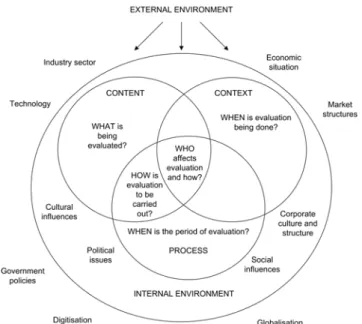
The CCP was introduced by Pettigrew (1985). Symons (1991a) reviewed IS literature using the framework and proposed it for IS evaluation in context. Later the CCP framework was applied in the IS evaluation case studies (Huerta, et al. 1999, Serafeimidis, et al. (1999). Stockdale, et al. (2006a), based on extensive IS literature review, modified the CCP framework that is composed of three main elements (Figure 1):
• Content - “what” is being evaluated
• Context - “why” and “who” evaluate IS implementation
Wojciech Piotrowicz and Zahir Irani
Information Systems evaluation in context– impact of the corporate level
2
Figure 1. CCP framework (Stockdale and Standing 2006)3
INFORMATION SYSTEMS EVALUATION IN CONTEXT
Context includes all factors which influence evaluation (Serafeimidis, et al. 1999, Serafeimidis, et al. 2000). Internal and external contexts determine “why” and “who” evaluate IS implementation, its time and purpose (Huerta, et al. 1999, Stockdale, et al. 2006a). Originally Pettigrew (1985) used several levels of context for the analysis. At the first level, it was a group level. Analysis of the group level was placed in the inner and immediate contexts. The next level of analysis is an outer context. However, in the IS evaluation literature, the context is separated into two levels only.
The first context level is located within an organisation, and is named as: internal (Huerta, et al. 1999, Serafeimidis, et al. 2003, Smithson, et al. 1998, Willcocks, et al. 1994), inner (Symons 1991a, Willcocks, et al. 1994), organizational/internal (Serafeimidis, et al. 1999), organisational (Dhillon 2005) or internal environment (Stockdale, et al. 2006a),it includes:
• Organisational structure (Huerta, et al. 1999, Irani, et al. 2002, Serafeimidis, et al. 1999, Smithson, et al. 1998, Stockdale, et al. 2006a, Stockdale, et al. 2006b, Symons 1991a, b, Willcocks 1992, Willcocks, et al. 1994)
• Organisational goals and strategies (Huerta, et al. 1999, Mirani, et al. 1998, Serafeimidis, et al. 1999, Stockdale, et al. 2006a, Stockdale, et al. 2006b, Willcocks, et al. 1994)
• Organisational culture (Huerta, et al. 1999, Irani, et al. 2001, Serafeimidis, et al. 2003, Smithson, et al. 1998, Stockdale, et al. 2006a, Stockdale, et al. 2006b, Symons 1991a, Willcocks, et al. 1996)
• Political influences (Farbey, et al. 1995, Huerta, et al. 1999, Stockdale, et al. 2006a, Stockdale, et al. 2006b, Symons 1991a, Wilson, et al. 2000)
• Management structures (Jones, et al. 2001, Remenyi, et al. 1999, Stockdale, et al. 2006a, Stockdale, et al. 2006b, Ward, et al. 1996)
• Management processes (Huerta, et al. 1999, Serafeimidis, et al. 1999)
• Individuals and their roles (Serafeimidis, et al. 1999)
• Expectations (Serafeimidis, et al. 2003)
• Social structures and processes (Stockdale, et al. 2006a, Stockdale, et al. 2006b, Willcocks 1992, Wilson, et al. 2000)
Wojciech Piotrowicz and Zahir Irani
Information Systems evaluation in context– impact of the corporate level
3
• Norms (Serafeimidis, et al. 1999, Serafeimidis, et al. 2003)
• IT strategy (Serafeimidis, et al. 1999), IS infrastructure and management (Willcocks, et al.
1994)
• Hardware and software technology (Huerta, et al. 1999)
• Human resources (Willcocks, et al. 1994)
• Rewards system (Willcocks, et al. 1994)
• Industrial relations management (Willcocks, et al. 1994)
The second level of context includes issues that are outside the organisation, and is named as: outer (Symons 1991a, Willcocks, et al. 1994), external (Huerta, et al. 1999, Serafeimidis, et al. 2003, Smithson, et al. 1998, Willcocks, et al. 1994), environmental/external (Serafeimidis, et al. 1999), or external environment (Stockdale, et al. 2006a), it is composed of:
• Government policy and legislation (Serafeimidis, et al. 1999, Stockdale, et al. 2006a, Willcocks, et al. 1994)
• Political influence (Huerta, et al. 1999, Symons 1991a, Willcocks, et al. 1994)
• Economy (Symons 1991a, Willcocks, et al. 1994), national economic situation (Stockdale, et al. 2006a)
• Market structures and conditions (Stockdale, et al. 2006a), market demand (Serafeimidis, et al. 1999), markets (Willcocks, et al. 1994)
• Industry sector (Stockdale, et al. 2006a)
• Globalisation (Stockdale, et al. 2006a)
• Privatisation (Stockdale, et al. 2006a)
• Cultural influences (Stockdale, et al. 2006a)
• Business environment (Smithson, et al. 1998)
• Competitive drivers (Huerta, et al. 1999), competitive environment (Stockdale, et al. 2006a, Symons 1991a), competition (Serafeimidis, et al. 1999, Willcocks, et al. 1994)
4
METHODOLOGY AND RESEARCH DESIGN
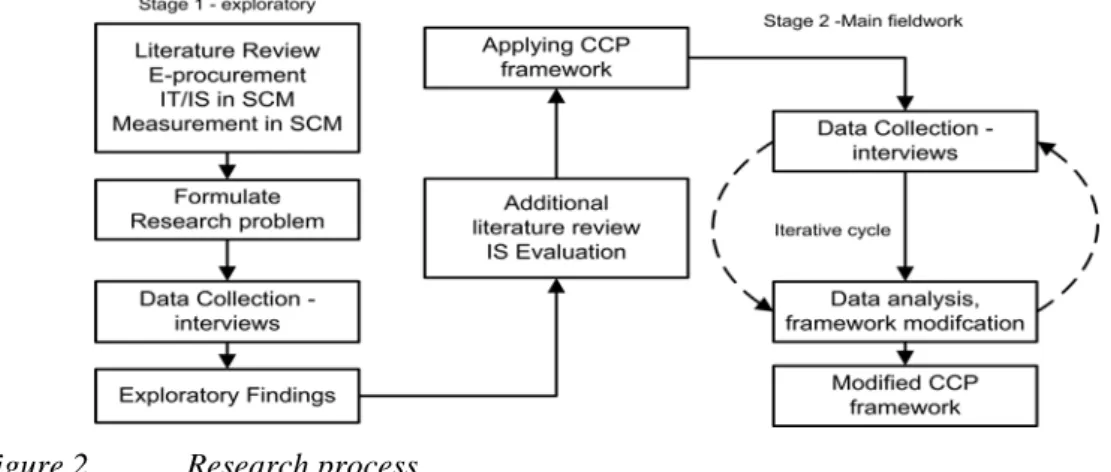
This paper presents results of the doctoral research, concentrating on the context modification only. The research aim was to understand evaluation of e-procurement systems within case companies, including contextual factors that influence evaluation process and content. The interpretive paradigm was selected, which determined research design. As a philosophical foundation critical hermeneutics and principles for interpretive research are used (Klein, et al.
1999, Myers 1997, 2004). The research was based on two stage processes (Figure 2).
Wojciech Piotrowicz and Zahir Irani
Information Systems evaluation in context– impact of the corporate level
4
The initial first exploratory research stage resulted in formulation of detailed research questions and selection of the CCP framework (Stockdale, et al. 2006a). The stage one aimed to look at methods and tools used to evaluate e-procurement and to determine detailed research questions. At the same time when results of exploratory study were available, also the CCP framework (Stockdale, et al. 2006a) was published. Research questions formulated as result of the stage one were very similar to the theoretical framework published by (Stockdale, et al. 2006a), this was an opportunity to test the literature-based framework using empirical data. The structured case method (Carroll, et al. 2000), which gives guidelines to apply hermeneutics principles in practice, was used. Structured case method provides a framework for theory building or modification and was already employed in the research related to IS evaluation (Love, et al. 2004, Love, et al. 2006). The purposeful sample of four case companies from IT/hi-tech, electronic components sector that are business units of large international corporations was selected. The business units are located in Central Europe. The research concentrates on evaluation of electronic procurement applications, defined as all systems used to support procurement processes (Presutti 2003). To reduce bias, and to include different views of the phenomenon studied, multiple respondents within each organisation have been interviewed, followed by data triangulation with external and internal documents, such as company reports, presentations, guidelines. Altogether 27 interviews with 20 people were completed. Interviewees were from various organisational levels: senior and middle management – purchasing and IT departments and system users. Interview length was up to two hours. Most of the interviews were recorded and transcribed. Data collection was stopped at the moment when new interviews did not generate any additional information. As the sample was from one country and from four organisations, in the different companies different aspects influence IS evaluation. However in different organisations, with similar structure, it is very likely that there is an impact of the corporate level on IS evaluation, the differences are regarding type and timing of the impact. Additionally findings are related to e-procurement applications only.In the following section
issues that impact IS evaluation have been identified in the case companies and are presented according to the context levels.5
EXTERNAL CONTEXT
This part gives overview of external factors that impact IS evaluation and were identified in the case companies.
5.1 Company situation on the market
In most companies the local market has an impact. Interviewees stated that the certain size of the market and turnover are required to perform formal evaluation, as only at a certain size can some statistical rules be identified. In one of case companies the market situation had an impact on the IS evaluation and on the decision about a system implementation. The company grew very fast, as well as the market, the old system was not able to fulfil new requirements. A new system was an answer, as a rapid response was required, but there was no time to complete formal pre-implementation evaluation. Another of the interviewees perceived that the Central/Eastern European market is small and not important from a global point of view, so some system changes and new implementations are not accepted by the corporation, as larger markets have priorities.
5.2 Legal requirements - laws and regulations
Laws and regulations at national and regional (EU) levels have an impact on the IS evaluation. Legal requirements determine system localisation and that documents should be in
Wojciech Piotrowicz and Zahir Irani
Information Systems evaluation in context– impact of the corporate level
5
a required format and language. In the case of the system implementation in three companies the only changes in the system that were allowed were those related to legal requirements. Three of case companies have to apply for changes in the current system that is managed at the corporate level, and highlight the fact that modifications are needed due to changes in the local law. Usually changes required by law are not evaluated, as they are perceived as necessary. At one company it was highly stressed that the company always had to fulfil legal requirements at a national level, which is not an easy task, as exactly the same system is used all over the world.5.3 Business partners
At three companies the interviews confirmed that a suppliers’ IS readiness determined an IS evaluation, especially the expected and achieved benefits. A system could not deliver benefits while business partners were not ready to use it. However, suppliers’ readiness to use e-procurement solutions was also determined by industry. At one case company it was easy to link systems with companies from IT and logistics sectors, while this was much harder with other suppliers. There were two groups of factors mentioned in relation to suppliers’ willingness and ability to use the system:
• technical – suppliers did not have enough expertise and there was too low a technology usage level
• cultural and business model problems – suppliers prefer face-to-face meetings and contact, instead of an electronic data exchange
5.4 IT trends and fashions
IT trends, such as publications, conference themes and external consultants, were also mentioned in two companies. Managers heard about some system, so they perceived it to be a necessity for the company to have certain systems. The fact that they do not use it might be seen as weak point. IT trends and fashions were not mentioned at two companies; employees of both organisations are aware that they work in world-leading IT companies, so they do not copy, but lead the IT development.
5.5 Business culture
Business culture also had an impact on decisions to implement the system. In countries that are perceived as highly corrupted, systems are implemented, to keep control, prevent fraud and corruption, even if it is not financially justified, it was mentioned in two cases.
6
ORGANISATIONAL (INTERNAL) CONTEXT
This section presents identified internal impact factors that influence an e-procurement evaluation. Internal factors are those that exist within case organisations.
6.1 Project value
An important factor of an evaluation was a project’s value. The low cost of a new project determined that implementation was not evaluated. Similarly low cost system modifications were just done, without evaluating them.
Wojciech Piotrowicz and Zahir Irani
Information Systems evaluation in context– impact of the corporate level
6
6.2 Position of the project initiatorThe common important factor was a position of a person who initiated the project and relationships between managers. At a company where a project was initiated by a senior manager evaluation was not required. At another company, where one of the system implementations was initiated by middle managers, the evaluation was necessary to convince senior managers that benefits could be achieved, as the interviewee stated, to “sell” the project within the organisation.
6.3 Previous experience with a system
In the case of both system users and managers their previous experience related to ERP and e-procurement systems was important. They compared systems that were used at their previous workplace with system used in the case company. Additionally new employees, who did not have a chance to use the old systems that were previously in the case companies had a different perception of new system. In all companies employees who worked longer compared the old system against the new one, while newer employees accepted the system “as is”.
6.4 Measurement difficulties
In one company there was mentioned an issue about how to measure system impact without process automation. There were difficulties is measuring paper-based processes.
7
CORPORATE CONTEXT
This section is related to issues that were identified as that impact evaluation from the corporate level. This context level was not used in the CCP framework proposed for IS evaluation, but it has emerged from the fieldwork.
7.1 Corporate level impact
Common for all the case companies was that the decision to implement system was taken at the corporate level. Implementation was often an “order”, with limited consultancy and involvement from the business unit. Implementation was initiated externally, so the system was implemented but not evaluated. Even in one case it was suspected that a system was too complex for the current needs and implementation would be costly. The structure of an IT department and regions also had an impact. At two case companies it is required to get support for all system changes and IT projects from countries that are in the IT region and at another case company all IT is highly centralised in the USA, where decisions are made. In one case the decision to implement the system was made jointly by corporate and country levels. In one case company corporate regulation requires performing evaluation in cases of systems implementation above one million Euro.
7.2 Corporate regulations
In all case companies internal regulations from corporate level define, if formal evaluation is needed or not, as well as determining the evaluation process. Similarly corporate system modifications in two cases should be formally evaluated. The fact that a company is listed in a stock exchange also impacts the evaluation as higher security standards are used when the system is designed and company employees remember about non-financial issues, such as
Wojciech Piotrowicz and Zahir Irani
Information Systems evaluation in context– impact of the corporate level
7
company reputation. Existing corporate regulations related to system modification were reasons why evaluation was completed.7.3 Organisational culture
Interviewees in all companies mentioned the importance of the organisational culture on system evaluation. In one company interviewees said that they are customer-oriented, so they only do things that could benefit customers. In another case it was mentioned that they are an “engineering company”. They want to make decisions based on data, so systems are evaluated, but at the same time they avoid unnecessary paper work and all logical explanations and calculations in any written form are accepted. In the third company financial approach is used, where everything needs to be based mainly on financial data. Interviewees also noted that there are differences in approaches to evaluation between countries within the IT region.
7.4 IT/IS structure and IT/IS cost allocation model
Two interlinked factors: the IT/IS structure and IT/IS cost allocation models used have an impact on the evaluation methods and processes. The structure determines at what level evaluation is performed and who is involved. It is especially visible in the case of system changes. In two cases new systems and system changes are agreed at the regional level - so agreement with other countries is needed to promote the change to be selected. Both companies have the IT/IS centres at the European level. In the third company there is only one IT centre in the USA, which determines priorities at the global level. Structure is related to costs, as costs are split at the level to which a company belongs. The last company has the most complex IT structure, as IT departments are at three levels – national, regional and global. IT/IS costing influences evaluation, as there are different cost allocation models used. One company has to cover all costs, so they try to avoid costly implementations. In two cases costs are split between countries; in such a situation it is easier to cover costs and they have a lower impact on financial results at a country level. Such costs of changes could be high, as changes are required at the world level. In another company changes are at the European level, so costs are calculated for the region. In another case several levels of system changes exist: local (national), regional and global. Cost evaluation is associated with the level of changes.
8
DISCUSSION
The findings suggest need of changes in the context analysis. The context in the framework proposed by Stockdale, et al. (2006a) is separated into two levels: external and internal environment, a similar approach was used by other authors (Dhillon 2005, Huerta, et al. 1999, Serafeimidis, et al. 1999, Serafeimidis, et al. 2003, Smithson, et al. 1998, Symons 1991a). Event though the initial CCP framework includes several context levels (Pettigrew 1985), later this approach was abandoned in favour of two-levels structure. Based on the fieldwork, the authors propose to modify the CCP framework for IS evaluation applying original approach proposed by (Pettigrew 1985). Pettigrew (1985) used more than two levels of analysis. Similar situations were identified in case companies. The case companies are business units of large corporations, however are financially independent and registered under national law. The corporate level has significant impact on organisations, however at the same time could not be classified as the external or the environmental context. According to Serafeimidis, et al. (2000) environmental context includes factors which are not controlled by the organisation, to which the organisation needs to respond. The impact of the corporate
Wojciech Piotrowicz and Zahir Irani
Information Systems evaluation in context– impact of the corporate level
8
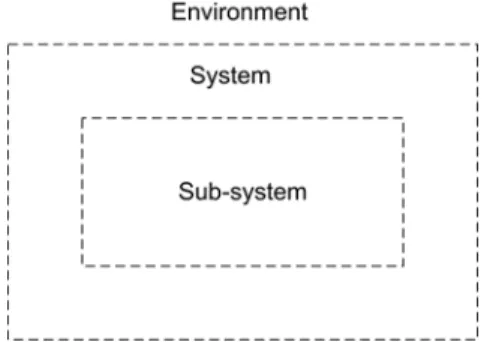
level cannot be classified as the external, as well as the internal context in the situation when evaluation is completed at the business unit level. Case organisations are part of the corporation, so to some extent they influence the corporate level, directly or indirectly. Using the systems view of an organisation (Cleland, et al. 1972) it is possible to treat a business unit (organisation) as sub-system of the larger system (corporation), which is located in the external environment.Figure 3. System view of organisation
To analyse IS evaluation in corporations, the additional layer: a system context, which is located between organisational and external context is proposed. Three context levels include:
• Internal context – an organisation analysed, which could be an independent company, process, large department, or other sub-system with boundaries defined by a researcher
• System context – a closest surrounding of the analysed organisation. The analysed organisation does not have full direct control on the system, but can influence the system, and at the same time is also influenced by the system. In the case organisations it was a corporate context.
• External context – everything around, on which the analysed organisation has little or no control, as defined by (Serafeimidis, et al. 2000).
Three-level context evaluation is required only in the case of more complex organisational structures analysis. To evaluate a single organisation traditional two levels should be enough. 8.1 Context and its impact on IS evaluation
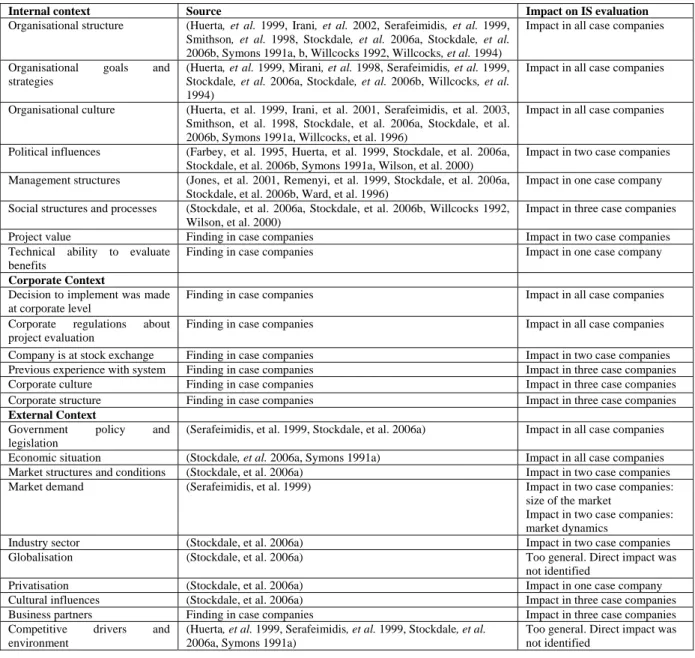
Stockdale, et al. (2006a) listed the internal and external factors which influence evaluation. However the authors conclude that while it is important to understand the context, it is even more important to identify the impact factors that influence IS evaluation. Context, at all levels, in the case companies includes similar issues (first column in Table 1). Also not in all cases the potential impact factors included in the context are influencing the IS evaluation (third column in Table 1). Thus the researcher’s goal is to understand the context and next to identify impact factors, within the context that influence the IS evaluation.
Wojciech Piotrowicz and Zahir Irani
Information Systems evaluation in context– impact of the corporate level
9
Internal context Source Impact on IS evaluation
Organisational structure (Huerta, et al. 1999, Irani, et al. 2002, Serafeimidis, et al. 1999, Smithson, et al. 1998, Stockdale, et al. 2006a, Stockdale, et al. 2006b, Symons 1991a, b, Willcocks 1992, Willcocks, et al. 1994)
Impact in all case companies
Organisational goals and strategies
(Huerta, et al. 1999, Mirani, et al. 1998, Serafeimidis, et al. 1999, Stockdale, et al. 2006a, Stockdale, et al. 2006b, Willcocks, et al. 1994)
Impact in all case companies
Organisational culture (Huerta, et al. 1999, Irani, et al. 2001, Serafeimidis, et al. 2003, Smithson, et al. 1998, Stockdale, et al. 2006a, Stockdale, et al. 2006b, Symons 1991a, Willcocks, et al. 1996)
Impact in all case companies
Political influences (Farbey, et al. 1995, Huerta, et al. 1999, Stockdale, et al. 2006a, Stockdale, et al. 2006b, Symons 1991a, Wilson, et al. 2000)
Impact in two case companies
Management structures (Jones, et al. 2001, Remenyi, et al. 1999, Stockdale, et al. 2006a, Stockdale, et al. 2006b, Ward, et al. 1996)
Impact in one case company
Social structures and processes (Stockdale, et al. 2006a, Stockdale, et al. 2006b, Willcocks 1992, Wilson, et al. 2000)
Impact in three case companies
Project value Finding in case companies Impact in two case companies Technical ability to evaluate
benefits
Finding in case companies Impact in one case company
Corporate Context
Decision to implement was made at corporate level
Finding in case companies Impact in all case companies
Corporate regulations about project evaluation
Finding in case companies Impact in all case companies
Company is at stock exchange Finding in case companies Impact in two case companies Previous experience with system Finding in case companies Impact in three case companies Corporate culture Finding in case companies Impact in three case companies Corporate structure Finding in case companies Impact in three case companies
External Context
Government policy and legislation
(Serafeimidis, et al. 1999, Stockdale, et al. 2006a) Impact in all case companies
Economic situation (Stockdale, et al. 2006a, Symons 1991a) Impact in all case companies Market structures and conditions (Stockdale, et al. 2006a) Impact in two case companies Market demand (Serafeimidis, et al. 1999) Impact in two case companies:
size of the market
Impact in two case companies: market dynamics
Industry sector (Stockdale, et al. 2006a) Impact in two case companies Globalisation (Stockdale, et al. 2006a) Too general. Direct impact was
not identified
Privatisation (Stockdale, et al. 2006a) Impact in one case company Cultural influences (Stockdale, et al. 2006a) Impact in three case companies Business partners Finding in case companies Impact in three case companies Competitive drivers and
environment
(Huerta, et al. 1999, Serafeimidis, et al. 1999, Stockdale, et al. 2006a, Symons 1991a)
Too general. Direct impact was not identified
Table 1. Impact factors within internal, system and external context
8.2 IT/IS context and impact factors
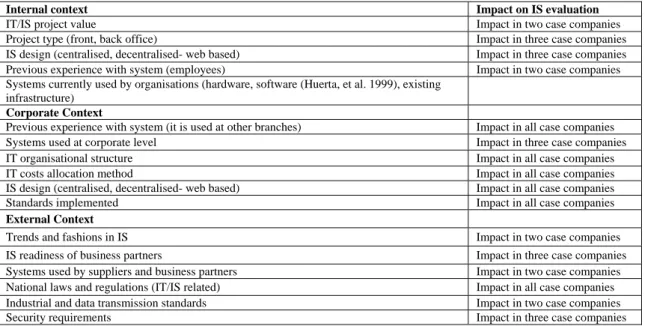
The next proposed modification is the addition of the IT/IS context. An IS evaluation, possibilities to achieve benefits, level and costs categories are strongly related to IT/IS aspects, such as a current level of the IT/IS maturity. Companies that a have higher level of existing systems usage are able more easier to implement new systems or modules, their staff and IT departments have more experience and internal expertise, moreover an existing electronic workflow system helps to measure benefits. Types of the systems used at corporate level determine, and often limit, system selection at the business unit level. From an external point of view, the IT/IS maturity of business partners determine who, and how will use the system. Similarly an IT structure, level of centralisation and cost allocation model had an impact on evaluation. The IT/IS context is a separate aspect, but is an integral part of the contextual analysis that cross other context levels. The concept of IT context is not new and has been covered in the IS literature. Robey, et al. (1996) and Shanks (1997) used a
Wojciech Piotrowicz and Zahir Irani
Information Systems evaluation in context– impact of the corporate level
10
framework developed by Orlikowski (1993), where the IT/IS context was also added. Some researchers incorporated IT/IS related issues into organisational context, such as hardware and software technology (Huerta, et al. 1999), IT strategy (Serafeimidis, et al. 1999) or IT system (Dhillon 2005), but do not separate it. Another issue is also the type of the system under evaluation (Themistocleous, et al. 2004). Smithson, et al. (1998) included IS context, however in the latest CCP framework (Stockdale, et al. 2006a), the IT/IS context is missing. The fieldwork confirmed that it is necessary to clearly distinguish IT/IS context of analysis. Within the IT/IS context the impact factors are included (Table 2), as not in all organisations exactly the same elements of the IT/IS context will play equal impact roles.Internal context Impact on IS evaluation
IT/IS project value Impact in two case companies
Project type (front, back office) Impact in three case companies IS design (centralised, decentralised- web based) Impact in three case companies Previous experience with system (employees) Impact in two case companies Systems currently used by organisations (hardware, software (Huerta, et al. 1999), existing
infrastructure)
Corporate Context
Previous experience with system (it is used at other branches) Impact in all case companies Systems used at corporate level Impact in three case companies IT organisational structure Impact in all case companies IT costs allocation method Impact in all case companies IS design (centralised, decentralised- web based) Impact in all case companies Standards implemented Impact in all case companies
External Context
Trends and fashions in IS Impact in two case companies IS readiness of business partners Impact in three case companies Systems used by suppliers and business partners Impact in two case companies National laws and regulations (IT/IS related) Impact in all case companies Industrial and data transmission standards Impact in two case companies Security requirements Impact in three case companies
Table 2. IT/IS impact factors within internal, system and external context
9
CONCLUSION
The original CCP framework that was composed of internal an external context, the authors added the system context, that can be used in case of evaluation of more complex organisations – such as corporations, or supply chains, where system context is the nearest surrounding of the analysed organisation – the organisation is linked closely with the system, and can influence it directly or indirectly, but does not have full control of it. The authors added also the IT/IS context, that includes all IT/IS related aspects, such as IT usage, standards, technologies and IT staff experience.
The importance of contextual analysis has been growing as the organisations increase their geographical scope of operations, acquire or create new business units in different countries and cultures. The successful implementation of IS, integration with new business units or partners need to considers wider spectrum of factors than those related only to IT. Differences in legal systems, culture and other factors that are listed in the paper should be taken into account when implementing new systems and selecting IS evaluation methods. Research confirmed that even among companies that operate in the similar context there are different factors that influence IS evaluation. However at the same time it was confirmed that in the companies that are part of the larger system, more than only two context levels exist, so the system context should be analysed when preparing IS implementation or evaluating already implemented systems.
Wojciech Piotrowicz and Zahir Irani
Information Systems evaluation in context– impact of the corporate level
11
References
Carroll, J.M. and Swatman, P.A. 2000. 'Structured-case: a methodological framework for building theory in Information Systems research'. European Journal of Information Systems,
9(4): 235-242.
Cleland, D.I. and King, W.R. 1972 'Management: A systems approach', New York, McGraw-Hill Book Company.
Dhillon, G. 2005. 'Gaining benefits from IS/IT implementation: Interpretations from case studies'. International Journal of Information Management, 5(6): 502-515.
Farbey, B., Land, F. and Targett, D. 1999. 'Moving IS evaluation forward: learning themes and research issues'. Journal of Strategic Information Systems, 8(2): 189-207.
Farbey, B., Land, F.F. and Targett, D. 1995. 'A Taxonomy of Information-Systems Applications - the Benefits Evaluation Ladder'. European Journal of Information Systems,
4(1): 41-50.
Huerta, E. and Sanchez, P.J. 1999. 'Evaluation of information technology: strategies in Spanish firms'. European Journal of Information Systems, 8(4): 273-283.
Irani, Z. 2002. 'Information systems evaluation: navigating through the problem domain'.
Information & Management, 40(1): 11-24.
Irani, Z. and Love, P.E.D. 2001. 'Information systems evaluation: past, present and future'.
European Journal of Information Systems, 10(4): 183-188.
Irani, Z. and Love, P.E.D. 2002. 'Developing a frame of reference for ex-ante IT/IS investment evaluation'. European Journal of Information Systems, 11(1): 74-82.
Jones, S. and Hughes, J. 2001. 'Understanding IS evaluation as a complex social process: a case study of a UK local authority'. European Journal of Information Systems, 10(4): 189-203.
Klein, H.K. and Myers, M.D. 1999. 'A set of principles for conducting and evaluating interpretive field studies in information systems'. MIS Quarterly, 23(1): 67-93.
Love, P.E.D., Ghoneim, A. and Irani, Z. 2004. 'Information technology evaluation: classifying indirect costs using structured case method'. Journal of Enterprise Information Management, 17(4): 312-325.
Love, P.E.D., Irani, Z., Ghoneim, A. and Themistocleous, M. 2006. 'An exploratory study of indirect ICT costs using the structured case method'. International Journal of Information Management, 26(2): 167-177.
Mirani, R. and Lederer, A.L. 1998. 'An instrument for assessing the organisational benefits of IS Projects'. Decision Science, 29(4): 803-838.
Myers, M.D. 1997. 'Qualitative research in information systems'. MIS Quarterly, 21(2): 241-242.
Myers, M.D. 2004 Hermeneutics in Information Systems'. in: Social Theory and Philosophy for Information Systems, Mingers J. and L.P. Willcocks (ed.), Chichester, John Wiley & Sons Ltd.
Orlikowski, W.J. 1993. 'Case Tools as Organizational-Change - Investigating Incremental and Radical Changes in Systems-Development'. MIS Quarterly, 17(3): 309-340.
Wojciech Piotrowicz and Zahir Irani
Information Systems evaluation in context– impact of the corporate level
12
Pettigrew, A. 1985 'The awakening giant, continuity and change in ICI', Oxford, Blackwell. Presutti, W.D. 2003. 'Supply management and e-procurement: creating value added in the supply chain'. Industrial Marketing Management, 32(3): 219-226.Remenyi, D. and Sherwood-Smith, M. 1999. 'Maximise information systems value by continuous participative evaluation'. Logistics Information Management, 12(1/2): 14-31. Robey, D. and Sahay, S. 1996. 'Transforming work through information technology: A comparative case study of geographic information systems in county government'.
Information Systems Research, 7(1): 93-110.
Serafeimidis, V. and Smithson, S. 1999. 'Rethinking the approaches to information systems evaluation'. Logistics Information Management, 12(1/2): 94-107.
Serafeimidis, V. and Smithson, S. 2000. 'Information systems evaluation in practice: a case study of organizational change'. Journal of Information Technology, 15(2): 93-105.
Serafeimidis, V. and Smithson, S. 2003. 'Information systems evaluation as an organizational institution - experience from a case study'. Information Systems Journal, 13(3): 251-274. Shanks, G. 1997. 'The challenges of strategic data planning in practice: an interpretive case study'. Journal of Strategic Information Systems, 6(1): 69-90.
Smithson, S. and Hirschheim, R. 1998. 'Analysing information systems evaluation: another look at an old problem'. European Journal of Information Systems, 7(3): 158-174.
Stockdale, R. and Standing, C. 2006a. 'An interpretive approach to evaluating information systems: A content, context, process framework'. European Journal of Operational Research,
173(3): 1090-1102.
Stockdale, R., Standing, C. and Love, P.E.D. 2006b. 'Propagation of a parsimonious framework for evaluating information systems in construction'. Automation in Construction,
15(6): 729-736.
Symons, V.J. 1991a. 'Impacts of Information Systems: Four Perspectives'. Information and Software Technology, 33(3): 181-190.
Symons, V.J. 1991b. 'A review of Information Systems evaluation: content, context and process'. Journal of the Operational Research Society, 1(3): 205-212.
Themistocleous, M., Irani, Z. and Love, P.E.D. 2004. 'Evaluating the integration of supply chain information systems: A case study'. European Journal of Operational Research,
159(2): 393-405.
Ward, J., Taylor, P. and Bond, P. 1996. 'Evaluation and realisation of IS/IT benefits: An empirical of current practice '. European Journal of Information Systems, 4(214-225.
Willcocks, L. 1992. 'Evaluating information technology investment: Research findings and reapprisal'. Journal of Information Systems, 2(4): 243-268.
Willcocks, L. and Lester, S. 1996 The evaluation and management of information systems investments: From feasibility to routine operations.' in: Investing in Information Systems. Evaluation Management, Willcocks L. (ed.), London, Chapman and Hall.
Willcocks, L. and Margets, H. 1994. 'Risk assessment ad information systems'. Operational Research Society, 3(2): 127-138.
Wilson, M. and Howcroft, D. 2000 'The politics of IS evaluation: a social shaping
perspective'. in:
Proceedings of the Twenty-First International Conference on
Wojciech Piotrowicz and Zahir Irani
Information Systems evaluation in context– impact of the corporate level