Task-technology fit aware expectation-confirmation model towards
understanding of MOOCs continued usage
Yuanxin Ouyang1, Cui Tang1, Wenge Rong1, Long Zhang1, Chuantao Yin2, Zhang Xiong1 1School of Computer Science and Engineering, Beihang University, Beijing 100191, China
2Sino-French Engineer School, Beihang University, Beijing 100191, China
{oyyx, tangcui.c, w.rong, zhanglong9527, chuantao.yin, xiongz}@buaa.edu.cn
Abstract
Massive Open Online Courses (MOOCs) have been playing a pivotal role among the latest e-learning ini-tiative and obtain widespread popularity in many uni-versities. But the low course completion rate and the high midway dropout rate of students have puzzled some researchers and designers of MOOCs. Therefore, it is important to explore the factors affecting students’
continuance intention to use MOOCs. This study inte-grates task-technology fit which can explain how the characteristics of task and technology affect the out-come of technology utilization into expectation-confirmation model to analyze the factors influencing
students’ keeping using MOOCs and the relationships
of constructs in the model, then it will also extend our understandings of continuance intention about MOOCs. We analyze and study 234 respondents, and results reveal that perceived usefulness, satisfaction and task-technology fit are important precedents of the intention to continue using MOOCs. Researchers and designers of MOOCs may obtain further insight in con-tinuance intention about MOOCs.
1. Introduction
Massive Open Online Courses (MOOCs) are play-ing an increasplay-ing important role in the field of open and distance education [1], holding the potential to open up access to world class teaching and educational resources beyond geographical and social bounda-ries[63]. Since MOOCs are mostly open and free to all, they have attracted millions of users’ enrollment [2], which improve the modern education, disseminate sci-ence around the globe [3], and provide new sources of data and opportunities for large-scale experiments [4]. As the emergent popularity of MOOCs threatened the institution of higher education [5][6], thousands of university students have been studying on MOOCs platforms [3], with the majority being from North
America or Europe rather than from developing world regions such as Africa and Asia [64].
Although MOOCs have been lauded and used all over the world, it is a fact that cannot be ignored that the low course completion rate and the high midway dropout rate of students widely exist. As is reported, no more than ten percent of registered students can finish the courses on MOOCs [1][7][8][9]. Completion rate may not the best way to evaluate learning in MOOCs, but it does reflect some of the existing issues.
Since there is high enrollment but low courses completion rate in MOOCs, this paper tries to find out the factors influencing students to continue using MOOCs rather than accept MOOCs. Previous re-searches have verify the importance of continuance intention [11][12]. Involving this concept in studying students’ behavior in the adoption of MOOCs, the true factors of success depends on continued use rather than first-time use [13]. Therefore, it is necessary to investi-gate students’ continuance intention to use MOOCs platform [66][67]. There are many reasons that why students cannot continue using MOOCs, such as a lack of incentive, failure to understand the content and a lack of focus on the discussion forum [59]. Some re-searches has examined the openness, reputation and enjoyment [2] that influence MOOC completion. The objective of this research is to identify some factors that influence university students to continue using MOOCs.
In academic study, expectation-confirmation model (ECM) is found to be a robust model for continued IT adoption [10][11]. ECM reveals the variables that in-fluence the continuance usage intention of individuals in the area of information technologies [68]. The varia-bles include perceived usefulness, confirmation, satis-faction and continuance intention. In the past years, researchers have successfully employed ECM with diverse factors to explain users’ continuance intention in different domains, like web-based service [14], smartphone banking services [15] and e-learning [16]. Nevertheless, it employs only three variables to explain Proceedings of the 50th Hawaii International Conference on System Sciences | 2017
behavioral intention, namely satisfaction, confirmation and perceived usefulness, lack of task focus. However, the capability of an information system that support a task can be delivered by the model of task-technology fit (TTF) [17][18][19][20][21].
The model of task-technology fit (TTF) reveals the linkage between information systems and individual performance [20]. The construct of task-technology fit in this model is the central component [18], represent-ing whether or not a technology provides features and support that “fit” the requirements of a task [18][20]. Task means the behaviors that users require to perform to accomplish a goal [72], and technology is the tool to perform tasks [20]. For example, when the teacher ar-ranges a coursework in class, your task is to complete the coursework, and if you want to the complete the coursework, you need some knowledge, and the knowledge is the technology. Past studies have showed the significance of studying the role of TTF in motivat-ing users to continue usmotivat-ing information systems [22] and the influences of TTF on learning [23]. According-ly, we integrate TTF into ECM and try to investigate university students’ continuance intention about MOOCs in this research. As the degree to which the technology offered MOOCs help students in perform-ing their coursework or work, TTF has an antecedent of confirmation and has influence on satisfaction and continuance intention, as with perceived usefulness.
The rest of this paper is organized as follows. Sec-tion 2 presents the basic theory related to this research, including expectation-confirmation model (ECM) and task-technology fit (TTF). In section 3, we will de-scribe the proposed model. Experimental process as well as results are presented in section 4. Section 5 and section 6 will describe discussion for the results and conclusion about the research respectively.
2. Theoretical background
2.1. Expectation-confirmation model (ECM)
Expectation-confirmation model (ECM) was origi-nally presented by Bhattacherjee in 2001 [11]. The model is based on expectation-confirmation theory (ECT) [24], which has been extensively applied to study consumer satisfaction, post-purchase behavior and service marking in general in the consumer behav-ior literature [25][26][27][28]. ECT has also been used in social psychology, sociology, and public policy do-mains [29]. Adapted expectation-confirmation theory (ECT) to the information system (IS) continuance con-text, expectation-confirmation model (ECM) focuses on cognitive beliefs and factors influencing one’s in-tention to continue using information system (IS) [11].
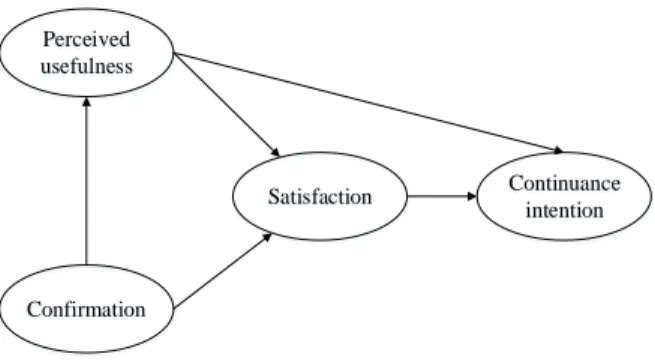
Fig. 1 depicts the constructs and relationships of ECM. Perceived usefulness means the perceptions re-garding what the users will gain by using the infor-mation system, and the confirinfor-mation is the perception of harmony between users’ expectation to the IS and the actual using experience of IS [11]. Satisfaction is the emotion of users after using the IS, and the contin-uance intention is the target of the model, expressing the users’ intention to the continuance usage of the information system [11]. Users’ extent of confirmation has positive effects on their perceived usefulness of IS. Users may accept the IS though they don’t have high initial perceived usefulness to it, then after initial use, they realize their initial perceptions were low and the confirmation experience will elevate users’ perceived usefulness [11][30]. Users’ perceived usefulness and confirmation are positively associated with their satis-faction with IS, which means if users believe the IS is very useful and better than expectation, they will be more satisfied with the IS. Then due to users’ satisfac-tion and perceived usefulness, they will continue using the IS. Confirmation Perceived usefulness Satisfaction Continuance intention
Figure 1. Expectation-confirmation model ECM and its reformation has been widely applied in various IT products and services. Susanto et al. (2016) used ECM, modified to include perceived secu-rity and privacy, trust and self-efficacy to investigate the continuance intention to use the smartphone bank-ing services. The results indicate that the confirmation after the initial use of smartphone banking services significantly influence users’ satisfaction, perceived usefulness, trust and perceived security [31]. Stone and Baker-Eveleth (2013) used ECM to study students’ intention to continue using electronic textbooks, find-ing that confirmation influence perceived usefulness and satisfaction with electronic textbooks and satisfac-tion and perceived usefulness of electronic textbooks affect continuance intention to electronic textbooks [32]. Similarly, Apollos et al. (2016) used an amended ECM to examine continue intention to use mobile in-stant messaging [33]. In a study of continuance inten-tion to using web service with a variainten-tion ECM includ-ing intimacy and familiarity, satisfaction was found
meaningful to continuance intention, and both intimacy and familiarity variables were measured to be im-portant [14].
2.2. Task-technology fit (TTF)
Goodhue and Thompson (1995) proposed task-technology fit model, revealing the linkage between information systems and individual performance [20]. The basic TTF model is composed of four key con-structs: task characteristics, technology characteristics, task-technology fit and utilization [20][35]. Consider-ing the fit between task and technology, task-technology fit is the central components of the model [18]. The fit will determine individual’s performance, when a technology provides features and support that “fit” the requirements of a task [20][34]. In other words, if you supply better technology to a specified task, and the perception of task-technology fit is great, then user will obtain high individual performance to the given task [18].
Empirical studies posited that a better fit between task and technology will yield the expectation of im-proved learning outcome [36][37]. McGill et al. used TTF to reveal that “the better the fit of an LMS to the skills of an instructor and the tasks that the instructor must complete, the more positive its effect on their performance is likely to be” [38]. In research [39], TTF are applied in the context of digital video tools use for oral presentation in a classroom environment, and re-sults indicate that there is a significant fit between digi-tal video tools (technologies) and improvement of oral presentation skills(tasks).
In the present study, the construct of task-technology fit is thought of the perception of individu-als that the technology offered on MOOCS helping students in performing their coursework or work. This perception was tested by the perceived impacts from students’ evaluations.
3. Hypotheses
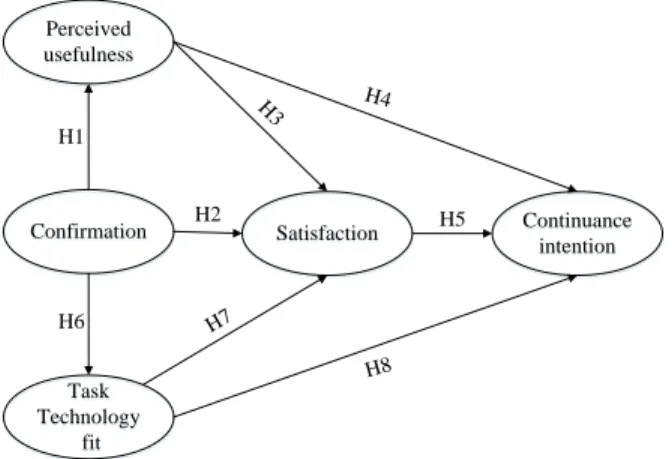
In an effort to understand the students’ intention to continue using MOOCs, we integrate TTF into expec-tation-confirmation model (see Fig. 2). TTF is incorpo-rated in the model to reflect the fit of the task and tech-nology students are learning, which is influenced by the extent of confirmation after initial acceptance, and has a positive influence on satisfaction and continuance intention about MOOCs.
Due to ECM is applied as a baseline model, the re-search measured the ECM hypothesized relationship in the MOOCs. Bhattacherjee indicated that IS usage con-firmation is positively associated with satisfaction and
perceived usefulness. And empirical results revealed an
Confirmation Confirmation Perceived usefulness Perceived usefulness Satisfaction Satisfaction Continuance intention Continuance intention Task Technology fit Task Technology fit H1 H6 H2 H7 H3 H4 H8 H5
Figure 2. The research model
explicit connection between confirmation and satisfac-tion [2][24][40] and perceived usefulness [41][42][43]. Previous studies have confirmed that perceived useful-ness is a robust and direct determinant of continued IS usage intentions [10][11][44]. There is a positive link between perceived usefulness and user satisfaction in research [10][11][12]. Moreover, satisfaction defined as the “perception of enjoyment and accomplishment in learning environment” in web-based learning, has a strong effect on continuance intentions [44][45][46]. In addition, studies [16][17][47] applied ECM to explain and predict users’ continuance intention toward e-learning showing the appropriateness of the study. Since MOOC is a kind of e-learning, we derive the following hypotheses from ECM:
H1. Students’ extent of confirmation has positive
effects on their perceived usefulness of MOOCs.
H2. Students’ extent of confirmation has positive effects on their satisfaction with MOOCs.
H3. Students’ perceived usefulness has positive ef-fects on their satisfaction with MOOCs.
H4. Students’ perceived usefulness has positive ef-fects on their continuance intention about MOOCs.
H5. Students’ satisfaction has positive effects on their continuance intention about MOOCs.
Just like the connection between confirmation and usefulness in ECM [11], students may have low initial perceived task-technology fit of a new MOOC, be-cause they are uncertain what they can get from MOOCs and whether it is benefit to their coursework or work. So the low perceived task-technology fit come into being. But after using the MOOC for a period time, students find that their initial low task-technology fit perceptions are unrealistically low, then they will
improve their perceived task-technology fit owing to the confirmation. To put it another way, confirmation is inclined to raise students’ perceived task-technology fit and disconfirmation will depress such perceptions. Therefore, we hypothesize the following:
H6. Students’ extent of confirmation has positive effects on their perceived task-technology fit.
Goodhue and Thompson (1995) have already re-ported the positive relationship between task-technology fit (TTF) and utilization [20]. Utilization can be perceived as user adoption [48] or as the behav-ioral intention to use [19][49]. Researchers have empir-ically tested the positive link between task-technology fit (TTF) and satisfaction [13]. In this study, this con-struct is integrated to measure students’ satisfaction with the degree to which the knowledge or technology obtained from MOOCs helps their coursework or work. Therefore, we hypothesize the following:
H7. Students’ perceived task-technology fit has positive effects on their satisfaction with MOOCs.
It is revealed that task-technology fit (TTF) and sat-isfaction are significant precedents of the intention to continue using VLS (Virtual Learning System) and individual performance [13]. Researchers have empiri-cally tested that the perceived the ease of use and the degree of usefulness are linked to task-technology fit
[50]. This construct is integrated here to test students’ continue intention to use MOOCs whether links with the degree to which the knowledge or technology ob-tained from MOOCs help their coursework or work. Therefore, we hypothesize the following:
H8. Students’ perceived task-technology fit has positive effects on their continuance intention about MOOCs.
4. Result and Analysis
4.1. Data Collection
The data used to test research model is obtained from questionnaires which are completed by some stu-dents in a university of China from August to October in last year. The MOOCs that the students in this uni-versity experienced are in two categories, one is that they are mandatory to use it, because they need to sat-isfy courses’ need, the other is that they use it by them-selves, because they want to learn some useful knowledge or technologies on it. The questionnaire items were written in English to avoid issues with translation, designed into two parts. The first part is the main body of the questionnaire, consisting of 15 ques-tions to measure the 5 constructs. Every question uti-lizes a seven-point scales with anchors from “Strongly disagree (1)” to “Strongly agree (7)”. The second part Table 1. Survey items
Constructs Items Measures Reference
Perceived usefulness(PU) PU1 PU2 PU3
Using MOOCs improves my learning performance. Using MOOCs increases my learning effectiveness. I find MOOCs is useful for me.
Roca et al. [51]
Confirmation(CNF) CNF1 CNF2 CNF3
My experience with using MOOCs was better than I ex-pected.
The service level provided by MOOCs was better than I expected.
Overall, most of my expectations from using MOOCs were confirmed. Bhattacherjee [11] Task-technology fit(TTF) TTF1 TTF2 TTF3
I think that using MOOCs would be well suited for the way I like to study tasks.
MOOCs would be a good tool to provide the way I like to study tasks.
Using MOOCs fit well for the way I like to study tasks.
Lee et al. [18]
Satisfaction(SAT)
SAT1 SAT2 SAT3
How do you feel about your overall experience with MOOCs use?
Very dissatisfied/Very satisfied Very frustrated/Very contented
Absolutely terrible/Absolutely delighted
Bhattacherjee [11]
Continuance intention(CI) CI1 CI2 CI3
I will continue using MOOCs in the future.
I will strongly recommend MOOCs for others to use it. I will keep using MOOCs as regularly as I do now.
Roca et al. [51] Chiu et al. [45]
consisting of 4 questions to investigate the background information of the informants, such as gender, age group, MOOCs platforms they used, and the number of courses they have finished. We conducted the survey with financial rewarding to encourage students to com-plete the questionnaire exploring their use of MOOCs. The questionnaires were distributed in different places at different time in the university. We received a total of 267 responses, and for the sake of the quality of the data, then we discard some responses that fit following criteria: 1) Respondents never or just use MOOCs. 2) Respondents have wrong or paradoxical answers. Fi-nally, there were 234 valid questionnaire responses and it is regarded as an effective data set.
4.2. Model Measurement
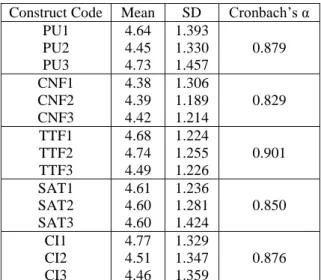
The reliability of the original data was evaluated by Cronbach’s α to measure internal consistency. The mean, standard deviation of each question and Cronbach’s α of each construct is shown in Table 2. As listed in Table 2, each of the Cronbach’s α is above the recommended value 0.7 [52]. The result indicates that subscales in the survey have a high internal reliability.
Table 2. Question standardization and reliability analysis
Construct Code Mean SD Cronbach’s α PU1 PU2 PU3 4.64 4.45 4.73 1.393 1.330 1.457 0.879 CNF1 CNF2 CNF3 4.38 4.39 4.42 1.306 1.189 1.214 0.829 TTF1 TTF2 TTF3 4.68 4.74 4.49 1.224 1.255 1.226 0.901 SAT1 SAT2 SAT3 4.61 4.60 4.60 1.236 1.281 1.424 0.850 CI1 CI2 CI3 4.77 4.51 4.46 1.329 1.347 1.359 0.876
Bartlett’s testing of sphericity and the Kaiser-Meyer-Olkin (KMO) of Sampling Adequacy were cal-culated for all measured factors to test the adequacy of data [53] before factor analysis. The results statics of χ2(234) = 2680.322(p<0.000) and the KMO measure = 0.939(>0.500), which supplied the suitability of con-ducting factor analysis.
The purpose of assessing construct validity of the measurement model is to exam whether the sample
data support empirically for the proposed model. And construct validity is divided into convergent validity
and discriminant validity. Fornell and Larcker [54] suggested that convergent validity is evidenced when 1) all of the item factor loadings (λ) are above 0.5 [17], 2) the composite reliability (CR) of each construct should be greater than 0.7 [2][55], 3) the average vari-ance extracted (AVE) should exceed 0.5 [2][17][55]. As seen in Table 3, all of the item factor loadings (λ), the composite reliability (CR) of each construct and the average variance extracted (AVE) satisfy the recom-mended threshold values.
Table 3. Model measurement Construct Code Item loading(λ) CR AVE
PU1 PU2 PU3 0.731 0.704 0.725 0.764 0.519 CNF1 CNF2 CNF3 0.735 0.796 0.607 0.758 0.514 TTF1 TTF2 TTF3 0.641 0.795 0.681 0.750 0.502 SAT1 SAT2 SAT3 0.556 0.793 0.847 0.782 0.552 CI1 CI2 CI3 0.647 0.797 0.809 0.797 0.569
Discriminant validity was tested comparing the square root of average variance extracted (AVE) for each construct and the correlations between any other constructs [54]. Only when the square root of average variance extracted (AVE) for each construct is bigger than the correlations between any other construct then the constructs in the model meet the discriminant va-lidity [54]. The results are illustrated in Table 4, and values in the diagonal are the square root of AVE, which is greater than the inner-construct correlations.
Table 4. Correlation matrix and discriminant validity PU CNF TTF SAT CI PU 0.720 CNF 0.669 0.717 TTF 0.699 0.689 0.709 SAT 0.649 0.702 0.668 0.743 CI 0.691 0.675 0.702 0.679 0.756
4.3. Hypotheses tests
Table 5 illustrates the statistics of the chi-square to degrees of freedom ratio (χ2/df), the normed fit index (NFI), the Non-Normed Fit Index (NNFI), the
good-ness-of-fit-index (GFI), the comparative fit index (CFI), and the root mean square error of approximation (RMSEA). The results of the indices exceed the rec-ommended value [56][57][58], indicating that the re-search model provides a good fit to the data. Then it is supported to proceed to path analysis for the proposed model.
Table 5. Overall indices for the research model Results Recommended value χ2/df 2.070 <3.0 NFI 0.941 >0.90 NNFI 0.958 >0.90 GFI 0.920 >0.90 CFI 0.968 >0.90 RMSEA 0.068 ≤0.08
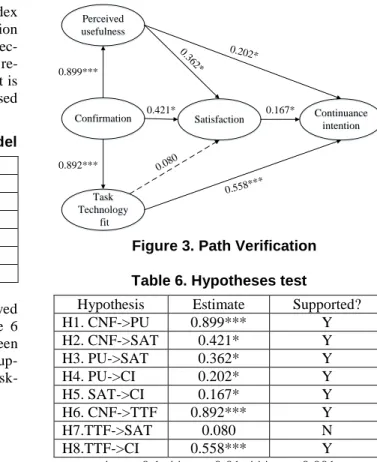
Structural equation modeling (SEM) was employed to test the proposed hypotheses. Fig. 3 and Table 6 depict the eight hypothesized relationships between diverse factors. Note that the results significantly sup-port all hypotheses except the link between task-technology fit and satisfaction.
5. Discussion
This study posits a conceptual framework integrat-ing task-technology fit (TTF) into expectation-confirmation model (ECM) to analyze the factors that enhance university students’ intention to continue us-ing MOOCs. Empirical results provide significant sup-port to the proposed model, indicating ECM can better explain and predict students’ continuance intention about MOOCs. Besides, it is also found that task-technology fit do influence students’ intention to con-tinue using MOOCs systems indeed.
It is not surprising to find the hypotheses in ECM are all supported. Students’ extent of confirmation de-riving from the performance of MOOCs and initial expectation to the MOOCs is essential determined of perceived usefulness as well as satisfaction with MOOCs. Satisfaction, in turn, will significantly con-tribute to continuance intention about MOOCs. These findings correspond to previous research [11]. From the results, we also prove the direct influence of per-ceived usefulness on students’ satisfaction and contin-uance intention about MOOCs. It is obvious that when students believe studying on MOOCs platforms will be useful in improving their capability or helpful for them to find new jobs, they will tend to continue using MOOCs [59]. Therefore, it is important for MOOCs platforms to enhance the quality of courses to improve students’ perceived usefulness.
Confirmation Confirmation Perceived usefulness Perceived usefulness Satisfaction Satisfaction Continuance intention Continuance intention Task Technology fit Task Technology fit 0.899*** 0.892*** 0.421* 0.080 0.3 62* 0.202* 0.558*** 0.167* Figure 3. Path Verification
Table 6. Hypotheses test
Hypothesis Estimate Supported? H1. CNF->PU 0.899*** Y H2. CNF->SAT 0.421* Y H3. PU->SAT 0.362* Y H4. PU->CI 0.202* Y H5. SAT->CI 0.167* Y H6. CNF->TTF 0.892*** Y H7.TTF->SAT 0.080 N H8.TTF->CI 0.558*** Y *: p < 0.1, **: p < 0.01, ***: p < 0.001 It is observed that the strong correlation between confirmation and task-technology fit, suggesting that students’ perceived task-technology fit to MOOCs may be adjusted by their extent of confirmation. Further, task-technology fit plays a very important role in ana-lyzing student’ continuance intention about MOOCs in this study, which is similar with the study [13]. This result reveals that the fit between knowledge or tech-nology in MOOCs and the task, work or coursework that students are facing with now, can highly influence their intention to continue using MOOCs. Considering that, supplying some courses related to the technology that students are learning in class or be helpful in find-ing jobs are vital factors in success of MOOCs plat-forms. Once students recognize they accomplish tasks more quickly, improve their job performance or en-hance their job effectiveness [13] assisted by MOOCs, there is a greater tendency to continue using MOOCs.
A significant relationship does not exist between task-technology fit and satisfaction in our study. Satis-faction with web-based learning was defined as the “perception of enjoyment and accomplishment in learning environment” by Sweeney and Ingram [60]. This finding reminds us university students studying on MOOCs may not get much enjoyment and achieva-bility. At the beginning, students have passion to use MOOCs, but with passion consuming, they may feel
boring and tedious about MOOCs. Nevertheless, stu-dents are aware of courses on MOOCs may assist their work or coursework, then they have no choice but to continue using MOOCs despite the perceived dissatis-faction. But it is still significant for MOOCs platforms to be more attractive, since some students may drop out in half way as they cannot stand dull atmosphere and there are low completion rates in MOOCs.
6. Conclusions, implications, and future
work
Massive Open Online Courses (MOOCs) play an increasing important role in educational area, but the high dropout rate of courses on MOOCs bothers some MOOCs’ designers. Researchers have found that there are many factors affecting students’ using MOOCs, like hope, enjoyment, effectiveness and instructor in-teraction in diverse approaches [61][62][65]. This pa-per integrates task-technology fit into expectation-confirmation model to analyze factors influencing uni-versity students to keep using MOOCs. We analyze 234 valid responses and results verify the effect of ECM and TTF on students’ intention to keep using MOOCs, especially the fit between task and technolo-gy playing a vital role in improving students’ continu-ance intention to the MOOCs.
In the area of information system, the exploration of continuance is very worthwhile and is more vital than the acceptance behavior, which is the one-time behavior [41]. Especially in the field of e-learning, learning is a long process, while patience and persis-tence are necessary. Therefore, how to attract more loyalty users will be critical to the designers and re-searchers of MOOCs. ECM is a theoretically rich mod-el in the research of post-acceptance in consumer be-havior literature[41], and the extension of ECM in the area of information system, including the research of MOOCs, are also very vital.
This research makes a better understanding of stu-dents’ continuance intention about MOOCs, providing valuable suggestions or solutions to designers of MOOCs platforms that providing some courses in-volved the technology that students are learning in class or be beneficial to find jobs may contribute to attract students to keep using MOOCs. The key is to supply some courses or activities that can help univer-sity students to do their work or task exactly. Once students find the MOOC is very useful to their career, then they will always choose MOOCs to learn knowledge and technologies, and they will be loyalty to MOOCs. Therefore, perceived usefulness and task-technology fit are vital consideration in the design of MOOCs.
Although our study provides some significant con-tributions, it has some limitations that should be taken into consideration. First, there are a variety of factors that can influence university students to keep using MOOCs, such as perceived openness, perceived repu-tation, perceived enjoyment and etc., and the research model only takes the fit degree between task and tech-nology into consideration. Thus the model can be inte-grated into more appropriate factors to discuss the con-tinuance of using MOOCs in future work. On the other hand, the object of study can expand to ordinary people rather than only among university students, and it is believed be more interesting and significant in the fu-ture.
7. Acknowledgements
This work was partially supported by the National Natural Science Foundation of China (No. 61402028), the Fundamental Research Funds for the Central Uni-versities, and the Fanzhou Education projects of Bei-hang University.
8. References
[1]A. D. Ho, J. Reich, S. O. Nesterko, and et al. HarvardX and MITx: The First Year of Open Online Courses, Fall 2012-Summer 2013, Social Science Electronic Publishing, 2014.
[2]K. M. Alraimi, H. Zo, and A. P. Ciganek, “Understanding the MOOCs continuance: The role of openness and reputa-tion”, Computers & Education, 2015, 80:28-38.
[3]R. A. Rehfeldt, H. L. Jung, A. Aguirre, and et al. “Begin-ning the Dialogue on the e-Transformation: Behavior Analy-sis’ First Massive Open Online Course (MOOC)”, Gait & Posture, 2016, 9(1):4-13.
[4]J. Reich, “Rebooting MOOC Research”, Science, 2015, 347:34-35.
[5]L. Yuan, and S. Powell, “MOOCs and Open Education: Implications for Higher Education”, Centre for Educational Technology & Interoperability Standards, 2013, 4(4):206-207.
[6]H. C. Lucas, “Can the Current Model of Higher Educa-tion Survive MOOCs and Online Learning”, Educause Re-view, 2013, 48(5):8.
[7]L. Breslow, D. E. Pritchard, J. Deboer, and et al. “Study-ing Learn“Study-ing in the Worldwide Classroom Research into edX's First MOOC”, Research & Practice in Assessment, 2013, 8:13-25.
[8]K. Jordan, “Initial Trends in Enrolment and Completion of Massive Open Online Courses”, International Review of Research in Open & Distance Learning, 2014, 15(15):133-160.
[9]S. Kolowich, The professors who make the MOOCs, Chronicle of Higher Education, 2013.
[10]A. Bhattacherjee, “An empirical analysis of the anteced-ents of electronic commerce service continuance”, Decision support systems, 2001, 32(2): 201-214.
[11]A. Bhattacherjee, “Understanding information systems continuance: an expectation-confirmation model”, MIS quar-terly, 2001: 351-370.
[12]A. Bhattacherjee, J. Perols, and C. Sanford, “Infor-mation technology continuance: A theoretic extension and empirical test”, Journal of Computer Information Systems, 2008, 49(1): 17-26.
[13]W. S. Lin, “Perceived fit and satisfaction on web learn-ing performance: IS continuance intention and task-technology fit perspectives”, International Journal of Human-Computer Studies, 2012, 70(7): 498-507.
[14]Y. Lee, and O. Kwon, “Intimacy, familiarity and contin-uance intention: An extended expectation–confirmation model in web-based services”, Electronic Commerce Re-search and Applications, 2011, 10(3): 342-357.
[15]A. Susanto, Y. Chang, and Y. Ha, “Determinants of continuance intention to use the smartphone banking services: An extension to the expectation-confirmation model”, Indus-trial Management & Data Systems, 2016, 116(3): 508-525. [16]C. H. Ho, “Continuance intention of e-learning platform: Toward an integrated model”. International Journal of Elec-tronic Business Management, 2010, 8(3): 206.
[17]M. C. Lee, “Explaining and predicting users’ continu-ance intention toward e-learning: An extension of the expec-tation–confirmation model”, Computers & Education, 2010, 54(2): 506-516.
[18]D. Y. Lee, and M. R. Lehto, “User acceptance of YouTube for procedural learning: An extension of the Tech-nology Acceptance Model”, Computers & Education, 2013, 61: 193-208.
[19]M. T. Dishaw, and D. M. Strong, “Extending the tech-nology acceptance model with task–techtech-nology fit con-structs”, Information & management, 1999, 36(1): 9-21. [20]D. L. Goodhue, and R. L. Thompson, “Task-technology fit and individual performance”, MIS quarterly, 1995: 213-236.
[21]D. M. Strong, M. T. Dishaw, and D. B. Bandy, “Extend-ing task technology fit with computer self-efficacy”, ACM SIGMIS Database, 2006, 37(2-3): 96-107.
[22]T. J. Larsen, A. M. Sørebø, and Ø. Sørebø, “The role of task-technology fit as users’ motivation to continue infor-mation system use”, Computers in Human Behavior, 2009, 25(3): 778-784.
[23]T. J. McGill, and J. E. Klobas, “A task–technology fit view of learning management system impact”, Computers & Education, 2009, 52(2): 496-508.
[24]R. L. Oliver, “A cognitive model of the antecedents and consequences of satisfaction decisions”, Journal of marketing research, 1980: 460-469.
[25]E. W. Anderson, and M. W. Sullivan, “The antecedents and consequences of customer satisfaction for firms”, Mar-keting science, 1993, 12(2): 125-143.
[26]J. E. McGrath, and J. R. Kelly, Time and human interac-tion: Toward a social psychology of time, Guilford Press, 1986.
[27]R. L. Oliver, “Cognitive, affective, and attribute bases of the satisfaction response”, Journal of consumer research, 1993: 418-430.
[28]L. E. Sandelancls, and G. C. Buckner, “Of art and work: Aesthetic experience and the psychology of work feelings”, Research in organizational behavior, 1989, 100: l05-l3l. [29]M. A. Hossain, and M. Quaddus, “Expectation– confirmation theory in information system research: A re-view and analysis”, Information systems theory, Springer New York, 2012: 441-469.
[30]S. Halilovic, and M. Cicic, “Antecedents of information systems user behaviour – extended expectation-confirmation model”, Behaviour & Information Technology, 2013, 32(4):359-370.
[31]A. Susanto, Y. Chang, and Y. Ha, “Determinants of continuance intention to use the smartphone banking services: An extension to the expectation-confirmation model”, Indus-trial Management & Data Systems, 2016, 116(3): 508-525. [32]R. W. Stone, and L. Baker-Eveleth, “Students’ expecta-tion, confirmaexpecta-tion, and continuance intention to use electron-ic textbooks”, Computers in Human Behavior, 2013, 29(3):984-990.
[33]A. P. Oghuma, C. F. Libaque-Saenz, S. F. Wong, and et al. “An expectation-confirmation model of continuance in-tention to use mobile instant messaging”, Telematics and Informatics, 2016, 33(1): 34-47.
[34]M. Pagani, “Determinants of adoption of high speed data services in the business market: evidence for a combined technology acceptance model with task technology fit mod-el”, Information & Management, 2006, 43(7): 847-860. [35]T. C. Lin, and C. C. Huang. “Understanding knowledge management system usage antecedents: An integration of social cognitive theory and task technology fit”, Information & Management, 2008, 45(6): 410-417.
[36]A. D. Carswell, and V. Venkatesh, “Learner outcomes in an asynchronous distance education environment”, Inter-national Journal of Human-Computer Studies, 2002, 56(5): 475-494.
[37]T. J. McGill, and J. E. Klobas, “A task–technology fit view of learning management system impact”, Computers & Education, 2009, 52(2): 496-508.
[38]T. McGill, J. Klobas, and S. Renzi, “LMS use and in-structor performance: The role of task-technology fit”, Inter-national Journal on E-Learning, 2011, 10(1): 43-62.
[39]A. Raven, E. Leeds, and C. W. Park, “Digital video presentation and student performance: A task technology fit perspective”, International Journal of Information and Com-munication Technology Education (IJICTE), 2010, 6(1): 17-29.
[40]R. L. Oliver, and W. S. Desarbo, “Response Determi-nants in Satisfaction Judgments”, Journal of Consumer Re-search, 1988, 14(4):495-507.
[41]C. S. Lin, S. Wu, and R. J. Tsai, “Integrating perceived playfulness into expectation-confirmation model for web portal context”, Information & management, 2005, 42(5): 683-693.
[42]Q. Min, and X. Shenghua, “An extended expectation confirmation model for information systems continuance”, Wireless Communications, Networking and Mobile Compu-ting, 2007: 3879-3882.
[43]S. J. Hong, J. Y. L. Thong, and K. Y. Tam, “Under-standing continued information technology usage behavior: A comparison of three models in the context of mobile inter-net”, Decision support systems, 2006, 42(3): 1819-1834. [44]K. Y. Lin, and H. P. Lu, “Why people use social net-working sites: An empirical study integrating network exter-nalities and motivation theory”, Computers in Human Behav-ior, 2011, 27(3): 1152-1161.
[45]C. M. Chiu, M. H. Hsu, S. Y. Sun, and et al. “Usability, quality, value and e-learning continuance decisions”, Com-puters & Education, 2005, 45(4): 399-416.
[46]A. Hayashi, C. Chen, T. Ryan, and et al. “The role of social presence and moderating role of computer self efficacy in predicting the continuance usage of e-learning systems”, Journal of Information Systems Education, 2004, 15(2): 139. [47]J. Wu, R. J. Tsai, C. C. Chen, and et al. “An integrative model to predict the continuance use of electronic learning systems: hints for teaching”, International Journal on ELearn-ing, 2006, 5(2): 287.
[48]T. Zhou, Y. Lu, and B. Wang, “Integrating TTF and UTAUT to explain mobile banking user adoption”, Comput-ers in human behavior, 2010, 26(4): 760-767.
[49]D. C. Yen, C. S. Wu, F. F. Cheng, and et al. “Determi-nants of users’ intention to adopt wireless technology: An empirical study by integrating TTF with TAM”, Computers in Human Behavior, 2010, 26(5): 906-915.
[50]H. H. Chang, “Task-technology fit and user acceptance of online auction”, International Journal of Human-Computer Studies, 2010, 68(1): 69-89.
[51]J. C. Roca, C. M. Chiu, and F. J. Martínez, “Understand-ing e-learn“Understand-ing continuance intention: An extension of the Technology Acceptance Model”, International Journal of human-computer studies, 2006, 64(8): 683-696.
[52]J. C. Nunnally, I. H. Bernstein, and J. M. F. Berge, Psy-chometric theory, New York: McGraw-Hill, 1967.
[53]J. F. Hair, W. C. Black, B. J. Babin, and et al. Multivari-ate data analysis, Upper Saddle River, NJ: Pearson Prentice Hall, 2006.
[54]C. Fornell, and D. F. Larcker, “Evaluating structural equation models with unobservable variables and measure-ment error”, Journal of marketing research, 1981: 39-50. [55]M. K. O. Lee, C. M. K. Cheung, and Z. Chen, “Ac-ceptance of Internet-based learning medium: the role of ex-trinsic and inex-trinsic motivation”, Information & management, 2005, 42(8): 1095-1104.
[56]D. Gefen, D. Straub, and M. C. Boudreau, “Structural equation modeling and regression: Guidelines for research practice”, Communications of the association for information systems, 2000, 4(1): 7.
[57]P. M. Bentler, and D. G. Bonett, “Significance tests and goodness of fit in the analysis of covariance structures”, Psy-chological bulletin, 1980, 88(3): 588.
[58]R. Nargundkar, Marketing Research-Text & Cases 2E, Tata McGraw-Hill Education, 2003.
[59]K. F. Hew, and W. S. Cheung, “Students’ and instruc-tors’ use of massive open online courses (MOOCs):
Motiva-tions and challenges”, Educational Research Review, 2014, 12: 45-58.
[60]J. C. Sweeney, and D. Ingram, “A comparison of tradi-tional and web-based tutorials in marketing education: An exploratory study”, Journal of Marketing Education, 2001, 23(1): 55-62.
[61]J. Dillon, G. A. Ambrose, N. Wanigasekara, and et al. “Student affect during learning with a MOOC”, Proceedings of the Sixth International Conference on Learning Analytics & Knowledge, ACM, 2016: 528-529.
[62]G. Veletsianos, and P. Shepherdson, “A Systematic Analysis and Synthesis of the Empirical MOOC Literature Published in 2013–2015”, The International Review of Re-search in Open and Distributed Learning, 2016, 17(2). [63]K. S. Hone, and G. R. E. Said, “Exploring the factors affecting MOOC retention: A survey study”, Computers & Education, 2016, 98:157-168.
[64]T. R. Liyanagunawardena, A. A. Adams, and S. A. Wil-liams, “MOOCs: A systematic study of the published litera-ture 2008-2012”, The International Review of Research in Open and Distributed Learning, 2013, 14(3): 202-227. [65]P. G. Barba, G. E. Kennedy, and M. D. Ainley, “The role of students' motivation and participation in predicting performance in a MOOC Motivation and participation in MOOCs”, Journal of Computer Assisted Learning, 2016. [66]J. A. Greene, C. A. Oswald, and J. Pomerantz, “Predic-tors of retention and achievement in a massive open online
course”, American Educational Research Journal, 2015: 0002831215584621.
[67]S. I. Freitas, J. Morgan, and D. Gibson, “Will MOOCs transform learning and teaching in higher education? En-gagement and course retention in online learning provision”, British Journal of Educational Technology, 2015, 46(3): 455-471.
[68]G. Dağhan, and B. Akkoyunlu, “Modeling the continu-ance usage intention of online learning environments”, Com-puters in Human Behavior, 2016, 60: 198-211.
[69]D. M. Eveleth, L. J. Baker-Eveleth, and R. W. Stone, “Potential applicants’ expectation-confirmation and inten-tions”, Computers in Human Behavior, 2015, 44(C):183-190. [70]C. Mingmuang, V. Chongsuphajaisiddhi, and B. Papas-ratorn, “Factors influencing continuance intention to use PSTN: A pilot study of an extended expectation confirmation model for legacy technology”, 2015 Seventh International Conference on Ubiquitous and Future Networks, IEEE, 2015: 874-878.
[71]C. F. Fang, D. G. Lee, and K. S. Han, “A Study on the Effect of Contents Characteristics and Operating Service Quality in Continued Usage Intention and Word of Mouth: Focus on Online Sports Game”, Journal of Korea Game So-ciety, 2015, 15(1): 101-114.
[72] R. M. Fuller, and A. R. Dennis, “Does Fit Matter? The Impact of Task-Technology Fit and Appropriation on Team Performance in Repeated Tasks”, Information Systems Re-search, 2009, 20(1):2-17.