Cryptanalysis of Dynamic SHA(2)
Jean-Philippe Aumasson1,∗, Orr Dunkelman2,†, Sebastiaan Indesteege3,4,‡,
and Bart Preneel3,4 1
FHNW, Windisch, Switzerland.
2 ´
Ecole Normale Sup´erieure, INRIA, CNRS, Paris, France.
3
Department of Electrical Engineering ESAT/COSIC, Katholieke Universiteit Leuven, Belgium.
4
Interdisciplinary Institute for BroadBand Technology (IBBT), Belgium.
Abstract. In this paper, we analyze the hash functions Dynamic SHA and Dynamic SHA2, which have been selected as first round candidates in the NIST hash function competition. These hash functions rely heav-ily on data-dependent rotations, similar to certain block ciphers, e.g., RC5. Our analysis suggests that in the case of hash functions, where the attacker has more control over the rotations, this approach is less favor-able than in block ciphers. We present practical, or close to practical, collision attacks on both Dynamic SHA and Dynamic SHA2. Moreover, we present a preimage attack on Dynamic SHA that is faster than ex-haustive search.
Key words:Dynamic SHA, Dynamic SHA2, SHA-3 candidate, hash function, collision attack.
1
Introduction
New generic cryptanalytic techniques for hash functions [1, 2] and the recent results on MD5 and SHA-1 [3–5], along with the fact that the SHA-2 family of hash functions was designed with a similar structure, have led to the initiation of the NIST hash function competition [6], a public competition to develop a new hash standard, which will be called SHA-3.
The competition has sparked a great deal of submissions: 64 new hash func-tion proposals were submitted to the competifunc-tion, of which 51 were accepted as meeting the submission criteria for the first round. Among the 51 candidates, Dynamic SHA and Dynamic SHA2 stand out as a combination of the SHA family design with data-dependent rotations.
The concept of data-dependent rotations has been explored for block ciphers in several constructions, most notably in the RC5 and RC6 block ciphers [7, 8].
∗Supported by the Swiss National Science Foundation, project no. 113329. †This author was supported by the France Telecom chaire.
The security of such block ciphers has been challenged many times, and a ma-jority of attacks is based on guessing the distances of the rotations. In crypt-analysis of hash functions, however, the internal state is known. The attacker even has control over (parts of) the internal state, including rotations, though sometimes this control is only indirect. For example, Mendel et al. [9] exploited data-dependent rotations to find collisions for the hash function of Shin et al. [10]. Our attacks on Dynamic SHA and Dynamic SHA2 also exploit data-dependent rotations, to find (second) preimages and collisions.
2
Brief Description of Dynamic SHA and Dynamic SHA2
Dynamic SHA and Dynamic SHA2 use similar building blocks, but have different compression functions. This section gives a brief description of these algorithms. Dynamic SHA and Dynamic SHA2 follow a classical Merkle-Damg˚ard con-struction, based on a compression function that maps an 8-word chaining value and a 16-word message to a new 8-word chaining value. The 256-bit versions use 32-bit words, and the 512-bit versions use 64-bit words. We focus on the 256-bit versions, also called Dynamic SHA-256 and Dynamic SHA2-256. See [11, 12] for details on the 512-bit versions, Dynamic SHA-512 and Dynamic SHA2-512. The following presents a bottom-up description of the compression function, thus starting with its building blocks.
The symbol⊕stands for exclusive OR (XOR),∧for logical AND,∨for logical OR, and + for integer addition. Numbers in hexadecimal basis are written in typewriter font (e.g., FF= 255). We count bit indices starting from zero at the least significant bit (LSB). Thus, the first bit of a word w is written as w0, and more generally we use the notation wi for the bit i of the word w. The most significant bit (MSB) of w is thus w31
for Dynamic SHA-256, and w63 for Dynamic SHA-512. Note that the i-th bit of a word corresponds to the bit number i−1, since we start counting from zero.
2.1 Building Blocks
The functionGtakes as input three wordsx1, x2, x3and an integert∈ {0,1,2,3}, and returns one word, computed as follows:
Gt(x1, x2, x3) =
x1⊕x2⊕x3 ift= 0 (x1∧x2)⊕x3 ift= 1 (x1∧x2)⊕x3⊕ ¬x1 ift= 2 (x1∧x2)⊕x3⊕ ¬x2 ift= 3
.
Note that this definition is simplified, but equivalent to the original in [11, 12]. The functionR takes as input eight wordsx1, . . . , x8 and an integer t, and returns one word computed as follows:
t0←(((((x1+x2)⊕x3) +x4)⊕x5) +x6)⊕x7 t1←((t0≫17)⊕t0)∧0001FFFF
t2←((t1≫10)⊕t1)∧000003FF t3←((t2≫ 5)⊕t2)∧0000001F returnx8≫t3
Finally, theCOMPfunction takes as input eight wordsa, . . . , hrepresenting the
internal state, eight message wordsw0, . . . , w7, orw8, . . . , w15, and an integert.
COMPupdates the internal state as follows (in the 256-bit versions):
T ←R(a, . . . , h, wtmod 32) T ←R(a, . . . , h,(wt≫15) mod 32) h←g h←g+wt+7
g←f ≫((wt≫ 5) mod 32) g←f ≫((wt≫20) mod 32)
f ←e+wt+3 f ←e+wt+6
e←d≫((wt≫10) mod 32) e←d≫((wt≫25) mod 32)
d←Gwt≫30(a, b, c) +wt+2 d←Gtmod 4(a, b, c) +wt+5
c←b c←b+wt
b←a b←a
a←T+wt+1 a←T+wt+4
2.2 Compression Functions
Given a chaining valueh0, . . . , h7and a message blockw0, . . . , w15, the compres-sion function of Dynamic SHA (Dynamic SHA2, respectively) produces a new chaining value, as described in Algorithm 1 (Algorithm 2, resp.).
The compression function of Dynamic SHA is composed of an initialization, an iterative part of 48 rounds, and a feedforward of the initial chaining value. It uses three constantsT T0, T T1, T T2.
The compression function of Dynamic SHA2 is composed of an initialization followed by three iterative parts, and finally by a feedforward. Note that, when calling COMP with the message words w8, . . . , w15 and an integert, wt stands
for w8, wt+1 stands for w9, etc. Dynamic SHA2 surprisingly enough, uses no constants.
3
Collision Attack on Dynamic SHA
Algorithm 1Compression function of Dynamic SHA.
Initialization
a=h0 b=h1 c=h2 d=h3 e=h4 f=h5 g=h6 h=h7
Iterative part
fort= 0,1. . . ,47
T ←R1(a, b, c, d, e, f, g, h)
U ←G(a, b, c, tmod 4) +wtmod 16+T Tt≫4
(a, b, c, d, e, f, g, h)←(T, a, b, U, d, e, f, g)
Feedforward
h0←h0+a h1←h1+b h2←h2+c h3←h3+d
h4←h4+e h5←h5+f h6←h6+g h7←h7+h
Algorithm 2Compression function of Dynamic SHA2.
Initialization
a=h0 b=h1 c=h2 d=h3 e=h4 f=h5 g=h6 h=h7
First iterative part
COMP(a, b, c, d, e, f, g, h, w0, w1, . . . , w7,0) COMP(a, b, c, d, e, f, g, h, w8, w9, . . . , w15,0)
Second iterative part
fort= 0,1. . . ,8
T ←R1(a, b, c, d, e, f, g, h)
(a, b, c, d, e, f, g, h)←(T, a, b, c, d, e, f, g)
Third iterative part
fort= 1,2. . . ,7
COMP(a, b, c, d, e, f, g, h, w0, w1, . . . , w7, t) COMP(a, b, c, d, e, f, g, h, w8, w9, . . . , w15, t)
Feedforward
h0←h0+a h1←h1+b h2←h2+c h3←h3+d
3.1 A Differential Property of the Function R1
To overcome the obstacle of data-dependent rotation, our attack ensures that no difference occurs in any of the data-dependent rotation amounts. This section clarifies how to achieve this.
The data-dependent rotations are located in the 8-input function R1. For Dynamic SHA-256, consider the difference ∆ = 80004000, i.e., only bits 31 and 14 are set. Let one of the first seven inputs to the function R1 have this difference, i.e., one of x1, . . . , x7. In the first step of R1, an intermediary word t0is computed as follows:
t0←((((((x1+x2)⊕x3) +x4)⊕x5) +x6)⊕x7 .
The difference in the MSB always propagates to t0. Assuming that no carry occurs for bit 14, the intermediary t0 also has the difference ∆. If t0 has a difference ∆, this difference is then absorbed by the rest of the function R1. Indeed, the next step computes the intermediary wordt1as
t1←((t0≫17)⊕t0)∧0001FFFF.
Note that (∆ ≫ 17)⊕∆ = 80000000, which is absorbed by the logical AND operation. We note that there are other differences of Hamming weight 2 that exhibit the same property and may be used without any change in the attack, e.g.,∆= 80000010
We now estimate the probability that a single∆-difference in one of the first seven inputs of the functionR1 is absorbed. As a∆-difference int0is absorbed with certainty, it suffices that a ∆-difference in one of the seven first inputs propagates tot0. This happens when no carry difference occur for bit 14 in any of the modular additions. The probability that a one-bit difference in one of the summands in an addition does not cause a carry difference is 1/2. Thus, the probability that a∆-difference is absorbed by the functionR1 can be estimated to 2−k, where k is the number of modular additions the difference propagates through. For instance, a difference in x3 activates two modular additions, so k= 2.
However, the actual probability is higher, as the undesirable effects of a carry difference in one modular addition can be reverted by another carry difference in a subsequent addition. The combination of modular additions and XOR can be represented compactly in a trellis, and a variant of the Viterbi algorithm can be used to efficiently count the probability that a ∆-difference is passed to t0 unchanged. Our computer aided research revealed that this is indeed an important effect: For a difference in x3 or x4, the actual probability is 2−1.58 rather than 2−2, and for a difference inx
Table 1. A 9-step local collision for Dynamic SHA. The difference at stept is the difference in the statebeforecomputing stept.
t a b c d e f g h w Pr
0 0 0 0 0 0 0 0 0 ∆ 2−1
1 0 0 0 ∆ 0 0 0 0 0 2−1.58
2 0 0 0 0 ∆ 0 0 0 0 2−1
3 0 0 0 0 0 ∆ 0 0 0 2−1
4 0 0 0 0 0 0 ∆ 0 0 1
5 0 0 0 0 0 0 0 ∆ 0 2−5
6 ∆ 0 0 0 0 0 0 0 0 2−2.07
·2−2
7 0 ∆ 0 0 0 0 0 0 0 2−2.07
·2−2
8 0 0 ∆ 0 0 0 0 0 ∆ 2−1.58
·2−1
0 0 0 0 0 0 0 0
3.2 A 9-step Local Collision
We present a simple 9-step local collision for Dynamic SHA in Table 1. A differ-ence of∆=80004000is introduced, then, all further diffusion of this difference is avoided. After seven more steps, the difference has rotated through the internal state of Dynamic SHA once, and can be canceled via an appropriate difference in the message word. The characteristic has probability 2−20.3
.
In step 0, a∆-difference is introduced via the message word. Note that the message word itself can contain any additive difference that can cause a ∆ -difference in the state. In steps 1 to 4, the ∆-difference in one of the state variables is absorbed by the function R1, as described in Section 3.1. Then, at the beginning of step 5, there is a∆-difference in the internal state wordh. This word is rotated by a data-dependent amount, and thus we can require that it is rotated by zero bits, i.e., not rotated at all. In steps 6 and 7, the ∆-difference should be absorbed by the G-functions. Any G-function except XOR absorbs differences in its first two inputs with probability 1/2 per bit. Also,R1 should absorb the differences in these steps. Finally, in step 8, the difference in the state variablec is canceled by another∆-difference coming from the message word.
The probability that the local collision pattern is followed is estimated by simply multiplying the probabilities of all the events discussed above. The prob-abilities of each step are indicated in Table 1. This yields an overall probability of 2−20.3
for the entire 9-step local collision.
3.3 The Attack
Our attack repeats the 9-step collision three times. This made possible by the simple message schedule, which consists of a simple repetition of the 16 words in a message block. Thus, the only message words that have a difference arew0, which introduces the differences, andw8, which cancels them.
collision is repeated three times, the complexity of this attack would be approx-imately (220.3)3= 261. This can be improved tremendously by making the three local collisions independent. Then, the three local collision complexities can be added rather than multiplied.
The first two local collisions can be decoupled in a straightforward manner as only the message wordsw0tow8influence the first local collision. Therefore, once suitable values for these message words have been found, there is still enough freedom remaining in the other message words. The words w0 to w8 can thus be kept constant, while values for w9 to w15 are searched such that the second local collision is also achieved.
Controlling Internal State Values. In each step of Dynamic SHA, the new value of the internal state worddis found as the modular addition of a message word and an intermediate depending on the internal state wordsa,bandc. Full control over message words allows an adversary to give the internal state wordd any desired value. Indeed, it holds that
wtmod 16=dnew−G(a, b, c, tmod 4)−T Tt≫4 .
Applying this to eight consecutive steps allows one to almost fully control the final internal state. In every step, the new value of d is fixed to some desired value. These values then shift through the internal state words a number of times, to end up as one of the internal state words after the eighth step. However, a complication arises with the first three steps, which ends up in the state wordsa, bandc. Before a controlled value fromdends up in one of these three state words, it is be rotated by a data-dependent amount. An obvious way to sidestep this issue is to choose a rotation-invariant value for these three words, i.e.,00000000 orFFFFFFFF. Then, the data-dependent rotations have no influence.
Decoupling All Three Local Collisions. Our attack consists of three phases, each dealing with one local collision. The first phase satisfies the first local col-lision, using the message words w0 to w8. It would be possible to use message modification techniques here to find a conforming message pair quicker, but as the later phases of the attack dominate the overall complexity anyway, no sig-nificant gains can be made in this way.
Finally, to satisfy the third local collision, we modifyw7. Then, onlydchanges after step seven. As the value in w8, which should force d to zero after step eight, depends only on the internal state words a, b and c before step eight, modifying w7 does not require a correction inw8. Thus, such modifications do not change the fact that the first local collision pattern is followed. The values of w9 to w15 are then updated such that the internal state after step 15 is unchanged, and so the start of the second local collision will be unaltered. For the same reasons as before, the change inw7also does not affect the end of the second local collision pattern.
Hence, we dispose of a modification algorithm that leaves the first two local collisions unaffected, but changes the internal state values before the third local collision randomly. This provides the required freedom to also satisfy this third and final local collision. Hence, the overall attack complexity can be estimated at about 221
Dynamic SHA compression function computations. Appendix A reports on our implementation of the attack, with an example of collision.
4
Preimage Attack on Dynamic SHA
This section describes (first and second) preimage attacks on Dynamic SHA. We first describe how to find preimages for the compression function of Dynamic SHA, and then explain how to extend this to first and second preimage attacks. on the Dynamic SHA hash function. We describe how to attack Dynamic SHA-256 here, and refer to Appendix C for details on how to adapt the attack to Dynamic SHA-512.
Conceptually, our preimage attack bears some similarity to the work on SHA-0 and SHA-1 by De Canni`ere and Rechberger [13], for it finds a preim-age bit slice per bit slice. If all data-dependent rotation amounts in Dynamic SHA are assumed to be zero, then a bit of any intermediate word cannot be influenced by any other bit of higher position. This is because, besides rotations, all operations are either bit-wise or modular additions.
4.1 Preimage Attack on the Compression Function
Assume that the rotations in a block of Dynamic SHA are all zero. Then, all words in Dynamic SHA can be divided into bit slices, as all computations are now T-functions [14]. As noted above, bitiof each word can only be influenced by bits 0 to i of other words. When bits 0 to (i−1) of each word are known, biti of all words can be determined.
We then proceed to the next bit slice. Keeping the choice for the LSB slice fixed, the same procedure can be repeated. For each choice of the LSB slice again 28 choices for the second LSB are expected to survive. For Dynamic SHA-256, this procedure is repeated until the 28 LSBs (bits 0–27) have been determined. At that point, one of the bits of each of the 48 rotation constants can be determined, as it does not depend on the higher bits of any word. Now, it can be verified if the initial assumption that all rotation constants are zero indeed holds. This corresponds to a 48-bit condition, i.e., for all rotation constants to be zero, surely this single bit of each rotation constant has to be zero. Any choices that do not satisfy this condition are eliminated. Then, the next bit is determined as before, after which another bit of each rotation constant can be verified. This is repeated until all bits have been determined.
4.2 Complexity Evaluation
The attack can be described as a simple tree search, where a tree level corre-sponds to a bit slice, and a node represents an assignment for all bits in the slice under consideration, and all LSB slices. To expand a node in the tree, one guesses the 16 message bits of the next slice, and checks that the conditions on the state words after step 47 are satisfied. As explained above, on average about 28
choices are expected to survive, i.e., the tree has a branching factor of 28 . When the 28 LSB slices are known, however, the average number of child nodes drops by 2−48due to the additional filtering. The cost of expanding one node is about 216 Dynamic SHA compression function evaluations, as 216 choices have to be investigated. The expected number of solutions is equal to the expected number of nodes at the deepest level of the tree, which is 28·32·2−48·5= 216. This agrees with the observation that for a given input/output chaining values of the compression function, there are expected to be 2256message blocks that conform to this combination. For each of these, the probability that all the rotations are by 0 positions is 2−240
, so about 216
remain.
As we aim to find just one solution, i.e., any node on the deepest level of the tree, a depth-first search is well suited to our application. It requires only negligible memory and can easily be parallelised. Since, for Dynamic SHA-256, 216
solutions are expected, the depth-first search needs to search only about a fraction 2−16
of the entire tree before encountering the first solution. Due to the large branching factor, the total number of nodes in the tree is well approximated by the number of nodes on the widest level of the tree, which has 28·27 = 2216 nodes for Dynamic SHA-256. The search is thus expected to expand about 2200nodes, each of which costs 216Dynamic SHA-256 compression function evaluations, resulting in a total attack complexity of 2216Dynamic SHA-256 compression function evaluations.
4.3 Application to the Hash Function
pro-vided that there is at least one message block that does not contain any padding in the challenge message.
For a first preimage, the padding bits limit the control an attacker has over the message bits. It is not possible to simply copy the padding as in a second preimage attack. Thus, we use the following approach instead. First, choose a message length such that the last padded message block only contains 65 bits of padding, which is the minimum. Then, choose an arbitrary message for all but the last message block. Finally, a modified version of the attack in Section 4.1 is used to determine the last message block.
The main difference is that the last 65 bits of the message block can not be chosen by the adversary, as they are padding bits. Their contents are fixed by the choice of the message length. However, the same approach as in Section 4.1 can still be applied, except that fewer bits can be chosen in each bit slice. For Dynamic SHA-256, the expected number of solutions in the search tree now be-comes 26·27·2−42·4·2−43·1 = 2−49. A solution is thus only expected to exist with probability 2−49, thus the attack is repeated sufficiently many times with a different message length. The number of nodes at the widest level of the tree is 26·27, and the cost for expanding a single node at this level is 214Dynamic SHA compression function calls. Thus, the total attack complexity becomes approxi-mately 249
·26·27 ·214
= 2225
Dynamic SHA compression function evaluations.
5
Collision Attack on Dynamic SHA2
To attack Dynamic SHA2, we use similar ideas as for Dynamic SHA. Specifically, we use the control of the message to ensure that as many rotations as possible are by the amounts that we need. Moreover, as many of the rotations amounts are directly determined by the message, our task becomes easier. Our attack is based on introducing a difference in the most significant bit of two message words,w8andw14. As a 32-bit condition is imposed on the chaining value, a two-block collision finding technique is used, where the first two-block is searched until a suitable chaining value is encountered. We describe our attack on Dynamic SHA2-256 here. It can be adapted to Dynamic SHA2-512, as Appendix C shows.
5.1 First Iterative Part
Given an initial valuea, . . . , h, the first iterative part of the compression function of Dynamic SHA2 updates the chaining value wordsa, . . . , hby computing
COMP(a, b, . . . , h, w0, w1, . . . , w7),
Since there is no difference in the message words w0, . . . , w7 nor in the initial value, we have no difference at this stage.
Then, Dynamic SHA2 computes
To follow our characteristic, the difference in w8 and in w14 should lead to a difference ∆ = 80000000in c and in f. Below, we show that, to obtain these differences, it suffices to setw30
8 = 1 and to ensure thatbequalsFFFFFFFFafter the first COMP. These conditions are easily satisfied, and do not increase the
complexity of our attack.
We note that w14 is used only once in the first iterative part. Thus the difference ∆ in w14 only propagates to f, whenCOMP sets f ← e+w14. The word w8, however, is used eight times, but as only the MSB has a difference, only two of these require our attention: first, when setting c ←b+w8 (which gives the difference∆ inc with probability one), and second when setting
d←Gw8≫30(a, b, c) +w10 .
Here, the two MSBs ofw8encode the index of the function used inG. Since we have a difference in the MSB ofw8, different functions are applied to (a, b, c). To obtain the same output, we require that the functionsG1andG3are used, that is, we set the bitw30
8 = 1. The reason for this is that, whenb equalsFFFFFFFF, it is ensured that the outputs of both functions are equal, as can readily be seen from the definition of theG-functions in Section 2.1.
To summarize, a difference∆inw8andw14yields a difference∆incandf after the first iterative part. To haveb=FFFFFFFF, it is sufficient to start from a chaining values that gives at the very first COMP a T such that T +w1 = FFFFFFFF. Such a chaining value can be reached in about 232 trials, and needs to be precomputed only once. That is, one first needs to find a message block leading to a chaining value that satisfiesT+w1=FFFFFFFF, before starting the actual differential attack with a second block. Actually, by using the freedom in w0andw1 rather than fixing them a priori, this step can be accelerated further. However, as the other parts of the attack dominate the overall complexity, no significant gains can be made in this way.
5.2 Second Iterative Part
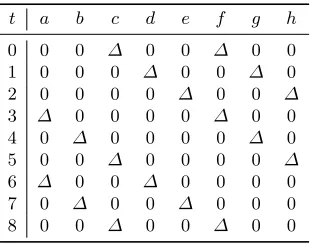
Table 2 describes our differential characteristic for the second iterative part of Dynamic SHA2. Note that no message word enters this part. A set of conditions that ensure that this characteristic is followed, is relatively simple. Indeed, except when t = 2 and t = 5, the two differences ∆ vanish in the first step of the computation ofR1, namely when computing
(((((a+b)⊕c) +d)⊕e) +f)⊕g .
Therefore, particular conditions are only required fort= 2 and t= 5.
When t = 2, the difference in e gives a difference of 16 in the rotation amounts, and so the functionR1 returnsh≫rand (h⊕∆)≫(r+16 mod 32),
respectively. In order to obtain, as required by our differential characteristic, the relation
Table 2. Differential characteristic for the second iterative part of Dynamic SHA2. The difference at steptis the difference in the statebeforecomputing stept.
t a b c d e f g h
0 0 0 ∆ 0 0 ∆ 0 0
1 0 0 0 ∆ 0 0 ∆ 0
2 0 0 0 0 ∆ 0 0 ∆
3 ∆ 0 0 0 0 ∆ 0 0
4 0 ∆ 0 0 0 0 ∆ 0
5 0 0 ∆ 0 0 0 0 ∆
6 ∆ 0 0 ∆ 0 0 0 0
7 0 ∆ 0 0 ∆ 0 0 0
8 0 0 ∆ 0 0 ∆ 0 0
a sufficient condition is to have r = 16, andh invariant under 16-bit rotation, i.e., (h≫16) =h. This means thathshould be of the formXYZTXYZT, which we call symmetric. Whent= 5, we require similar conditions.
Now, observe that the words that should be symmetric arecandf obtained after the first iterative part. The values ofc andf then directly depend onw8 andw14 (see description ofCOMPin Section 2). We now have to find values of w8 and ofw14 that give symmetriccandf.
Suchw8andw14can be found as follows: first fixw14to some arbitrary value, and search for aw8 that gives a symmetric c, in 216 trials. Then, fixw8 to the value found, and search for a pair (w5, w14) that gives a symmetricf after the first iterative part. Here we need w5 to have enough freedom, since for certain choices ofw5, there does not exist a suitablew14. Again, 216trials are expected. Then we are enough degrees of freedom in the message words that do not affect c andf to find rotationr= 16.
Assuming symmetricc andf after the first iterative part, the characteristic is followed with probability 2−10, since the conditionr= 16 is satisfied for both t = 2 and t = 5 with probability 2−5×2−5. By trying several values of, for example, w9, and leaving the other message words fixed, one can thus find a conforming message pair for the first two iterative parts in about 210trials.
5.3 Third Iterative Part
Given the final difference of the second iterative part, we found a characteristic for the second round that yields no difference in the final state, thus given a colli-sion. Table 6 in Appendix B describes our differential characteristic. Appendix B also explains in detail why the characteristic can be followed with probability 2−42
, given some conditions on the input.
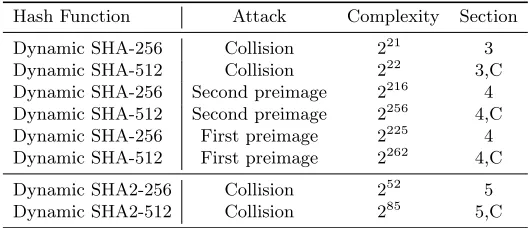
Table 3.Summary of our results.
Hash Function Attack Complexity Section
Dynamic SHA-256 Collision 221
3
Dynamic SHA-512 Collision 222
3,C Dynamic SHA-256 Second preimage 2216
4 Dynamic SHA-512 Second preimage 2256
4,C Dynamic SHA-256 First preimage 2225
4 Dynamic SHA-512 First preimage 2262
4,C
Dynamic SHA2-256 Collision 252
5 Dynamic SHA2-512 Collision 285
5,C
6
Conclusion
In this paper we have discussed the security of the two SHA-3 candidates Dy-namic SHA and DyDy-namic SHA2. We have analyzed their security, and found out that, despite their reliance on data-dependent rotations and in the case of Dy-namic SHA2 even data-dependent functions, their security is subverted by the vast control and knowledge the adversary has while attacking a hash function. We also showed that neither Dynamic SHA nor Dynamic SHA2 are suitable to be selected as SHA-3, following their lack of security. Table 3 summarizes our results.
Acknowledgements
The research presented in this paper was performed in part while the authors were visiting Schloss Dagstuhl (http://www.dagstuhl.de/) in January 2009.
This work was supported in part by the IAP Programme P6/26 BCRYPT of the Belgian State (Belgian Science Policy), and in part by the European Commission through the ICT programme under contract ICT-2007-216676 ECRYPT II.
References
1. Kelsey, J., Schneier, B.: Second preimages on n-bit hash functions for much less than 2n work. In Cramer, R., ed.: EUROCRYPT. Volume 3494 of LNCS., Springer (2005) 474–490
2. Kelsey, J., Kohno, T.: Herding hash functions and the Nostradamus attack. In Vaudenay, S., ed.: EUROCRYPT. Volume 4004 of LNCS., Springer (2006) 183–200 3. Wang, X., Yu, H.: How to break MD5 and other hash functions. In Cramer, R.,
ed.: EUROCRYPT. Volume 3494 of LNCS., Springer (2005) 19–35
4. Canni`ere, C.D., Rechberger, C.: Finding SHA-1 characteristics: General results and applications. In Lai, X., Chen, K., eds.: ASIACRYPT. Volume 4284 of LNCS., Springer (2006) 1–20
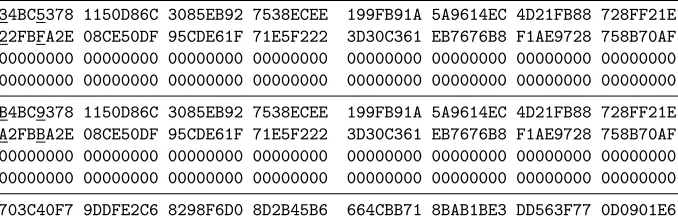
Table 4.Collision example for Dynamic SHA-256: two messages and their common digest.
34BC5378 1150D86C 3085EB92 7538ECEE 199FB91A 5A9614EC 4D21FB88 728FF21E
22FBFA2E 08CE50DF 95CDE61F 71E5F222 3D30C361 EB7676B8 F1AE9728 758B70AF
00000000 00000000 00000000 00000000 00000000 00000000 00000000 00000000
00000000 00000000 00000000 00000000 00000000 00000000 00000000 00000000
B4BC9378 1150D86C 3085EB92 7538ECEE 199FB91A 5A9614EC 4D21FB88 728FF21E
A2FBBA2E 08CE50DF 95CDE61F 71E5F222 3D30C361 EB7676B8 F1AE9728 758B70AF
00000000 00000000 00000000 00000000 00000000 00000000 00000000 00000000
00000000 00000000 00000000 00000000 00000000 00000000 00000000 00000000
703C40F7 9DDFE2C6 8298F6D0 8D2B45B6 664CBB71 8BAB1BE3 DD563F77 0D0901E6
6. of Standards, N.I., Technology: Cryptographic hash algorithm competition. http://www.nist.gov/hash-competition
7. Rivest, R.L.: The RC5 encryption algorithm. In Preneel, B., ed.: FSE. Volume 1008 of LNCS., Springer (1994) 86–96
8. Rivest, R.L., Robshaw, M.J.B., Yin, Y.L.: RC6 as the AES. In: AES Candidate Conference. (2000) 337–342
9. Mendel, F., Pramstaller, N., Rechberger, C.: Improved collision attack on the hash function proposed at PKC’98. In Rhee, M.S., Lee, B., eds.: ICISC. Volume 4296 of LNCS., Springer (2006) 8–21
10. Shin, S.U., Rhee, K.H., Ryu, D., Lee, S.: A new hash function based on MDx-family and its application to MAC. In Imai, H., Zheng, Y., eds.: Public Key Cryptography. Volume 1431 of LNCS., Springer (1998) 234–246
11. Xu, Z.: Dynamic SHA. Submission to NIST (2008) 12. Xu, Z.: Dynamic SHA2. Submission to NIST (2008)
13. Canni`ere, C.D., Rechberger, C.: Preimages for reduced sha-0 and sha-1. In Wagner, D., ed.: CRYPTO. Volume 5157 of LNCS., Springer (2008) 179–202
14. Klimov, A., Shamir, A.: Cryptographic applications of t-functions. In Matsui, M., Zuccherato, R.J., eds.: Selected Areas in Cryptography. Volume 3006 of LNCS., Springer (2003) 248–261
A
Practical Results
We have implemented our collision attack on Dynamic SHA. Collisions for Dy-namic SHA-256 and DyDy-namic SHA-512 are found in a matter of seconds on an average desktop PC. A collision example for Dynamic SHA-256 is given in Ta-ble 4. An all-zero block was appended to both messages to circumvent an error in the padding routine of the Dynamic SHA reference implementation, which causes part of the last message block to be reused in the padding block.
B
Differential Characteristic for Dynamic SHA2
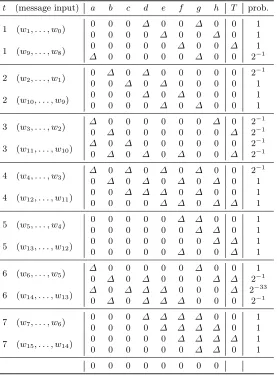
A transition in Table 6 has probability 1/2 when there is a difference in a or bandG1,G2 or G3 is used. In this case, the difference does (not) propagate with probability 1/2. When there is a difference only inc, it always propagates to the output of theGfunction, independent of the function used. We also note that a difference ∆ in one operand of R is always transferred to T, and thus to a, except when wt+1 or wt+4 are w8 or w14, in which case the differences vanish. When two operands ofT have a difference∆, they cancel out and yield no difference inT.
The probabilities for each step assume some conditions on the message. We will take as example the firstCOMPwhent= 2: we start with a difference
0 ∆ 0 ∆ 0 0 0 0
in the chaining valuea, b, . . . , h. In the computation ofCOMP(first half), there is
no difference inT, because the∆difference inbcancels that ofd. The assignment of the new values of f, g, h requires no condition on the message, for it only involves words with no difference. To obtain a difference ∆ in e, we need that d is rotated by zero bit positions, that is, we need the bits 10 to 14 of w2 to be zero. This is easy as we have direct control over w2. Then, to obtain no difference ind, we require that the difference inbdoes not propagate inG. This is only possible if the Boolean function inGis notx1⊕x2⊕x3(see Section 2.1). Since the Boolean function is determined by the last two bits ofw2, we require w30
2 ∨w 31
2 = 1, i.e., these bits should not be both zero. Now, the difference will not propagate inGwith probability 1/2. Finally, we get a difference∆incwith probability 1.
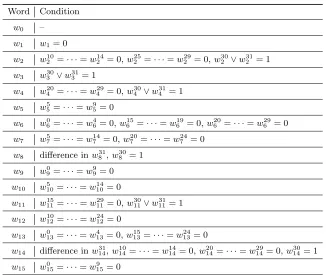
By applying a similar reasoning to all the steps of our differential charac-teristic, we obtain conditions on the message w0, . . . , w15 that are sufficient to conform to the characteristic with probability 2−42. Table 5 summarizes these conditions, along with the conditions for the other iterative parts.
Conditions on w0, . . . , w7 ensure that in the first COMP of each step the rotations are by bit zero positions, and thus the difference remains in the MSB. The probabilities smaller than one are the probabilities that the function G absorbs or passes a difference in a or b. In the second COMP, we need some
rotations to be zero in order the difference to stay in the MSB. This is achieved by setting conditions on the message, for example att= 1, the first ten bits ofw9 should be zero. Table 5 summarizes these conditions. After satisfying all these conditions, about 200 bits of freedom remain; indeed, besides w8 and w14, the message wordsw1tow4have to be fixed to let the symmetriccandf unchanged after the first iterative part.
At step t = 6, the difference in the MSB of w14 implies that Gwill apply different functions to (a, b, c). Similarly to Section 5.1, we will require w30
Table 5.Conditions on the message wordsw0, . . . , w15sufficient to follow our
differ-ential characteristic.
Word Condition
w0 –
w1 w1= 0
w2 w 10
2 =· · ·=w 14 2 = 0,w
25
2 =· · ·=w 29 2 = 0,w
30 2 ∨w
31 2 = 1
w3 w 30 3 ∨w
31 3 = 1
w4 w 20
4 =· · ·=w 29 4 = 0,w
30 4 ∨w
31 4 = 1
w5 w 5
5=· · ·=w 9 5 = 0
w6 w 0
6=· · ·=w 4 6 = 0,w
15
6 =· · ·=w 19 6 = 0,w
20
6 =· · ·=w 29 6 = 0
w7 w 5
7=· · ·=w 14 7 = 0,w
20
7 =· · ·=w 24 7 = 0
w8 difference inw 31 8 ,w
30 8 = 1
w9 w 0
9=· · ·=w 9 9 = 0
w10 w 5
10=· · ·=w 14 10= 0
w11 w 15
11=· · ·=w 29 11= 0,w
30 11∨w
31 11= 1
w12 w 10
12=· · ·=w 24 12= 0
w13 w 0
13=· · ·=w 4 13= 0,w
15
13=· · ·=w 24 13= 0
w14 difference inw 31 14,w
10
14=· · ·=w 14 14= 0,w
20
14=· · ·=w 29 14= 0,w
30 14= 1
w15 w 0
15=· · ·=w 9 15= 0
C
Extensions to the 512-bit Versions
The attacks presented in this paper can be extended to the 512-bit versions of Dynamic SHA and Dynamic SHA2 in a straightforward way. This appendix details how the attacks can be adapted.
Collision Attack on Dynamic SHA. The attack on Dynamic SHA-256 can be adapted to Dynamic SHA-512 with almost no change. Due to the different R1 function, the difference word is ∆ =8000000080000000. Also, the probability of the local collision is lowered by about 2−1
compared to Dynamic SHA-256, as in the fifth step six rotation bits have to be fixed to zero instead of only five.
Table 6.Differential characteristic for the third iterative part of Dynamic SHA2. The difference at steptis the difference in the state beforecomputing step t. The column T indicates the difference in the temporary variableT. The probability on a line is the probability to reach thenextdifference, when conditions on the message are satisfied.
t (message input) a b c d e f g h T prob.
1 (w1, . . . , w0) 0 0 0
∆ 0 0 ∆ 0 0 1
0 0 0 0 ∆ 0 0 ∆ 0 1
1 (w9, . . . , w8) 0 0 0 0 0
∆ 0 0 ∆ 1
∆ 0 0 0 0 0 ∆ 0 0 2−1
2 (w2, . . . , w1)
0 ∆ 0 ∆ 0 0 0 0 0 2−1
0 0 ∆ 0 ∆ 0 0 0 0 1
2 (w10, . . . , w9) 0 0 0
∆ 0 ∆ 0 0 0 1
0 0 0 0 ∆ 0 ∆ 0 0 1
3 (w3, . . . , w2)
∆ 0 0 0 0 0 0 ∆ 0 2−1
0 ∆ 0 0 0 0 0 0 ∆ 2−1
3 (w11, . . . , w10)
∆ 0 ∆ 0 0 0 0 0 0 2−1
0 ∆ 0 ∆ 0 ∆ 0 0 ∆ 2−1
4 (w4, . . . , w3)
∆ 0 ∆ 0 ∆ 0 ∆ 0 0 2−1
0 ∆ 0 ∆ 0 ∆ 0 ∆ 0 1
4 (w12, . . . , w11)
0 0 ∆ ∆ ∆ 0 ∆ 0 0 1
0 0 0 0 ∆ ∆ 0 ∆ ∆ 1
5 (w5, . . . , w4) 0 0 0 0 0
∆ ∆ 0 0 1
0 0 0 0 0 0 ∆ ∆ 0 1
5 (w13, . . . , w12) 0 0 0 0 0 0 0
∆ ∆ 1
0 0 0 0 0 ∆ 0 0 ∆ 1
6 (w6, . . . , w5)
∆ 0 0 0 0 0 ∆ 0 0 1
0 ∆ 0 ∆ 0 0 0 ∆ ∆ 2−1
6 (w14, . . . , w13)
∆ 0 ∆ ∆ ∆ 0 0 0 ∆ 2−33
0 ∆ 0 ∆ ∆ ∆ 0 0 0 2−1
7 (w7, . . . , w6)
0 0 0 ∆ ∆ ∆ ∆ 0 0 1
0 0 0 0 ∆ ∆ ∆ ∆ 0 1
7 (w15, . . . , w14)
0 0 0 0 0 ∆ ∆ ∆ ∆ 1
0 0 0 0 0 0 ∆ ∆ 0 1
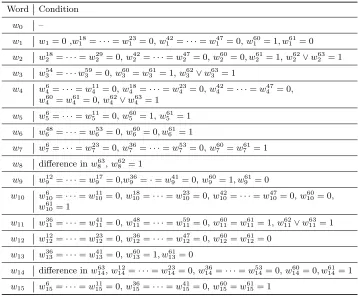
Table 7.Conditions on the message wordsw0, . . . , w15sufficient to follow our
differ-ential characteristic in Dynamic SHA2-512
Word Condition
w0 –
w1 w1= 0 ,w 18
1 =· · ·=w 23 1 = 0,w
42
1 =· · ·=w 47 1 = 0,w
60 1 = 1, w
61 1 = 0
w2 w 18
2 =· · ·=w 29 2 = 0,w
42
2 =· · ·=w 47 2 = 0,w
60 2 = 0, w
61 2 = 1,w
62 2 ∨w
63 2 = 1
w3 w 54 3 =· · ·w
59 3 = 0,w
60 3 =w
61 3 = 1,w
62 3 ∨w
63 3 = 1
w4 w 6
4=· · ·=w 11 4 = 0,w
18
4 =· · ·=w 23 4 = 0,w
42
4 =· · ·=w 47 4 = 0,
w60 4 =w
61 4 = 0,w
62 4 ∨w
63 4 = 1
w5 w 6
5=· · ·=w 11 5 = 0,w
60 5 = 1,w
61 5 = 1
w6 w 48
6 =· · ·=w 53 6 = 0,w
60 6 = 0, w
61 6 = 1
w7 w 6
7=· · ·=w 23 7 = 0,w
36
7 =· · ·=w 53 7 = 0,w
60 7 =w
61 7 = 1
w8 difference inw 63 8 ,w
62 8 = 1
w9 w 12
9 =· · ·=w 17 9 = 0,w
36
9 =·=w 41 9 = 0,w
60 9 = 1, w
61 9 = 0
w10 w 6
10=· · ·=w 11 10= 0,w
18
10=· · ·=w 23 10= 0,w
42
10=· · ·=w 47 10= 0,w
60 10= 0,
w61 10= 1
w11 w 36
11=· · ·=w 41 11= 0,w
48
11=· · ·=w 59 11= 0,w
60 11=w
61 11= 1,w
62 11∨w
63 11= 1
w12 w 12
12=· · ·=w 23 12= 0,w
36
12=· · ·=w 47 12= 0,w
60 12=w
61 12= 0
w13 w 36
13=· · ·=w 41 13= 0,w
60 13= 1, w
61 13= 0
w14 difference inw 63 14,w
12
14=· · ·=w 23 14= 0,w
36
14=· · ·=w 53 14= 0,w
60 14= 0, w
61 14= 1
w15 w 6
15=· · ·=w 11 15= 0,w
36
15=· · ·=w 41 15= 0,w
60 15=w
61 15= 1
Collision Attack on Dynamic SHA2. To attack Dynamic SHA2-512 we use a similar differential path. The changes are that the condition on the first block is on 64 bits (starting from a chaining value with b = FFFFFFFFFFFFFFFF), the fact that in the second iterative part the probability is 2−6 for each of the two transitions, the decrease in the probability only of the sixth COMP from
2−33
to 2−65
, and the different set of conditions on the message described in Table 7. Hence, the total time complexity of this attack is 285
. We note that in this approach the attack fixes w60
i and w 61