Knowledge-based Systems for Logo Recognition
Dzulkifli Mohamad
Fakulti Sains Komputer & Sistem Maklumat Universiti Teknologi Malaysia
Kuala lumpur
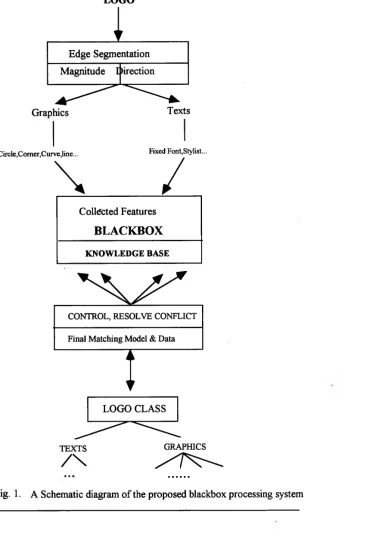
Abstract: We describe a flexible system fo r recognising complex images o f Logo comprises o f texts and graphics.. Logo is a unique trade mark o f any legal company registered under the Ministry o f Home Trade. The proposed system uses a "blackbox" to act as a rule-based system or an expert system to which all the knowledge sources have access. The main idea is to reduce a long matching process between targetted Logo and the data based models before one-to-one matching is carried out to finally give the correct answer o f recognition.
1. Introduction
or she has to submit an appication form issued by the Ministry. One of the item checked is the proposed Logo. In order to make it acceptable, the applied Logo should not match to any existing Logo. The similarity to any Logo will cause the application is rejected. Under the current process, the matching is done manually. The applied Logo is running over probably thousands of Logos to check its validity. To add the matter worst, the number of Logos in hand does not stop but increase day by day with the growth of successful registrations.
Under the proposed automation system, an expert rule is introduced to optimize the number of matching taken place to finally gives the the answer of recognition. The rules will give the closest informations of the proposed Logo to the data based Logo of that characteristics before one-to-one matching is made.
2. The Proposed System
LOGO
Circle,Comer,Curve,line... Fixed Font,Stylist...
\ ___/
Collected Features
BLACKBOX
There are two major processes are going to take place in the proposed system (1). Segmentation and (2). Recognition/interpretation. The segmentation is an iconic process which is best carried out procedurally and the image interpretation is a symbolic process which is probably best carried out declaratively.
Furthermore, from the iconic process we extract object primitives such as comer, circle, curve, line and other extended features such as texts, which we can store as a list of items on a table for subsequent symbolic processing. The symbols can be manipulated through predicate logic. This consraint affects the choice of our comer detector [Dzulkifli 93], The line and circle detection are via the use of Hough transformation. These three features can be considered as being generic. Other extended features often termed salient, are detected using s(y) graph.
The great and challenging task is to extract texts from the iconic process. Text is always considered as a part of image under sanning process of data acquisition. Though there are several choices of OCR softwares around us, yet text in Logo could be in different forms (fancied letter, flourish, etc) and probably far beyond their capabilities to recognize it.
Knowledge base
Fig. 2. Architecture of a proposed rule based system
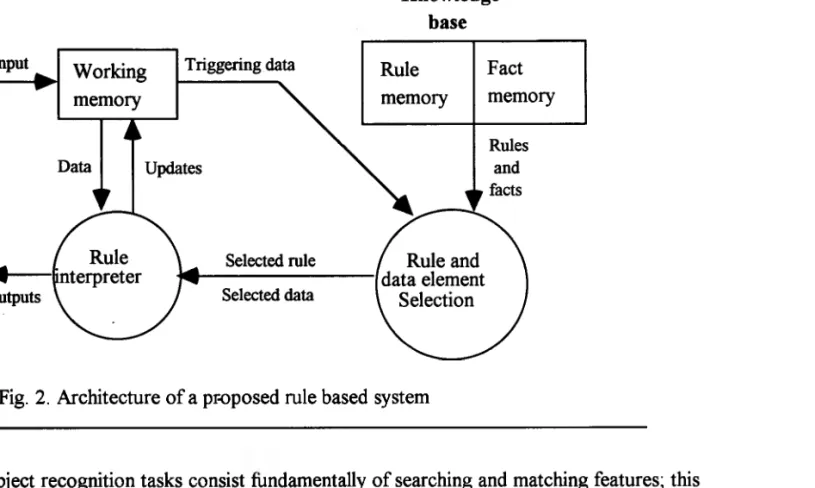
Object recognition tasks consist fundamentally of searching and matching features; this task requires a priori knowledge about such entities as arcs, circle, etc (as prescribed above). This knowledge can be represented either in procedural or declarative form. In our blackbox, a rule has the form of;
if <condition> then <actiori>
3. Conclusions
A proposed knowledge-based system for Logo recognition could give a solution to the problem of automation process in Logo recognition at the Ministry of Home Trade. A quick decision could be on a finger tip in determining whether or not an applied Logo is already patented.
A mixture of the traditional image processing program and rule based system solution proposed in this proposal could be an interesting point to look at. A traditional image processing solution differs from a rule based system in that it lacks a rule and selection sub-system. However, it often has a knowledge database containing model information (not rules). Instead of a rule interpreter, there is a user defined program consisting of one or more algorithms with control and dataflow designed into the system. However, they often have a common workspace which is used and updated by the algorithms. A program lacks the flexibility of a rule-based system. For a modification in its task execution, a new program may need to be written because the control and data flow may be changed by he addition of the new code. In a rule-based system, only the new rules need to be added to the knowledge base. To summarize the advantages of a rule- based system, a list of which is shown below.
1. It presents problem-solving method in a way which is suitable for computers. 2. It is modular.
3. It is incremental. 4. It is explainable.
5. It provides a framework for conceptualising computation. 6. It provides parallel method for problem solving, and
4. References
[Husain 91] Z.Husain, Digital Image Processing, Ellis Horwood Series in Digital and Signal Processing.
[Dzulkifli 93] D.Mohamad,"A Fast Corner Detection Algorithm On Skeletonized Digital Image", Unpublished.