1103 CENTRAL EXCHANGE NEWSLETTER NUMBER 10
December 1956
PX
71900-10
DIVISION Of SPERRY RAND CORPORATION
o
o
v
0"-N
CONTENTS
4
0F PUBLICATION 'Page 1 of 2
Titl~ =' llO') CENTRAL EXCHJ.NCE NEWSLETTER l~u"~BER 10, . December 1956
C las.sifica tion _U _ _ -,-- Publi<;ation Date_.,....,...---. _ _ ...- Charge_93~~~ _ _ '
TeXt pa:ges ___ :~ _ _ jO--,' _ _ ~ Photogl'aph$ . ..---___ --...---.,....,...,.' Drawings -, ._._. _. _:
-Page No.
(of )
i
thru
i i i10-1 thru 10-5
Contents . Print
Number
itlePage,
71900-10
ont Hatter (Newsletter) ,71900-10
nere1 Card ~ed-In
Rouline
Drawing N-umher
10-6
thru
10-15 Eigenvalues of aTr1-Die-gor.al
Metrix
.
71900-10-16 (RW~169) 10-l6thru10-17
Floo 1;.ing Point Cere Dump 719~lo.1 (l1.W~l70)·,10-018
thru 10-24 llD3 to l103A Conversion ,Routine
71900-10-1
~0-25 thru 10-48·· Floating
';Vector
Arithmetio , .,Pa'okage' 71900-10-1'
10-49
thru10-73 Sierdficance
PreservirgF100ting
Binary Point
Arithmetic
for
Digitol
Computers10-74
thru
10-135 A
Methodfor
Gene~~tin,Random Numbers on
the
EPJ. 1103';',
"1
71900-10..l 10-136 thru 10-1 Evaluation'or
IA-
~
to.'t' "': Matrix A (Complex ~ingle 10-142 thru
1()..14
Floating Point Linea~ .t . -(M-17l)
(~172)
.(ilR-1731
. ',' j'
Precisio~noc.ting Po~t) 71~1~l,' . . l-1atrix F.qpe tior" rol "lor
. . (AX=B) .', 7l9~lo..l .(R)1 ..
176)
io-150 thru 10-15 ,Complex ~ingle
Precision
, 'Floating PQint LinearMatrix F£luatiorJ Sol vel'
(AX ::: B)' . '71900-10-.1 ' :(RW .. l77) , 1~158
thru
10-16 Complex Oil1 MethodRout1)')
.719QO..lo..l .(RW-17S)
10-170 thru'l~l. ~lgebre.ic Eq,uation 'Solver 71~10-1(RtV.l7<?)
10-181 . thru 10-1 Unpacked 'FloGting PointCard Output 71900-.10-1' ,(CY ... 180)
10-,191 thru 10-21 Continuous Mtltrix
14ulti-pIler
Using.PLIP III
719~lo.1 (CV..-1Sl), ontlr;uousMatrlx
Multi-plier Using Sivgle or
Multi-Precision
Arith-Metic
10-241
thru
10-3
PUR - Single Precieion
Unpopked Rounded Floating PointPackage
forERA-1103
719QO.IO-l
(CV' .. 182)
CONTENTS OF PUBUCATION Page
2
of2
' . : " 1··.:tl",i~ ... :~~"',"I·'~"'" , '~ .' ; . '
.,. Classification . .. ________ . ___ ' U lca Ion U . ' PhI' t· D ' a e ____ t .____ Ch arge ... 9.,388_ . . -... 8-4._._ .
,'. '~' :Text p~ g e s . J'.:...L _. ____
o ...
~...l,.
Pl" ,loto g r a ph s '._ _ __ . _. __ ~ ____ ._2__ _ __ . _.' , D raw in g sJ_ r.,,~age No.
. . .. J9t .. ", ..
J
';"'l"¥f3 ". ·,~~:,.'l ,";
10-33.1,;,:th;r;u:l0-J3 Canputing Cer:t. r
OrC8T.iZe-~ ,.~.:. 'tioh ~'. The Rarr;o .... Wdoldrid[
Print Number'
Corpor~tior. " ·'·71900.:10t
10-335 th~ 10-33 themt. t.lcvl S~rvicee
Bra.nch
l'0-J~€,.trn:u. 1~3
Unpacked
Flofltlr;e, Poir:t ea rd Reao'<'!'1~3J7thru) lQ..;.)5 Utility' Routine Librery '-'
Draw,ing Number
(10:27)
. (C'V-l'54'
'pm ).
,(R\<J-? 1 ~EV
10-J53"thrtl'lO:j6
.LheRtSmo-Wooldrldpe' Corpo .·One-Pass AsseinblY Routine
71900-10-(:P.\J":'7:2
R'E\,~
lQ-J6A>'thro 10-3 TieClnite Ir.te£r81"' Eve:lui;-. ' .
~ ,_~,.;" ". "tio,~
Rcrutire. . . . .
~" 719O('~10-~(Rl~-B;9 REV)· , inc Poitlt r8cl:arEl ·'7190C):.10-1'···
'(pt:roe
KrVX10-372 ~~hru 10-38 ~NAP - Interpretl va floflt-" ~' ,
I
1Q-.382 thru 10-J8~Sr;AP Sempler Tr8c~' '. 71906-10-1 (m,]-140 R"f.\1)
1~3~!
tr
.lo-.~~S,~JI.~'
-~pterpri.tive
Floc·t-1
1, .
I
.
I. . .
': ... , -jlong
P01:I;t PfAc}.:Bce-C"rrplex:71~lo-14p.. (R~:~l4l~)
10-390 ,thr.,U,
,:~,
0-39,,)'1', l,ie, ",F.,e, rrar.ti.~r~l:t ',J~~ti'fel
71900-.. ' 10.:..6,~;'
, ", <ffi.!.;..(,3?..F.V~'
10-)94 !-t.ru lC-J91Arcsine-Aroosl.lle R011tlT a, . , '. ":
"""":, ''';,\:
,."t'
·~:tf't~ POiTJ~, . 719?O-lO- " (m~:-148 BE.>
10-398 thru 10-40~F108.t1ne Point r.rcslr~e- . , , ' I ' . ' · i Arcosine Routine' 71900-10-1
r
(P'·';-149PJ'1)
· . Routlr;e ' . . , 71900""110-7 '(f'Jt-74 P:F.V
10-4., .02:ttla:-U'
l~~"'n08t~rie
pOirt,Arcta,r.g~r,t,
... , ," , " '.'
"",'"
19-406
tr.ru ~O-4 Ch8nged ,W6rd post-Mortem': ~ .1'.' ' "Routi'1le 71(01)...;10-1. (Rw-102 HEV.)
10-408 tl.oru 10-41 th Root, Routir.A.'. . 7190()....lo.ii ,- '.
(F.1..\r~116
nB-a,),
lq-4l2 thru 10-42 i l l lltethod ~(;brou~ine,,' 71~0f\-10-9' (pll-91 REV~
10-'~~ ",,~hru
lO-J" .
F;L~ tir.r. j 'Poir:t elll Method! ?1900-10-U' (U\>!-.!43 P.E\l)10-1.30 ~~."1O-4}· +~h'~ing'.Poh:t Sjre-... Cof:ir ',71900-10-. .. (RV-:l!+L.) (~V) lq-/+J5, .
th,~:l0-:44! ~~lE
71900-10(~}.-86 ~f,V~.,
, • I ~ ,'" _. '-" '
I I !,' 1\,1 t
i"
l\ (I I<.
j
I
I
Correction:
Correction:
Newslet t\;r Number 10
Deoember
1956
EDITOR'S PAGE
On page
9-392
ofNewsletter
9,
line
2,
paragraph
4,
of
RR-162
should read " • • •
will be p-l
=
2
35
_32=34,
359,738,336 • • • ".
'The ootal equivalent given for the constant
A4
in the
descriptions for
the
arsin-areos floating point
(RR-75)
and the arosin-areos stated point
(RR-25)routines is
in error and should read
37
50417
41233instead of the listed value of
37 04174
41233.
This oorreotion should be entered in Newsletter
3 (pg.3-108) for RR-25 and in Newsletter
6
(pg.
6-73)
for
RR-75.
Editor,
-
...
...
...
6
~
~t:
NEV1SLETTER
10
DECEJviBER 1956
ENCLOSURES
RW-168
RW-169
RW-170
RR-171
.~'\~
~172
~
(
173
\., . ..-./
W'8-174
RV-l75
RW-176
RW-177
RW-l78
RW~l79
.CV:~l80
OV-181
CV-182CV-183
10.2:)
10:28
REVISIONS
CV-154
RW-71
General Card
Read-In
RoutineEigenvalues of a Tri-Diagonal Matrix
Floating Point Card
Dumpl103 to l103A Conversion Routine
Floating
Vector Atithmetic PackageSignificance Preserving Floating Binary Point Arithmetic
for Digital Computers
A Method for
Generati~gRandom Numbers on the ERA 1103
Evaluation of IA-iU
I
for Matrix A(Complex Single
Precision Floating Point)
.
Floating Point Linear
MatrixEquation Solver
(AX=B)Complex Single Precision Floating Point Linear Matrix
Equation Solver
(~).
Complex Gill
Method Routine
AlgebraicEquat~on
Solver
Unpacked Floating Point Card' Olltput
Continuous Matrix
MUltiplierUsing
FLIPIn
Continuous Matrix .Multiplier Using Single or
Multi-Precision Arithmetic
SPUR - Single Precision Unpacked Rounded Floating Point
Package r~ERA-l103 Computers
Computing Center Organization -.The Ramo-Wooldridge CorPoration
Mathematical
ServiceBranch - Eglin Field
Unpacked Floating Point
Card ReadRW-72
RW-89
RW-108
RW-140
RW-l4l
RW:-63
RW':148
RW-149
RR-74
RW-I02
RW-116
RW-9l
RW-143
,...
RW-144
oM
ori
oM
RR-86
...,I 0
'1
8
'"
f!
>< p..
2. Conventions
3.
Reminders
4.
Tape Bootstrap
5.
Pool of Flex Codes
6.
Cumulative Errata
7. Utility Routine Transfer Drum to Magnetic Tape
8. Utility Routine Transfer - Magnetic Tape to
DrumThe Ramo-Wooldridge One-Pass Assembly Routine
Definite
I~tegralEvaluation Routine
SNAP - Interpretive Floating Package
SNAP Sampler Trace
SNIP - Interpretive Floating Point Package, Complex
The Ferranti Input Routine
Arcsine-Arcosine Routine, Stated Point
Arcsine-Arcosine Routine, Floating Point
Arctangent Routine, Floating Point
Changed Word Post-Mortem Routine
~
Root Routine
Gill Method Subroutine
Floating Point Gill Method Subroutine
Floating Point Sine-Cosine Routine
-CO' -0
...
'-'
,
o
....
,
o o
0"-
....
... ><a..
Identification Tag: Type:
Special Storage:
Program Entrance: Program Exit: Alarm Exit:
Coded by: Approved by:
THE RAlv.lO -\vGOLDRffiGE CORPORATION
Los ili1geles 45J California General Card Read-In Routine
Specifications
CRI-3
CRI-3
Pg. 1 of
5
11-5-56Service Routine. (with subroutine entrance) The constant pool and temporary pool are not
used by' this routine 400l7b
40020b
The alarm routine is used by this routine
M. Perry November,
1956
w.
F. Bauer November,1956
"
Description
Rtv-168
CRI-3 Pg. 2 of
5
11-5-56
This routine reads cards produced by
MDP-l
(binary cards), CPO-O (fixed point output), CPO-l (floating pOint output) and cards~key-punched on the4
field format (described below) for input in tloating point, double precision floating point, fixed point, or octal. These input forms may be intermixed on a card, and the cards may be in any sequence desired. The routine automaticallydifferentiates the 2 card forms, and for
4
field cards, recognizes the type of input in each fieldo All input is rounded properly. This routine readscards at :full card reader speed and loads the memory as directed by the address or addresses appearing on the cards. Once activated, it continues to read cards until it has read and stored a card containing a stop code as described below. The input need !not be normalized to retain full significance. The routine stores high speed memory on the drum, operates in high speed roomory, and restores high speed memory from the drum prior to leaving the routine. Qperating Instructions
1.
When routine is used as a service routine, set PAK to 40011b and start. Routine will read ~ards until a stop code is recognized, at which time the ma:chine will stop (MSO ) with P AK set to 40011b.2. When routine is used as a subroutine, enter the routine with
37
40020
4OOl7b.. Routine vill read cards until a stop code ·is recognized, at which time control is transferred to cell 40020b and hence to the cell following the return jump mentioned above •To restore high speed memory at any time, start at 40040b. A andQ will not be restored.
Card Positioning
Card positioning is required before the initial read only. Card reading
automatically positions the next card to be read,and a card will be positioned
for punching before leaving the routine. If the routine is, used as a service routine, the initial'positioning must be manual. If the routine is used as a' subr'outine, initial card positioning should be programmed. This can only be done
by.
one instruct ion, ~ 00000VVVlf'iI
where vvvvv contains00 00000 001l4b.
S
Stop Codes..
..
I ) of
1. Read stoE, 12 col
80.
When this code is detected on e~ther a binary card ora four field input card, the' routine will stop reading, pos'ition a card 'on the punch side of the bull, and then exit properly (see operating instructions).-co
...0
....
-
o....
•
Io
o
0'
....
t-:>< a..
RW ... 168
CRI-3 Pg.
3
of5
11-5-56
Either of the above codes may be entered on a blank card and the routine will sense them. The prograIDI!ler is cautioned not to place the machine stop code on a binary card as this will result in improper loading (see MOP -1 write -up) •
Alarm Conditions
1. Binary Cards - As a binary card is read, the words are summed and the result is compared with a sum punched in the card (see MOP -1 write -up) • If the sums do not agree, the flexowriter will print
"ALARM 00211 000000000000 OOOOOOOvvvvv QQQQQQQQQQQQ"
a.nd the ma~hine will stop. vvvvv is the storage address appearing on the card. The contents of Q are not important. Starting the computer will bypass the alarm, the words will be stored as read, and in the absence of a stop code, reading will proceed.
2. 4 Field Cards - An alarm on a four field card indicates' that a number was too large to be entered appropriately into the computer. For floating point numbers (single and double precision) this is equivalent to exponent over-flow. For fixed point numbers J this indicates that the input properly
scaled and rounded was too large to be. entered into a single cell. If an alarm'condition is detected, the flexowriterwill print,
"ALARM 00164 000000000000 OOOOOOOvvvvv 000000000000"
and the machine will stop. vvvvv is the storage address of the right-most incorrect number. Any or all of the other numbers may have been incorrect. vvvvv equal to 20,000 indicates, that the indicated address field was blank. Starting the computer will cause the correct numbers to be stored, the incorrect numbers to be ignored, and in the absence of a stop code', reading will proceed.
4
Field Card FormatThe format described below is one of the formats used'by this routine and is the for.mat used by CPO-O, CPO-I, CRI-2, and SNAP Read.
The card columns are deSignated as follows:
Col 1 ... 4 Identification This field is ignored by the reading routines
Col 5-23 Field 1 Col 24-42 Field 2
Col 43-61 Field
3
Col 62-80 Field 4
,...,
co
...0
...
...,
•
0
... I
8
0-...
t->It
c..
RW-168
CRI-3 .Pg.
4
of5
11-5-56
Each field (except identification) is divided as ·follows. digit
1-5
digit
6-15
digit16-17
digit18-19
Location or address Value 'or Mantissa Decimal exponent Binary exponent
(x digit 1 for octal location) (x digit
15
for negative value) (x digit17
for negative exponent) (x digit19
for negative exponent) Addressing OptionsThe following Addressing options are allowable on the
4
Field input card. Option I is used by CPO-O, CPO-I, CRI-2, and SNAP Input.1. Decimal - Stra.ight conversion to the octal equivalent of the decimal address in the card. No indication is necessary.
2. RAWOOP Decimal.;. Straight conversion to the octal equivalent of the decimal address except that 1+0,000 decimal is designated as the first drum address
(40
,OOOb). No indication is necessary.3.
Octal -The octal. number appearing. on the card is the actual.. address.. This mus-r-be indicated by an x(ll punch) ,over the first digit of the address.4.
Blank'-' ,':A completely' blank a.ddress field indicates that the number in thatfield is not to be stored ~ · This is differentiated from an address containing 1 or more zeros which will load cell zero.
Input Numbers
The following varieties of input may be punched on'the
4
field input card. They may be in any combination on a card with the exception that fora
double precision floating point number. the two fields 'muSt be co:gsecutive, and on the same card. For all input, thedecima.l point 1s presl.l1Iled to be at the extreme left end of the value "field. It is 'recoIIl.Il.kended that the codes listed below be used for ea.ch field. However, cards fromCPO-o
and CPO-l are differentiated by the fact that their"B" (Binary Rxponent) fields are non-blank and blank respectively.
1.
2.
Floating Point .., RS. An input n:umber is designated as floating po:Lnt by the code RS (Read Snap) in the ''B" field. There is no restriction on the tiD" field. The resulting floating binary number is rounded and is' in the form used by SNAP and by the internal floating' painton the l103A computer. A floating point number consisisof
3
parts; a sign bit., follo'W'ed by an8
binary.bitcharacteristic biased by 200b, and'a 27 bit normalized mantissa • To negate a floating point number, the complete cell 'is complemented •Double Precision Floating Point - RT. An input· number is designated as double preciaion floating point by the code RT (Read Two) in the ''B''field. The
"value~1 portions of 2consecutlve fields are joined to allow 20 decimal digits
of in~ut. Both fields must contain addresses but the ,control information
-co ..0 ...
--
,
o
...
6
o a-
....
t-><
0..
RW-168
CRI-3 Pg.
5
of5
11--5
-56
consists of a sign bit and
35
binary digits which are an extension of the27
binary digit mantissa in the upper cell.The programmer is again cautioned that the two fields concerned must be consecutive and on the same card.
3o.
Fixed Point - No code. An input number is' designated as fixed point by the fact that the r~rr field is not blank and does not contain an R. Since thetlB" field is used to express the binary scale factor desired, the only caution' is that it must not be left blank.
00
(zero zero) must be punched if a scale factor of zero is desired.. The binary scale factor is allowed to be ne gat i ve and the only restriction is that the combination,of the B andD
:fields result in a number which is not too large for a single cell. Normalization is, not important since the conversion is done in double precision. The resulting binary ntimber is rounded p r o p e r l y . ".,
4.
Octal- RU. An input number is designated as being octal by the code RU (Read Unc.onverted) in the liB" field. Since 12 octal digit's are d.esirable, the "value" and ''D" fields are joined giving 12' digits. Each digit is loaded modulo8,
such that an8
becomes a zero, and a9
becomes a 1 /'Examples. The following ,list of, in,pu~
..
w~d be. p~<?hed on two cards. The. second card would have a trStop ReSod." code in' col 80 because of the "+tt signeD the iast line. The octal address and translation are listed in the comments.QUANTITY LOCATION VALUE l:d:z ,D
d::-
B:::b
COMMENTS4"
0.1 2 2 1 2
O,·it 1 I j I1
o
1:
R S:40122 20 14631 46315
j
.. ,
1 6.1 8.4 4 5
a
0a
b,b,0~0,4t2
15:
I
40000 45 00000 00425
RIU'I
o
1:
I4·0 0
6.4 3 1 4 1
5
~9,2 ,6,5
3:-
R,TJ40100 57 51557·00452
I I
,
4,0 06 5 5 8 9 79
3'
23,8 5:
I,
40101 75· 67513 47562
I
,
,
o~o
1 2
3 001 5
r , I I I I I0:
,
o
4'
0
OQ123 , 00 00000 . 0001 7
,
I I ,
99
15
,
o
2:
1 5: 00143 00 0001 7 00000
,
,
, I,
,
P,l:
2:
00144
1 0,0 1
,
,
,-
, I77 77777 67777
Identification Tag:
Type:
Storage:
Regional Addresse~ Used:
Entrance and Exit:
Machine Time:
Mbdeor Operation:
Coded by:
Approved by:
mv-169
EGN-l
Pg. 1 of 10
10/1/56
THE RAlviO-}lOOLDRIDGE CORPORATION
J~s Angeles
45,
CaliforniaEigenvalues of a Tri-Diagonal ~~trix
Specifications
EGN-l
Subroutine available on cards for assembly.
145
words of storage needed to assemble this routine.18 + 2n cells of temporary storage inunediately following the temporary pool used, but not stored with subroutine. (n =' order of matrix).
The constant pool and temporary storage pools are used by this rout ine •
OOR, OlM, 02M, OlR J OOK, OCT J FOO, COO
RJ OOROI OOR02 No Punching }
. See Instructions
RJ OOROl OOR03 Cards Punched See table in text.
Floating Complex Arithmetic requiring SNIP be activated.
w.
Frank September1956
.-..
0"-...0
r-I
--
I0
"""'
I0 0
0"-r-! t-:><
c..
Description
HW-161.J
EGN-l
Pg. 2 of 10 10/1/56
This subroutine Co.il~utes the n eigenvalues of any real or complex tri-diagonal matrix D, having the form:
a
1 b
l 0 0
1 a2 b
2 0
0 1 a
3
b3
0D =
U
I
J
a b I
n-l n-1 1
I
1
anJ
Since complex arithmetic is employed, the elements of the matrix must be presented according to the specification for number representation tor use wi th SNIP. The n elements of the main diagonal, ai' must be followed by the n-1 elements of the upper adjacent diagonal, hi' in a region whose initial address is specified by a parameter word.
The more general tri -diagonal matrix J, (also called a "Jacobi Matrix") has all its non-zero elements on the main diagonal and on either of the two immediately adjacent diagonals:
a
l bl 0
o
c
l a2 b2 0
o
0 c
2 a
3
b3
o
J
=
0
RW-lb'i
EGN-lPg.
3
of 10 10/1/56This routine can also treat this case if in place of the n-l elements of the upper adjacent diagonal, the n-1 products, c
i bi, are supplied.
The subroutine occupies 145 cells and uses the constant and temporary storage pools. In addition 18 + 2n cells of temporary storage must be provided immediately following the Ramo~ooldridge Temporary Pool. Practical limitations are imposed on n by the available 1024 words of ES storage and. the use of SNIP, hence n must
be
less than157.
In all cases the eigenvalues can be found in the last 2n cells of the (18+2n) cells of temporary storage. In addition the eigen-values tti and associa.ted residues in the characteristic polynomial p(;:\.. i) can be punched on cards.pC (\
i) appears in fields one and two while (\. i is in fields ti ve and six. The eigenvalues are also identified serially in the identification field. At the option of the progra.xrmer thesl,1ccessive approximations to the{\. i obtained during the iterative process can also be punched with their associated residues in the reduced polynomial. In the event that no punching is desired then a third entrance is available. or ~
PrOgrammdng
Instructions1. Complex mode of SNIP must be activated.
2. Entrance to the subroutine is made as follows:
a. ,RJ OOROI OOR03
xx
,OOAOO vvvvvwhere
OOROO is the location of the first word of the subroutine
OOAOO is the location of the real part of the first element of the diagonal
,...
0"-...0
~ '-"
I
0 r-t
I
0
0
0'
r-t
t-><
~
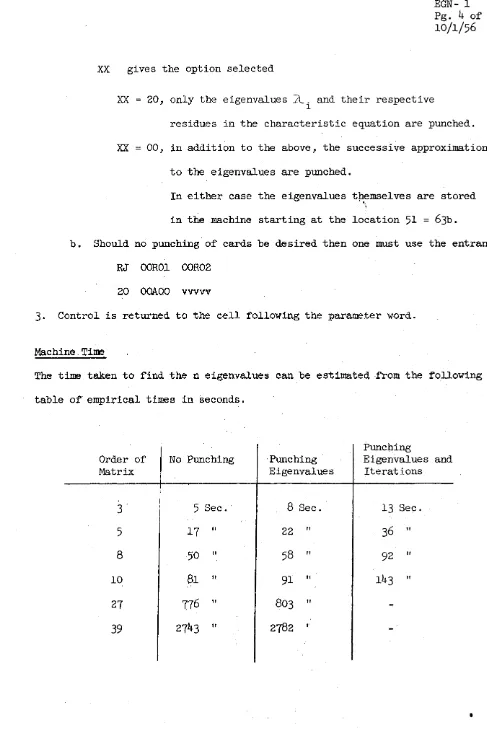
XX gives the option selected
RW-169
EGN- 1Pg.
4
of10
10/1/56
xx
=
20, only the eigenvalues2l
i and their respective
residues in the characteristic equation are punched.
xx
=
00, in addition to the above, the successive approximationto the eigenvalues are punched.
In either case the eigenvalues tp.emselves are stored
in the machine starting at the location
51 =
63b.b. Should no punching of cards be desired then one must use the entrance:
RJ OOROI OOR02
20
oOAdo
vvvvv3. Control is returned to the cell following the parameter word.
Machine. Time
The time taken to find the n eigenvalues can be estimateqfrom the following
table of empirical times in se.conds.
I
No PunchingPunclling
Order of -Punching Eigenvalues and
Matrix Eigenvalues Iterations
3
5
Sec.8
Sec. 13 Sec.5
17"
22 f!36 n
8
50"
58
fI92
"
10
81
"
91
"
14
3 fI27 776
"
803"
39 2743
"
2782" "
:>
..
..
I )
..
I ) )
"
..
Given the tri~iagonal matrix J
a
l bl 0 c
l a2 b2
0 c
2 a3
J =
o
b
3
0
a b
n-l n-l
RW-169
EGN-l
,Pg.
5
of 10 10/1/56The following recursion formula evaluates the characteristic polynomial
p (it) of J for given
A:
n
where
P =0
-1 P o = I
i = 1, 2, •.• , n
'l!he problem loses no generality by assuming all c i = 1 so that only the a
i and b i need be given. Alternatively the general problem can be solved by this routine if one supplies Cib
i in place of bi ,
Using P (-1), P (1) and P (0), the program enters a modified version of the
n n n
Algebraic' Equation Solver (POL-O) and finds, by iteration, the first root 1\1 of Pn(a).
, at
RW-169
•
EGN-l
Pg.
6
of 10 10/1/56where~l' ~2'
···,21
r are the eigenvalues already found. This code prevents the re-computation of a multiple eigenvalue by not allowing JLr+l to approach the'
value of any of the r roots already found. This, however, dId not prohibit the
determination of multiple roots in any of the matrices tested, for the reason statec
below.
Convergence
A
convergence criterion~
i+l-.Ai
L
10-k:it
i+lis applied to determine the end of the iteration. In this code k
=
6.
Thisgives an accuracy of
6
to7
places in many low order cases. For large order(n~20)'accuracy is reduced since not enough figures are carried in the
27
bit word ofSNIP
to accurately define the roots after a large number of arithmetic operations have been performed. In the case eigenvalues are repeated theaccur-acy deteriorates.. Furthermore, the residues of the characteristic polynomials
in 'the neighborhood of such a root are exceedingly small. Rence, a second
convergence criterion was introduced in order to avoid exponent overflow. If
the residue
P
(Ll)i
2 -100n-r
then Ai is accepted as a root.. If Ap has multiplicity p then the code will
find p estimates of
A
such thatp
a) no two estimates are equal
b) ail estimates have residues
L
2 -100If Ak is an eigenvalue then det(D -AkI) should be zero. Inspecting successive
iterations and associated residues can therefore give some, indication of the
convergence of the procedure.. The programmer is, however, cautioned in regards
...
I'
,
..
'"
I
)
..
I
) )
...
of
..
RtV-169
EGN-l
Pg.
7 of10
10/1/56
to using this quantity as a measure of accuracy of the root. It is possible, for
example, to have a root accurate to 6 places and yet obtain a residue of high
0
OOROO
001000
OIMOO
001180 02MOO 00151
D
OIROO
00204D
OOKOO
00239D OOTOO 00033
0
FOOOO
00002D
coooo
00003OOROO 00 00000 01R16 OOROI
MJ
00000 00000OOR02
MJ
00000 02M37 OOR03TP
01R34 02M50 OOR04 SPOOROI
00015 OOR05TU
ADOOO
OOR07 OOR06 TU AOOQO 02M32 OOR07TP
00000 AOOOOOORoa
TP
00013 00T15OOR09
TP
00013 00T14OORIO
TV
AOOQO 00T15OORll
TU AOOOO OOROOOOR1Z TP OOKOS QOOOO
OOR13 R5 00T15 00016 OOR14
LA
AOOOO
00016DORIS
QS AOOOO 01R06 OOR16TP
00115 00T16 OOR17TN
00016 00T17OIMOO
RA
OOROI
00016 OIMOI RP 10005 OlM03 01M02 TP 00013 00T09 01M03 TP OOK01 00T12 01M04 TNOOKOO
00T08 OlMOS TPaOKOO
00T10 OlMU6 TN 00K01 00T06 01M07 TP 00013 00T07OlM08
RJ
OlR30OIRoa
OlM09 TP 00029 OOTOOOlHIO
TP
00030 OOTOI":'"
OlM!l
TP
OOKOl 00T060' OlM12
RJ OlR30
OlROC-..0
r-f
01M13 TP 00029 00T02
"-'
I
01M14 TP 00030 00T03
0
r-f
01M15 TP 00013 00T06
I
0 01M16
RJ
OlR30 01ROO 00' 01M17
TP
00029 00T04...;
t- OlM18 TP 00030 00T05
>< OlM19
MJ
00000 02M31 P..OlM20
LDMP
OOTOO 00T08 OlM21 ADST 00T04 00023 01M22MPST
00T08 0002501M23
LDMP
OOT02OOTlO
OlM24 STSU 00027 00023 5
00144 00166 00227 00314 00357 00041 00002 00003 00144
EXIT 00145
ENTRANCE 1 00146 ENTRANcE 2 00147 00150
S 00151
E 00152
T 00153
00154
A 00155
0 00156
0 00157
R 00160
N-1 [ 00161
2N-2" $ 00162
5 00163
E 00164
S 00165 00166
SET
0016700170
UP
0017100172
STARTING
0017300174
VALUES
0017500116 00177 00200 00201 00202 ;)0203 J0204 00205 )0206
i 0207
( 0210
r~ 0211
::>212 :J213 : ')214 0)215 (I 216
l l \ _ l ' l
00 00 00 00 00 00 00 00 00 45 45 11 31 15 15 11 11 11 16 15 11 23 54 53 11 13 21 75 11 11
13
11 13 1137
11 11 11 37 11 11 1137
11 11 45 14 14 14 14 14RW-169
EGN .. 1
Pg.
8
of10
10/1/56
00000 00000 00000 00000 00000 00000 00000 00000 00000 00000 00000 00000 00000 00000 00000 00000 00000 00334 00000 00000 00000 00274
00356 00311 00145
OOOl7
20000 00153 20000 00267 00000 20000 00015 00060 00015 00057 20000 00060 20000 00144 00364 10000 000)60 00020 20000 00020 20000 00322 000'60 00061 00020 0006200145 00020 10005 00171 00015 00052 00360 00055 00357. ,00051 00357 00053 00360 00047
00015 00050
00352 00314 00035 00041 00036·00042 00360- 00047 00352 00314 00035 00043 00036 00044 -00015 00047
0035200314
00035 00045
0003;6 000 46
0000000266
30041 14051 04045 34027 14051 34031 30043 14053
01M25 lDMP 00T04 00T10 01M26 ADNO FOOOO 00000 01M27 TN FOOOO 00029 01M28 TN COOOO 00030 01M29 ADMP FOOOO 00T08 OlM30 MPLD 00023 00104 5 01M31 SUMP 00027 00TI0 01M32 ADMP 00025 FOOOO S 02MOO ADRT 00023 00023 S 02MOl TN COOOo
COOOO
02M02 LDMP FOOOO 00025 02M03 SJ 02M04 02M06 02M04
TN
00023 00023 02MG5 TN 00024 0002402M06 LOAD 00025 00023 5 02M07
PMNO
00000 0000002M08
ZJ
02MIO 02M09 02M09 1POOKOI
0002302MIO
LODV 00029 0002302Mll STMP 00T08 00T12 S 02M12 ADNO 00T06 00000 S 02Ml3 RJ 01R30 OIROO 02M14 OVPM 00104 00000 02MlS 1J 00K02 02M20 02Ml6
·TN OOKOO
FOOOO 02Ml7 TP 00013cocoa
02M18 LDMP Fooeo 00T08 02Ml9 MJ 00000 02Mll 02M20 TP OOKOIFOOOO
02M21 ADNO 00T08 00000 02M22 TP Fooao 00TI0 02M23 TP 00T09 00T11 02M24 RP 30004 02M26 02M25 TP 00T02 OOTOO02M26 TP 00029 00T04 02M21 TP 00030 00T05 02M28 LDDV 00T12 OOT06 02M29 PMNO 00000 00000 02M30 T J OOK03 02M40 02M31 TP 02M29 Aoaoo 02M32
TJ
00000 0,lM20 02M33 RP 30004 02M35 02M34 TP 00T04 00006 02M35 PDNO 00010 00000 02M36 MJ 00000 01M20 02M37 TP 02~39 02M50 02M38 MJ 00000 OOR04 02M39 MJ 00000 02MS1 02M40 Tp 00114 00004 02M41 LOST 00T06 0000802M42 5TST 00025 OOT18 B
00217 00220 00221 00222 00223 00224 00225 00226 00227 00230 00231 00232
F 00233
I 00234
N 00235
0 00236
00237 00240 ITERANT 00241
00242
AND 00243
00244
FUNCTIONAL
00245,j 00246
VALUE 00247
00250· 00251 00252 00253 00254 00255 00256 SET UP 00251 00260 . FORNEXT 00261
00262 ITERATION 00263 00264 CONVERGED 00265 00266 00267 00270 00271 00272 00273 00274 00275 00216 00211 00300 14 14 13 13 14 14 14 14 14 13 14 46 13 13 14 14 47 11 r~W-169
EGN-l
Pg.
9
of 1010/1/56
30045 14053 04002 00000 00002 00035 00003 00036
04002 14051 15021 30045
10033 14053
05031 14002 04021 51027
00003 00003
30002 14031 00233 00235 00027 00027 00030 00030 30031 05027 24000 00000 00241 00240 00360 00027
14 30035 20027
14 34051 15055 14 05041 00000
37 00352 00314
14 20045 24000 42 00361 00253 13 00357 00002 11 00015 00003 14 30002 14051 45 00000 00242 11 00360 00002 14 04051 .00000 11 00002 00053 11 00052 OOO~4
75 30004 00261 11 0·0043 00041 11 00035 00045 11 ·00036 00046 14 30055 20047 14 24000' 00000 ft2 00362 00277 '11 00264 20000 42 00000 00212 15 3.0004 00272 11 00045 00006
14 74012 00000
02M43 RA 00T14 00K04 02M44
RJ
01R1S OlROl 02M45 TP FOOOO 00006 02M46 TP COOoo 00007 02M47RA
00T17 00016 02M48 SA 00016 00015 02M49 TU AOaeO 00005 02M50 PDPD 00010 00010 02M51 IJ 00T16 01MOI 02M52MJ
00000 OOR01 OlROO TV OOROO 01R15 01R01 RP 10003 01R03 01R02 TP 00013 00030 01R03 TP OOK01 00029 01R04TU
OOROO 00004 01ROSTP
00T15 0002301R06 LDMP 00000 00031 B S
OlR07 LDSU 00000 00r06 B
OlRoa
MPSU 00029 00031 01R09TP
00029 00031 OlRI0 TP 00030 00032 01RllTP
Fooeo
0.0029 OlR12 TPcoooo
00030 01Rl)RA
00004 QOK04 01R14IJ
00023 OlR06CJ1Ri5
MJ
00000 00000OlR16
TP
00T17Aoaoo
01R17 SJ a 1Ri8 01R18 01Rla TP 00T11 00023 01R19TP
OOK01 00031 01R20 TP 00013 00032 01R21TP
00013 0000401R22
LDSU
oor06 OOT18 '801R23
MPPM
00031 00000 S01R24 Z,J 01R25 01R31 OlR25
RA
00004 OOK04 01R26IJ
00023 01R22 01R27LDDV
00029 00031 ;:;-. 01R28 STPM 00029 00000-D OlR29
ZJ
OlR30
02M40...
'-" 01R30
MJ
00000 00000I
0 01R31 TP
aOKOO
FOOOO...
I 01R32
ADNO
00T06 00000 S0
.:::> 01R33
MJ
00000 OIROlJ"
,-i 01R34
PDPD
000.10 00010
t-0.0000 00000
OOKOO 05 -01 F
x
OOK01 01 00000 00000 F
~
OOK02 01 00000 00000 1 F
OOK03 01 00000 00000 -06 F
OOK04 00 00002 00000 OOKOS 00 00777 00000 B
START 00302 00303 00304 00305 00306 00301
PUNCH 00310
ITERANT 00311 00312 00313 00314 00315
E 00316
V 00317
00320
L 00321
U 00322
00323
T 00324
E
00325S 00326
C
00327H 00330
A 00331
R 00332
A
00333c
00334T 00335
E 00336
R 00337
ISTIC 00340
00341 00342 00343 EQUATION 00344 00345 00346 00347 00350
CONVERGED
0035100352 00353 00354
00355
00356
C 00351
0 00360
N 00361
S 00362
T
00363ANTS
0036400000
RW-169
EGN-l
Pg. 10 of 10
10/1/56
21 00057 00363 37 00333 00315 11 00002 00006 11 00003 00007 21 00062 00020 32 00020 00017 15 20000 00005 14 74012 74012
41 00061 00167 45 00000 00145 16 00144 00333 75 10003 00317 11 00015 00036 11 00360 00035 15 00144 00004 11 00060 00027
14 32000 15037 14 32000 10047 14 14035 10037 11 00035· 00037 11 00036 00040
11 00002
00035
11 00003 0003621
00004 00363 41 00027 00322 45 00000 00000 11 00062 20000 46 00350 00336 11 00062 0002711 00360 00037 11 00015 00040 11 00015 00004 14 30047 12063 14 15037 24000 47 00345 00-353 21 00004 00363
41 00027 00342 14 30035· 20037 14 34035 24000
Identification Tag:
Type:
Service Entrance:
THE RAMO -HOOLDRIDGE COHPORATION
Los Angeles ~'5, California
P10ating Point Card Dump
Specifications
HDP-5
mV-170
MDt.'
-5
Pg. 1 of ).10/15/56
Service Routine (with subroutine entrance)
Address 40024 b
Program Entrance and Exit: 37 40020 ~,o024 b Other Routines ,Used:
Coded and Checked by:
Approved:
This routine uses MDP-4 and SNAP Output
R.
Beachw.
F. BauerOctober,
1956
RW-170
MDP-5
Pg. 2 of 2...
10/15/56
Description:
This routine operates exactly the same as MDP-4 (Octal Card Dump)
with the following exceptions:
1. Entrance Address is. 40024 b
2. Output is floating decimal on SNAP output cards. Addresses are
five digit octal numbers with leading zeros suppressed.
3 • A parameter word of zero will dump cells 00000 - 00777 b. The routine ,treats each word to be dumped as a floating point (SNAP
form) number and converts it to a,floating decimal number. Non SNAP numbers
(i.e. instru.ctiOns and fixed point numbers) may be included among the words
to be dumped but their converted values will be meaningless.
The listing will be double-spaced,; however, if a card was omitted because it would have contained all zeros, no additional spacing is provided
on the listing.
The routine is essentially a driver for the SNAP output routine and
MDP ..
4,
modifying 'each so that MDP-4 uses the SNAP output routine instead of itsoctal output section.
RR-171
REMINGTON RAND UNIVAC
ST. PAUL DEPARTMENT-INFORMATION SCIENCE
IS
December1956
110) TO llO)A
CONVERSION ROUTINEI. TYPEs Service routine or subroutine.
II. STATUS. Gode cheeked and machine checked by Bill Wallace.
III. PURPOSEs This routine changes A and Q machine addresses from 20000 and
10000 to 32000 and 31000 respectively, and detects magnetic tape and external function instructions. Various options are provided for print out of those addresses where an
A
or Q reference i8 modified, (indicating also u or v portion) and punching the converted program in bioctal or flex code.IV. USAGE:
A.
STORAGEREQUIRED:
The program 1s coded in RECO form and it is therefore possibleto
operate the program from 8 locationproviding 320 ootal drum address and 2000 additional octal drum addresses for a
nss
image regIon. Such a location of the program Rnd image region is done b.y Rssigning the desired starting addressesto
regions BB end' IR respectively, of the reco tape (see coding)'811
other regions being inHSS,
and hence remaining the same. The regional assignment can be ana separatetape
from the main program reeo tape, but this tape should have END. c .r. at the end. (See RECO write-up.)In addition to the REeO tapes, 8 bioetal tape of the program is
availBble where the program ie stored at 66000-66320, with the
image region 76OCJO-7?7n.
B. INP11f-OUTPUT: Output is a punched tape in bioctal or nex code of the changed program if desired. Also the following is printed out as the conversion routine is operating: (This is also optional.) u a88Ba or VSS8SS, where 8B6a8 is the sddress where an A or Q
reference has been modified 8nd u or
v
shows whether the u or v.address of the instruction hes been modified. Also,TAPE 1s
printed out when an 1103 magnetic tape instruction is enco~tered, snd
EF
and address when an externel function eommand occurSoc.
OPERATINGINSTRUCTIONS:
(1)
Used 8S e. service routine proceed as follows: (the term"program" here refers to a program to be converted.)
8) Master cleer, MD stsrt
b) Set PAK to 66000,
(or bb)c) Insert in ~ the first addreB~
at
the prosra-d) Insert In ~ the last address ot" the program e) Insert in v address ofAa
the addressot
the lastBWapeo
RR-171
- 2 ...
r) Insert in v address
ot AL
the following codes tor thevarlous options:00000
00001 00002
00003
00004
00005
bioctal punoh of converted program and print out of addresses where modification occurs.
same as above but no print out.
flex code punch of converted program end
print out.
same as above, but no print out.
print out, but no punch of converted. progreme no print out and no puncb of converted progrmn.
A 56 0 66010 (bb10) stop occurs it a gross error is made in the set-up, e.g. transposition
ot
~ and ~.(2) Used as a subroutine, proceed as followsl
(3)
a) Program the transfer of par8llleter as listed above to
the
A
andQ
registers. b) Execute the instruction}RJ bb2 bb
c) The options are selected in the same manner a8 previously shown.
a) The use of this conversion routine assumes that tbe program to be converted is stored either all in core storage or all in drum storage.
b) The conversion routine is coded for operation on either an 110)!, or on the 110,3 (Serial 9) at RRU, St. Paul.
RR-111
v.
COPINQ
A.
Hegions
re bb66000
r. un124
re
lr76000
re val37
re rf30000
re up155
re orO
re prI62
re ob33
re tp173
re
od54
re ef200
re oMI
re os205
re kk75
re dd212
re mm1l2
re tt.3l0
B.
ProgrambbO
45
0 bblOEntrance
1
56
0 bblOErrer step
2
45
0 (rt)SubrCiJUtlne exit
.3
0 0 0storage first address
4
0 00
storage last address
S
0
0
0storage initial A
6
0 0 0stQrage initial
Qr
7 4~ 0
tt
Constant
10
tp
Qbb6
III
It
10000bb5
12
It
00000 A13
tp
0ir
14
tp
bb 0IS
rp
31mbbl7
16
tp 1irl
Store HSS
17
rp 30400 cbTo start
ot
core program
20
tp
bblorl
Conclusion
ot
program
21
rJ) )1777bb23
22
tp irl
1Restore
HSS
23
tp ir
024
tp
bb6
QRestore
Qtor dump
25
tp
bb7 A-
,...26
eJ
bb2
bb31
Test, subr. or
BerY?
t-27
rj 700)6
tTOOO6)
No, 8'Qbr.
,....
...
)0
45
0 bb2To exit
• 0
31
rj 70036
f10006)
,... I
32
56
00000
bb0
0 ::t-,....
33
obO
ej dd43
od No punch
to-=-< ~
34
1
e.1
dd64 od2Punch fiex
35
2e.1
dd6S
odS
tJo
print, no punoh
36
.3
e.1
dd66
cd13
No print, punoh flex
37
4
e.1
dd60
od6
No print, punch biootal
RR-171
2
-41
6
iJ
dd
ot
HSS?42
7
.qtddl
or4
Store first address
43
10
lq
q25
J.4
11
qt ddl
or3
Store last address
45
12.
tv or3
DUBSet up transfer
46
13
laor3
20017
of Modified Contents
47
14
tu
A kkSet up first addres8
S<>
15
ra or4
dd60
to be modified
51
16
st or3
tt
No. of words
52
17
ij tt
kk
53
20
45 0
bbl
Error
54
odO
,tv dd67
mm4
55
1
45 0
cb5
Nopunch
56
2ra bb27
dd6057
3
rs bbJl
dd60
60
4
45 0
cb5
Flex punch
61
5
rj cd1
cd
62
6
tv up4
'ualO
63
7tv
up4ua12
64
10
tv va15
va7
65
11
tp
va15
vall
No print
66
12
45
0cb5
67
1J
rj cd4
cd2
70
14
45
0cd6
71 efO
ra or5
dd3
Add 76000 to V
72
1
ra
Qdd2
Add 76000 to U and V
73
2tp cs
pr
Arrange to print core address
74
3
45 0
cb7
75 kkO
tp
(ff) Q76
1
tp
Qttl
77
2
qt dd5
tt3
Maskoperation code
100
3
tp tt3
A
101
4
ejddlO
ef
External function
102
5
ej ddll
mmFinal stop
103
6ej ddl2
mm
Interpret
104
7
rp20014 kkll
Commands where
105
10
ej dd13
tp
V only to
bemodified
and
tapecommsnda
(i---
~106
1(17
11
12
rp 20004 kk13
ej dd2'1
mmlOSplit instruction,
ModifyU
on~
t-P""4
110
13
rj ua6
uaModify U
'-"
I III 14
rj va5
vaModify V
0
P""4
112
JIIIIlOtp ttl
(ttl)
Transfer modified
I
113
1tp
kk AContent
0 0
114
2 It25
AObtain current
0--P""4
115
3
dd6 A AddreS8l"-
rs
><
116
4
ejor5
blQlTest, end
ot
p."
117
5
ra
kkdd7
MOdifIable address
RR-171
... ;3
-120
6
ra
JmJldd60
Add 1
121
745
0 obI?122
10
rjua6
ua
Modify Uonly
123
11
45 0
IIDJl124 uaO
tp
tU Q125
1
lq Q25
.
st
l26
2qt dd33
tt4
Mask 1
octal digit
.127
J
tp tt4
1130
4
ej dd34 \18?Q?
131
5
ejdd35
uall
A1
132
645
0 if133
7
ra; ttl
ddJ6
Add 21000
134
10
45 0
up
To print
135
IIra ttl
dd3'Z
Add 12000
136
12
45 0
up
137 vaO
tp
ttl Q140
1
qt ddJ3
tt4
141
2tp tt4
A
142
J
ejdd34
va6
Q?
143
4
ejdd)5
va 10
A?144
5
45 0
ff1.45
6ra
ttldd40
Add 21000
l46
7
45
0vall
To Print
147
10
ra ttl
dd41
Add 12000150
11pr 0
dd42Carriage return
151
12
pr 0
dd43
Space152
13
pr0
dd44
"V-153
14
rjprl0
pr154
15
45
0va5
155
upO pr 0dd42
Carriage return
156
1
pr 0dd45
"U.
157
2pr 0
dd43
Space160
J
rJ prl0
pr161
445
0ua6
162
prOtp kk
Q163
1
1q
Q 6164
2
tp dd43
tt2
Index165
.3
1q
Q:3
166
4
qt
dd46
A167
5
at
dd47pr6
170
6
(pr
0 rt)171
7
i~
tt2
~3
172
10
0173
tpOrp
20004kk14
Teat for tape
-4-.175 2 pr 0 dd42
Carriage r.turn
176 '3 rp 10004 nun
177 4 pr 0 dd60 Print ntapen
200 efO pr 0 dd42 Carriage return
201 1 rp 10005 af3
202 2 pr 0 dd70 Print "EF"
203 3 rj prlO pr .Print address
204
4
45 0 kk14 To V address mmdifioation205 osO rj cs4 cs1
206 1 tu kk tt5
207 2 rs tt5 dd4 Subtract
76000
from V 210.3
tp tt5 Q211 4 45 0
rr
212 ddO 0 0 02000
213 1 0 0 77777
214 2 0 76000 76000
215
.3
0 0 76000216 4 0 76000 0
217 5 77 0 ()
220 6 0 11 0
221 7 0 1 0
222 10 af 0 0
223 11 fa 0 0
224 12 ip 0 0
225 13 It 0 0
226 14 45 0 0
227 '15 56 0 0
230 16 pr 0 0
231
17
pu 0 0232 20 rm 0 0
2J3 21 WID 0 0 234 22 am 0 ()
235 23 bm 0 0
236 24 rp 0 0
237 25 er' 0 0
240 26 ew 0 0
241 27 sp 0 0
... 242 30 sa 0 0
r-i
24.3 31 en 0 0
l'-... 244 32 aa 0 0
'-"
I
245 33 0 0 70000
0 r-i
246 34 0 0 10000
I
0 247 35
0
0 200000
0- 250 36 0 21000 0
r-i
l'- 251 37 0 12000 0
>< 0... 252 40 0 0 21000
RR-171
5
-·253
41
00
12000
254
420
045
Carriage return255
43
0 0 4 Space256
44 0 017
V257
4'5
0
0
34
U260
46
0 0 7261
4761
0dd50
...e262
500
037
Flex code 0263
51
0 052
1264
52 0 074
2265
53
0 070
.3
266
54 0 064
4
.267
55
0
0
62
5
2:70
56
0
0 66 6271
57
0 0 72 7272 60 0 0 1 flex code t
Z73
61 0 030
flex code 8274
62
0
0
15
flex code p275
630
020
flex code 9276
640
0
:2277
65
0
0
5
300
66
0
0.3
301
67
0
0bb32
302
70
0
047
Shift up ..303
71
0
0
20 n~n304
72
0
0 26"rtf
305
7)
0
0 'J7 Shift down306
74
0
04
307
75
0
0 0 Not used310
ttO 0 0 0311
1 0 00
312
2
0
0
0
Temporary storage313
.3
0
0
0314
4
0 0 0315
5
0
0 0Remi ;igton Rnnc! Un i vac
Floating Vector Arithmetic Package
GENEHAL DESCHIPTION
This package contains four subroutines: vectbr roll-off, vector
unpack, scalar product of two vectors, and vector sume Each of the
subrou-tines is self-contained and can be used independently of the others. These
operations are performed on arbitrarily located vectors.of not more than 108
elements. The arithmetic is floating point with one biased characteristic
serving for all of the elements of a vector. The bias of the characteristic
PACKEO FOI!)1 OF A VECTOR
Associated with every vector. X
=
(xl,.o~tXn)t is a set of numbers, (bl, •• o,hn), each element of which is either 0 or 1. This set of numbers is defined in the following t'my: if xi=O, then bi=O; if xi10, then bi=l. Thethree binary numbers,
blx235+b2x234+ ••• +b36.
35
34
b37x2 +b30x2 + ••• +b72 ,
35 34
b73x2 +b
74x2 + ••• +b I08t
where bn+l=bn+2= ••• =bl08=O if n~I08. are called the Q-words of the vector
X.
It is clear that u vector is well-defined if the Q-words, the number
of
ele-ments, and an ordered list of the non-zero elements are given.The operand vectors of the floating vector subroutines must be
packed (or stored) in the manner which we now describe. The first three
...
N
r-r-t ' - ' I
o
r-t
I
o o
:J' ...
r-~ c...t
-2-
RR-172
The mantissae of the non-zero elements of the vector are stored sequentially
in the addresses immediately following the address of the last Q-word. These
mantissae are sealed so that th-e numerically largest has 32 binary' digi ts.
There are no blank addresses between successive vectors.
Each vector hus a keyword. The v-address of the keyword contains
the biased characteristic of the vector; the u-address contains the starting
address (address of the first Q-word) of the vector. The address of the
key-word of a vector is called the directory address of that vector; the aggregate of all the directory addresses of a system of vectors is called the directory
of that system. The ke~vords are$ored in the same order as the corresponding
vectors, and there are no hlank addresses between successive keywords.
Fol-lowing the last keYWQrd in the directory is a pseudo keyword. If the last
non-zero mantissa of the last stored vector is in location y. then y+l is
entered in the v-address of the pseudo-keyword.
NOTATION
1. Throughout the subroutines three blocks of addresses are utilized
for vector work spaces and temporary storane. We shall refer to these blocks
as Ri" S. and T. By Ri we will mean the ith address in the block R. We denote
by m the number of elements in the operand vectors •
PROGRAM PAHAMETERS
1. Locations 00005 through 00017 are reserved for constants and
-3-
RR-172
The following para~eters must be provided by the programmer: 00005: Rl=stdrting address of R
00006 : Sl=starting address of S
00007: T1=st3rting address of T
00010: m=number of elements in operand vectors.
The following parameters are provided by the various subroutines:
00011: Keyword of vector in R
00012 : Keyword of next vector in the directory
00013: (u-address) 3+number of non-zero elements of vector in
R
00014: Keyword of vector in S
00015: Keyword of vector in
T
00016: (u-address) 3+nurnber of non-zero elements of vector in S
00017: (u-address) 3+number of non-zero elements of vector in
T4
In the event that the programmer wishes to use some of the routines
without using the whole package, it will be necessary for him to provide some of the parameters in this last group.
ROLL-OFF
The roll-off subroutine transfers a packed vector, X, including
Q-words, from permanent storage to R. It is coded in standard form \vith one
exit and one entrance, and is assembly mOdifiableo
UNPACK
The unpack subroutine unpacks (i.e., provides all zero elements that
were omitted in the packed vector) the vector, X, contained in R and leaves
the result in either S or T, depending on which entrance is selected o It is
coded in standard form with one exit and two entrances, and is assembly
modi-fiable.
..-C\I
t-...
--
to
... I
o
o
0' ...
t-><
c..
RR-172
-1-Defore cntcriag the unpack subroutine.
X
must be rolled-off in
R.
The roll-off provides all program patameters.
If X=(xl •••• ,xn) and Y=(Ylt •••
Y
n), then the scalar product,
X·V,
is defined
byThe scalar product subroutine
for~sthe scalar product of the vector
in
Sand the vector in T.
It scales the mantiss2 of this product so that it
contains 32 binary digits.
If
either xi=O or Yi=O then. of course, the term xiYi conttibutes
nothing to the scalar product; in this case the subroutine avoids formation
ofthe term
xiY
i •l~e give
a brief explanation of how the Scalar product is formed.
m
Associated with the sum
X-V
=
~xiYi are three words
i=l
35 34
Cl : clx2 +c
2x2 + ••• +c
36,235 234
C
2:c
37x
+c
36
x
+ ••• +cI08.
analogous to the Q-words of
avector (i.e., if xiYi=O, then ci=O. and if
xi~i,Otthen ci=l;
andif n(
108.then
cn+l=-- •• =c
108=O).
It is clear that if AI'
A2t
A3are the Q-words of
X,and
if Bl • B2 , B3
are the Q-words of
V,
then
The subroutine forms Cl.
t
2,
C
3 ;it then stores sequentially in
Sall those
RR-172
!:-X:y
=~
(Si) (T i) t i::::lwhere k is the number of non-zero terms in the sum
Before entering this subroutine the vectors X and Y must be unpacked in Sand T respectively. The unpack subroutine provides all program parameters.
VECTOR SUM
by
The vector sum subroutine forms the sum of
the
vector in S and the vector in T and leaves the result in S •.The subroutine compares the characteristics of X and Y; it then
shifts right the mantissae of the vector with the smaller characteristic a
number of bits equal to the absolute value of the difference of the characteristics;
next it adds corresponding mantissae of the two vectors; finally it shifts the
mantissae of the sum until the largest has 32 binary digits.
Before entering this subro~tine. the vectors X and Y must be unpacked
in Sand T respectively~ The unpack subroutine provides all nec~ssary
para-meterse
...
)
RR-172
-6;..
Roll-Off
Author:
P, Nikolai
Date:
27 August 1956
Type:
subroutine
Code Check
by:
R. C. Gunderson
Machine Check by:
p.Nikolai
Correction of Routine:
R. C. Gunderson
Revision of Routine:
C. D. Dixon
Form: Standard
1103
Subroutine;Assembly
modifiableExit: 01001
Entrance: 01002
Storage Required:
Instructions:
01000through 01020
Constants:
01023 through 01023
Temporary Storage: 01021 through 01022
Number
of commands for assembly modification:
£1.QPreliminary settings: The directory address of the vector to be
rolled-off must be placed in the u-address of the accumulator •
Final Results:
(R)=Q-words and non-zero mantissae of vector
(OOOll)=Ke~vord
of vector
<00012)=Next
keyword in directory
(00013)=3+number
of non-zero elements of vector
-7-Unpack
Author:· Po Nikolai Type: subroutine
Code Check by: R, C" Gunderson
Machine Check by: Po Nikolai Correction of R~utine:
Revision of Routine:
C. D.
DixonForm: Standard 1103 Subroutine Assembly modifiable
Exit: 01001
Entrance for unpock in
T:
01002Entrance for unpack in S: 01003
Storage Required:
Instructions:
Constants:
01000
01047
through 01046
through 01054
Temporary Storage: 01055 through 01056 Date:
Number of commands for assembly modification: ~7(e)
RR-172 .
27 August 1956
Preliminary Settings: Before entering the unpack subroutine. the vector.
X.
must be rolled-off in R, The roll-off subroutine provides all program parameters,Finul Results:
for unpack in S,
(S)=Q-words and mantissae of
X
(OO014)=Keyword of
x
-8~
for unpack in T,
(T)=Q-words and mantissae of
~(OOOlS)=Keyword of
x
(000I7)=3+number of non-zero elements of
x
Operating instructions:
1. Directory address of
i
~Au
o2. Enter Roll-off subroutine; roll-off i
in R.
RR-172
3. Enter unpack subroutine at 01002 (01003); unpack
x
in T(S).
RR-112
Scalar Product
Author:
E.
Feller Date: 27 August 1956Type: subroutine
Code Check by: R, C. Gunderson
Machine Check by:
E,
FellerCorrection of Routine: Ro C, Gunderson Revision of Routine: Co D, Dixon
Form: Standard 1103 Subroutine; Assembly modifiable !
Exit: 01001
Entrance: 01002
Stornge ,required:
Instructions: 01000 through 01124
Constants: 01125 through 01141
Temporary Storage: 01142 through 01152
Number of commands for assembly modification: 125(8)
Preliminary settings: Before entering this subroutine the vectors
x
andy must be unpacked in S ant T respectively. The unpack subroutine
provides all program parameters.
Final Results:
(A)=(01152)= mantissa of
x.y.
(Q)=(01151)= characteristic of
x.y.
Accuracy:
32
bitsOther subroutines used: Roll-off Unpack
-10-
RR-112Operating Instructions:
1.
(
Enter Roll-off subroutine;
jfhll-0ffx
in
R.v
3.
Enter Unpack subroutine at
01003;unpack
x
in
So4. Directory address of
y
----~Au.59
Enter Roll-off subroutine; roll-off
y
'inR.
6. Enter Unpack subroutine at
01002,unpack
y
in To7. Enter Scalar product subrol!tine; for
-X·Y.
-11- RR-172
Vector S!J!"r.
Author: ___ r~,~N_i_!co_l~a~i __ _ D ate : ____ 2;;"..7"'--""A...;.u ... 9'-"'u.;;;.s.._t _1;;,.9;...,;56;..;;...._
Type: subroutine
Code check by: Ro Gunderson Machine Check by: Po Nikolai
Correction of Routine: R, Gunderson
Revision of Routine: C, D. Dixon
Form: Standard 1103 Subroutine Assembly modifiable
Exit: 01001
Entrance: