
IMPROVING ENGINEERING INFORMATION RETRIEVAL BY
COMBINING TD-IDF AND PRODUCT STRUCTURE
CLASSIFICATION
Jones, David (1); Matthews, Jason (2); Xie, Yifan (3); Gopsill, James (1); Dotter, Martin (3); Chanchevrier, Nicolas (3); Hicks, Ben (1)
1: University of Bristol, United Kingdom; 2: University of the West of England, United Kingdom; 3: Airbus Group, United Kingdom
Abstract
Engineering Information Management (EIM) and Information Retrieval (IR) systems are central to the day to day running of large engineering organisations. The capture, interrogation, retrieval and presentation of information from design to disposal is considered to be a key enabler for greater efficiency and decision making and in turn improved productivity, profitability and competitiveness. This paper presents a contribution to the field of engineering IR through combining TF-IDF with classification against the product structure. The results of this initial investigation show that Precision, Recall and F1-Scores can be improved depending on the method of results integration and thus tailored to the search system and context.
Keywords: Knowledge management, Information management, Design informatics, Product Lifecycle Management (PLM)
1 INTRODUCTION
Engineering Information Management (EIM) and Information Retrieval (IR) systems are central to the day to day running of large engineering organisations. Like the Business Intelligence (BI) drive (Chen et al. 2012), the reuse of information and data driven management is considered a route to greater efficiency and decision making and in turn improved productivity, profitability and
competitiveness (Hicks et al. 2002).
Similarly, to BI, a key undertaking in EIM is the development of Information Systems (IS) that better support the management of information generated across the product lifecycle. This includes the capture, interrogation, retrieval and presentation of information from design to disposal. Systems such as Product Data Management (PDM) (Liu & Xu 2001; Lee et al. 2008) and Building Information Management (BIM) (Eastman et al. 2011) have been developed to synchronise product related documentation with their respective digital models. These systems can be viewed as an
In relation to IR, one cannot disregard the continuing work and speed of development occurring across Internet technologies to further improve the indexing, search and retrieval of online documents. Over recent years there has been a drive to improve search results by supplementing the search query with context through techniques such as personalised search or the use of Ontologies, Taxonomies and Semantics (Klampanos 2009). While both CAD and IR are mature technologies in their own rights; in terms of document search, PDM, BIM and such data
management systems are still found lacking in their ability to return accurate and relevant search results (Eastman et al. 2011; Stocker et al. 2014; Hawking 2004).
Expanding search queries with user profiles have been shown to improve IR (Finkelstein et al. 2001). This approach aims to provide context to the search based on the users personal preferences. The domain specific nature of engineering and the commonality of engineering tasks present an
opportunity to implement a domain specific solution. For example, (Jones, Xie, et al. 2015) discusses a classification of enterprise search queries and shows that within a large engineering organisation search queries are specific and most of them can be classified into ten business related classes, one of these being the product itself. It then stands to reason that supporting search using the highly-structured engineering product model could improve search results. However, the best method(s) for achieving this is an ongoing research area.
This paper presents a contribution to this research challenge through consideration of the product structure as an Ontology, with concepts comprised of components and subsystems. Ontology expanded search has been shown to improve engineering search (Xie et al. 2011) however this article discusses a new perspective on Ontology search to realise further improvements. Term Frequency - Inverse Document Frequency (TF-IDF) is widely accepted to improve the performance of search systems yet does not always return all relevant documents due to the ambiguity of language. The work presented here combines TF-IDF and a product structure based classification system to improve the precision and recall of an IR system. The challenges of precision and recall become ever more pertinent when seeking to automatically classify documents which are one of the longer term aims of the research. That is, users rely on the classification and lose faith if results are irrelevant and get frustrated if too many results are returned.
The paper begins by discussing TF-IDF and the proposition of classifying documents against the product before expanding on the detail of how the approach was constructed tested and evaluated.
2 BACKGROUND
There are then two aspects to the approach examined here, a TF-IDF search engine and a
classification system that classifies documents against the product structure. This section examines each of these in turn before discussing the measures of Precision, Recall and F1 Score. Measures that are frequently used to compare IR techniques.
2.1 TF-IDF Search Engines
total number of documents (N) divided by the number of documents containing the term t (2). The TF-IDF is the multiplication of the two measures (3).
tf
(
t , d)=
ft , d(1)
idf
(
t , D)=
log N∣{d∈D∶t∈d}∣
(2)
tf ⎼idf
(
t , d , D)=
tf(
t ,d)
∙idf(
t , D)
(3)2.2 BOM Classification
Classification is one of the cornerstones of machine learning and used to label a dataset against a pre-set list of classes (Witten & Frank 2005). The benefits of classification in the context of the work presented here is that the BOM components can be used as classes against which a corpus can be classified.
Attempts to make improvements in the field or IR have examined techniques like Synsets and Ontologies/Taxonomies. These try to improve search by using relationships and concepts between terms. Synsets expand the search query by including the terms with the same meaning ‘powertrain’ and ‘engine’ for example. Ontologies/Taxonomies capture the relationships between terms and concepts and use these to expand and filter searches. A search for ‘powertrain’ could be expanded to return the results for all the powertrain components for example.
Another notable field of research in this area is that of Extended and Annotated CAD that merge the CAD models and product related information (Camba et al. 2014). These systems are part of a drive to place the product and product structure at the heart of the product lifecycle. Recent work by (Jones, Chanchevrier, et al. 2015) expands on this by the suggestion of placing the product structure at the heart of engineering search. Part of the justification being that a large proportion of search within an engineering organisation are product related (Jones, Xie, et al. 2015). In such cases the user necessarily must select areas or elements of the product structure to retrieve information. In contrast to free text search where the query can be modified to manipulate results, when pre-classification is used optimising precision and recall are ever more critical.
2.3 Precision, Recall and F1 Score
The evaluation of IR systems has traditionally involved the measures of precision, recall and f1-score
(Witten & Frank 2005). Precision is the number of relevant results returned divided by the total number of retrieved results (4). Maximum precision would be a system that returned every correct result in the corpus and none of the incorrect results. In reality, maximum precision is rarely achieved. Recall is then the number of relevant results returned divided by the number of relevant results that should have been returned (ground truth) (5). To obtain a better understanding of an IR systems effectiveness it is important that these two measures be used together and the f1-score or
f-measure combines the two to give a single measure (6).
precision=
|{
relevant documents}
∩{
retrieved documents}
|
|{
retrieved documents}
|
recall=
|{
relevant documents}
∩{
retrieved documents}|
|
{
relevant documents}|
(5)
f1⎼score=2∙ precision ∙recall
precision+recall
(6)
3 RESEARCH APPROACH
This section outlines the overall experimental approach and the implementation using a Formula Student project including a collection of student feasibility and final year reports. The approach comprises of five components: a standard TF-IDF Search Engine, the Product Structure, Example Text, a TF-IDF Model and a Classification Algorithm to classify documents against the model. Each of these is now discussed.
3.1 TF-IDF Search Engine
The TF-IDF search engine generates a matrix that represents each document in the corpus as a list of terms and a corresponding TF-IDF weight that reflects the importance of that term to that document within the context of the corpus. Searching the TF-IDF structure with a search query involves
retrieving each document containing a non-zero TF-IDF weight for term(s) contained within the query. The retrieved documents are then ranked based on the weight/summed weights with the highest appearing at the top of the results list.
3.2 Product Structure
A product's Bill Of Materials (BOM) is a hierarchical tree of the systems, subsystems and components required to construct it. As an example, a finished car comprises of several subsystems: chassis, power train, drive train, etc. and each of these is then comprised of another list of components: engines contain a cylinder head, cylinder block, camshaft, crankshaft, etc. Typically, this hierarchy is stored as either a tree diagram or an indented list. The hierarchy can also be represented using parent, child and sibling terminology: if a system (e.g. engine and drivetrain) comprises of subsystems or components (e.g. engine, fuel system, exhaust system, etc.) then the system is the parent and subsystems the children. The children then are all siblings to each other.
3.3 Example Text
Example text should provide a textual ‘blueprint’ that truly and accurately represents the terminology and style of writing of the documents within the corpus and how they refer to the components within the BOM. From this, a model will be generated and a classification system will attempt to match documents with the most similar body of text and hence the product structure. This body of text should also be of similar length (number of words and sentences) across sibling components (although this is not always possible).
3.4 TF-IDF Model
3.5 Classification Algorithm
Document Classification involves calculating a similarity score between each component in the BOM and each document within the corpus. Approaches like Cosine Similarity (Baeza-Yates et al. 1999; Bird et al. 2009; Witten & Frank 2005) are commonly used by search engines. The approach outlined in (Bird et al. 2009) splits the document into individual terms to form document vectors, calculate and sums the accumulative term TF-IDF scores and ranks documents based on this score. It is worth noting that both these approaches allow each document to relate to more than one component.
4 IMPLEMENTATION
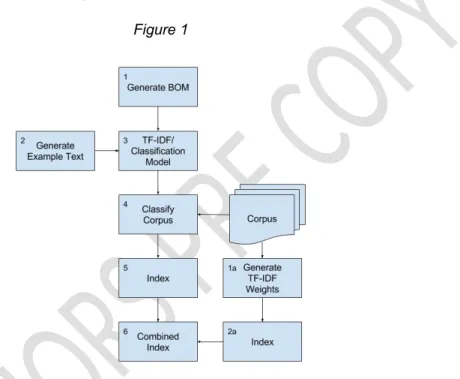
Figure 1 shows the process diagram for creating both a traditional TF-IDF search engine (1a - 2a) and the combined approach (1-6 and 1a-2a).
Figure 1
The Institution of Mechanical Engineers Formula Student is a competition that requires University students to design, build and race a single seat racing car. Teams of around 30 students design the car in their third year and construct it in their fourth year. For the purposes of this study the 2013-14, 2014-15 and 2015-16 reports from the University of Bath were used. Reports are in pdf format, around ten pages in length and comprise of raw unstructured text, tables and images. In total this corpus comprised of 241 reports.
In addition to these reports, students submit a financial statement which includes a BOM. Each year students generate a new design and with it a slightly new BOM and so for the purposes of this study a generic BOM was determined from the past three years. Table 1 shows an extract from this generic BOM. This relates to stage 1 in the process diagram.
Table 1
Generic Formula Student BOM
Level 1 Level 2 Level 3 Level 4
... ... ... ...
fs car engine and drivetrain exhaust system collector fs car engine and drivetrain exhaust system secondary pipe fs car engine and drivetrain exhaust system muffler
fs car engine and drivetrain oil system oil tank deaerator fs car engine and drivetrain oil system overflow bottle holder fs car engine and drivetrain oil system overflow bottle
fs car engine and drivetrain oil system oil coolant heat exchanger fs car engine and drivetrain fuel system fuel tank
... ... ... ...
The next stage (2) involves obtaining component level example text; this was achieved by asking a domain expert to generate bodies of text for each component in the BOM. The domain expert had 30 years engineering experience with 10 years specifically on Formula Student. An extract from the result is shown in Table 2. On average, each example text contained 31 words split over two sentences.
Table 2
BOM
Component Example Text
anti-roll bar
The anti-roll bar is part of the suspension system. Its function is to reduce the body roll of a vehicle during fast cornering or over road irregularities. It connects opposite (left/right) wheels together through short lever arms linked by a torsion spring.
balance bar
A balance bar is an adjustable lever that is pivoted on spherical bearings and employs two individual master cylinders for the actuation of the front and rear brakes. It forms part of the pedal assembly and also provides a mounting for the master cylinders. When the balance bar is cantered, it pushes equally on both master cylinders creating equal pressure.
battery The battery is an electrochemical device that supplies the electric power to the low voltage system on the vehicle.
bearing A collective term for is a machine element that constrains relative motion to only the desired motion, and reduces friction between moving parts.
... ...
Stage 3 constructed the model by parsing each component's example text and performing a TF-IDF comparison with its siblings' components. TF-IDF scores were then stored for each component. An extract from the model for the component ‘Crank Sensor’ is shown in Table 3.
Table 3
Component Term TF-IDF Weight
Crank Sensor crank 0.0084170581
speed 0.0084170581
combustion 0.0068013304
engine 0.0068013304
internal 0.0068013304
rotational 0.0058561903
monitor 0.0058561903
sensor 0.0051856027
Stage 4 includes the classification of the FS reports. This was done by extracting raw text from the pdf reports and tokenizing the text to obtain a list of terms in each report. For each component in the BOM model the TF-IDF weight for any shared term was summed to give each document a similarity score.
By its nature, the model generates a similarity score between every document and every component (stage 5). These scores are locally generated and so are not comparable across BOM branches. Some measure is then needed to limit the number of documents returned and the results section
discusses how such a measure can be determined. In addition to the cut off, the results section also discusses techniques for combining the two sets of results. Essentially, the Results and Discussion and Conclusion section of this paper discuss techniques for delivering an effective Stage 6.
Stages 1a and 2a show the construction of the TF-IDF search engine. This was achieved by extracting the text from all 241 reports and generating the TF-IDF weights for each term in the corpus. These were then stored in an index that was interrogated to produce the combined index and the TF-IDF results for the comparison.
A search involves traversing both the TF-IDF search index and BOM Classification search index. The results from both are then combined and ranked based on the summation of the two scores and this is discussed in the following sections. For the purposes of the study and to explore the potential benefits, seven component names were selected at random from the BOM.
5 RESULTS
This section focuses on two main areas; the first is a strategy to limit the number of results returned by the BOM Classification system. The second examines two approaches to combine the results from the two techniques. From the seven terms used, five returned results for both approaches, see Table 4. Neither approach returned 100% of the ground truth documents. The BOM Classification
approach returned a higher number of relevant results however, as expected; Table 5 shows how the approach also returns a far higher number of non-relevant results.
Table 4
Query Ground Truth Retrieved Relevant Documents BOM Classification TF-IDF
Brake System 38 22 19
Cooling system 21 17 13
Exhaust System 40 30 19
Front Wing Assembly 26 21 7
Paint - Body 2 0 0
Steering Column 8 6 5
Table 5
Query Ground Truth Total Retrieved Documents
BOM Classification TF-IDF
Brake System 38 229 86
Cooling system 21 232 81
Exhaust System 40 240 66
Front Wing Assembly 26 238 45
Paint - Body 2 0 0
Steering Column 8 238 22
Track Rod 3 0 48
5.1 Cut-Off
Several techniques were tested to find a representative cut-off for the classification results, top n-results or top x-percent for example. Further study in this area is needed and so this paper does not focus on this investigation. However, the closest representative measure found was using the number of results returned by the TF-IDF approach.
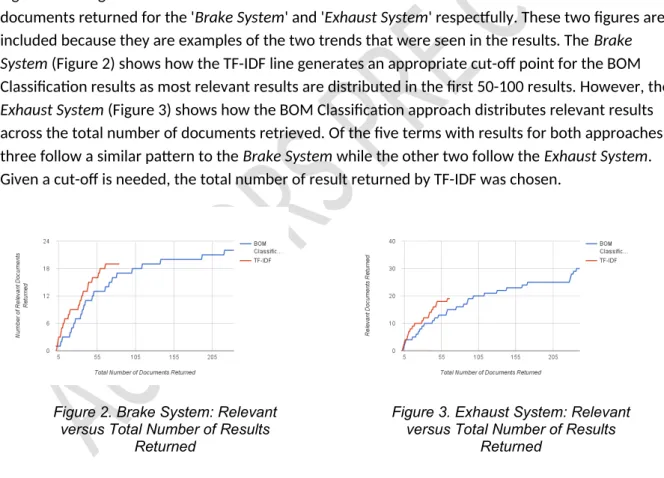
Figure 2 and Figure 3 show the number of relevant documents returned versus the total number of documents returned for the 'Brake System' and 'Exhaust System' respectfully. These two figures are included because they are examples of the two trends that were seen in the results. The Brake System (Figure 2) shows how the TF-IDF line generates an appropriate cut-off point for the BOM Classification results as most relevant results are distributed in the first 50-100 results. However, the
Exhaust System (Figure 3) shows how the BOM Classification approach distributes relevant results across the total number of documents retrieved. Of the five terms with results for both approaches, three follow a similar pattern to the Brake System while the other two follow the Exhaust System. Given a cut-off is needed, the total number of result returned by TF-IDF was chosen.
Figure 2. Brake System: Relevant versus Total Number of Results
Returned
Figure 3. Exhaust System: Relevant versus Total Number of Results
Returned
5.2 Combining Results
Both figures do however show a result that goes against these trends. The large percentage
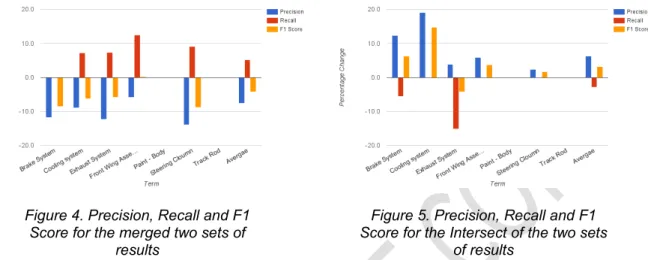
improvement for the ‘Front Wing Assembly’ causes a very slight increase in the F1-Score. Looking at the figure for the intersect; a large percentage decrease in the ‘Exhaust System’ also causes a decrease in the F1-Score.
Figure 4. Precision, Recall and F1 Score for the merged two sets of
results
Figure 5. Precision, Recall and F1 Score for the Intersect of the two sets
of results
Figure 6 and Figure 7 show the same data as Figure 2 and Figure 3 with the addition of the values for the merged and intersected results. Again, these two examples are typical of those seen across the five terms that returned results for both approaches. Both Figures show how the results for the merged results lie between the TF-IDF and BOM Classification results - as one would expect. The line reaches a maximum at a point that is either equal to or exceeding the TF-IDF approach but does so over a larger number of returned results. Both figures also show how the intersection of the two approaches delivers relevant results sooner - with fewer non-relevant results returned, this is at the cost of the number of relevant results returned with the line stopping short of the lines for the other three approaches.
Figure 6. Precision, Recall and F1 Score for the merged two sets of
results
Figure 7. Precision, Recall and F1 Score for the Intersect of the two sets
of results
6 CONCLUSION AND DISCUSSION
The approach outlined in this paper aimed to improve a IDF search system by combining the TF-IDF with a classification system that classified documents against the product structure. To
approaches and methods for combining these results were examined. The results show that the number of results returned by a TF-IDF search generated a representative cut-off point for the number of results returned by the BOM Classification approach used. In combining the results from the two approaches, promise was seen depending on whether the goal is to expand on the number of relevant results returned or to increase the precision of those results.
This trade-off is one that is frequently experienced in IR - hence the existence of the measures of the Precision, Recall and F1-Score. The goal of any search engine is 100% precision but challenges such as the ambiguity of language and the uncertainty in the user's information needs mean that there are no perfect IR systems and we all perform our searches with an expectation that the final stages of the search will be performed by our own evaluation and browsing of a corpus subset. The work presented here shows that the technique provides some tailoring of this subset. An example of where this is useful was presented by the authors in (Jones, Chanchevrier, et al. 2015) where IR is performed via a three-dimensional visual representation of the artefact. Representing many results within a three-dimensional artefact space will quickly swap the visualisation and become unusable. In this case the intersect of the two results set will benefit the visualisation and the possible
reduction in the recall may be acceptable given an increase in precision and greatly reduced number of documents returned.
The work presented here is however an initial study into the use of classification alongside TD-IDF to improve IR and there is still a lot of further work to do in this area and on many levels. Beginning with the example corpus and techniques for building the classification model to expanding and optimising the techniques for combining results and even including the TF-IDF search engine within the classification model.
The size of the corpus used here is relatively small and did not allow for the more traditional division of the corpus into training and testing sets and so example text was generated and used. One can question whether the example text is representative of the corpus itself and it would be beneficial to repeat this study on a larger corpus, for example those used within large organisations such as Aerospace where mature products generate larger corpora, standardised lexicons,
reporting/documentations and procedures.
There are several alternative machine learning approaches to construct the classification model - artificial neural networks and deep learning for example. The aim of the work presented here was to determine if the product structure can be used to improve IR and not to determine the best
approach for doing so. Now that it has been shown that the technique can have a positive impact on the results returned the foundations are in place for this future work.
The final aspect to discuss is whether there are better strategies for merging the two results sets. This study showed the intersect improved Precision while the merging improved the Recall and F1-Score. No attempt was made to integrate the two approaches and generate a result set that optimised for all three measures. This would also benefit from further study.
ACKNOWLEDGMENTS
(LOCM) Project (EPSRC grant reference EP/K014196/1) and the Airbus Group. The authors would like to thank colleagues at the Airbus Group, University of Bristol, University of West England and the University of Bath for their support and contribution.
REFERENCES
Baeza-Yates, R., Ribeiro-Neto, B. & others, 1999. Modern information retrieval, ACM press New York. Bird, S., Klein, E. & Loper, E., 2009. Natural language processing with Python, “ O’Reilly Media, Inc.” Camba, J. et al., 2014. Extended 3D annotations as a new mechanism to explicitly communicate geometric
design intent and increase CAD model reusability. Computer-Aided Design, 57, pp.61–73.
Chen, H., Chiang, R.H.L. & Storey, V.C., 2012. Business Intelligence and Analytics: From Big Data to Big Impact, Available at: http://aisel.aisnet.org/misq/vol36/iss4/16.
Eastman, C. et al., 2011. BIM handbook: A guide to building information modeling for owners, managers, designers, engineers and contractors, John Wiley & Sons.
Finkelstein, L. et al., 2001. Placing search in context: The concept revisited. In Proceedings of the 10th international conference on World Wide Web. pp. 406–414.
Hawking, D., 2004. Challenges in enterprise search. In Proceedings of the 15th Australasian database conference-Volume 27. pp. 15–24.
Hicks, B.J. et al., 2002. A framework for the requirements of capturing, storing and reusing information and knowledge in engineering design. International Journal of Information Management, 22(4), pp.263–280. Jones, D.E., Chanchevrier, N., et al., 2015. A STRATEGY FOR ARTEFACT-BASED INFORMATION
NAVIGATION IN LARGE ENGINEERING ORGANISATIONS. In DS 80-10 Proceedings of the 20th International Conference on Engineering Design (ICED 15) Vol 10: Design Information and Knowledge Management Milan, Italy, 27-30.07. 15.
Jones, D.E., Xie, Y., et al., 2015. Improving Enterprise Wide Search in Large Engineering Multinationals: A Linguistic Comparison of the Structures of Internet-Search and Enterprise-Search Queries. In IFIP International Conference on Product Lifecycle Management. pp. 216–226.
Klampanos, I.A., 2009. Manning Christopher, Prabhakar Raghavan, Hinrich Schütze: Introduction to information retrieval. Information Retrieval, 12(5), pp.609–612. Available at:
http://link.springer.com/10.1007/s10791-009-9096-x.
Lee, S.G. et al., 2008. Product lifecycle management in aviation maintenance, repair and overhaul. Computers in industry, 59(2), pp.296–303.
Liu, D.T. & Xu, X.W., 2001. A review of web-based product data management systems. Computers in industry, 44(3), pp.251–262.
Stocker, A. et al., 2014. Is enterprise search useful at all?: lessons learned from studying user behavior. In Proceedings of the 14th International Conference on Knowledge Technologies and Data-driven Business. p. 22.
Witten, I.H. & Frank, E., 2005. Data Mining: Practical machine learning tools and techniques, Morgan Kaufmann.
![3 Chloro 6 {4 [3 (4 chlorophenoxy)propyl]piperazin 1 yl}pyridazine](data:image/gif;base64,R0lGODlhAQABAIAAAP///wAAACH5BAEAAAAALAAAAAABAAEAAAICRAEAOw==)