Scholarship@Western
Scholarship@Western
Electronic Thesis and Dissertation Repository
5-24-2012 12:00 AM
Flexible Workplace Practices in Small IT Firms: A Multiple Case
Flexible Workplace Practices in Small IT Firms: A Multiple Case
Study
Study
Catherine E. Gordon
The University of Western Ontario Supervisor
Dr. Julie McMullin
The University of Western Ontario Graduate Program in Sociology
A thesis submitted in partial fulfillment of the requirements for the degree in Doctor of Philosophy
© Catherine E. Gordon 2012
Follow this and additional works at: https://ir.lib.uwo.ca/etd Part of the Work, Economy and Organizations Commons
Recommended Citation Recommended Citation
Gordon, Catherine E., "Flexible Workplace Practices in Small IT Firms: A Multiple Case Study" (2012). Electronic Thesis and Dissertation Repository. 561.
https://ir.lib.uwo.ca/etd/561
This Dissertation/Thesis is brought to you for free and open access by Scholarship@Western. It has been accepted for inclusion in Electronic Thesis and Dissertation Repository by an authorized administrator of
A MULTIPLE CASE STUDY
(Spine title: Flexible Workplace Practices in Small IT Firms)
(Thesis format: Monograph)
by
Catherine Elizabeth Gordon
Graduate Program in Sociology
A thesis submitted in partial fulfillment of the requirements for the degree of
Doctor of Philosophy
The School of Graduate and Postdoctoral Studies The University of Western Ontario
London, Ontario, Canada
CERTIFICATE OF EXAMINATION
Supervisor
______________________________ Dr. Julie McMullin
Supervisory Committee
______________________________ Dr. Tracey Adams
Examiners
______________________________ Dr. Tracey Adams
______________________________ Dr. Kim Shuey
______________________________ Dr. June Cotte
______________________________ Dr. Donna Lero
The thesis by
Catherine Elizabeth Gordon
entitled:
Flexible workplace practices in small IT firms: A multiple case study
is accepted in partial fulfillment of the requirements for the degree of
Doctor of Philosophy
______________________ _______________________________ Date Chair of the Thesis Examination Board
Flexible workplace practices (FWPs), such as flex-time and working from home,
facilitate employees’ work-life balance or integration and enhance their quality of work.
Yet, their use is constrained by time-oriented and gendered workplace cultures. Typically
past research involves either a quantitative analysis of individual-level data or a
qualitative examination of a single large firm. Meanwhile in Canada, small businesses
(with less than 100 employees) employ 48 percent of the total labour force in the private
sector (Industry Canada, 2010). In this dissertation, I investigate the FWPs available and
used at small information technology (IT) firms. Cross-firm comparisons are made with
respect to this flexibility and the working time aspect of workplace culture. I then
examine potential individual and structural factors that may influence the availability and
use of FWPs, as well as the working time rules and behaviours of small firms. How
employees experience FWPs is also explored.
This research is guided by a theoretical orientation that is multi-levelled and
multi-directional and incorporates the life course perspective. A multiple case study is
utilized here to compare 17 small firms located in the IT industry. Data sources include
103 quantitative web-surveys, 136 in-depth interview transcripts, and 17 case study
reports and snapshots, as well as eight human resource (HR) policies that existed among
these firms. These data come from a larger project, Workforce Aging in the New Economy
(WANE). Findings reveal three patterns among firms regarding their FWPs and working
time behaviours and rules. These firms vary along gender, class, and age lines. The small
business owners’ recent employment transitions and past employment experiences
shaped how they ran their firms. Employees’ experiences differ accordingly. This
among knowledge-intensive firms regarding the managerial control strategies used and
implications for employees. Results also suggest that similar and different processes
occur in large and small firms. In order for greater flexibility to be available in small
firms, both structural and individual changes need to occur.
Keywords: sociology, flexible workplace practices, alternative work arrangements,
employment, workplace cultures, new economy, knowledge-intensive, life course,
work-life integration/balance, information technology, case study, small firms
My doctoral dissertation has not been a solitary adventure. Here I would like to
acknowledge the many people who contributed to this final product. First, I would like to
thank the University of Western Ontario for the financial support I received for four
years. The availability of this aid made the choice to pursue doctoral studies an easy one.
I consider myself fortunate to have had Julie McMullin as my doctoral supervisor.
During my first two years in the Ph.D. program, I was a research assistant for her project
Workforce Aging in the New Economy (WANE). Being an R.A. gave me the flexibility to
focus solely on my assignments and comprehensive exams when need be and this
undoubtedly saved my sanity. I went into this supervisor-student relationship knowing I
was about to experience growing pains. Indeed, I did and am grateful for it. Julie’s candid
remarks, advice, and patience pushed me to be a better scholar. I thank her for helping me
develop my research and writing skills. At times when I felt insecure about my progress,
Julie assured me I was on pace with the long process of a dissertation. I always left our
meetings feeling motivated and confident. You are a great mentor Julie, thank you!
My co-supervisor Tracey Adams came onto this project rather late in the analysis
and writing process. At this time, I was a little worried about her feedback after already
putting in a lot of time and effort. Tracey provided constructive criticisms that added
depth to my research. She introduced me to scholarly work on responsible autonomy after
seeing a parallel between it and some of my findings. It became a very useful concept
that helped situate my work into the sociological perspectives that are the backbone to my
work. Thank you Tracey for pushing me to further my analysis and to highlight my
findings better.
research assistant for the WANE project, I saw different stages of the research process and
its complexities. The investigators, researchers, and participants of the WANE project
made this dissertation possible; without their involvement and hard work, the good
quality data would not be available for my use. This project was funded by the Social
Sciences and Humanities Research Council of Canada (SSHRC). The WANE project gave
me resources (i.e., data, equipment, and office space) for my research and introduced me
to many ‘aging and work’ researchers including Tammy Duerden Comeau and Emily
Jovic. These intelligent women have been an inspiration to me, especially when I started
on the project as a Master’s student. I am grateful for the conversations Emily and I
shared about our research interests, thoughts about the future, and the hardships and
successes she experienced in the dissertation process. I reflected on these conversations
when it came time for me to work on my dissertation and was reassured that I was not the
only one who faced difficulties.
I would also like to thank Gale Cassidy and Ingrid Connidis for giving me
teaching opportunities while I was a teaching assistant for them. This experience gave me
the confidence I needed to get my toes wet and teach a whole semester by myself last fall.
Both Gale and Ingrid have been forthright about the rewards and challenges involved in
teaching university students and I enjoyed hearing these stories. I thank Ingrid for
continuing to be a great mentor to me while I pursued my Ph.D. Ingrid, I appreciate all of
the sage advice you have given me and the good conversations we have had about
academia.
Cotte, and Donna Lero – for committing to this project. Their thoughtful questions were
challenging and tested the depth of my knowledge. My research will greatly improve
from their comments and suggestions.
The staff and faculty in the sociology department at UWO have been supportive
of my endeavours throughout my time in the Ph.D. program. I thank them for their
encouragement and shared stories of their academic experiences.
I am forever grateful for my great family and friends. I especially thank my
parents Heather and Don, brother Stu and sister-in-law Amanda, Grandma and Grandpa
Gordon, Grandma Goldie, and Mike. Throughout grad school, they have been my pillars
of strength. They learned quickly that I often did not want to be probed about when I will
graduate, although I knew my Grandma Gordon was getting quite anxious. ‘Someday’
has finally come. My family brought balance to my life and made sure I would not be ‘in
the bubble’ all of the time. Mike would call me out if I, the work-life researcher, was not
having an even balance of work and fun in my own life. Mike helped me think through
my ideas (often by listening to my rambling tangents), celebrate my successes, and
calmed my fears. Family and friends, it is time to celebrate the end of one chapter and the
beginning of another.
Certificate of Examination...ii
Abstract and Keywords...iii
Acknowledgements...v
Table of Contents...viii
List of Tables...xiii
List of Figures...xiv
List of Appendices...xv
Chapter 1: Introduction...1
1.1 Flexible Workplace Practices (FWPs)...2
1.2 Benefits for Individuals ...3
1.3 Benefits for Businesses...5
1.4 Benefits for Society...6
1.5 This Dissertation...9
Chapter 2: Theoretical Perspectives and Conceptual Framework...13
2.1 Stratification Perspective...14
2.2 Institutional Theory...15
2.3 Managerial Control Perspectives ...17
2.3.1 Marx: Surplus Value, Exploitation, and Alienation...18
2.3.2 Direct Control and Responsible Autonomy...20
2.3.3 Gaining Workers’ Consent by Playing Games...23
2.3.4 Elements of Control Systems: Rewards and Discipline...27
2.3.5 Summary Remarks...28
2.5 Feminist Perspectives...37
2.5.1 Separate Spheres of Life...37
2.5.2 Gendered Workplaces...40
2.5.3 Summary Remarks...41
2.6 Conceptual Framework...44
2.6.1 Life Course Principles...44
2.6.2 Structured Social Relations and Agency...48
2.6.3 Modified Conceptual Framework...51
Chapter 3: Methods...56
3.1 Sample...58
3.2 Data Collection...61
3.3 Ethics...65
3.4 Sample Characteristics...66
3.5 Study Research Design...68
3.6 Limitations...73
Chapter 4: Classifying Small Firms by their Flexibility for Employees...75
4.1 Cross-Firm Comparisons of Flexible Workplace Practices...76
4.1.1 Presence of Flexible Workplace Practices: Formal Policies and Informal Negotiations...77
4.1.2 Types of Flexible Workplace Practices Used ...79
4.1.3 The Range of Flexible Workplace Practices Used and the Associated Conditions...82
4.2 Workplace Cultures and Flexible Workplace Practices...87
4.3 The Characteristics of Firms, Owners, and Employees across Firm-Types...90
4.3.1 Firm Characteristics...91
4.3.2 Characteristics of Owners...93
4.3.3 Characteristics of Employees...96
4.3.4 Summary Remarks...99
4.4 Application of the Flexible Workplace Practices and Workplace Culture Typology...100
Chapter 5: Sources of Rigid and Flexible Firms...102
5.1 Rigid Firms...103
5.1.1 Education, Gender Ideologies, and Recent Work History...104
5.1.2 Employment Experiences and Current Firm Organization ...105
5.2 Flexible Firms ...110
5.2.1 Firm Characteristics...110
5.2.2 Education, Gender Ideologies, and Recent Work History...111
5.2.3 Discontent about Previous Work Experiences...113
5.2.4 Positive Reflections of Working in IT...117
5.2.5 Work-Life Experiences...121
5.3 The Linked Lives in Family-Owned Small Businesses and the Firm’s Flexibility...124
5.3.1 E&C Solutions, a Rigid Firm: A Traditional Relationship...126
Relationship...129
5.4 Chapter Summary...131
Chapter 6: Employee Experiences of Flexibility in Small IT Firms...133
6.1 Employees in Rigid Firms ...133
6.1.1 ComTech: “a small company … run as if it’s a big company” ...134
6.2 Employees in Flexible Firms ...143
6.2.1 Interface Consulting: “work is important but so is your home life” ...143
6.2.2 Online Design: “some projects call for it” ...150
6.3 Chapter Summary ...155
Chapter 7: Discussion and Conclusions...157
7.1 Classification of the Small IT Firms: Differences in FWPs and the Time and Place of Work...158
7.2 Past Employment Experiences of Owners, Present Experiences of Employees, and Linked Lives in Family-Owned Firms...159
7.3 Contributions of this Dissertation...161
7.3.1 Management Control Strategies in Small, Knowledge-Intensive Firms...162
7.3.1.1 The lasting effects of structured social relations on the agency of powerful individuals...163
7.3.1.2 Paternalism: The intersection of class, age, and gender relations in rigid firms...165
7.3.2 Responsible Autonomy: The Intersections of Class, Age, and Gender Relations among Flexible Firms...166
7.3.3.1 Decisions regarding FWPs in small firms...171
7.3.3.2 Class relations...173
7.3.4 Flexible Workplace Practices in Family-Owned Businesses...175
7.3.5 Studying Flexible Workplace Practices...177
7.4 Limitations...174
7.5 Future Research Directions...180
7.6 Conclusions...182
References...184
Appendices...203
Curriculum Vitae...216
Table 3.1: Availability and Use of FWPs among WANE Canadian Participants...64
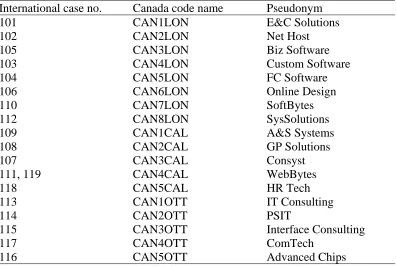
Table 3.2: Firms by their Identification Number, Code Name, and Pseudonym...66
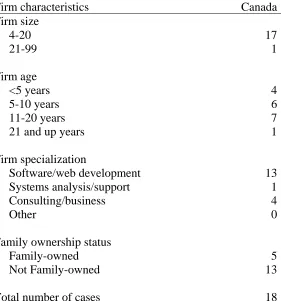
Table 3.3: Firm Characteristics of the Canadian Sample...67
Table 4.1: The Presence of Flexible Workplace Practices through Formal HR Policies and Informal Negotiation across Firms ...78
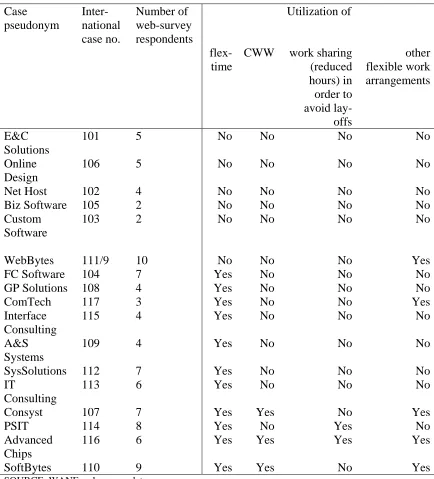
Table 4.2: Types of Flexible Workplace Practices Used across Firms….……….81
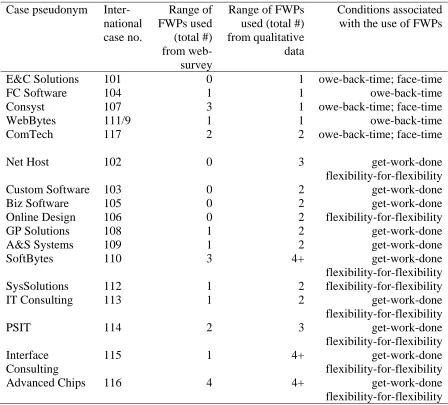
Table 4.3: The Range of Flexible Workplace Practices Used and the Associated Conditions...83
Table 4.4: The Workplace Culture Dimensions of Rigid and Flexible Firms…...89
Table 4.5: Firm Characteristics across Rigid and Flexible Firms...92
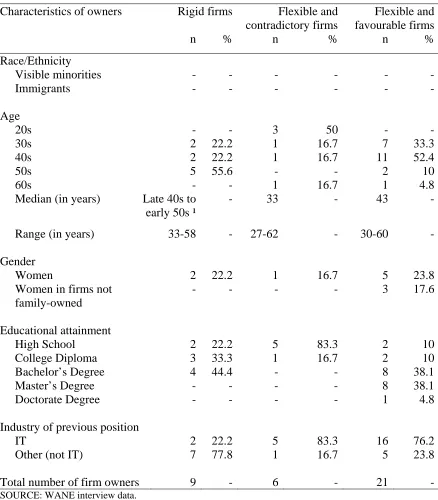
Table 4.6: Characteristics of Owners across Rigid and Flexible Firms...95
Table 4.7: Characteristics of Employees across Rigid and Flexible Firms...98
Figure 2.1. McMullin’s (2010) CAGE Framework...45
Figure 2.2. Adaptation of McMullin’s (2010) CAGE Framework...55
xv
Appendix A: Employment Regulations in Ontario and Alberta...203
Appendix B: WANE Interview Guide...209
Appendix C: WANE Case Study Report Template...212
Chapter 1: Introduction
Workplace flexibility, the topic of this dissertation, has become a prominent issue
in scholarly research and mainstream media over the past two decades. The term has
become a catchword used by businesses, governments, and academics that is fraught with
multiple meanings (Benner, 2002; Hill et al., 2008). From an organizational perspective,
flexibility enables companies to respond to the economic transformations that have
occurred over the past twenty years. Businesses have increasingly experienced global
competition that requires them to innovate continuously and quickly adapt to market
demands (Benner, 2002; Carnoy, Castells, & Benner, 1997). Currently, market risks and
insecurities are ever-present as organizations and economies are either recovering from or
still suffering the effects of the recent recession (2008). Flexible practices that help
businesses be competitive involve employment contracts (e.g., hiring temporary workers
over permanent workers) and/or labour process activities (e.g., changing the quantity and
pace of work required of employees) (Benner, 2002). These practices also require
workers to be adaptable (Kalleberg, 2000; Smith, 1997). For instance, workers may be
required to respond promptly to emergent problems or issues “after hours” in the
evenings or on weekends; technologies (i.e., smart phones, laptops) facilitate this 24/7
work environment (Presser, 2003; Valcour & Hunter, 2005). For businesses, the
economic bottom line is the primary concern, and working conditions and job insecurity
are only minor concerns (Burchell, Ladipo, & Wilkinson, 2002; Sennett, 1998).
From a worker’s perspective, flexibility has the potential to help individuals and
their families overcome the challenges involved in combining their work and personal
attention given to this kind of flexibility over the past 20 years coincides with the
increasing participation of women in the labour force, the commonality of dual-income
earner households, and the increasing amount of time men spend performing child care
(Marshall, 2006, 2009). These social trends help expose how work is often organized in a
way that is incompatible with family life (Corman & Luxton, 2007; Rapoport, Bailyn,
Fletcher, & Pruitt, 2002). Working long hours, for example, is frequently an idealized
behaviour; but, it presumes that workers have an unlimited amount of time available for
work (Rapoport et al., 2002). Flexible practices that primarily benefit workers gives them
some choice about where, when, and for how long they perform their work (Hill et al.,
2008; Jacob & Gerson, 2004; Korabik et al., 2008; Lewis & Cooper, 2005). This
flexibility is the focus of my dissertation; I refer to these practices as flexible workplace
practices or FWPs.
1.1 Flexible Workplace Practices (FWPs)
There are three dimensions of flexible workplace practices (FWPs) that are
considered in this thesis. The first has to do with the extent to which employers are
flexible with regard to alternative work arrangements. Examples include taking leaves of
absence and extended breaks during the workday, as well as reducing hours from
full-time to part-full-time, job-sharing, or phased retirement (Hill et al., 2008; Jacobs & Gerson,
2004; Kossek & Van Dyne, 2008). These work arrangements tend to affect the number of
hours worked. The second kind of FWPs considered here involves scheduling when work
is performed and the possibility of varying the scheduling of work without changing the
2008). Examples include flex-time, variable work days or work-weeks, and compressed
work-weeks. Flex-time refers to choosing when to begin and end a workday; it typically
has limitations regarding when hours are to be worked (e.g., between 8am and 8pm)
and/or what core hours must be worked (e.g., 10am to 4pm) (Akyeampong, 1993; Kossek
& Van Dyne, 2008). Variable work days or weeks mean that employees work more one
day or week and less another day or week; these FWPs should not be confused with the
irregular shift-work involved in part-time and/or temporary jobs because such variability
is decided by managers. A compressed work-week refers to working the equivalent
amount of weekly hours but spread over fewer days (e.g., four 10-hour days). The third
consideration regards the location of where work is performed (e.g., at home on an
occasional or permanent basis).
1.2 Benefits for Individuals
FWPs are a means through which individuals can integrate their work and
personal lives in more harmonious ways. Two-thirds of Canadians experience a moderate
level of life conflict and just less than 30 percent experience a high level of
work-life conflict (Duxbury & Higgins, 2003; MacBride-King & Bachmann, 1999). Work-work-life
integration, balance, and conflict are phrases that are commonly used to indicate whether
individuals are able to fulfill or “manage effectively multiple responsibilities at work, at
home, [and] in their community” (Human Resources and Skills Development Canada
[HRSDC], 2005). Unintentionally, the phrase ‘work-life’ may imply that work is separate
from one’s life, but the term is more recognized and convenient to use than
Higher work-life conflict is associated with stress (Kelloway, Gottlieb, &
Barham, 1999), poor physical health (Burke & Greenglass, 1999; Grzywacz, 2000), low
life satisfaction (Kossek & Ozeki, 1998), and family distress (Aryee, Srinivas, & Tan,
2005). It is also associated with lower job satisfaction (Kossek & Ozeki, 1998;
Mesmer-Magnus & Viswesvan, 2005; Netemeyer, Maxham, & Pullig, 2005) and lower
organizational commitment (Kossek & Ozeki, 1998; Netemeyer et al., 2005), as well as
higher absenteeism (Kossek & Ozeki, 1998; Netemeyer et al., 2005), a desire to find new
employment (Kelloway et al., 1999; Kossek & Ozeki, 1998; Mesmer-Magnus &
Viswesvan, 2005), and actual turnover (Greenhaus, Collins, Singh, & Parasuraman,
1997).
Research consistently finds that the use of FWPs is associated with lower
work-life conflict, stress, and anxiety (Christensen & Staines, 1990; Glass & Estes, 1997;
Higgins, Duxbury, & Lyons, 2008; Hill, Hawkins, Ferris, & Weitzman, 2001). As a
result, one’s health is also enhanced (Fenwick & Tausig, 2004; Galinksy et al., 2010).
Using FWPs is also associated with greater job satisfaction (Christensen & Staines, 1990;
Comfort, Johnson, & Wallace, 2003) and the retention of employees who may have
exited the labour force otherwise (Glass & Riley, 1998; Rodgers, 1992). Access to FWPs
is also found to have positive effects on individuals’ job satisfaction and health, and
decrease the likelihood they seek out a different job (Galinksy, Sakai, & Wigton, 2010).
In short, individuals who experience low work-life conflict are happier and healthier
1.3 Benefits for Businesses
The business case for why organizations should facilitate the development and
use of FWPs largely rests on the benefits derived from employees reducing their
work-life conflict and stress. Employees who experience low work-work-life conflict have greater
organizational commitment and motivation to do their jobs well (Osterman, 1995) and
are more productive (Konrad & Mangel, 2000; Rodgers, 1992) compared to employees
who experience higher work-life conflict. These employee qualities are presumed to
benefit businesses because employees are focused, committed, and happy.
Some argue, however, that employee qualities, such as happiness, do not serve
businesses’ immediate needs for profitability in the marketplace leaving managers
wondering how FWPs add to the bottom line. Their concerns are addressed through the
idea of mutual flexibility, a reciprocal exchange between employees and employers that
enables both parties to fulfill their immediate needs (Gonyea & Googins, 1996; Harker,
1996). Mutual flexibility requires employees and employers to recognize each others’
needs and know the differences between them. When these needs conflict, trade-offs
should be made (Gonyea & Googins, 1996). For instance, employees will go beyond their
typical work duties or hours of work when needed to by their employer in exchange for
using FWPs (Atkinson & Hall, 2009; Gonyea & Googins, 1996). Through this exchange,
employers receive more direct benefits compared to situations in which FWPs are
available only as entitlements (Atkinson & Hall, 2009). Notably, however, power
imbalances between employers and employees are bound to influence employment
they give more to employers than what they receive in return (Atkinson & Hall, 2009;
Gonyea & Googins, 1996).
1.4 Benefits for Society
Implementation of FWPs in the workplace also benefits society as a whole. These
practices potentially help businesses align with demographic and social trends and
contribute towards gender equity in the workplace. The great range of FWPs involving
when, where, or for how long work is performed can accommodate a variety of
preferences and needs.
Gender equity in the workplace means that opportunities and constraints are
distributed equally for men and women (Perrons, Fagan, McDowell, Ray, & Ward, 2006;
Rapoport et al., 2002). It respects the different preferences, circumstances, and needs
among both men and women (Perrons et al., 2006; Rapoport et al., 2002). Any movement
towards gender equity through FWPs requires that such practices are supported by
employees’ immediate supervisors and the workplace culture of a company. Otherwise,
the use of FWPs is limited (see Bailyn, 2006; Bond, 2004; Callan, 2007; Hochschild,
1997; Peper, den Dulk, & van Doorne-Huiskes, 2009) and the gendered connotation that
FWPs are only for mothers will persist (Atkinson & Hall, 2009; Peper et al., 2009).
Recognition of diversity not only facilitates gender equity but also reflects the
current portrait of Canadian families. Eighty-four percent of Canadians live with
immediate family members (spouse or partner, children, and/or parents) (Milan, Vézina,
Wells, 2007).1 Among these families, 16 percent are lone-parent, 43 percent are couples
(married or common-law) who do not have children under the age of 25 living in the
1
home, and 41 percent are couples who have children 24 years and under living in the
home.2 FWPs enable parents to drop off and/or pick-up their children from daycare or
school, take them to appointments, and stay home when they are sick or home from
school, among other things. Parents, however, are not the only potential beneficiaries of
FWPs. The remaining 16 percent of Canadians who do not live with family members and
the couples who are childless may need to use FWPs in order to fulfill their personal
(e.g., educational training), caregiving (e.g., care for or help a parent), or community
responsibilities (e.g., coach of minor sports) and work activities with ease. In short, it is
important to recognize that Canadian employees have varying responsibilities,
circumstances, and needs.
In addition to the diversity briefly described above, changes have occurred among
husband and wife couples who are either legally married or common-law. The prevalence
of dual-income earners among these couples has risen from 36 percent in 1976 to 69
percent in 2006 (Marshall, 2006).3 Further, the likelihood that both partners work
full-time (30 or more hours per week) has increased over the past 10 years (Marshall, 2009).4
This change is largely because fewer wives work part-time (from 26 percent in 1997 to
21 percent in 2008, p<.05). Another change within these couples is that men are
becoming more involved in parental care, although women are more likely to be the
primary caretakers (Marshall, 2006). These trends highlight the pressing concern of
2
Among the 84 percent of Canadians who live with family members, 69 percent are married couples and 16 percent are common-law couples.
3
Data are from the 2005 General Social Survey (GSS).
4
work-life conflict, particularly if young children live at home, as fewer couples have a
partner at home on a part-time or full-time basis (Marshall, 2009).5
Workplaces that do not acknowledge employees’ non-working lives (e.g., through
FWPs) presume work-life conflict is an individual’s problem. Using Mills’ (1959)
terminology, this issue is a ‘private trouble’ that is often shouldered by women
considering the inequitable division of caregiving responsibilities (Luxton & Corman,
2001; Marshall, 2006). Mills (1959) argues that private troubles should also be
considered beyond an individual level as a ‘public issue’ in order for resolution. Treating
work-life conflict as a public issue requires institutions (i.e., workplaces) to take some
responsibility for the problem or issue; helping employees overcome their personal
challenges with FWPs, for example, may not eradicate work-life conflict as a social
phenomenon but will provide some alleviation. These supports may also improve
women’s status because they might serve to enhance the value that society places on
family and domestic labour. This possibility is based on the reasoning that the
devaluation of family and domestic labour contributes to gender inequality and the
private troubles of work-life conflict (see Corman & Luxton, 2007; Luxton & Corman,
2001).
Another matter to consider in discussions of FWPs is population aging.
Population aging has garnered attention in the work-life literature regarding the looming
elder care that employees are expected to provide for their Baby Boomer parents
(individuals born between 1946 and 1966) (see Galinsky, 2001; Higgins et al., 2008; Lero
& Lewis, 2008). Population aging also implies that the needs of the labour force will
change as it becomes older and workplaces will need to adapt in order to retain older
5
workers and high levels of productivity. In 2006, the oldest Boomers turned 60. Record
levels of labour force participation of older workers were set that year, as 59 percent of
those aged 55 to 64 participated in the labour force (Marshall & Ferrao, 2007); 45 percent
of those aged 60 to 64 participated in the labour force.6 Although the majority of these
older workers aged 55 to 64 years work full-time (81 percent), they are more likely to
work reduced hours compared to their core-aged counterparts aged 25-54 years (Marshall
& Ferrao, 2007). Other research indicates that workers over the age of 65 who work
reduced hours are highly satisfied with their jobs (Haider & Loughran, 2010). As more
Boomers become older workers (aged 55 years and older), there may be an increase in
the need or desire for phased retirement or related FWPs that involve reduced hours,
either weekly, monthly, or annually.
1.5 This Dissertation
Work-life research tends to analyze phenomena at the individual level (Brandth &
Kvande, 2002; Kossek & Lambert, 2005; Kossek & Friede, 2006; Lero & Lewis, 2008).
Consequently, organizational structures and processes receive scant attention. Studies on
workplace culture are exceptions; they generally show that whether a workplace culture
(or immediate supervisor) is supportive of FWPs influences an employee’s experience of
work-life conflict (see Andreassi & Thompson, 2008; Bailyn, 2006; Bond, 2004; Callan,
2007; Hochschild, 1997; Peper et al., 2009; Thompson et al., 1999). Scholars suggest that
additional research is needed on the obstacles to and opportunities for FWPs in
workplaces (Jacobs & Gerson, 2004) and how decisions are made about these practices
(Zeytinoglu, Cooke, & Martin, 2009). This dissertation addresses these concerns by
6
examining small firms’ FWPs in relation to the context of the firm and then making
comparisons with the findings from other small firms. Notably, the firms studied in this
dissertation are located in Ontario and Alberta. In Appendix A, I review regulations
regarding hours of work and leaves of work in the Ontario’s Employment Standard Act
(ESA) and Alberta’s Employment Standard Code (Code). The policy context in which a
firm operates may influence the firm’s Human Resource (HR) policies and practices.
Examining organizations will help us to better understand work-life issues as
public issues (Mills, 1959). The focus is on small firms because little is known about
their FWPs (Lero & Lewis, 2008; MacDermid, Williams, Marks, & Heilbrun, 1994;
Pitt-Catsouphes & Litchfield, 2001). This gap is a concern in Canada because small
businesses (with less than 100 employees) employ 48 percent of the total labour force in
the private sector (Industry Canada, 2010).7 Additionally, small firms are not legally
required to give employees sick days for personal or family purposes (see Appendix A).
There is a tendency in the literature to assume that the same processes occur in small and
large firms with regard to the implementation and utilization of FWPs. Yet, equating
small firms with larger firms may understate their differences.
In the following chapter, theoretical perspectives and concepts are reviewed to
explain access to and use of FWPs. This overview highlights their strengths and
weaknesses. A conceptual framework is developed in this chapter that is used in this
dissertation. The research questions that arise from this framework are also presented.
Chapter 3 provides the details of the methods used in this dissertation. The sample
and data used are drawn from the Workforce Aging in the New Economy (WANE)
project. The sources of quantitative and qualitative data enable a multiple case study
7
approach whereby each firm in the study is considered a case. The limitations of the
analyses of this thesis are also discussed in this chapter.
The next three chapters are empirical. In Chapter 4, I use multiple sources of data
to facilitate a holistic understanding of a firm’s FWPs. The small firms are classified in
relation to their FWPs. “Rigid firms” and “Flexible firms” are two types of firms that
emerge. Also in this chapter, the working time aspect of a workplace culture is compared
across firms. A typology emerges from this chapter that is used in the subsequent two
chapters.
Chapter 5 identifies potential sources of a firm’s FWPs that have received limited
attention. This chapter includes two analyses both of which draw heavily on the life
course concepts of this dissertation’s conceptual framework. First, the lives of small
business owners are examined in relation to their firm’s FWPs. I argue that the
employment patterns and experiences of the small firm owners influence how they
developed FWPs at their respective firms. A select number of cases that were
owned are further examined in the second part of Chapter 5. I show that these
family-owned small firms vary in their FWPs partly because of the family members’ linked
lives. The context in which these lives are lived is also discussed throughout this chapter.
Organizational processes influencing FWPs in firms are reviewed in Chapter 6.
Employees’ experiences of FWPs in small firms are subsequently examined in relation to
these processes. I show how employees’ experiences varied by the firm’s relative
position in the typology developed in Chapter 4. Chapter 6 also addresses whether good
In Chapter 7, I summarize the study findings and then discuss their contributions
to the literature. This study’s limitations and new insights for future research are also
Theoretical Perspectives and Conceptual Framework
In Chapter 1, flexible workplace practices (FWPs) were discussed in relation to
how they benefit individuals, firms, and society but it was also suggested that such
policies and practices are not widely used by employees. This chapter attempts to explain
this two-fold phenomenon. Some employees may not have access to FWPs and other
employees may not be able to use available FWPs. Recall from the previous chapter that
FWPs inherently involve giving workers some choice over where, when, and for how
long they perform their work (Hill et al., 2008; Lewis & Cooper, 2005). In sociology,
there is a large body of literature that attempts to explain control in the workplace. I draw
on this theoretical literature, as well as related work-life scholarship, in my dissertation.
Although flexibility for employees is a topic in the business/management and
organizational psychology fields, the focus here is in strengthening sociological-based
understandings of the access to and use of FWPs.
I discuss theoretical perspectives in relation to what they explain and what they do
not adequately address. A general critique of these theories is that they tend to focus on
an individual, a workplace, or a structural level in their explanations, rather than
integrating all of these levels of analysis. These gaps are addressed in a conceptual
framework that is put forward and that is the basis for the theoretical perspective guiding
this dissertation. This chapter ends with a presentation of this conceptual framework and
2.1 Stratification Perspective
Lambert and colleagues (Lambert & Haley-Lock, 2004; Lambert & Waxman,
2005) favour a stratification perspective to explain differences in access to FWPs.
Consistently, research finds that workers who are most likely to have access to FWPs are
professional men who work in service sectors not related to construction, transportation,
education, or health industries (Comfort et al., 2003; Ferrer & Gagné, 2006; Gerson &
Jacobs, 2001; Golden, 2009; Higgins et al., 2008; Hyman, Scholarios, & Baldry, 2005;
Jacobs & Gerson, 2004; Swanberg, Pitt-Catsouphes, & Drescher-Burke, 2005;
Zeytinoglu et al., 2009). Many employees do not have a choice about whether to use
FWPs because such practices are not available to them. The stratification perspective
explains these differences by pointing to the relative opportunities that are often available
to those in privileged labour market positions (Lambert & Haley-Lock, 2004; Lambert &
Waxman, 2005).
The stratification perspective suggests that occupations and jobs are stratified or
arranged hierarchically so that some are considered “good” and others are “bad” (Duffy,
Glenday, & Pupo, 1997; Lambert & Haley-Lock, 2004; Lambert & Waxman, 2005;
Lowe & Schellenberg, 2001). Good jobs tend to involve greater power, autonomy, and
wealth than do bad jobs. The greater wealth that good jobs offer refers not only to
incomes but also to employment benefits, such as dental insurance, supplementary health
insurance, pension plans, and FWPs. Examples of good jobs include accountants,
engineers, and lawyers and examples of bad jobs include insurance agents, production
operators, and retail sales clerks. The unequal distribution of rewards and wealth in the
& Schellenberg, 2001). Generally speaking, individuals who are women, of visible
minority, not Canadian-born, younger and older tend to hold bad jobs (Charles & Grusky,
2004; Creese, 2007; Duncan, 2003; O’Rand & Henretta, 1999; Pendakur, 2000; Reskin &
Roos, 1990). Access to good jobs and their advantages is not equal for all individuals.
Mapping out distributive inequalities helps sort out who does and does not have
access to good jobs and who, as a result, is more likely to have access to FWPs. It does
not, however, inform us about why individuals with access to FWPs do not use them. The
most privileged employees (professionals) do not necessarily have the power to choose
their own work arrangements or conditions based on their own needs (Higgins et al.,
2008; Jacobs & Gerson, 2004). Research finds that workplace barriers to FWPs cut
across occupations (Collinson & Collinson, 2004; Hochschild, 1997; Peper et al., 2009).
Power relations and potential conflict between managers and employees are not explicitly
considered in Lambert and colleagues’ stratification approach (Lambert & Haley-Lock,
2004; Lambert & Waxman, 2005). The omission of conflict reflects a central criticism of
the stratification approach in general; that it is consensus-based (see Grabb, 2002). This
perspective also does explain why firms may vary in their availability of FWPs to
employees, an issue addressed by institutional theory.
2.2 Institutional Theory
Institutional theory, which emerged from organizational studies and sociology, is
used by work-life scholars to explain the motivations of organizations to formalize FWPs
(Blair-Loy & Wharton, 2002; Ollier-Malaterre, 2009; Peper et al., 2009). It assumes that
HR policies, such as FWPs (DiMaggio & Powell, 1983; Meyer & Rowan, 1977).
Demographic and social trends, such as the rise of dual full-time earners, presented in
Chapter 1 may generate increased social pressure for organizations to adopt policies that
facilitate the integration of work and personal lives of workers. Such pressure already
occurs through the top 100 lists that magazines and newspapers publish about the
companies that have the most or best work-life policies like FWPs, for example (see e.g.,
CNN, 2011). According to institutional theory, the more visible the organization is to the
public, the greater scrutiny it receives if FWPs (and other benefits) are not established
(Blair-Loy & Wharton, 2002; Hutchens & Nolen, 2010; Ollier-Malaterre, 2009; Peper et
al., 2009). This presumption partially explains why larger firms are more likely than
small firms to offer FWPs through a formal policy (Dex & Scheibl, 2001; Ferrer &
Gagné, 2006; Kalleberg, Knoke, Marsden, & Spaeth, 1996; Pitt-Catsouphes, &
Litchfield, 2001; Swanberg et al., 2005; Zeytinoglu et al., 2009). The reputation of
smaller companies is not necessarily tarnished if they do not make the top 100 lists,
which larger companies tend to dominate.
According to Blair-Loy and Wharton (2002), an institutional approach also helps
explain why formal FWPs are not used by employees. Incorporating FWPs into an
organization’s HR policy is merely symbolic because they are not necessarily integrated
into the workplace’s structure. The new policies may conflict with existing workplace
practices regarding where, when, and for how long workers perform the work that
managers (and some workers) value. Consequently, the new policies may not be
supported. Blair-Loy and Wharton (2002) suggest that in order for FWPs to be integrated
compared to others need to support their use. Workplace culture and managerial beliefs
about how work should be performed also need to change in ways that do not challenge
FWPs (Blair-Loy & Wharton, 2002; Peper et al., 2009). Managerial control and
workplace culture have been widely theorized in sociology; I review some of these
perspectives in the subsequent sections.
2.3 Managerial Control Perspectives
The FWPs studied in this thesis involve alternative work arrangements (e.g.,
reduced hours of work, taking time off during the day), as well as changing the timing
and place of when work is performed (Hill et al., 2008; Korabik et al., 2008; Lewis &
Cooper, 2005). They give employed individuals, including workers and supervisors,
some choice regarding how they work. This definition implies that workers possess some
control in the workplace if FWPs are available or used (Hill et al., 2008). Indeed,
research consistently finds that lacking control over one’s job is a barrier to utilizing
FWPs (Bailyn, 2006; Blair-Loy & Wharton, 2004; Fenwich & Tausig, 2004; Jacobs &
Gerson, 2004; Peper et al., 2009).
Job control refers to having autonomy over various aspects of one’s working
conditions, such as job tasks and the scheduling of work. According to work-life scholars,
workers can gain greater job control if they challenge constraining workplace practices
about how work should be performed (e.g., working from at least 9am to 5pm) and how
workers should be managed and push for new workplace practices that involve trust. The
premise here is that workers will perform their work but because one’s work and personal
2002; Hochschild, 1997; Lewis & Cooper, 2005; Rapoport et al., 2002). These scholars
focus on gendered relations in connection with employees’ control in the workplace,
which will be discussed later in this chapter. Class relations that characterize the power
relations between managers and employees, however, receive insufficient attention in
work-life research. Here, I review particular sociological theories of work that address
workers’ lack of control in the workplace. I begin with a brief overview of how Marx
(1961) theorized the relationship between owners and workers in capitalism and then
discuss how Friedman (1977), Burawoy (1979), and Edwards (1979) build upon Marx’s
work. The contributory works of contemporary scholars who follow these traditions are
also discussed.
2.3.1 Marx: Surplus Value, Exploitation, and Alienation
Marx (1961) argues that money in and of itself has no value. It obtains value from
what it is exchanged for, from capital. Hence, capitalists who are the owners of the means
of production aim to accumulate capital (Marx, 1961). Capital is obtained when a
produced commodity is consumed. Capital is also a function of surplus value. Surplus
value is derived from the labour performed beyond workers’ necessary labour; the point
at which wages and the use-value of the product produced is equal. Workers participate
in an exchange of labour for wages in order to cover the subsistence costs of themselves
and their families; these costs refer to the expenses required for survival such as food and
shelter. Typically, their wages are much less than the value of their total labour
performed. This imbalance leads Marx (1961) to consider the relationship between
According to Marx (1961), the power difference between owners and workers
also results in alienation. Workers are alienated in five ways. They are alienated from the
product that they produced (which is owned by the capitalist), the labour process (their
work activities), their self-development and expression, their own essence (human
creativity), and relationships with others at work. Of particular interest here is alienation
from the labour process. Workers with no or limited control over the labour process
cannot choose when, where, and/or for how long their work is performed. Hence, this
lack of control is an underlying issue in the study of FWPs (Fenwich & Tausig, 2004;
Hill et al., 2008).
Marx (1961) suggested that capitalists have an interest in controlling workers’
behaviours in order to avoid disruptions in the labour process and consequently, the
accumulation of capital; the accumulation of capital is the primary concern of capitalists
but not workers. According to Marx, workers will consent to alienation and exploitation
because they are paid enough to live but not enough to stop working indefinitely. This
argument explains why individuals need to work in the context of capitalism but does less
to explain why workers endure alienating and exploitive workplace conditions.
Friedman (1977), Burawoy (1979), and Edwards (1979) adapted Marx’s
arguments about industrial capitalism to the context of monopolistic capitalism.
Monopoly capitalism is seemingly less despotic but involves a greater centralization and
concentration of capital compared to industrial capitalism (Burawoy, 1979; Edwards,
1979; Friedman, 1977). Companies extend their operations by performing additional
stages of operation for materials and services that they previously purchased from
acquired (concentration). Other changes include capitalists’ reliance on managers to carry
out their own interests and intensification of the labour process (e.g., shortened time
required to finish work tasks) in order to maximize the surplus value for capitalists
(Burawoy, 1979). Below, I review the theories of Friedman (1977), Burawoy (1979), and
Edwards (1979) that explain how control over workers’ behaviours is maintained in the
context of monopoly capitalism. I relate their respective perspectives to contemporary
theoretical perspectives. Critiques of their approaches are discussed together at the end of
this section.
2.3.2 Direct Control and Responsible Autonomy
Friedman (1977) builds upon Marx’s work by theorizing about different kinds of
control strategies managers needed as a result of changes to the labour process and/or
worker resistance in the context of monopolistic capitalism. According to Friedman
(1977, 2000), managers exercise their authority over workers through strategies of direct
control or responsible autonomy. Together, these strategies constitute a rough continuum
of direct and indirect managerial control (Friedman, 2000). Both strategies have been
found throughout capitalism’s history (Friedman, 1977). Responsible autonomy strategies
are typically used to manage privileged white-collared workers (i.e., middle managers,
professionals, clerks), whereas direct control strategies are primarily used to manage
workers in low or no-skilled jobs.
Direct control involves close supervision, coercive threats, and minimal
responsibility of workers (Friedman, 1977). A scientific approach reflects a direct control
involves little-to-no skill (see Braverman, 1974; Taylor, 1947). In the context of
monopoly capitalism, firms were growing in size and complexity. According to Friedman
(1977), scientific management approaches enabled firms to improve their productivity
and competitiveness in the market. Over time, however, workers became increasingly
dissatisfied with being treated like machines and resisted in an organized manner, making
them difficult to replace. Although capitalism was not overthrown, managers responded
to the resistance by shifting away from direct control strategies to responsible autonomy
strategies.
Responsible autonomy is an indirect way to control workers and their labour
(Friedman, 1977, 2000). According to Friedman, it requires managers to give workers
some freedom in how they perform their work tasks and makes managers reliant on their
“goodwill” to work in productive ways. The contrasting class interests of workers and
owners motivate managers to align workers’ interests to the firm’s goals. In order to
facilitate a goodwill that contributes to firms’ productiveness and competitiveness,
managers give workers higher statuses and greater authority and responsibilities
compared to their previous circumstances and to other workers. In the past, this strategy
was abandoned when owners or top managers decided that managers needed greater
control over the day-to-day work activities of workers in order to respond to changes in
demand in the market (Friedman, 1977).
Direct control and responsible autonomy are useful concepts to explain
managerial control and can be used in relation to the study of FWPs. Whether workers
can use FWPs depends on their relative control over their work and the strategies
Tausig, 2004; Jacobs & Gerson, 2004; Peper et al., 2009). As discussed earlier in this
chapter, workers stratified in relatively privileged or better jobs, such as professionals and
managers, tend to have access to FWPs compared to workers stratified in lower-leveled
jobs, such as part-time retail workers (see e.g., Higgins et al., 2008; Jacobs & Gerson,
2004; Lambert & Haley-Lock, 2004). Privileged workers’ relative advantage to access
FWPs and greater control over work tasks may be a function of responsible autonomy.
Friedman warns that responsible autonomy is flawed because it emphasizes
workers’ autonomy while obscuring the lack of control workers actually have over the
labour process. This contradiction may become evident when workers begin to expect
firms to be responsive to their needs (Friedman, 1977, 2000). If workers’ needs oppose
the owners’ interests in increasing profits, accommodations will not be made.
Accordingly, workers may lose their goodwill and disrupt the labour process or leave the
firm. Managers then may need to change their managerial control strategies once again.
MacEachen and colleagues (MacEachen, Polzer, & Clarke, 2008) illustrate this
contradiction in their examination of managers’ discourse of flexibility in computer
software firms. MacEachen and colleagues find that although managers speak of
flexibility for employees (FWPs) favourably, greater flexibility is required by workers to
the firm than the flexibility given to workers. In these workplaces, workers had the
autonomy to work when and where they wanted but had to finish their work, which
required long hours. Firms largely benefit from this practice of responsible autonomy.
Personal and work time and space became merged or blurred for workers, and as a result,
FWPs that involved a reduction in hours of work, problems would likely arise because
the bottom-line may be affected.
Responsible autonomy is typically the way to manage workers in
knowledge-intensive firms in the new economy (Frenkel, Korczynski, Donoghue, & Shire, 1995;
MacEachen et al., 2008). This strategy is described as the most effective way to
“coordinate and cultivate” (Malone, 2004) highly skilled knowledge workers (Damarin,
2006; Newell, Robertson, Scarbrough, & Swan, 2002). Managers are to set the goals and
objectives for workers and to facilitate their creativity and knowledge work through
favourable workplace conditions (Malone, 2004; Newell et al., 2002). For instance, better
wages, monetary benefits, and the lack of rules about how to work are touted as strategies
to keep workers motivated and be committed to the goals of the firms (Frenkel et al.,
1995; Malone, 2004; Newell et al., 2002); they are also a means to retain skilled and
knowledgeable workers. But the urgency to come up with new ideas and the
precariousness of knowledge-intensive firms in the market results in managerial control
over the working and personal lives of workers (MacEachen et al., 2008).
2.3.3 Gaining Workers’ Consent by Playing Games
In the context of an intensified labour process, Burawoy (1979) questions why
workers are exerting greater effort over their work activities instead of disrupting the
labour process. According to him, Marx’s explanation based on workers’ economic
dependence on capitalists and the prevalent Marxist presumption at the time that workers
workers’ consent. Burawoy argues that some form of consent is required for workers’
co-operation.
Burawoy (1979) uses the metaphor of a game to represent the mechanisms
employed by managers to gain the consent of workers. This representation goes beyond
the means-to-an-end conception involved in the scientific management approach which
focuses on how the labour process is broken up into standardized tasks (see e.g.,
Braverman, 1974; Taylor, 1947). A game metaphor allows Burawoy to tease out the
informal activities and interpersonal relations involved in the labour process. Managers
establish specific rules and goals for the game that facilitate the accumulation of capital
through increased surplus value. In order to attract workers to participate in the game and
adopt the goals as their own, they are given incentives or rewards for reaching certain
performance levels. Workers are also given some autonomy whereby they choose
whether to play and how to perform.
Burawoy (1979) finds support for this game metaphor in his research on a
manufacturing company. He refers to the game used at this company as “making out” and
claims it advanced from the piece-rate system. In the piece-rate system, benchmarks of
production within a timeframe (e.g., 100 pieces in an hour) were specified for each
worker. When excess output was produced, workers were rewarded through bonuses,
bragging rights, and/or having a reputation of being a good worker. Bargaining with
managers on an individual basis abated over time and negotiations began to occur in the
conference room. The piece-rate system transitioned to become a making-out game
Recall that Marx (1961) identified increasing workers’ surplus labour as an
interest of owners of production but not of workers. According to Burawoy (1979),
games obscure and secure workers’ surplus labour. Surplus labour is obscured through
minimizing hierarchical conflict between managers and workers in two ways. The first
and most effective way is to redistribute hierarchical conflict laterally. Competing against
each other as individuals or as teams, who vie to be the best and win the game, generates
new tensions among workers. This competition may also pressure workers to participate
in the game with their team. Burawoy suggests that a workplace culture emerges from a
game because workers pursue common values, which are the goals of the game. A second
obscuring technique is to distract workers with the technology used to complete their
work activities. Workers may be alienated from their co-workers in the labour process
because they do not perform their work tasks alongside each other. But, workers do have
direct relationships with the machines they use to generate output. Together, the
relationship with technology and playing the game as individuals and teams and not as a
group of workers collectively, obscures surplus labour because workers are unaware or
unconcerned with any lack of control over the labour process.
A game also secures surplus labour by generating consent. Playing the game
implies that workers accept the rules, such as target outputs, that management established
(Burawoy, 1979). According to Burawoy, workers cannot play the game and question the
rules of it at the same time. Playing presents the rules as natural, but the game has a set of
goals that correspond to the particular interests of managers and employers. The desired
levels of production, for example, are within acceptable profit margins for the employer.
process. Although the games Burawoy described were manufacturing-based, his
metaphor also helps us understand how workers’ behaviours are controlled in
service-based or combined services and manufacturing companies. Stewart (2004) and Sharone
(2004) both use the game metaphor to better understand why workers adhere to the time
pressures they experience in contemporary workplaces. Such time pressures may counter
FWPs and inhibit their use.
Stewart (2004) examined time pressures in the urban bicycle messenger industry.
Messengers are pressured to deliver packages in a fast manner in order to increase the
number of packages that can be delivered in a shift. Being fast enhances one’s reputation
among employers and colleagues. Valued skills of this game include riding without
braking, figuring out optimal routes, and participating in messenger alley races. There is a
requirement to work a certain number of hours continuously during the workday.
Although FWPs were not the focus of Stewart’s research, one could presume this
industry does not widely adopt FWPs and that if policies include them their use would
not contribute to having a speedy reputation.
Sharone (2004) studied time pressures in a large technology firm. Here, workers
are pressured to work long hours. The minimum and average numbers of hours worked
per week were 50 and 67, respectively. The minimal hour requirement was established by
managers through a competitive self-management game. The rules of this game entail
two time-consuming activities. Workers must perform long hours of work and upgrade
their skills on their own time. Participating in this game and following its rules is
indicative of workers’ professional competence. Managers conduct periodic performance
percent of workers to receive an average or below average score. These rules, or rather
goals, of the self-management game seem to contradict or at least serve as barriers to the
use of FWPs, which likely take time away from work.
Despite the different rules of Burawoy’s (1979) manufacturing game and the
service games illustrated by Stewart (2004) and Sharone (2004), the results are similar.
These games are a vehicle to control a workforce. Attention is diverted away from
antagonistic and exploitive class relations; instead, workers focus on competing with their
colleagues. Edwards’ (1979) system of control is another means by which organizations
can obtain certain behaviours from their workers.
2.3.4 Elements of Control Systems: Rewards and Discipline
According to Edwards (1979), the increasing size and complexity of companies
pose challenges for managers in their attempt to control workers’ behaviours. Edwards
sought to understand how managers made workers’ behaviours as predictable as possible
in the context of monopolistic capitalism. He defines control in the workplace as “the
ability of capitalists and/or managers to obtain desired work behaviours from workers”
(Edwards, 1979: 17). He considers control as three-fold. One element is the coordination
of work tasks by capitalists or managers. This direction of work was previously
illuminated in the discussion of workers’ alienation from the labour process (see Marx,
1961). Prescribed ways to perform work are established in order to maximize the
resources of capitalists; such direction can come from workers’ supervisors and the
technology relied upon in the production process. Another element of control is the
monitor behaviours. Disciplinary action that rewards or reprimands certain behaviours is
also an element of control. Managers can use this disciplinary apparatus to enforce the
compliance of workers and elicit their co-operation. Ideal behaviours are considered to be
indicative of personal attributes, which workers can aspire to possess. Examples of these
attributes include company loyalty (workers identify with the company), and being
rule-oriented and dependable.
According to Edwards (1979), workplaces that have all three elements are highly
controlled. He places the greatest emphasis on the rewards and discipline apparatus
because it aligns the interests of workers with the interests of capitalists. Similar to the
game-system previously described, rules are established in the disguise of desirable (or
undesirable) behaviours that are either rewarded or reprimanded; game-playing parallels
the rewards and disciplinary apparatus of Edwards’ control system. Work-life research
consistently finds that workers perceive they will face career repercussions if they do not
follow prescribed ideal behaviours (Higgins et al., 2008; Hochschild, 1997; Lewis &
Smithson, 2009; Thompson, Beauvais, Lyness, 1999). This element of control is further
discussed in relation to FWPs in the section on workplace culture below.
2.3.5 Summary Remarks
This section reviewed theoretical perspectives that explain how capitalists or
managers control workers’ behaviours. This control was carried out through the
exploitation and alienation of workers (Marx, 1961), direct control or responsible
autonomy (Friedman, 1977), game-playing (Burawoy, 1979; Sharone, 2004; Stewart,
among these strategies. These perspectives consider class inequality as the basis of
disruption in the labour process. Workers and capitalists have conflicting or different
interests. Capitalists aim to accumulate capital through surplus value. Presumably,
workers are not interested in exploiting themselves by earning less than their total labour
value. Hence, capitalists attempt to control workers’ behaviours in order to ensure some
order and predictability in the labour process.
Workers’ alienation from the labour process helps us understand why FWPs are
not widely utilized by workers. If workers cannot choose how to perform their work
activities, then they cannot choose to use FWPs. FWPs then, are considered to be an
interest of workers. Accordingly, they are not likely to be given as rewards from
managers for exemplifying desirable behaviours or performance levels.
Individual agency is included in management control perspectives through the
concept of class resistance. Organized worker resistance was discussed in relation to
direct control and responsible autonomy (Friedman, 1977), but it was not mentioned or
elaborated on in the other preceding sections. This concept reflects the collective action
of workers who refuse to conform to the constraining and controlling techniques used on
them (see Burawoy, 1979; Friedman, 1977). How individuals experience and negotiate
these techniques at the individual level receives little attention from management control
perspectives.
The salience of class relations in the perspectives presented in this section is a
short-coming because workers are considered a homogeneous group. Other sets of
relations including gender, race, ethnicity, and age influence production and distribution
work are experienced because there are different social expectations for men and women.
The belief that women should be primarily responsible for domestic work and caregiving
continues to be present in our society (Crompton, 2006; Luxton & Corman, 2001; Shalla,
2007); this ideology of domesticity guides attitudes and behaviours in taken-for-granted
ways (Luxton & Corman, 2001; Williams, 1995). Studies documenting the means
through which workers are controlled often do not consider these different gendered
expectations (Acker, 1992; Duerden Comeau & Kemp, 2011; Ranson & Dryburgh, 2011;
Williams, 1995). Even if greater autonomy or power was given to workers, these
gendered expectations likely lead to some divergence in the degree of control that men
and women possess over where, when, and for how long they work. How gender
relations and the structured relations of race, ethnicity, and age influence the structure of
work and workers’ experiences are elaborated on and discussed further in subsequent
sections of this chapter.
Workplace culture was alluded to in the discussion on game-playing as a
consequence of the control mechanisms employed by managers. The same could be said
of elements of Edwards’ (1979) control system. Certain behaviours are established as
either desirable or undesirable, as management attempts to align workers’ interests with
the interests of capitalists. Both game-playing and control systems imply that managers
can create shared values and common behaviours in the workplace. The idea that a
2.4 Workplace Culture
Many work-life scholars favour the concept of work-family culture articulated by
Thompson and colleagues (1999).8 They define it as the “shared assumptions, beliefs,
and values regarding the extent to which an organization supports and values the
integration of employees’ work and family lives” (Thompson et al., 1999: 394).
According to Thompson and colleagues, whether an organization supports and values
work-family integration is dependent on the time demands or work expectations of
workers, the perception of whether managers are supportive of employees’ work-family
balance, and whether employees will experience negative consequences for their caree
if time is taken from work for their family responsibilities. Organizational time is a
dimension of a work-family culture because the expected hours of work required o
workers may interfere with their ability to fulfill their family responsibilities (Thompson
et al., 1999). Supervisors are the gatekeepers of FWPs; if unsupportive of employees’ u
of FWPs, they may reprimand workers who use such policies and practices. Accordi
the potential consequences for individual careers is a dimension of a work-family cultu
because it has the potential to constrain workers from using available FWPs. Together,
the three dimensions of work-family culture help produce and reproduce the informal
rules which workers follow in order to avoid negative career consequences. These rules
are a vehicle of control. Studies that use this work-family culture concept capture its three
dimensions through quantitative data in order to determine the relationship between a rs
f
se
ngly,
re
8