Hiding Image In A Video By Using Dwt With Svd
Tirnati Ashok Naidu
M.Tech, DECS JIET
Kunda Praveen
Assistant Professor, Dept. of ECE JIET
Abstract: The Internet is always vulnerable to interception by unauthorized people over the world. The importance of reducing a chance of the information being detected during the transmission is being an issue now days. Some solution to overcome these issues is cryptography, but once it is decrypted the information secrecy will not exits any more. Hiding data for confidentiality, this approach of information hiding can be extended to copyright protection for digital media. The importance as well as the technique used in implementing data hiding is trying to discuss in details here. The traditional LSB modification technique by randomly dispersing the bits of the message in the image and thus making it harder for unauthorized people to extract the original message, is vulnerable to lose of valuable hidden secrete information. Here, we propose a data hiding and extraction procedure for AVI (Audio Video Interleave) videos embedding the secret message bits in DCT higher order coefficients. The secret information taken here is an grayscale image pixel values. The grayscale pixel values are converted to binary values and embedded those values in higher order coefficient value of DCT of AVI video frames. Data Hiding and Extraction procedure are experimented successfully. Various experiment results are show here. All experiments are done using Matlab 2010a simulation software.
Keywords— Deformation & formation Algorithm, Iframes,Video encryption.
I. INTRODUCTION
The word Steganography is of Greek origin and means “covered or hidden writing”. Data hiding can be used forclandestine transmission, closed captioning, or watermarking. It is in contrast to cryptography, where the existence of themessage itself is not distinguished, but the content is obscured[1].The steganography is implemented in different fields such as military and industrial
securely. Traditionally, steganography was based on hidingsecret information in image files[2,3]. Lately, there has been growing interest applying steganographic techniques to videofiles as well[4,5]. The advantage of using video files in hiding information is the added security against hacker attacks dueto the relative complexity of video compared to image files [4].Image-based and video-based steganograpy techniques are mainly classified in to spatial domain and frequency domainbased methods [5-7]. The former embeds messages directly in least Significant Bits (LSB) of the intensity of pixels ofimage or video.
based on frequency domain processing of AVI video files as covert video. Theimage hiding mechanism provides imperceptibility and robustness.
II. LITERATURE SURVEY
Nosrati et al. [6] introduced a method thatembeds the secret message in RGB 24 bit colorimage. This is achieved by applying the conceptof the linked list data structures to link the secretmessages in the images. First, the secret messagethat is to be transmitted is embedded in theLSB‟s of 24 bit RGB color space. Next, like thelinked list where each node is placed randomlyin the memory and every node points to everyother node in list, the secret message bytes areembedded in the color image erratically andrandomly and every message contains a link or apointer to the address of the next message in thelist. Also, a few bytes of the address of the firstsecret message are used as the stego-key toauthenticate the message. Using this techniquemakes the retrieval and the detection of thesecret message in the image difficult for theattacker.
Kuo et al. [7] [8] [9] [10] presented a reversibletechnique that is based on the block division toconceal the data in the image. In this approachthe cover image is divided into several equalblocks and then the histogram is generated foreach of these blocks. Maximum and minimumpoints are computed for these histograms so thatthe embedding space can be generated to hidethe data at the same time increasing theembedding capacity of the image. A one bitchange is used to record the change of theminimum points.
Das et al. have listed different techniques to hidedata [11] [12]. The authors have mainly focusedon how steganography can be used andcombined with cryptography to hide sensitivedata. In this approach they have explained andlisted various methods like PlaintextSteganography, Still Imagery Steganography,Audio/Video Steganography and IP DatagramSteganography which can be used to hide data.The authors have also elucidated theSteganalysis process which is used to detect ifsteganography is used for data hiding.
Naseem et al. [13] presented an Optimized BitPlane Splicing algorithm to hide the data in theimages. This method incorporates a differentapproach than the traditional bit plane splicingtechnique. In this approach instead of just hidingthe data pixel by pixel and plane by plane, theprocedure involves hiding the data based on theintensity of the pixels. The intensity of the pixelsin categorized into different ranges anddepending on the intensity of the pixel, thenumber of bits are chosen that will be used tohide data in that particular plane. Also, the bitsare hidden randomly in the plane instead ofhiding them adjacent to each other and theplanes are transmitted sporadically thus makingit difficult to guess and intercept the transmitteddata.
Fu et al. presented some novel methods for datahiding in halftone images [14], [15]. Theproposed method enables to hide huge amountsof data even when the original multitone imagesare unavailable by forced pair-toggling. Theresulting stego-images have high quality andvirtually are indistinguishable from the originalimage.
III. PROPOSED SYSTEM
Fig1 DWT of system
Singular Value Decomposition
Singular value decomposition is a numerical method used todiagonalize matrix in numerical analysis. It is an algorithmdeveloped for a various applications. Any matrix ‘A’ isdecomposed into three sub matrices [u,s,v] such that:
A=u*s*vT. where ‘u’ and ‘v’ are the orthogonal matricessuch that u*uT=I and v*vT=I where ‘I’ is the identity matrixand ‘s’ is the diagonal matrix (s1,s2,s3……….sN) such thats1>=s2>=s3…..s(N-1)>=sN.
These values are known as singular values, and matrices uand v are known as corresponding singular vectors ofmatrix A. the above decomposition is called as singularvalue decomposition. A SVD, applied to the image, providessingular values or diagonal matrix ‘s’ that represent theluminance or color intensity of the image while the matrices‘u’ and ‘v’ represents the geometry of the image. It has beenproved that slight variation in the singular values does notchange the visibility of an image.
The main advantages of using this SVD is,
i. The singular values of an image have very goodstability. Even when there is a little disturbance withA, it provides rotation invariance, translationinvariance, transposition invariance, etc.
ii. SVD is used to represent the intrinsic algebraicproperties of an image, where singular valuescorresponds to the brightness of the image andsingular vectors corresponds to geometrycharacteristics of the image.
iii. An image matrix contains many small singularvalues compared with the first singular value. Even
ignoring the small singular values in thereconstruction of the image does not affect theoriginal quality of the reconstructed image.These properties are much desirable in image hiding
Embedding Process
i. Read the carrier image and resize it.
ii. Apply 1-level DWT on the carrier image. Itprovides four sub bands LL, LH, HL, HH. The LLsub band is taken for the embedding of secretimage.
iii. SVD is calculated for LL sub band only. This willreduce the computational complexity as we are notconsidering the whole carrier image.
iv. Read the secret image and resize it as same as thecarrier image.
v. Apply DWT on the secret image
vi. SVD is calculated for LL sub band of secret image.
SA1 = SU + SS + SV’
vii. Modify the singular values of LL sub band ofcarrier image.
E1 = CS + αSS
Where, CS is the singular values of the carrierimage and SS are the singular values of the secretimage. α is the embedding strength.
CA1/ = CU + E1 + CV/.
viii. Perform the inverse DWT by combining the subbands with the modified one to get the embeddedimage.
Extraction Process
i. Perform 1-level DWT on embedded image.
ii. Perform SVD on the LL sub band.
iii. Extract the singular values of the embedded image
SSextract = (E1 – CS )/α .
iv. Perform IDWT by combining the all sub bands with the modified one to get the extracted image.
IV. RESULTS AND DISCUSSION
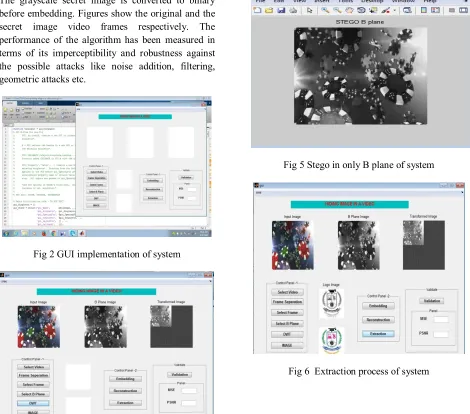
The proposed algorithm is applied to a sample video sequence filename.avi using a 32 × 32 secret image. The grayscale secret image is converted to binary before embedding. Figures show the original and the secret image video frames respectively. The performance of the algorithm has been measured in terms of its imperceptibility and robustness against the possible attacks like noise addition, filtering, geometric attacks etc.
Fig 2 GUI implementation of system
Fig 3 DWT implementation of system
Fig 4 DWT and Logo Embedding process of system
Fig 5 Stego in only B plane of system
Fig 7 Validation of performance metrics of system
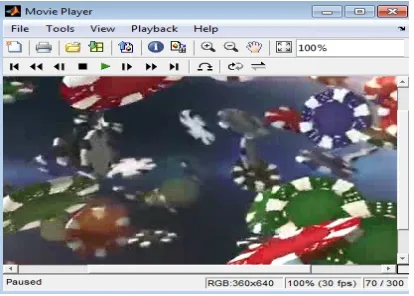
Fig 8 Video player of system
MSE: The Mean Square Error (MSE) and the Peak Signal to Noise Ratio (PSNR) are the two error metrics used to compare image compression quality. The MSE represents the cumulative squared error between the compressed and the original image, whereas PSNR represents a measure of the peak error. The lower the value of MSE, the lower the error.
PSNR: To compute the PSNR, the block first calculates the mean-squared error using the following equation: In the previous equation, M and N are the number of rows and columns in the input images,
respectively. Then the block computes the PSNR using the following equation:
In the previous equation, R is the maximum fluctuation in the input image data type. For example, if the input image has a double-precision floating-point data type, then R is 1. If it has an 8-bit unsigned integer data type, R is 255, etc
V. CONCLUSION
The paper here discusses the algorithm implemented using DWT and LSB is robust and imperceptible in nature and embedding the binary secret image in the low LL subband helps in increasing the robustness of the embedding procedure without much degradation in the video quality. As a future work the video frames can be subject to scene change analysis to embed an independent secret image in the sequence of frames forming a scene, and repeating this procedure for all the scenes within a video.
REFERENCES
[1] F. Hartung, and M. Kutter, “Multimedia watermarking techniques”, Proc. IEEE, vol. 87, no. 3, 1999, pp.1079–1107.
[2] V. Aslantas, “Optimal SVD based Robust Watermarking using Differential Evolution Algorithm”.
[3] Chih-Chin Lai,“An improved SVD-based watermarking scheme using human visual characteristics”, Department ofElectrical Engineering, National University of Kaohsiung, Kaohsiung 81148, Taiwan
[4] G.Prabakaran, R.Bhavani, M.Ramesh “A Robust QR- Code Video Watermarking Scheme Based on SVD and DWTComposite Domain “Department of computer science Engineering, AnnamalaiUniversity, Tamilnadu, India.
Conference on Machine Learning and Computer Science (IMLCS'2012) August11-12, 2012 Phuket (Thailand).
[6] Shanjun Zhang1 * and Kazuyoshi Yoshino2, “DWT-Based Watermarking Using QR Code” By a grand of ResearchInstitute for Integral Science, Kanagawa University.2005
[7] Wen-Chung Kuo, Dong-Jin Jiang, Yu-ChihHuang, “A Reversible Data Hiding SchemeBased on Block Division”, Congress onImage and Signal Processing, Vol. 1, 27-30May 2008, pp. 365-369
[8] Yih-Chuan Lin, Tzung-Shian Li, Yao-TangChang, Chuen-Ching Wang, Wen-TzuChen, “A Subsampling and InterpolationTechnique for Reversible Histogram ShiftData Hiding”, Image and SignalProcessing, Lecture Notes in ComputerScience, Vol. 6134, 2010, Publisher:Springer Berlin/Heidelberg, pp. 384-393.
[9] Chyuan-Huei Thomas Yang, Chun-HaoHsu, “A High Quality Reversible DataHiding Method Using InterpolationTechnique," IEEE Fifth InternationalConference on Information Assurance andSecurity, Vol. 2, 18-20 Aug. 2009, pp. 603-606.
[10] Che-Wei Lee and Wen-Hsiang Tsai, “ALossless Data Hiding Method byHistogram Shifting Based on an AdaptiveBlock Division Scheme”, PatternRecognition and Machine Vision, RiverPublishers, Aalborg, Denmark, pp. 1–14.
[11] Soumyendu Das, Subhendu Das,
BijoyBandyopadhyay, Sugata
Sanyal,“Steganography and Steganalysis: DifferentApproaches”, International Journal ofComputers, Information Technology andEngineering (IJCITAE), Vol. 2, No 1, June,2008, Serial Publications, pp. 1-11.
[12] Abbas Cheddad, Joan Condell, KevinCurran, Paul Mc Kevitt, “Digital imagesteganography: Survey and analysis ofcurrent methods”, Journal of SignalProcessing, Elsevier, Volume 90, Issue 3,March 2010, pp.727-752.
[13] M. Naseem, Ibrahim M. Hussain, M.Kamran Khan, Aisha Ajmal, “An OptimumModified Bit Plane Splicing LSBAlgorithm for Secret Data Hiding”,International Journal of ComputerApplications, Vol. 29, No. 12, 2011.Foundation of Computer Science, NewYork, USA, pp. 36-43.
[14] Ming Sun Fu and O.C. Au, “Data hidingwatermarking for halftone images", IEEETransactions on Image Processing, Vol.11,No. 4, Apr. 2002, pp.477-484.