Improved Face Recognition approach Using ILTP for Low Resolution
Images
Gurpreet Singh
Reserch scholar at
UGI, lalru
[email protected]
Er. Priyanka Mehta
Asst. proff. at
UGI, Lalru
Abstract-
The field of biometrics examines the unique physical or behavioural traits that can be used to determine a person’s identity. Biometric recognition is the automatic recognition of a person based on one or more of these traits. Low resolution is main problem in face recognition that degrades performance of recognition approach In this paper ILTP approach that computes texture features from gray scale images. ILTP approach is used for extraction of face texture features from low resolution images based on DCT and DWT wavelet filter. SVM classifier is used for the matching between the training and testing images. In our work we improved the accuracy for the low resolution images.Keywords: DIP, Face Recognition, LTP, LBP, FAR.
1 INTRODUCTION 1.1 Digital Image Processing
An image may be defined as a two-dimensional function, f(x, y), where x and y are spatial (plane) coordinates, and the amplitude of at any pair of coordinates (x, y) is called the intensity or gray level of the image at that point. When x, y, and the amplitude values off a real finite, discrete quantities, we call the image a digital image. The field of digital image processing refers to processing digital images by means of a digital computer. Note that a digital image is composed of a finite number of elements, each of which has a particular location and value. Biometric Characteristics
1.2Face
The face plays a major role in our social intercourse in conveying identity and emotion. The human ability to recognize faces is remarkable. We can recognize thousands of faces learned Throughout our lifetime and identify familiar faces at a glance even after years of separation. The skill is quite robust, despite large changes in the visual stimulus due to viewing conditions, expression, aging, and distractions such as glasses or changes in hairstyle. Computational models of faces have been an active area of research since late 1980s, for they can contribute not only to theoretical insights but also to practical applications, such as criminal identification, security systems, image and film processing, and human-computer interaction, etc.
1.2.1 Face verification (or authentication)
Face verification is the process to verify person’s identity that has been claimed to be matched with template. Face verification is the process of one to
face. Verification is to be done on the basis of features of template image and query image. to evaluate performance of the face verification different parameters have to be classified that has been used for different ROC curves.
1.2.2 Face identification (or recognition)
Face identification is the process of matching of single person image with multiple images available in the database. This face identification process is also known as one too many matching process. In this process query face image is compared with all the template images available in the face image database. The image that is closest match with the database images is most identifying image that match with test image. The query face image features has been compared with the database face images so that can identify that maximum matched image on the basis of distance. The distance has been computed with all the images available in the database of facial images. These distances have been arranged numerically in ascending order. The top level image distance is maximum matched image with the test image available in the database.
1.2.3 Appearance-based (View-based) face recognition
Many approaches to object recognition and to computer graphics are based directly on images without the use of intermediate 3D models. Most of these techniques depend on a representation of images that induces a vector space structure and, in principle, requires dense correspondence. Appearance-based approaches represent an object in terms of several object views (raw intensity images). An image is considered as a high-dimensional vector, i.e., a point in a high-dimensional vector space. Many view-based approaches use statistical techniques to analyze the distribution of the object image vectors in the vector space, and derive an efficient and effective representation (feature space) according to different applications. Given a test image, the similarity between the stored prototypes and the test view is then carried out in the feature space.
1.2 4 Face Recognition Techniques
applications, such as access to top security domains, may even necessitate the forgoing of the nonintrusive quality of face recognition by requiring the user to stand in front of a 3D scanner or an infra-red sensor. Therefore, depending on the face data acquisition methodology, face recognition techniques can be broadly divided into three categories: methods that operate on intensity images, those that deal with video sequences, and those that require other sensory data such as 3D information or infra-red imagery. The following discussion sheds some light on the methods in each category and attempts to give an idea of some of the benefits and drawbacks of the schemes mentioned therein in general.
2.
REVIEW OF LITERATURE
Jian Yang, YongXu and Jing yu Yang “Bi-2DPCA: A Fast Face Coding Method for Recognition” [1] proposed a algorithm the works same as that of the 2DPCA in this method the coefficients are more than that of the PCA. So this leads the slow classification speed and large storage requirements for large scale database. In this algorithm to overcome this problem the 2DPCA compression is done twice the first one in horizontal direction and second one in the vertical direction. By using this approach classification speed of the algorithm increases and the storage requirements decreases for the large scale databases. In the whole process, the first 2DPCA transform B=AU performs the compression of 2D-data in horizontal direction, making the image energy pack into a small number of columns. While the second 2DPCA transform C=transpose of V*B performs the compression of 2-D data in vertical direction, eliminating the correlations between columns of image Band making its energy further compact into a small number of rows.
O. Deniz , M. Castrill on, M. Hern_andez “Face recognition using independent component analysis and support vector machines” [2] proposed a combination of two techniques used in the face recognition. SVM and ICA are two approaches that have been used in different facial applications. SVM is a classifier that classifies the different objects into different classes on the basis of different features. This divided the object on the basis of their properties and feature values. SVM classifier is widely used in the object recognition problems. ICA is an approach that is used to extract the features from the facial images. This approach divides the image into different segments and computes the independent components from the facial image. This approach mainly works on the principal of PCA. The ICA is used to solve the problems that are dependent on blind separations. In this paper author used SVM
classifier with ICA approach on the face recognition database. The combination of these two approaches has been used for different datasets achieved high accuracy rate as compare to the other approaches.
Alessandro L. Koerich, Luiz E. S. de Oliveira “Face Recognition Using Selected 2DPCA Coefficients” [3] proposed a new technique 2DPCA using coefficients. 2DPCA is an approach that has been utilized for feature extraction for facial images. The major issue in the 2DPCA is that the numbers of coefficients produced by this approach are high. To reduce the number of coefficients author utilizes the approach selection of features to reduce dimension of the features this approach neglects the features that are not relevant to the facial image. This approach has been tested for different database containing facial images and that provides less time for computation and better accuracy.
Yue ZENG, Dazheng FENG, Li XIONG “An Algorithm of Face Recognition Based on the Variation of 2DPCA” [4] proposed a new approach for symmetry of face, the Characteristic of PCA and 2DPCA. The covariance matrix developed using 2DPCA is the mean of the PCA components that computes diagonally. This algorithm sometimes neglects the important feature information that has been useful for recognition. An algorithm of face recognition based on the variation of 2DPCA (V2DPCA) is proposed which make the most useful of the discriminate information of covariance, and use the fewer coefficient to representing an image. Experiments on the ORL and YALE face bases show improvement in both recognition accuracy and recognition time over the original 2DPCA, and are also superior to the traditional Eigen faces, ICA (Independent Component Analysis) and Kernel Eigen faces in terms of the recognition accuracy.
3.
PROBLEM FORMULATION
Face recognition based on Euclidean distance and texture feature. A method for face recognition by using the GLCM (Gray Level Co-occurrence Matrix) and texture features. Euclidean distance classifier is used for the matching between the training and testing images.Texture features are particularly susceptible to the resolution of images, when the resolution changes the calculated textures are not accurate. Texture features calculated by the GLCM is not adaptive for low resolution images or blurred images. For blurred images this method achieves poor accuracy.
The purpose of the research is to improve the accuracy for the low resolution images. By analysing various approaches for face recognition there is need to develop a new approach which can provide better results using texture features for blurred images.
4. PROPOSED WORK
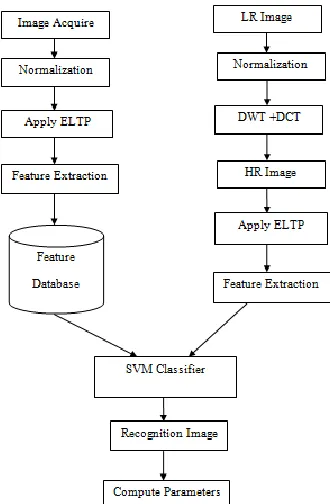
In this flow chart of the purposed system the chart explain the flow of work in the system that has been purposed. This chart shows how the data flows in the system and which steps are used for the development of the system.
In the purposed system face recognition has been done on the basis of various features that have been evaluated from facial images for the process of recognition.
Local Ternary Pattern is applied to the image produced by using the discrete wavelet transform. A 3*3 matrix will move on the different regions of the
image and computes the features on the basis of threshold set by the user. The histograms are computed by using the values computed by LTP. The histograms of each region on which mask will move are generated and concatenated these histograms to develop a feature set that is used for matching purpose.
The mask will move on the every region of the image and compute the values for feature histograms according to the centre value (c) under the mask, neighbourhood pixel value (p) and threshold value (k).
5.
RESULTS
In the purposed work Low resolution face image has been used for recognition process. These images that has been used for recognition has been down sampled by using low resolution conversion.
After down sampling DWT and DCT has been used for increasing resolution quality so that image features can be properly extracted.
After this improved uniform pattern based local ternary approach has been implemented for extraction of features that has been matched with dataset features using SVM classifier.
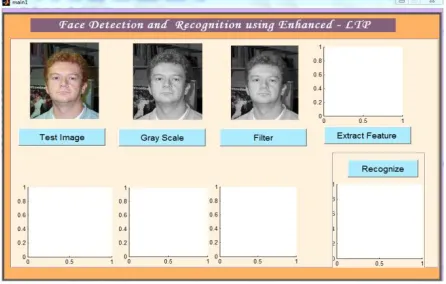
Fig 5.1: Load Test Image
This figure is use to load the test image. Test image has been loaded to system for feature extraction this image has been under goes process of feature extraction
a single sample, that is, it carries only intensity information. Images of this sort, also known as black-and-white, are composed exclusively of shades of gray, varying from black at the weakest intensity to white at the strongest.
Fig 5.4: Apply 2D Median Filter on Image
Performs median filtering of the matrix A in two dimensions. Each output pixel contains the median value in a 3-by-3 neighborhood around the corresponding pixel in the input image. Medfilt2 pads the image with 0's on the edges, so the median values for points within one-half the width of the neighborhood ([m n]/2) of the edges might appear distorted.
t
Fig 5.5: Extract feature from Image
This figure is use to represent the extraction of features from image. To extracting the features from image we used chi-square. The chi-squared distribution (also chi-square or χ²-distribution) with k degrees of freedom is the distribution of a sum of the squares of k independent standard normal random variables. It is a special case of the gamma distribution and is one of the most widely used probability distributions in inferential statistics, e.g., in hypothesis testing or in construction of confidence intervals. When it is being distinguished from the more general non central
chi-squared distribution, this distribution is sometimes called the central chi-squared distribution.
Fig 5.6: Match extracted feature with database image This figure is use to represent the extracted feature with the database image feature.
Table 4.3 Comarision Table of Accuracy
Resolution of
Test Image
DWT+DCT+ELTP
Accuracy
EULBP
Accuracy
112 X 92 97.25 % 85 %
64 X 64 96.50 % 87.5 %
32 X 32 93.70 % 84.37 %
Table 4.3 illustrate the accuracy given by different approaches of face recognition. Accuracy has been computed on the basis of the different resolution of images has been taken for performance evolution of the system for low resolution images.
6. CONCLUSION
very large in size and takes much computation time. These approaches are not relevant to give accuracy for the images with low resolution.
REFRENCES
[1] Jian Yang, YongXu and Jing yu Yang “Bi-2DPCA: A Fast Face Coding Method for Recognition”, Conference on Innovative Mobile and Internet Services in Ubiquitous Computing, 2013, pp. 249-255.
[2] O. Deniz , M. Castrill on, M. Hern_andez “Face recognition using independent component analysis and support vector machines”, international conference on Pattern Recognition Recent Advances, 2012, pp 567-578.
[3] Alessandro L. Koerich, Luiz E. S. de Oliveira “Face Recognition Using Selected 2DPCA Coefficients”, IEEE Geoscience And Remote Sensing Letters, 2014, pp 678-685.
[4] Yue ZENG, Dazheng FENG, Li XIONG “An Algorithm of Face Recognition Based on the Variation of 2DPCA”, IEEE Conf. on 2DPCA, 2013, PP 45-55.
[5] Hae-Min Moon, Sung Bum Pan “The LDA-based Face Recognition at a Distance using Multiple Distance Image”, IEEE Conf on LDA, 2015, pp 10-22.
[6] Demirel, Hasan, Ozcinar, Cagri and Gholamreza Anbarjafi (2010) “Satellite Image Contrast Enhancement Using Discrete Wavelet Transform and Singular Value Decomposition”, IEEE Geoscience And Remote Sensing Letters, Vol. 7, No. 2.
[7] Deniz O., Castrillon M. and Hernández M. (2003), “Face recognition using independent component analysis and support vector machines” Pattern Recognition Letters, Volume 24, Issue 13, Pages 2153-2157, DOI 10.10160167-8655(03)00081-3.
[8] Dong-Ju Kim, Sang Heon Lee and Myoung Kyu Sohn (2013) “Face Recognition with Local Directional Patterns”, International Journal of Security and Its Applications Vol. 7, No. 2. [9] Georghiades, A.S. and Belhumeur, P.N. and
Kriegman, D. J. (2001) “From Few too Many: Illumination Cone Models for Face Recognition under Variable Lighting and Pose” IEEE Trans. Pattern Anal. Mach. Intelligence, vol. 23, 6, pp. 643-660.
[10] Grgic, Mislav. Delac, Kresimir and Grgi, Sonja (2011) “SC face surveillance cameras face”, Multimed Tools Appl, vol 51, pp.863-879. DOI 10.1007/s11042-009-041.