ISSN(Online): 2320-9801 ISSN (Print) : 2320-9798
I
nternational
J
ournal of
I
nnovative
R
esearch in
C
omputer
and
C
ommunication
E
ngineering
(An ISO 3297: 2007 Certified Organization)
Vol. 4, Issue 10, October 2016
A Survey on Smart Crawler Using
Deep-Web Interfaces
Ujjwala Zaware1, Pooja Chougule2, Priyanka Gadhave3, Anmol Bhoite4, Prof. Sheetal Thokal5
B. E Students, Dept. of Computer Engineering, JSPM’S ICOER, Wagholi, Pune, Maharashtra, India1,2,3,4
Asst. Professor, Dept. of Computer Engineering, JSPM’S ICOER, Wagholi, Pune, Maharashtra, India5
ABSTRACT: As wide area of web grow at the very fast pace, there are increased interest in techniques is that help efficiently locate wide web interfaces. However, due to the large volume of web resources and the dynamic nature of deep web, achieving large coverage and high efficiency is a challenging issue. We propose a twostage framework, namely Smart-Crawler, for efficient harvesting wide web interfaces. In the first stage, It is site based searching for center pages with the help of search engines, it avoid to visit large number of pages. To achieve more accurate results for a focused crawl, It is ranking the websites to prioritize highly relevant ones for a given topic. In the second step, It searches fast insite searching by extracting most relevant link s with an adaptive link-ranking. To eliminate bias on visiting some it also contain highly relevant link s in hidden web directories, we design a link tree data structure to achieve wider coverage for a website.
KEYWORDS:Deep web, two-stage crawler, feature selection, ranking, adaptive learning
I. INTRODUCTION
Internet is an indivisible and essential part of our day to day life. Internet is mainly used to communication and to get answers for most of the question arises in our daily life. World Wide Web is information space which contains resources and documents that has particular URL. Many search engines are available to extract contents of web and to provide the answers for all types of queries; the popular ones are Google, Yahoo, and MSN. The data thatare most relevant to the users, often present in Deep Web. Deep web is also known as dark web and it is concealed web that consist innumerable pages that can be accessed by public, but their IP addresses will be hidden. They cannot be discovered in a single search attempt and it is tough to identify who are people behind that web sites. These contain database information namely catalogues and thereference that are not indexed by any search engine. Most of the search engines fail toexact the data fromthe deep web. They tend to concentrate in returning much number of results rather in returning accurate and most relevant result to the users that is very much expected. As the size space of web increases the valuable information cannot be indexed and accessed by the search engines. To overcome this problem there is aneed of efficient harvesting of deep webwhich explore quickly and return accurate results to the users. It is challenging for search engines to discover and explore the database of deep web as they are not registered with any search engines.
ISSN(Online): 2320-9801 ISSN (Print) : 2320-9798
I
nternational
J
ournal of
I
nnovative
R
esearch in
C
omputer
and
C
ommunication
E
ngineering
(An ISO 3297: 2007 Certified Organization)
Vol. 4, Issue 10, October 2016
employs special code robots, known as spiders, to make lists of the words found on websites to find info on the many ample sites that exist. Once a spider is building its lists, the application is termed net crawling. (There are unit some disadvantages to line a part of the web the globe Wide net an oversized set of arachnid centric names for tools is one among them.) So as to make and maintain a helpful list of words, a look engine's spiders ought to cross check plenty of pages. We have developed an example system that's designed specifically crawl entity content representative. The crawl method is optimized by exploiting options distinctive to entity oriented sites. In this paper, we are going to concentrate on describing necessary elements ofour system, together with question generation, empty page filtering and URL deduplication.
II. RELATED WORK
Automatic Luciano Barbosa and Juliana Freire.[1] This paper describes new adaptation crawling techniques that locate the entry points to deep web source efficiently. Hidden web resources are distributed sparsely which make it difficult to locate. This problem can be overcome by focusing on the keyword which is provided by the users that how many times the keyword has been repeated in deep web sites. In the new methodology described in this paper, crawling learns the pattern of appropriate link automatically and then as crawling process progresses, crawler adapt their focus which reduces manual intervention for setup and tuning. Dr. Jill Ellsworth[2]. This paper focuses problems encountered in deep web. In traditional searchengines thecontents of deep web is not obtained in the single search result. Search enginefails to access dynamic contents of the deep web pages. Hence deep internet is also known as invisible or hidden internet. Deep web pages have lot of important data and are publicly available but it is not registered to most of search engines. IP addresses are not known to the search engines hence we can’t know the people behind deep websites and hence there exists authentication issues.
Raju Balakrishnan and Subbbarao Kambhampati[3].This paper focus on the challenge in extracting informationfrom deep web. Main challenge of deep web is to choose. the relevant data that users expect to obtain as result from the search engine. Enormous amount of useful data are hidden in deep web pages which are not indexed by search engine. Two main issues arise here are, deficiency of crawler to understand whether the information of deep web is trustworthy or not. The second issue is the relevancy of data obtained in contemplates tothe importance of results or not. Choosing reliable and relevant data as an answer to the query is very critical issue. The relevancy assessment is primarily bases on similarity of the data fetched to the data that is appropriate to the users.
ISSN(Online): 2320-9801 ISSN (Print) : 2320-9798
I
nternational
J
ournal of
I
nnovative
R
esearch in
C
omputer
and
C
ommunication
E
ngineering
(An ISO 3297: 2007 Certified Organization)
Vol. 4, Issue 10, October 2016
Proposed system:
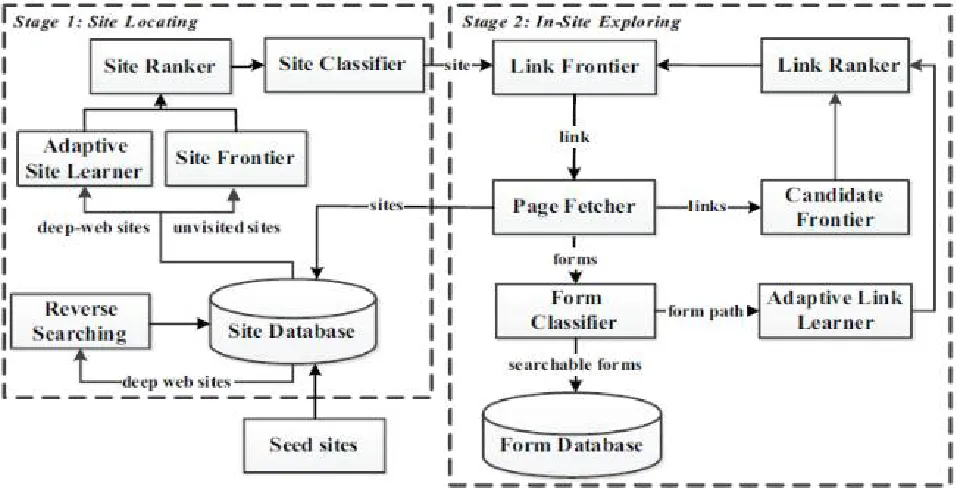
Smart Crawler is two stage crawlers that efficiently harvest deep web. Seed web sites are given as input to crawler. At the first stage crawler determines the most relevant data according to the keyword given by the users. At second stage insite exploration is done that divulge searchable forms from the sites. Once the search is made, the relevant URL is stored in the site database. Site locating is done by reverse searching technique, which search for the data second time but this time in reverse manner. This is used to obtain maximumamount of appropriate data. Reverse search is triggered when there are less results than that of threshold specified. To achieve more coverage of web, insite searching is done in the directories. In the insite exploring stage, crawler crawls through the pages and finds the hyperlinks present in the pages and add it to the database yet it limits visits to the large number of the sites. This uses Stop Early mechanism and Balanced Link Tree. Stop Early method stops the crawler from visiting to non appropriate websites. Here, simple breadth first method is used that is not efficient. It results in incomplete directory visits and omits highly relevant links. Links are often unevenly distributed across web, this results in biasing on some directories. This problem is overcome by merging trees or directories. Ranking is done in two phases. First Link Ranker prioritizes links so that the crawler can locate pages that are searchable. The high relevance score is given to those sites which is most similar to that of searchable form pages. At the next phase crawling is focused using Form Classifier that filters irrelevant forms and nonsearchable forms from the database. Site ranking and Link ranking is done using two features that are, Site
Fig 2: Two-stage SmartCrawler architecture
ISSN(Online): 2320-9801 ISSN (Print) : 2320-9798
I
nternational
J
ournal of
I
nnovative
R
esearch in
C
omputer
and
C
ommunication
E
ngineering
(An ISO 3297: 2007 Certified Organization)
Vol. 4, Issue 10, October 2016
breaking points, while performance and load testing simulate regular user activity. Failures found by stress testing are mainly due to faults in the running environment.Web site map generation is done using accessibility crawling test, that can be considered as a particular type of usability testing whose aim is to verify that access to the content of the application is allowed even in presence of reduced hardware/ software configurations on the client side of the application (such as browser configurations disabling graphical visualization, or scripting execution), or of users with physical disabilities (such as blind people). In the case of Web applications, accessibility rules such as the one provided by the Web Content Accessibility Guidelines have been established, so that accessibility testing will have to verify the compliance to such rules. The application is the main responsible for accessibility, even if some accessibility failures may be due to the configuration of the running environment (e.g.,browsers where the execution of scripts is disabled).
III.PROPOSED ALGORITHM
A. REVERSE SEARCHING:
The main aimis to exploit existing search engines, such as Google, to help in finding centre pages of unsearchedsites. This is done because search engines like Googlerank the WebPagesof a site. Thispages will tend to have high ranking values. This algorithm discuss about the reverse searching.
This reverse searching is used in:
When the crawler will be bootstrapped.
When the size of site frontier decreases to a predefined threshold.
We are randomly picking up a known wide website or a seed site and using general search engine facility to find canter pages and other relevant sites, Such as Google link. For instance, we are taking one example: link: www.google.com
In that web page it will be pointing to the Googlehome page. And Also In this system, the final page from the search engine is first parsed and go to the extract the links. Then that page will be downloaded and doinganalyztation todecide whether the links are relatedit is related.
If the no. of seed sites or fetched to the wide web sites in the page is greater than a user defined threshold. Finally, we will getting the output. In this way, we keepSite Frontier with enough site.
B. INCREMENTAL SITE PRIORITIZING:
To resume the crawling process and achieving large coverage on websites, for that the incremental siteprioritizing strategy is proposed. This concept is to record the learned patterns from deep web sites andforming paths forincremental crawling. Firstly we will discuss on the prior knowledge is used for initializeSite Ranker and Link Ranker. Then, unsearched sites are denoting to the Site Frontier and are prioritized by the Site Ranker,and searched sites are added to combine the site list. And The detailed incremental site prioritizing process is described in
Algorithm 2.When smart crawler follows the out of site links of related sites. To currentlyclassify the out of sitelinks, The Site Frontier utilizes two queues to save unsearched sites. The large priority queue is for out of site links that are classified by the relevant Site Classifier and they will be judged by Form Classifier to contain searchableforms. The lowest priority queue is for out of site links that will be only judged by a relevant Site Classifier. The lowest priorityqueue is using to supply more candidate sites.
Advantages:
1) We can get related website or link of the information. 2) User gets an ranked list of websites
3) Ranking of websites is done. 4) It keeps all sites in balance condition
5) Ranking of websites is done through most visited by the users
IV.CONCLUSION AND FUTURE WORK
ISSN(Online): 2320-9801 ISSN (Print) : 2320-9798
I
nternational
J
ournal of
I
nnovative
R
esearch in
C
omputer
and
C
ommunication
E
ngineering
(An ISO 3297: 2007 Certified Organization)
Vol. 4, Issue 10, October 2016
afocused crawler containing of two stages: efficient sitelocating and balanced insite exploring.Smart Crawlerperforms sitebased locating by reversely searchingthe known deep web sites for center pages, whichcan effectively find many data sources for sparse domains. By ranking collected sites and by focusingthe crawling ona topic, Smart Crawlerachievesmore accurate results. The insite exploring stage usesadaptive linkranking to search within a site;andwe design a link tree for eliminating bias towardcertain directories of a website for wider coverage of web directories. Our new results on a representative set of domains show the effectiveness of the proposed two-stage crawler, which achieveshigher harvest rates than other crawlers. We have worked on pre-query and post-queryapproaches for classifying deep-web forms to further improve the correctness of the form classifier.
REFERENCES
[1] Peter Lyman and Hal R. Varian. How much information? 2003. Technical report, UC Berkeley, 2003.
[2] Roger E. Bohn and James E. Short. How much information?2009 report on american consumers. Technical report, University of California, San Diego, 2009.
[3] Martin Hilbert. How much information is there in the ”information society”?Significance, 9(4):8–12, 2012.
[4] Idc worldwide predictions 2014: Battles for dominanceand survival – on the 3rd platformhttp://www.idc.com/research/Predictions14/index.jsp, 2014.
[5] Michael K. Bergman. White paper: The deep web: Surfacinghidden value.Journal of electronic publishin, 7(1), 2001.
[6] Yeye He, Dong Xin, Venkatesh Ganti, Sriram Rajaraman, andNirav Shah. Crawling deep web entity pages. InProceedingsof the sixth ACM international conference on Web search and datamining, pages 355–364. ACM, 2013.
[7] Infomine. UC Riverside library.http://lib-www.ucr.edu/,2014. [8] Clusty’s searchable database dirctory.http://www.clusty.com/, 2009
[9] Booksinprint. Books in print and global books in print access.http://booksinprint.com/, 2015.
[10] Kevin Chen-Chuan Chang, Bin He, and Zhen Zhang. Towardlarge scale integration: Building a metaquerier over databaseson the web. InCIDR, pages 44–55, 2005.
[11] Denis Shestakov. Databases on the web: national web domainsurvey. InProceedings of the 15th Symposium on InternationalDatabase Engineering &Applications, pages 179–184. ACM, 2011.
[12] Denis Shestakov and Tapio Salakoski. Host-ip clusteringtechnique for deep web characterization. InProceedings of the12th International Asia-Pacific Web Conference (APWEB, pages378–380. IEEE, 2010.