Transactions of the 17th International Conference on Structural Mechanics in Reactor Technology (SMiRT 17)
Prague, Czech Republic, August 17 –22, 2003
Paper # K12-6
Experimental Study on Fracture Behavior of Piping Support under Seismic
Loading (Material Properties of Mild Steels)
Minoru Tomimatsu1), Tomomichi Nakamura1), Yoshihiro Takayama1), Eiji Shirai2), and Hideyasu Ogo2) 1) Mitsubishi Heavy Industries, Ltd., Hyogo, Japan 2)
The Kansai Electric Power Co., Inc., Osaka, Japan
ABSTRACT
Some steel structures were fractured in a brittle manner in 1995, when the Great Hanshin Earthquake occurred. As the similar steel structures are used for piping supports existing outside buildings in nuclear power plants, vibration tests which simulated the fracture behavior of nuclear piping support were performed.
The study is composed of material tests and the vibration tests. And this paper describes the portion of the material tests.
The material tests were performed to clarify the fracture toughness properties for mild steels which are used not only in nuclear piping supports, but also for the vibration tests material. Effects of temperature, loading rate and prestrain on the fracture toughness were investigated in order to take the seismic loading into account. It was found that both loading rate and prestrain decrease fracture toughness properties of mild steels. These fracture toughness data are applicable for the evaluation of the nuclear piping support integrity against brittle fracture under seismic loading based on the fracture mechanics analysis.
KEY WORDS: Brittle fracture, Fracture toughness, Mild steel, Loading rate, Prestrain, Seismic event, Piping support,
Steel structure
INTRODUCTION
The Great Hanshin Earthquake in 1995 brought the brittle type fracture to some steel structures, such as buildings and bridges. There are some steel structures even in nuclear power plants, and even if this brittle type fracture is regarded to occur at low temperature there are some structures located in the outside of the buildings. Then, it has been requested to examine the possibility of this kind of fracture in operating plants, since cyclic loading due to seismic event might cause the reduction in fracture toughness of steels used for the plants.
The material tests were performed to clarify the fracture toughness properties for mild steels which are used not only in nuclear piping supports, but also for the vibration tests material. Effects of temperature, loading rate and prestrain on the fracture toughness were investigated in order to take the seismic loading into account. These fracture toughness data are applicable for the evaluation of the nuclear piping support integrity against brittle fracture under seismic loading based on the fracture mechanics analysis.
EXPERIMENTAL PROCEDURE
Materials
A Material used for this study are a mild steel, designated as JIS SS400, which is currently used for nuclear piping support as well as general steel structures in Japan. This steel was also used for the vibration tests shown hereafter. The thickness of the steel is approximately 10mm. A butt welding joint of this steel was fabricated by three pass welding (GMAW) method. The welding conditions simulated the representative of actual nuclear piping support, except that the K-groove was applied so that specimens for measuring material’s properties can be taken.
In addition, two kinds of prestrained steels were also prepared in order to investigate the influence of prestrain on fracture toughness. These prestrain materials were supplied by loading tensile plate-type specimen of the same base metal upto the aimed strain level. The aimed level of prestrain were about 5 % and 10%, respectively. After fully unloading of the specimen, the actual level of prestrain was determined by measuring the change of gage length.
Table 1 shows the chemical composition of the base material. Tensile properties of the test materials at room temperature are shown in Table 2.
Table 1 Chemical composition of the base materials(wt.%)
C Si Mn P S
Table 2 Tensile properties at room temperature
Material
Yied Stress Tensile
Stress
Elongation Reduction
in Area
(N/mm2) (N/mm2) (%) (%)
Base Metal 337 482 36 67
Weld Metal 506 618 32 58
Prestrained 1 482 531 25 63
Prestrained 2 549 571 24 63
[1]
Fracture Toughness Test Procedure Specimens
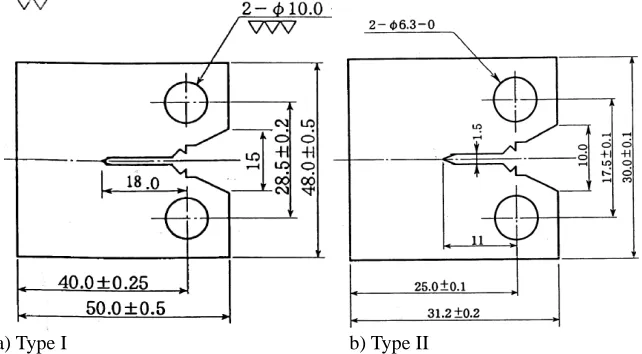
Two kinds of compact tension specimen as shown in Fig.1 were used for measuring fracture toughness of the materials. Type I specimen of approximately 10mm thickness was machined from base metal, weld metal and heat affected zone, and type II specimen was used for the prestrained materials.The thicknesses of two kinds of prestainted materials were 9.5mm and 9.1mm for 5% and 10% prestrain, respectively. The fatigue precracking were conducted for all specimens in accordance with the Test Method ASTM E 399-90[1].
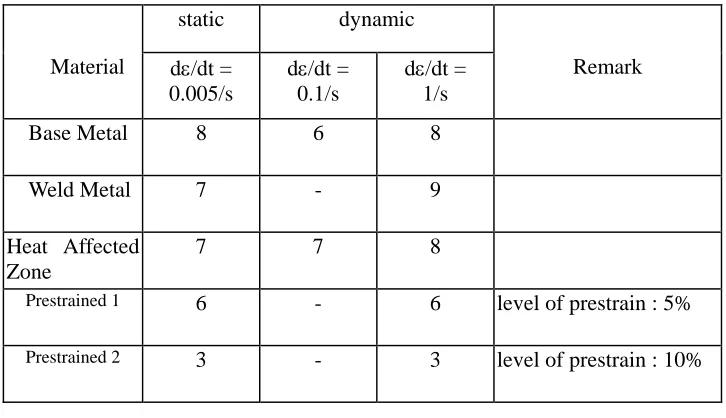
The matrix of fracture toughness tests is presented in Table 3.
a) Type I b) Type II
Fig.1 Compact tension specimen.
Test Procedure
Fracture toughness tests were conducted in accordance with the ASTM E 399-90,” Standard Test Method for Plane-Strain Fracture Toughness of Metallic Materials”. For dynamic fracture toughness test, the annex 7 “Special Requirements for Rapid-Load Plane-Strain Fracture Toughness KIc(t) Testing” in the ASTM E 399-90 was used.
In the case that plane strain fracture toughness KIc is not obtained in accordance with the procedures described in the ASTM E 399-90, KJc is calculated by the following equation from J-integral at the onset of cleavage fracture, Jc assuming plane strain for elastic modulus:
KJc = ( Jc E / (1 - ν 2
))1/2 (1) where E = Elastic modulus, and
ν = Poisson’s ratio
Jc = Je + Jp = (Ke)
2
(1 - υ2)/E + η Ap/ (B b0) (2)
where Ke = stress intensity factor for load at point of instability. The value is calculated by the equation described in the ASTM E 1921-97" The Method for the Determination of Reference Temperature, T0, for Ferritic Steels in the Transition Range, " [2]
η = 2 + 0.522 b0/W ,
Ap = plastic component of area under load versus load-line displacement curve for J calculation described in Fig.5 of the ASTM E 1921-97,
B = specimen thickness, b0 = initial ligament length,
For static fracture toughness test, loading rate of about 1MPa√m/s corresponding to strain rate of 0.005/s was applied. Both loading rates of 20 to 30 MPa√m/s and 200 to 300 MPa√m/s, which corresponding to strain rates(dε/dt) of 0.1/s and 1/s were applied for dynamic fracture toughness tests.
Table 3 Matrix of fracture toughness tests
static dynamic
Material dε/dt =
0.005/s
dε/dt = 0.1/s
dε/dt = 1/s
Remark
Base Metal 8 6 8
Weld Metal 7 - 9
Heat Affected Zone
7 7 8
Prestrained 1 6 - 6 level of prestrain : 5%
Prestrained 2 3 - 3 level of prestrain : 10%
RESULTS AND DISCUSSION Fracture Toughness Test Results
Plane strain fracture toughness KIc was obtained only at extreamly low temperature due to the smaller specimen thickness. Then, KIc as well as KJc was used for the following evaluation.
Effect of Temperature on Fracture Toughness
Static fracture toughness and dynamic fracture toughness for base metal, weld metal, prestrained materials and heat affected zone (HAZ), as a function of temperature, are shown in Fig.2 and Fig.3, respectively. Fracture toughness increases as temperature increases. As for the static fracture toughness, fracture toughness for HAZ is higher than that for base metal and weld metal. In the case of the dynamic fracture toughness, that for HAZ is highest, and that for weld metal is slightly higher than base metal. It was found that base metal has the lowest fracture toughness among all materials except presrtained materials. Fracture toughness for the prestrained materials is lower than that for base metal as expected, and described later.
Effect of Loading Rate on Fracture Toughness
∆Td = -20{(log10(dε/dt)+4) for dε/dt > 10-4 (3)
where, ∆Td is the temperature shift in degree Centigrade, and dε/dt is strain rate (1/s.). Assuming that Eq.(3) can be applicable for the materials used for this study, that is, 20℃ for each strain rise by one order, values of ∆Td for strain rate of 0.1/s and 1/s are estimated as 26℃ and 46℃, respectively. Fracture toughness for base metal as a function of relative temperature, that is, actual test temperature (T)- ∆Td is shown in Fig.6. Fracture toughness can be well expressed as a narrow scatter band. Therefore, fracture toughness can be estimated from Fig.6 by determining ∆Td value.
Effect of Prestrain on Fracture Toughness
By comparing fracture toughness for prestrained materials with that for base metal as shown in Fig.2, the values of temperature shift ∆TA due to prestrain, are approximately 50℃ and 60℃ for 5% prestain and 10% prestain ,respectively. These two values of temperature shift are somewhat larger than values reported in literature[3]. Fracture toughness for base metal as a function of relative temperature, that is, actual test temperature (T)- ∆TA is shown in Fig.7.
Fracture Toughness Curve for Nuclear Piping Support Steels
Fracture toughness which both loading rate and prestrain effects are taken into account, is shown as a function of relative temperature, that is, actual test temperature (T)- ∆Td -∆TA in Fig.8. Fracture toughness is well expressed as a function of this relative temperature.
As no fracture toughness data for mild steels which are used for nuclear piping supports are available, Charpy impact test data for base steels used for this study are compared with those for mild steels used in 1970’s. Fig.9 shows Charpy impact energy for similar mild steels used for nuclear piping supports[4]. These data were published in 1978, when early Japanese PWR plants started in operation. Charpy impact data for the mild steel in this study are also plotted in Fig.9. It was found the steel in this study has low toughness comparing with steels used for nuclear piping supports steels at that time. Thus, fracture toughness as a function of relative temperature shown in Fig.8 is applicable for the evaluation of a nuclear piping support integrity against brittle fracture under seismic loading based on the fracture mechanics analysis.
CONCLUSION
Conclusions in this study are as follows,
1) Fracture toughness for base metal is lower than those for weld metal and heat affected zone.
2) Temperature shift of 20℃ for each strain rise by one order, is expressed as a effect of loading rate on fracture toughness.
3) Temperature shift ΔTA due to pestrain, are approximately 50℃ and 60℃ for 5% prestain and 10% prestain 4) Fracture toughness versus relative temperature is applicable for the evaluation of the nuclear piping support
integrity against brittle fracture under seismic loading .
REFERENCES
[1] ASTM E 399-90 " Standard Test Method for Plane-Strain Fracture Toughness of Metallic Materials”
[2] ASTM E 1921-97 "The Method for the Determination of Reference Temperature, T0, for Ferritic Steels in the Transition Range”
[3] Japan Welding Engineering Society Standard WES 2805-1997, "Method for Assessment for Flaws in Fusion Welded Joints with respect to Brittle Fracture and Fatigue Crack Growth”
0 50 100 150 200 250 300 350 400
-200 -150 -100 -50 0 50 100 Temperature (℃)
F
ra
ct
ur
e T
oughne
ss
K
Ic
,K
Jc
(
M
P
a
√m)
Base Metal (dε/dt=0.005)
Prestrain 5%(dε/dt=0.005)
Prestrain 10%(dε/dt=0.005)
Weld Metal (dε/dt=0.005)
HAZ(dε/dt=0.005)
Fig.2 Static fracture toughness for base metal, weld metal, prestrained material and HAZ, as
a function of temperature.
0 50 100 150 200 250 300
-200 -150 -100 -50 0 50 100 Temperature (℃)
F
ra
ct
ur
e T
oughne
ss
K
Ic
,K
Jc
(
M
P
a
√m)
Base Metal (dε/dt=0.1)
HAZ(dε/dt=0.1)
Base Metal (dε/dt=1)
Prestrain 5% (dε/dt=1)
Prestrain 10%(dε/dt=1)
Weld Metal (dε/dt=1)
HAZ(dε/dt=1)
Fig.3 Dynamic fracture toughness for base metal, weld metal, prestrained material and HAZ,
0 50 100 150 200 250 300 350
-200 -150 -100 -50 0 50 100 Temperature (℃)
F
ra
ct
ur
e T
oughne
ss
K
Ic
,K
Jc
(
M
P
a
√m)
Base Metal (dε/dt=0.005)
Base Metal (dε/dt=0.1)
Base Metal (dε/dt=1)
Prestrain 5%(dε/dt=0.005)
Prestrain 5% (dε/dt=1)
Prestrain 10%(dε/dt=0.005)
Prestrain 10%(dε/dt=1)
Fig.4 The influence of loading rate on fracture toughness for base metal and prestrained material.
0 50 100 150 200 250 300 350 400
-200 -150 -100 -50 0 50 100 Temperature (℃)
F
ra
ct
ur
e T
oughne
ss
KIc
,K
Jc
(
M
P
a
√
m)
Weld Metal (dε/dt=0.005)
Weld Metal (dε/dt=1)
HAZ(dε/dt=0.005)
HAZ(dε/dt=0.1)
HAZ(dε/dt=1)
0 50 100 150 200 250 300 350
-200 -150 -100 -50 0 50 T - ∆Td (℃)
F
ra
ct
ur
e T
oughne
ss
KIc
,K
Jc
(
M
P
a
√
m)
Base Metal (dε/dt=0.005)
Base Metal (dε/dt=0.1)
Base Metal (dε/dt=1)
Fig.6 Fracture toughness for the base metal as a function of relative temperature, (T)- ∆Td..
0 50 100 150 200 250 300 350
-140 -120 -100 -80 -60 -40 -20 0 T - ∆TA (℃)
F
ra
ct
ur
e T
oughne
ss
KIc
,K
Jc
(
M
P
a
√
m)
Base Metal (dε/dt=0.005)
Prestrain 5%(dε/dt=0.005)
Prestrain 10%(dε/dt=0.005)
0 50 100 150 200 250 300 350
-200 -150 -100 -50 0
T - ΔTd - ∆TA (℃)
F
ra
ct
ur
e T
oughne
ss
K
Ic
,K
Jc
(
M
P
a
√m)
Base Metal (dε/dt=0.005)
Base Metal (dε/dt=0.1)
Base Metal (dε/dt=1)
Prestrain 5%(dε/dt=0.005)
Prestrain 5% (dε/dt=1)
Prestrain 10%(dε/dt=0.005)
Prestrain 10%(dε/dt=1)
Fig.8 Fracture toughness for the base metal as a function of relative temperature, (T)- ∆Td-∆TA..