Adaptive Network Coding Mechanism for
Network Lifetime Extension Based on Body
Area Network
Uma Jasawat1, Nisha Pandey2
M. Tech Student, Department of CSE & Shri Ram College of Engg. & Mgmt, Palwal, Haryana, India1,
Asst. Professor, Department of CSE & Shri Ram College of Engg. & Mgmt, Palwal, Haryana, India2
ABSTRACT: Global routing protocols are taken in wireless body area networks. Global routing is increased with a new connection cost function planned to balance energy consumption throughout the network. The result is a significant increase in lifetime of network at the cost of a marginal enhancement in energy per bit. Network maintenance needs are decreased as well, however balancing energy consumption implies all batteries required to be serviced simultaneously and less quickly. The suggested routing protocol is measured utilizing a hardware experimental setup consisting an access point and multiple nodes. The setup is utilized to assess network architectures, involving an off-body access point and an on-body access point with varying no. of antennas. Real-time experiments are carried out in indoor surroundings to achieve performance improvements. In summation, the setup is employed to store channel attenuation data which are then processed in broad computer simulations offering insight on the impact of protocol parameters on performance. Results establish effective balancing of energy consumption throughout all nodes, an average increase of up to 40% in lifetime of network corresponding to a small average increase of 0.4 dB in energy per bit, and a cut off impact on needed transmission power to obtain reliable connectivity.
KEYWORDS: wireless body area networks; network lifetime, routing protocols.
I. INTRODUCTION
Wireless Body Area Network (WBAN) is a reliable wireless communication technology. It gives short range and low power communication inside the human body. This network consists of PDA. It provides a network witch coordinate with WBAN[3]. It can be used in different fields else than the medical measuring the temperature, heart rate, blood pressure, PH-monitor are its same medical applications on the other hand data transmission, remote control application, real time video etc. are its some non-medical application[5].
Fig:1 A coexisting application scenario of WBAN and WPAN and WLAN
Wireless Body Area Network (WBAN) support real time application. It always remains an issue. Real time and non-real time applications require accurate estimation of Qos levels. To provide a trusted assistance to the patient. It network capacity is not sufficient and it become more critical. It also effects the non-medical real time applications like data file transfer, gamming etc. as they are delaying sensitive. In a health care system data delivery, privacy, reliability, mobility support, Qos parameters etc. are the major requirements. For this work Wireless Body Area Network(WBAN) is used as a secure and preserving communication. In Wireless Body Area Network (WBAN) real time traffic is classified only to reduce delay time in health applications [8].
II. BAN COMPONENTS
Generally, the basic architecture of the technologies used in different types of WSNs is similar. Figure 2 Shows typical sensor node structure .The main components used in a BAN is the brief description is given below [1].
Figure :2 BAN Sensor Node Structure [2]
Energy Source: In BAN nodes the size of the batteries limits the source of energy available in BAN nodes. As compared to the larger batteries used in the WSN nodes the tiny size of sensor node batteries allows very low power levels [5].
Processor: Processor is the brain of the sensor node. All computations in the node is handles by the processor. The MSP430 from Texas Instrument (TI) is an example of a processor used in some of the BAN nodes[39]. The world’s Ultra-low power MSP430 is a 16-bit microcontroller platform. 8MHz to 15 MHz is the speed of this processor and 14 to 113 is number of pins.
Memory: In BAN different kinds of memories are used. MSP430 processor contains 128B to 64KB RAM and 0.5KB to 512KB Flash memory with a typical BAN node .
Transceiver: To send or receive the data from or to the node the transceiver is used. In a BAN node Chipcon CC2420 is used for low power and low voltage wireless communication. The current consumption of receiver and transmitter of CC2420 are 19.7 mA and 17.4 mA respectively.
Sensors: Multiple sensors are contained by the sensing unit in the sensor node. These sensors are used to monitor the biochemical and physiological parameters of the disease processes in the human body. The heartbeat rate and any damage of the heart is determine by the ECG sensors. On the blood vessels pressure of circulating blood is measures by the sensing unit in Blood Pressure (BP) sensor [11].
Actuators: Actuators are used to take action after getting the data from the sensor or from the user. Motion into energy or energy into motion converted by the actuators . The healthcare professional to inject the insulin in case it is required for a diabetic patient allows when an actuator placed with a body sensor .
III. BAN REQUIREMENT
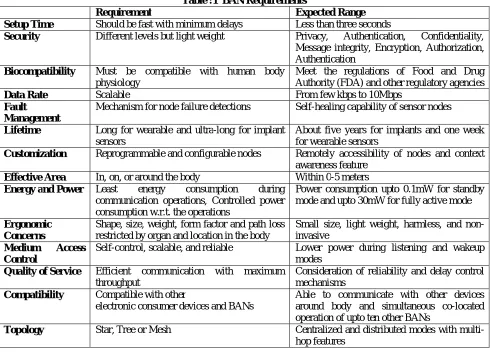
Due to diversity of applications BAN face unique technical challenges. On the other existing wireless sensor technologies the BAN has different requirements from them. Table shows the technical requirement for a typical Body Area Network.
Table :1 BAN Requirements
Requirement Expected Range
Setup Time Should be fast with minimum delays Less than three seconds
Security Different levels but light weight Privacy, Authentication, Confidentiality,
Message integrity, Encryption, Authorization, Authentication
Biocompatibility Must be compatible with human body
physiology
Meet the regulations of Food and Drug Authority (FDA) and other regulatory agencies
Data Rate Scalable From few kbps to 10Mbps
Fault Management
Mechanism for node failure detections Self-healing capability of sensor nodes
Lifetime Long for wearable and ultra-long for implant
sensors
About five years for implants and one week for wearable sensors
Customization Reprogrammable and configurable nodes Remotely accessibility of nodes and context
awareness feature
Effective Area In, on, or around the body Within 0-5 meters
Energy and Power Least energy consumption during
communication operations, Controlled power consumption w.r.t. the operations
Power consumption upto 0.1mW for standby mode and upto 30mW for fully active mode
Ergonomic Concerns
Shape, size, weight, form factor and path loss restricted by organ and location in the body
Small size, light weight, harmless, and non-invasive
Medium Access
Control
Self-control, scalable, and reliable Lower power during listening and wakeup
modes
Quality of Service Efficient communication with maximum
throughput
Consideration of reliability and delay control mechanisms
Compatibility Compatible with other
electronic consumer devices and BANs
Able to communicate with other devices around body and simultaneous co-located operation of upto ten other BANs
Topology Star, Tree or Mesh Centralized and distributed modes with
multi-hop features
IV. LITERATURE SURVEY
Christina Fragouli et.al.[1]., In this paper the authors explores the case for network coding as a unifying design model for wireless networks, by describing how it addresses issues of throughput , management, mobility, and reliability. The authors also discuss the practical challenges facing the integration of such a design into the network stack. After the simulation the authors conclude that the network coding enables more efficient, scalable, and reliable wireless network. Rethinking our MAC, routing, and transport protocols need for these opportunities.
David Smith et.al.[2]., Here authors present the main characteristics and challenges associated with BANs from a healthcare perspective and based on studies of the BAN channel present some MAC techniques that could be used to address these challenges. After that the authors described particular means to make best use of the provisions for the MAC in the current standard, including intelligently dealing with retransmitting wisely ,outages ,such as people sleeping ,using relays in particularly difficult scenarios, and transmit power control.
BANs. The author also discuss briefly about the challenges associated with BANs and some solutions that are on the horizon. Author concluded in the paper by looking at some challenges related to BAN. After that author also covered signal and path loss in the human body and some of the challenges associated with communication and power within the human body and usability and the fusion of cutting edge technology and textiles .
V. METHODOLOGY AND ALGORITHM
Although every node has the ability to perform network coding, it does not require to if there is no such need. In fact, study indicates that by selecting suitable network nodes to perform network coding, network computational complexity
and decoding procedures can be decreased. A node is known as a coding node if selected to perform network coding.
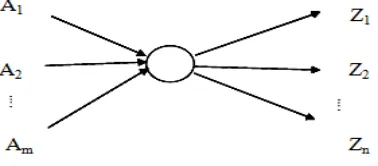
When selected, it operates on numerous packets from different information flows passing through. It outputs packets that are integration of the input packets after some computations as described below.
Figure : 3 Coding at a Node
Fig 3 is the function of a normal coding node with m input streams and n output streams. The variablesA1,2…A represent incoming packets from different traffic flows. After network coding at the intermediary node, coded packets represented by Z1,2…Z (as integrations of the real packets A1,A2…A .) are created. Based on the routing mechanism, they can then be forwarded to downstream nodes in several combinations (i.e. one per output link or as a subset per link). There are two kinds of coding algorithms employed in our study here: the XOR coding and the linear network coding, as explained in the following.
(1) XOR coding
This is a very easy operation. The coding node just integrates the m incoming packets by an XOR operation on their corresponding bits to generate one coded packet Z=A1⊕ A2⊕…⊕A . Decoding is simply performed by utilizing
A =Z⊕A1…⊕A−1⊕A +1⊕…⊕A . In other words, as long as a recipient node has obtained the coded packet Y
and any m-1 of the actual packets, it can always decode the left original packet.
Encoding Implementation
For general operation without network coding, packets of several lengths can reach at a single buffer and served in a FIFO (First In First Out) manner. With network coding, a packet may have to wait for another packet to conduct the coding operation. The data portion of every packet must have the same length (no. of bits) so that the coding computation in bits can be conducted.
Figure: 4 Queuing at A Coding Node
queue and codes them into n packets. After providing them to the outgoing connections (according to some mentioned routing algorithm), the server would eliminate the m old packets from their queues and repeat the same operation for the next m HOL packets. Fig 5 below is the flow chart explaining the coding operation.
Observe that there must be a packet available in every queue (called the coding condition). Else, packets in other queues to wait for an arrival to the empty queues. All coded packets created from the same actual packets are known as “packets of the same generation”.
Figure: 5 Flowchart of a Coding Node
We also observe on passing that generally, one does not need the packet streams to come from different physical connections. They can just be logical flows within the same physical connection. So the buffers in Figure 4 can be utilized for packets of the same logical connection.
For illustrating the decoding procedure explicitly, here we describe N(g)as the no. of coded packets from the same generation it obtained, and N(s)is the no. of actual packets mused in the encoding procedure. One must have ≥ to recover the actual packets. So whenever N(g)*N(s), we know that decoding can occur. To permit decoding, the recipient may wish to have assigned minimum m buffer space. Figure 6 is the decoding flowchart. Observe that an innovative packet is a packet helpful for decoding to retrieve an actual packet A.
A packet is non-innovative if it is not required any more, either because the recipient has sufficient coded packets from the same generation, or the actual packet has been retrieved. When a coded packet reaches at the recipient, the decoder will first examine its generation no. in the packet header, and find if it is “non-innovative”. If so, the recipient will drop this coded packet. If the no. of packets N(g)from the same generation is no less than the no. of sources N(s) the recipient can decode all packets. In some scenarios i.e. packet loss, there will not be sufficient packets to decode and retrieve the actual packets, and the recipient will drop all packets at this generation.
V. PERFORMANCE EVALUATIONS
We shall measure the performance with respect to throughput. Unless otherwise mentioned in some performance comparisons, data arrival rate of a stream is 1 packet/sec and packet loss rate is 0.2. The packet size is 128 bytes. For a default connection data rate of 9600bps, this is same as 9.38 packets/s. The packet arrival rates in all performance diagrams are packet arrival rates at the source node but not essentially at a queuing node (such as sink or relay) whose performance evaluation is under investigation.
Figure 7 a: Throughput with Different Packet Size, Big Network
Throughput: Fig 7a is the throughput viewed at a sink node (both T1 and T2 are symmetrical in performance) as a function of the packet arrival rate at the source node when packet size is set to 128 byte, 196 byte and 256 byte, respectively. For a network without Network coding and utilizing a packet size of 128 byte, the throughput is increasing less or more linearly in terms of the increasing packet arrival rate before levelling off at 4.8 packets/sec beyond a packet arrival rate of 8 packets/s. By utilizing NC, one can view the throughput can level off at a higher level of 6.2 packets/sec and beyond a higher packet arrival rate of 9 packets/sec.
VI. CONCLUSION
the problems. Some of these can be briefly explained in the lessons we have learned from our OPNET experience. First, one should be careful about the Transit conditions.
REFERENCES
[1]Mrinmoy Barua ,” Secure Data Aggregation and Access Control in Cloud Assisted eHealth Care System” , University of Waterloo , Ontario, Canada, 2014.
[2] Zahoor Ali Khan ,” A Novel Patient Monitoring Framework and Routing Protocols for Energy & QoS Aware Communication in Body Area Networks” ,Dalhousie University Halifax, Nova Scotia ,June 2013.
[3] M.-R. Ra, J. Paek, A. B. Sharma, R. Govindan, M. H. Krieger,and M. J. Neely, “ Energy-delay tradeoffs in smart phone applications ” ,in MobiSys ’10: Proceedings of the 8th international conference on Mobile systems, applications, and services, pp. 255–270 ,2010.
[4] Michael Langberg , Alexander sprinston , Johoshua Bruck . “ The Encoding Complexity of Network Coding” , California Institute of Technology [5] L. Stabellini and J. Zander, “Energy efficient detection of intermittent interference in wireless sensor networks” , In International Journal of Sensor Networks (IJSNet), vol. 8, no. 1, 2010.
[6] Gabriel E. Arrobo and Richard D. Gitlin , “New Approaches to Reliable Wireless Body Area Networks” , IEEE International Conference on Microwaves, Communications, Antennas and Electronics Systems (COMCAS 2011) Tel Aviv , pp. 7-9 , November 2012.
[7] H. Chan, A. Perrig, and D. Song, “Random key pre distribution schemes For sensor at works,” IEEE Symposium on Security and Privacy, pp. 197-213, May 2003.
[8] Christina Fragouli, Dina Katabi, Athina Markopoulou, Muriel M´edard, Hariharan Rahul, “Wireless Network Coding: Opportunities & Challenges”,MIT AND UC Irvine.
[9]David Boyle, Thomas Newe ,“Securing Wireless Sensor Networks:Security Architectures”, Journal of networks, Vol. 3, 2008.
[10] E. Jovanov, A. Milenkovic, C. Otto, and P. de Groen, “A wireless body area network of intelligent motion sensors for computer assisted physical rehabilitation”, Journal ofNeuro Engineering and Rehabilitation, vol. 2, no. 1, pp. 6, 2005.
[11] Fan Li and Yu Wang; “ Survey of Routing in Wireless Sensor Networks”,in Proceedings ofIEEE Wireless Sensor Networks Technology Magazine, Volume 2, Issue 2, June 2007; pp. 12-22.