Functional Encryption with Bounded Collusions via
Multi-Party Computation
∗Sergey Gorbunov† Vinod Vaikuntanathan‡ Hoeteck Wee§
September 5, 2012
Abstract
We construct a functional encryption scheme secure against an a-priori bounded polynomial number of collusions for the class of all polynomial-size circuits. Our constructions require only semantically secure public-key encryption schemes and pseudorandom generators computable by small-depth circuits (known to be implied by most concrete intractability assumptions). For certain special cases such as predicate encryption schemes with public index, the construction requires only semantically secure encryption schemes, which is clearly the minimal necessary assumption.
Our constructions rely heavily on techniques from secure multi-party computation and randomized encodings. All our constructions are secure under a strong, adaptive simulation-based definition of functional encryption.
Keywords: Functional Encryption, Multi-Party Computation, Randomized Encodings. ∗
A preliminary version of this work appeared in the Proceedings of the 32ndAnnual International Conference on Cryptology (CRYPTO 2012).
†
University of Toronto. Email: [email protected]. Supported by NSERC Alexander Graham Bell Graduate Scholarship.
‡
University of Toronto. Email: [email protected]. Supported by an NSERC Discovery Grant and by DARPA under Agreement number FA8750-11-2-0225. The U.S. Government is authorized to reproduce and distribute reprints for Governmental purposes notwithstanding any copyright notation thereon. The views and conclusions contained herein are those of the author and should not be interpreted as necessarily representing the official policies or endorsements, either expressed or implied, of DARPA or the U.S. Government.
§
Contents
1 Introduction 1
1.1 Our Results . . . 2
1.2 Overview of Our Constructions . . . 3
1.2.1 Functional Encryption for NC1 Circuits . . . 3
1.2.2 A Bootstrapping Theorem and Functional Encryption for P . . . 5
1.3 Definitions of Functional Encryption . . . 6
1.4 A Perspective: Bounded-Use Garbled Circuits . . . 6
2 Preliminaries 7 2.1 Functional Encryption . . . 7
2.2 Shamir’s Secret Sharing . . . 7
2.3 Public Key Encryption. . . 8
2.4 Decomposable Randomized Encoding . . . 8
3 Security of Functional Encryption against Bounded Collusions 9 4 Background Constructions 11 4.1 Adaptive, Singleton . . . 11
4.2 Adaptive, “Brute Force” . . . 12
4.3 One-Query General Functional Encryption from Randomized Encoding . . . 14
5 A Construction for NC1 circuits 16 5.1 Our Construction . . . 16
5.1.1 Correctness . . . 17
5.2 Setting the Parameters . . . 18
5.3 Proof of Security . . . 18
6 A Bootstrapping Theorem for Functional Encryption 22 6.0.1 Correctness . . . 23
6.1 Proof of Security . . . 24
7 Yet Another Bootstrapping Theorem Using FHE 26 7.0.1 Correctness and Security . . . 27
A Relations between Definitions of Functional Encryption 30 A.1 A Simulation-based Definition . . . 30
A.2 An Indistinguishability-Based Definition . . . 31
A.3 Relations Between Definitions . . . 32
B Probabilistic Proofs 35 B.1 Small Pairwise Intersection . . . 35
1
Introduction
Traditional notions of public-key encryption provideall-or-nothingaccess to data: users who possess the secret key can recover the entire message from a ciphertext, whereas those who do not know the secret key learn nothing at all. While such “black-and-white” notions of encryption have served us well for the past thirty years and are indeed being widely used for secure communications and storage, it is time to move beyond. In particular, the advent of cloud computing and the resulting demand for privacy-preserving technologies demands a much more fine-grained access control mechanism for encrypted data.
Boneh, Sahai and Waters [BSW11] recently formalized the notion of functional encryption to-wards this end, building on and generalizing a number of previous constructs including (anonymous) identity-based encryption (IBE) [Sha84,BF01,Coc01,BW06], fuzzy IBE [SW05], attribute-based encryption (ABE) [GPSW06,LOS+10], and predicate encryption [KSW08, LOS+10]. Informally, a functional encryption scheme for a circuit familyC associates secret keys SKC with every circuit C, and ciphertextsCTwith every inputx. The owner of the secret keySKC and the ciphertextCT should be able to obtainC(x), but learn nothing else about the input messagexitself.1 Moreover, security should hold against collusions amongst “key holders”, namely, a collusion of users that hold secret keys SKC1, . . . ,SKCq and an encryption of x should learn nothing else about x apart from C1(x), . . . , Cq(x).
Functional encryption transparently captures as special cases a number of familiar notions of encryption, such as identity-based encryption (IBE), anonymous IBE, fuzzy IBE, attribute-based encryption and so forth. For example, an identity-based encryption scheme can be seen as a functional encryption scheme for the following family of circuits parametrized by the identity:
Cid0(id, µ) =
(id, µ) ifid=id0
(id,⊥) otherwise
In a similar vein, fuzzy IBE schemes correspond to a circuit that detects proximity between two strings, and attribute based encryption schemes correspond to circuit that can be computed by Boolean formulas. The central and challenging open question in the study of functional encryption is:
Can we build a functional encryption scheme for the class of all poly-size circuits?
To date, constructions of functional encryption are known only for these limited classes of circuits (see [BF01,Coc01,SW05, GPSW06,KSW08,LOS+10] and others). More concretely, the state-of-the-art constructions are limited to predicate encryption schemes, where the predicate itself is computable by a “low complexity” class, such as Boolean formula and inner product over fields, both of which are computable in NC1. In particular, a large part of the difficulty in constructing functional encryption schemes lies in the fact that we typically require security against a-priori unbounded collusions, namely, adversaries who obtain secret keys for an unbounded number of circuits C1, . . . , Cq. This raises the following natural question: can we build functional encryption
schemes for arbitrary circuits for some meaningful relaxation of this security requirement? 1
Functional Encryption for Bounded Collusions. In this work, we initiate a systematic study of functional encryption for bounded collusions. We consider a relaxed notion of security where the adversary is given secret keys for an a-priori bounded number of circuits C1, . . . , Cq of her
choice (which can be made adaptively). This notion, which we callq-bounded security (or security against q collusions), is a natural relaxation of the strong definition above, and could be sufficient in a number of practical use-case scenarios. Our main result in this paper is a construction of q-bounded secure functional encryption schemes forarbitrary polynomial-size circuit familiesunder
mild cryptographic assumptions.
The question of designing IBE schemes with bounded collusions has been considered in a number of works [DKXY02, CHH+07, GLW12]. The functional encryption setting presents
us with a significantly richer landscape since (1) a secret key SKC can be used to obtain (partial) information about many messages, as opposed to IBE where a secret key decrypts only ciphertexts for a single identity, and (2) the partial information is a result of a potentially complex computation on the message itself. Our constructions leverage interesting ideas from the study of (information-theoretic) multi-party computation [BGW88,BMR90,DI05] and randomized encodings [Yao86,IK00,AIK06].
We stress that q-bounded security does not restrict the system from issuing an unbounded number of secret keys. We guarantee security against any adversary that gets hold of at mostqkeys. Specifically, our security definition achieves security against multiple “independent” collusions, as long as each collusion has size at most q. Indeed, it is not clear how to achieve such a security notion for general circuits even in the stateful setting where the system is allowed to maintain a counter while issuing secret keys (analogous to the early notion of stateful signatures). We note that our construction does not require maintaining any state.
1.1 Our Results
The main result of this work is the construction of aq-query functional encryption scheme for the class of all polynomial-size circuits. Our construction is based on the existence of semantically secure public key encryption schemes, and pseudorandom generators (PRG) computable by polynomials of degree poly(κ), whereκis the security parameter. The former is clearly a necessary assumption, and the latter is a relatively mild assumption which, in particular, is implied by most concrete intractability assumptions commonly used in cryptography, such as ones related to factoring, discrete logarithm, or lattice problems.
An important special case of functional encryption that we will be interested in is predicate encryption with public index (which is also called attribute-based encryption by some authors). This corresponds to a circuit family C parametrized by predicatesg and defined as:
Cg(ind, µ) =
(ind, µ) ifg(ind) =true
(ind,⊥) otherwise
Here, ind is the so-called public index, and µ is sometimes refered to as the payload message. For the special case of predicate encryption schemes with public index, our construction handles arbitrary polynomial-size circuits while relyingsolelyon the existence of semantically secure public-key encryption schemes, which is clearly the minimal necessary assumption. In particular, we do not need the “bounded-degree PRG” assumption for this construction.
product predicates [KSW08, LOS+10, OT10]. In particular, constructing an unbounded-query secure functional encryption scheme for general circuit families is considered a major open problem in this area [BSW11]. As for functional encryption schemes with public index (also referred to as “attribute-based encryption” by some authors) that handle an unbounded number of secret-key queries, there are a handful of constructions for polynomial-size formulas [GPSW06,OSW07], which themselves are a sub-class of NC1 circuits.
We will henceforth refer to a functional encryption scheme that supports arbitrary polynomial-size circuits as ageneral functional encryptionscheme. Summarizing this discussion, we show:
Theorem 1.1 (Main Theorem, Informal). Let κ be a security parameter. Assuming the existence of semantically secure encryption schemes as well as PRGs computable by arithmetic circuits of degree-poly(κ), for every q = q(κ), there exists a general functional encryption scheme secure againstq secret key queries.
Corollary 1.2 (Informal). Let κ be a security parameter. Assuming the existence of semantically secure encryption schemes, for every q =q(κ), there exists a general predicate encryption scheme with public index secure against q secret key queries.
We have so far avoided discussing the issue of which security definition to use for functional encryption. Indeed, there are a number of different definitions in the literature, including both
indistinguishabilitystyle andsimulation style definitions. In a nutshell, we prove our constructions secure under a strong, adaptive simulation-based definition; see Section 1.3 for details.
1.2 Overview of Our Constructions
We proceed with an overview of our construction of a q-bounded general functional encryption scheme.
Starting point. The starting point of our constructions is the fact, observed by Sahai and Seyalioglu [SS10], that general functional encryption schemes resilient against a single secret-key query can be readily constructed using the beautiful machinery of Yao’s “garbled circuits” [Yao86] (and in fact, more generally, from randomized encodings [IK00,AIK06]).2 The construction given in [SS10] only achieves “selective, non-adaptive” security, where the adversary must specify the input message x before it sees the public key, and the single key query C before it sees the challenge ciphertext. We show how to overcome these limitations and achieve “full adaptive security” (for a single key query) by using techniques from non-committing encryption [CFGN96], while still relying only on the existence of semantically secure encryption schemes. All of our constructions henceforth also achieve full adaptive security.
Building on this, our construction proceeds in two steps.
1.2.1 Functional Encryption for NC1 Circuits
In the first step, we show how to construct aq-query functional encryption scheme for NC1 circuits starting from any 1-query scheme.
2
We denote a “degree” of a circuitCas the degree of the polynomial computingCin the variables of x. A degree of a circuit family denotes the maximum degree of a circuit in the family. Let D denote the degree of NC1 family. The complexity of our construction will be polynomial in both D and q, where q is the number of secret keys the adversary is allowed to see before he gets the challenge ciphertext. This step does not require any additional assumption (beyond semantically secure public key encryption).
The high level approach is as follows: we will run N independent copies of the 1-query scheme. To encrypt, we will encrypt the views of someN-party MPC protocol computing some functionality related to C (aka “MPC in the head” [IKOS07]). As the underlying MPC protocol, we will rely on the BGW semi-honest MPC protocol without degree reduction (c.f. [DI05, Section 2.2]). We will exploit the fact that this protocol iscompletely non-interactivewhen used to compute bounded-degreefunctions.
We proceed to sketch the construction. Suppose the encryptor holds inputx= (x1, . . . , x`), the decryptor holds circuit C, and the goal is for the decryptor to learn C(x1, . . . , x`). In addition, we fixt andN to be parameters of the construction.
• The public keys of the system consists ofN independent public keys for the 1-query scheme for the same familyC(·). The key generation algorithm associates the decryptor with a random subset Γ⊆[N] of size Dt+ 1 and generates secret keys for the public keys MPKi fori∈Γ. (Note key generation is already a point of departure from previous q-bounded IBE schemes in [DKXY02,CHH+07] where the subset Γ is completely determined byC.)
• To encrypt x, the encryptor first chooses ` random polynomials µ1, . . . , µ` of degree t with constant terms x1, . . . , x` respectively. The encryptor computesCTi to be the encryption of (µ1(i), . . . , µ`(i)) under the i’th public key, and sends (CT1, . . . ,CTN).
• To decrypt, observe that sinceC(·) has degree at mostD,
P(·) :=C(µ1(·), . . . , µ`(·))
is a univariate polynomial of degree at most Dt and whose constant term is C(x1, . . . , x`). Now, upon decryptingCTi for each i∈Γ, the decryptor recoversP(i) =C(µ1(i), . . . , µ`(i)). It can then recoverP(0) =C(x1, . . . , x`) via polynomial interpolation.
The key question now is: what happens whenq of the decryptors collude? Let Γ1, . . . ,Γq ⊆[N] be the (uniformly random) sets chosen for each of theqsecret key queries of the adversary. Whenever two of these sets intersect, the adversary obtains two distinct secret keys for the same public key in the underlying one-query FE scheme. More precisely, for everyj ∈Γ1∩Γ2, the adversary obtains
two secret keys under the public key MPKj. Since security of MPKj is only guaranteed under a single adversarial query, we have to contend with the possibility that in this event, the adversary can potentially completely break the security of the public key MPKj, and learn a share of the encrypted message x.
In particular, to guarantee security, we require that sets Γ1, . . . ,Γq have small pairwise
intersectionswhich holds for a uniformly random choice of the sets under an appropriate choice of the parameterstandN. With small pairwise intersections, the adversary is guaranteed to learn at mosttshares of the input message x, which together reveal no information aboutx.
by adding a random share of 0; this is needed to ensure that the evaluations ofP correspond to a random share of C(x1, . . . , x`), and indeed, the same issue also arises in the BGW protocol. More generally, we need to rerandomize the polynomial P for each of the q queriesC1, . . . , Cq, in order
to ensure that it is consistent with random shares of Ci(x1, . . . , x`), for i= 1,2, . . . , q. This can be done by having the encryptor hard-code additional randomness into the ciphertext. For more details, see Section 5.
Predicate encryption with public index. We point out that this construction also gives us for free a predicate encryption scheme with public index forarbitrary polynomial-sizecircuits (with no a-priori bound on the degree). In this setting, it suffices to realize the following family of circuits parametrized by predicatesg:
Cg(ind, µ) =
(ind, µ) ifg(ind) = 1 (ind,0) otherwise
We can writeCg as:
Cg(ind, µ) = (ind, µ·g(ind))
Since ind is always part of the output, we can just publish ind “in the clear”. Now, observe that for all ind, Cg, we have Cg(ind, µ) is a degree one function in the input µ.
To obtain a predicate encryption scheme with public index, we observe that the construction above satisfies a more general class of circuits. In particular, if the input to the encryption algorithm is composed of a public input (that we do not wish to hide) and a secret input (that we do wish to hide), then the construction above only requires that the circuit C has small degree in the bits of the secret input. Informally, this is true because we do not care about hiding the public input, and thus, we will not secret share it in the construction above. Thus, the degree of the polynomial P(·) grows only with the degree of C in its secret inputs. The bottom line is that since predicate encryption schemes with public index deal with circuits that have very low degree in the secret input (degree 1, in particular), our construction handles arbitrary predicates.
1.2.2 A Bootstrapping Theorem and Functional Encryption for P
In the second step, we show a “bootstrapping theorem” for functional encryption schemes. In a nutshell, this shows how to generically convert a q-query secure functional encryption scheme for NC1 circuits into one that is q-query secure for arbitrary polynomial-size circuits, assuming in addition the existence of a pseudo-random generator (PRG) that can be computed with circuits of degree poly(κ). Such PRGs can be constructed based on most concrete intractability assumptions such as those related to factoring, discrete logarithms and lattices.
The main tool that enables our bootstrapping theorem is the notion of randomized en-codings [Yao86, IK00, AIK06]. Instead of using the FE scheme to compute the (potentially complicated) circuit C, we use it to compute its randomized encoding Ce which is typically a
much easier circuit to compute. In particular, secret keys are generated for Ce and the encryption
algorithm for the bounded-degree scheme is used to encrypt the pair (x;R), whereRis a uniformly random string. The rough intuition for security is that the randomized encoding C(x;e R) reveals
Unfortunately, intuitions can be misleading and so is this one. Note that in the q-query setting, the adversary obtains not just a single randomized encoding, but q of them, namely
f
C1(x;R), . . . ,Cq(x;f R). Furthermore, since all these encodings use the same randomness R, the
regular notion of security of randomized encodings does not apply as-is. We solve this issue by hard-coding a large number of random strings (proportional to q) in the ciphertext and using a cover-free set construction, ensuring that the adversary learns q randomized encodings with independently chosen randomness. See Section 6 for more details.
Putting this construction together with a randomized encoding scheme for polynomial-size circuits (which follows from Yao’s garbled circuits [Yao86,AIK06]) whose complexity is essentially the complexity of computing a PRG, we get our final FE scheme.
As a bonus, we show a completely different way to bootstrap q-query FE schemes for NC1 circuits into a q-query FE scheme for any polynomial-size circuits, using a fully homomorphic encryption scheme [Gen09,BV11]. See appendix 7 for more details.
1.3 Definitions of Functional Encryption
Our constructions are shown secure under a strong simulation-based definition, in both the adaptive and non-adaptive sense. The non-adaptive variant requires the adversary to make all its secret key queries before receiving the challenge ciphertext whereas in the adaptive variant, there is no such restriction. Although the adaptive variant is clearly stronger, Boneh, Sahai and Waters [BSW11] recently showed that it is also impossible to achieve, even for very simple circuit families (related to IBE). We observe that the BSW impossibility result holds only if the adversary obtains an unbounded number of ciphertexts (essentially because of a related lower bound for non-committing encryption schemes with unbounded messages). Faced with this state of affairs, we show our constructions are shown secure in the non-adaptive sense, as well as in the adaptive sense with a bounded number of messages.
In addition, we show a number of implications between different variants of these definitions; see Section 3 and Appendix A for more details.
1.4 A Perspective: Bounded-Use Garbled Circuits
The reason why the construction of Sahai and Seyalioglu only achieves security against collusions of size 1 is intimately related to the fact that Yao’s garbled circuits become completely insecure when used more than once. Our constructions may be viewed as a stateless variant of Yao’s garbled circuit that can be reused for some a-priori bounded number of executions. Fix two-parties inputs to be C and x. We can view the ciphertext as encoding of a “universal” circuit of Ux(·) on some fixed input value x, such that we can “delegate” computation on q different inputs C1, . . . , Cq
without leaking any information aboutx beyond C1(x), . . . , Cq(x).
2
Preliminaries
Notations. Let D denote a distribution over some finite set S. Then,x ← D is used to denote the fact that x is chosen from the distribution D. When we say x ←$ S, we simply mean that x is chosen from the uniform distribution over S. Unless explicitly mentioned, all logarithms are to base 2. Forn∈N, let [n] denote the set of numbers 1, . . . , n. Letκ denote the security parameter.
2.1 Functional Encryption
Let X ={Xκ}κ∈N and Y ={Yκ}κ∈N denote ensembles where each Xκ and Yκ is a finite set. Let C = Cκ κ∈
N denote an ensemble where each Cκ is a finite collection of circuits, and each circuit C∈ Cκ takes as input a string x∈ Xκ and outputs C(x)∈ Yκ.
A functional encryption schemeF EforCconsists of four algorithmsF E = (FE.Setup,FE.Keygen,
FE.Enc,FE.Dec) defined as follows.
• Setup FE.Setup(1κ) is a p.p.t. algorithm takes as input the unary representation of the security parameter and outputs the master public and secret keys (MPK,MSK).
• Key Generation FE.Keygen(MSK, C) is a p.p.t. algorithm that takes as input the master secret keyMSKand a circuit C∈ Cκ and outputs a corresponding secret keySKC.
• Encryption FE.Enc(MPK, x) is a p.p.t. algorithm that takes as input the master public key
MPK and an input messagex∈ Xκ and outputs a ciphertextCT.
• DecryptionFE.Dec(SKC,CT) is a deterministic algorithm that takes as input the secret key
SKC and a ciphertext CTand outputs C(x).
Definition 2.1 (Correctness). A functional encryption scheme F E is correct if for all C∈ Cκ and allx∈ Xκ,
Pr
(MPK,MSK)←FE.Setup(1κ);
FE.Dec(FE.Keygen(MSK, C),FE.Enc(MPK, x))6=C(x)
= negl(κ)
where the probability is taken over the coins of FE.Setup, FE.Keygen, andFE.Enc.
Refer to Section 3 for the security definition.
2.2 Shamir’s Secret Sharing
We assume familiarity with Shamir’s secret-sharing scheme [Sha79] which works as follows: LetF
be a finite field and let x= (x1, . . . , xn) be a vector of any distinct non-zero elements of F, where
n <|F|. Shamir’st-out-of-nsecret-sharing scheme works as follows:
• To share a secretM ∈F, the sharing algorithmSS.Sharet,n(M) chooses a random univariate polynomialµ(x) of degreet with constant coefficientM. The nshares areµ(x1), . . . , µ(xn). Note that any tor fewer shares look uniformly random.
An important property of this scheme is that it permits computation on the shares, a feature used in many multi-party computation protocols starting from [BGW88]. In particular, adding shares gives us µ1(i) + µ2(i) = (µ1 +µ2)(i) meaning that that sharing scheme is additively
homomorphic. Multiplying shares gives us µ1(i)µ2(i) = (µ1µ2)(i) meaning that the scheme is
also multiplicatively homomorphic (where µ1µ2 denotes the product of the polynomials). The
main catch is that the degree of the polynomial increases with the number of multiplications, requires more shares to recover the answer post multiplication. In other words, the scheme per se is multiplicatively homomorphic for a bounded number of multiplications (but an arbitrary number of additions).
2.3 Public Key Encryption.
A public key encryption schemePKE = (PKE.Setup,PKE.Enc,PKE.Dec), over message spaceM= {Mκ}κ∈N, is a triple of pptalgorithms as follows.
• Setup. PKE.Setup(1κ): takes a unary representation of the security parameter and outputs public and private secret keys (PK,SK).
• Encryption. PKE.EncPK(M): takes the public encryption key PKand a message M ∈ Mκ and outputs a ciphertextCT.
• Decryption. PKE.DecSK(CT): takes the secret key SK and a ciphertextCT and outputs a
message M∗ ∈ Mκ.
Correctness and security against chosen plaintext attacks are defined as follows.
Definition 2.2. A public key encryption scheme PKE is correct if for all M,
Pr[(PK,SK)←PKE.Setup(1κ);PKE.DecSK(PKE.EncPK(M))6=M] = negl(κ) ,
where the probability is over the coins of PKE.Setup,PKE.Enc.
Definition 2.3. A public key encryption schemePKE is(t, )-IND-CPA secure if for any adversary
A that runs in time t it holds that
Pr[A
PKE.EncPK(·)(1κ,PK) = 1]−Pr[APKE.EncPK(0)(1κ,PK) = 1]
≤ ,
where the probability is over (PK,SK)←PKE.Setup(1κ), the coins of PKE.Enc and the coins of the adversaryA.
2.4 Decomposable Randomized Encoding
Let C be a circuit that takes inputs k ∈ {0,1}`, x ∈ {0,1}n and outputs C(k, x) ∈ {0,1}m. A decomposable randomized encoding schemeREconsists of two algorithms (RE.Encode,RE.Decode) satisfying the following properties:
1. Decomposable Encoding. RE.Encode(1κ,C, x): A p.p.t. algorithm takes as inputs a security parameter, a description of a circuitC, an inputxand outputs a randomized encoding:
2. Decoding. RE.Decode((yei)`i=1): On input of an encoding of a circuit ˜yi = Ci(ki, x;R) for somek= (k1, . . . , k`) outputC(k, x).
3. Semantic Security. We say decomposable randomized encoding REis secure if there exists a p.p.t. simulatorRE.Sim, such that for every p.p.t. adversaryAthe outputs of the following two distributions are computationally indistinguishable:
ExprealRE,A(1κ): ExpidealRE,RE.Sim(1κ):
1: (C, k= (k1, . . . , k`), x)←A(1κ)
2: ( ˜Ci(·, x;R))`i=1←RE.Encode(1κ,C, x)
3: Output ( ˜Ci(ki, x;R))`i=1)
1: (C, k= (k1, . . . , k`), x)←A(1κ)
2: ( ˜Ci(ki, x;R))`i=1←RE.Sim(1κ,C,C(k, x)) 3: Output ( ˜Ci(ki, x;R))`i=1)
Note that such a randomized encoding for arbitrary polynomial-size circuits follows from Yao’s garbled circuit construction [Yao86,AIK06].
3
Security of Functional Encryption against Bounded Collusions
In this section, we first describe simulation-based definitions for functional encryption with
bounded collusions, largely based on the recent works of Boneh, Sahai and Waters [BSW11] and O’Neill [O’N10]. We then go on to discuss relations between various flavors of these definitions, with details in Appendix A.
Definition 3.1 (q-NA-SIM- and q-AD-SIM- Security). Let F E be a functional encryption scheme for a circuit family C=
Cκ:Xκ → Yκ κ∈
N. For every p.p.t. adversary A= (A1, A2) and a p.p.t.
simulator S= (S1, S2), consider the following two experiments:
ExprealF E,A(1κ): ExpidealF E,S(1κ):
1: (MPK,MSK)←FE.Setup(1κ)
2: (x, st) ←AFE1 .Keygen(MSK,·)(MPK)
3: CT←FE.Enc(MPK, x)
4: α ←AO2(MSK,·)(MPK,CT, st)
5: Output (α, x)
1: (MPK,MSK)←FE.Setup(1κ)
2: (x, st)←AFE1 .Keygen(MSK,·)(MPK)
I Let (C1, . . . , Cq) be A1’s oracle queries
I Let SKi be the oracle reply to Ci
I Let V :=yi =Ci(x), Ci,SKi .
3: (CT, st0)←S1(MPK,V,1|x|)
4: α←A2O0(MSK,st0,·)(MPK,CT, st)
5: Output (α, x)
We distinguish between two cases of the above experiment:
• the oracle O(MSK,·) =FE.Keygen(MSK,·) and
• the oracle O0(MSK, st0,·) is the second stage of the simulator, namely SUx(·)
2 (MSK, st0,·) where Ux(C) =C(x) for any C∈ Cκ.
The simulator algorithm S2 is stateful in that after each invocation, it updates the state st0 which is carried over to its next invocation. We call a simulator algorithm S = (S1, S2)
admissible if, on each inputC, S2 makes just a single query to its oracle Ux(·) onC itself. The functional encryption scheme F E is then said to be q-query simulation-secure for one message against adaptive adversaries (q-AD-SIM-secure, for short) if there is an admissible
p.p.t. simulatorS = (S1, S2) such that for every p.p.t. adversaryA= (A1, A2) that makes at most q queries, the following two distributions are computationally indistinguishable:
ExprealF E,A(1κ)
κ∈N c ≈
ExpidealF E,S(1κ)
κ∈N
2. The non-adaptive case, where the oracles O(MSK,·) and O0(MSK, st,·) are both the “empty oracles” that return nothing: the functional encryption scheme F E is then said to be q-query simulation-secure for one message against non-adaptive adversaries (q-NA-SIM-secure, for short) if there is a p.p.t. simulator S = (S1,⊥) such that for every p.p.t. adversary
A = (A1, A2) that makes at most q queries, the two distributions above are computationally indistinguishable.
Intuitively, our security definition states that any information that the adversary is able to learn from the ciphertext and secret keys, can be obtained by a simulator from the secret keys and the outputs of the circuit alone. A number of remarks on this definition are in order.
1. In the non-adaptivesetting, the simulator
(a) is not allowed to “program” the public parameters or the pre-ciphertext secret key queries;
(b) given the real public parameters, adversary’s oracle queries, corresponding real secret keys and circuit output values, is asked to produce a ciphertext indistinguishable from the real ciphertext.
2. In the adaptivesetting, in addition to the above bullets the second stage simulator
(c) is given the realMSKand is allowed to “program” the post-ciphertext secret keys.
3. Even if the the adversary does not request any secret keys, he learns the length of x and therefore, the simulator should be given this information to be on even ground with the adversary. This also ensures that the definition properly generalizes (regular) public-key encryption.
4. We remark that our definitions imply (and are stronger than) those presented in the work of Boneh, Sahai and Waters [BSW11]1, except we only consider asingle ciphertext and impose an upper bound on the number of secret key queries.
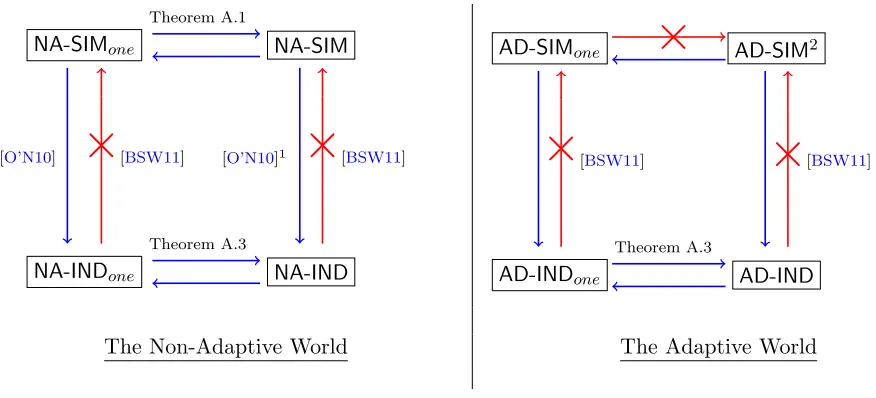
Why focus on this definition? First, as mentioned above, our definition is at least as strong as the definition presented in [BSW11]. In addition, in Appendix A we show the following relations between the definitions:
1. Relations between simulation and indistinguishability: We show that a single message simulation definition implies single message indistinguishability definition for both non-adaptive and non-adaptive worlds.
2. Relations between single and many messages (simulation): We show that a single message non-adaptive simulation impliesmanymessages non-adaptive simulation definition. However, we cannot hope to achieve the same implication for adaptive world due to the impossibility results presented in [BSW11].
3. Relations between single and many messages (indistinguishability): Finally, we show that a single message indistinguishability implies many message indistinguishability definition in both the adaptive and non-adaptive worlds.
These definitional implications are summarized in Figure 1 and proved in Appendix A. As a result of these definitional implications, we focus on proving that our constructions are secure under thesingle message simulation definitions for both adaptive and non-adaptive worlds.
4
Background Constructions
4.1 Adaptive, Singleton
Consider the following simple circuit family that consists of a single identity circuit C = {C}, input space X ={0,1} and C(x) =x. We construct a 1-AD-SIM-secure functional encryption for this circuit family, starting from any CPA-secure encryption (PKE.Setup,PKE.Enc,PKE.Dec). (The construction is inspired by techniques used in non-committing encryption [CFGN96,DN00,KO04].) • Setup BasicFE.Setup(1κ): Run PKE.Setup twice to generate independent master
public-key/secret-key pairs
(PKi,SKi)←PKE.Setup(1κ) for i= 0,1 Output the master public/secret key pair
MPK:= (PK0,PK1) and MSK:= (SK0,SK1)
• Key Generation BasicFE.Keygen(MSK, C): On input the master secret key MSK and a circuitC, pick a random bitr ← {0,$ 1}and output the secret key
SK:= (r,SKr)
• Encryption BasicFE.Enc(MPK, x): On input the master public key MPK and an input message x∈ {0,1}: output as ciphertext
CT:= (PKE.Enc(PK0, x),PKE.Enc(PK1, x))
• Decryption BasicFE.Dec(SK,CT): On input a secret key SK = (r,SKr) and a ciphertext
CT= (CT0,CT1), output
Correctness. Correctness is straight-forward.
Security. We prove that the scheme is 1-AD-SIM-secure. We define a simulatorBasicFE.Simthat proceeds as follows:
• If the adversary makes a secret key query before seeing the ciphertext, the simulator learns x and can therefore simulate the ciphertext perfectly via normal encryption.
• If the adversary requests for the ciphertext first, then the simulator picks a random bit β ← {0,$ 1} and outputs as ciphertext:
CT:= (PKE.Enc(PK0, β),PKE.Enc(PK1, β))
When the adversary then requests for a secret key, the simulator learns MSK= (SK0,SK1)
and x, and outputs as the secret key:
SK:= (β⊕x,SKβ⊕x)
We establish security via a series of Games.
Game 0. Normal encryption.
Game 1. If the adversary requests for the ciphertext before making a secret key query, then we modify the ciphertext as follows:
CT:= (PKE.Enc(PK0, x⊕r),PKE.Enc(PK1, x⊕r))
Game 2. Output of the simulator.
It is easy to see that the outputs of Games 0 and 1 are computationally indistinguishable by CPA security, and that the outputs of Games 1 and 2 are identically distributed.
Extension to largerX. It is easy to see that this construction extends toX ={0,1}λviaλ-wise repetition (that is, λindependent master public keys, etc).
4.2 Adaptive, “Brute Force”
Boneh, et. al [BSW11, Section 4.1] presented aAD-IND-secure scheme for any functionality where the circuit family has polynomial size, starting from any semantically secure public-key encryption scheme. For simplicity, we just write down the construction for a family of two circuitsC={C0, C1},
which easily extends to any poly-size family. We show that if we replace the underlying encryption scheme with the previous 1-AD-SIM-secure FE encryption for singleton circuit space C0 = {C∗}, then we obtain a 1-AD-SIM-secure FE encryption forC.
• Setup BFFE.Setup(1κ): Run BasicFE.Setup twice to generate independent master public-key/secret-key pairs
(MPKi,MSKi)←BasicFE.Setup(1κ) fori= 0,1
• Key GenerationBFFE.Keygen(MSK, Cb): On input the master secret keyMSKand a circuit Cb∈ C, output as secret key SKb←BasicFE.Keygen(MSKb, C∗).
• EncryptionBFFE.Enc(MPK, x): On input the master public keyMPKand an input message x∈ X, output as ciphertext
CT:= (BasicFE.Enc(MPK0, C0(x)),BasicFE.Enc(MPK1, C1(x)))
• Decryption BFFE.Dec(SKb,CT): On input a secret key SKb and a ciphertext CT = (CT0,CT1), output
BasicFE.DecSKb(CTb)
Correctness. Correctness is straight-forward.
Security. We prove that the scheme is 1-AD-SIM-secure. The simulator BFFE.Sim proceeds as follows:
• If the adversary makes a query Cb before seeing the ciphertext, the simulator learns Cb(x) and then simulates the ciphertext as follows:
CTb ←BasicFE.Enc(MPKb, Cb(x)) and CT1−b ←BasicFE.Sim(MPK1−b,∅,1|x|)
OutputCT:= (CT0,CT1)
• If the adversary requests for the ciphertext first, then the simulator simulates the ciphertext as follows:
CTi ←BasicFE.Sim(MPKi,∅,1|x|), fori= 0,1
Output CT := (CT0,CT1). When the adversary then requests for a secret key Cb, the simulator learns MSK= (MSK0,MSK1) andCb, Cb(x) and outputs as secret key
SKb ←BasicFE.Sim(MSKb,(Cb(x), Cb),1|x|)
We establish security via a series of Games.
Game 0. Normal encryption.
Game 1. Roughly speaking, we will simulate on MPK0,CT0 and follow normal encryption on
MPK1,CT1. More precisely, the simulator proceeds as follows:
• If the adversary makes a secret key queryCb before seeing the ciphertext, proceed as follows:
– ifb= 0, use the normal encryption for both CT0 and CT1.
– ifb= 1, follow BFFE.Sim (that is, generateCT0 using BasicFE.Sim).
• If the adversary requests for the ciphertext first, then the simulator simulates the ciphertext as follows:
CT0 ←BasicFE.Sim(MPK0,∅) and CT1 ←BasicFE.Enc(MPK1, C1(x))
Output CT := (CT0,CT1). When the adversary then requests for a secret key Cb, the
– ifb= 0, follow BFFE.Sim (that is, generateSK0 using BasicFE.Sim);
– ifb= 1, follow normal encryption (that is, generateSK1 using BasicFE.Keygen).
Game 2. Output of the simulator.
It is easy to see that the outputs of Games 0 and 1 are computationally indistinguishable by 1-AD-SIMof the underlying scheme. The same applies to the outputs of Games 1 and 2.
4.3 One-Query General Functional Encryption from Randomized Encoding
Sahai and Seyalioglu [SS10] proved 1-NA-SIM; we observe the same “bootstrapping” construction works for 1-AD-SIM. Let C be an arbitrary family of poly-size circuits. We construct ON EQF E scheme forC as follows.
Let BF F E denote the brute-force construction defined above. In a high-level the idea is this: suppose we wish to construct an FE scheme for a polynomial-size circuitCand inputx. LetU(C, x) denote the universal circuit that output C(x). Let Ue(C, x;R) denote a randomized encoding of
U(C, x) where for every x, R, Ue( · , x;R) has small locality. Then, assuming C has length λ, we
can write
e
U(C, x;R) = (Ue1(C[1], x;R), . . . ,Ueλ(C[λ], x;R))
whereUi(e ·, x;R) depends only onC[i], theith bit of circuitC. For eachi, we can now useBF F E
scheme for a family of two circuits:
e
Ui :={Uei(0, ·; ·),Uei(1, ·; ·)}
• Setup FE.Setup(1κ): Run the brute-force setup algorithm λ times to generate independent master public-key/secret-key pairs
(MPKi,MSKi)←BFFE.Setup(1κ) forUei and i= 1, . . . , λ
Output (MPKi)λi=1 as the master public key and (MSKi)λi=1 as the master secret key.
• Key Generation FE.Keygen(MSK, C): On input the master secret key MSK and a circuit C∈ C, compute
SKC,i←BFFE.Keygen(MSKi,Uei(C[i], ·; ·)) fori= 1, . . . , λ
Output as secret key
SKC := ((SKC,i)i∈[λ])
• Encryption FE.Enc(MPK, x): On input the master public key MPK and an input message x∈ X, choose R and compute
CTi ←BFFE.Enc(MPKi,(x;R)) for i= 1, . . . , λ Output (CTi)λi=1 as the ciphertext.
• Decryption FE.Dec(SKC,CT): On input a secret keySKC = (SKC,i)i∈[λ]) and a ciphertext
CT= (CTi)λi=1, do the following:
1. Compute eyi←BFFE.Dec(MSKi,CTi) =Uei(C[i], x;R) fori= 1, . . . , λ;
2. Run the decoder to get y←RE.Decode(ey1, . . . ,yeλ).
Correctness. Correctness follows directly from the correctness of the brute-force FE construction and randomized encodings.
Security. We first prove that ON EQF E is 1-NA-SIM-secure (See below on how to modify the proof to show 1-AD-SIM-security). Recall that the simulator gets as input the following values:
1. The public key: (MPKi)λi=1;
2. The queryC and the corresponding secret key SKC = (SKC,i)λi=1;
3. The output of C: C(x);
On the very high level, the security of the scheme follows from the fact that by the security of brute-force construction the adversary can only learn yei for all i and by the security of the randomized encoding the adversary can only learn y=C(x).
We establish security via a series of Games. Game 0 corresponds to the real experiment and Gameλ+ 1 corresponds to the ideal experiment where simulatorS produced the ciphertext. The goal of the simulatorS is to produce a ciphertext that is indistinguishable from the real ciphertext. LetBFFE.SimandRE.Simbe the brute-force FE and randomized encoding simulators, respectively.
Game 0. Real encryption experiment.
Game ifor i∈ {1, . . . , λ}. In Gamei,iciphertexts are encrypted properly usingMPKiandλ−i ciphertexts are simulated. Formally, for all 1≤j≤i, let
CTi ←BFFE.Enc(MPKi,(x;R))
For alli < j ≤λ, let
CTi←BFFE.Sim(MPKi,(Uei(C[i], x;R),Uei(C[i], ·; ·),SKC,i))
Output the ciphertext
CT:= (CT1, . . . ,CTλ)
Game λ+ 1. Same as Gameλ, except the randomized encoding is now produced by the RE.Sim. Formally, the simulator S does the following.
1. Let
(Uei(C[i], x;R))λi=1 ←RE.Sim(1κ, U, U(C, x)))
2. For alli∈[λ], let
CTi ←BFFE.Sim(MPKi,(Uei(C[i], x;R),Uei(C[i], ·; ·),SKC,i))
3. Output the ciphertext
CT:= (CT1, . . . ,CTλ)
Proof. The only different between Games 0 andλis that in the later the ciphertext produced by the simulator. If there is a distinguisher between the Games, then by we can distinguish between Games iand i+ 1 for somei, hence compromise the security of the underlyingBF F E construction.
Claim 4.0.2. The outputs of Game λand Game λ+ 1are computationally indistinguishable.
Proof. This claim follows directly from the security of the randomized encoding simulator.
Therefore, we can conclude that the real experiment is indistinguishable from the ideal experiment.
We now sketch how to modify the above proof to show that ON EQF E is 1-AD-SIM-secure. Construct the simulator S = (S1, S2) as follows. The simulator S1 is the same as in the
non-adaptive case, except it passes the simulated decomposable randomized encoding Ue(C, x;R) as a
part of the state to S2. Now, assume the oracle queryC comes after the challenge ciphertext (the
other case is trivial). We invoke the single brute-force simulatorBFFE.Simmany times for allMSKi. For every oracle queries Uei(C[i], ·; ·) made byBFFE.Sim reply withyei←Uei(C[i], x;R). Finally,
output (SKC,i)i∈[λ] as the secret key to the adversary.
5
A Construction for NC1 circuits
In this section, we construct a functional encryption scheme for all NC1 circuits secure against q secret-key queries, starting from one that is secure against a single secret-key query. Our construction will rely on any semantically secure public-key encryption scheme.
The Class of Circuits. We construct q-bounded FE scheme for a circuit family C := NC1. In particular, we consider polynomial representation of circuits C in the family. The input message space X = F` is an `-tuple of field elements, and for every circuit C ∈ C, C(·) is an `-variate
polynomial overFof total degree at mostD. The complexity of our construction will be polynomial
in bothDandq, whereq is the number of secret keys the adversary is allowed to see before he gets the challenge ciphertext.
5.1 Our Construction
LetC:= NC1 be a circuit family with circuits of degreeD=D(κ) in its input, and letq =q(κ) be a bound on the number of secret key queries. Our scheme is associated with additional parameters S =S(κ),N =N(κ),t=t(κ) andv=v(κ) (for an instantiation of the parameters, see Section 5.2).
We start by defining a new family G as follows:
GC,∆(x, Z1, . . . , ZS) :=C(x) +
X
i∈∆
Zi (1)
where ∆⊆[S] and Z1, . . . , ZS ∈F.
• SetupBdFE.Setup(1κ): Run the one-query setup algorithmN times to generate independent master public-key/secret-key pairs
(MPKi,MSKi)←OneQFE.Setup(1κ) fori= 1, . . . , N
Output (MPKi)Ni=1 as the master public key and (MSKi)Ni=1 as the master secret key.
• Key Generation BdFE.Keygen(MSK, C): On input the master secret keyMSKand a circuit C∈ C,
1. Choose a uniformly random set Γ⊆[N] of size tD+ 1; 2. Choose a uniformly random set ∆⊆[S] of sizev; 3. Generate the secret keys
SKC,∆,i←OneQFE.Keygen(MSKi, GC,∆) for every i∈Γ
Output as secret keySKC := (Γ,∆,(SKC,∆,i)i∈Γ).
• Encryption BdFE.Enc(MPK, x): On input the master public keyMPK= (MPKi)Ni=1 and an
input messagex= (x1, . . . , x`)∈ X:
1. Fori= 1,2, . . . , `, pick a random degreetpolynomial µi(·) whose constant term is xi. 2. Fori= 1,2, . . . , S, pick a random degreeDtpolynomial ζi(·) whose constant term is 0. 3. Run the one-query encryption algorithmOneQFE.Enc N times to produce ciphertexts
CTi ←OneQFE.Enc MPKi,(µ1(i), . . . , µ`(i), ζ1(i), . . . , ζS(i))
for i= 1, . . . , N
Output (CTi)Ni=1 as the ciphertext.
• Decryption BdFE.Dec(SKC,CT): On input a secret key SKC = (Γ,∆,(SKC,∆,i)i∈Γ) and a
ciphertext CT= (CTi)Ni=1, do the following:
1. Compute a degree Dt polynomial η(·) such that η(i) = OneQFE.Dec(SKC,∆,i,CTi) for all i∈Γ.
2. Outputη(0).
5.1.1 Correctness
We show that the scheme above is correct. By correctness of the underlying single-query FE, we have that for all i∈Γ,
η(i) = GC,∆(µ1(i), . . . , µ`(i), ζ1(i), . . . , ζS(i)) = C(µ1(i), . . . , µ`(i)) +
X
a∈∆
ζa(i)
Since |Γ| ≥Dt+ 1, this means thatη is equal to the degreeDt polynomial
η(·) =C(µ1(·), . . . , µ`(·)) +
X
a∈∆
ζa(·)
5.2 Setting the Parameters
We show how to set the parametersS =S(κ),N =N(κ) and t=t(κ). These parameters govern the choice of the sets Γ and ∆ during the key generation algorithm, and are required to satisfy the following two conditions:
Small Pairwise Intersections. Let Γ1, . . . ,Γq ⊆ [N] be the (uniformly random) sets chosen
for each of the q secret key queries of the adversary. Whenever two of these sets intersect, the adversary obtains two distinct secret keys for the underlying one-query secure FE scheme. More precisely, for everyj ∈Γ1∩Γ2, the adversary obtains two secret keys under the public keyMPKj. Since security of MPKj is only guaranteed under a single adversarial query, we have to contend with the possibility that in this event, the adversary can potentially completely break the security of the public key MPKj. In particular, for every such j, the adversary potentially learns a share of the encrypted input message x.
Thus, to guarantee security, we require that the union of the pairwise intersections of Γ1, . . . ,Γq
is small. In particular, we require that
S
i6=j(Γi∩Γj)
≤t. This ensures that the adversary learns
at mosttshares of the input message x, which together reveal no information aboutx.
A simple probabilistic argument shows that this is true (with probability 1−2−Ω(t/q2)) as long asq2·(Dt/N)2·N ≤t/10. In other words, we will sett(κ) = Θ(q2κ) andN(κ) = Θ(D2q2t) which satisfies the above constraint with probability 1−2−Ω(κ). For details, we refer an interested reader to Appendix B.1.
Cover-Freeness. Let ∆1, . . . ,∆q ⊆[S] be the (uniformly random) sets of sizev chosen for each of the q secret key queries of the adversary. The security proof relies on the condition that the polynomials P
a∈∆jζa(·) are uniformly random and independent which is true if the collection of
sets ∆1, . . . ,∆q is cover-free. That is, for every i∈[q]: ∆i\
S
j6=i∆j
6=φ.
A simple probabilistic argument shows that this is true (with probability 1−2−Ω(q2v2/S)) as
long asq2v2/S≤v/100. In other words, we will setv(κ) = Θ(κ) andS(κ) = Θ(vq2) which satisfies the above constraint with probability 1−2−Ω(κ). For details, we refer an interested reader to Appendix B.2.
We remark that in our construction, multiple secret key queries for the same C ∈ C result in different secret keys SKC, essentially because of the different random choices of the sets ∆ and Γ. Using a pseudorandom function (applied to C), it is possible to ensure that multiple secret key queries for the sameC result in the same answer.
5.3 Proof of Security
Theorem 5.1. Let ON EQF E be a 1-AD-SIM-secure (resp. 1-NA-SIM-secure) functional encryp-tion scheme for any family of poly-size circuits. Then, for any circuit family C computable in NC1 the BDF E scheme described above isq-AD-SIM-secure (resp. q-NA-SIM-secure).
q-AD-SIM-secure (see Figure 1 for relations).
We establish security by first defining the simulator and then arguing that its output is indistinguishable via a series of Games. For readability, we adopt the following convention: we useito index over values in [N], and we use j to index over the queries.
Overview. Suppose the adversary receives the challenge ciphertext after seeing q∗ ≤ q queries. The simulator has to simulate the ciphertext and answer the remaining secret key queries. We may assume it already knows all of Γ1, . . . ,Γq,∆1, . . . ,∆q. This is because:
• forj≤q∗, the simulator gets Γj,∆j from SKj;
• forj > q∗, the simulator gets to program Γj,∆j and could pick all these quantities in advance.
We first describe our strategy for simulating the ciphertext CT= (CT1, . . . ,CTN) and the secret keys. Let I denote
[
j6=j0
(Γj∩Γj0)
We will consider two cases:
• i∈ I: Here, we may issue more than one secret key corresponding to (MPKi,MSKi); therefore, we can no longer rely on the security of the underlying one-query FE scheme. Instead, we rely on the statistical security of the underlying MPC protocol and the fact that |I| ≤ t. Specifically, we can simulate CTi and the secret keys honestly.
• i /∈ I: Here, we issue at most one secret key corresponding to (MPKi,MSKi); this is because at most one of the sets Γ1, . . . ,Γqcontainsi. Supposei∈Γj. We may now appeal to the security of the underlying one-query FE scheme. Specifically, we simulateCTi computationally using the simulator for the underlying one-query FE scheme. If j ≤ q∗, then we do not need to program secret keys at all. Ifj > q∗, upon receiving query Cj, we program the corresponding keysSKCj,∆j,i using the one-query simulator.
We formally define the simulator BdFE.Simas follows:
Simulating the ciphertext after queryq∗. Here, the simulator knows Γ1, . . . ,Γq,∆1, . . . ,∆q; the queriesC1, . . . , Cq∗, the outputs C1(x), . . . , Cq∗(x), and the secret keys SK1, . . . ,SKq∗.
1. Uniformly and independently sample`random degreetpolynomialsµ1, . . . , µ`whose constant terms are all 0.
2. We sample the polynomials ζ1, . . . , ζS as follows: let ∆0:=∅. For j= 1,2, . . . , q:
(a) by the cover-free property, fix somea∗ ∈∆j\(∆0∪ · · · ∪∆j−1);
(b) for all a∈(∆j \(∆0∪ · · · ∪∆j−1))\ {a∗}, set ζa to be a uniformly random degree Dt polynomial whose constant term is 0;
(d) the evaluation ofζa∗ on the points inI is defined by the relation:
ηj(·) =Cj(µ1(·), . . . , µ`(·)) +
X
a∈∆j ζa(·)
Finally, for all a /∈ (∆1∪ · · · ∪∆q), set ζa to be a uniformly random degree Dt polynomial
whose constant term is 0.
3. For eachi∈ I, run the one-query encryption algorithm OneQFE.Enc to produce ciphertexts
CTi ←OneQFE.Enc MPKi,(µ1(i), . . . , µ`(i), ζ1(i), . . . , ζS(i))
4. For each i /∈ I, run the one-query simulator OneQFE.Sim to produce ciphertexts CTi as follows: at most one of Γ1, . . . ,Γq containsi.
• If such a set exists, letj denote the unique set Γj that containsi(i.e. i∈Γj). Ifj≤q∗, compute
CTi ←OneQFE.Sim MPKi,(ηj(i), GCj,∆j,SKCj,∆j,i)
whereSKCj,∆j,i is provided as part ofSKj. • If no such set exist orj > q∗, then compute
CTi ←OneQFE.Sim MPKi,∅
Output (CTi)Ni=1 as the ciphertext.
Simulating secret key SKj, for j > q∗. Here, the simulator gets MSK = (MSK1, . . . ,MSKN) and Cj(x), Cj and needs to simulate (SKCj,∆j,i)i∈Γj.
1. For eachi∈Γj∩ I, pickSKCj,∆j,i←OneQFE.Keygen(MSKi, GCj,∆j).
2. For eachi∈Γj\ I (i.e, Γj is the only set that containsi),
(a) pick a random degreeDtpolynomial ηj(·) whose constant term is Cj(x) and subject to the constraints on the values inI chosen earlier;
(b) runOneQFE.Sim(MSKi,(ηj(i), GCj,∆j)) to obtainSKCj,∆j,iso thatCTidecrypts toηj(i).
Output (SKCj,∆j,i)i∈Γj.
We establish security via a series of Games. The simulator is described above.
Game 1. We modifyζ1, . . . , ζS, η1, . . . , ηq to be the same as that in the simulator.
Game 3. The output of the simulator. That is, we modify how polynomials µ1, . . . , µ` are sampled.
Claim 5.1.1. The outputs of Game 0 and Game1 are identically distributed.
Proof. In the normal encryption,ζa∗ is chosen at random andηj(·) is defined by the relation. From Step 2 in the ciphertext simulation and Step 2 in the secret keys simulation (forj > q∗)BdFE.Sim, essentially, chooses ηj(·) at random which defines ζa∗. It is easy to see that reversing the order of how the polynomials are chosen produces the same distribution.
Claim 5.1.2. The outputs of Game 1 and Game2 are computationally indistinguishable.
Proof. Informally, this follows from the security of the underlying one-query FE scheme and the fact that for all i /∈ I, we runOneQFE.Keygen(MSKi,·) at most once.
By a hybrid argument, it suffices to show that for alli /∈ I, the distribution ofCTi in Game 1 and 2 are computationally indistinguishable (given MPKi and SK1, . . . ,SKq). Indeed, fix such ai /∈ I and a corresponding unique j such thati∈Γj (the case no such j exists is similar).
First, observe that amongstSK1, . . . ,SKq, onlySKj contains a keySKCj,∆j,ithat is generated using either SKCj,∆j,i ← OneQFE.Keygen(MSKi, GCj,∆j) (for the non-adaptive queries) or SKCj,∆j,i ←
OneQFE.Sim(MSKi,(ηj(i), GCj,∆j)) (for the adaptive queries).
Case 1: Assume j≤q∗. Observe that
ηj(i) = Cj(µ1(i), . . . , µ`(i)) +
X
a∈∆j ζa(i)
= GCj,∆j(µ1(i), . . . , µ`(i), ζ1(i), . . . , ζS(i)) (2)
which means that in both Games 1 and 2,CTi decrypts to the same value. Now, note that in Game 1,CTi is generated using
CTi←OneQFE.Enc MPKi,(µ1(i), . . . , µ`(i), ζ1(i), . . . , ζS(i))
By the security of the underlying FE scheme, this is computationally indistinguishable from
OneQFE.Sim MPKi,(GCj,∆j(µ1(i), . . . , µ`(i), ζ1(i), . . . , ζS(i)), GCj,∆j,SKCj,∆j,i)
By the Equation 2, this is the same as
OneQFE.Sim MPKi,(ηj(i), GCj,∆j,SKCj,∆j,i)
which is the distribution ofCTi in Game 2.
Case 2: Assume j > q∗. Then:
• CTi←OneQFE.Sim MPKi,∅
and
Similarly, by the Equation 2 and by the security of the underlying one-query FE scheme this simulated pair of ciphertext and secret key is indistinguishable from the real.
Claim 5.1.3. The outputs of Game 2 and Game3 are identically distributed.
Proof. In Game 2, the polynomials µ1, . . . , µ` are chosen with constant terms x1, . . . , x`, respec-tively. In Game 3, these polynomials are now chosen with 0 constant terms. This only affects the distribution ofµ1, . . . , µ` themselves and polynomialsζ1, . . . , ζS. Moreover, only the evaluations of these polynomials on the points inI affect the outputs of the games. Now observe that:
• The distribution of the values {µ1(i), . . . , µ`(i)}i∈I are identical in both Game 2 and 3. This is because in both games, we choose these polynomials to be random degree t polynomials (with different constraints in the constant term), so their evaluation on the points in I are identically distributed, since|I| ≤t.
• The values{ζ1(i), . . . , ζS(i)}i∈I depend only on the values{µ1(i), . . . , µ`(i)}i∈I.
The claim follows readily from combining these observations.
6
A Bootstrapping Theorem for Functional Encryption
In this section, we show a “bootstrapping-type” theorem for functional encryption (FE). In a nutshell, this shows how to take a q-query functional encryption scheme for “bounded degree” circuits, and transform them into aq-query functional encryption scheme for arbitrary polynomial-size circuits. The transformation relies on the existence of a pseudorandom generator (PRG) that stretches the seed by a constant factor, and which can be computed by circuits of degree poly(κ). This is a relatively mild assumption, and in particular, is implied by most concrete intractability assumptions commonly used in cryptography, such as ones related to factoring, discrete logarithm, or lattice problems.
In a high-level the idea is this: Suppose we wish to construct an FE scheme for a family C of polynomial-size circuit. Let C ∈ C and x be some input. Then, let C(x;e R) denote a randomized
encoding ofC that is computable by a constant-depth circuit with respect to the inputsx and R. By [AIK06, Theorem 4.14], we know that assuming the existence of a pseudo-random generator in ⊕L/poly, such a randomized encoding exists for every polynomial-size circuitC.
Consider a new family of circuits G defined as follows:
GC,∆(x, R1, . . . , RS) :=Ce
x;M a∈∆
Ra
Observe the following:
• Since for any C, C(e · ; · ) is computable by a constant-depth circuit, then GC,∆( · ; · ) is
computable by a constant-degree polynomial. Using the result from the previous scheme, we have aq-AD-SIM-secure FE scheme forG.
• Given a functional encryption scheme ford G, it is easy to construct one for C. Decryption works by first recovering the output ofGC,∆and then applying the decoder for the randomized
• Informally, 1-AD-SIM-security follows from the fact that the ciphertext together with the secret key reveals only the output of C(x), which in turn reveals no more information thane
C(x). More formally, given C(x), we can simulate C(x) and then the ciphertext, using firste
the simulator for the randomized encoding and then that for the underlying FE scheme.
• The role of the subset ∆ is similar to that in the preceding construction — to “rerandomize” the randomness used inG, which is necessary to achieveq-AD-SIM-security.
Functional Encryption Scheme for C. Let (BdFE.Setup,BdFE.Keygen,BdFE.Enc,BdFE.Dec) be aq-AD-SIM-secure scheme forG, with a simulatorBdFE.Sim. We construct an encryption scheme (FE.Setup,FE.Keygen,FE.Enc,FE.Dec) forCworks as follows (that takes parameters S, vas before).
• Setup FE.Setup(1κ): Run the bounded FE setup algorithm to generate a master public-key/secret-key pair (MPK,MSK)←BdFE.Setup(1κ).
• Key Generation FE.Keygen(MSK, C): On input the master secret key MSK and a circuit C∈ C, do the following:
1. Choose a uniformly random set ∆⊆[S] of sizev;
2. Generate the secret keySKC,∆←BdFE.Keygen(MSK, GC,∆).
Output as secret keySKC := (∆,SKC,∆).
• Encryption FE.Enc(MPK, x): On input the master public key MPK and an input message x∈ X, do the following:
1. Fori= 1,2, . . . , S, choose uniformly randomRi← {0,$ 1}r.
2. Run the bounded degree encryption algorithm BdFE.Enc to produce a ciphertext
CT←BdFE.Enc(MPK,(x, R1, . . . , RS))
OutputCTas the ciphertext.
• Decryption FE.Dec(SKC,CT): On input a secret key SKC and a ciphertext CT,
– Run the bounded FE decryption algorithm to getye←BdFE.Dec(SKC,∆,CT). – Run the randomized encoding decoder onyeto get the outputy←RE.Decode(y).e
6.0.1 Correctness
We first show correctness of the scheme F E. Given a secret key SKC and a ciphertext CT ←
FE.Enc(MPK, x), the decryption algorithm computes
e
y=BdFE.Dec(SKC,∆,CT) =GC,∆(x, R1, . . . , RS) =C(x;e M
a∈∆Ra))
Bootstrapping for Unbounded Queries. Although the transformation above assumes the knowledge ofq (the bound on the number of secret key queries of the adversary), we can generalize it to work for unbounded queries as follows. Essentially, the idea is to generate fresh (computational) randomness for each randomized encoding using a pseudo-random function.
In particular, let {prfS}S∈{0,1}κ be a circuit family of weak pseudo-random functions. Consider a new circuit familyC that works in the following way:
GC,R(x, S)) :=Ce
x;prfS(R)
Then, essentially the same construction as above works as a way to bootstrap an FE scheme for arbitrary circuits from FE schemes for circuits that can compute the weak PRF followed by the randomized encoding. Assuming the existence of weak PRFs and PRGs that can be computed by circuits of degree poly(κ), we then obtain functional encryption schemes for arbitrary circuits. Note, that by [AGVW12] it is impossible to achieve functional encryption for PRFs underNA-SIM -security for unbounded queries. However, constructions secure under a weaker -security definition (for example, indistinguishability) are still open.
6.1 Proof of Security
Theorem 6.1. Let BDF E be a q-AD-SIM-secure (resp. q-NA-SIM-secure) functional encryption scheme for any family of circuits computable in NC1. Then, for any family C of polynomial-size circuits the F E scheme described above is q-AD-SIM-secure (resp. q-NA-SIM-secure).
We prove that the construction F E given in Section 6 isq-AD-SIM-secure if we start out with a q-AD-SIM-secure scheme. This subsumes the non-adaptive variant of the proof.
Proof overview. Suppose the adversary sees q∗ queries before seeing the ciphertext. The simulator has to simulate the ciphertext and answer the remaining secret key queries. We may again assume that the simulator knows all of Γ1, . . . ,Γq,∆1, . . . ,∆q.
Simulating the ciphertext. The simulator gets{Cj(x), Cj,SKCj}j∈[q∗] and outputs:
CT←BdFE.Sim
MPK,RE.Sim(Cj(x)), GCj,∆j,SKCj,∆j j∈[q∗]
with fresh independent randomness for each of the q∗ invocations ofRE.Sim.
Simulating secret key SKCj, for j > q
∗. Here, the simulator gets MSK and Cj(x), Cj and needs to simulate SKCj := (∆j,SKCj,∆j). It proceeds as follows:
1. Picks ˜yj ←RE.Sim(Cj(x)).
2. RunsBdFE.Sim(MSK,(˜yj, GCj,∆j)) to obtainSKCj,∆j so thatCTdecrypts to ˜yj. OutputSKCj = (∆j,SKCj,∆j).
Game 0. Normal encryption.
Game 1. We modify the distribution of the ciphertext to useBdFE.Sim as in the static case for both the ciphertext and the secret-key queries after the adversary sees the ciphertext. That is,
CT←BdFE.SimMPK,
GCj,∆j(x;R1, . . . , RS), GCj,∆j,SKCj,∆j j∈[q∗]
Moreover, for j > q∗, it
1. Picks ˜yj ←GCj,∆j(x;R1, . . . , RS).
2. RunsBdFE.Sim(MSK,(˜yj, GCj,∆j)) to obtainSKCj,∆j so thatCTdecrypts to ˜yj.
OutputSKCj = (∆j,SKCj,∆j).
Game 2. We replace La∈∆
jRa j∈[q] with
R0j j∈[q], where for eachj:
GCj,∆j(x;R1, . . . , RS) :=C(x;e
M
a∈∆j Ra)
Game 3. The output of the simulator (that is, switch to usingRE.Sim).
Claim 6.1.1. The outputs of Game 0 and Game1 are computationally indistinguishable.
Proof. This follows readily from q-AD-SIM-security of the underlying FE scheme.
Claim 6.1.2. The outputs of Game 1 and Game2 are identically distributed.
Proof. By cover-freeness of ∆1, . . . ,∆q, we have that
n M
a∈∆j Ra
o
j∈[q] and n
R0j
o
j∈[q]
are identically distributed.
Claim 6.1.3. The outputs of Game 2 and Game3 are computationally indistinguishable.
Proof. This follows readily from a hybrid argument and the security of the randomized encoding scheme, which says that for eachj = 1, . . . , q:
e
Cj(x;R0j) and RE.Sim(Cj(x))
7
Yet Another Bootstrapping Theorem Using FHE
We show a bootstrapping theorem that transforms a q-query FE scheme supporting NC1 circuits into a q-query FE scheme for arbitrary polynomial-size circuits using, in addition, a fully homomorphic encryption scheme [Gen09, BV11]. Intuitively, the construction can be viewed as follows: we reduce functional encryption for a circuit C to one for the decryption algorithm for a fully homomorphic encryption scheme computable in NC1. Putting this together with theq-query, NC1 ciruit scheme from Section 5 gives us Theorem 7.1.
First, we need a generalization of the construction for NC1 circuits from Section 5. Assume that the message is split into apublic part and asecret part. Then, the key observation is that the construction from Section 5 works for any circuit C which is computable in NC1 in the variables of the secret part. The rationale for this is the same as that used to obtain a predicate encryption with public index from the scheme in Section 5.
We show the following theorem:
Theorem 7.1. Let BDF E be a q-query, FE scheme which works for any NC1 circuit, and let
F HE be a semantically secure fully homomorphic encryption scheme whose decryption algorithm
FHE.Dec(SK, ct) can be implemented by an NC1 circuit in the secret key. Then, for any family of poly-size circuits C there exists a q-query FE schemeF E = (FE.Setup,FE.Keygen,FE.Enc,FE.Dec).
Furthermore, if BDF E isq-NA-SIM-secure (resp. q-AD-SIM-secure), then so is F E.
Any of the recent fully homomorphic encryption schemes have decryption algorithms com-putable in NC1. Putting these together, we get q-bounded FE schemes under the “learning with errors” and the “ring learning with errors” assumptions (together with certain circular security assumptions) [BV11].
Let C be an arbitrary polynomial-size circuit family. Our construction uses the following components:
• An Inner Encryption Scheme: Let F HE = (FHE.Keygen,FHE.Enc,FHE.Eval,FHE.Dec) be a fully homomorphic encryption scheme where the decryption algorithm FHE.Dec can be implemented by an NC1 circuit in the secret key.
• An Outer Encryption Scheme: LetBDF E = (BdFE.Setup,BdFE.Keygen,BdFE.Enc,BdFE.Dec) be aq-query functional encryption scheme for the familyGthat is computable by NC1 circuits in their secret input defined as follows:
GC(ct,SK) :=ct,FHE.Dec(SK,FHE.Eval(C, ct))
Note that althoughG has circuits that are at least as large as those forC, all we are interested in is its degree in the secret input, namelySK.
Ourq-query secure encryption scheme (FE.Setup,FE.Keygen,FE.Enc,FE.Dec) forCworks as follows.
• Setup FE.Setup(1κ): Run the bounded FE setup algorithm to generate a master public-key/secret-key pair:
• Key Generation FE.Keygen(MSK, C): On input the master secret key MSK and a circuit C∈ C, run the bounded FE key generation algorithm to generate a secret key
SKC ←BdFE.Keygen(MSK, GC)
for the circuitGC.
• Encryption FE.Enc(MPK, x): On input the master public key MPK and an input message x∈ X:
1. Choose a uniformly random public-key/secret-key pair for the fully homomorphic encryption schemeF HE by running
(PK,SK)←FHE.Keygen(1κ)
2. Encrypt the input messagex using the FHE encryption algorithm
ct←FHE.Enc(PK, x)
3. Run the bounded FE encryption algorithm to encrypt the ciphertext ct together with the fully homomorphic secret keySK:
CT←BdFE.Enc(MPK,(ct,SK))
OutputCT as the ciphertext.
• Decryption FE.Dec(SKC,CT): On input a secret key SKC and a ciphertext CT, run the bounded FE decryption algorithm to get [ct, y]←BdFE.Dec(SKC,CT), and output [ct, y].
7.0.1 Correctness and Security
We first show correctness of the scheme F E. Given a secret key SKC and a ciphertext CT ←
FE.Enc(MPK, x), the decryption algorithm computes
[ct, y] = BdFE.Dec(SKC,CT)
= BdFE.Dec(SKC,BdFE.Enc(MPK,(ct,SK)))
(where ct←FHE.Enc(PK, x)) = GC(ct,SK)
= [ct,FHE.Dec(SK,FHE.Eval(C, ct))] = [ct, C(x)]
We establish security via a series of Games. The simulator is described in Game 2.
Game 0. Normal encryption.
Game 1. Run theq-query simulator on input ([ct←FHE.Enc(PK, x), Ci(x)], GCi,SKi) n
i=1, where
Game 2. Run theq-query simulator on input ([ct←FHE.Enc(PK,0), Ci(x)], GCi,SKi) n
i=1, where
n≤q is the number of oracle query calls made to BdFE.Keygen.
References
[AGVW12] Shweta Agrawal, Sergey Gorbunov, Vinod Vaikuntanathan, and Hoeteck Wee. Functional encryption: New perspectives and lower bounds. Cryptology ePrint Archive, Report 2012/468, 2012. http://eprint.iacr.org/.
[AIK06] Benny Applebaum, Yuval Ishai, and Eyal Kushilevitz. Computationally private randomizing polynomials and their applications.Computational Complexity, 15(2):115– 162, 2006.
[BF01] Dan Boneh and Matthew K. Franklin. Identity-based encryption from the weil pairing. In CRYPTO, pages 213–229, 2001.
[BGW88] Michael Ben-Or, Shafi Goldwasser, and Avi Wigderson. Completeness theorems for non-cryptographic fault-tolerant distributed computation. In Proceedings of the twentieth annual ACM symposium on Theory of computing, STOC ’88, pages 1–10, New York, NY, USA, 1988. ACM.
[BMR90] Donald Beaver, Silvio Micali, and Phillip Rogaway. The round complexity of secure protocols (extended abstract). In STOC, pages 503–513, 1990.
[BSW11] Dan Boneh, Amit Sahai, and Brent Waters. Functional encryption: Definitions and challenges. In TCC, pages 253–273, 2011.
[BV11] Zvika Brakerski and Vinod Vaikuntanathan. Efficient fully homomorphic encryption from (standard) LWE. In FOCS, pages 97–106, 2011.
[BW06] Xavier Boyen and Brent Waters. Anonymous hierarchical identity-based encryption (without random oracles). In CRYPTO, pages 290–307, 2006.
[CFGN96] Ran Canetti, Uriel Feige, Oded Goldreich, and Moni Naor. Adaptively secure multi-party computation. In STOC, pages 639–648, 1996. Longer version at
http://publications.csail.mit.edu/lcs/pubs/pdf/MIT-LCS-TR-682.pdf.
[CHH+07] Ronald Cramer, Goichiro Hanaoka, Dennis Hofheinz, Hideki Imai, Eike Kiltz, Rafael Pass, Abhi Shelat, and Vinod Vaikuntanathan. Bounded CCA2-secure encryption. In
ASIACRYPT, pages 502–518, 2007.
[Coc01] Clifford Cocks. An identity based encryption scheme based on quadratic residues. In
IMA Int. Conf., pages 360–363, 2001.
[DI05] Ivan Damg˚ard and Yuval Ishai. Constant-round multiparty computation using a black-box pseudorandom generator. In CRYPTO, pages 378–394, 2005.