© 2015, IRJET.NET- All Rights Reserved
Page 27
Effective Method of Treating Wastewater from Meat Processing Industry
Using Sequencing Batch Reactor
M Baskar ¹, Dr. B. Sukumaran ²
1
PG Student,Department of Civil Engineering,Dr.M.G.R Educational and Research Institute
University,Chennai,TamilNadu,India.
2
Professor,Department of Civil Engineering,Dr.M.G.R Educational and Research Institute
University,Chennai,TamilNadu,India
---***---Abstract -
The meat-processing industry slaughters animals to produce primary meat products, processed cuts, and a variety of byproducts. Environmental issues specific to meat processing may include Solid waste and by-products, Wastewater and Emissions to air. Meat processing wastewater typically has a high content of organic material and consequently a high biochemical oxygen demand (BOD) and chemical oxygen demand (COD) due to the presence of blood, tallow etc. BOD can be as high as 3,000 mg/l, of slaughtered animal; and pathogenic and non-pathogenic viruses and bacteria. Odor may often be the most significant form of air pollution in meat processing. Major process odor sources include wastewater treatment and rendering. Sequential Batch Reactor (SBR) was chosen for biological treatment for waste water.This reactor is based on the active sludge process and the aerobic stabilization of sludge. Continuous operation was planned in two SBR reactors. In one reactor will be loading phase, and in the other will be reaction, settling and outlet phase, this means that in every moment the plant will operate continually and will be able to receive maximum waste water inlet.The study aimed to determine the feasibility of using SBR and to determinethe capability of aerobic SBR for BOD and COD removal of 90 -95% from Meat industrial wastewater.
Keywords
:
Sequencing Batch reactor, meat processing
wastewater, Biological Treatment, BOD, COD,
1. INTRODUCTION
Meat processing wastewater constitutes one of the majorconcerns increasing concern over environment pollution as a result of fast growing animal industry that has led to development of new and complex wastewater treatment processes.of the agro- industries. Generally, meat processingwastewater contains high levels of various contaminants such asfat, suspended solids, chemical oxygen demand, biologicaloxygen demand, chlorides, and nitrogen1. Considering thestandard allowable limit for effluent discharge, pollutants mustbe removed from these food industry wastewaters beforedischarging to the environment. Anaerobic digestion in highratereactors such as anaerobic sequencing batch reactor(ASBR) can be applied for meat processing.
2. MATERIALS AND METHODS
2.1 Characterization of Waste water from Meat
Industry
© 2015, IRJET.NET- All Rights Reserved
Page 28
wastewater generated and the pollutant load depend on the kind of meat being processed. The wastewater from a slaughterhouse can containblood, manure, hair, fat, feathers, and bones.Influents characters from meat industry may varies day to day on production basis.
Table - 1: Influent water quality
Parameters Unit
2.2 Aerobic Biological organic matter oxidation:
Earlier days, the primary purpose of biological waste water treatment to remove organicWastewater for itshigh amount of organic material and it provides high chemicaloxygen demand (COD) and suspended solid removal2.Wastewater for itshigh amount of organic material and it provides high chemicaloxygen demand (COD) and suspended solid removal2. TheSBR treatment method is relatively simple to operate,economical, with flexible control, required limited manpower,generates low quantity of sludge, and produce alternative energyin the form of methane.2.3 Sequential Batch Reactor
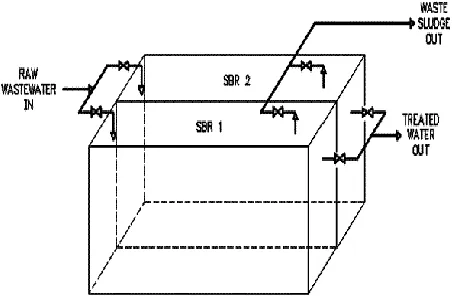
SBR Tank two numbers is provided to control organic destruction. Fine bubble diffuser is provided in this tank at bottom. In the SBR Tank the air will flow through the fine bubble diffuser to the opposite direction of the flow of the water. This will help more contact of air with water so that the organic destruction is more effective. The SBR tank is a civil construction with partly below ground level, the size of the each tank is 0.2m X 0.15m X 4m (LD) + 0.5 FB and the volume is 1200L each. The Retention time of the tank will be around 30 hrs. The SBR tank with an air diffuser at the bottom of the tank.
The effluent from Equalization tank is taken at the top of the SBR tank and in the aeration process oxygen transfer takes place by molecular diffusion through the interface film between air and liquid and increases in proportion to the interface area, In this aerobic process, the effluent will be subjected to extended aeration type activated sludge
process for bio-degeneration of organic impurities in the presence of recirculated biomass. MLSS in the SBR tank will be 3500 mg/l to 4000 mg/l. TheSBR treatment method is relatively simple to operate,economical, with flexible control, required limited manpower,generates low quantity of sludge, and produce alternative energyin the form of methane.
2.4 SBR batch process:
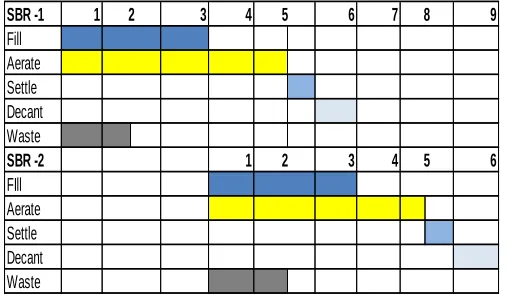
SBR treats the waste water in Batches, Oxygen is bubbled through the mixed liquor to reduce BOD the first two stages. Fill and React. It blows air through the finely perforated diffusers fixed on the bottom floor of the SBR. Aeration timing varies according to the plant size and the organic loading but it is typically 90-270 minutes in each cycle.
Aeration encourages the multiplication of aerobic bacteria and they consume organic carbon and nutrients. This process also encourages the conversion of ammonia to nitrate and nitrite forms a Process known as nitrification. The settling stage usually takes 0.5 – 1.0 hour. During this stage, Biomass settles and is separated from the supernatant in the SBR. At pharse of decant the supernatant after pharse of settle decants to a separate tank.
Fig 1: SBR model
© 2015, IRJET.NET- All Rights Reserved
Page 29
Fig 2: Time Interval of SBR
DO LEVEL IN SBR:
DO level was maintained 2 – 3ppm. High DO concentration at the beginning of each anoxic phase of the lab scale SBR was reached when system worked without a DO control, It provoked a decrease of the De-nitrification Efficiencies. From these experiences, DO control was applied in the SBR Pilot plant.
2.5: Design Calculation
A sequencing batch reactor is to be used to treat wastewater with the characteristics considered from meat processing industry. Determine the mass of suspended solids in the capacity and air required in SBR.
Table-2: Design calculation sheet
Quantity of sewerage-m3/day 2
No. of Hours of Operation 4.5
Average system flow rate 0.44
BOD of the raw sewage - mg/ltr 500
COD of the raw sewage - mg/ltr 500.00
pH of the sewage 7.5 TO 8.5
Total Suspended Solids - mg/ltr 200
BOD Load - Kg/day 1
COD Load - Kg/Day 2
Size of the Tank capacity 0.2,m x 0.15m x 4m
Total O2 required – Kgs/day 2.00
Air required for SBR Tank -m3/hr 14.36
3. RESULTS AND DISCUSSIONS:
After achieving the stable state operation, an analysis of the SBR’s cycle profiles using BOD, COD, TSS and Turbidity was carried out. This analysis provides the information about the reduction in organic load.
3.1 Study of Reduction of BOD& COD:
As a result of Proper Aeration and DO level maintained in SBR tank, BOD& COD level was reduced up to 90% – 95%. Below graphsshows the percent of BOD & COD removal during SBRtreatment runs. Percent BOD removal wasobserved in reactor with longer ASBR reaction time.. Maximum BOD & COD removalwas 88%, 95%, and 96% in 2, 3 and 4th cycle and continues which shows consistent
reduction.
Grap
h-1: Study of Reduction of BOD level
© 2015, IRJET.NET- All Rights Reserved
Page 30
3.2 study of removal efficiency of TSS&
Turbidity:
By reducing the organic load in SBR Tank, we observed the reduction Total Suspended solids and Colloids particles (turbidity) present in the water. This result shows the performance and clarity of final outlet water.
Graph-3: Study of Reduction of TSS level
Graph-4: Study of Reduction of Turbidity level
4. CONCLUSIONS:
Normally SBR technology works with a fixed cycle configuration, which has been developed to multiple reactor with adjusting the Cycle range based on the load
and Tank design. The reductions in COD and BOD were also significant (90 to 95%), evincing that the system could produce quality effluent that would very less pose a threat to the environment. The final effluent was a clear, odorless, and yellowish liquid with a reduction in turbidity by 90%.SBR system successfully carried out the organic load reduction.
The secondary sludge from SBR units will be pumped to any dewatering unit and the thickened sludge can be used for the Rendering process. There are many advantages of SBR includes system can handle large fluctuations in flow and influent quality.
REFERENCES:
1. Wastewater Effluent Treatments and Control Technologies
in the Beef Processing Industry - By Nicholas J. Flugaur (MAY 2003)
2. Biological Treatment of Meat Processing Wastewater using
Anaerobic Sequencing Batch Reactor (ASBR) - Tansengco Myra1, Herrera David1, Tejano Judith1, Yao Marina2, Beraye Jose Ricky1 and Esguerra Reynaldo1 (March 2015)
3. Sequencing Batch Reactor: A Promising Technology in
Wastewater Treatment A.H Mahvi, Department of Environment Health Engineering, School of Public Health and center for Research, Tehran Iran (March 2008)
4. Treatment of slaughterhouse wastewater in anaerobic
sequencing batch reactors D.I. MASSÉ and L. MASSE Agriculture and Agri-Food Canada, P.O. Box 90, 2000 Route 108 East, Lennoxville, QC, Canada J1M 1Z3. Agriculture and Agri-Food Canada contribution No. 659. Received 5 July 1999; accepted 6 June 2000.
5. Nitrification and denitrification of leachate with SBR in pilot scale at Spillepeng waste deposition site Karin Görfelt Water and Environmental Engineering, Department of Chemical Engineering Lund University, Sweden May 2008.
6. Emerging Technologies for Waste Water Management and
In plant Wet Weather Management EPA 832-R-12-001 (March 2013)
7. Operation and Control of SBR Processes for Enhanced
Biological Nutrient Removal from Wastewater,
SebastiaPuigBroch, Ph D Thesis, Griona, July 2007
8. Waste Water Treatment Plant Project in Carnex meat
© 2015, IRJET.NET- All Rights Reserved
Page 31
BIBLOGRAPHIES
Dr. B.SUKUMARAN,Professor, Department of Civil Engineering, Dr M.G.R Educational and Research Institute University, Chennai,Tamil Nadu,India.
M. BASKAR, PG Student, M.Tech,Environmental