253
Overview on Power Quality Event Detection &
Classification
Mr.P.R.Jawale
1, Prof.A.V.Mohod
2, Prof.R.B.Pandhare
3,
Department1, 2, 3, , Student of Electrical Power System1 , Faculty of Electrical & Electronics Engineering 2,
Faculty of Electrical Power System 3
Email:[email protected]1 , [email protected]2, [email protected]3
Abstract- The Electrical power quality issue has attained considerable attention in last decade due to large
penetration of power electronics based loads and microprocessor based controlled loads. These devices introduce power quality problem on one hand and these mal-operate due to induced power quality problems on other hand. PQ disturbances/events cover a broad frequency range with significantly different magnitude variations and can be non-stationary, thus, accurate techniques are required to identify and classify these events/disturbances. This paper presents a comprehensive overview of different techniques used for PQ events’ classifications. Various artificial intelligent techniques which are used in PQ event classification are also discussed. Major Key issues and challenges in classifying PQ events are critically examined and outlined.Index Terms- Keyword1, keyword2, keyword3 (Separate Index Terms with semicolon).
1. INTRODUCTION
A PQ problem can be defined as “any power problem manifested in voltage, current and/or frequency deviations that result in failure or mal-operation of customers’ equipment”. The highly complicated and vibrant technology stresses on high power quality, which is free from interruption or disturbance, i.e., the voltage and current signals must maintain virtually sinusoidal shape, with constant frequency, and amplitude at all times to ensure continuous and smooth equipment operation. Until now there is no fully accepted definition about what exactly is power quality, but the quality should involve the waveforms of voltage and current in an ac system; the presence of harmonic signals in bus voltages and load current, the presence of spikes and momentary low voltages, and other issues of distortion . Poor power quality is generally a result of various power-line disturbances, such as voltage sag/swell, harmonic distortion, flicker, momentary interruptions, impulses, and so on. The poor power quality can have adetrimental effect on both the industrial and commercial users. To address the problems on power quality it is necessary to identify the source and causes of such disturbances. When the type of disturbance has been classified accurately, only then the power quality engineer can define the major effects at the load and analyze the source of the disturbances. Thus it is important to develop a 30 method for detecting, identifying and analyzing all the kinds of disturbances. Because of the monitoring devices the PQ events are often found corrupted with noise, and this makes the detection and classification task a bit tough. These tasks become even more complex with the linear and non-stationary behavior of the events.
In the last few years, many new and powerful tools for the analysis and classification of power quality disturbance have been developed. However, the correct classification rate for the actual event is not high enough; there is still space for improvement. Further, PQ event recognition is often troublesome because it involves a broad range of events categories or classes and that normally occurs in multiple kinds at the same time. Therefore, the decision boundaries of event features may overlap, and hence rigid classifiers may not be helpful to categorize these classes.
2. POWER QUALITY
254
2.1. Classification of power quality problems
PQ problems fall into two basic categories
1. Events or Disturbances: Disturbances are measured
by triggering on an abnormality in the voltage or the current.
Transient voltages may be detected when the peak magnitude exceeds a specified threshold. RMS voltage variations (e.g.,sags or interruptions) may be detected when it exceeds a specified level.
2. Steady-State Variations: Steady state variation is basically a measure of the magnitude by which the voltage or current may vary from the nominal value, plus distortion and the degree of unbalance between the three phases. These include normal rms voltage variations, and harmonic and distortion.
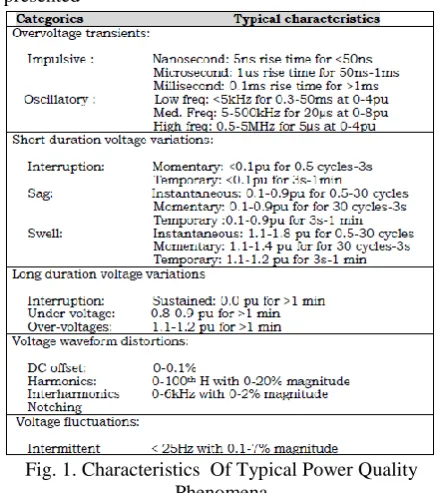
The power quality events/disturbances can further be classified according to the nature of the waveform distortion. The information regarding typical spectral content, duration and magnitude for each category of electromagnetic disturbances are shown in Table 1. The phenomena listed in the Table 1 can be described further by various appropriate attributes. For steady-state disturbances, the amplitude, frequency, spectrum, modulation, source impedance, notch depth and notch area attributes can be utilized. However, for non-steady state disturbances, other attributes such as rate of rise, rate of occurrence and energy potential are useful. The main reasons for the increased interest in PQ can be summarized as follows:
• Modern electric appliances are equipped with power electronics devices utilizing microprocessor or microcontroller. These appliances introduce various types of PQ problems and moreover, these are very sensitive to the PQ problems.
• Industrial equipments such as high-efficiency, adjustable speed motor drives and shunt capacitors are now extensively used. The complexity of industrial processes, which results in huge economic losses if equipment fails or malfunctions.
• The complex interconnection of systems, resulting in more severe consequences if any one component fails. Moreover, various sophisticated power electronics equipments, which are very sensitive to the PQ problems, are used for improving system stability, operation and efficiency.
• There has been a significant increase in embedded generation and renewable energy sources which create new power quality problems, such as voltage variations, flicker and waveform distortions.
• Introduction of competitive electricity market gives right to the customers to demand high quality of supply
The main purpose of classification is to divide all disturbances into subgroups to make it easier to managing and analyzing them. This can be achieved in several ways, depending on the criteria used.32 In other words, power quality disturbances can be classified according to one of the following factors:
Typical characteristics
Causes or sources of disturbance Effects on sensitive devices
[image:2.595.303.524.367.614.2]To minimize power quality disturbances and to devise suitable corrective and preventive measures, efficient detection and classification techniques are required in the emerging power systems. Classification of power quality disturbances based on the visual inspection of waveforms by human operators is laborious and time consuming. Moreover, it is not always possible to extract important information from simple visual inspection. The classification of PQ disturbances in electric power systems has become an important task for proper developing and designing the preventive and corrective measures. Extensive research work and books are now available in the area of power quality. In this paper, a comprehensive survey of different classifications techniques used for PQ events has been presented. Various artificial intelligent techniques which are used in PQ event classification are also discussed. Major key issues and challenges in classifying PQ events are critically analyzed and presented
255
[image:3.595.70.294.116.244.2]3. AUTOMATIC POWER QUALITY CLASSIFIERS
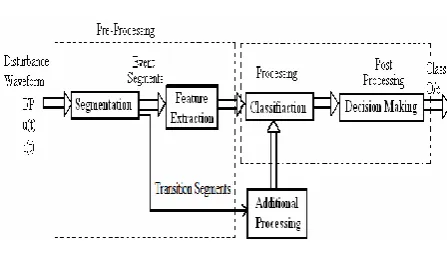
Fig. 3.1. Block Diagram of Power Quality Classification
A basic block diagram of automatic classifier is shown in Fig. 1. The disturbance signal is passed to the pre-processing unit having two function blocks: segmentation and feature extraction. Extracted features are used to classify the PQ events. The classifier’s information is used to make the final decision through the post-processing unit. The various blocks of automatic classification system is described below.
Segmentation:-
It is a preprocessing technique which divides the data sequence into stationary and non-stationary parts i.e. data is divided into a large number of transition segments (corresponding to large and sudden change in signal, and event segments). Events are the segments in between transition segments. The features are extracted from the event segments because the signal is stationary in this segment and normally contains the information that is unique enough to distinguish between different types of disturbances. To capture disturbance waveform period, a triggering method is required to get start and end time instant of PQ event (Bollen et al,2006).The current methods used for detecting PQ disturbances are based on a point-to-point comparison of adjacent cycle or a point to point comparison of the RMS values of the distorted signal with its corresponding pure signal and/or frequency domain transformed data. The recent methods proposed for this purpose are parametric (or model based) such as Kalman filter (KF) and auto-regressive (AR) models, and nonparametric (or transform based) such as short-term Fourier transform (STFT) and wavelet transform (WT). Parametric methods exploit the prominent residuals obtained by fitting the captured waveform into the chosen model and nonparametric methods by finding singular points from multi-state decomposition of PQ signal. Residual signal from a model can be used for detecting transition points and for analyzing and characterizing the disturbances. The basic idea in KF
and AR residuals based detection and triggering method is to fit the PQ data into a chosen KF or AR model
Features Extraction
Feature extraction from PQ disturbances is also known as detection of disturbances. Extracted features are used to classify the PQ events. Thereafter, the classifier's information is used to make the final decision through a post-processing unit. The selection of suitable features of PQ events is extremely important for classification. Features may directly be extracted from the original measurement either from some transformed domain or from the parameters of signal models. In this context, recent developments regarding feature extraction techniques are dis-cussed in the subsections as detailed below.
3.1 Fourier transform based methods
256 Kalman filter have been developed efficiently for
detecting PQ events..
3.2 S Transform Based Methods
The S-transform is a time–frequency tool generated by the combination of WT and STFT. It produces a time–frequency representation of a time series. It uniquely combines a frequency-dependent resolution that simultaneously localizes the real and imaginary spectra. The basic function for the S-transform is Gaussian modulated co-sinusoids. In the case of non-stationary disturbances with noisy data; the S-transform provides patterns that closely resemble the disturbance type and thus requires a simple classification procedure. In, authors proposed a simple and effective method for classification and quantification of ten typical kinds of power quality disturbances using S-transform. In, authors presented a real-time power quality disturbances’ classification by using a hybrid method based on S-transform and dynamics where the dynamics is used to reduce run time. In, a S-transform based neural network structure is presented for automatic classification of power quality disturbances. The S-transform technique is integrated with neural network model with multi-layer perception to con-struct the classifier. Power quality analysis using discrete orthogonal S-transform is presented in. Multi-resolution S-transform based fuzzy recognition system for power quality events is pro-posed in. This is based on a variable width analysis window which changes with frequency according to user defined function. In, authors proposed more suitable fast variants of the discrete S-transform (FDST) algorithm to accurately extract the time loca-lized spectral characteristics of non-stationary signals.
3.3 Wavelet transform based methods
The wavelet transform (WT) is a mathematical tool, much like FT, that decomposes a signal into different scales with different levels of resolution by dilating a signal prototype function. The WT is based on a square-integral function and group theory representation. The WT provides a local representation (in both time and frequency) of a given signal; therefore it is suitable for analyzing a signal where time– frequency resolution is needed such as disturbance transition events in power quality. The WT is classified into discrete wavelet transform (DWT) and continuous wavelet transform (CWT).In, authors introduced the use of WT and multi-resolution signal decomposition as a powerful analysis tool for PQ events. A wavelet based method for detecting, localizing, quantifying and classifying short duration PQ disturbances is presented in. In, authors introduced a compression technique for power disturbance data via DWT and wavelet packet transform (WPT). In, authors proposed a model of
disturbance detection for harmonics and voltages using wavelet probabilistic network which is a two-layer architecture containing the wavelet two-layer and the probabilistic network. Consequently, a novel approach for the PQ disturbances’ classification based on the WT and self-organizing learning array system is proposed in. In, authors introduced a new perspective for the IEEE standard 1459-2000 definitions using the stationary wavelet transform (SWT) for defining power components, power factors, and pollution factor. In, PQ indices that were recommended in and are redefined in the time frequency domain using WPT. A wavelet norm entropy based effective feature extraction method for PQ disturbance classification is presented in. In, authors proposed a WT and S-transform based approach for islanding detection and disturbance due to load rejection in the distributed generation (DG) based hybrid system. In, authors introduced the un-decimated wavelet transform to compute power quantities using complex wavelet coefficients. The important issue related to the use of wavelet method is the choice of suitable wavelet. The computational cost increases with an increase in filter length.
CLASSIFICATION APPROCHES
Both conventional and artificial intelligence (AI) based classification methods are reported in the literature. The limitations of conventional methods are overcome by the AI based methods. Some frequently used AI based classifiers are rule-based expert systems, fuzzy classification systems, artificial neural networks, kernel machines, and support vector machines. The artificial neural network is the most popular method in literature often combined with other AI techniques. Reference (Bollen et al, 2007) has shown the advantage of statistical classifiers over the expert system based approach.
4.1 Artificial Neural Network Based Classifiers Neural network is a non-linear, data driven self adaptive method and is a promising tool for classification. These can adjust themselves to the data without any explicit specification of functional or distributional form for the underlying model (Santoso
257 ANN is a universal function approximator i.e. this can
approximate any function with arbitrary accuracy. All the above mentioned attributes make ANN flexible in modeling real world complex problems. Santoso et al
(2000b) have classified six types of PQ events using wavelets and multiple neural networks. The classifier uses wavelet transform coefficient at five-scale signal decomposition level as input to multiple neural. The squared wavelet transform coefficients (SWTC) at each scale are used as inputs to the multiple neural networks for classifying the disturbances type. The architecture of the network is learning vector quantization (LVQ). The final decision for the disturbances type is made by combining the outcomes of multiple neural networks by using two- decision making schemes. One is simple voting scheme and the other is Dempster-Shafer theory of evidence. The proposed classifier is able to provide a degree of belief for the identified waveform. The classifier is able to achieve the accuracy rate of 90% by rejecting less than 10% of the waveform as ambiguous.
The scheme is not good for sag and monitoring interruptions because of the fact that the irregularities caused by these disturbances are not significantly irregular compared to 60Hz background sinusoidal signal and the time scale over which they occur is large. Discrete wavelet transform (DWT) has been widely used to capture the transient occurrence and exact frequency features of PQ disturbances. DWT technology has been integrated with AI technologies to recognize and classify the PQ disturbances accurately. It was demonstrated by (Mo et al, 1997) how to extract features from wavelet transform coefficients at different scales that can be applied as input to neural networks for classification of non stationary signal type. Angrisani et al (1998) proposed to employ disturbances time duration estimated by continuous wavelet transform (CWT) and disturbances amplitude estimated by DWT to classify transient disturbance type. To extract the squared wavelet transform coefficients at each scale as inputs to neural networks for classification of the disturbances have been proposed in (Santoso et al,
1996; Santoso et al, 2000c; Gaouda et al, 1999). (Perunicic et al, 1998) used DWT coefficient as inputs to a single layer self organizing map neural network to train and classify the transient disturbance type. An effective wavelet multi-resolution single decomposition method was proposed for analyzing the power quality transient events based on standard derivation (Gaouda et al, 1999) and root mean square value (Gaouda et al, 2002a). Although wavelet transform emerges as a powerful tool for PQ analysis, employing DWT coefficients directly as inputs to the neural networks require large memory space and much learning time. The computing efficiency can be enhanced if decomposition levels with the number of extraction features can be reduced. (Giang, 2004)
258 quantization (LVQ) shows that PNN classifies events
more effectively than FFML and LVQ.
4.2 Support Vector Machine Based
The foundation of Support Vector Machine (SVM) has been developed by Vapnik, where statistical learning theory being the basis provides a new pattern recognition approach. SVMs are a set of related supervised learning methods used for classification and regression. They belong to family of generalized linear combiners.I n, authors presented an identification method for PQ events based on N-1 SVMs’ classifier which is particularly effective in the automatic classification of voltage disturbances. Con-sequently, Whei-Lin et al. presented one-versus-one approach based SVM which can process the multiple classifications of PQ disturbances. The SVM method is better than optimal time frequency representation (OTFR) and is a low complexity event classifier. An integrated model for recognizing PQ distur-bances using wavelet multi-class SVM is presented in. A SVM classifier combined with DWT to recognize the type of power system PQ is presented in. The direct acyclic graph SVM correctly classifies the PQ events with high degree of accuracy and less training as well as testing times in comparison to other kernel-based learning techniques and ANN based methods. The classification of PQ events based on wavelet transform and SVM is presented in. The number of SVM and the compactness of different clusters are enhanced using modified immune optimization algorithm in classification of non-stationary power signals using modified TT-transform and SVM. In, authors presented classification of PQ events using SVM andhigher order statistical features.
4.3 Fuzzy expert system based classification
Fuzzy classification system is based on Mamdani type rules to evaluate the information provided by the linguistic variable inputs.Fuzzy logic refers to a logic system that generalizes theclassical two-valued logic for reasoning under uncertainty. It is motivated by observing that human reasoning can utilize concepts and knowledge that do not have well defined or sharp boundaries. A fuzzy expert-system is an expert system that uses a collection of fuzzy sets and rules instead of Boolean sets for reasoning about data.In, authors proposed the design of a tool to quantify PQ parameters using wavelets’ and fuzzy sets’ theory. A hybrid technique for characterizing PQ events using a linear Kalman filter and a fuzzy-expert system is presented in. An approach for the detection and classification of single and combined PQ disturbances using fuzzy logic and a particle swarm optimization algorithm is proposed in. In, authors presented an approach for the classification of PQ data using decision tree and chemo-tactic differential evolution based fuzzy clustering. An approach for PQ time series data mining using S-transform based fuzzy expert system is presented in. In, authors presented an
approach for the visual localization, detection and classification of various non-stationary power signals using a variety of windowing techniques. In, a hybrid scheme using a Fourier linear combiner and a fuzzy expert system for the classification of transient disturbance waveforms in a power system is presented. In, authors proposed a wavelet-based extended fuzzy reasoningapproach to PQ disturbance recognition and identification. An adaptive fuzzy self-learning technique for detection of abnormal operation of electrical systems is presented in. A data compression technique for power waveform using adaptive fuzzy logic is presented.
4. CONCLUSION
The problem of power quality has been discussed in this paper. This paper is a survey of work published on power quality disturbances and techniques for detection and classification of electrical power disturbance. The transformed feature extraction techniques and artificial intelligence techniques of PQ events classification are highlighted in particular. These methods are suitable for large and complex networks. This paper provides a general literature survey useful for the research on power quality disturbances ,detection & classification of it in electrical power system
REFERENCES
[1] D. Saxena , “Power Quality Event Classification : an overview and key issue”, in International Journal of Engineering Science and Technology ,Vol.2, No 3,2010, pp.186-199.
[2] Devendra Mittal , “ Classification of power quality disturbances in Electrical Power System, A Review” in ISOR Journal of Electrical & Electronics Engineering (ISOR-JEEE) ISSSN:2278-1676 Volume 3,Issue-5 (Nov-Dec.2012).
[3] V.Kumar , “ Power Quality Analysis using Wavelet Transform: A review”, in International Journal of Innovative Reasearch in Science ,Engineering and Technology ,Volume 3,Special issue 3,March 2014.
[4] Rafael A.Flores, “ State of the art in the Classification of Power Quality Events ,An Overview” .
[5] Pernucic B., Mallini M., Wang Z., Liu Y., and Heydt G.T., 1998. Power quality disturbance detection and classification using wavelets and artificial neural networks, Proc. 8th Int. Conf.
Harmonics and Quality of Power, pp. 77–82.