Lampiran 20 UTM/RMC/F^!024 (regE)
IJNTVERSITI TEKNOLOGI MAI.AYSIA
CATATAI{ : * lika Lqran Akbh Petycltdikan ini SUUT atd* TEEIIAD, sih bapdrkan wrat dadpafu pihak
bcrfuasa/ oryadrati btrfunaaa &rgra mrymhar nka| vbab dat tatpb @orar ini ped* diklaskar vbagai SULIT fun TERIIAD. TAJUKPROJEK:
BORANG
PENGESAHAN
IAPORAN ATTHIR
PENYALIDIKAhI
TIIE $TUDY ON THE DAVETOPMENT OF SATURATION
PROFILE IN SOIL
Sava J # NURLY GOFAR
Mengalu mernbenarkan LapomnAlfiir Penyelidlkanini disimpan di Pe4pustnkaan Univeniti Teknologi Malaysia dengan syarat-syarat kegunaan seperti berikut:
1. Laporan Athir Penyelidikan ini adelah hakmilik Universiti Teknologi Malaysia.
2. Perpust'ltaan Universiti Teknologi Malaysia dibenarkan rnembuat salinan untuk tuiuan ruiukan sahaja.
3. Perpustakaan dibenarkan membuat penjualan Penyelidikan ini bagi kategori TIDAK TERFIAD. 4. *silatandakan ({)
salinan Laporan Akhir
m
n
m
SULIT (l\dengand*g maklwnat yang berdariah keselamatan atau Kepentiagan Malaysia seperti yry terrnal$ub di dalarrr AIffARAHSIARASMI 1974.
(hdengand*gt maklumat TERHAD yang telah ditentukan oleh Organisasi/badan di rnana periyelidikan diialankan).
TERHAD
TTDAK TERHAD
TANDATANGAN KETUA PEhIYELIDIK DR,. ]II,'IRIV COFAR
Associate ??ofessor (DS53)
t d Gedefinfcs &Transportati Frcufty d Clvll Englneerlrg
UnlverslH Teknofogi MalaYsia
VOT 78239
THE STUDY ON THE DEVELOPMENT OF SATURATION PROFILE IN
SOIL
(KAJIAN MENGENAI PERKEMBANGAN PROFIL KETEPUAN DALAM TANAH)
NURLY GOFAR
KHAIRUL ANUAR KASSIM
AZMAN KASSIM
LEE MIN LEE
FAKULTI KEJURUTERAAN AWAM
UNIVERSITI TEKNOLOGI MALAYSIA
ACKNOWLEDGEMENT
First and foremost, our sincere gratitude goes to Universiti Teknologi Malaysia for funding the research through Fundamental Research Grant Scheme (FRGS) Vot 78239. This research would not be accomplished without the financial aids provided.
The research was shaped through interaction with many academicians. For this, we are deeply grateful to Professor Dr. Harianto Rahardjo, Dr. David Toll, Professor Dr. Roslan Zainal Abidin, Professor Dr. Faisal Ali, Professor Dr. Mohd Amin Mohd Sam, and Mr. Low Tian Huat for sharing their valuable experiences.
iii
ABSTRACT
ABSTRAK
v
TABLE OF CONTENTS
CHAPTER TITLE PAGE
TITLE OF PROJECT
ACKNOWLEDGEMENT
ABSTRACT
ABSTRAK
TABLE OF CONTENTS
LIST OF TABLES
LIST OF FIGURES
LIST OF SYMBOLS
LIST OF APPENDICES
i ii iii iv v ix x xiv xvi
1 INTRODUCTION 1
1.1 Background of the Study 1.2 Objectives
1.3 Scope of the Study 1.4 Significance of the Study
1 3 4 5
2 LITERATURE REVIEW 6
2.1 Introduction
2.2 Hydraulic Properties of Soil
2.2.1 Soil Water Characteristic Curve (SWCC) 2.2.2 Hydraulic Conductivity Function
2.3 Rainfall Infiltration Model 2.4 Wetting Front and Redistribution
2.5 Correlation between Rainfall Pattern, Soil Suction and Slope Stability
2.5.1 The Role of Suction on Shear Strength and 6 6 7 8 10 13 16
Stability of Unsaturated Soil Slope 2.5.1.1 Shear Strength of Unsaturated Soil 2.5.1.2 Stability Analysis of Unsaturated Soil
Slope
2.5.2 Effect of Rainfall Pattern on Suction Distribution and Slope Stability
17 20
22
2.6 Soil Column for Infiltration Analysis
2.7 Numerical Simulation for Seepage and Slope Stability Analyses
2.8 Concluding Remarks
25 28
31
3 METHODOLOGY 33
3.1 Introduction 33
3.2 Statistical Analysis of Extreme Rainfall 3.3 Numerical Simulation
3.3.1 Geometry of the slope 3.3.2 Finite Element Mesh Design 3.3.3 Slope Stability Analysis Approach 3.3.4 Numerical Simulation Design
3.3.4.1 Parametric Study
3.3.4.2 Critical Rainfall Pattern Analysis 3.4 Laboratory Soil Column Tests
35 38 38 39 42 43 43 44 48 3.4.1 Soil Column
3.4.2 Water Flow System 3.4.3 Instrumentations
3.4.4 Data Acquisition System 3.4.5 Experimental Design
50 50 53 55 57 3.5 Field Study
3.5.1 Instrumentations
vii
4
3.5.1.1 Installation of Tensiometers 3.5.1.2 Installation of Rain Gauge
3.5.1.3 Installation and Calibration of Runoff Collector
3.5.2 Field Monitoring 3.6 Concluding Remarks
PRELIMINARY DATA
4.1 Introduction
4.2 Extreme Rainfall Distribution
4.2.1 Assumption of Surface Runoff 4.3 Soil Properties
4.4 Concluding Remarks
61 62 62
65 65
66 66 66 68 70 77
5 RESULTS AND DISCUSSIONS
5.1 Introduction
78 78 5.2 Numerical Simulations
5.2.1 Parametric Study
5.2.1.1 Influence of Initial Condition on Suction Distribution
5.2.1.2 Influence of Rainfall Intensity on Suction Distribution
5.2.1.3 Influence of Rainfall Duration on Suction Distribution
5.2.1.4 Influence of Slope Inclination on Suction Distribution
5.2.2 Critical Rainfall Pattern Analysis 5.3 Laboratory Soil Column Tests
5.3.1 Initial Condition of Soil Column Tests
78 79 79
84
86
89
5.3.2 Relationships between Infiltration and Runoff 101
5.3.3 Saturation Profiles 104
5.3.4 Suction Redistributions 107
5.4 Field Study
5.4.1 Overall Trend of Suction Distributions 5.4.2 Response of Suction Distribution to Single
Rainfall Pattern 5.5 Concluding Remarks
108 109 112
117
6 CONCLUSIONS AND SUGGESTIONS 121
6.1 Introduction 6.2 Conclusions
121 121 6.2.1 Extreme Rainfall Characteristics for the
Malaysian Peninsular
6.2.2 Relationships between Rainfall, Runoff and Infiltration Rate
6.2.3 Effect of Soil Permeability on Suction Distribution and Redistribution
6.2.4 A Chart for Preliminary Evaluation of Rainfall-Induced Slope Instability
122
122
123
124
6.3 Suggestions for Future Researches 124
REFERENCES
Appendix A-D
List of Related Publications
126
136-175
ix
LIST OF TABLES
TABLE NO. TITLE PAGE
3.1
4.1
4.2
4.3
4.4
4.5
4.6
Experimental design for infiltration tests
Ten-year return period extreme rainfalls for five selected locations in the Malaysian Peninsular
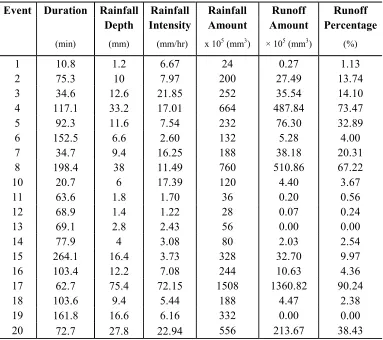
Rainfall and runoff data recorded from July 2007 to August 2007
Physical properties of soils used in the study
Mineral constituents obtained from XRD test
Mineral compositions obtained from mineralogy test
SWCC parameters of soils used in the study
58
67
69
72
74
74
76
5.1
5.2
Critical duration of antecedent rainfall for different locations and depths of slip plane
Contrasting responses of suction distribution to rainfall infiltration for a coarse-grained soil slope and a fine-grained soil slope
99
LIST OF FIGURES
FIGURE NO. TITLE PAGE
2.1 Typical absorption and desorption SWCC (Zhan and Ng, 2004)
7
2.2 Typical suction-dependent hydraulic conductivity function
9
2.3 Relationship between rainfall and infiltration 12
2.4 Development of wetting front 14
2.5 Volumetric water content and suction in the development of wetting front
15
2.6 Redistribution of soil moisture for (a) Lf < Lcr and (b) Lf >
Lcr
16
2.7
2.8
2.9
Unsaturated soil strength properties
Soil element of typical infinite unsaturated soil slope
Schematic diagram of soil column developed by Yang et al. (2004)
20
21
27
3.1 Research framework 34
3.2 Five selected locations in the Malaysian Peninsular 36
3.3 Geometry of the infinite slope for numerical simulation 39
3.4 Element meshes and boundary conditions of the numerical model
41
3.5 Techniques used to assign slip surface plane parallel to ground surface
xi 3.6 3.7 3.8 3.9 3.10 3.11 3.12 3.13 3.14
Parametric study design for various initial conditions
Parametric study design for various rainfall intensities
Parametric study design for various rainfall durations
Parametric study design for various slope inclinations
Simulation scheme for determining critical antecedent rainfall
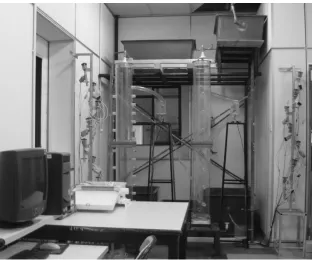
Three-dimensional diagram of the laboratory model setup Photograph of the laboratory model setup
Components of the soil column model
(a) An assembled tensiometer-transducer, (b) Gypsum block 45 46 46 47 48 49 49 51 53
3.15 (a) Photograph, (b) Three-dimensional diagram, and (c) Cross-sectional view of the tensiometer connector
54
3.16 (a) Photograph, (b) Three-dimensional diagram, and (c) Cross-sectional view of the gypsum block connector
55
3.17 Data acquisition system 57
3.18 Location map of the study areas 59
3.19
3.20
3.21
3.22
Contours of study areas: (a) Balai Cerapan (b) Kolej 12
Photographs of study areas: (a) Balai Cerapan (b) Kolej 12
Runoff collector installed at research plot
Dimensions and components of runoff collector
60
60
64
64
4.1 IDF curves for five selected locations in the Malaysian Peninsular
67
4.2 Output of non-linear regression analysis for the relationship between rainfall and runoff
4.3 4.4 4.5 4.6 5.1 5.2 5.3 5.4 5.5 5.6 5.7 5.8 5.9 5.10
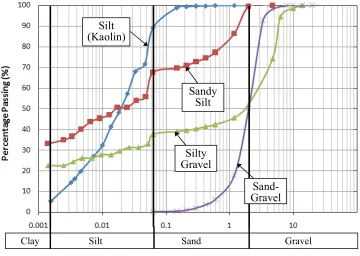
Particle size distribution of soils used in the study
SEM images of (a) sand-gravel, (b) silty gravel, (c) sandy silt, and (d) silt (kaolin)
SWCC of soils used in the study
Hydraulic Conductivity function predicted by Van Genutchten’s method (1980)
Influence of initial condition on suction distribution as the result of short and intense rainfall for (a) sand-gravel, (b) silty gravel, (c) sandy silt, and (d) silt (kaolin)
Influence of initial condition on suction distribution as the result of prolonged rainfall for (a) sand-gravel, (b) silty gravel, (c) sandy silt, and (d) silt (kaolin)
Drying paths of suction for (a) sand-gravel, (b) silty gravel, (c) sandy silt, and (d) silt (kaolin)
Estimation of initial condition from SWCC
Initial conditions for the four types of soil
Influence of rainfall intensity on the suction distribution for (a) sand-gravel, (b) silty gravel, (c) sandy silt, and (d) silt (kaolin)
Influence of rainfall duration on suction distribution for (a) sand-gravel, (b) silty gravel, (c) sandy silt, and (d) silt (kaolin)
An idealized infiltration model
Influence of slope inclination on suction distribution as the result of short and intense rainfall for (a) sand-gravel, (b) silty gravel, (c) sandy silt, and (d) silt (kaolin)
xiii
5.11
5.12
5.13
5.14
Rainfall infiltration components on a sloping surface
Suction distributions as the result of various extreme antecedent rainfalls for (a) sand-gravel, (b) silty gravel, (c) sandy silt, and (d) silt (kaolin)
Variation in factor of safety as the result of various extreme antecedent rainfalls at the slip planes of (a) 1m, (b) 3m, and (c) 5m depth
Proposed chart to predict critical antecedent rainfall and critical suction value of a soil slope
92
93
94
98
5.15 The setup of soil column models for (a) sand-gravel, (b) silty gravel, (c) sandy silt, and (d) silt (kaolin)
101
5.16 Relationships between rainfall and surface runoff for (a) silty gravel, (b) sandy silt, and (c) silt (kaolin)
102
5.17 Cracks formed at the surface of silt (kaolin) 103
5.18 Saturation profiles in (a) sand-gravel, (b) silty gravel, (c) sandy silt, and (d) silt (kaolin)
105
5.19
5.20
5.21
5.22
5.23
Suction redistributions in (a) sand-gravel, (b) silty gravel, (c) sandy silt, and (d) silt (kaolin)
Rainfall and suction distributions monitored for 12 months at Balai Cerapan site
Rainfall and suction distributions monitored for 12 months at Kolej 12 site
Suction distributions as the result of (a) Rainfall pattern A, (b) Rainfall pattern B, and (c) Rainfall pattern C at Balai Cerapan site
Suction distributions as the result of (a) Rainfall pattern D, and (b) Rainfall pattern E at Kolej 12 site
108
110
111
114
LIST OF SYMBOLS
Aev - Air entry value
c’ - Effective cohesion
h - Hydraulic head
I - Rainfall intensity
Icr - Critical rainfall intensity
k - Water coefficient of permeability
ksat - Saturated permeability
La - Wetting front depth as the result of antecedent rainfall
Lcr - Critical wetting front depth
Lf - Wetting front depth
mw - Slope of soil water characteristic curve (SWCC)
P - Rainfall amount
q - Rainfall unit flux
Q - Rainfall total flux
R - Rainfall return period
Rf - Surface Runoff
R
It - Average rainfall intensity for a particular return period
Sr - Degree of saturation
Sx - Standard deviation of annual maximum rainfall intensities
t - Time
tp - Time when surface runoff start to occur
ua - Pore-air pressure
uw - Pore-water pressure
xv
W - Total weight of soil Wev - Water entry value
X - Extreme rainfall intensity for a particular rainfall duration
X - Mean of annual maximum rainfall intensities
Y - Gumbel’s reduced variate
Y - Mean of Gumbel’s reduced variates
z - Elevation head β - Slope inclination angle
χ - Parameter related to the soil degree of saturation φ' - Effective friction angle
φb - Unsaturated friction angle
γd - Unit weight of dry soil
γw - Unit weight of water = 9.81kN/m3 θ - Volumetric water content
θa - Average volumetric water content in the wetted zone θi - Initial volumetric water content
θr - Residual volumetric water content
θs - Volumetric water content at saturation of desorption curve
θ's - Volumetric water content at saturation of absorption curve σ - Total normal stress
'
σ - Effective normal stress
σy - Standard deviation of Gumbel’s reduced variates
f
τ - Shear stress at failure
ψ - Suction
ψmin - Minimum Suction value
LIST OF APPENDICES
APPENDIX TITLE PAGE
A
B
C
D
Example of Statistical Extreme Rainfall Analysis for Johor Bahru
Program for CR10X Data Logger
Calibration Result of Runoff Collector
Field Monitoring Data
136
147
155
CHAPTER 1
INTRODUCTION
1.1 Background of the Study
Rainfall-induced slope failure is one of the most severe disasters in tropical regions causing major loss of life and property. Generally, the high occurrences of the slope failures in these regions can be attributed to two major factors: intense and frequent downpours, and natural characteristics of residual soil.
Conventionally, most of the cut slopes were designed based on the assumption of saturated soil behavior. However, recent studies discovered that the design and construction of saturated soil slope cannot be applied successfully for the slopes under unsaturated conditions (Brand 1984, Fourie 1996, Raharjo et.al., 2001, Tsaparas et al. 2002, and others). The increasing acceptance of unsaturated soil mechanic has highlighted the need to correlate the slope failure with rainfall and the soil behavior in order to understand the mechanism of rainfall-induced slope failures.
and the groundwater table to the rainfall infiltration are mainly governed by the ratio of q/ksat and ksat /mw, where q is the infiltration flux, ksat is saturated permeability, and mw is the slope of the soil water characteristic curve (SWCC), as well as the initial suctions and boundary conditions. Collins and Znidarcic (2004) did an analytical analysis to develop a methodology for predicting the depth and the relative time of failure for slopes subjected to infiltration. Extensive studies on the causation of rainfall-induced slope failures in different parts of the world have been conducted, for example by Brand et al. (1984) in Hong Kong and Rahardjo et al. (1996-2001) in Singapore. In fact, hundreds of articles written on this topic based on case studies from different geographical region have suggested different conclusions on the threshold rainfall condition for the slope failures.
The process of rainfall infiltration through soil could induce seepage problem, increase in soil moisture content, and groundwater fluctuation. As rainfall water infiltrates into the soil, it flows through the unsaturated zone of soil, until it reaches the groundwater table. Estimating the seepage path and fluctuation of groundwater table is another complex problem due to the variations in soil properties. The saturation profile is governed by several mechanisms which should be treated as an integrated problem. However, existing methods treated each mechanism separately. Most of the methods were developed based on laboratory and field test, each of them has its own limitation in term of sample size and the extent of the study area. Furthermore, most of the methods involve numbers of parameters which are difficult to estimate precisely. Even the existing software has treated the different mechanism separately, instead of taking it as an integrated problem.
3
and the hydraulic condition, as well as the effect of the mechanism itself on the shear strength characteristics of the soil. The ability to combine those mechanisms into a comprehensive analysis will enhance the understanding of the effect of changing in moisture content on the slope stability.
1.2 Objectives
The focus of this study is to model the flow of water through unsaturated soil. The study is also aimed at identifying the real mechanism of slope failure induced by rainfall; thus appropriate preventive measures can be developed. The study embarks on the following objectives:
i. To identify the extreme rainfall characteristics for five selected locations in the Malaysian Peninsular.
ii. To evaluate the relationship between rainfall, runoff, and infiltration rate.
iii. To investigate the effect of soil permeability on the suction distribution and redistribution under various rainfall pattern (rainfall duration and rainfall intensity).
1.3 Scope of the Study
The study focuses mainly on three research approaches, namely numerical simulation, laboratory modeling, and field monitoring.
The numerical simulations were performed by utilizing an imaginary infinite slope model. As such, the analysis can be regarded as one-dimensional analysis. The rainfall patterns assigned on the slope model were obtained from the extreme rainfalls in Johor Bahru. The behaviours of four types of homogeneous soil (i.e. sand-gravel, silty gravel, sandy silt, and silt) under various rainfall conditions were investigated.
The laboratory modeling was performed to provide experimental evidences for the results of numerical simulation. A soil column model was fabricated to simulate the one-dimensional model employed in the numerical simulation. Monitoring instruments with automated data acquisition system were installed on the model to allow continuous pore-water pressure measurements.
In addition, two instrumented slopes were monitored for a period of one year. The suction variation and runoff under actual field condition were measured to further verify the findings from the present study.
5
dimensional analysis, thus only the vertical flow was concerned. (4) The soil materials used in the numerical simulation and laboratory modeling are assumed to be homogeneous. It is believed that these limitations could be overcome through inferences of the results from multiple methodologies adopted in this study.
1.4 Significance of the Study
With regards to the importance of this research, the findings may be viewed as a coupled fundamental-application research. The benefits that would be gained from the study may include the following:
i. Understanding of the saturation profile for different combinations of soil types, boundary conditions, and rainfall patterns.
CHAPTER 2
LITERATURE STUDY
2.1 Introduction
This chapter provides the basic and clinical researches on the topic of
saturation profile in soil. Considerable literatures relevant to the topic are available.
Most of the literatures were directed towards determining the saturation profile under
certain rainfall condition, development of wetting front, and studies on the hydraulic
properties of unsaturated soils, and case studies from different parts of the world.
The numerical simulations and laboratory soil column tests carried out by previous
researchers are also reviewed in the latter part of this chapter.
2.2 Hydraulic Properties of Soil
The hydraulic properties of soil can be attributed to water retention
characteristic (soil water characteristic curve) and water coefficient of permeability
7
2.2.1 Soil Water Characteristic Curve (SWCC)
The soil water characteristic curve (SWCC), also referred to as the soil
moisture retention curve, depicts the relationship between soil water content and soil
water pressure potential. A typical adsorption and desorption SWCC are shown in
Figure 2.1.
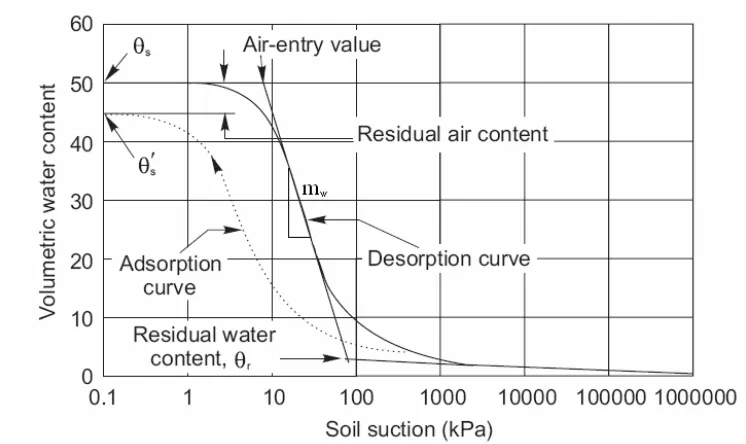
Figure 2.1 Typical absorption and desorption SWCC (Zhan and Ng, 2004)
As observed in Figure 2.1, the volumetric water content at saturation of
desorption curve (θs) is greater than that of absorption curve (θ's). The difference
between θs andθ's, defined as the residual air content, is caused by the entrapped air
in the soil during absorption process. There are two characteristic points in a
SWCC, namely air entry value (Aev) and residual water content (θr) (Zhan and Ng,
2004). The Aev indicates the maximum suction required to dissipate the entrapped
air from the soil. Before the suction exceeds Aev, the soil is saturated or nearly
saturated, hence the behaviour of the soil is similar to that of saturated soil with a
compressible fluid due to the existence of occluded air bubbles. On the other end of
The effect of water content on the behaviour of soil is thus negligible. As the result,
the soil at these two unsaturated stages is not the main concern for the behaviour of
unsaturated soil (Bao et al., 1998). What is of greater concern is the SWCC
between Aev and θr, in which both air and water phases are continuous or partially
continuous, and the soil properties are strongly related to its water content or
negative pore-water pressure (Zhan and Ng, 2004). The rate of changes in negative
pore-water pressure corresponding to volumetric water content is represented by the
slope of SWCC (mw).
A wide-array of methods can be used to obtain the SWCC, depending on the
desired path (absorption or desorption) and the range of matric suction. Laboratory
SWCC test can be conducted by using pressure plate test (for suction less than 1500
kPa), salt solution method (for suction greater than 1500 kPa), and capillary rise open
tube method (for absorption SWCC), while field SWCC can be obtained by taking
the field measurements of water content and suction by moisture probe and
tensiometer, simultaneously. Alternatively, the SWCC can be predicted by using
empirical relationships, as proposed by several researchers included Fredlund and
Xing (1994), Agus et al. (2001) and Gitirana and Fredlund (2004).
2.2.2 Hydraulic Conductivity Function
The water coefficient of permeability (k) represents the soil’s ability to
transmit and drain water. This, in turn, indicates the ability of the soil to change
matric suction as a result of environmental changes (Fredlund and Rahardjo, 1993).
Water coefficient of permeability of saturated soil is a function of void ratio (e) only.
For unsaturated soil, the water coefficient of permeability is a function of void ratio
9
suction-dependent hydraulic conductivity function, as illustrated in Figure 2.2.
Figure 2.2 Typical suction-dependent hydraulic conductivity function
The hydraulic conductivity function of unsaturated soil can be obtained
through direct or indirect measurement. The direct measurement of unsaturated
flow behaviour that commonly conducted by using Instantaneous Profile Method
(IPM) is not encouraged in practice since the test requires elaborate equipment and
qualified personnel, which proves time consuming and expensive (Brisson et al.,
2002). The duration of the test increases as the water content in the soil decreases
(Leong and Rahardjo, 1997).
The indirect prediction methods for hydraulic conductivity function have
been proposed by several researchers. Van Genuchten (1980) developed a close
form equation to estimate unsaturated hydraulic conductivity through three
independent parameters obtained by fitting the proposed soil water retention model
to experimental data. The unsaturated hydraulic conductivity was predicted well in
four out of five study cases. Fredlund et al. (1994) and Gribb et al. (2004)
suggested that hydraulic conductivity function can be estimated through saturated
permeability and SWCC by using fitting method. Leong and Rahardjo (1997)
compared the hydraulic conductivity function estimated from several empirical
of newly developed empirical equations could give a good fit to the experimental
data. In conclusion, methods of predicting hydraulic conductivity function
indirectly can be used with confidence when no experimental data are feasible.
2.3 Rainfall Infiltration Model
Studies of rainfall infiltration have been performed systematically since the
1970s (Sung and Seung, 2002). From the definitions, the rainfall may be separated
into four components, i.e. runoff, infiltration, interception (rainfall that is caught on
the vegetation surfaces), and evapotranspiration (ET). Interception and ET are
often disregarded when identifying rainfall components because they represent a
small portion of the total rainfall (Joel et al. 2002). These simplifications leave the
approximation of rainfall is nearly equal to the infiltration and runoff.
One of the earliest physical infiltration models was developed by Green and
Ampt (1911). Based on the model, the time (t) required to saturate the soil to a
depth (Lf) is:
+
−
= ln( )
S L S S L k
t f f
w
µ
(2.1)
Where, µ = differences between the volumetric water content
before and after wetting
kw = hydraulic conductivity of wetted zone
11
The infiltration rate (If) is the rate at which water enter the soil surface. The
Green-Ampt model predicts:
f f w f
L L S k
I = + (2.2)
In Green and Ampt’s model of infiltration, water from precipitation is
assumed to enter the soil as a sharp wetting front. The soil above the front is
assumed to be saturated. The soil below of the front is assumed at some uniform
initial moisture. This model gives a very reasonable prediction even when
compared with other more rigorous approaches based on unsaturated flow (Bouwer,
1966). Other researchers such as Mein and Larson (1973), Neuman (1976),
Loáiciga and Huang (2007) have produced a similar infiltration equation with some
modifications.
Figure 2.3 shows the relationship between rainfall and infiltration. Initially
the infiltrability (Ip) is greater than the rainfall intensity (I). Thus, the infiltration
rate (If) is limited by the I. After a period of constant rainfall, the Ip decreases over
time to a rate of less than I. At this stage, the If is controlled by the Ip, and surface
runoff takes place. Horton (1933) found that when there is plenty of water available
for infiltration, the infiltration rate follows the limiting function of Ip, until a constant
rate known as infiltration capacity is reached. Freeze and Cherry (1979) found that
the infiltration capacity is equal to the saturated permeability of soil (ksat). This
finding was supported by Mein and Larson (1973) who found that the infiltration rate
is initially exceeded the saturated permeability of soil, but drops to a value identical
to the saturated permeability when the soil becomes fully saturated.
One of the often heard questions is how long after a constant rainfall intensity
when surface runoff start to occur. Mein and Larsson (1973) found that tp can be
predicted from an empirical equation as follows:
)
( w
w p
k I I
k S t
−
= µ (2.3)
Figure 2.3 Relationship between rainfall and infiltration
In actual condition, the infiltration-runoff system sustains much more
complexity than those expressions in a simple physical or empirical model. The
infiltration rate could be affected by the distribution of rainfall, soil initial condition,
rearrangement of soil particles due to the impact of raindrops, swelling of clayey
soils, activities of worms and other soil fauna etc. (Bouwer 1966). The simulation
of infiltration process as result of a rainfall event is still possible. However, the
threshold rainfall for a slope failure could be a combination of a number of rainfall
events or a prolonged antecedent rainfall. Under such circumstances, the simulation
of rainfall infiltration could be extremely time consuming if not impossible. Ng et
al. (2003) who carried out their studies on the rainfall-induced slope failure in Hong
13
Rahardjo et al. (2004) made another assumption in Singapore by suggesting 60% of
rainfall contributed to the surface loss. Despite of the fact that such correlation
could be vague, it is still an acceptable assumption in practice.
2.4 Wetting Front and Redistribution
Wetting front and redistribution are two important phenomena in the
saturation profile of unsaturated soil. As mentioned earlier, the conceptual model
based on a sharp wetting front approach was first developed by Green and Ampt
(1911). The studies in wetting front have been extended by numerous researchers,
with the likes of Lumb (1962), Bouwer (1966), Mein and Farrel (1974), Pradel and
Raad (1993), Kim et al. (2006), and Wang et al. (2003). Recent studies attempted
to correlate the wetting front with the redistribution in order to provide a more
comprehensive explanation to the soil moisture movement after the infiltration
processes (Youngs, 1958; Jury et al., 2003; Wang et al.,2003).
As illustrated in Figure 2.4, the wetting front depth (Lf) under uniform
amount of rainfall infiltration (P) can be approximated to:
i a f
P L
θ
θ −
= (2.4)
Where θa is the average moisture content in the wetted zone, and θi is the
Figure 2.4 Development of wetting front
From the absorption and desorption SWCC shown in Figure 2.5, Wang et al.
(2003) found that the soil below the wetting front initially takes up moisture
following an absorption curve OA until the suction reaches the water entry value
(Wev) at the wetting front. Subsequently, the volumetric water content increases
abruptly to θ’s. Above the wetting front (soil near the ground surface), water drains
out from the soil following the desorption curve BO. When the suction reaches the
air-entry value (Aev), the major pores begin to empty. The difference between the
Wev and Aev indicates the ability of a porous medium to entrap a zone of higher water
content behind the wetting front (Glass et al., 1989). Considering the inclination
angle of slope (β), Wang et al. (2003) revised this special moisture retention ability
and proposed a term known as the critical wetting front depth (Lcr):
β
cos ev ev cr
A W
L = − (2.5)
The term of critical wetting front depth was given because it is the limit for
the redistribution and unstable flow to take place. In other words, when Lf < Lcr, the
downward flux is not possible and the corresponding suction redistribution will be as
15
input stops due to excessive amount of infiltration and the corresponding suction
redistribution is as illustrated in Figure 2.6b. It can be inferred from recent studies
that with this type of redistribution pattern, a threshold water-entry pressure at the
wetting front is required for the water to enter the unwetted zone (Liu et al., 1993;
Geiger and Durnford, 2000).
Figure 2.5 Volumetric water content and suction in the development of wetting
Figure 2.6 Redistribution of soil moisture for (a) Lf < Lcr and (b) Lf > Lcr
2.5 Correlation between Rainfall Pattern, Soil Suction and Slope Stability
The suction distribution of soil is greatly affected by the rainfall pattern (Li et
al., 2005). A rainfall pattern can be attributed to the rainfall intensity (I), rainfall
duration (t), frequency of rainfall occurrences, and antecedent rainfall. In addition,
the response of suction distribution to the rainfall pattern is also governed by other
controlling factors such as soil permeability and initial suction condition. The
variation in suction in turn would alter the shear strength of soil, and subsequently
affect the stability of soil slope. In this section, the relationships between rainfall
pattern, suction distribution, and slope stability are discussed in detail to provide a
more comprehensive understanding in the mechanism of rainfall-induced slope
failure.
17
2.5.1 The Role of Suction on Shear Strength and Stability of Unsaturated Soil
Slope
Most natural soil deposits encountered in engineering practice are often
unsaturated or only partially saturated (Chen et. al., 2004). In unsaturated soil, the
pore-water pressure will turn up as negative value or referred as matric suction. A
better understanding of the role of negative pore-water pressures in increasing the
shear strength of the soil has been developed, i.e. since the publication of book “Soil
Mechanics for Unsaturated Soils” by Fredlund and Rahardjo (1993). Even though
the inclusion of matric suction parameter into the slope stability analysis may cause
more intricate solution, for certain situation where groundwater table is deep, the
matric suction can no longer be ignored.
2.5.1.1 Shear Strength of Unsaturated Soil
The shear strength of soil is an important parameter for the slope stability
analysis since the factor of safety of a slope is assessed by the ratio of the resistance
force (quantified by the shear strength of the soil) to the mobilized force. The shear
strength computed from the conventional Mohr-Coulomb failure criterion and
effective stress concept (Terzaghi, 1936) is defined as:
' tan '
' σ φ
τf =c+ (2.6)
Where, τf = shear stress at failure
c’ = effective cohesion
'
'
φ = effective friction angle
For unsaturated soil, the water phase occupies only parts of the pore volume,
while the remainder is covered by air (Cai and Ugai, 2004). Therefore, the main
difference between shear strength of saturated soils and unsaturated soils is the
definition for effective normal stress. The effective normal stress of saturated soils
is commonly expressed in the form of equation as follows:
w
u
− =σ
σ' (2.7)
Where
σ
is the total normal stress.Evidence has shown that only a single-valued effective stress [i.e.,(σ −uw)]
is required to describe the mechanical behaviour of saturated soil. However, the
single-valued effective stress could not be applied in unsaturated soil as the
behaviour of unsaturated soil is much more complicated than that of saturated soils.
Several attempts to estimate the effective stress and shear strength for
unsaturated soils have been proposed by the researchers. Bishop (1959) proposed
an equation for the effective stress of unsaturated soils which has gained widespread
reference.
) (
) (
'= σ −ua +χ ua −uw
σ (2.8)
19
The χ parameter with the value between zero (dry soil) and unity (saturated
soils) can be obtained experimentally based on the degree of saturation (Sr). Similar
form of equation has been proposed by Aitchison (1961) and Jennings (1961).
Jenning and Burland (1962) were the first to suggest that Bishop’s equation did not
provide adequate relationship between volume change and effective stress of the soil.
Subsequently, there were attempts to separate the single-valued effective stress into
two independent stress state variables in order to eliminate the need for inclusion of
soil properties in the stress state description.
Fredlund et al. (1978) proposed an equation that include a parameter known
as unsaturated friction angle (φb). The φb depicts the increment rate of shear
strength with a change in negative pore-water pressure. The equation has been
widely accepted, even until today:
b w a a
f c σ u φ u u φ
τ = '+( − )tan '+( − )tan (2.9)
The unsaturated friction angle (φb) can be obtained by performing a series of
triaxial compression tests under various matric suction conditions. Measurement of
unsaturated friction angle (φb) requires modification to the standard triaxial test
apparatus through which the pore-air pressure control and transducer are installed to
measure the matric suction (ua-uw). Figure 2.7 shows the unsaturated friction angle
(φb) obtained from the Mohr circle diagram. Commonly, the unsaturated friction
angle (φb ) range from 15° to 20° (GEO-SLOPE International Ltd., 2004a).
Rahardjo et al. (2004) found that φbremains constant and can be approximated toφ’
Figure 2.7 Unsaturated soil strength properties
2.5.1.2 Stability Analysis of Unsaturated Soil Slope
The stability of a slope can be assessed by using several methods such as the
methods of Janbu (1954), Bishop (1955), Morgenstern and Price (1965) etc. The
major differences between these methods are the assumptions on the horizontal force
and the equilibrium state (force equilibrium or moment equilibrium). The
appropriateness of an analysis method is also greatly influenced by the potential
failure mode of the slope (translational or rotational). Since the initial failures for
most of the unsaturated soil slopes have small depth-to-length ratios and form the
failure planes parallel to the slope surface, the use of infinite slope analysis for
stability evaluation is thus justified (Collins and Znidarcic, 2004).
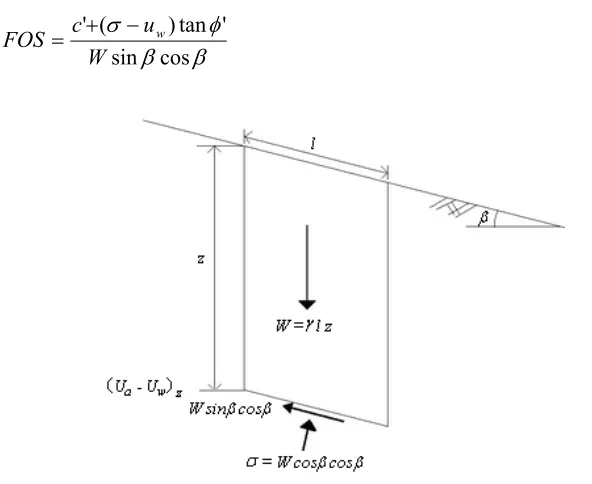
Figure 2.8 shows the soil element of a typical slice of an infinite slope in
21
calculated using a modified Mohr-Coulomb failure criterion (Fredlund et al., 1978):
β β
φ φ
σ
cos sin
tan ) (
' tan '
W
u u c
FOS
b w
a−
+ +
= (2.10)
Where W is the total weight of soil. By assuming that φb = φ’ and the pore-
air pressure (ua) is at atmospheric, Equation 2.10 can be rewritten as:
β β
φ σ
cos sin
' tan ) (
'
W u c
FOS= + − w (2.11)
Figure 2.8 Soil element of typical infinite unsaturated soil slope
From Equation 2.11, it is evidenced that other than the contributing factors
such as soil strength properties, soil mass, and slope geometry, the factor of safety of
a slope can be altered by the changes in negative pore-water pressure or suction,
which in turn is greatly influenced by the triggering factor of rainfall infiltration.
These relationships reveal the importance of the studies in rainfall pattern and
2.5.2 Effect of Rainfall Pattern on Suction Distribution and Slope Stability
The effect of rainfall intensity on the stability of slope has been studied by
numerous researchers (Ng and Shi, 1998; Kasim et al., 1998; Ng et al., 1999, Gasmo
et al.,2000; Rahardjo et al., 2001 etc). Kasim et al. (1998) performed a numerical
simulation to investigate the influence of hydraulic properties of soil on the
steady-state suction distributions in horizontal and inclined unsaturated soil layer.
The study showed that the ratio of rainfall unit flux to saturated permeability (i.e.,
q/ksat) and the air-entry value of the soil are the dominant factors affecting the
steady-state suction distributions.
Ng and Shi (1998) and Ng et al. (1999) accounted for more parameters in
their numerical studies on the effects of rain infiltration on suction in unsaturated
slopes and hence on slope stability. The parameters considered in their study
included intensity and duration of rainfall, saturated permeability, the presence of an
impeding layer and conditions of surface cover. They found that the responses of
suction and the groundwater table to the rainfall infiltration are mainly governed by
the ratio of q/ksat and ksat /mw, as well as the initial condition and boundary condition.
Previous studies on rainfall-induced slope failure (e.g. Lumb, 1975; Ng and
Shi, 1998; Tsaparas et al., 2002) have focused on the role of antecedent rainfall other
than the influence of a single rainstorm event for the initiation of slope failure.
Ayalew (1999) conducted a study through an observation of slope failure incidents in
Hong Kong. He found that there were a few occasions where the slope experienced
a rainfall with the intensity is identical to the intensity of triggering rainstorm, but no
slope failures has occurred. Therefore, he rose up a question to the role of major
rainfall in causing the slope failure. Besides, Ayalew (1999) found that more
landslides generally occur in September than in July, despite July being wetter; and
23
October is almost negligible. The phenomenon indicates that there could be some
time delay between a rainfall event and its effect on the stability of a slope.
Whether this is due to the antecedent rainfall leading to a build up of moisture within
the soil, or whether it is a reflection of the movement of water in some form of
wetting front, is still not clear.
Lumb (1975) suggested that rainfall-induced slope failure should be related to
the duration and intensity of antecedent rainfall (up to fifteen days prior to the failure
event), in addition to the intensity of triggering rainstorm. These findings have
been contested by Brand (1984), who pointed out that Lumb’s work was based on
daily rainfall data at the Hong Kong Royal Observatory, not from the data collected
local to the landslide locations. Brand used both 1-hour and 24-hour rainfall data
recorded from the rain gauges installed near the landslides, and found that antecedent
rainfall had no significant effect on major landslide events in Hong Kong, although
he conceded that three to four days antecedent rainfall does seem significant to minor
landslides. Brand's data indicated that major events were resulted from the short
duration, high intensity rainfall events. Most of the severe landslides occur when
rainfall exceeded 70 mm/hr. A significant number of failures could be expected in
Hong Kong if the rainfall exceeded 100 mm/day.
The findings from Brand were contested by Ng and Shi (1998) who carried
out a numerical investigation on the slope instability as result of rainfall in Hong
Kong. They found that single threshold rainfall did not provide a reliable warning
of land movement, and that a critical rainfall duration preceding the failure, of
between three to seven days, was also applicable to failure events. From the
foregoing findings, it is evidenced that the duration of antecedent rainfall to be
Rahardjo et al. (2001) carried out a case study in Singapore by considering
5-day antecedent rainfall in the slope stability analysis. They analyzed four actual
rainfall patterns with the amounts of rainfall were identical to the storm event that
has actually triggered the slope failure. They concluded that both triggering rainfall
and antecedent rainfall have significant influence on the initiation of slope failure.
The triggering rainfall alone cannot be used as the determinant for slope failure.
However, the soil characteristics were not accounted in their study.
Tsaparas et al. (2002) used Seep/W to perform seepage analysis for an
unsaturated soil slope and determine the factor of safety by integrating the seepage
results in the Slope/W. They considered the effect of antecedent rainfall, and found
in general that prolonged antecedent rainfall would significantly alter the pore water
pressure conditions prior to the main rainfall event. The effect of rainfall on the
stability of slope was controlled by the duration of the rainfall event, in which the
longer the rainfall duration, the lower the factor of safety of the slope. Antecedent
rainfall had some impact, especially when continuous, as previously noted. Soil
slope with lower saturated permeability tended to be more stable, since higher
permeability permitted deeper and more rapid penetration of the wetting front,
leading to greater loss of suction.
Tsaparas et al.’s findings were supported by Cai and Ugai (2004) who found
that the slope with low permeability should fail after sufficient duration of rainfall
even if the rainfall was with a low intensity. For slope with comparatively high
permeability, the slope failures possibly took place under the rainfall with a shorter
duration and a greater intensity. However, their findings have not yet been verified
with the field or laboratory evidences.
Zêzere et al. (2005) studied the landslides event in Portugal for the past 50
25
and short rainfall which responsible to the shallow landslide. On the other hand,
one to three months prolonged rainfalls are the main factor causing the deep-seated
slope failure. It should be noted that the study was carried out in the European
region in which the climate and the soil properties could be a huge factor affecting
the conclusion of the study.
In Malaysia, Roslan and Mohd (2005) suggested that seven days of rainfall
should be considered in the slope stability analysis. The energies associated to the
rainfalls were applied in the Universal Soil Loss Equation (USLE). However, their
studies were more emphasizing on the soil erosion or erosion-induced slope failures
which might not be applicable in the case of rainfall-induced slope failure.
In summary, despite of the fact that abundant numerical, field and laboratory
studies can be traced, the rainfall pattern that should be accounted in the stability
analysis of a slope is still a matter of debate. Experiences from different regions of
the world have resulted in different conclusions as to the significance of antecedent
rainfall for slope instability. Therefore, the mechanism of rainfall-induced slope
failure should be treated as a localized problem. In Malaysia, there are still very
limited studies conducted by employing the local rainfall data. Furthermore, the
permeability of soil appears to be another controlling factor that could greatly affect
the mechanism of rainfall-induced slope failure.
2.6 Soil Column for Infiltration Analysis
Soil column has been used by several researchers to model the infiltration
mechanism. Stormont and Anderson (1999) used a soil column apparatus to study
cylinder of 203 mm in diameter and 800mm in height. Nahlawi et al. (2007)
carried out an infiltration experiment to study the one-dimensional unsaturated
hydraulic behaviour of a layered soil-geotextile system. Their infiltration
experiments were conducted in a clear Perspex cylinder of 138.7 mm in diameter and
1,600 mm in height. The column assembly comprises four-part cylindrical sections,
with each section having a 400 mm height. Other published works on infiltration
testing using one-dimensional soil column include Rousseau and Pietro (2004), Jason
and Joel (2004) and Hincapié et al. (2007). Their studies mainly focused on the
investigation of the transportation of contaminants, chemical solutes and leachate in
soil.
The modeling of infiltration mechanism by the soil column infiltration test
can be traced from the studies conducted by Yang et al. (2004b) and Yang et al.
(2006). Yang et al. (2006) investigated the effect of rainfall intensity and duration
on infiltration mechanism through a large scale soil column apparatus, and provide
experimental evidence for soil water redistribution and hysteresis. The details and
the performance of the apparatus are described by Yang et al. (2004b).
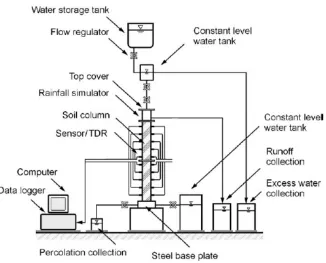
Figure 2.9 shows the schematic diagram of the soil column apparatus
developed by Yang et al. (2004b). The soil column was made of acrylic and
supported by a steel frame. The soil column was 1.5m in height with the internal
diameter of 190mm. Two types of instruments were installed on the soil column
model, i.e. tensiometer for suction measurement, and TDR for volumetric water
content measurement. The measurements were logged automatically into a data
logger. Water circulation system was installed to circulate the water discharged
27
Figure 2.9 Schematic diagram of soil column developed by Yang et al. (2004)
A few criteria should be considered in the design of soil column model to
accommodate the requirements of specific research, i.e. the dimension, the material
and the boundary conditions of the model. Generally, it is recommended that the
diameter of the soil column is ten times greater than the soil particle size in order to
minimize the boundary effect on the test results. Lim et al. (1996) measured the
pore-water pressure changes during rainfall in a slope in Singapore and concluded
that the pore-water pressure changes occurred within the depths of 1.5m. It is thus
essential to use a soil column with sufficient length and dimensions for pore-water
pressure monitoring. Besides, the boundary conditions of the soil column should
2.7 Numerical Simulation for Seepage and Slope Stability Analyses
From the past few decades, the numerical modeling technique has been
increasingly applied in the seepage and slope stability analysis owing to the rapid
development in the computing power and commercial software. In this section,
some of the pronounced published works using numerical simulation are cited.
Ng and Shi (1998) performed a parametric study to investigate the effect of
rainfall infiltration on a typical unsaturated hillside with a steep cut slope in Hong
Kong. Their study was performed by using the finite element program Seep/W,
with the rainfall modeled through the application of a specified infiltration rate
(equal to the rainfall data) on the boundary surface. The resultant pore water
pressures were then applied in a conventional limit equilibrium analysis to calculate
the factors of safety. By using the infiltration rate equal to the rainfall data, their
results on the pore-water pressure distribution seems to have over-estimated.
Chapuis et al. (2001) considered a number of both saturated and
saturated-unsaturated problems, while assessing the validity of the numerical codes.
They carried out the numerical analysis by using Seep/W. Two significant points
were noted from their work. Firstly, they show that numerical convergence
problems may occur due to large elements used in the model. This clearly
reinforces the point that non-linear numerical analysis can be highly influenced by
the size and geometry of the elements used, and that care must be taken to investigate
the sensitivity of an analysis to the proportions of the mesh used to solve it. There
were certainly no published rules or guidelines to determine the size and density of
the mesh elements. GEO-SLOPE International Ltd. (2004b) suggested that the
density of the mesh should be designed such that every single element is visible
when the model is zoomed at 100%. Secondly, Chapuis et al. (2001) did consider
29
less permeable clay. As modeled directly, very high pore pressures are generated in
the fissured clay layer as the infiltration is forced into this layer, but the water is
unable to penetrate into the less permeable clay beneath. This is presented as an
illustration of a weakness in a numerical code generating an inaccurate result.
Chapuis et al. (2001) suggested that this particular problem could be dealt with by
adding a surface, highly permeable gravel layer, which more readily allows lateral
flow, thus preventing the build up of pore pressures.
Ng et al. (2001) used a finite element program, FEMWATER to perform a
three-dimensional analysis of rainfall infiltration on a cut slope in Hong Kong.
They investigated the effect of rainfall intensity on the pore water pressure
distribution of soil. In order to account for the amount of rainwater that taken off as
runoff and evapotranspiration, Ng et al. did not reproduce this effect directly, but
rather simulate it indirectly with a ‘60% of rainfall as infiltration’ assumption.
Rahardjo et al. (2001) used Seep/W to compute the changes in pore-water
pressure as result of various rainfall patterns. In order to simulate a groundwater
fluctuation condition, the left and right boundaries below the groundwater table were
specified as constant total head, while zero total flux boundaries were assigned above
the groundwater table.
Generating the initial condition of pore-water pressure as identical as possible
to the in-situ condition is always a difficult task in numerical modeling. Rahardjo et
al. (2001) performed a steady state analysis to produce a hydrostatic condition.
Subsequently, a transient analysis was used to establish an initial pore-water pressure
profile by applying low unit flux to the slope surface for a long duration. The value
of the applied net flux on the slope surface was determined by trial and error until the
Tsaparas et al. (2002) used Seep/W to perform seepage analysis in an
unsaturated soil slope, and subsequently determined the factor of safety by using
Slope/W. They simulated a high rainfall relative to the saturated permeability
which resulted in only shallow wetting front because most of the rain water became
run-off. This was done by re-setting the surface pore water pressure to 0 kPa which
indicated that ponding is not allowed on the soil surface.
Cai and Ugai (2004) carried out a finite element analysis of transient water
flow through unsaturated-saturated soils to investigate the effects of hydraulic
characteristics, initial relative degree of saturation, methods to consider boundary
condition, rainfall intensity and duration on the pore-water pressure in slope. Shear
strength reduction technique was adopted in the slope stability analysis using a
software package known as SLOPE@FE. They found that the higher the initial
volumetric moisture content, the faster the water pressure increase in the slopes that
subjected to rainfall. This point can be explained with the suction dependent
hydraulic conductivity in unsaturated soil. As shown in hydraulic conductivity
function, higher suction (lower volumetric water content as shown in SWCC curve)
in soil will lead to lower hydraulic conductivity, and vice versa.
Babu and Murthy (2005) performed a reliability analysis of unsaturated soil
slope by using finite element program developed by Döll (1997). They found that
reliability theory can be used by means of evaluating the effects of various
parameters on the stability of an unsaturated soil slope. The matric suction (ua-uw)
and unsaturated friction angle (φb) were found to be the critical random variables in
31
2.8 Concluding Remarks
In this chapter, the basic theories and the clinical researches relevant to the
topic of rainfall-induced slope failure were discussed in details. Besides, the
published works related to the statistical prediction of extreme rainfall, soil column
model, and numerical simulation techniques were reviewed to provide supportive
information for the methodologies employed in the present study.
Despite of the fact that the theory of unsaturated soil mechanic has been well
established, the application of unsaturated soil mechanic in the slope stability
analysis is still very limited. Apparently, the designer found that it is too risky to
apply such approach that exposed to so many uncertainties. There are several
factors that may govern the mechanism of rainfall-induced slope failure, such as
rainfall intensity, rainfall duration, antecedent rainfall, soils strength properties, slope
geometry, and hydraulic properties of soils etc. Which factors are dominating the
mechanism is still unclear. It is questions such as this that provoked this study to be
carried out.
Several research gaps have been identified from the existing literatures to
form the basis for much of the research works carried out in the present study.
Firstly, the rainfall infiltration characteristic of soil, particularly on slope is still
unclear. The problem is mainly caused by the high temporal and spatial variability
in both rainfall pattern and soil behaviour.
Secondly, the critical rainfall pattern for the rainfall-induced slope failure is
still a matter of debate. The major uncertainties associated with the critical rainfall
pattern include the critical rainfall duration that should be considered in a slope
initiation of slope failure. Furthermore, the minimum suction corresponding to the
critical rainfall pattern is yet to be identified.
Thirdly, the studies on the topic of rainfall-induced slope failure are still very
limited in Malaysia. As mentioned earlier, the rainfall-induced slope failure
problem should be treated as a localized problem, in which experiences from
different regions of the world would result in different conclusions. Thus, it is
necessary to study the mechanism of rainfall-induced slope failure based on the
extreme rainfall analyzed from the local historical rainfall data.
Fourthly, the permeability of soil is found to be one of the main controlling
factors affecting the mechanism of rainfall-induced slope failure. Most of the
previous studies were conducted numerically and analytically. It is thus essential to
provide the laboratory and field evidences for verification purpose.
Lastly, the application of unsaturated soil mechanic and the integration of
extreme rainfall into the slope stability analysis have yet to become a common
practice, in view of large number of parameters and uncertainties involved in the
analysis. A simplified analysis is required for the preliminary stability evaluation
CHAPTER 3
METHODOLOGY
3.1 Introduction
The main objective of this research is to investigate the mechanisms involved
in the development of saturation profile. To achieve the objective, five phases of
research activities were undertaken, i.e. research initialization, preliminary
preparation, experiments, analysis, and generalization. In general, the research was
shaped through three approaches, namely numerical simulation, laboratory modelling,
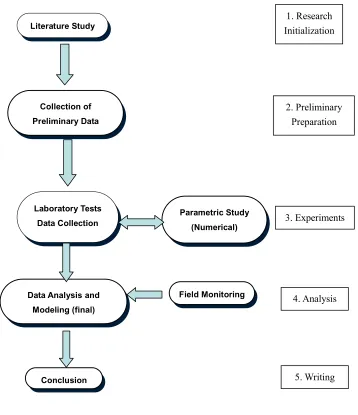
and field monitoring. Figure 3.1 shows the flow chart of the research activities.
The study was initiated by critically reviewing published works related to the
topic of rainfall-induced slope failure in order to develop a strong background of the
research. The knowledge on the state of the art of the research topic was gained
through consultation with several well-known experts such as Professor Harianto
Rahardjo from Nanyang Technological University Singapore, Dr. David Toll from
University of Durham, Professor Faisal Ali from University of Malaya, Professor
Roslan Zainal Abidin from University Technology Mara, and Mr. Law Tien Huat
from Mohd. Asby Consultant Sdn. Bhd. Problem statement and hypothesis were
Figure 3.1 Research framework
The second stage of the research involves the preliminary preparation of
experimental apparatus. Numerical analysis was performed to facilitate the
preliminary design of the laboratory model. The sketch of the laboratory model was
then fabricated.
Investigation on the dominant factors affecting saturation profile, and the
threshold rainfall patterns for different types of soil were carried out during the third
stage of research through numerical simulation. A series of laboratory experiments
Literature Study
Laboratory Tests
Data Collection
and Analysis
Parametric Study
(Numerical)
Data Analysis and
Modeling (final)
Field Monitoring
Conclusion Collection of
Preliminary Data
3. Experiments
4. Analysis
5. Writing 1. Research Initialization