A Bayesian Approach for Segmentation
in Stereo Image Sequences
George A. Triantafylllidis
Information Processing Laboratory, Electrical and Computer Engineering Department, Aristotle University of Thessaloniki, Thessaloniki 54006, Greece
Email: [email protected]
Dimitrios Tzovaras
Informatics and Telematics Institute, 1st Km Thermi-Panorama Road, Thermi-Thessaloniki 57001, Greece Email: [email protected]
Michael G. Strintzis
Information Processing Laboratory, Electrical and Computer Engineering Department, Aristotle University of Thessaloniki, Thessaloniki 54006, Greece
Informatics and Telematics Institute, 1st Km Thermi-Panorama Road, Thermi-Thessaloniki 57001, Greece Email: [email protected]
Received 31 August 2001 and in revised form 14 May 2002
Stereoscopic image sequence processing has been the focus of considerable attention in recent literature for videoconference ap-plications. A novel Bayesian scheme is proposed in this paper, for the segmentation of a noisy stereoscopic image sequence. More specifically, occlusions and visible foreground and background regions are detected between the left and the right frame while the uncovered-background areas are identified between two successive frames of the sequence. Combined hypotheses are used for the formulation of the Bayes decision rule which employs a single intensity-difference measurement at each pixel. Experimental results illustrating the performance of the proposed technique are presented and evaluated in videoconference applications.
Keywords and phrases:Bayesian decision test, segmentation, stereoscopic video, disparity, motion.
1. INTRODUCTION
Stereo vision provides a direct way of inferring the depth in-formation and therefore 3D perception by using two images (a stereo pair) destined for the left and right eye, respectively. Stereoscopic video sequences are represented by a number of consecutive stereo pairs each of which corresponds to a constant time instant. In a stereoscopic image sequence, each different view in a stereo pair is recorded with a difference in the observation angle, creating an enhanced 3D feeling to the observer and increasedtele-presence, for example, in telecon-ferencing [1]. Such video can provide more vivid and accu-rate information about the scene structure than monoview video. For these reasons, stereoscopic video processing has been the focus of considerable attention in recent literature [2, 3, 4].
As stereo vision is used in more and more applications, efficiency in stereo sequence coding, transmission and stor-age becomes increasingly important. The major goal is to
exploit the correlation between the two frames (left and right) of a stereo sequence, along with the correlation which is present between the stereo pairs at consecutive time in-stances, in order to achieve reduction of the number of bits required to represent the stereo sequence [1, 4, 5]. Increased data compression will make the stereo imaging applications faster and more economical.
Accurate detection of occlusion and visible foreground and background areas in stereo is a valuable task for efficient coding of stereo imaging. Occlusion regions mark disparity discontinuity jumps which can be used to improve stereo im-age encoding and transmission, segmentation, motion anal-ysis, and object identification processes. For example, it is highly useful for various stereoscopic coding methods [6], for sprite generation [7] and for background and depth ex-traction in stereoscopic videoconference sequences [8, 9].
a future frame from a previous frame by estimating the motion present in the scene and performing motion compensation on the previous frame [10]. The existence of the newly introduced pixels in an image frame degrades the quality of the motion compensation reconstructed image frames. This is due to the fact that the prediction method reduces prediction errors in static as well as moving regions but it fails where the scene background is uncovered by mov-ing pixels since new picture information appears, for which no corresponding information can be found in the previous frame [11]. Therefore, an effective coding scheme should em-ploy uncovered background pixel prediction, in addition to motion compensation for interframe coding.
The previous two paragraphs clearly imply that the de-tection of occlusion and visible foreground and background regions, along with the detection of uncovered-background areas is significant and valuable, since stereo image sequence processing requires information of the displacements created both by the motion of objects and also, by the disparity be-tween two views of the 3D scene projects on two images.
These areas are defined as follows. Using only stereo-scopic image information the scene may be segmented into the following areas [12, 13].
(i) Theocclusion areasin one image of a stereo sequence, are spatially coherent groups of pixels in the background or the foreground that can be seen only in this frame and thus are occluded in theothercounter frame of the same time in-stant.
(ii) Thevisible foreground areasin one image of a stereo sequence, consist of those pixels of the foreground, which are visible in both images of the same time instant.
(iii) Thevisible background areasin one image of a stereo sequence, are formed by those pixels of the background, which are visible in both images of the same time instant.
Correspondingly, in each stereo channel using only mo-tion informamo-tion the scene may be segmented into the fol-lowing areas [14]:
(i) The uncovered background areas in one image of a stereo sequence, are formed by those pixels in the back-ground, which are newly introduced in this image compared to the previous frame.
(ii) Thealready existing areasin one image of a stereo sequence, are groups of pixels that are displaced or are the same as in the previous frame.
We indicate as foreground the regions of the primary ob-ject having small values of depth, while background is the re-gions with large values of depth. Also note, at this point, that each pixel of one image of the stereo sequence can be classi-fied in one of the first three regions as well as in one of the two last regions. Therefore, there existsixdifferent classes— situations to which a pixel may belong.
The segmentation into visible and occlusion regions is treated as a secondary process in early stereoscopic research, postponed until matching is completed and smoothing is underway [15]. Techniques are also proposed that indi-rectly address the occlusion problem by minimizing spuri-ous mismatches resulting from occlusion regions and dis-continuities [16]. In [17], Belhumeur and Mumford point
out that occlusion areas must be identified and incorpo-rated into matching process and, using Bayesian reason-ing, they derive an energy functional using pixel intensity as the matching feature. Geiger et al. [18] also directly ad-dress occlusion regions by defining an a priori probabil-ity for the disparprobabil-ity field based upon a smoothness func-tion and an occlusion constraint. Cox et al. [19] propose a dynamic programming solution to stereo matching based on matching edge-delimited intervals between correspond-ing scan lines. A similar strategy is used in [20, 21], where a dynamic programming algorithm is developed for the detec-tion of significant disparity changes and large occlusion areas in a stereoscopic image pair. In this approach no smooth-ness or interscan-line compatibility constraints are used. Two additional constraints, namely the extended continu-ity constraint and the disparcontinu-ity gradient limit, are considered in [22].
As far as the detection of uncovered background areas is concerned, most methods utilize an algorithm based on change detection [23], evaluating the difference signal be-tween the present and the previous frame. However, these methods are very sensitive to noise. In addition, most of the uncovered background techniques described in the literature use change detection for initial image segmentation and then use information provided by motion estimation to further detect the uncovered background pixels [24].
In the present paper, a novel approach is introduced for segmenting a videoconference stereo image sequence, employing a Bayes decision criterion followed by a simple checking procedure for the elimination of possible outliers. The only assumptions made for the stereoscopic video are related to the disparity and motion vector fields: the dispar-ity and motion vectors are assumed to be relatively small and to obey a truncated Gaussian and a Gaussian distribution, re-spectively. The main advantage of the proposed algorithm is that it segments the frame using both the disparity and mo-tion informamo-tion, resulting in detecting simultaneously the occlusions and visible foreground and background regions as well as the uncovered-background areas.
This paper is organized as follows. Section 2 describes the mathematical analysis underlying the concept of Bayes testing. In Section 3, the calculation of the pdfs needed for the Bayes decision test is presented. Experimental results given in Section 4 evaluate visually and quantitatively the performance of the proposed method. Finally, conclusions are drawn in Section 5.
2. BAYES DECISION TEST
At two subsequent time instances, the following four frames are presented:
Irt1: right frame at time instantt1,
Ilt2: left frame at time instantt2,
Irt2: right frame at time instantt2.
(1)
Ilt2
A
A m A d A
Irt2
Irt1
A
Figure1: Disparity vectordand motion vectormdefined for the framesIrt1,Ilt2,Irt2.
be the current frame which will be segmented. Considering a pointAat the current frameIrt2, the corresponding points
at the framesIrt1 andIlt2 are the pointsAandA,
respec-tively. Then, the disparity vectordand the motion vectorm
are defined as shown in Figure 1.
The noisy intensityvlt2of each pixel of the left image of a
stereo pair at time instantt2is given as follows.
Left image
vlt2(k)=slt2(k) +wlt2(k), (2)
where the vectorkrepresents the spatial location [x, y]T of
each pixel,vlt2(k) is the noisy intensity value of the pixel
lo-cated ink=[x, y]Tin the left image at time instantt2,s lt2(k)
is the respective noise-free intensity value in the left image at the same time instant, andwlt2(k) is the zero-mean, additive,
white Gaussian noise corrupting the left image.
Assuming the left Ilt2 to be the reference image, each
pixel of the right image at time instantt2 can be assigned to three different classes: the visible foreground (Artf2), the
visible background (Abrt2), and the occlusion (A o
rt2) classes of
pixels, all defined in Section 1.
One of the most important parameters in the study of stereo vision is the disparity field. Assuming parallel axes camera configuration [25], two cameras with parallel optical axes, that is, image planes of the cameras are coplanar and collinear, and with identical optical characteristics, are em-ployed to acquire the stereo pair sequence. In this case, the disparitydreduces to the signed magnitude of the horizon-tal component dx of the disparity vector, since the vertical
component is always zero. Therefore, if the direction from the right image to the left image is considered as the posi-tive direction, the disparities in stereo are always nonposiposi-tive if we regard the left image as reference and always nonnega-tive if we regard the right image as reference, due to camera geometry.
Then, the noisy intensityvrt2(k) of the right image at the
same time instantt2in terms of the noise-free intensity of the left imageslt2(k) may be expressed as follows [13].
Right image
• ifk∈Aort2then
vrt2(k)=ort2(k) +wrt2(k), (3)
• ifk∈Artf2then
vrt2(k)=slt2
k−d(x,l,tf)2(k)
+wrt2(k), (4)
• ifk∈Abrt2then
vrt2(k)=slt2
k−d(x,l,tb)2(k)
+wrt2(k), (5)
where d(x,l,tf)2(k) is the disparity of the foreground pixels at
time instant t2, which is negative, since it is calculated in reference to the left image, dx,l,t(b)2(k) is the disparity of the background pixels at time instant t2, which is nonpositive, ort2(k) is the noise-free intensity of each occlusion pixel of
the right image at t2 and wrt2(k) is the zero-mean,
addi-tive, white Gaussian noise corrupting the right image of the stereo pair. The terms wlt2(k) andwrt2(k) are assumed
uncorrelated, since they express noises corrupting diff er-ent images (the left and the right images of the stereo pair).
Assuming that the disparitiesd(x,l,tf)2(k) andd
(b)
x,l,t2(k) are
small enough, a first order approximation ofslt2(k−d
(f)
x,l,t2(k))
andslt2(k−d
(b)
x,l,t2(k)) may be used [14]. Then, (4) and (5)
become
• ifk∈Artf2then
vrt2(k)=slt2(k)−gx,l,t2(k)d
(f)
x,l,t2(k) +wrt2(k), (6)
• ifk∈Ab
rt2then
vrt2(k)=slt2(k)−gx,l,t2(k)d
(b)
x,l,t2(k) +wrt2(k), (7)
wheregx,l,t2(k) is the horizontal component of the gradient
vector of pixelkin the left image at time instantt2. We also define the differences
z(r−l),t2(k)=vrt2(k)−vlt2(k), (8)
w(r−l),t2(k)=wrt2(k)−wlt2(k). (9)
The above may be used to write the following equations:
• klocated in occlusion area,Aort2area
z(r−l),t2(k)=q(r−l),t2(k) +w(r−l)(k), (10)
• klocated in visible foreground area,Artf2area
z(r−l),t2(k)= −gx,l,t2(k)d
(f)
• klocated in visible background area,Ab
Now consider two consecutive right frames at time in-stancest1andt2. The noisy intensity of the first (previous) right frame at time t1 is given by the following equation which is equivalent to (1).
Time instantt1
vrt1(k)=srt1(k) +wrt1(k), (13)
wheresrt1(k) is the noise-free intensity value in the right
im-age at the same time instant and wrt1(k) is the zero-mean,
additive, white Gaussian noise corrupting the right image at timet1.
The noise free pixel intensity of the right frame at time instant t2, in terms of the pixel intensity of the right frame at time instantt1can be that of either an uncovered back-ground value (Aurt2), or an already existing value (displaced
or stationary pixel) (Aert2). Then, the expression for the noisy
intensity of the present frame (t2) is as follows.
Time instantt2
wheremr,t1(k) is the nonuniform displacement vector due to
motion, since it is calculated in reference to the right frame at time instantt1andbrt2(k) is the noise-free intensity of each
uncovered background pixel of the right image att2. Assuming thatmr,t1(k) is small enough, a first-order
ap-proximation ofsrt1(k−dr,t2(k)) may be used, simplifying (15)
wheregr,t1(k) is the intensity gradient vector of the previous
frame atk.
In terms of the differencey(t2−t1),r(k)=vrt2(k)−vrt1(k)
and (9) the following expressions are obtained:
• klocated in uncovered background area,Aurt2area
y(t2−t1),r(k)=p(t2−t1),r(k) +w(t2−t1),r(k), (17)
• klocated in already existing area,Ae
rt2area
The Bayes decision test dictates that for each pixelk, the hypothesisHiis selected if
ri(k)< rj(k), ∀j=i, (20)
where ri(k) is the average cost of accepting the
hypoth-esis Hi. This cost depends on the a priori probabilities
p(Hi) of hypotheses Hi, on the costsLmn of deciding that
Hm is correct while the actually correct hypothesis is Hn,
and finally on the conditional probability density functions (pdfs) ofz(r−l),t2(k) andy(t2−t1),r(k). The average costri(k) is
Assuming that the a priori probabilities p(Hi) and the
costs Lmn are known, the conditional probability density
functions f(z(r−l),t2(k), y(t2−t1),r(k)|Hj), must be calculated.
The assumption of uncorrelated motion and disparity vec-tors for the right frame at time instantt2(see Figure 1), im-plies that
in order to apply the Bayes decision test of (20).
3. CALCULATION OF THE PDFS
3.1. Calculation off(z(r−l),t2(k)|Hi), i=0,1
Using the Bayes rule under the assumption thatk∈Ao
Left image
slt2
Pixels used for
ort2estimation ort2
Right image
Contour of primary object of left image Copy of contour of primary object of right image
Contour of primary object of right image Copy of contour of primary object of left image
However, in order to evaluate the integral of (23), knowl-edge of the density f[q(r−l),t2(k)] is necessary. By definition,
q(r−l),t2(k) is the difference between the intensity of the
occlu-sion areasort2(k) of the right image and the intensityslt2(k)
that the same pixels would have in the left image. Therefore, the region slt2(k) is a strip of the boundary pixels from
in-side theright part of the contour of the primary object of the left image [13]. We may also reasonably assume that the statistics of the adjacent regionoutsidetheright part of the contour of the primary object will be sufficiently similar to the statistics of the intensity of the occlusion areas ort2(k)
(see Figure 2).
The intensity histogram (f[slt2(k)]) of the right
bound-ary pixels inside the primbound-ary object and the intensity his-togram (f[ort2(k)]) of the pixels outside the right boundaries
of the primary object, may then be calculated, after defining the contour of the primary object in the left image, using the method of active contour models (orsnakes) [27, 28]. There-fore, sinceq(r−l),t2(k)=ort2(k)−slt2(k) and assuming
inde-where the star denotes the flipped histogram (since q(r−l),t2(k)=ort2(k)−slt2(k)) and the asterisk∗denotes
con-volution. Then, each pdf f(z(r−l),t2(k)|Hi),i=0,1, is easily
derived from (23), (24), and (25).
3.2. Calculation off(z(r−l),t2(k)|Hi), i=2,3
a zero-mean, additive, white Gaussian noise, the pdf of w(r−l),t2(k) will be given by the following expression [14]:
random variables, then trivially [26]
Due to the parallel camera geometry, sincek∈Artf2, the
disparitydx,l,t(f)2(k) is negative
d(x,l,tf)2(k)<0. (30)
Then, the probability density function ofd(x,l,tf)2(k) can be
as-sumed to be a truncated Gaussian
fd(x,l,tf)2(k)
From the same assumption of uncorrelatedgx,l,t2(k)d
(f)
truncated Gaussian with varianceσ2 = |σ2
z(r−l),t2 −σ
2
w|.
Fol-lowing [29], we will approximateσ2
z(r−l),t2byz
Section 3.2 for the case of foreground pixels may also be used, with obvious modifications, for the evaluation of
f(z(r−l),t2(k)|Hi),i=3,4
However, very often in practice, either the background is sufficiently uniform so thatgx,l,t2(k) ≈ 0 or far away from
the camera (high depth) forcing the background disparity to very small values. In either such case gx,l,t2(k)d
(b)
x,l,t2(k) ≈ 0,
hence the pdf is no longer conditioned on the value of a ran-dom number and reduces to the following expression:
fz(r−l),t2(k)|Hi
alternatively, this is also trivially seen to be the form of (33) reduces to, whengx,l,t2(k)d
(b)
x,l,t2(k)≈0.
3.4. Calculation off(y(t2−t1),r(k)|Hi), i=0,2,4
In this casek∈Aurt2, an analysis similar to Section 3.1 is used.
On applying the Bayes rule, we obtain [14]
fz(t2−t1),r(k)|Hi
From (35) and (36), it is clear that to evaluate the inte-gral of (35) the pdf of p(t2−t1),r(k) must be computed.
Re-call that p(t2−t1),r(k)=brt2(k)−srt1(k), wherebrt2(k) is the
intensity of the uncovered background andsrt1(k) refers to
the intensity of the scene pixels which have moved from the frameIt1to the frameIt2uncovering the background. Thus,
srt1(k) is the intensity of the portions of the moving object
which uncover background as the object moves. We assume that the statistics of the uncovered backgroundbrt2(k) is
suf-ficiently described by the statistics of the neighboring scene background and the statistics of moving-object pixelssrt1(k)
are well approximated by the statistics of the primary object [14]. Using snakes for boundary detection as in Section 3.1 we obtain that
sian distributed [14] with zero-mean and covariance matrix
Stereoscopic Figure3: Flow graph of the proposed scheme.
my(k), respectively, andσmxy(k) is the cross variance between
mx(k) andmy(k). Assuming that the motion variance is the
same in both x and y directions and that the mx(k) and
my(k) are uncorrelated with each other and with the noise,
we find
This section presents the results of the simulation experi-ments using the proposed scheme. The algorithm was ap-plied to both synthetic and natural stereo pair sequences to evaluate the performance of the proposed approach for segmenting stereo pair sequences into occlusion and visible background and foreground areas, along with the detection of the uncovered background areas.
The a priori probability vectorPwill be defined by
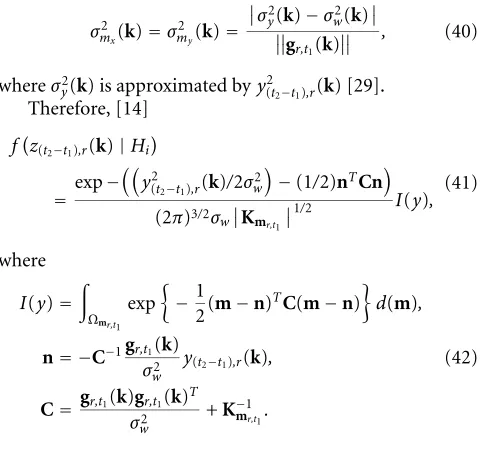
P=pH0 pH1 pH2 pH3 pH4 pH5, (43) where p(Hi),i=0, . . . ,5, is the a priori probability that
hy-pothesisHiis valid.
The cost matrix L used in our experiments is the cost matrix Lwhich corresponds to the maximum a posteriori probability—MAP test
The use of Lassigns no cost to a correct decision and the same cost to all incorrect decisions.
Figure 3 describes the scheme which was used for the ex-periments. We use a noisy stereoscopic video as input and after the specification of the framesIrt1,Ilt2, andIrt2, we
calcu-late the pdfs needed for the Bayes decision test which follows. Then, after a simple post-processing step for outlier removal, we obtain the classification for the pixels into one of the six situationsHi, wherei=0, . . . ,5.
To resolve possible ambiguities in region classification a simple isolation technique is used, as a post processing step, in order to correct the classification of some pixels. This pro-cedure produces a final re-classification into one of the six situationsHi,i=0, . . . ,5. Specifically, a 4×4 neighborhood
window is defined around the current pixel in the map pro-duced by the Bayes decision test. If most of the pixels, belong-ing to this window, have been classified to other regions than that of the current pixel, then, the current pixel is re-classified to the most frequent situationHifound in the window.
We first used the simple synthetic stereo pair sequence El-lipsewhich presents a uniform foreground and background, in order to evaluate the efficiency of the proposed algorithm. We employed the imagesIrt1,Ilt2,Irt2 as shown in Figure 4,
which correspond, respectively, to the right frame at time in-stantt1, the left frame at time instantt2, and the right frame at time instant t2. Zero-mean, white Gaussian noises were added to both left and right channel withσl=7 andσr=8,
respectively. We used the MAP cost matrixLand the a priori probability vector
P=0.1 0.15 0 0.25 0.15 0.35. (45)
This is a typical selection for the vectorPfor stereo video used for videoconference applications, which works well for such stereo videos as it will be shown next. Also, note that the probability p(H2) which corresponds to the probability of a pixel to belong to uncovered background and visible fore-ground areas is zero, since such a pixel classification cannot be true for these images.
Applying the proposed Bayes decision test followed by the checking procedure for the elimination of outliers, the segmented image of Figure 5 is obtained, where each greyscale colour corresponds to a different region as de-scribed from the hypothesesHi.
(a)
(b)
(c)
Figure4: The generated test image sequenceEllipse, (a) frameIrt1, (b) frameIlt2, (c) frameIrt2.
H5
H3
H4
H0
H1
Figure5: The segmentation map ofEllipse, produced from the pro-posed algorithm, indicating the regions which correspond to the sit-uationsHi.
(a)
(b)
(c)
Figure6: The generated test image sequenceHouse, (a) frameIrt1, (b) frameIlt2, (c) frameIrt2.
H3
H4
H5
H0
H1
(a)
(b)
(c)
Figure8: The stereoscopic real test image sequenceLudo, (a) frame Irt1, (b) frameIlt2, (c) frameIrt2.
H3
H5 H1
H0
H4
Figure9: The segmentation map ofLudo, produced from the pro-posed algorithm, indicating the regions which correspond to the sit-uationsHi.
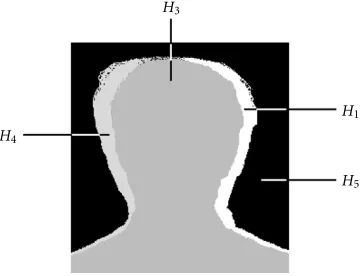
colour as in Ellipse. Assuming the same vector P and cost matrixLas before, we obtain Figure 7 which illustrates the produced region map, indicating the pixel classification into one of the situationsHi,i=0, . . . ,5.
To further evaluate the effectiveness of the proposed tech-nique, results were obtained using the stereoscopic real image sequenceLudo.1Figure 8 shows the three images correspond-ing to the framesIrt1,Ilt2,Irt2. After adding white Gaussian
1This sequence was developed byThomson Broadcast Systemsfor use in the PANORAMA (ACTS 092) EU project.
(a)
(b)
(c)
Figure 10: The stereoscopic real test image sequenceSergio, (a) frameIrt1, (b) frameIlt2, (c) frameIrt2.
H4
H3
H1
H5
noise to the images, the proposed Bayes decision test was ap-plied, segmenting the frameIrt2. We assumed that the a priori
probability vectorPis the same as in (45) and the MAP cost matrixLwas also selected. Figure 9 illustrates the segmen-tation resulting from the application of the proposed algo-rithm.
Finally, the proposed algorithm was evaluated using the stereoscopic real image sequenceSergio. Figure 10 shows the three framesIrt1,Ilt2,Irt2. The produced segmentation is
pre-sented in Figure 11. We must note at this point, that in this case, the produced region map does not have pixels belong-ing both to the uncovered background areas and the occlu-sion regions. This is due to the motion between the frames at the timest1andt2which does not uncover pixels that are occluded in the left frame at timet2.
5. CONCLUSIONS
In this paper, we introduce a novel Bayesian scheme for the segmentation of a videoconference noisy stereoscopic im-age sequence. A Bayes decision test is employed for detect-ing occlusions, visible foreground, and background regions and uncovered-background areas. Combined hypotheses are used for the formulation of the Bayes decision rule. It was assumed that the disparity and motion are small and obey a truncated Gaussian and a Gaussian distribution, respec-tively. The main advantage of the proposed method is that it segments the frame using both the disparity and motion information, resulting in detecting simultaneously the oc-clusions and visible foreground and background regions as well as the uncovered-background areas. Experimental re-sults using both synthetic and natural stereo pairs sequences demonstrate the efficient performance of the proposed technique.
REFERENCES
[1] M. Perkins, “Data compression of stereo pairs,” IEEE Trans. Communications, vol. 40, no. 4, pp. 684–696, 1992. [2] N. Grammalidis, S. Malassiotis, D. Tzovaras, and M. G.
Strintzis, “Stereo image sequence coding based on 3D mo-tion estimamo-tion and compensamo-tion,” Signal Processing: Image Communication, vol. 7, no. 2, pp. 129–145, 1995.
[3] A. Tamtaoui and C. Labit, “Constrained disparity and motion estimators in 3DTV image sequence coding,” Signal Process-ing: Image Communication, vol. 4, pp. 45–54, November 1991. [4] D. Tzovaras, N. Grammalidis, and M. G. Strintzis, “Object-based coding of stereo image sequences using joint 3-D mo-tion/disparity compensation,” IEEE Trans. Circuits and Sys-tems for Video Technology, vol. 7, no. 2, pp. 312–328, 1997. [5] M. G. Strintzis and S. Malassiotis, “Object-based coding of
stereoscopic and 3D image sequences: a review,” IEEE Signal Processing Magazine, vol. 16, no. 3, pp. 14–28, 1999, Special Issue on Stereo and 3D Imaging.
[6] N. Grammalidis and M. G. Strintzis, “Disparity and occlu-sion estimation in multiocular systems and their coding for the communication of multiview image sequences,” IEEE Trans. Circuits and Systems for Video Technology, vol. 8, no. 3, pp. 327–344, 1998.
[7] N. Grammalidis, D. Beletsiotis, and M. G. Strintzis, “Mul-tiview sprite generation and coding,” inProc. IEEE Interna-tional Conference on Image Processing, Kobe, Japan, October 1999.
[8] L. Falkenhagen, “Block-based depth estimation from image triples with unrestricted camera setup,” inProc. IEEE Work-shop on Multimedia Image Processing, Princeton, NJ, USA, June 1997.
[9] D. Tzovaras, N. Grammalidis, and M. G. Strintzis, “3-D cam-era motion estimation and foreground/background separa-tion for stereoscopic image sequences,” Optical Engineering, vol. 36, no. 2, pp. 574–579, 1997.
[10] G. Tziritas and C. Labit, Motion Analysis for Image Sequence Coding, Elsevier, Amsterdam, 1994.
[11] D. Hepper, “Efficiency analysis and application of uncovered background prediction in low bit rate image coder,” IEEE Trans. Communications, vol. 38, no. 9, pp. 1578–1584, 1990. [12] G. A. Triantafyllidis, D. Tzovaras, and M. G. Strintzis, “Effi
-cient classification of occlusion areas in stereo pairs,” inProc. International Workshop on Synthetic-Natural Hybrid Coding and Three Dimensional Imaging: IWSNHC3I ’99, Santorini, Greece, September 1999.
[13] G. A. Triantafyllidis, D. Tzovaras, and M. G. Strintzis, “Occlu-sion and visible background and foreground areas in stereo: a Bayesian approach,” IEEE CSVT, vol. 10, no. 4, pp. 563–575, 2000, Special Issue on 3D Video Technology.
[14] K. E. Matthews and N. M. Namazi, “A Bayes decision test for detecting uncovered-background and moving pixels in image sequence,”IEEE Trans. Image Processing, vol. 7, no. 5, pp. 720– 728, 1998.
[15] U. R. Dhond and J. K. Aggarwal, “Structure from stereo: A review,” IEEE Trans. Systems, Man, and Cybernetics, vol. 19, no. 6, pp. 1489–1510, 1989.
[16] C. Chang, S. Catterjee, and P. R. Kube, “On an analysis of static occlusion in stereo vision,” inProc. Conference on Computer Vision and Pattern Recognition, pp. 722–723, Kauai, Hawaii, 1991.
[17] P. Belhumeur and D. Mumford, “A Bayesian treatment of the stereo correspondence problem using half-occluded re-gions,” inProc. IEEE Conference on Computer Vision and Pat-tern Recognition, pp. 506–512, Champaign-Urbana, Ill, USA, 1992.
[18] D. Geiger, B. Ladendorf, and A. Yuille, “Occlusions and binoc-ular stereo,” inProc. European Conference on Computer Vision, pp. 425–433, Santa Margherita Ligure, Italy, May 1992. [19] I. J. Cox, S. Hingorani, B. Maggs, and S. Rao, “Stereo
with-out regularization,” NEC Research Institute Report, NEC Re-search Institute, October 1992.
[20] S. S. Intille and A. F. Bobick, “Disparity-space images and large occlusion stereo,” Tech. Rep. 220, MIT Media Lab Per-ceptual Computing Group, 1993.
[21] S. S. Intille and A. F. Bobick, “Incorporating edges in the re-covery of occlusion region,” Tech. Rep. 246, MIT Media Lab Perceptual Computing Group, 1994.
[22] L. Falkenhagen, R. Koch, A. Kopernik, and M. G. Strintzis, “Disparity estimation based on 3-D arbitrarily shaped re-gions,” Tech. Rep. R2045/UH/DS/P/023/b1 RACE Project R2045 Digital Stereoscopic Imaging and Applications (DIS-TIMA), 1994.
[24] C. Lettera and L. Masera, “Foreground/background segmen-tation in videotelephony,”Signal Processing: Image Communi-cation, vol. 1, no. 2, pp. 181–189, 1989.
[25] H. Aydinoglu and M. Hayes III, “Stereo image coding: A pro-jection approach,”IEEE Trans. Image Processing, vol. 7, no. 4, pp. 506–516, 1998.
[26] A. Papoulis,Probability Random Variables and Stochastic Pro-cesses, McGraw-Hill, New York, NY, USA, 3rd edition, 1991. [27] M. Kass, A. Witkin, and D. Terzopoulos, “Snakes: Active
con-tour models,” inProc. 1st International Conference on Com-puter Vision, pp. 259–269, London, UK, 1987.
[28] S. Malassiotis and M. G. Strintzis, “Tracking the left ventri-cle in echocardiographic images by learning heart dynamics,”
IEEE Trans. on Medical Imaging, vol. 18, no. 3, pp. 282–291, 1999.
[29] N. M. Namazi, P. Penafiel, and C. M. Fan, “Nonuniform image motion estimation using the Kalman filtering,” IEEE Trans. Image Processing, vol. 3, no. 5, pp. 678–683, 1994.
George A. Triantafylllidis was born in Thessaloniki, Greece, in 1975. He received the Diploma degree from the Electrical En-gineering Department of Aristotle Univer-sity of Thessaloniki, Greece in 1997. He is currently associated with the Information Processing Laboratory of Aristotle Univer-sity of Thessaloniki, where he is pursuing the Ph.D. degree, and the Informatics and Telematics Institute, Thessaloniki, Greece,
as a Research Associate. He has participated in several research projects funded by EU and the Greek Secretariat of Research and Technology. Since 2000, he serves as a Teaching Assistant in Aris-totle University. His research interests include image compression and analysis as well as monoscopic and stereoscopic image se-quence coding and processing.
Dimitrios Tzovarasreceived the Diploma degree in electrical engineering and the Ph.D. degree in 2D and 3D image com-pression from Aristotle University of Thes-saloniki, ThesThes-saloniki, Greece, in 1992 and 1997, respectively. He is now a Researcher in the Informatics and Telematics Institute of Thessaloniki. Prior to his current posi-tion, he was a Leading Researcher on 3D imaging at the Aristotle University of
Thes-saloniki. His main research interests include image compression, 3D data processing, virtual reality, medical image communication, 3D motion estimation, and stereo and multiview image sequence coding. His involvement with those research areas has led to the coauthoring of more than 20 papers in refereed journals and more than 50 papers in international conferences. He has served as a reg-ular reviewer for a number of international journals and confer-ences. Since 1992, he has been involved in more than 20 projects in Greece, funded by the EC, and the Greek Ministry of Research and Technology. Dr. Tzovaras is a member of the Technical Chamber of Greece.
Michael G. Strintzisreceived the Diploma in electrical engineering from the National Technical University of Athens, Athens, Greece in 1967, and the M.A. and Ph.D. de-grees in electrical engineering from Prince-ton University, PrincePrince-ton, NJ, USA in 1969 and 1970, respectively. He then joined the Electrical Engineering Department at the University of Pittsburgh, Pittsburgh, Pa., where he served as Assistant (1970–1976)