R E S E A R C H
Open Access
Performance analysis of probabilistic soft SSDF
attack in cooperative spectrum sensing
Linyuan Zhang
†, Qihui Wu
*, Guoru Ding
*†, Shuo Feng and Jinlong Wang
Abstract
In cognitive radio networks, spectrum sensing data falsification (SSDF) attack is a crucial factor deteriorating the detection performance of cooperative spectrum sensing. In this paper, we propose and analyze a novelprobabilistic softSSDF attack model, which goes beyond the existing models for its generalization. Under this generalized SSDF attack model, we firstly obtain closed form expressions of global sensing performance at the fusion center. Then, we theoretically evaluate the performance of the proposed attack model, in terms of destructiveness and stealthiness, sequentially. Numerical simulations match the analytical results well. Last but not least, an interesting trade-off between destructiveness and stealthiness is discovered, which is a fundamental issue involved in SSDF attack, however, ignored by most of the previous studies.
Keywords: Cognitive radio; Spectrum sensing data falsification attack; Destructiveness; Stealthiness
1 Introduction
Cognitive radio (CR) has been regarded as a promising technology to improve the spectrum utilization [1]. To enable CR, cooperative spectrum sensing, among multi-ple spectrum sensors, is one of the key technologies [2]. However, due to the openness of low-layer protocol stack of CR, the reliability of cooperative spectrum sensing is challenged by many security threats [3].
The most well-known security threat is the spectrum sensing data falsification (SSDF) attack [4], where abnor-mal or abnor-malicious spectrum sensors falsify their true sens-ing results. The main goal of SSDF attack can be roughly expressed as two points. One point is to decrease the global detection probability for disturbing the normal operation of the primary user (PU). The other is to increase the global probability of false alarm with the pur-pose of wasting the access opportunities of the honest secondary users (SUs).
Previous studies on SSDF attack modeling can be gen-erally grouped into two classes: hard SSDF attack and soft SSDF attack. Briefly, in hard SSDF attack, malicious SUs falsify their local binary decisions [5-8], while in soft SSDF attack, malicious SUs falsify their received energy values.
*Correspondence: [email protected]; [email protected]
†Equal contributors
College of Communications Engineering, PLA University of Science and Technology, Yudao Road, Nanjing 210007, China
Compared to hard SSDF attack, soft SSDF attack is gen-erally more powerful and elusory for its relatively larger value space [9-12], since malicious SUs falsify real energy observations, rather than binary decisions, to mislead the fusion center (FC).
Three soft SSDF attack models have been widely adopted to test various secure sensing algorithms: Always Yes [13], Always No [14,15], and Always Adverse [16]. In Always Yes soft SSDF attack, an attacker raises its local observations by injecting a positive offset in every sens-ing slot. In Always No attack, an attacker decreases its local observations by injecting a negative offset in every sensing slot. InAlways Adverseattack, an attacker firstly performs a local binary hypothesis testing betweenH0and
H1by comparing its energy observation with a predefined
threshold, withH0denoting the case that the primary
sig-nal is absent and H1 otherwise; then, the malicious SU
raises its observations when its local binary decision is H0and decreases its observations when its decision isH1.
One main limitation of the existing soft SSDF attack mod-els is that they are oversimplified and not general enough to serve as the baseline for the design of counter-attack or secure sensing algorithms.
Motivated by the observations above, in this paper, we start with an objective to develop a more general soft SSDF attack model, which should go beyond the existing
models and include them as special cases. We also con-sider that each attacker should be smart to have dual goals in mind: (i) causing harmful disturb to cooperative spec-trum sensing and (ii) protecting itself against being easily detected. Specifically, the main contributions of this paper are as follows:
• Propose a generic probabilistic soft SSDF attack model and derive the corresponding closed-form expressions of global sensing performance at the fusion center.
• Analyze the destructiveness of the proposed attack model under three general scenarios and obtain the corresponding optimal attack strategies.
• Define a stealthiness metric and analyze the stealthiness of the proposed attack model under a classical secure sensing algorithm.
• Discover an interesting trade-off between destructiveness and stealthiness, which is a
fundamental issue involved in SSDF attack, however, ignored by most of the previous studies.
The remainder of this paper is organized as follows. Section 2 presents the spectrum sensing preliminaries. In Section 3, we formulate the proposed probabilistic soft SSDF attack model and present the analysis of its impacts on the sensing performance. Analytical results on destruc-tiveness and stealthiness of the proposed attack model are provided in Sections 4 and 5, respectively. Numer-ical results are given in Section 6, and conclusions are provided in Section 7.
2 Spectrum sensing preliminaries
As shown in Figure 1, we consider a cooperative spectrum sensing system consisting ofN SUs and a FC. Each SU
Figure 1Cooperative spectrum sensing system.PU, primary user; SU, secondary user; FC, fusion center.
conducts energy detection and transmits its observation to the FC. At the FC, the global decision is made based on the combination of observations. In particular, there are some malicious SUs reporting falsified observations to the FC to deteriorate the spectrum sensing performance.
For a given frequency band, spectrum sensing is gener-ally formulated as a binary hypotheses as follows:
H0:ri(t)=ni(t), i=1, 2. . .,N
H1:ri(t)=hi(t)si(t)+ni(t), i=1, 2. . .,N, (1)
where H0 denotes the case that the primary signal is
absent andH1 denotes the case that PU is present,N is
the number of SUs, ri(t) is the t-th sample of the i-th SU’s received signal,si(t)is the PU’s transmit signal,hi(t) is the channel gain, and ni(t) denotes the additive white
Gaussian noise (AWGN).
With an energy detector, the collected energy
obser-vation at the i-th SU can be given asxEi =
2U
t=1|
ri(t)|2,
whereU =TW is the time-bandwidth product. Accord-ing to the central limit theorem, whenUis large enough (e.g.,U >>10),xEican be well approximated as a
Gaus-sian random variable under both hypothesesH0andH1as
follows [14,16,17]:
H0:xEi∼ N
u0i,σ02i
H1:xEi∼ N
u1i,σ12i
, (2)
where u0i = 2U, σ02i = 4U, u1i = 2U(γi +1), σ12i =
4U(2γi+1)andγiis the received SNR of theith SU. The local binary decision di at the i-th SU can be
obtained by comparing its energy observation with a local thresholdηi,
xEi di=H1
di=H0
ηi. (3)
At the FC, a weighted combination is generally used to obtain the global decisionDas follows:
xE= N
i=1
wixEi D=H1
D=H0
ηf (4)
whereηf is the global threshold at the FC andwi ∈[0, 1]
is the weight assigned to the i-th SU by the FC, and N
i=1wi=1.
3 Probabilistic soft SSDF attack
In this section, we will propose a generic soft SSDF attack model and present the analysis of its impacts on the sensing performance. Before going into deep analysis, we declare that a generic and effective SSDF attack model should at least have the following features:
imperfection of the local sensing results should also be considered.
• Attackers should be able to jointly consider harmfully disturbing the FC to obtain wrong decisions and reliably protecting itself from being easily detected, by properly adjusting attack parameters.
3.1 The proposed attack model
Based on considerations previously mentioned, a prob-abilistic soft SSDF attack modelis proposed as follows. Firstly, an attacker (say, thei-th SU) makes its local binary decision via (3). Then, it utilizes a probabilitypito decide
whether to perform attack. If it decides to attack, it will randomly produce a Gaussian value as sensing result to report; otherwise, it will hold its true observation. Mathe-matically, this attack model can be written as
Local
ance when the local decision of the i-th SU is H0 (i.e.,
PU is absent),u3iandσ32i denote the mean and variance
when the local decision is H1. Obviously, for an honest
SU, the attack probability equals to zero. For a malicious SU, the attack probabilitypi ∈ (0, 1). Naturely, the two
mean values of random distributions have such a relation: u2i≥u3i, as the attacker generally falsifies sensing results
by reversing them. To facilitate the following analysis, we define (u2i,u3i) as the attack strength and consider the
caseσ22i=σ32i=σ12i.
The attack model in (5) is general enough to include the existing models as special cases, via properly adjusting the attack parameters (u2i,u3i,pi). For example, Always
No [13], Always Yes [14,15], and Always Adverse attacks [16] can be realized when (u2i,u3i,pi) is set as (u0i,u0i, 1),
(u1i,u1i, 1) and (u1i,u0i, 1), respectively. In particular, the
attack probabilitypican make the proposed attack more
elusory and flexible.
3.2 Local sensing performance under probabilistic soft SSDF attack
For the proposed attack model in the Section 3.1, the probability density function (PDF) of the reported result by thei-th malicious SU, under hypothesisH0andH1, can
be respectively calculated as
gH0i(x)=lim→
represents the PDF of the Gaussian vari-ablexwith the meanuiand standard deviationσi,Q(x)is
the Gaussian Q-function andηiis local threshold.
3.3 Global sensing performance under probabilistic soft SSDF attack
In a cooperative spectrum sensing system with a FC and NSUs, among which the firstkSUs are malicious attack-ers, the FC fuses results from both malicious SUs and honest SUs via Equation 4. The fusion result’s PDF, under hypothesisH0andH1, can be respectively calculated as
In (8) and (9), we have
LetPf andPddenote the probabilities of detection and
false alarm at the FC, respectively, which can be obtained as
In this section, we evaluate the impacts of the three model parameters pi,u2i,u3i on the proposed attack model’s
destructiveness. Specifically, we analyze three general and actual scenarios in sequence:
(i) Probabilistic attack : The optimal attack probability is derived to cause the largest harm to FC’s detection performance.
(ii) Contention attack : Setting appropriate attack strength, a malicious SU implements the optimal attack to maximize the global probability of false alarm to waste access opportunities of honest SUs. (iii) Interference attack : With specific attack strength, a
malicious SU conducts the optimal attack with the purpose of minimizing the global probability of detection to disturb the normal operation of the primary user.
Furthermore, without loss of generality, in the following analysis, the weightwiis set as 1/N.
4.1 Probabilistic attack
Consider a scenario that a malicious SU aims to deterio-rate spectrum sensing performance of the system, raising Pf and reducing Pd. Here, we analyze the impacts of
the attack probabilitypi on performing the above attack
objective. The problem can be expressed as:
max
attack probability piand the probability of false alarm Pf
increases with pi.
Furthermore, we have
Consequently, the probability of false alarmPf increases
with the attack probability pi. Similarly, we can obtain
Pd(pi+)− Pd(pi) < 0, and thus the probability of
detection Pd decreases with pi. Therefore, the
detec-tion error probabilityPe = {(1−Pd)P(H1)+PfP(H0)}
increases withpi.
Note that Theorem 1 without taking into account any defense or secure sensing algorithms at the FC, obviously, a malicious SU with a high attack probability is prone to being easily found out for its low stealthiness, which will be further studied in the next section.
4.2 Contention attack
Consider a scenario that a malicious SU intends to con-tend with honest SUs for secondary access opportunities, i.e., to induce the FC to maximize the probability of false alarm, which can be expressed as follows:
max (u2i,u3i)
Pf,
subject toPd=β∈(0, 1).
(15)
To simplify proofs, we assume that there exists a single malicious SU (i.e., the i-th SU) in the system. Simul-taneously, to partially ensure the stealthiness of attack behaviors, attack strength is limited (see Appendix).
Theorem 2. Given the probability of detection as Pd=β
and the attack probability as pi = pa, the probability of
false alarm Pf increases with u2i.
Proof.For a given probability of detection at the FC, we have
Pd(u2i,u3i)=β. (16)
Take the derivation of both sides, we have
du3i
From (11), we have
dPf
Based on limitation of attack strength in the Appendix, we have
Theorem 2 points out that the global probability of false alarm can reach the maximum whenu2ireaches the
available maximum. This theorem provides us with an approach to derive the optimal solution of attack strength to the optimization in (15). FixedPdprovides an implicit
function aboutu3i andu2i whose range is limited in the
Appendix. Then based on Theorem 2, the optimal value can be selected from the set of (u2i,u3i) satisfying the
function.
4.3 Interference attack
Consider another scenario that a malicious SU aims to bring harmful interference to disturb the normal opera-tion of the PU, i.e., to minimize the probability of detec-tion, which can be formulated as
min (u2i,u3i)
Pd,
subject toPf =α∈(0, 1).
Theorem 3. Given the probability of false alarm as Pf = αand the attack probability as pi =pa, the probability of
detection decreases with u3i.
Proof. For a given probability of false alarm at the FC, we have
Pf(u2i,u3i)=α. (23)
Take the derivation of both sides, we have
du2i
du3i = −
b3if Nηf−u3i−Nuh1
σ2 1i+N2σh21
!
b2if Nηf−u2i−Nuh1
σ2 1i+N2σh21
!.
From (12), it can be calculated as follows:
dPd
du3i =
a3if
⎛ ⎜
⎝Nηf−u3i−Nuh0
σ2
1i+N2σh20 ⎞ ⎟ ⎠du2i
du3i
−a2if
⎛ ⎜
⎝Nηf−u2i−Nuh0
σ2
1i+N2σh20 ⎞ ⎟
⎠ (24)
Based on the results in (19) and (20), we finally have
dPd
du3i <
0. (25)
Theorem 3 points out that the global probability of detection can reach the maximum whenu3i reaches the
available minimum. This theorem provides us with an approach to derive the optimal solution of attack strength to the optimization in (22). FixedPf provides an implicit
function about u3i and u2i whose range is limited in
Appendix. Then based on Theorem 3, the optiaml value can be selected from the set of (u2i,u3i) saitisfying the
function.
5 Stealthiness analysis
In the previous section, analysis on destructiveness is done without taking into consideration any defense or secure sensing algorithms at the FC, while in this section, we consider that a classical secure sensing algorithm developed in [18] is adopted at the FC to find out the potential attackers. Therefore, stealthiness of the pro-posed attack model should further be studied.
Current secure algorithms at the FC mainly leverage history sensing results to identify malicious SUs [3]. To ensure the generality of the stealthiness analysis, a clas-sical algorithm developed in [18] is chosen in this paper. Breifly, we first review this algorithm as follows.
Initially, all SUs are treated as reliable ones with a repu-tation value ofri(0). Then, the reputation value of thei-th SU at thek-th time slot is updated as [18]
ri(k)=ri(k−1)+(−1)di(k)+D(k) (26)
whereD(k)represents the global decision at the FC and di(k)is thei-th SU’s local decision at thek-th time slot. When the reputation value is lower than a discarded thresholdλ, the SU is identified as a malicious one; other-wise, it is treated as a honest one. In [18],ri(0) =λ+ , whereλis set as 1 andis set as 4. At thek-th time slot, the local decision of thei-th SU is obtained as follows:
i(k)
di(k)=H1
di(k)=H0
ηi (27)
where
i(k)=lnPr(xEi(k)|H1) Pr(xEi(k)|H0)
The global decisionD(k)is calculated as
(k)=
j∈S(k)
wj(k) i(k)
D(k)=H1
D(k)=H0
ηf (28)
whereS(k)represents the set of SUs with the reputation values larger than the thresholdλ, and
wj(k)= rj(k−1)
i∈S(k)ri(k−1)
. (29)
Through analysis about the previous algorithm, we define a stealthiness metricψas follows:
ψ(k)= ⎧ ⎪ ⎪ ⎪ ⎪ ⎪ ⎪ ⎨ ⎪ ⎪ ⎪ ⎪ ⎪ ⎪ ⎩
1 Nm
Nm
i=1 rim(k)
1 N−Nm
N−Nm
j=1 rhj(k)
, Nm
i=1
rmi (k) >0
0, otherwise
(30)
whereNmis the number of malicious SUs,rmi (k)denotes
the reputation value of the i-th malicious SU, and rhi(k) denotes the reputation value of the i-th honest SU. We choose honest SUs as a baseline and the FC hardly dis-tinguish a malicious SU from malicious ones when the stealthiness metric is close to 1, that is to say, the mali-cious SU has good stealthiness. Deeper analysis is done in the next section.
6 Performance evaluation and discussions
In this section, numerical simulations are used to verify the analytical results on destructiveness and stealthiness of the proposed probabilistic soft SSDF attack model.
In the following simulations, the cooperative spectrum sensing system consists of a FC andNSUs, among which Nm SUs are malicious. The average received SNR is set
local false alarm probability as 0.1. The time bandwidth productUis 100. The probability of primary signal being present is set asP(H1) = 0.5. Without loss of generality,
in the following simulations, for all malicious SUs, we set A=1.1u1i,B=0.9u0i,u2i=u2,u3i=u3,∀i=1,. . .,Nm.
6.1 Destructiveness evaluation
Figure 2 shows the global sensing performance at the FC under the proposed SSDF attack model, in terms of global detection error probabilityPe, defined as
Pe=P(H1)(1−Pd)+P(H0)Pf. (31)
In the simulation, N = 10,Nm = 3. Curves with
four groups of attack strengths(u2,u3) are plotted. We
also plot the curve without malicious SUs as the base-line. It is shown in Figure 2 that (i) the global detection error probability increases with the attack probability, (ii) when the attack strength increases, i.e., increasing ofu2
and/or decreasing ofu3, the global detection error
proba-bility increases, and (iii) simulations match the theoretical results very well.
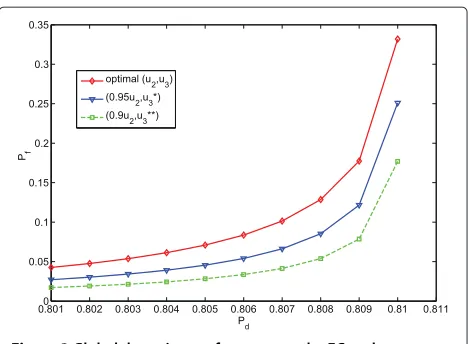
Figure 3 shows the global false alarm probability versus different detection probabilities, when the malicious SU implements contention attack as discussed in Section 4.2. In the simulation, the attack probability is set as 0.7 and the optimal values of attack strength(u2,u3)is obtained
according to Theorem 2. Remind that in Theorem 2, we consider the case that there is a single malicious SU in the system and we setN =5,Nm = 1. Other two curves are
also presented for comparison when 0.95u2and 0.9u2are
set lower than the optimal valueu2,u∗3andu∗∗3 are
corre-spondingly calculated for the givenPd. It can be observed
in Figure 3 that the global false alarm probabilityPf gets its
maximum when the malicious SU implements contention attack.
Figure 2Global detection performance at the FC under different attack probabilities.N=10,Nm=3.
Figure 3Global detection performance at the FC under contention attack.N=5,Nm=1.
Figure 4 shows the global detection probability ver-sus different false alarm probabilities when the mali-cious SU implements interference attack as discussed in Section 4.3. In the simulation, the attack probability is set as 0.7 and optimal value of attack strength (u2,u3)
is obtained according to Theorem 3. Remind that in Theorem 2, we consider the case that there is a single malicious SU in the system and we setN = 5,Nm = 1.
Other two curves are also presented for comparison when 1.01u3and 1.02u3are set larger than the optimal valueu3,
u∗2 andu∗∗2 are correspondingly calculated for the given Pf. As shown in Figure 4, the global detection probability
Pdgets the minimum when the malicious SU implements
interference attack.
6.2 Stealthiness evaluation
In this subsection, we study the impact of the attack prob-ability on stealthiness of the proposed attack model. The
attack strength is set as u2 = u1,u3 = u0, andN =
10,Nm=3.
Figure 5 shows the evolution of the stealthiness metric, defined in (30), under different attack probabilities. Two main observations are as follows:
• After a few sensing slots, the stealthiness metric restrains itself to a constant valueψfor each given attack probabilitypa.
• Malicious users’ stealthiness deteriorates with the attack probabilitypa.
Mathematically, denotekas the index of the sensing slot, the first observation above can be rewritten as:
∃constantM∈R,k>M,ψ(k)=ψ=h(pa) (32) As shown in Figure 5, the secure algorithm is not suffi-ciently valid to probabilistic attack. Essentially, the secure algorithm in [18] uses a reputation accumulation mecha-nism based on history decision information. However, the reputation accumulating process is ruined by such mali-cious SUs that may behave in a honest manner, then turn malicious at the next moment. Furthermore, there exists a probability of collisionpc(k), with which thei-th mali-cious SU’s local decisiondmi (k)is inconsistent with FC’s global decisionD(k), which can be denoted as
pc(k)=P(dm
i (k)=D(k))
=P(H0)P(dm
i (k)=D(k)|H0)+P(H1)P(dmi (k)=D(k)|H1) (33)
Simultaneously, there is a collision between FC’s global decision and a honest user’s local decision with a proba-bilitypc(k)during thek-th sensing slot as well. Consistent
with the stealthiness metric, the collision probabilities restrain themselves to constant values as well.
∃M,k>M,
pc(k)=pc
pc(k)=pc
. (34)
Figure 5Stealthiness under different attack probabilities. N=10,Nm=3.
Furthermore, we can obtain the relation between col-lision probabilities and the stealthiness metric as follows
ψ= pc
pc
. (35)
The second observation above is opposite to the results in Figure 2. Briefly, destructiveness in Figure 2 increases with the attack probability while stealthiness in Figure 5 decreases with the attack probability. Consequently, there should be a trade-off between stealthiness and destruc-tiveness with respect to the attack probability.
Motivated by this discovery, we further plot Figure 6, which shows the global detection error probabilityPeof
the robust defense or secure sensing algorithm devel-oped in [18], under the proposed probabilistic soft attack model. In the simulation,N=10,Nm=3.
Although thex-axis and y-axis of Figures 2 and 6 are of the same content, their results are quite different. The main reason behind the differences lies on the fact that the secure sensing algorithm developed in [18] is adopted at the FC in producing Figure 6 to discard the detected malicious SUs before the global fusion. It is observed in Figure 6 that with defense or secure sensing algorithms into consideration, there generally exists an optimal attack probabilitypa∈(0, 1], not necessarily equal to 1.
Taking the curve with the attack strength(u1,u0)as an
example and comparing it with the curve without mali-cious SUs, we can divide the attack probability into three intervals:
• An interval with a low attack probability than the first point drawn as a circle in Figure 6, namedrole reversal interval, where malicious SUs’ participation does not pose harm to FC’s global fusion, but is beneficial to it.
• An interval of a high attack probability than the second point drawn as a square, namedexposure
interval, where attackers are found out and removed, and their powerful attack action is nearly transparent to FC for their low stealthiness.
• An interval of a medium attack probability between the above two points, namedfavorable attack interval, where effective but stealthy attack can be implemented.
7 Conclusions
In this paper, a generic and novel probabilistic soft SSDF attack model has been proposed. In the proposed attack model, a malicious SU has a certain probabil-ity, varying from 0 to 1, to conduct attacks. Under this generalized SSDF attack model, we firstly obtained closed-form expressions of the global sensing perclosed-formance at the fusion center. Then, we theoretically evaluated the performance of the proposed attack model, in terms of destructiveness and stealthiness, sequentially. More-over, numerical simulations match the analytical results well. An interesting trade-off between destructiveness and stealthiness has also been discovered, which is a funda-mental issue involved in SSDF attack, however, ignored by most of the previous studies.
Appendix
Limitation of attack strength
An extremely large or small value viciously reported by malicious users will bring about huge damage for the fusion center without any defense schames, but such attack behaviors are very prone to be identified. So, before studying optimal attack parameters’ setting, we list restricted conditions as follows:
⎧ ⎨ ⎩
Au2iu3iB
Nηf −uh1<
u3i+u2i
2 <Nηf −uh0
(a)
(b) (36)
whereAandBare constants. In the condition(a), attack stength are restricted within certain intervals determined by the constants A and B and the relationship of size betweenu2i andu3i is referred to before, revealing the
attack intention. Further, the condition(b)is used to avoid the large deviation from honest reports through the inter-constraint relationship betweenu2i andu3i, and the two
sides of the inequation can be used to denote the residual of FC’s threshold minus the honest means.
Competing interests
The authors declare that they have no competing interests.
Acknowledgements
This work is supported in part by the National Natural Science Foundation of China under Grant No. 61172062 and No. 61301160 and in part by Jiangsu Province Natural Science Foundation under Grant No. BK2011116.
Received: 2 March 2014 Accepted: 20 May 2014 Published: 31 May 2014
References
1. J Mitola, Cognitive radio: an integrated agent architecture for software defined radio. Ph.D. Dissertation, KTH (2000)
2. Q Wu, G Ding, J Wang, YD Yao, Spatial-temporal opportunity detection in spectrum-heterogeneous cogntive radio networks: two-dimensional sensing. IEEE Trans. Wireless Commun.12(2), 516–526 (2013) 3. H Rifa Pous, MJ Blasco, C Garrigues, Review of robust cooperative
spectrum sensing techniques for cognitive radio networks. Wireless Personal Commun.67(2), 175–198 (2012)
4. R Chen, JM Park, YT Hou, Toward secure distributed spectrum sensing in cognitive radio networks. IEEE Commun. Mag.46(4), 50–55 (2008) 5. F Penna, Y Sun, L Dolecek, D Cabric, Detecting and counteracting statistical attacks in cooperative spectrum sensing. IEEE Trans. Signal Process.60(4), 1806–1822 (2012)
6. JN Yao, Q Wu, J Wang, Attacker detection based on dissimilarity of local reports in collaborative spectrum sensing. IEICE Trans. Commun. 9, 3024–3027 (2012)
7. H Li, Z Han, Catch me if you can: an abnormality detection approach for collaborative spectrum sensing in cognitive radio networks. IEEE Trans. Wireless Commun.9(11), 3554–3565 (2010)
8. A Vempaty, L Tong, P Varshney, Distributed inference with byzantine data: state-of-the-art review on data falsification attacks. IEEE Signal Process. Mag.30(5), 65–75 (2013)
9. F Farmani, MA Jannat-Abad, R Berangi, Detection of SSDF attack using SVDD algorithm in cognitive radio networks, inIEEE Third International Conference on Computational Intelligence, Communication Systems and Networks (CICSyN):26–28 July 2011 (IEEE, Bali, 2011), pp. 201–204 10. AW Min, KG Shin, X Hu, Secure cooperative sensing in IEEE 802.22 WRANs
using shadow fading correlation. IEEE Trans. Mobile Comput.10(10), 1434–1447 (2011)
11. G Ding, Q Wu, YD Yao, JL Wang, YY Chen, Kernel-based learning for statistical signal processing in cognitive radio networks: Theoretical foundations, example applications, and future directions. IEEE Signal Process. Mag.30, 126–136 (2013)
12. S Cui, Z Han, S Kar, TT Kim, H Poor, A Tajer, Coordinated data-injection attack and detection in smart grid. IEEE Signal Process. Mag. 29(5), 106–115 (2012)
13. R Chen, JM Park, K Bian, Robust distributed spectrum sensing in cognitive radio networks, inINFOCOM. 13-18 April 2008; Phoenix, AZ (IEEE, 2008), pp. 1876–1884
14. Y Han, Q Chen, JX Wang, An enhanced DS theory cooperative spectrum sensing algorithm against SSDF attack, inIEEE Vehicular Technol.ogy Conference (VTC Spring). 6–9 May 2012; Yokohama (IEEE, 2012), pp.1–5 15. P Kaligineedi, M Khabbazian, VK Bhargava, Secure cooperative sensing
techniques for cognitive radio systems, inIEEE International Conference on Communications. 19–23 May 2008; Beijing (IEEE, 2008), pp. 3406–3410 16. N Nguyen-Thanh, I Koo, A robust secure cooperative spectrum sensing
scheme based on evidence theory and robust statistics in cognitive radio. IEICE Trans. Commun.12, 3644–3652 (2009)
17. H Urkowitz, Energy detection of unknown deterministic signals. Proc. IEEE.55(4), 523–531 (1967)
18. K Zeng, P Paweczak, D Cabric, Reputation-based cooperative spectrum sensing with trusted nodes assistance. IEEE Commun. Lett.14(3), 226–228 (2010)
doi:10.1186/1687-6180-2014-81