Volume 2006, Article ID 37952, Pages1–14 DOI 10.1155/WCN/2006/37952
Blind Synchronization in Asynchronous UWB Networks Based
on the Transmit-Reference Scheme
Relja Djapic,1Geert Leus,2Alle-Jan van der Veen,2and Ant ´onio Trindade2
1TNO-ICT, Brassersplein 2, 2612 CT Delft, The Netherlands
2Department of Electrical Engineering, Delft Institute of Microelectronics and Submicron-technology (DIMES), Delft University of Technology, Mekelweg 4, 2628 CD Delft, The Netherlands
Received 15 September 2005; Revised 13 December 2006; Accepted 13 December 2006
Ultra-wideband (UWB) wireless communication systems are based on the transmission of extremely narrow pulses, with a du-ration inferior to a nanosecond. The application of transmit reference (TR) to UWB systems allows to side-step channel estima-tion at the receiver, with a tradeoffof the effective transmission bandwidth, which is reduced by the usage of a reference pulse. Similar to CDMA systems, different users can share the same available bandwidth by means of different spreading codes. This allows the receiver to separate users, and to recover the timing information of the transmitted data packets. The nature of UWB transmissions—short, burst-like packets—requires a fast synchronization algorithm, that can accommodate several asynchronous users. Exploiting the fact that a shift in time corresponds to a phase rotation in the frequency domain, a blind and computationally effcient synchronization algorithm that takes advantage of the shift invariance structure in the frequency domain is proposed in this paper. Integer and fractional delay estimations are considered, along with a subsequent symbol estimation step. This results in a collision-avoiding multiuser algorithm, readily applicable to a fast acquisition procedure in a UWB ad hoc network.
Copyright © 2006 Relja Djapic et al. This is an open access article distributed under the Creative Commons Attribution License, which permits unrestricted use, distribution, and reproduction in any medium, provided the original work is properly cited.
1. INTRODUCTION
Impulse radio (IR) ultra-wideband (UWB), further on sim-ply called UWB, has recently been proposed as a system that can provide high data rate communications (up to 100 Mbit/s) on short distances (order of 10 m). Exploitation of the bandwidth of at least 500 MHz induces a great num-ber of issues in the transceiver design and signal processing (see [1] for a recent overview of UWB signal processing and communications challenges).
The classical transceiver schemes use the data signal in order to modulate a carrier, that is, the spectrum of the data sequence is shifted from the baseband to a higher car-rier frequency. Reversely, in UWB systems a carcar-rier-less ap-proach is employed. The information is conveyed by mod-ulation of temporal pulses of extremely short duration— less than a nanosecond. As a consequence, the spectrum of the UWB signal is covering an extremely large frequency band. To allow for coexistence with already deployed nar-rowband communication systems such as GSM, GPS, and WLAN, the energy of the emitted UWB pulses needs to be lowered to the noise level. In addition, generation of the pulses is an extremely low-complexity and low-power op-eration [2] and therefore facilitates the accomplishment of
low-cost transmitter devices. All these features make impulse radio attractive for high data rate, short distance, and mul-tiuser personal area networks (PAN).
Propagation of a temporally narrow pulse (in the order of a nanosecond), also known as amonocycle, results in a chan-nel impulse response that is much longer than the duration of the pulse itself and that has a large number of delay taps [3]. As the channel resolution is inversely proportional to the bandwidth of the signal, differences in path delays or path lengths of 1 ns and 30 cm, respectively, can be resolved [4,5]. The resulting low probability of multipath fading permits a larger amount of transmitted energy to be collected at the receiver.
The large bandwidth of UWB signals allows to accommo-date multiple simultaneous users. The most common mod-ulation scheme that facilitates coexistence of multiple users in UWB systems is time-hopping pulse position modulation (TH-PPM) [6]. A monocycle is considered to be a part of a longer time interval defined as a frame. To avoid collisions due to multiple access, each user is assigned a random time-hopping code and shifts his monocycles within frames ac-cording to it.
the channel impulse response has to be estimated and con-volved with the known user code to obtain the template ap-plied in the correlation process with the received signal. Per-forming an exhaustive search over different delays, averaging over several data symbols and finally searching for the maxi-mum of the recollected energy function provide the estimate of the packet offset. Note that for this kind of receiver the knowledge of the channel is required. Some authors propose the implementation of a RAKE receiver to obtain the esti-mate of the channel but taking into account the current state of technology, we consider this approach unsuitable for im-plementation in a low-cost UWB transceiver because of the high computational complexity and high sampling rates.
A way to avoid channel estimation is in the implementa-tion of a transmit-reference transmission scheme introduced already in [7] and revived by Hoctor and Tomlinson [8,9]. The idea consists of the transmission of two pulses (doublet) one after another, where the first pulse is used as the refer-ence for the second pulse which is modulated with data (po-larity of the pulse corresponds to data symbols{−1, +1}). Both pulses undergo the same multipath channel. At the re-ceiver, the reference pulse is delayed and correlated with the data pulse allowing to recollect the energy which was spread by the channel. The effective data rate is thus reduced by 50% but the receiver sampling rate and complexity are highly re-duced because the correlation and integration steps are done in the analog part of the receiver.
Taking into account the fact that the UWB signal is trans-mitted at low-power level (comparable to the noise level), further performance improvements by suppressing the noise are possible as proposed in [10]. In [11], an advanced noise-less data model for a specific TR-UWB receiver was derived, taking into account that the channel has a long impulse re-sponse. The extension of this data model to the noisy case is presented in [12].
The work in [11,12] represents the starting point for the present paper. In contrast to [11,12], we consider finite data packets with an unknown time offset. The particular struc-ture of the TR-UWB scheme only requires a synchroniza-tion at the chip-level, which is an easier problem than syn-chronization for more traditional pulse-based UWB schemes where the starting point of a very narrow pulse has to be found. Hence, the blind synchronization problem considered in this paper is to find the known user code at an unknown offset, which is an extension of a similar problem considered in CDMA, now for a more complicated data model. In par-ticular, we propose an extension of the blind channel estima-tion algorithm for CDMA proposed by Torlak and Xu [13]. The received data samples are stacked in a matrix such that a shifted version of the user specific block code is in its column span. Subsequently, we exploit the fact that a shift in time corresponds to a phase rotation in the frequency domain. Fi-nally, a MUSIC-like search for a shift invariant vector in the signal subspace provides a high resolution delay estimate.
Notation
Tdenotes the matrix transpose,Hthe matrix complex
conju-gate transpose,†the matrix pseudoinverse (Moore-Penrose
D3
D2
D1
r(t)
t t W
t t W
t t W
x3(t)
x2(t)
x1(t)
DSP
Figure1: The structure of the autocorrelation receiver.
inverse).I(orIp) is the (p×p) identity matrix.0(or0p×q)
and1(or1p×q) are (p×q) matrices for which all entries are
equal to 0 and 1, respectively. For a vector, diag(v) is a di-agonal matrix with the entries ofvon the diagonal.⊗is the Kronecker product. vec(A) is a stacking of the columns of matrixAinto a vector.
2. SINGLE USER DATA MODEL
2.1. Single doublet
In the TR-UWB scheme presented in [11, 14], pulses g(t) are transmitted in pairs (doublets) which are mutually sep-arated by a delay Di, i = 1, 2,. . .,M, where M represents
the total number of delays used. Besides, we assume that D1< D2<· · ·< DM. The first pulse is fixed and represents
the reference, whereas the second one is modulated with the data. In the sequel, we first describe the data model for the synchronous single doublet transmission. In addition, we outline the parameters that arise as a result of the deployment of the specific correlation receiver derived in [11,12,15].
Consider the transmission of a single doubletd(t),
d(t)=g(t) +c·s·gt−Di
, (1)
whereg(t) represents a reference pulse whilec·s·g(t−Di) is
a data modulated pulse, with scalarsc= {±1}ands= {±1}
representing a polarity code and a data symbol, respectively. Accordingly, the sign of the data modulated pulse is defined by the value ofc·s = {±1}. We assume that a doublet is placed within a frame of lengthTdand that a constraint
Td≥Th+ 2 max
Di
=Th+ 2DM (2)
holds, whereThstands for the duration of the channel
im-pulse response. This condition implies that the im-pulses of a doublet affected by the channel fade out completely within a single frame after correlation (seeFigure 1). In this manner, the existence of interframe interference in case of multiple doublet transmission is prevented (seeFigure 4). After prop-agation through a long convolutive channel, the signal at the output of the receiver antenna can be written as
r(t)=h(t) +c·s·ht−Di
, (3)
whereh(t)=g(t)hp(t) represents the overall channel
50 0 50 100 150 200 250 300 0.1
0 0.1 0.2 0.3 0.4 0.5 0.6 0.7 0.8 0.9
Time (ns)
A
m
plitude
m=1 m=2 m=3
(a)
0 10 20 30 40 50
0.1 0.05 0 0.05 0.1 0.15
Time (ns)
A
m
plitude
(b)
Figure2: (a) The signal at each of theM=3 integrator outputs. (b) A measured UWB channel impulse response in a typical university building used to generate (a).
that the latter comprises the effects of the transmit and re-ceive antennas together with the wireless propagation chan-nel.
Since both pulses of a doublet undergo the same chan-nel, one is used as a “matched filter” for the other one at the receiver. This is the principle behind the autocorrelation re-ceiver depicted inFigure 1[11,14]. The received data r(t) is delayed over all possible delaysDm,m= 1, 2,. . .,M, and
correlated with the original nondelayed signal. Finally, inte-gration with a sliding window of widthWat themth receiver branch yields
xm(t)=
t
t−Wr(τ)r
τ−Dm
dτ. (4)
50 0 50 100 150 200 250 300 350 0
0.5 1 1.5 2 2.5 3
Time (ns)
A
m
plitude
m=1 m=2
m=3 P=Nd
Figure3: The signal at the output of the 1st, 2nd, and 3rd receiver branches. A single chip transmission is considered that comprises Nd=3 doublets. The width of the sliding window integrator isW= Tc=3Td.
Let us now introduce the channel correlation function
ψ(t,Δ)=
t
t−Wh(τ)h(τ−Δ)dτ. (5)
AssumingW ≥ Td > Th, we can writeψ(t,Δ)=b(t)ρ(Δ).
Here,ρ(Δ) = 0∞h(τ)h(τ−Δ)dτ depicts the energy recol-lected in the correlation process. It is maximized forΔ=0 and is, in general, nonzero forΔ=0 (see [15]). Further,b(t) has a brick shape and can be written as
b(t)=
⎧ ⎪ ⎪ ⎪ ⎪ ⎨ ⎪ ⎪ ⎪ ⎪ ⎩
1, Th< t≤W,
0, t <0 or t > Th+W,
ψ(t,Δ)/ρ(Δ), 0≤t < Th or W < t≤W+Th.
(6)
Note that in the regions 0 ≤t < Th andW < t ≤W+Th,
b(t) depends on the particular channel realization but it is approximated by a linear rising and decaying slope, respec-tively.
If we now assume thatW DM, the output of themth
integrator (4), in case delayDiis used at the transmitter and
Dmat the receiver, becomes [15]
xm(t)=b(t)
2ρDm
+c·s·ρDm−Di
+ρDm+Di
=b(t)αm,i·c·s+βm
,
(7)
whereαm,i = ρ(Dm−Di) +ρ(Dm+Di) andβm = 2ρ(Dm)
transmitter delayDiand the receiver delayDm, the DC off
-set only depends on the receiver delayDm. Moreover, both
αm,iandβmdepend on the particular correlation properties
of the channel, as indicated in [11]. Note that althoughαm,i
is generally maximal ifm=i, some residual information re-mains whenm=i, as an effect of the channel correlation.
Figure 2(a)depicts the response of the system to a sin-gle transmitted doublet for the channel impulse response of Figure 2(b). The latter is obtained from a measurement cam-paign performed in a typical university building [16]. The spacing between the pulses at the transmit side is chosen to beD3 = 2.1 ns, the data symbol iss = +1, and the polar-ity code isc=+1. At the receiver side three delay branches m=1, 2, 3 are deployed whereDm = {0.7 ns, 1.4 ns, 2.1 ns}.
Deploying a sliding window integration that is three times wider than the frame width, that is, W = 3Td = 180 ns
produces the signal xm(t) with a nonzero support in the
range [0,W+Th]. In our case the length of the channel is
Th =50 ns. The solid line depicts the signal at the output of
the third receiver branch for the matched transmit and re-ceive delaysΔ=Dm−Di=0. Signals for the nonmatching
delaysDm=Diare depicted by dashed and dash-dotted lines.
2.2. Single chip transmission
According to the spectral regulations, the UWB signal needs to be transmitted at very low-power level. In order to be able to extract the useful information at the receiver side some kind of spreading gain needs to be introduced. The most sim-ple approach is to repeat several, say,Ndframes of total
du-rationTc=NdTd. Define such a sequence of frames asa chip
in which the spacing between pulses (Di) and the polarity of
the information pulses (c·s) remains unchanged. In such a case the transmitted signaltx(t) is given by
tx(t)=
The signal at the output of themth receiver branch is computed as the superposition of the contributions ofNd
doublets
The function p(t) represents a typical response of the sliding window integration process for a case in which a sin-gle chip is considered. In general, p(t) has a staircase tent shape and is modeled as
p(t)=
whereb(t) is the brick shape function defined in (6). Note that sinceb(t) depends on the particular channel realization, so doesp(t).
InFigure 3the signalxm(t) at the integrator outputs is
represented. A transmission of a single chip containing three doubletsTc=3Tdis taken into account. The strongest signal
is obtained for matching transmit and receive delays (solid line). Dashed and dash-dotted lines depict the cases in which a delay mismatch occurs (Dm=Di). In these cases, the signal
is nonzero due to the effect of channel correlation coefficients αm,iandβm. Note that even though the transmitted chip is
Tcwide, the deployment of a sliding window integration of
widthW =Tcexpands the nonzero support of the signal at
the receiver side to the [0, 2Tc] region.
2.3. Transceiver design for asynchronous multiple symbol transmission
In this section, we build a data model for the asynchronous transmission of multiple data symbols. As UWB systems cover a large frequency band and in order to avoid catas-trophic collisions in multiuser scenarios, the broadcasted sig-nal is spread by means of the polarity and time-hopping codes. As described inSection 2.1the basic information unit is aframeof durationTd. Further,Ndframes represent a chip
of durationTc=NdTd, andNcchips represent a data symbol
of durationTs=NcTc. The jth chip of thekth data symbol
is modulated byskcj, where sk ∈ {±1}represents the data
symbol sequence andcj∈ {±1},j =0, 1,. . .,Nc−1,
repre-sents the polarity code. The value of the delayDiis constant
within the jth chip but changes from chip to chip accord-ing to the so-called time-hoppaccord-ing codeJi,j,i = 1, 2,. . .,M,
j=0, 1,. . .,Nc−1, which is 1 if the delayDiis used for the
jth chip and 0 otherwise. To summarize, the transmitted se-quence can be written as
tx(t)=
An example of a transmitted pulse sequence for a single sym-bol is presented inFigure 4.
Hence, we can write the received sequence as
r(t)=
Note that we consider no additive noise throughout this work, in order to simplify the presentation. However, all the simulations will be carried out in the presence of noise.
The output of the mth receiver branch in an asyn-chronous single user scenario is then modeled as
Tc Td Td Td
D2 D1 D3
Doublet s1c0=1 s1c1= 1 s1c2=1 Chip
Figure4: The structure of a transmitted UWB signal. The data symbol is set tos1=+1. The polarity (CDMA) code vector comprises three
chipsc=[c0,c1,c2]T=[+1,−1, +1]T, the delay code isJ=[J2,0,J1,1,J3,2]T. The latter means that the transmit delaysD2,D1, andD3are used
for the 1st, 2nd, and 3rd chips, respectively.
x3(t) p(t τ)(α3,2s1c0+β3) s1c2=+1
t x2(t)
p(t τ)(α2,2s1c0+β2)
s1c0=+1
s1c1=+1
t x1(t)
Tc 2Tc 3Tc 4Tc 5Tc 6Tc
p(t τ)(α1,2s1c0+β1)
τ
t
Figure5: The appearance of the signals at the integrator outputs for the single transmitted data symbol presented inFigure 4.
whereτ represents an unknown delay of the received data signal with respect to the beginning of the analysis window, which we try to estimate in this work. Since short polarity and time-hopping codes (cjandJi,j) are considered and
sym-bols are assumed unknown in a first stage, we may restrictτ to the intervalτ∈[0,Ts).
An example of the expected behavior of the signals at the output of the integrators is presented inFigure 5. Solid lines represent the integrator output for matched transmit and re-ceive delays (Dm=Di) while dashed lines depict the residual
information for nonmatching delaysDm = Di. The overall
signal at each receiver branch is obtained as the sum of the matched and nonmatched delay contributions (sum of solid and dashed lines).
The bandwidth ofxm(t) is of the same order of
magni-tude as the chip rate, which is significantly smaller than the transmission bandwidth. Hence, at this point, it is realistic to introduce sampling and switch to the digital domain. Let us samplexm(t) at rateP/Tc, wherePis the oversampling factor.
The sampled signal can then be written as
xm,n=xm
nTc/P
= ∞
k=−∞
Nc−1
j=0
M
i=1 pn,j+kNc
αm,iJi,jcjsk+βmJi,j
, (14)
wherepn,j=p(nTc/P−jTc−τ). The crucial observation now
is that if we sample once per frame, that is, if we sample at rateP=Nd,pn,jmay be observed as a sequence of samples of
a perfectly known triangular pulse shape (see dash-asterisked line in Figure 3). As a result, pn,j is completely known ifτ
is an integer multiple ofTc/P. This fact is exploited in the
process of estimating an arbitrary offset τ as presented in Section 3.
We generally stack the NcP samples xm,n, n = kNcP,
kNcP+ 1,. . ., (k+ 1)NcP−1 together in theNcP×1 vector
xm,k=
xm,kNcP,. . .,xm,(k+1)NcP−1
T
and stack theMvectorsxm,k,m=1, 2,. . .,M, together in the
NcP×Mmatrix
Xk=
x1,k,. . .,xM,k
. (16)
We now first introduce a matrix model for a single transmit-ted data symbol, and then generalize this to multiple trans-mitted data symbols.
2.4. Single transmitted data symbol-matrix model
Suppose only thekth symbol is transmitted. If we then stack verticallyXkandXk+1, we obtain as in [17] the following ma-trix model for a single transmitted data symbol:
Xk
Xk+1
=Pdiag(c)JTATs
k+P1Ncb
T, (17)
whereAandbare theM×Mmatrix andM×1 vector defined as [A]m,i =αm,iand [b]m =βm, respectively. As mentioned
before, they depend on the correlation properties of the channel. It can be shown thatAis symmetric, approximately Toeplitz, and diagonally dominant with positive entries on its main diagonal. TheNc×1 vectorc=[c0,. . .,cNc−1]
Tis the
known polarity code vector. The matrixJof sizeM×Ncis
a known selector matrix which has a single unit element per column (chip), which determines the transmitter delay for that column (chip), or more specifically, [J]i,j+1=Ji,j. Finally,
Pis the 2NcP×Ncblock-Toeplitz matrix whose columns are
shifts ofpn,j, or more specifically, [P] n+1,j+1=pn,j.
Let us now splitτ in an integer delayκand a fractional delayasτ=κTc/P++Tc/(2P), whereκ∈ {0,. . .,NcP−1}
and∈[−Tc/(2P),Tc/(2P)) (the additional offsetTc/(2P) is
included to force the interval forsymmetric around 0). This allows us to writePas
P=
⎡ ⎢ ⎣
0κ×Nc
P 0(K−κ)×Nc
⎤ ⎥
⎦, (18)
whereK = (Nc−1)P andPis the (Nc+ 1)P×Nc
block-Toeplitz matrix with entries given by [P]n+1,j+1=p(nTc/P−
jTc+Tc/(2P)−), that is, it only depends on(seeFigure 6).
In other words, if we only focus on coarse synchronization, we may assume that=0 and thus thatPis known.
As a result, we can rewrite (17) as
Xk
Xk+1
=
⎡ ⎢ ⎣
0κ×M
Pdiag(c)JT
0(K−κ)×M
⎤ ⎥ ⎦ATs
k+
⎡ ⎢ ⎣
0κ×1 P1Nc
0(K−κ)×1 ⎤ ⎥ ⎦bT
=
⎡ ⎢ ⎣
0κ×M 0κ×1
Z q
0(K−κ)×M 0(K−κ)×1 ⎤ ⎥ ⎦
ATs k
bT
,
(19)
whereZ:=Pdiag(c)JTis a (N
c+ 1)P×Mcode matrix, which
is known if = 0, andq := P01Nc ≈ 1(Nc+1)P is a known
(Nc+ 1)P×1 offset vector. The approximationq≈1(Nc+1)P
follows from the structure of thePmatrix. The channel pa-rametersAandbas well as the data symbolskare unknown.
P=
Figure6: The structure of thePmatrix. Each darkened block (a vector) collects the samples ofp(t) and the shifts thereof;p(t)=0 fort∈(0, 2Tc).
Analysis window
XT1 XT2
0 0
ZTs1 τ
Figure7: A single symbol spread by the block code, shifted overτ with respect to the beginning of a data packet.
The representation of the block matrix structure for a single symbol is depicted inFigure 7.
Observe that the presented data model resembles a con-ventional data model for DS-CDMA, up to the channel gain (A) and DC offset (b) term of the channel correlation. This will allow us to use synchronization methods similar in spirit to the DS-CDMA synchronization methods. But before we introduce these synchronization methods, we first general-ize the above model to a data model for multiple transmitted data symbols.
2.5. Multiple transmitted data symbol-matrix model
When transmission of multiple data symbols is considered, intersymbol interference (ISI) arises due to the implemen-tation of the sliding window integration. Generally two data symbols affect a single block of received dataXk. Therefore,
Analysis window
XT0 XT1 XT2 XT3
ZTs 1 ZTs0 ZTs1 ZTs2 ZTs3
τ
Figure8: The structure of the analysis window for an asynchronous TR-UWB scheme.
comprise the effects of the polarity and time-hopping codes as well as the effect of the pulse shape p(t). We begin with defining the second block columnZτ, which is similar to the
first block column of (19):Zτ =[0Tκ×M,ZT,0T(K−κ)×M]T. This
block column comprises the complete version of a user spe-cific code matrixZ=Pdiag (c)JT, which is known if =0,
shifted by an integer delayκ. The other two block columns Zτ andZτ can be defined asZτ =[ZT,0T(NcP+K−κ)×M]
“subsequent” data symbol, respectively. It is thereby crucial to observe thatZ=[ZT
ZT
]T. Writing (20) in a more
com-pact form, we obtain Let us now define a received data matrixXas
X=
wherenis the length of the analysis window over which data is collected. Using (21), we can write this matrix as
X=G 1 S the received data blocks for multiple transmitted symbols is depicted inFigure 8.
In the case where the analysis window is not within the transmitted packet, we can use the same model but allow some of the symbolsskto be zero (note that1Tn⊗bTwill also
change in that case).
3. BLIND SYNCHRONIZATION ALGORITHM
3.1. Optimization problem
We now describe the synchronization algorithm. InFigure 8 the relation between the received data at the integrator
outputsXkand the transmitted symbols is presented. We
scribe a block algorithm that provides an estimate of the de-layτ, and also allows us to estimate the data symbolssk.
The algorithm is an extension of the algorithm of Torlak and Xu [13], who considered blind channel estimation for DS-CDMA using subspace techniques. The idea is to use the property that the matrixGis orthogonal to the left nullspace (U0) of the matrixX, that is,UH0G=0. We can use this rela-tionship in order to find an estimate ofτ. More specifically, we solve
and the second halves of theith column ofU0, respectively. Z1andZ2are of sizeNcP×Mand represent the upper and
lower halves of the middle block column ofG, that is,Zτ =
[ZT
1 ZT2]T.
We now aim to transform (24) without changing the cri-terion, in order to bring out the block columnZτ, containing
the user specific code matrix Z, which is known if = 0, shifted by an integer delayκ. Restacking (24) as in [13] yields
arg min
Here,isweeps all the vectors from the left null space ofX. By stacking horizontallyU(i)for all possiblei’s we get the matrix
U0. Now (25) can be written as
At this point, let us make a distinction between integer delay estimation and noninteger delay estimation.
3.2. Integer delay estimation
We first assume that = 0, and focus on the estimation of the integer delayκ. As already mentioned before, if=0, the matrixPand thus the matrixZare completely known. As a result,Zτ, which can then be written asZκTc/P, only depends
This can be solved by performing an exhaustive search over κ∈ {0,. . .,NcP−1}, since we knowZκTc/Pup to the integer
delayκ.
Since the above time-domain approach is rather compu-tationally intensive, we switch to a much simpler frequency-domain approach, recognizing that an integer shift in the time domain corresponds to a phase shift in the frequency domain. More specifically, we can writeZκTc/Pas
ZκTc/P=F
H
X0
n⊗b)]Tfor the asynchronous single user case using a TR-UWB scheme.
where F stands for the 2NcP ×2NcP normalized discrete
Fourier transform matrix, Dτ represents the 2NcP ×2NcP
diagonal matrix given by
Dτ=diag
Due to the structure ofφκTc/Pthat corresponds to the (κ+1)th column of the FFT matrixF, searching for the φκTc/P that minimizes the last expression is equivalent to performing an inverse FFT (IFFT) on the matrixK and searching for the row of the resulting matrix that has the lowest norm. The index of the row with the lowest norm determines the in-teger delayκ. Note that through the use of the (I)FFT this frequency-domain approach is much simpler than the earlier developed time-domain approach. However, since we have assumed=0, the resolution of this algorithm is limited by the sampling periodTc/P. This problem will be treated in the
next section.
In order to compare the computational complexity of the integer delay estimation carried out in the time and frequency domain, we compute the number of multipli-cations needed in both cases. The time-domain search requires O(2M2(N
cP)4) multiplications, in contrast to O(M2(2N
cP)2log2(2NcP)) multiplications in case the
pro-posed frequency-domain search is employed.
3.3. Noninteger delay estimation
Let us now consider the more general case, where=0. We can then actually proceed as in the previous section, by ob-serving that if the sampling rate is close to the Nyquist rate, we can also express a noninteger shift in the time domain by a phase shift in the frequency domain. In other words, we can extend (28) for the noninteger delay case to
Zτ=FHDτFZ0. (31)
Following similar steps as in the previous section, we can then transform (26) to
arg min
As before, we can first look for an integer delayκby comput-ing the IFFT ofK and searching for the row of the result-ing matrix that has the lowest norm. The fractional delayis then obtained by performing an additional fine grid MUSIC-kind search aroundκT c/P:
After estimating the delayτ, we can reconstruct the complete Gmatrix. Estimation of the transmitted data symbols is now possible by performing a deconvolution of the matrixX us-ing the known user code, that is, we compute
where †denotes the pseudoinverse. We subsequently limit our attention to the middle block row ofS, name itSas the part that carries most of the energy (see alsoFigure 9). The data symbols at this point can be estimated fromSin two different ways [17]: (i) by computation of the trace of the M×M data blocksAsk, or (ii) by vectorizing theM ×M
data blocksAskand stacking the results column-wise into a
4. EXTENSION TO THE MULTIUSER CASE
In this section, we extend the previous ideas developed for a single user to multiple users. Let us start by extending the data model ofSection 2.5to multiple users. This is not triv-ial, since next to the autocorrelation terms of the different users, there are also crosscorrelation terms, due to the use of the autocorrelation receiver. However, since different users employ distinct time-hopping and polarity codes, propagate through different channels, and arrive at the receiver at ran-dom time instants, we can treat these cross terms as addi-tive white noise, and add them to the other noise terms that might be present. As before, we do not take the additive noise terms into account in our derivations, but we do include them in our simulations.
As a result, indicating the user index by means of a su-perscriptq(q =1, 2,. . .,Q), we can write the received data are not active for the duration of the whole analysis window, severalS(kq)matrices will be zero and some small changes in the structure of1T
n⊗
Q q=1b(q)
T
will occur. Consequently, a few additional vectors with low energy may emerge in the left signal space.
4.1. Identifiability for multiuser case
In the multiuser (MU) case as presented in (35), the ma-trix GMU = [G(1)|···|G(Q)|1] is of size 2N
cP ×(3MQ + 1),
whereas the matrix comprising all data blocks and offset effects, SMU = [S(1)T,. . .,S(Q)T,1n⊗
Q q=1b(q)]
T
, is of size (3MQ+ 1)×Mn. In order to determine the column space ofGMUfromX(and hence its left nullspace),GMUshould be
tall and of full column rank, that is, 2NcP > 3MQ+ 1, and
SMU should be fat and of full row rank, that is, 3MQ+ 1<
Mn. Note that a full column rankGMU is also required to
subsequently detect the data symbols. From the first con-dition, a limit on the code size is obtained:Nc >3MQ/2P,
which for typical values ofP=2 andM=4 yieldsNc>3Q.
The condition on the size ofSMU gives the relation between
the number of usersQand the lowest number of symbols transmittedn, that is,Q <(Mn−1)/3M.
5. APPLICATION IN UWB NETWORKING
The ability to achieve high resolution packet offset estimation in a multiuser environment in a fast and computationally
simple way is of crucial importance for the subsequent data symbol estimation step. Imagine the scenario of a UWB ad hoc network where users need to exchange their codes at the moment they join the network. The simplest way to solve this problem is to implement a common codeknown to all the users in the initialization phase. In existing wireless net-work protocols a data packet is considered to be lost if several users simultaneously use the same code which is known as the packet collision problem. Nevertheless, the structure and the design of the considered TR-UWB scheme will allow us to avoid the collision problem. In TR-UWB systems, different users propagate through different channels creating distinct correlation matricesA(i). This can be viewed as an additional coding introduced by the channel itself and can be adopted to solve the collision problem, as illustrated next.
Consider a two-user system where both users adopt the same spreading code. The data model (35) then becomes
X=Gτ1 Gτ2 1
The synchronization of both users to the common code and the subsequent data detection is in general only possible if τi=τjfori= jand by implementation of a common code
that has a low autocorrelation property.
But even if the two users completely overlap in time it is still possible to separate both overlapping users and detect their data sequences. In that case the linear dependency be-tweenGτ1andGτ2reduces the rank of the code matrix, that which can be modeled as
Performing the vectorization of eachM×Mblock ofSyields produces a rank-two decomposition and is an indication of the existence of two overlapping users. Now, the column vec-tors (a(1),a(2)) and the data symbols ({s(1)
k },{s
(2)
k }) can be
es-timated from the column and row span ofS
0 5000 10000 15000 0.25
0.2 0.15 0.1 0.05 0 0.05 0.1 0.15 0.2 0.25
Time (ns)
Amplitude
The received noiseless signal
(a)
0 5000 10000 15000
0.25 0.2 0.15 0.1 0.05 0 0.05 0.1 0.15 0.2 0.25
Time (ns)
Amplitude
The white noise added at the receiver
(b) Figure10: Received single user signal (a) and noise (b) (Eb/N0=34 dB).
26 28 30 32 34 36 38 40 42
0 10 20 30 40 50 60 70 80 90 100
Eb/N0(dB)
Re
co
ve
ry
fa
il
u
re
ra
te
(%
)
Recovery failure rate for delay estimates
Subspace scheme Correlation
1 user case
Onset=[0(Nc 1)Tc] P=3
M=3 Ns=30 Nc=15 MCruns=200
Figure11: The percentage of incorrectly estimated packet offsets using the proposed subspace-based (solid line) and correlation-based (dashed line) schemes.
6. SIMULATIONS
6.1. Single user case
The performance of the proposed algorithm is first tested for a single user in noise. Signals are generated in accordance to the description provided inSection 2. Two hundred and fifty Monte Carlo runs are performed for fixed polarity and time-hopping codes. Data symbols and noise are varied in each
26 28 30 32 34 36 38 40 42
0.16 0.18 0.2 0.22 0.24 0.26 0.28 0.3 0.32 0.34
Eb/N0(dB)
Standar
d
de
vi
ation
Subspace scheme Correlation
1 user case
Onset=[0(Nc 1)Tc] P=3
M=3 Ns=30 Nc=15 MCruns=200
Figure12: Standard deviation of the correctly estimated packet off -set delays.
run, as well as the packet offsets, which are randomly chosen from the interval [0,NcTc). We consider the transmission of
Ns = 30 data symbols, a polarity code length ofNc = 15
26 28 30 32 34 36 38 10 2
10 1
100
Eb/N0(dB)
BER
Subspace scheme Correlation
1 user case
Onset=[0(Nc 1)Tc] P=3
M=3 Ns=30 Nc=15 MCruns=200
Figure13: BER of the estimated data symbols computed for all es-timates ofτ.
site and nonline of site channel impulse responses are cov-ered in this fashion (see [16]). A sampling rate of 10 ps is used in the channel measurements. We limit the measured channel impulse responses to the interval [0, 50] ns, as the contributions of the channel components that fall outside this interval are insignificant. The duration of the frame is chosen to beTd = 60 ns. The energy of a single
transmit-ted data symbol (bit) is defined asEb = 2NdNc
[h(t)]2dt, whereh(t) represents the total channel impulse response, in-cluding the monocycle and the transmit and receive antenna effects.N0is the power spectral density of the white Gaussian noise which is added after the receive antenna. TheEb/N0is changed in steps of 1 dB.
After the white Gaussian noise is added, a bandpass fil-tering is performed to limit the bandwidth of the observed signal to the interval 4–10 GHz. This filtering step reduces the impact of the noise and the low-frequency interference. Note though that theEb/N0is computed before the filtering. At the output of the autocorrelation receiver with three receiver branches, oversampling is performed at a rate equal to the number of frames per chip, that is,P=Nd=3. Note
that the oversampling factorP =3 leads to a sampling rate that is still lower than the Nyquist rate for the expected pulse shapes at the integrator outputs, but it is sufficient as the es-timation errors forτ are negligible compared to sampling at the Nyquist rate [18].
An example of a received single user signal and noise (af-ter bandpass fil(af-tering) is presented inFigure 10. In this figure Eb/N0 = 34 dB. At thisEb/N0, the useful signal will clearly drown in the noise, yet the proposed method can synchro-nize, as will be illustrated next.
Figure 11shows the percentage of cases where the packet offset is estimated incorrectly. An estimate is considered to be
0 2000 4000 6000 8000 10000
0.04 0.03 0.02 0.01 0 0.01 0.02 0.03 0.04
Time (ns)
A
m
plitude
(a)
0 2000 4000 6000 8000 10000
0.04 0.03 0.02 0.01 0 0.01 0.02 0.03 0.04
Time (ns)
A
m
plitude
(b)
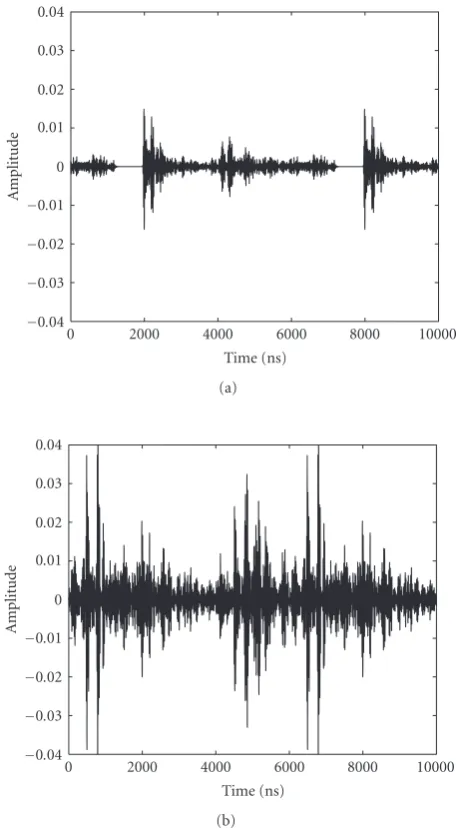
Figure14: Received signal of a single user (a) and three users (b) (SIR= −10 dB).
incorrect if it does not fall into the intervalτ−Tc/2 ≤τ <
τ+Tc/2. The solid line depicts the performance of the delay
estimation based on the subspace-based frequency-domain search (as presented in Section 3.3), while the dashed line shows the performance of the correlation-based scheme:
arg max
τ
XH
G2, (40)
which can be solved in a similar fashion as the subspace-based scheme, but which does not require a subspace de-composition.Figure 12shows the standard deviation of the “good” estimates ofτexpressed as a fraction of the chip du-rationTcfor the subspace-based (solid line) and
20 15 10 5 0 5 10 0
10 20 30 40 50 60 70 80
SIR (dB)
Re
co
ve
ry
fa
il
u
re
ra
te
(%
)
Recovery failure rate for delay estimates
2 users 3 users 4 users
Onset=[0(Nc 1)Tc] P=3
M=3 Ns=30 Nc=15
Figure15: The percentage of incorrectly estimated packet offsets.
6.2. Multiple user case
In this section, we test the resistivity of the proposed syn-chronization scheme to multiuser interference. To clearly see the effect of the multiuser interference, we consider a noise-less scenario. We define the signal to interference ratio (SIR) as SIR = 10 log(P1/PI), where Pi represents the energy of
a single data symbol (bit) of user i at the receiver before the bandpass filtering step is carried out. Note that it cor-responds to the Eb for user i. As each data symbol (bit) is
spread overNcchips and further overNd frames containing
two pulses (a doublet) the signal energy can be expressed as Pi = 2NdNc
[h(i)(t)]2dt, where h(i)(t) is the channel cor-responding to user i. PI =
N
i=2Pi collects the energy Pi
of all interfering sourcesi = 2,. . .,N. InFigure 14, the re-ceived signal of a single user (a) and three users (b) can be observed (after bandpass filtering). For the three-user case, we take SIR = −10 dB, that is, the two interfering users to-gether are 10 dB stronger than the user of interest. Note that thex-axis represents the number of samples, where sampling is performed at a rate of 10 ps.
InFigure 15, we present the recovery failure rate versus the signal to interference ratio. Any packet offset estimateτ that does not fit into the rangeτ −Tc/2 < τ < τ +Tc/2
is considered to be a failure. The chosen interval is consid-ered to provide sufficient recovery of the energy after the deployment of a decorrelating receiver. We start by choos-ing a time-hoppchoos-ing and polarity code, the latter bechoos-ing a gold code sequence of lengthNc. Both codes remain unchanged
in all Monte Carlo runs. In each run, a new set of channels as well as packet offsets is assigned to each of the users and is kept the same for all the values of the SIR changed in steps of 5 dB. Ns = 30 stands for the number of data symbols
20 15 10 5 0 5 10
0.13 0.14 0.15 0.16 0.17 0.18 0.19 0.2 0.21 0.22
SIR (dB)
Standar
d
de
vi
ation
2 users 3 users 4 users
Onset=[0(Nc 1)Tc] P=3
M=3 Ns=30 Nc=15
Figure16: Standard deviation of the correctly estimated packet off -set delays.
within a transmitted packet. The oversampling rateP = 3 equals the number of frames (doublets) per chip. Delays used in the time-hopping scheme are chosen to be D1 = 1 ns, D2 = 2 ns, and D3 = 3 ns. InFigure 15, the solid, dashed, and dash-asterisked lines correspond to the two-, three-, and four-user cases, respectively. The performance of the algo-rithm drops by increasing the total number of users. This can be explained by an augmented influence of the cross-correlation terms as the number of users increases. However, in the four-user case, the algorithm exhibits a low failure rate even for SIR = 0 dB, that is, in the case the energy of the signal of interest equals the energy of all interfering sources. This issue could be improved by selecting the user codes to have lower cross-correlation properties for any code offset.
Figure 16describes the standard deviation of the “good” estimates ofτexpressed as a fraction of the chip durationTc.
Due to the low number of Monte Carlo iteration, and to the unresolvable ambiguity related to the initial sampling point, the three-user scenario has a slightly degraded performance compared to the other scenarios.
7. CONCLUDING REMARK
In this paper, we have presented an algorithm that pro-vides fast, low-complexity, blind packet synchronization in multiuser TR-UWB systems. Its foremost application could be the fast initial code exchange in multiuser asynchronous UWB ad hoc networks.
ACKNOWLEDGMENTS
channel impulse responses. This research was supported in part by the Dutch Min. Econ. Affairs/Min. Education Freeband-impulse projectAir-Linkand by NWO-STW un-der theVICIprogram (DTC.5893). Parts of this paper were presented in [17,19].
REFERENCES
[1] L. Yang and G. B. Giannakis, “Ultra-wideband communica-tions,”IEEE Signal Processing Magazine, vol. 21, no. 6, pp. 26– 54, 2004.
[2] S. Bagga, W. A. Serdijn, and J. R. Long, “A PPM Gaussian monocycle transmitter for ultra-wideband communications,” inInternational Workshop on Ultra Wideband Systems; Joint with Conference on Ultra Wideband Systems and Technologies, pp. 130–134, Kyoto, Japan, May 2004.
[3] D. Cassioli, M. Z. Win, and A. F. Molisch, “The ultra-wide bandwidth indoor channel: from statistical model to simu-lations,”IEEE Journal on Selected Areas in Communications, vol. 20, no. 6, pp. 1247–1257, 2002.
[4] M. Z. Win and R. A. Scholtz, “On the robustness of ultra-wide bandwidth signals in dense multipath environments,” IEEE Communications Letters, vol. 2, no. 2, pp. 51–53, 1998. [5] M. Z. Win and R. A. Scholtz, “Ultra-wide bandwidth
time-hopping spread-spectrum impulse radio for wireless multiple-access communications,”IEEE Transactions on Communica-tions, vol. 48, no. 4, pp. 679–691, 2000.
[6] M. Z. Win and R. A. Scholtz, “Impulse radio: how it works,”
IEEE Communications Letters, vol. 2, no. 2, pp. 36–38, 1998. [7] R. Gagliardi, “A geometrical study of transmitted reference
communication systems,”IEEE Transactions on Communica-tion Technology, vol. 12, no. 4, pp. 118–123, 1964.
[8] R. Hoctor and H. Tomlinson, “Delay-hopped transmitted-reference RF communications,” inIEEE Conference on Ultra Wideband Systems and Technologies (UWBST ’02), pp. 265– 270, Baltimore, Md, USA, May 2002.
[9] N. van Stralen, A. Dentinger, K. Welles II, R. Gauss Jr., R. Hoc-tor, and H. Tomlinson, “Delay hopped transmitted reference experimental results,” inIEEE Conference on Ultra Wideband Systems and Technologies (UWBST ’02), pp. 93–98, Baltimore, Md, USA, May 2002.
[10] G. Leus and A.-J. van der Veen, “Noise suppression in UWB transmitted reference systems,” inIEEE 5th Workshop on Signal Processing Advances in Wireless Communications (SPAWC ’04), pp. 155–159, Lisbon, Portugal, July 2004.
[11] A. Trindade, Q. H. Dang, and A.-J. van der Veen, “Signal pro-cessing model for a transmit-reference UWB wireless commu-nication system,” inIEEE Conference on Ultra Wideband Sys-tems and Technologies (UWBST ’03), pp. 270–274, Reston, Va, USA, November 2003.
[12] Q. H. Dang, A.-J. van der Veen, and A. Trindade, “Statisti-cal analysis of a transmit-reference UWB wireless communi-cation system,” inProceedings of IEEE International Conference on Acoustics, Speech, and Signal Processing (ICASSP ’05), vol. 3, pp. 317–320, Philadelphia, Pa, USA, March 2005.
[13] M. Torlak and G. Xu, “Blind multiuser channel estimation in asynchronous CDMA systems,”IEEE Transactions on Signal Processing, vol. 45, no. 1, pp. 137–147, 1997.
[14] R. Hoctor and H. Tomlinson, “Delay-hopped transmitted-reference RF communications,” inIEEE Conference on Ultra
Wideband Systems and Technologies(UWBST ’02), pp. 265– 269, Washington, DC, USA, May 2002.
[15] Q. Dang, A. Trindade, A.-J. van der Veen, and G. Leus, “Signal model and receiver algorithms for a transmit-reference ultra-wideband communication system,”IEEE Journal on Selected Areas in Communications, vol. 24, no. 4, part 1, pp. 773–779, 2006.
[16] Z. Irahhauten, G. J. Janssen, H. Nikookar, A. Yarovoy, and L. P. Ligthart, “UWB channel measurements and results for office and industrial environments,” inIEEE International Confer-ence on Ultra-Wideband (ICUWB ’06), Waltham, Mass, USA, September 2006.
[17] R. Djapic, G. Leus, and A.-J. van der Veen, “Blind synchroniza-tion in asynchronous UWB networks based on the transmit-reference scheme,” inProceedings of 38th Asilomar Conference on Signals, Systems, and Computers (ACSSC ’04), vol. 2, pp. 1506–1510, Pacific Grove, Calif, USA, November 2004. [18] A.-J. van der Veen, M. C. Vanderveen, and A. J. Paulraj, “Joint
angle and delay estimation using shift-invariance properties,”
IEEE Signal Processing Letters, vol. 4, no. 5, pp. 142–145, 1997. [19] R. Djapic, G. Leus, and A.-J. van der Veen, “Synchronization and detection for transmited reference UWB systems,” in Pro-ceedings of the Asilomar Conference on Signals, Systems, and Computers (ACSSC ’05), pp. 1084–1088, Pacific Grove, Calif, USA, October/November 2005.
Relja Djapic was born in Novi Sad, Ser-bia, in 1975. He received the Electrical En-gineering degree from the University of Novi Sad, Serbia, in 2000, and the Ph.D. degree from TU Delft, The Netherlands, in 2006. His research interests include sig-nal processing for communication systems, blind source separation, and synchroniza-tion schemes in wireless ad hoc networks and ultra-wideband systems. He is currently
with TNO-ICT, Delft, where he is working on broadband commu-nication techniques over cable and coax.
Geert Leuswas born in Leuven, Belgium, in 1973. He received the Electrical Engineering degree and the Ph.D. degree in applied sci-ences from the Katholieke Universiteit, Leu-ven, Belgium, in June 1996 and May 2000, respectively. He was a Research Assistant and a Postdoctoral Fellow of the Fund for Scientific Research, Flanders, Belgium, from October 1996 to September 2003. During that period, he was affiliated with the
Alle-Jan van der Veen was born in The Netherlands in 1966. He received the Ph.D. degree (cum laude) from TU Delft in 1993. Throughout 1994, he was a Postdoctoral Scholar at Stanford University. At present, he is a Full Professor in Signal Processing at TU Delft. He is the recipient of the 1994 and 1997 IEEE Signal Processing Society (SPS) Young Author Paper Awards, and was an Associate Editor for IEEE Transactions on
Processing (1998–2001), Chairman of IEEE SPS Signal Process-ing for Communications Technical Committee (2002–2004), and Editor-in-Chief of IEEE Signal Processing Letters (2002–2005). He is currently an Editor-in-Chief of IEEE Transactions on Signal Pro-cessing, and Member-at-Large of the Board of Governors of IEEE SPS. His research interests are in the general area of system theory applied to signal processing, and in particular algebraic methods for array signal processing, with applications to wireless communi-cations and radio astronomy.
Ant ´onio Trindadewas born in Lisbon, Por-tugal, in 1973. He graduated from IST, Technical University of Lisbon, in 1997, and continued to work as a Research Engineer at TU Delft, in cooperation with Nokia Re-search. From 2002 onwards, he was work-ing as a Ph.D. student in the area of sig-nal processing for mobile communications, in particular on the application of multiple antennas for WCDMA, in cooperation with