© 2019, IRJET | Impact Factor value: 7.211 | ISO 9001:2008 Certified Journal
| Page 2504
Smart Gloves for Hand Gesture Recognition and Translation into Text
and Audio
Anshula Kumari
1, Rutuja Benke
1, Yasheseve Bhat
1, Amina Qazi
21
Project Student, Department of Electronics and Telecommunication, Bharati Vidyapeeth’s College of Engineering,
Navi Mumbai, Maharashtra, India.
2
Professor and Project Faculty member, Department of Electronics and Telecommunication, Bharati Vidyapeeth’s
College of Engineering, Navi Mumbai, Maharashtra, India.
---***---Abstract -Smart Gloves used for hand gesture recognition and translation which acts as a tool for communication by the deaf and dumb people in real life. The gloves make use of Sign language which is translated in text and audio. It uses hand gesture and orientation of the fingers which has flex sensors embedded to it to measure the movement and convey the message. This data is then sent to the microcontroller. The input signal needs to stay constant for the defined period and if the gesture remains unchanged then it is valid and the translated text and audio is observed on the smart phone application. The transmission of signals is done with the help of Bluetooth.Key Words: Bluetooth Module, Flex Sensor, PIC 16F877A, Sign language, Arduino text to speech convertor.
1. INTRODUCTION
Hand Gesture Recognition (HGR) is one of the emerging semantic Human Computer Interaction (HCI) methods [6]. Sign language helps in expressing and enables a physically challenged person to freely communicate with normal person which not only help them in workspace but also in day to day life. In this paper we propose a wireless hand glove which make use of orientation of the fingers to depict a particular sentence. The language being used is American English. There are only about 250 certified sign language interpreters in India, translating for a deaf population of between 1.8 million and 7 million [7]. Thus, the purpose of the project is to provide mode of communication to the mass and remove the dependence of the disabled on the interpreter. The application on which the output is displayed and heard is an open source software which can be easily available to any person.
Chart -1: Deaf and dumb work survey
From the chart. We can see the decreasing ratio of literates and employed deaf and dumb population which is a result of the disability due to lack of communication between the deaf and dumb and normal person. This glove will be helpful to remove the differences in communication.
2. SIGN LANGUAGE
© 2019, IRJET | Impact Factor value: 7.211 | ISO 9001:2008 Certified Journal
| Page 2505
some sign languages have obtained some sort of legal recognition, while other languages have no status at all. In this paper we are going to use gestures for English language.3. RELATED WORK
Many attempts are made to convert sign language into different languages.
In [1] sign language is converted to a Taiwanese language. Here a wireless hand gesture recognition glove is used for real-time translation of sign language into Taiwanese sign language. The flex and inertial sensors are embedded into the glove. The input is given by finger flexion postures acquired by flex sensors, the orientation of palm acquired by G-sensor, and the trajectory of motion acquired by gyroscope are used as the input signals of the proposed system. The paper delivers a accuracy of 94%.
For Chinese language [2] uses a virtual keyboard constructed to provide a visualized interface to retrieve sign icons from a sign database. A proposed language model (LM), based on a predictive sentence template (PST) tree, integrates a statistical variable -gram LM and linguistic constraints. The PST tree collected from the deaf schools is used in the model for correspondence between signed and written Chinese. These approaches improved the efficiency of text generation and the accuracy of word prediction and, thus, improved the input rate.
Different sign gestures are converted into Arabic language [3]. Flex sensors are used to recognize the degree of bent. The input is given to the microcontroller-based Arduino UNO board at analog pin which programmed. Then the digital output is connected to the display which gives output as Arabic alphabet. The project gives output only for alphabets.
However, our model is based on a system that coverts sign language in English in both text and audio format which depicts sentences and the model uses PIC microcontroller which gives high power efficiency.
4. HARDWARE COMPONENTS AND THEORETICAL BACKGROUND
4.1 FLEX SENSOR
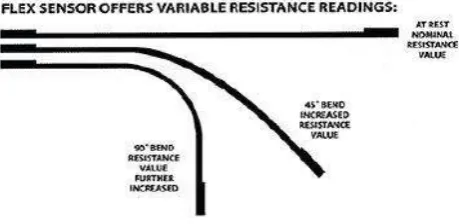
A flex sensor is a sensor which calculates the amount of degree of bend. It is a non-inverting operational amplifier. It works at 5V input voltage. The degree of bend is calculated with respect to the resistance. Greater the degree of bend lower will be the output voltage.
Fig -1: Flex sensor w.r.t degree of bend.
4.2 PIC MICROCONTROLLER
It is 40-bit microcontroller IC. It has one 16 bit and two 8-bit timer. Five input/output ports along with serial and parallel ports are present in it. Under software control it can also self-reprogram itself.
4.3 BLUETOOTH MODULE
[image:2.595.184.414.487.599.2]© 2019, IRJET | Impact Factor value: 7.211 | ISO 9001:2008 Certified Journal
| Page 2506
5. WORKING
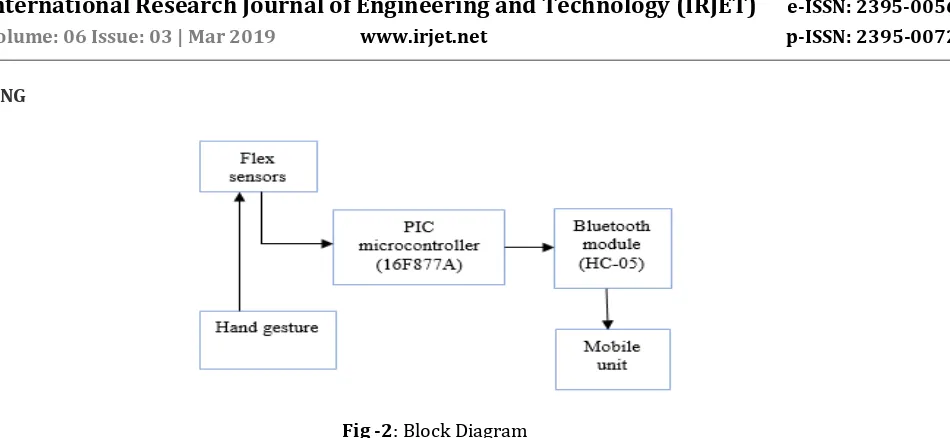
Fig -2: Block Diagram
The model proposed in this paper is an interpreter that translates. The sign language makes use of various hand gestures that have their generic meaning in their respective language like the sentence “hello” is stated by keeping all the fingers bend apart from the little finger which is kept straight. The word hello in binary would be denoted as 00001.
The first step to recognize hand gesture is to detect the orientation of the finger from the 31 fundamental postures as shown in fig 3. are the sample examples. These hand gestures are sensed by the flex sensor. The flex sensor varies its resistance with respect to the degree of bend. The flex sensor output voltage varies from 0-5V. It is a non-inverting operational amplifier working on the principles of voltage divider rule. The sensors are connected via three pins they are the ground, live and output pins. When a finger bends the output from the flex sensor are taken which is concatenated with fixed resistors. Then we measure the output voltage between the fixed resistor (Rb) and flex sensor (R) as given by (1).
………. (1)
If for flex 1 we get a value 207 then 207*5=1035mV which will be the output of the flex sensor.
All output signals generated by flex sensors are in analog form and it is digitized by using PIC microcontroller, as it has 10-bit inbuilt ADC. All digital values are then stored in the buffer. Microcontroller compares static data and digital values to determine the gesture. According to the finger movement, it generates further output. The values sensed by flex sensors are in number form and to send those numbers over Bluetooth module we need to convert it into ASCII characters so that it can be readable at the receiver end.
[image:3.595.80.555.53.272.2]For each flex sensor, there is a fixed threshold value that is based on the bend of the finger. Threshold values are obtained with the help of ADC values. ADC values are calculated using free Android software named as Bluetooth terminal HC-05. Calculated threshold values of each flex sensor are as shown below in the table.
Table -1: Threshold values of flex sensors
Flex sensor Threshold value
H1 150
H2 150
H3 165
H4 160
H5 235
By considering the above table, if threshold value of flex sensor H1 is greater than 150 then it will give 1 as output and if it is less than 150 it will give 0 as output.
[image:3.595.192.408.599.694.2]© 2019, IRJET | Impact Factor value: 7.211 | ISO 9001:2008 Certified Journal
| Page 2507
application named as Arduino Bluetooth text to speech converter via Bluetooth connected in the UART interface. This communication is made at a baud rate of 9600 bits/sec. When an application receives the message, it will convert it into speech.Fig -3: Sample gestures used for communication along with binary code.
6. PROGRAMMING IN C
All the signs corresponding to the sentences were decoded using C programming language the code was then dumped into the PIC microcontroller. We have used an open source software for the display of the output in both text and audio form.
7. RESULT
[image:4.595.184.408.137.395.2] [image:4.595.212.385.502.722.2]© 2019, IRJET | Impact Factor value: 7.211 | ISO 9001:2008 Certified Journal
| Page 2508
8. CONCLUSIONIn this paper a real-time and portable system for English language. To provide a mode of communication, an independent smart glove was designed for mute people at a low cost. We were able to achieve a high degree of accuracy for gesture recognition. The model can be coded for 31 sentences. The whole system is made up of easily available electronic components and free android apps which helped in reducing the overall cost. Such cheap but effective product will help the mute people to put forward their words through gestures and reduce the dependency they have on the interpretators.
9. REFERENCE
[1] A Real-time Portable Sign Language Translation System. Authors: Lih-Jen kau, Wan-Lin Su, Pei-Ju Yu, Sin-Jhan Wei. Published in: 2015 IEEE 58th International Midwest Symposium on Circuits and Systems (MWSCAS).
[2] Text Generation from Taiwanese Sign Language Using a PST-Based Language Model for Augmentative Communication. Authors: Chung-Hsien Wu, Senior Member Published in: IEEE Transaction on Neural System and Rehabilitation Engineering, VOL. 12, NO. 4, Dec 2004
[3] Design of a Real-Time Interpreter for Arabic Sign Language. Authors: Tariq Jamil. Published in: IEEE Southeast Conference 2018.
[4] Design of Smart gloves International Journal of Engineering Research & Technology (IJERT)vol.3 Issue 11, November-2014
[5] Laura DiPietro, Angelo M. Sabatini and Paulo Dario "A survey of Glove-Based systems and their Applications", IEEE Transactions on systems, Man and Cybernetics-part C:applications &review,vol.38,no.04,pp. 461-482,July 2008
[6] With a deaf community of millions, hearing India is only just beginning to sign. GlobalPost January 04, 2017 · 11:00 AM EST By Nimisha Jaiswal